

In this guide
There is a particular quality of sound — bright, shimmering, percussive, almost crystalline — that has defined whole chapters of rock history and yet remains impossible to adequately describe in words. Guitarists call it jangle. It is the sound of chords that ring with uncommon clarity, of individual notes that sustain without blurring into each other, of a guitar that cuts through a mix like light through glass rather than pushing its way through like a fist. It is the sound that announces itself on the opening chord of “What Difference Does It Make,” that rings through the verses of “Free Fallin’,” that shimmers beneath every Jam record ever made. You know it the instant you hear it.
Almost all of it comes from the Rickenbacker 330.
This is not a guitar that tries to be everything to everyone. It has a specific voice, a particular aesthetic, a distinct way of relating to the hands of the player. In over six decades of continuous production, it has not fundamentally changed what it is. It doesn’t need to. The music that has been made with a Rickenbacker 330 — from the raw mod aggression of Pete Townshend in 1965 to the tightly coiled post-punk of Paul Weller in 1979 to the indie shimmer of the 1980s and beyond — is simply too compelling, too enduring, and too identifiably its own thing for the instrument to need reinvention.
The jangle is not a trick. It is the 330’s entire argument.
Roger Rossmeisl and the Capri Series: 1958
The Rickenbacker company’s story begins earlier than most people realize. Adolph Rickenbacker was building electrified instruments in the early 1930s — the iconic “frying pan” lap steel, widely considered the first commercially produced electric guitar — at a time when Gibson and Fender were still years from entering the electric market. By the time Roger Rossmeisl arrived at Rickenbacker in the 1950s, the company had a long history and a clear aesthetic identity, but not yet the guitar that would define it for posterity.
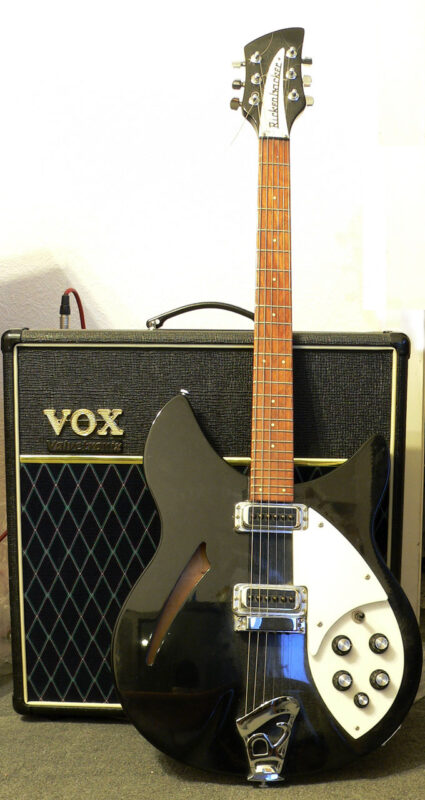
Rossmeisl was a German luthier trained in the classical European tradition, the son of a master guitar builder who had absorbed the principles of archtop construction and brought them to California with a modernist sensibility. At Rickenbacker, he developed what became known as the Capri series — a range of semi-hollow electrics with a visual identity unlike anything else on the market in 1958. The body shape was unlike a Gibson, unlike a Fender, unlike any hollow guitar that had come before: the double-cutaway “crescent moon” form, with two sharp, asymmetric horns flanking a shallow semi-hollow maple body, looked more like something out of a science fiction magazine than a musical instrument showroom. The slash-shaped sound hole — not a conventional f-hole, not a round hole, but a diagonal slash on the bass-side bout — completed the alien visual character.
The 330 entered this Capri series at its founding, positioned as the standard two-pickup, single-output model. Its sibling, the 360, added bound body edges and triangle fingerboard inlays. The 330 remained the unbound, dot-inlay workhorse of the line — less cosmetically elaborate, no less tonally capable, and ultimately the more common instrument in the hands of the players who made Rickenbacker’s reputation.
The Architecture of Jangle: How the 330 Sounds the Way It Does
The Rickenbacker 330’s sonic character is not an accident. Every element of its specification contributes to the particular quality of sound that distinguishes it from any other guitar.
Body Construction
The 330 is semi-hollow in the Rickenbacker manner, which is different from the Gibson manner. Where a Gibson ES-335 has a solid maple center block running through the body with hollow wings on either side, the Rickenbacker 330’s hollow construction is distributed differently — there is no full center block, but internal bracing runs through the body in a configuration that controls feedback while preserving the acoustic resonance that defines the instrument’s voice. The result sits between a fully hollow instrument and a solid-body: resonant enough to give the notes an acoustic bloom, controlled enough to be manageable at stage volumes without the constant feedback management that a White Falcon demands.
The body is maple — a tonewood that emphasizes brightness and clarity rather than warmth. This is a deliberate choice that runs through the entire 330 specification: where Gibson tends toward mahogany and warmth, where Fender’s ash and alder bodies aim for tonal balance, Rickenbacker’s maple body pushes consistently toward the high end of the frequency spectrum. The crescent moon shape keeps the body relatively compact — comfortable to play, lighter than it looks.
The Neck: Scale, Profile, and Dual Truss Rods
The 330’s neck is one of its most distinctive features. The scale length is 24.75 inches — the same as a Gibson Les Paul, shorter than Fender’s 25.5″ standard — but the neck profile and feel are unlike either. Rickenbacker necks are built from a three-ply maple/walnut laminate rather than a single piece of wood, which contributes to the neck’s exceptional stability and adds a subtle tonal characteristic of its own. The nut width is 1.625 inches, slightly narrower than most guitars, giving the 330 a particular feel in the fretting hand — some players find it remarkably comfortable and fast, others find the string spacing too tight for comfortable chord work.
The dual truss rod system is another Rickenbacker idiosyncrasy. Two adjustable rods run through the neck rather than the single rod found in virtually every other production guitar, allowing correction of both bowing (the common single-rod function) and twisting — a neck-stability feature that remains unusual and reflects an engineering thoroughness unusual for a production instrument. The shallow headstock angle — nearly flat — combined with the string tension from the standard R-shaped trapeze tailpiece gives the 330 a specific string feel: slightly slinky, with a particular compliance under the picking hand that contributes to the compressed, bouncy attack that defines its rhythm playing.
The Fingerboard
The rosewood fingerboard on the 330 is notably thicker than those found on most production guitars, finished with a clear conversion varnish rather than the more common oil or gloss lacquer. This thick, varnished surface has a particular feel under the fingers — slightly different from the unfinished rosewood of a Gibson or the maple board of a Fender, neither better nor worse but distinctly its own. Current production 330s feature 24 frets — a specification that dates to 1970, when Rickenbacker extended the fret count from the original 21. Dot inlays rather than the 360’s triangle markers keep the 330 visually clean and functional.
Pickups: Toasters and Hi-Gains
The pickup history of the Rickenbacker 330 divides its career into two distinct sonic eras. Original models from 1958 through the late 1960s came equipped with “Toaster Top” pickups — single-coil units named for their resemblance to a chrome kitchen appliance, low-output, bright, with a particular chime that was equally responsible for the Beatles’ Rickenbacker sound and the Byrds’ twelve-string shimmer. The Toaster’s sound is relatively gentle: moderate output, limited low-end extension, exceptional clarity in the upper-mid and treble frequencies.
In the early 1970s, Rickenbacker introduced the Hi-Gain pickup, which replaced the Toaster in production. The Hi-Gains are still single-coil units but with noticeably higher output, capable of pushing an amp harder and sustaining longer. The Toasters sound like the Beatles and the Byrds. The Hi-Gains sound like the Smiths and R.E.M. — still bright, still clear, still unmistakably Rickenbacker, but with more grunt, more ability to handle overdrive without losing definition. Both versions are excellent. Which era suits you depends on what music you’re after.
A capacitor wired between the pickup selector switch and the bridge pickup’s volume knob on vintage models filtered out lower frequencies, producing an even more trebly bridge pickup output than the pickup itself generated. This capacitor was removed from the circuit in the mid-1980s. Many players restore it to modern 330s, often via a push/pull pot that allows switching between the vintage “high-pass filtered” bridge sound and the fuller modern voicing.
The Five-Knob Control Layout
The Rickenbacker 330’s control layout confounds players accustomed to Gibson or Fender wiring. There are five knobs rather than the standard four: two volume controls (one per pickup), two tone controls (one per pickup), and a fifth “blend” knob added in 1961. The blend knob is a potentiometer wired specifically into the neck pickup circuit, allowing the typically louder neck pickup to be reduced to match the bridge pickup’s level. Since the neck pickup tends to be significantly hotter than the bridge on a Rickenbacker, this control is practically essential for balanced pickup switching. It has no effect in the bridge-only position — only in neck-only and combined positions does the blend pot do its work.
The three-position pickup selector provides the expected neck-only, both, and bridge-only options. In the combined position with the blend knob correctly set, the 330 produces one of the most useful rhythm tones in all of electric guitar — the two pickups together creating a phase-shifted, complex character that is simultaneously fuller than either alone and more transparent, sitting in a mix without crowding.
The Players Who Made the 330
The Rickenbacker 330’s cultural footprint runs directly through some of the most important guitar playing of the past sixty years. The list of players who reached for a 330 at defining moments reads like a map of rock’s most significant chapters.
Pete Townshend: The Mod Who Smashed Them
Pete Townshend of The Who is the player who first established the Rickenbacker 330 as a rock instrument rather than a jazz or pop tool. In the early and mid-1960s, Townshend was playing Rose-Morris export 330s — the UK import version sold as the model 1997, featuring a conventional f-hole rather than the slash sound hole of American models, which gave them an instant collector-item distinction. Through a Vox AC30 or Marshall amp pushed hard, the 330’s bridge pickup produced the cutting, aggressive tone that defined The Who’s early recordings: the same chimey clarity of the Rickenbacker voice, but with enough midrange push to cut through Keith Moon’s drumming at full velocity.
Townshend also made the 330 into a prop of surpassing theatrical effectiveness: he destroyed them. Guitar smashing was not an entirely new idea when Townshend began doing it in 1964, but no one had done it with a Rickenbacker at this volume and on this stage. The destruction was partially practical — a low ceiling at the Railway Hotel in Harrow caused an accidental collision between guitar and ceiling that the audience misread as deliberate provocation, and Townshend, understanding the response, committed to the performance — and partially philosophical. The 330 was expendable because the music was not. The image of Townshend flailing a Rickenbacker against a stack of Marshall amplifiers is one of rock’s defining visual moments.
Paul Weller: The Woking Wonder
Paul Weller is the player most directly responsible for the Rickenbacker 330’s cultural significance in the post-punk era. As the primary guitarist, vocalist, and songwriter of The Jam, Weller chose the 330 specifically because of its association with Townshend — a mod hero paying homage to the instrument of a mod ancestor. He acquired multiple 330s in various finishes (Fireglo, Jetglo, Mapleglo, a rare white example, and the pop-art “Whaam!” guitar hand-painted with a Roy Lichtenstein graphic), and played them with a combination of Townshend’s aggressive attack and a melodic sensibility entirely his own.
The Jam’s first album, released in 1977, sounds like a Rickenbacker 330 through a British amp pushed hard: everything bright, everything cutting, every chord articulated with military precision. “In the City,” “Art School,” “The Modern World” — the 330’s bridge pickup through a Vox AC30 or Marshall gave The Jam their sonic identity as surely as any other single element. Weller has spoken about the instrument’s particular clarity being essential to his chord voicings: “The first attraction was the look, because I liked Pete Townshend on the early Who stuff. When I got an advance from the record company I went out and bought as many Rickenbackers as I could.”
Johnny Marr: The Sound of This Charming Man
Johnny Marr‘s relationship with the Rickenbacker 330 produced some of the most celebrated guitar tones in British music. His 1983 Jetglo 330 — acquired from A1 Repairs on Oxford Road in Manchester — became the instrument most visually associated with The Smiths, appearing in the “This Charming Man” video. Marr is characteristically precise about its role: the famous intro riff to “This Charming Man” was recorded on a 1952 Telecaster, not the Rickenbacker. But the 330 was his live instrument through the first Smiths album and on subsequent records, responsible for the jangling, cascading chord figures that defined tracks like “What Difference Does It Make” and “Reel Around the Fountain.”
“It’s the sound of the riff on What Difference Does It Make and Reel Around the Fountain, all of the first album and on other albums too,” Marr has said. “I still use it now.” The 330’s Hi-Gain pickups, through a clean-to-crunch Fender amplifier, gave The Smiths’ guitar sound its particular combination of brightness and warmth — the chord voicings Marr favored, often including suspended fourths and open string drones, ring differently on a Rickenbacker than on any other guitar. The interaction between the Hi-Gains’ clarity and Marr’s instinct for harmonic richness produced a guitar style that remains entirely his own.
Tom Petty: American Jangle
Tom Petty‘s relationship with Rickenbacker was primarily with the 12-string 620/12 and 660/12 models rather than the 330 itself, but he played a Rose Morris 1997 (the UK-market 330) in the acoustic performance of “Free Fallin'” that introduced many American players to the Rickenbacker sound in a mainstream context. Petty’s use of Rickenbacker tones — the particular chimey quality that the 330 and its 12-string siblings share — defined the heartland rock sound of the 1980s and connected directly back to the Byrds’ 1960s Rickenbacker work, which Petty openly acknowledged as a primary influence.
Thom Yorke and Radiohead
In Radiohead’s earlier phase, Ed O’Brien played Rickenbacker 360s extensively, but Thom Yorke subsequently adopted a 330 as his own instrument of choice within the band, using it for the rhythmic, chordal work that underpins Radiohead’s atmospheric guitar textures. The 330’s compressed attack and clarity suit Yorke’s strumming style particularly well — the way the guitar articulates each chord separately, with individual strings maintaining definition rather than blending into one mass of sound, complements the rhythmic precision Radiohead’s music demands.
The Punk and Post-Punk Players
Joe Strummer of The Clash used a Rickenbacker in The Clash’s earliest period, the instrument’s aggression fitting the band’s musical philosophy before he transitioned primarily to Telecasters. Carrie Brownstein of Sleater-Kinney used Rickenbacker guitars throughout the band’s most acclaimed period, the 330’s cutting high-end suiting the duo-guitar band’s need for each guitar to occupy distinct sonic space. The 330 has appeared in the hands of punk, post-punk, and indie players with enough frequency to constitute a sub-tradition within those genres — a lineage running from Townshend through Weller through Marr to a generation of players who heard the instrument’s voice in those records and sought the source.
Tone Recipes for the Rickenbacker 330
Classic Jangle: The Clean Rickenbacker Sound
Into a Vox AC30 set clean or to its natural break-up point — the 330’s Hi-Gain pickups pushing the AC30’s EL84-loaded power section into that particular British compression. Treble at 6–7, Bass at 4, the AC30’s Top Boost engaged. The 330’s tone controls set to full open on both pickups; the blend knob adjusted until the neck and bridge pickups balance in the combined position. Pick with a medium pick near the strings’ midpoint for maximum clarity. The resulting sound — bright, chimey, slightly compressed, with a sustain that blooms rather than sustains linearly — is the definitive Rickenbacker 330 tone. It is the sound of “This Charming Man” and “Town Called Malice” and a hundred other records that defined what a guitar could sound like.
The Jam: Driven and Aggressive
Weller’s approach pushed the 330 considerably harder than the clean-jangle template. Into a Marshall-voiced amp with moderate to high gain — treble at 7, mids at 6, bass at 5, presence at 7 — the 330’s bridge pickup produces an aggressive, cutting tone that retains its characteristic note separation even under heavy overdrive. Weller played hard with a stiff pick, attacking the strings with the kind of force that gives rhythm guitar a percussive as well as harmonic quality. The high-pass filter effect of the vintage capacitor in the bridge circuit — or the push/pull restoration of that capacitor on a modified modern 330 — accentuates this aggressive treble character and makes the rhythm playing snap in the mix rather than blend into it.
The Byrds/Beatles Vintage Tone
For players seeking the earlier, softer Toaster-pickup sound without acquiring a vintage pre-1970 instrument: the Hi-Gain pickups can be coaxed toward Toaster territory by rolling the tone controls back to around 6–7 and using a slightly lower-gain clean amp — a Fender Princeton or Deluxe Reverb, treble at 5–6, bass at 3–4, reverb at 3. The result won’t be an exact replica of the Toaster sound, but the 330’s fundamental character will lean toward warmth rather than brightness. For players who specifically want Toaster pickups, vintage 330s from the 1960s appear regularly on the used market, and TV Jones and other pickup manufacturers produce modern Toaster-style units that can be retrofitted to current instruments.
The Modern Indie Approach
For contemporary indie applications — Strokes-adjacent, post-punk revival, alternative — the 330 into a clean pedal platform amp with a light overdrive pushed from a Tube Screamer or Blues Driver at low gain and boosted level produces a driven but articulate tone. The 330’s inherent note separation means that complex chord voicings remain intelligible even with moderate overdrive, which is the precise quality that makes it invaluable for rhythm playing in guitar-forward indie music. Add a chorus effect at subtle depth and slow rate for the shimmering, atmospheric quality of 1980s alternative guitar; a delay at 300–400ms for depth and dimension.
The 330’s tonal range is wider than its jangle-pop reputation suggests. The instrument responds to different amplifiers, settings, and playing approaches with considerable variety — while the fundamental Rickenbacker character always comes through, it can be clean and chimey, driven and aggressive, or somewhere in between.
The 330 versus the 360: Knowing the Difference
Players approaching Rickenbacker for the first time often face the question of 330 versus 360, and understanding the distinction helps considerably in making the right choice.
The 360 features bound body edges, headstock, and fingerboard — the binding adds visual elegance and a slightly more refined aesthetic. The 360 also has triangle-shaped “shark fin” fingerboard inlays rather than the 330’s dots. In some production periods, the 360 featured a slightly different internal construction — the “new style” body with a slanted internal edge on the treble side — though these distinctions have varied across the model’s history. The 360 is generally considered the slightly more premium of the two models, with a correspondingly higher price point.
Tonally, the differences between a 330 and a 360 in the same condition and production year are subtle — the binding and construction details affect the resonance slightly, but the fundamental character of both models is the Rickenbacker voice. The 330’s unbound, rawer aesthetic has its own appeal — the instrument that Paul Weller chose specifically because he wanted something direct and unadorned rather than refined. The 360 is the 330’s more elegant sibling. Neither is definitively better. The choice comes down to aesthetic preference and specific tonal comparison of individual instruments.
The 330 and the Rickenbacker 360/12
Much of what is popularly attributed to “the Rickenbacker sound” in classic rock contexts — the Beatles on A Hard Day’s Night, the Byrds throughout their catalog, Tom Petty across three decades — is actually the sound of the twelve-string 360/12 rather than the six-string 330. The two instruments share the same pickup architecture and general tonal character, but the twelve-string’s doubled strings create a natural chorus effect and an octave shimmer below each note that produces a sound more lush and multi-dimensional than anything the six-string can achieve. Players who are drawn to the jangle of the Beatles’ guitar tones specifically should investigate whether the 330 or the 360/12 is actually the instrument they’re hearing.
That said, the 330’s six-string voice has its own advantages. It is more versatile for lead work and single-note playing. It is easier to tune and maintain. It is better suited to driven, aggressive rhythm playing where the twelve-string’s octave doubling creates unwanted complexity. The 330 is the instrument Paul Weller and Johnny Marr chose for the music they were making. That endorsement alone is argument enough.
Buying a Rickenbacker 330: What to Know
New Production
Current production Rickenbacker 330s retail in the $2,100–$2,400 range and are available in the classic Rickenbacker finishes: Fireglo (a red-to-amber sunburst unique to Rickenbacker), Jetglo (black), Mapleglo (natural maple), and Midnight Blue. All current models feature Hi-Gain pickups, 24 frets, and the standard five-knob control layout. Rickenbacker manufactures in Santa Ana, California, and production volumes are relatively modest for an instrument at this price point — lead times for new orders can extend to months, and dealer stock often sells quickly.
New 330s arrive with a molded hardshell case. Setup quality from the factory is adequate but benefits from professional attention — Rickenbacker’s intonation and action settings are conservative, and many players find a professional setup dramatically improves playability. The dual truss rods require a specific adjustment approach (consult a technician familiar with Rickenbacker instruments specifically), and the neck’s stability across seasonal humidity changes is generally excellent once properly set.
Used and Vintage Market
The used Rickenbacker 330 market is well-supplied. 1970s–1990s models in solid condition are available in the $700–$1,200 range and often represent strong value, particularly if the original pickups are intact. Pre-1970 Toaster-pickup models command premiums — $1,500–$2,500 or more for clean examples — and require verification that the original pickups are present, as Hi-Gain swaps were common.
Rose Morris UK export models (sold as the 1997) command particular collector interest. The f-hole rather than slash sound-hole design gives them a distinctive appearance, and their association with Townshend, Weller, and the British Invasion makes them historically significant. Condition and completeness are paramount — original tail-pieces, tuners, and pickguards matter substantially to value.
When evaluating any used 330: check the neck for straightness under string tension (dual truss rods don’t eliminate all relief issues); verify that both Hi-Gain pickups are original matching units; test the blend knob through its full range; and check the tail-piece and bridge for corrosion or wear. The R-shaped trapeze tailpiece is a wear point — replacement units are available but original hardware is preferred for vintage instruments.
Alternatives to Consider
Players attracted to the Rickenbacker 330’s jangle character but deterred by its price or availability should consider the Epiphone Casino as a semi-hollow alternative with P-90 pickups that produce a different but equally compelling clear, single-coil character. The Gibson ES-335 offers similar semi-hollow construction with a dramatically different tonal family. For players specifically after the Rickenbacker chimey quality, there is no true substitute — the instrument’s character is too specific to be replicated convincingly — but players who want the sonic family without the Rickenbacker price and wait times should explore Japanese-made alternatives like the Tokai Hummingbird or similar instruments that draw from the same inspiration.
Frequently Asked Questions
What is the difference between a Rickenbacker 330 and a 360?
The 360 features bound body edges, headstock, and fingerboard, plus triangle “shark fin” fingerboard inlays versus the 330’s dots. The 360 is the more visually refined and slightly more expensive model. Both share the same Hi-Gain single-coil pickups, five-knob control layout, and semi-hollow maple construction. Tonal differences between a 330 and 360 in the same production year are subtle; the choice is primarily aesthetic. The 330 has a rawer, more utilitarian character that many players — Paul Weller and Johnny Marr among them — prefer precisely for its lack of ornamentation.
Do Rickenbacker 330s have feedback problems?
The 330’s semi-hollow construction makes it more susceptible to feedback at high stage volumes than a solid-body guitar, but considerably less so than a fully hollow instrument like the Gretsch White Falcon. At moderate rehearsal or club volumes the guitar handles feedback well with no intervention. At large-venue stage volumes, players who push high gain may need to manage positioning relative to amplifiers. Pete Townshend famously exploited feedback creatively. Players who need a completely feedback-free experience should consider a solid-body guitar; players who understand how to work with the 330’s nature will find it manageable and the semi-hollow resonance a tonal asset.
What is the blend knob on a Rickenbacker 330 for?
The blend knob, added in 1961, is a potentiometer wired into the neck pickup circuit only. Its primary function is to reduce the neck pickup’s output to match the bridge pickup’s level — on Rickenbacker instruments, the neck pickup tends to be significantly louder than the bridge, which creates a noticeable volume jump when switching between them. Rolling back the blend knob until the two pickups balance in the combined position is standard setup practice. The blend knob has no effect when the pickup selector is in the bridge-only position.
Are Rickenbacker 330s good for high-gain rock or metal?
The 330 is not typically used for extreme high-gain applications — its single-coil pickups lack the noise rejection of humbuckers, and the semi-hollow construction can make high-gain playing challenging at stage volumes. However, the Hi-Gain pickups have sufficient output to drive a moderately high-gain channel convincingly, and the 330’s note separation under overdrive is actually remarkable — individual notes in complex chords remain audible where a PAF humbucker might blur them together. Paul Weller pushed his 330 considerably harder than its reputation suggests. Players who want the 330 for primarily high-gain playing should investigate feedback management seriously, but the instrument’s versatility is greater than its stereotype indicates.
What makes the Rickenbacker 330 sound “jangly”?
Multiple factors combine to produce the 330’s characteristic jangle. The maple body and neck emphasize bright, clear frequencies rather than warmth. The Hi-Gain (and especially Toaster) pickups are single-coil designs that preserve treble and upper-mid information rather than warming it. The dual truss rods and three-ply neck contribute to exceptionally stable intonation, so chords ring clearly across the full neck. The relatively shallow headstock angle and R-shaped tailpiece give the strings a particular compliance that produces a slightly compressed, bouncing attack. The vintage high-pass filter capacitor in the bridge pickup circuit (on pre-1985 models) accentuated treble further. All of these elements working together produce a tonal character that genuinely cannot be replicated by any other guitar.
What amplifier works best with a Rickenbacker 330?
The 330’s historical partnerships have been primarily with British amplifiers: Vox AC30 (Weller, Marr, Townshend), Marshall combo amps (Weller on later Jam albums), and Hiwatt heads (Townshend). The AC30’s particular interaction with single-coil pickups — its natural compression and the way its EL84 power tubes respond to the attack of a Rickenbacker — produces the most characteristically “Rickenbacker” sound of any amplifier combination. American clean amplifiers (Fender Twin, Deluxe Reverb) also work well for cleaner applications, producing a brighter, more glassy response. The 330’s character comes through strongly regardless of amplifier choice — its voice is distinctive enough to assert itself across different rigs — but the AC30 remains the canonical pairing.
Is the Rickenbacker 330 a good first guitar?
The 330 is not ideal as a first instrument. Its narrow nut width and specific neck feel require adjustment time; the five-knob control layout is initially confusing; the price point is substantial for a beginner; and the instrument’s specific tonal character means it’s less versatile across genres than a Stratocaster or Les Paul for a player still exploring their stylistic direction. Players who are specifically drawn to indie, jangle-pop, or British guitar music and want to develop their sound from the outset could certainly start with a 330, but most instructors would recommend beginning on a more versatile, more forgiving instrument and reaching for the Rickenbacker once the fundamental direction is clear.
The Jangle Endures
The Rickenbacker 330 has been manufactured continuously since 1958, through the Beatles era and the mod era and the punk era and the indie era and everything that has come between and after. It has survived multiple changes of ownership at Rickenbacker, survived the 1970s when Rickenbacker’s market relevance nearly collapsed entirely, survived the superstrat era of the 1980s when the entire industry seemed to pivot toward active pickups and 24-fret shred machines.
It survived because the jangle is irreplaceable. You can approximate it with EQ, you can suggest it with certain pickups in certain bodies through certain amps, but you cannot replicate it. The guitar that produces the actual jangle — the real Rickenbacker jangle that Townshend invented and Weller deployed and Marr made his own — is the 330. The maple body, the three-ply neck, the Hi-Gain single-coils, the shallow headstock angle, the R-tailpiece, the blend knob and the five controls and the slash sound hole: all of it together produces something that is simply and completely itself.
Sixty-seven years after Roger Rossmeisl drew the first Capri body outline, the 330 still sounds like no other guitar in the world. It is still, in the hands of the right player for the right music, one of the most powerful tonal statements available on six strings. The jangle carries. It always will.