The Machine That Never Stopped Running: Inside the Boss OD-3 OverDrive
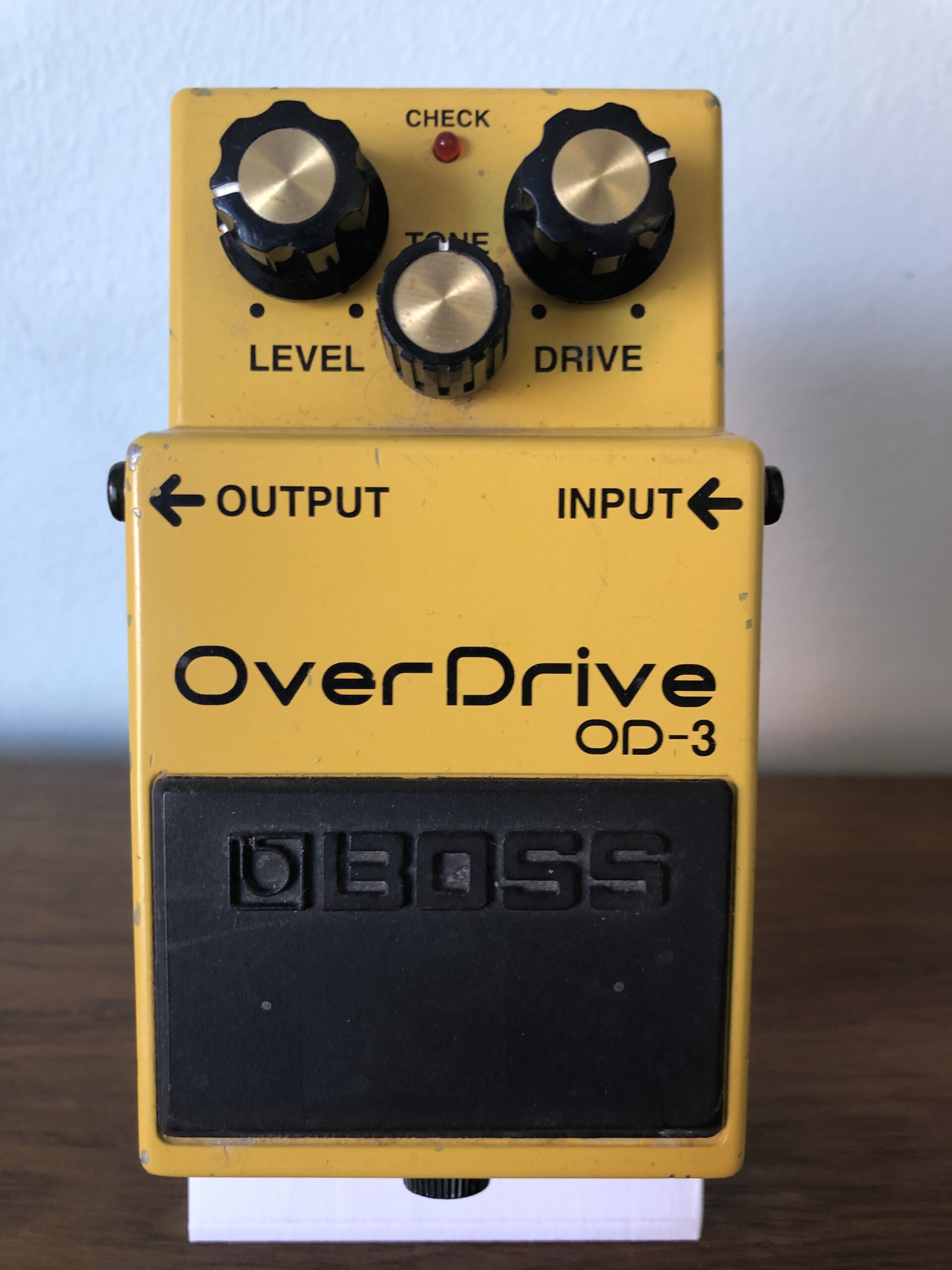
Boss OD-3 OverDrive, photographed 8 April 2021. Photo: Kuriosatempel. CC BY-SA 4.0 (https://creativecommons.org/licenses/by-sa/4.0/). Full source frame retained with stored EXIF orientation respected; resized for web without cropping or retouching. Web version licensed under CC BY-SA 4.0. Source: https://commons.wikimedia.org/wiki/File:Boss_OD-3_Overdrive.jpg
The Boss OD-3 OverDrive packs a Dual Stage Drive circuit into Boss's legendary compact shell. Full specs, tone recipes, honest comparisons, and buying guide.
Most gear has a lifespan. Boutique pedals arrive in limited batches and sell out before the hype cycle cools. Flagship amps get discontinued when production costs outrun demand. Even legendary designs get updated, revised, and eventually retired to the history books. The Boss OD-3 OverDrive launched in 1997 and never stopped. Nearly three decades later it still ships in the same compact yellow enclosure, still costs around a hundred dollars, still draws 2mA from a 9-volt supply, and still lands on professional pedalboards from Nashville session work to Tokyo club stages. That kind of staying power is not an accident. It is the result of a circuit that does something the OD-1 and SD-1 could not: it gives you the full frequency picture without sacrificing dynamics.
The OD-3 is not a boutique pedal. It will never command premium prices on the used market. Nobody is rehousing it in a hand-painted enclosure with gold-plated hardware. What it offers instead is a workhorse overdrive with a wide gain range, a fuller low-end response than any of its predecessors, and a control set simple enough that you can dial it in on a dark stage between songs. This is the pedal that working guitarists reach for when they need something that works every time, every gig, in every rig.
This is not a review. This is the technical story of how the OD-3 happened, what it sounds like, how to use it, and why it has earned the rare distinction of being genuinely irreplaceable in its category despite competition from hundreds of alternatives across every price point.
The OverDrive Lineage: From OD-1 to OD-3
To understand the OD-3 you need to understand where it came from. Boss — the effects pedal division of Roland Corporation — released the OD-1 OverDrive in 1977. That pedal was revolutionary for its time: a compact, battery-powered box that could push a clean amp into warm overdrive territory without the unpredictability of a fuzz circuit. The OD-1 used a single op-amp gain stage with asymmetrical clipping diodes, producing a sound that leaned toward the treble-mid range with a certain compressed smoothness. It became a foundational piece of gear for players who wanted controlled overdrive rather than the chaos of a fuzz.
The Boss SD-1 Super OverDrive arrived in 1981 and refined the formula. Borrowing asymmetrical clipping from the OD-1 design family and adding a more sophisticated tone control, the SD-1 became one of the most widely used and widely modified overdrive circuits ever produced. Countless professional players have run SD-1s in front of high-gain tube amps as clean boost and mid-push devices. The SD-1 circuit has been cloned, tweaked, and studied at the component level by the mod community for over four decades.
The OD-2 followed in 1985, introducing a Turbo mode that added a second higher-gain channel — a logical evolution but one that complicated the compact-pedal simplicity that made the OD-1 compelling. The OD-2R in 1994 revised the design with a remote footswitch option. Neither model lasted. When Boss released the OD-3 in 1997 they were essentially resetting the concept: what would a modern overdrive look like if it were designed from the ground up for the way players actually used the OD-1 and SD-1, but without the frequency-response compromises those circuits carried?
The answer was a new topology Boss called the Dual Stage Drive Circuit, and it changed the conversation about what a Boss overdrive could sound like.
The Dual Stage Drive Circuit: How It Works
The OD-1 and SD-1 both use single-stage gain architectures with op-amp clipping. They produce overdrive through a single pass: the signal hits the gain stage, gets clipped, runs through the tone section, and exits. This approach is efficient and produces a characteristic compressed, mid-forward sound that works exceptionally well as a transparent boost in front of an already-driven tube amp. Where it falls short is in low-frequency response: single-stage op-amp overdrive circuits tend to thin out the bass and low-mid content of the input signal, which is why the SD-1 and TS9 are often described as “mid-hump” or “mid-boost” circuits.
The OD-3 addresses this by running the signal through two cascaded gain stages. The first stage handles the initial overdrive character and dynamics. The second stage adds gain on top of the first while preserving more of the original signal’s low-frequency content. The result is a fuller, deeper overdrive sound — one that keeps the thickness of a Telecaster’s bridge pickup or the warmth of a Les Paul’s neck without the frequency-thinning that earlier single-stage Boss overdrives exhibited.
This dual-stage approach also produces a wider effective gain range. At minimum Drive settings the OD-3 functions as a clean boost with minimal coloration — useful for pushing tube amp input stages without adding much overdrive character of its own. As you increase the Drive knob the overdrive character builds gradually and smoothly, passing through blues-crunch territory around the noon position and arriving at heavier rock crunch at maximum settings. That range, from clean boost to significant overdrive saturation within a single control, is more practical than it sounds: many players never need a separate boost pedal if the OD-3 is already on their board.
The Tone control on the OD-3 sweeps from warm and dark at counterclockwise positions through a relatively neutral center to bright and cutting at clockwise positions. The range is broader than the SD-1’s tone control, making it more useful as an actual tone-shaping tool rather than just a treble-trim. Set it dark and run into a bright single-coil amp combination; set it bright and run into a dark PAF-equipped humbucker rig. The OD-3 adjusts to the guitar and amp rather than imposing a fixed character.
Boss uses their standard FET-based switching system rather than true bypass. The buffered output is a deliberate design choice that stabilizes impedance across the signal chain — particularly relevant when using long cable runs or passive volume pedals. Players who need true bypass have other options, but Boss’s buffer implementation is clean enough that it is rarely the source of tone degradation in practice.
Specifications
| Specification | Boss OD-3 OverDrive | Boss SD-1 Super OverDrive | Ibanez TS9 Tube Screamer |
|---|---|---|---|
| Release Year | 1997 | 1981 | 1982 (reissue) |
| Drive Circuit Type | Dual Stage JFET/op-amp | Single stage asymmetrical | Single stage symmetrical |
| Controls | Level, Tone, Drive | Level, Tone, Drive | Level, Tone, Drive |
| Bypass Type | Buffered (FET) | Buffered (FET) | True Bypass (reissue) |
| Current Draw | 2mA | 5mA | ~4mA |
| Power | 9V DC or battery | 9V DC or battery | 9V DC or battery |
| Dimensions | 73mm W × 129mm D × 59mm H | 73mm W × 129mm D × 59mm H | 70mm W × 120mm D × 55mm H |
| Price (New) | ~$100 USD | ~$60 USD | ~$100 USD |
| Price (Used, Excellent) | ~$50–70 USD | ~$35–50 USD | ~$60–80 USD |
Who Plays the Boss OD-3?
The Boss OD-3 presents an honest challenge for a Famous Players section: this is a pedal whose reputation was built by working musicians rather than celebrity endorsements. Unlike the Boss DS-1 Distortion — which carries documented associations with Kurt Cobain, Steve Stevens, and Robert Smith — or the Ibanez TS9 Tube Screamer with its Stevie Ray Vaughan lineage, the OD-3 does not have a canonical list of famous users that can be verified through manufacturer artist pages, Premier Guitar Rig Rundowns, or primary-source interviews.
This is not a shortcoming. It is a reflection of what the OD-3 actually is: a professional tool used widely among session guitarists, touring musicians, and working players who do not necessarily generate the kind of documented gear coverage that boutique or historically significant pedals attract. The OD-3 shows up on the pedalboards of players who are more focused on the gig than on being photographed for a rig rundown article. Its low price and high reliability make it a common backup overdrive on professional touring boards, where it functions as either a primary tone source or a transparent clean boost in front of a driven amp.
That grassroots professional adoption is more durable than celebrity association. Pedals that live on working guitarist boards get evaluated honestly by the professionals who depend on them. The OD-3 has remained in continuous production since 1997 not because of endorsement campaigns but because the players who actually use it keep buying it. In the economics of professional pedal adoption, that is the stronger vote of confidence.
Tone Recipes and Settings
Recipe 1: Clean Boost Into a Driven Tube Amp
Set Drive fully counterclockwise or at minimum. Set Level high — at least three-quarters clockwise, or wherever it matches your amp’s bypass volume. Set Tone at noon. Engage the OD-3 in front of a tube amp with its preamp running at the edge of natural breakup. The pedal adds output level and signal density without contributing significant overdrive coloration of its own. The dual-stage circuit’s higher headroom at minimum gain means this is genuinely clean rather than subtly compressed. Use this setting with a Fender Stratocaster into a tweed-style amp for blues and country clean boost applications where you want the amp’s own character to do the distortion work.
Recipe 2: Blues Crunch with a Telecaster
Drive at 9 o’clock. Tone at noon. Level to match bypass volume. Run a Fender Telecaster into a Vox or low-gain Marshall. The OD-3 at this setting produces warm, touch-sensitive overdrive that responds clearly to pick attack dynamics — dig in hard and it crunches; back off and it cleans up toward the amp’s natural sound. This is the working-guitarist blues setting: enough dirt for rhythmic authority, transparent enough for lead clarity without a boost pedal.
Recipe 3: Classic Rock Rhythm — Stacked Into Another Overdrive
Set OD-3 with Drive at noon, Level at unity, Tone slightly clockwise. Stack it after a Boss BD-2 Blues Driver or a Klon-style transparent overdrive (Klon Centaur or clone). The first pedal provides the gritty low-gain edge; the OD-3 doubles the gain and thickens the result. The dual-stage circuit handles stacking gracefully without compressing into fizz — the output stays defined and articulate even at higher combined gain levels. Use this for thick rhythm work in hard rock contexts where you need more saturation than either pedal provides alone.
Recipe 4: High-Gain Rock Lead
Drive at maximum or near-maximum. Tone at 1 o’clock. Level above unity to push the amp hard. Run into a Marshall JCM800 on a relatively clean channel, or into the clean channel of any high-headroom tube amp. The OD-3 at full Drive is not a modern high-gain metal sound — that territory belongs to the Boss MT-2 Metal Zone or dedicated distortion circuits — but it covers aggressive classic rock lead territory with sustain and warmth. Think late-period classic rock leads: sustained, thick, with enough compression to sustain notes without artificial pinch harmonics requiring excessive pick pressure.
Recipe 5: Dark Rhythm for Humbucker Guitars
Drive at 10 o’clock. Tone fully counterclockwise or at 8 o’clock. Level slightly above unity. Use with a humbucker-equipped guitar into a relatively dark amp. The OD-3’s Tone control at counterclockwise extremes produces a warm, woolen overdrive character that works well for thick rhythm parts where high-end clarity would create harshness. This is an underexplored range of the OD-3’s character — most players set Tone at or above noon out of habit, but the dark end of the control has genuine applications for fat rhythm tones in dense mixes.
How the Boss OD-3 Compares
OD-3 vs Boss SD-1 Super OverDrive
The SD-1 is the OD-3’s most direct predecessor and closest sibling in the Boss catalog. Both cost similar amounts, occupy the same physical footprint, and offer the same three-control interface. The sonic difference is significant: the SD-1 uses asymmetrical diode clipping that creates a mid-forward, treble-cut overdrive with a compressed feel at higher gain settings. The OD-3’s dual-stage circuit retains more low-end content and produces a fuller, less compressed sound at equivalent Drive settings. Players who run the SD-1 as a mid-boost in front of a high-gain amp often find the OD-3 less effective for that specific application — the SD-1’s pronounced mid-hump is precisely what makes it work as an amp-enhancing boost. But for standalone overdrive tone, the OD-3 is the fuller-sounding option. If you want a mid-boost into an already-saturated amp, choose the SD-1. If you want standalone overdrive with more frequency coverage, choose the OD-3.
OD-3 vs Ibanez TS9 Tube Screamer
The TS9 is the overdrive reference point for a huge proportion of the professional market, particularly in blues and country. Its JRC4558-based symmetrical clipping circuit produces a characteristic warm compression and the famous mid-peak that cuts through a band mix at moderate volumes. Compared to the OD-3, the TS9 has a narrower frequency response and more pronounced compression — the TS9 feels “squishier” at high gain, while the OD-3 stays more articulate and open. The TS9’s clipping character softens attack transients; the OD-3 retains more of the pick attack. For Stevie Ray Vaughan-style Texas blues tone with a Strat, the TS9 is the historically accurate choice. For a broader-range overdrive that works across more musical styles without committing to the Tube Screamer voicing, the OD-3 is more versatile.
OD-3 vs Boss BD-2 Blues Driver
The BD-2 uses a JFET circuit that produces a snappier, more cutting overdrive with a different kind of tube-amp emulation — one that emphasizes the spiky transient behavior of a pushed small amp. The BD-2 at low gain has more “bite” than the OD-3; the OD-3 at equivalent settings is smoother and warmer. Both pedals work well as clean boosts. The BD-2 is generally favored for blues applications where you want a sharp, crisp, amp-like quality; the OD-3 is favored for rock applications where thickness and warmth matter more than transient snap. Both have earned professional-level reputations and both are valid choices — the difference is tonal character rather than quality.
OD-3 vs Nobels ODR-1
The Nobels ODR-1 occupies a similar price point and philosophical territory: a working professional’s overdrive that prioritizes natural tone over boutique character. The ODR-1 has a Spectrum control that functions as a contour/bass-presence adjustment; the OD-3’s Tone control is a more conventional treble sweep. The ODR-1 has attracted a devoted following in Nashville session work for its transparent, dynamic response. The OD-3 has a slightly fuller low-end at equivalent drive settings. Both are worth owning; they stack well together because their characters complement rather than duplicate each other.
OD-3 vs Klon Centaur
Comparing the OD-3 to the Klon Centaur is largely a price and philosophy conversation. The Klon circuit — original or clone — produces a transparent boost with a characteristic harmonic density that has made it one of the most obsessed-over overdrive circuits in the boutique market. A used Klon Centaur costs ten to forty times more than a used OD-3. Both operate effectively as clean boosts into driven amps. The Klon’s harmonic character is more distinctive and more specifically colored; the OD-3 is more neutral. For players who primarily use their overdrive as a front-end boost without much drive character of their own, the Klon-style circuit has more sonic personality. For players who want a wider gain range and a less expensive entry point into professional-level overdrive, the OD-3 is the rational choice.
Buying Guide
The Boss OD-3 sells new for approximately $100 USD through most major music retailers. Boss’s distribution is excellent and the OD-3 is widely available — Guitar Center, Sweetwater, Musician’s Friend, and most regional music stores stock it. There are no limited editions, no variants, no anniversary models, and no special versions worth premium prices. The circuit has remained unchanged since 1997. What you buy new today is the same circuit as what launched the pedal nearly three decades ago.
Used OD-3 units in excellent condition typically sell for $50–70 USD on Reverb or similar platforms. Boss pedals are durable — the compact enclosure is steel, the jacks and knobs are solid, and the FET switching is essentially bulletproof — so a used OD-3 in good cosmetic condition is reliably functional. The only caveat is battery corrosion: check any used Boss compact pedal’s battery compartment before purchasing, as corroded battery holders are the most common issue with older units.
At the new price point, the OD-3 competes directly with the TS9, the SD-1, and a large number of boutique-adjacent overdrives from brands like Walrus Audio, JHS, and EarthQuaker Devices. The OD-3’s advantages over those competitors are Boss’s reliability track record, the widest possible parts availability, and a circuit that has been proven over decades of real-world professional use. For players who want the security of buying from the most tested pedal manufacturer in the world at a modest price, the OD-3 is the default rational choice.
Owning the Boss OD-3
The OD-3 integrates into nearly any signal chain without drama. Standard placement is early in the signal chain, after tuners and before modulation and time-based effects. The OD-3’s buffered bypass output actually benefits long signal chains — Boss’s FET switching maintains stable output impedance regardless of the pedal’s engaged/bypassed state, which matters when running multiple true-bypass pedals followed by long cable runs.
The 2mA current draw is among the lowest of any overdrive on the market, making the OD-3 easy to power on almost any multi-outlet power supply without concern for current budget. It runs on 9V DC center-negative, the universal standard, or a 9V battery. Battery life is long given the ultralow current draw.
The OD-3 rewards exploration of the Drive control’s full range. Many players set it and forget it somewhere around noon. The clean boost end (minimum Drive, high Level) and the darker end of the Tone control are underexplored and genuinely useful territories that reward time spent. If you have used the OD-3 for years and always run Drive at noon and Tone at noon, try ten minutes with Drive at minimum and Level at maximum — the pedal’s character changes significantly in ways that might recontextualize how you use it.
The OD-3 stacks well with almost everything. Running it before a fuzz — particularly a gated fuzz like a DS-1 at low Drive settings — produces a combined sound that is different from either pedal alone. Running it after a TS9 with both pedals at moderate settings creates a layered gain texture that can fill out a sound without the compression artifacts of running a single overdrive at high gain.
If you need to adjust the character of the OD-3 beyond what the controls offer, the mod community has documented several modifications: swapping the clipping diodes to change the compression character, adjusting the input capacitor to change the bass response, and other component-level tweaks. Boss’s standardized construction makes the OD-3 one of the more accessible pedals for home modders. That said, the stock circuit is well-optimized and most players will find the controls sufficient for their applications without modification.
FAQ: Boss OD-3 OverDrive
When was the Boss OD-3 released?
The Boss OD-3 OverDrive was released in 1997. It replaced the OD-2R in the Boss compact lineup and has remained in continuous production ever since, making it one of the longest-running unchanged pedal designs in Boss’s history.
What does “Dual Stage Drive Circuit” mean?
The Dual Stage Drive Circuit is Boss’s name for the OD-3’s two-cascaded-gain-stage topology. The first stage handles the initial overdrive character and dynamics; the second stage adds additional gain while preserving more low-frequency content than a single-stage design would retain. The result is a fuller, thicker overdrive sound with more low-end response than the OD-1 or SD-1 circuits.
Does the OD-3 have true bypass?
No. The OD-3 uses Boss’s standard FET buffered bypass system, which is standard across the entire Boss compact pedal lineup. The buffer maintains stable output impedance in both engaged and bypassed states, which benefits signal chains with multiple pedals and long cable runs. Players who specifically require true bypass have other options, but Boss’s buffer implementation is transparent enough that it rarely causes practical problems.
How does the OD-3 compare to the SD-1?
The SD-1 uses a single-stage asymmetrical clipping circuit that produces a mid-forward, treble-cut overdrive with a compressed character. The OD-3’s dual-stage circuit retains more low-end content and sounds fuller at equivalent Drive settings. The SD-1 is generally preferred as a mid-boost in front of an already-saturated amp; the OD-3 is preferred for standalone overdrive tone with broader frequency coverage. Both are valid; the choice depends on your specific application.
Can the OD-3 work as a clean boost?
Yes, and effectively. With Drive set at minimum and Level set high, the OD-3 adds output level with minimal tonal coloration. The dual-stage circuit at minimum gain has enough headroom to function as a genuine clean boost rather than adding subtle overdrive. This is a legitimate and underused application of the OD-3, particularly useful in front of tube amps at the edge of natural breakup.
What guitars work best with the OD-3?
The OD-3 works well with both single-coil and humbucker guitars, which is part of its versatility. Single-coil guitars benefit from the broader frequency response — the OD-3 does not thin out the low end the way some overdrive circuits do, which helps single coils retain body in the overdrive signal. Humbucker guitars can use the Tone control’s dark end to prevent excessive high-frequency content in the overdrive. In short: the OD-3 adjusts to the guitar, rather than imposing a fixed character that only works with one pickup type.
Does the OD-3 stack well with other overdrives?
Yes. The OD-3 handles stacking gracefully in both positions — before and after other overdrives. As a first-in-chain boost with Drive at minimum and Level high, it pushes a second overdrive harder without contributing its own character. As a second-in-chain stage after a lower-gain overdrive, it adds thickness and sustain without the compression artifacts of running a single overdrive at maximum gain. The dual-stage circuit’s dynamic headroom makes it particularly good at handling already-saturated input signals without collapsing into fizz.
Is the OD-3 worth buying in 2026 given all the boutique competition?
Yes, for practical reasons. The OD-3 costs around $100 new and $50–70 used, is universally available, and has a reliability track record spanning nearly thirty years of continuous production. The boutique overdrive market offers interesting circuits and beautiful enclosures, but the OD-3’s Dual Stage Drive circuit does something the OD-1 and SD-1 could not, and it does it at a price that makes it the rational first overdrive for working guitarists who need something proven. The boutique alternatives that outperform it tonally generally cost two to five times as much. For players prioritizing reliability and value, the OD-3 remains a legitimate professional choice in 2026.
Image credits
- Top image: Boss OD-3 OverDrive, photographed 8 April 2021. Photo: Kuriosatempel. Source photograph · CC BY-SA 4.0. Full source frame retained with stored EXIF orientation respected; resized for web without cropping or retouching. Web version licensed under CC BY-SA 4.0.
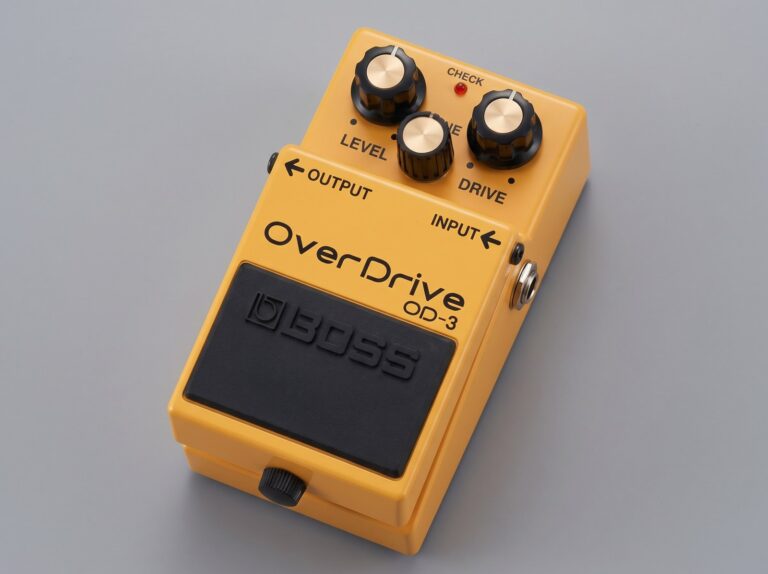
- Boss OD-3 OverDrive: GuitarGangsters AI-generated reference illustration, not a photograph.
Latest News
Related
On This Day
Monday 9 November
From this week: