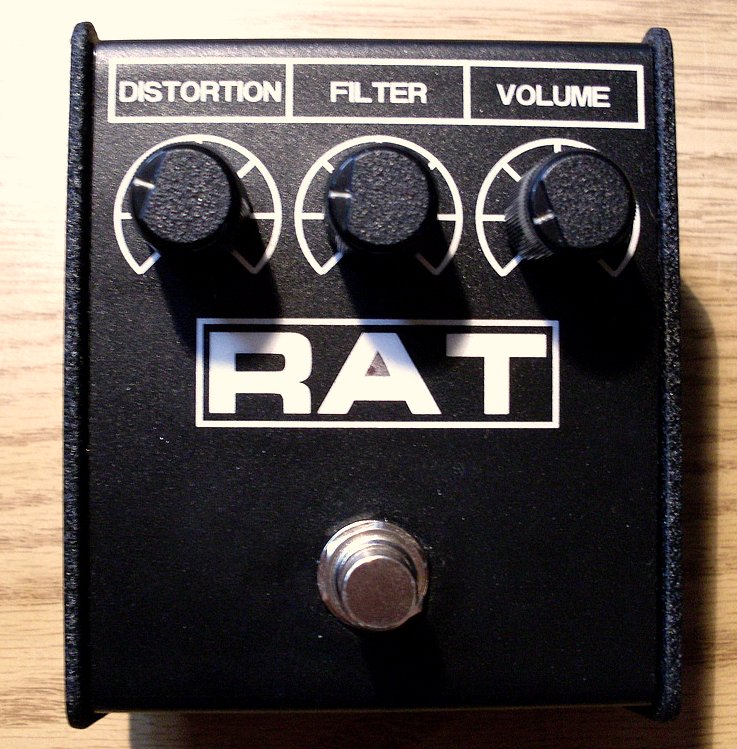
From Kurt Cobain’s Riff Machine to Nuno’s Secret Weapon: The JHS PackRat Puts Nine Legendary RAT Distortions in One Box
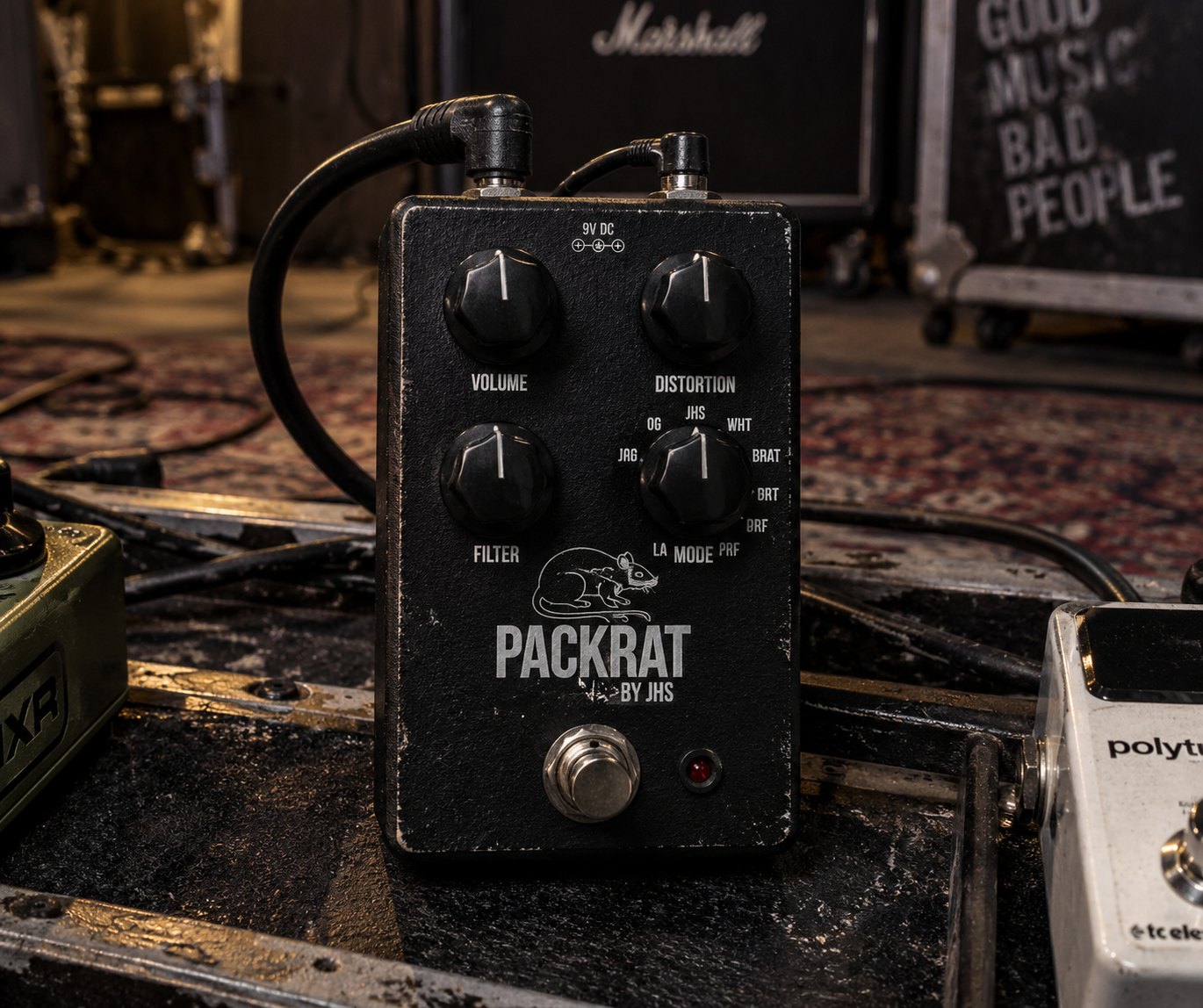
JHS PackRat Distortion Pedal. AI-generated reference illustration, not a photograph.
Josh Scott's PackRat packs nine legendary RAT distortion circuits—from the 1979 OG to the JHS Mode—into one fully analog stompbox. Complete player's guide.
In 1979, a rat-infested basement in Kalamazoo birthed one of the most influential distortion circuits in guitar history. The Pro Co RAT went on to define the sound of grunge, sharpen the edge of British alternative rock, underpin a generation of arena-metal riffs, and give a jazz-fusion icon his signature grit. Across four decades of incremental evolution — swapped diodes, new enclosures, circuit tweaks — the RAT stayed recognizably itself while mutating into nearly a dozen distinct versions, each with its own devotees who would argue to the death that their version sounds best.
JHS Pedals’ Josh Scott decided he didn’t need to choose. After studying over 100 original RAT specimens, interviewing former ProCo employees, and cross-referencing more than a thousand archival photographs, Scott built the PackRat: a single stompbox that routes your signal through nine fully analog RAT circuits via 261 components and 40 individual switches. Same concept as the JHS Bonsai did for the Tube Screamer family — and equally essential if the RAT is your thing.
The PackRat launched in 2021 at $249. At current used-market prices for the nine pedals it replicates, you’d spend north of $6,000 — JHS’s own updated figure — hunting them down individually. The PackRat doesn’t cost you that. It doesn’t cost you a shelf unit either. Here’s everything you need to know.
The RAT’s 40-Year Evolution — and Why It Matters for the PackRat
Scott Burnham was a ProCo Sound engineer who repaired and modified every distortion pedal he could find and was dissatisfied with all of them. He wanted something the market didn’t have: a single box capable of clean boost, overdrive, high-gain distortion, and near-fuzz in one circuit, controlled by a single gain knob. He got there through op-amp clipping — specifically an LM308 op amp being pushed harder than originally intended after an errant resistor choice during prototyping. That “mistake” became the voice of the RAT.
The first production units appeared in 1979, and by the time the RAT2 landed in the late 1980s, the circuit had passed through several major revisions — some purely cosmetic, others genuinely circuit-altering. Swapped diode types, different capacitor values, input buffers added and removed, taper and rotation changes on the filter control: each generation of the RAT sounds and feels subtly different under a player’s fingers, even when the differences look trivial on paper. The PackRat’s entire premise is that those differences are real, audible, and worth preserving.
Josh Scott’s research process went further than any previous attempt at RAT taxonomy. Dating vintage RATs by potentiometer codes is unreliable — ProCo stockpiled components that could be years older than the production date — so Scott cross-referenced pot codes with enclosure artwork changes, logo revisions, and archival sale photographs to build a more accurate timeline. He also gathered prototypes. The result, by his own admission, may not be perfect, but it is the most rigorous attempt anyone has made at properly charting the RAT’s history across 40-plus years. That rigor is what the PackRat runs on.
Scott is direct about a common misconception he encountered throughout his research: many of the “widely accepted facts” about RAT version differences — including some he himself had previously believed — turned out to be inaccurate. Reliable sites had wrong timelines and incorrect photos of the respective models. Even ProCo’s own published history was missing significant details. The PackRat is built on corrected information, not inherited mythology.
Specs at a Glance
| Feature | Detail |
|---|---|
| Year Released | 2021 |
| Manufacturer | JHS Pedals, Kansas City, USA |
| Circuit | Analog (nine discrete circuits, digital routing of analog signal paths) |
| Power | 9V DC center negative |
| Current Draw | 100mA |
| Dimensions | 2.2″ × 4.8″ × 1.6″ |
| Controls | Volume, Distortion, Filter, Mode (9-position rotary) |
| Price (MSRP) | $249 USD |
| Street New (2026) | ~$200–$249 |
| Street Used Excellent (2026) | ~$150–$200 |
| Equipboard | 7 pro artists, from $179.98 |
The 100mA draw is the same current requirement as several well-known digital multi-function pedals. On a quality isolated power supply — Strymon Zuma, Cioks DC7, Voodoo Lab Pedal Power 3 Plus — it fits into a single isolated output without issue. Do not daisy-chain it; the analog switching mechanism requires clean, regulated 9V.
The Nine Modes: What’s Actually Different
This is the core of the PackRat, and it rewards close reading. Not all nine modes represent dramatic circuit changes — some differences are subtle but cumulative: different diode materials, capacitor value shifts, control taper. Scott is specific about what his research found versus what conventional wisdom assumed, and the two sometimes differ significantly.
1. OG v1 (1979–83)
The first production RAT, known to collectors as the “Fringe Logo” model for the graphic treatment of the T in the typeface. The OG mode runs the exact circuitry of Scott’s personal 1979 v1 Fringe specimen, including the original Tone control orientation rather than the later Filter label. Critically: on the OG, turning the knob clockwise adds treble — the opposite of the Filter orientation most RAT players are used to. If you switch to OG mode and suddenly everything sounds dark, that’s why: your muscle memory is working against you.
The underlying circuit is essentially identical to the v2 Big Box — the transition between those early models was primarily cosmetic. The practical difference in the OG mode is the Tone control’s rotation and taper, which widens the effective range and changes the feel of tone sculpting. It’s a more gradual sweep across a broader range of high-frequency content than the later Filter control provides.
2. White Face v3 (1984–86)
The “holy grail” RAT among collectors — the distinctive white-rectangle logo that appeared when ProCo moved to a smaller square enclosure to compete with the compact format BOSS, DOD, and Ibanez were popularizing. Here’s the part that deflates a lot of gear mythology: according to Scott’s research, the White Face is the same circuit as the OG v1 and the v2 Big Box. The enclosure transition was driven by aesthetic and manufacturing factors, not circuit evolution. The logo inversion from “RAT in black on white” to “RAT in white on black” was similarly cosmetic, triggered by screen printing inconsistencies.
What actually changed in the PackRat’s White Face mode is the Filter control orientation — now back to standard RAT rotation (counterclockwise = more treble). Scott notes this mode also “widens the sweet spot for the most beloved RAT tones,” which translates to more of the knob’s travel sitting in the most musically useful range. For many players, White Face is where the PackRat sounds immediately and satisfyingly like a RAT.
3. Turbo v5 (1989)
This is where the RAT genuinely reinvented itself. The Turbo RAT swapped the silicon clipping diodes of every previous version for LEDs — a first in pedal design history. The practical effect is significant: LEDs have a higher forward voltage threshold than silicon diodes, meaning they require more signal level to reach the clipping point. This produces a cleaner, more touch-responsive distortion at moderate gain settings, with more of the original note’s attack preserved before clipping takes over.
The Turbo tends to sound more open and less compressed than the original silicon-diode circuit, which is exactly the character that suits players who use a distortion pedal for dynamics rather than uniform saturation. The 1989 Turbo also introduced the sloped enclosure silhouette that defines the modern RAT’s visual identity. For players who find the original RAT too compressed or mid-heavy, the Turbo mode is typically the first revelation on the PackRat’s rotary.
4. BRAT v6 (1997)
ProCo’s budget-tier RAT, released alongside the Guitar Center-exclusive Roadkill. Despite its bargain positioning in 1997, the BRAT has the most significant circuit changes of any RAT in the lineup: it adds an input buffer (the first RAT to include one from the factory), introduces soft clipping inside the op-amp on top of the existing hard clipping diode stage, and shifts several capacitor values that alter frequency response and distortion character. The Filter control also returns to the reverse taper — counterclockwise adds treble.
The net result is a denser, more saturated tone with less transient snap than the original, but more compression and sustain. The dual-clipping architecture (soft inside the op-amp, hard at the diodes) gives the BRAT mode a smoothness that the earlier versions lack. It is not a “worse” circuit — it is a different creative palette that suits players who want the RAT character without the original’s more jagged attack.
5. Dirty v7 (2004)
Derived from the “Dirty RAT” mode of ProCo’s Deucetone, a dual-channel RAT released in 2002, then released as the standalone You Dirty RAT. This version uses germanium diodes for the symmetrical hard clipping section. Germanium clips harder and faster than silicon, producing the most saturated and fuzz-adjacent tone in the PackRat lineup. With the Distortion knob past noon, the Dirty mode pushes into sustained fuzz territory — the waveform is clipped hard, the sustain extends unnaturally, and the overall character becomes genuinely extreme.
Combined with several capacitor changes that reshape the frequency response, the Dirty RAT has a distinct midrange density that sets it apart from the more open-sounding OG and White Face modes. For players in Thurston Moore or noise-rock territory, the Dirty mode at full gain is the most aggressive point on the PackRat’s spectrum.
6. LA (1986)
The wildcard and the most historically unexpected mode in the lineup. This isn’t a ProCo RAT at all — it’s based on the Ibanez 10 Series LA Metal pedal, released in 1986, which Scott considers one of the best modified RAT circuits of the decade. The key technical difference: the LA Metal removes the clipping diodes entirely. Distortion is produced entirely by “rail clipping” — overloading the op-amp itself until the output hits its voltage supply rails. Rail clipping produces a harder saturation with a different harmonic profile than diode-clipped versions, and it has a more amp-like quality because it behaves similarly to a pushed output stage.
The LA mode handles more gain before the sound becomes unpleasant; it responds well to high Distortion settings with a brighter Filter setting to compensate for the op-amp saturation’s natural midrange push. Scott’s note on this mode — “You may not play LA metal, but I promise you’ll love this mode” — holds up. For tight, aggressive rhythm tones with a different character than any of the diode-clipped versions, the LA mode is worth extended time on the dial.
7. Landgraff MO’D (1999/2000)
John Landgraff began building pedals by hand in Pensacola around 1999, each with a unique swirl paint job and point-to-point wiring. His MO’D distortion became a boutique legend — individually voiced, highly sought after, and expensive on the used market. Scott describes it as a “distant cousin” of the RAT circuit rather than a strict derivative, with its own voicing that produces a particular smoothness at higher gain settings that distinguishes it from the more aggressive original versions. Scott names the Landgraff as his personal favorite mode on the PackRat — a significant endorsement from the builder.
8. Caroline (2010)
Based on the Wave Cannon by Caroline Guitar Company, designed by Philippe Herndon. Scott contacted Herndon directly when developing the PackRat — the two had spoken years earlier about RAT circuit design — and Herndon’s Wave Cannon was a natural addition as the PackRat’s boutique contemporary entry. The Caroline mode represents a working designer’s current take on the RAT architecture, voiced for modern players who want RAT DNA with updated frequency response. It’s the youngest design in the lineup and the least traditionally “RAT-like” in character.
9. JHS Mode
Scott’s personal mod, originating with a $15 vintage Small Box RAT he bought from a walk-in customer at a guitar shop in Northwest Alabama in 2003. That RAT stayed on his own board for a decade. When he started building and modifying pedals professionally in 2007, he developed the modification into a service — offered on customers’ RAT pedals from 2008 to 2018 — and as the discontinued JHS All American standalone. The JHS Mode applies his favorite modifications to the RAT architecture: more gain, different EQ character, and the refinements Scott developed through modifying thousands of customer pedals over a decade. It is the only mode in the PackRat that is not a tribute to someone else’s design.
RAT Sonic Lineage: The Players Who Built This Pedal’s Legend
The JHS PackRat was released in 2021 — a tribute to 40-plus years of RAT history rather than a pedal with its own decades-long roster of confirmed users. The artists who define the RAT’s legend built that legend on the original Pro Co circuits the PackRat replicates. That distinction matters: what follows are documented RAT-family players whose tones directly informed the PackRat’s existence. They are not confirmed PackRat users — the pedal is too new for most of these documented connections. The PackRat exists precisely because their use of those original circuits made them legendary.
Jeff Beck
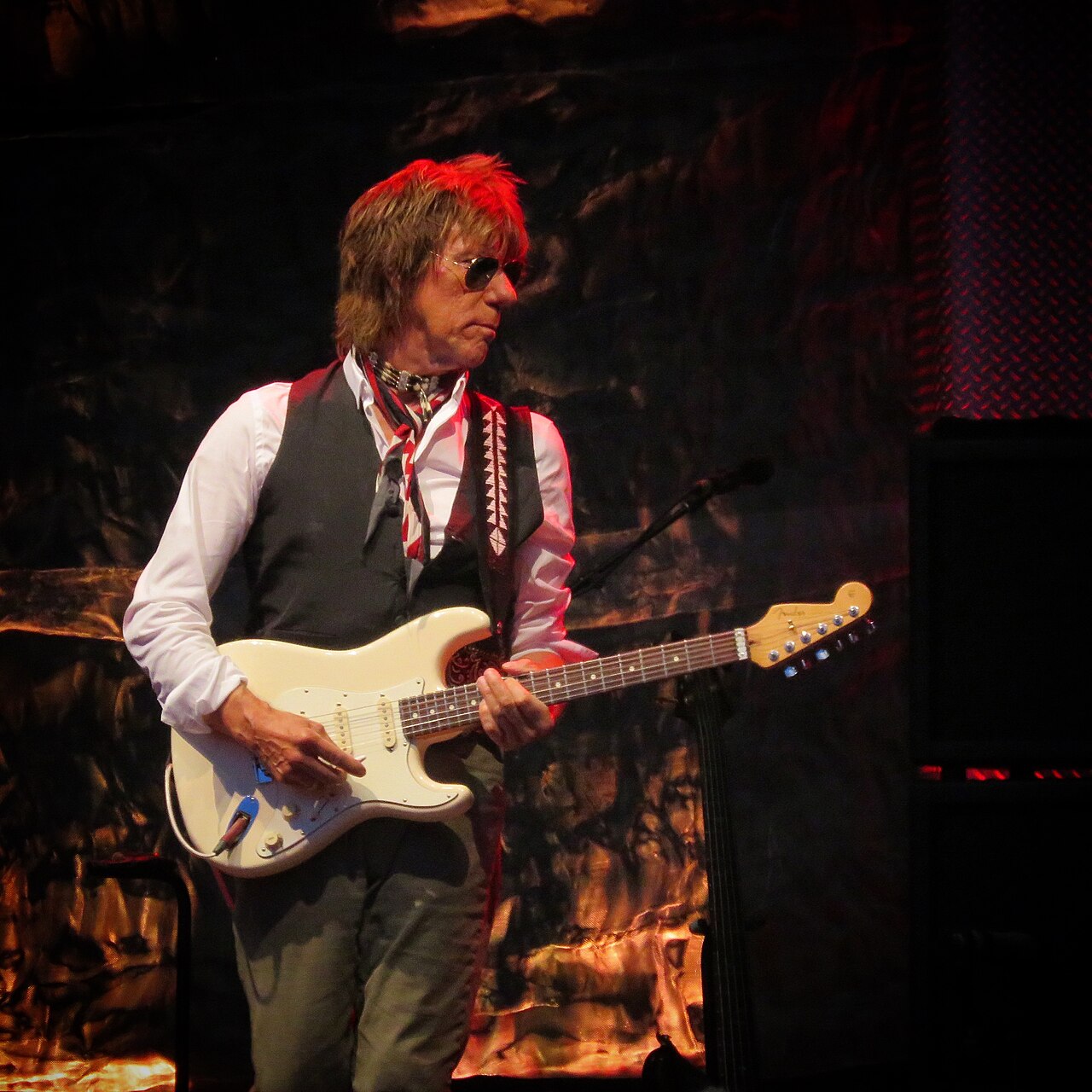
Multiple sources confirm Beck as a long-term Pro Co RAT user. His mid-1990s touring rig documented a Pro Co RAT feeding an A/B switch that drove either a 50-watt Marshall MkII or a ’59 Reissue Bassman. That era’s Turbo RAT — with its LED clipping, more touch-sensitive response, and sloped enclosure — aligns with what Beck needed: a distortion pedal that followed his playing’s dynamic range rather than compressing it. He ran the RAT for dynamics and tone color rather than always-on saturation, which is a less obvious use of a distortion pedal and a more demanding one. The Turbo v5 mode on the PackRat most directly replicates the circuit Beck used in that period. See: Jeff Beck.
Kurt Cobain
Confirmed as a RAT user by Guitar Player (Dave Hunter, December 2022) and multiple contemporaneous sources. Cobain’s approach was the opposite of Beck’s — he cranked the Distortion knob to generate the wall-of-noise that defined Nevermind and In Utero’s heaviest sections, using the RAT alongside the Boss DS-1 in a layered dirt chain. The DS-1 provided compressed, uniform saturation; the RAT added a rawer, more aggressive edge that the DS-1 doesn’t produce at high gain. Guitar Player’s Dave Hunter noted that the DS-1 compresses more as gain increases, whereas the RAT “stays raw and immediate almost to the end of the dial.” Cobain understood this distinction and used both. See: Kurt Cobain.
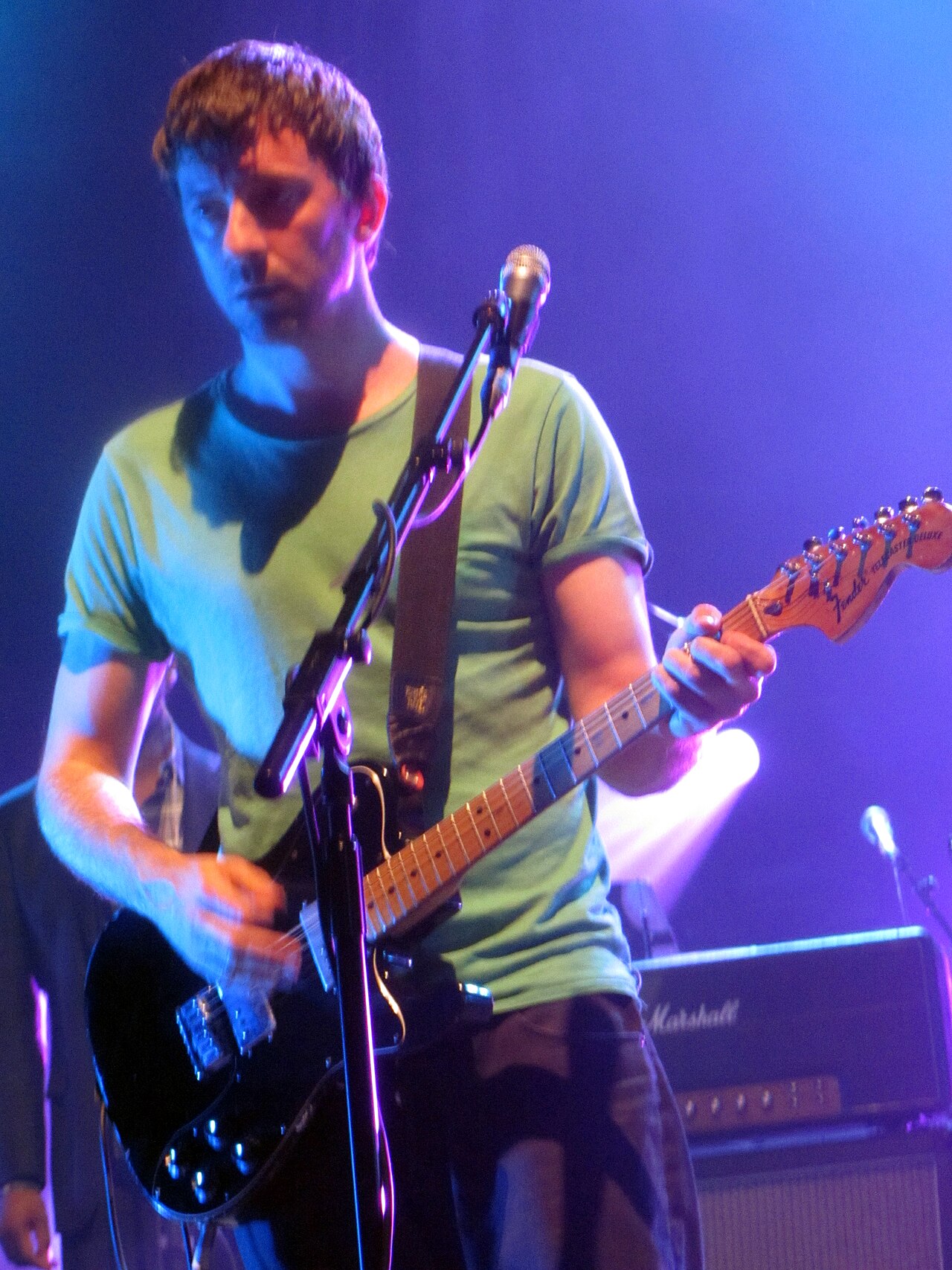
Graham Coxon
Blur’s guitarist is, by any credible measure, the most committed RAT player in British rock. He has run multiple RAT units simultaneously — often two stacked — and cited the pedal repeatedly across interviews as a permanent fixture of his sound. A Guitar World interview found him reassessing elements of his classic Blur rig while maintaining his core allegiance to the RAT architecture. One documented configuration included a Pro Co RAT 2 with the JHS PackRat mod applied — the closest primary-source connection between any major player and the specific modifications Josh Scott codified in the PackRat. This makes Coxon the most direct historical bridge between the broader RAT user community and the PackRat’s own JHS Mode. See: Graham Coxon / Graham Coxon Gear Guide.
James Hetfield
Confirmed RAT user by Guitar Player’s December 2022 feature. Metallica’s rhythm authority used the RAT alongside a Marshall stack for the tight, percussive attack that defined the band’s thrash crunch. The way the RAT interacts with a pushed Marshall — adding gain compression without eliminating the amp’s natural breakup character — is a specific tonal trick. Hetfield’s RAT ran into the front of a Marshall JCM800, letting the pedal handle the gain structure while the amp contributed its own natural compression and harmonic response at volume. See: James Hetfield.
Nuno Bettencourt
Bettencourt’s RAT use is the most counterintuitive documented application in the pedal’s history — and the most instructive. In interviews with Guitar World and Guitar.com, he confirmed he runs a Pro Co RAT with the Distortion knob turned all the way off. Not for distortion. For bottom-end tightening and signal definition on single-note riffs. “I tried playing without one and f***in’ hated it!” he told Guitar World. With gain zeroed, the RAT acts as a signal conditioner: the circuit’s input impedance, filter stage, and output buffer collectively tighten his low-end response and make single-note lines — particularly on passages like “Suzi (Wants Her All Day What?)” from Pornograffitti — feel chunkier and more defined against the amp’s input. His Ibanez RG550 signal goes straight into the RAT at zero gain, then into his amp head. This is a lesson in using a distortion pedal not for distortion — and the JHS Mode at minimum Distortion setting is where that application translates most directly on the PackRat. See: Nuno Bettencourt / Nuno Bettencourt Gear Guide.

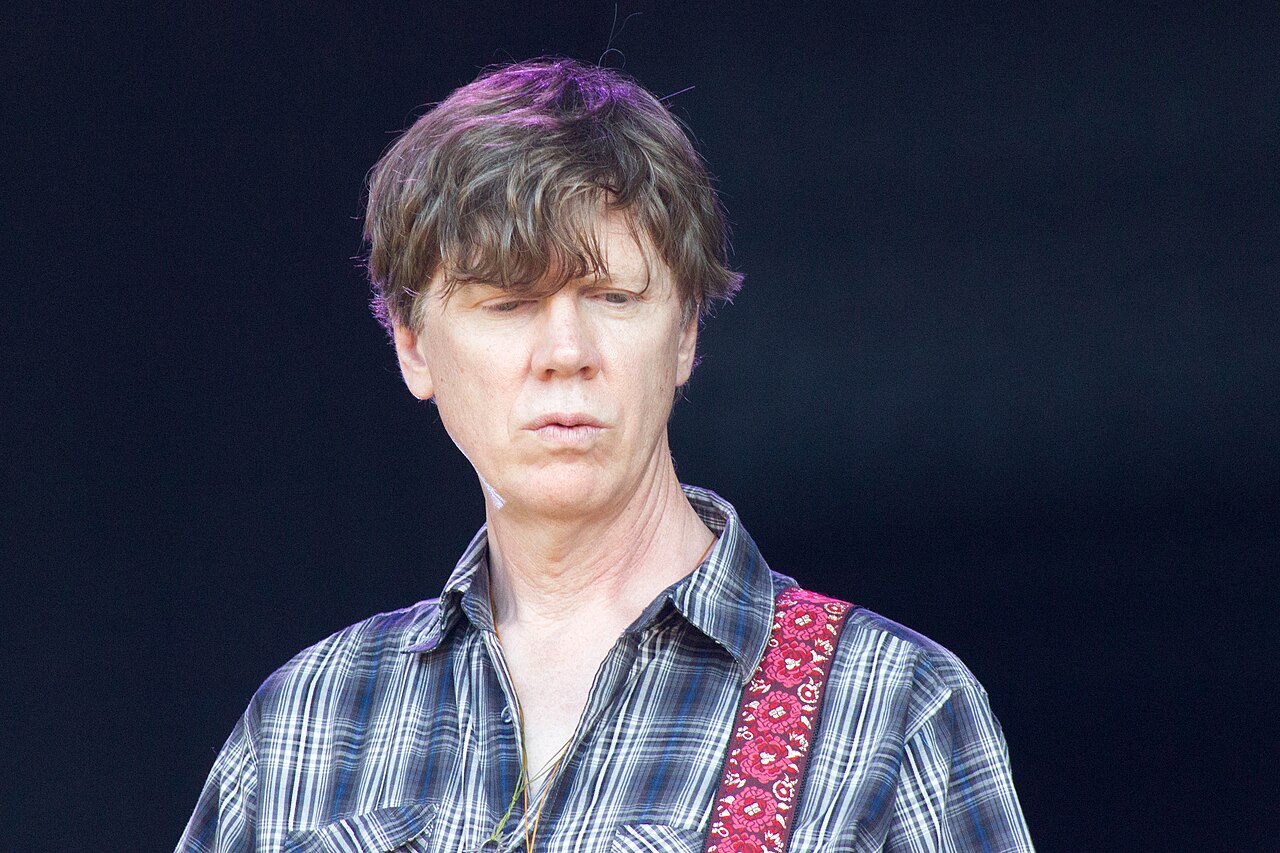
Jonny Greenwood, Thurston Moore, Joe Perry
All three confirmed RAT users by Guitar Player’s December 2022 feature. Greenwood’s application with Radiohead tends toward textural noise and controlled feedback — the RAT’s wide dynamic range and its tendency to get rawer rather than more compressed at high gain suits that application precisely. Moore with Sonic Youth ran the RAT as an always-on texture generator, frequently pushed into fuzz territory; his use aligns directly with the Dirty v7 mode’s germanium-clipped saturation. Perry’s application within Aerosmith was more conventional hard-rock crunch — the RAT’s op-amp clipping has an authority and midrange presence that suits classic rock riffs at medium gain. See: Jonny Greenwood, Thurston Moore, Joe Perry.
Tone Recipes: Starting Points for Each Mode
OG v1 — Open Vintage Crunch
Distortion: 10–11 o’clock. Filter: remember the reverse taper — start at noon and rotate clockwise for darker tones, counterclockwise for brighter. Volume: unity with your amp’s clean channel. Rolled back Distortion on the OG produces an overdrive-adjacent character with more harmonic richness than a Tube Screamer and none of the mid-forward hump. Bridge pickup, volume at full, pick lightly for blues tones; dig in for crunch.
White Face v3 — The Classic RAT Tone
Distortion: noon. Filter: 10 o’clock (standard orientation, counterclockwise = brighter). Volume: unity or slight boost for solos. This is the mode where the PackRat sounds immediately and recognizably like a RAT — the canonical crunch that sounds correct the moment you hit the strings. Best starting point for players new to the PackRat who want to find their feet before exploring the rest of the dial.
Turbo v5 — Dynamic Touch Response (Beck Territory)
Distortion: 8–9 o’clock (lower than you’d expect). Filter: 10 o’clock. Volume: slightly above unity to compensate for the more open clipping. Roll back your guitar’s volume knob to clean up the signal; dig in hard to saturate. The LED clipping makes the Turbo mode dramatically more responsive to pick attack — gain follows your playing rather than compressing it into a uniform wall of sound.
LA Mode — Tight Rhythm Crunch (Metal Applications)
Distortion: 2 o’clock. Filter: 9–10 o’clock (brighter setting compensates for the op-amp saturation’s natural midrange push). Volume: unity. Rail clipping gives this mode an amp-like response — it feels like a pushed output stage more than a diode clipping circuit. Well suited to downtuned rhythm guitar and fast picking patterns where standard diode-clipped distortion tends to blur note definition.
Dirty v7 — Fuzz-Adjacent Saturation (Noise Rock Zone)
Distortion: 2–3 o’clock or higher. Filter: full counterclockwise (maximum brightness cuts through the density). Volume: match bypass level first, then push for boost. The germanium clipping’s saturation at high gain is genuinely extreme — this mode sustains notes into fuzz territory with the right amp. Works exceptionally well with guitar volume rolled back for dynamic gating; dig in for full saturation, back off for cleaner, more open chord tones.
JHS Mode — The Nuno Zero-Gain Trick
Distortion: 7–8 o’clock (minimum, nearly off). Filter: noon. Volume: unity to slight boost. Apply the Bettencourt method: zero gain as a bottom-end tightener and signal conditioner rather than a distortion source. The JHS Mode at low gain settings acts as a clean boost with RAT character — signal is clarified, low-end definition tightens, single notes gain articulation. Push the Distortion toward noon for the JHS mod’s own gain voice, which is more aggressive than the stock circuit at equivalent settings.
How the PackRat Compares to the Competition
JHS PackRat vs. Pro Co RAT2
The Pro Co RAT2 is the current production version of the circuit, still made in Kalamazoo and available new for around $80. If you know exactly which one RAT tone you want and that tone is the standard modern RAT crunch, the RAT2 is the obvious choice at a fraction of the price. The PackRat earns its premium when you need multiple RAT voicings on a single board, when you’re specifically hunting the Turbo’s LED response or the BRAT’s dual-clipping character without scouring the used market, or when the Landgraff and Caroline modes represent sounds you couldn’t otherwise access at any reasonable price.
JHS PackRat vs. JHS Bonsai
The JHS Bonsai is the PackRat’s direct sibling — same concept (nine Tube Screamer circuits), same price ($249), same analog routing methodology, same Kansas City craftsmanship. The key difference is sonic character: the Bonsai replicates the TS family’s mid-forward, smooth overdrive quality; the PackRat replicates the RAT family’s harder-clipping, more aggressive distortion. They are not redundant — they occupy different positions on the gain spectrum and serve different roles in a signal chain. A player who uses a TS-style pedal for rhythm and a RAT-style for leads needs both boxes. A player who needs all the variations within one family needs the corresponding single box.
JHS PackRat vs. Boss DS-1
The Boss DS-1 runs a similar op-amp topology to the early RAT circuits, but with a fundamentally different character at high gain: the DS-1 compresses progressively as gain increases, producing a smoother, more uniform wall of saturation. The RAT stays rawer — more dynamically honest — through its gain range, getting more aggressive rather than more uniform as the knob goes up. Cobain ran both simultaneously and understood this distinction: DS-1 for compressed saturation, RAT for unhinged edge. The PackRat gives you nine versions of that edge across 40 years of RAT evolution, none of which replicate the DS-1’s specific compression profile.
Buying Guide
The PackRat is available new at $249 from authorized JHS retailers and from jhspedals.info directly. The pedal remains in current production as of 2026. Used examples — circulating since 2021 — typically run $150–$200 in excellent condition on Reverb and the used market, representing solid value. The PackRat holds its price well relative to its release MSRP; don’t expect steep depreciation on a pedal with this kind of demand.
The form factor is identical to the Bonsai: 2.2″ × 4.8″ × 1.6″. It’s slightly wider than a standard single-width pedal but compact enough for most medium-to-large pedalboards, and it occupies far less space than the nine pedals it replaces. Power: any isolated 9V 100mA output. Cioks DC7, Strymon Zuma, Voodoo Lab Pedal Power 3 Plus, and similar quality isolated supplies all handle it without issue. Standard daisy-chain power is not recommended — clean, regulated voltage ensures stable analog switching behavior.
The nine-mode rotary switch clicks audibly between positions, as on the Bonsai. The PackRat is not designed for hot-switching between modes mid-song; the click is intentional and part of the analog circuit routing mechanism. Set your mode before you start playing.
Ownership Notes
The Filter control’s reverse orientation in OG v1 mode is the detail that trips up PackRat owners most often. In every other mode, counterclockwise is brighter — the standard RAT Filter orientation. In OG mode only, clockwise is brighter. Mark your settings for OG mode separately. This isn’t a manufacturing error or a quirk — it’s an accurate replication of how the original 1979 Tone control worked.
Signal chain placement follows standard distortion practice: PackRat after tuner and wah (wah before distortion is conventional, though post-wah distortion is a valid creative choice), before modulation and delay. The BRAT v6 mode includes an input buffer that changes how it interacts with passive pickups and true-bypass fuzz pedals upstream — if you run a germanium fuzz before the PackRat in BRAT mode, expect different impedance interaction than with the other modes, which lack an input buffer.
The LA Metal mode is particularly sensitive to output level from your guitar. Humbuckers with hot output levels push the op-amp rails faster, yielding more saturation at lower Distortion settings. Low-output single-coils may need the Distortion knob higher to achieve equivalent density. The guitar’s volume knob interacts expressively with the LA mode — pulling it back cleans up the rail clipping significantly, giving you a clean-to-distorted range from your picking hand alone.
The Landgraff and Caroline modes are the PackRat’s most surprising voices and often the slowest to click with players who arrive with established RAT intuition. Neither sounds like what the conventional RAT muscle memory predicts. Reserve extended time for both — ideally across different amp settings, clean and driven — before drawing conclusions. They reward patience in ways that the more immediately familiar OG and White Face modes don’t require.
FAQ
Is the JHS PackRat actually analog?
Yes. Your audio signal travels through fully analog circuitry for all nine modes. The 261 components and 40 individual switches create nine discrete analog signal paths — the correct op-amp type, diode type, and component values for each version. The “digital runway system” Scott mentions refers to the switching mechanism that routes your signal to the correct components; your audio itself never passes through digital circuitry.
Does the PackRat use true bypass?
JHS Pedals builds their current multi-mode pedals — including the Bonsai — with true bypass. The PackRat follows the same architecture. When bypassed, no active circuitry sits in your signal path. Note: the BRAT v6 mode has an input buffer as part of its circuit replication, but this is inactive when the pedal is bypassed.
Why does the OG mode’s Filter control work backwards?
Because the original 1979 v1 RAT had a Tone control, not a Filter control, and the Tone control’s clockwise rotation added treble — the opposite of the Filter orientation introduced on later versions. Scott’s OG mode replicates this accurately, including the original taper and rotation. Once you know this, it becomes a feature: the OG mode’s taper provides a wider effective range of dark-to-bright adjustment than the standard Filter orientation delivers on subsequent versions.
How does the PackRat compare to buying nine vintage RATs?
JHS estimates the current used-market cost of the nine pedals at over $6,000 (figure updated Summer 2024). Beyond cost, sourcing a genuine White Face v3 in playable condition is a months-long hunt, a Landgraff MO’D is rarer still, and some of the earlier Big Box models are fragile vintage electronics with aging components. You’d also need nine pedalboard slots, nine power supply outputs, and a switching system to change between them mid-set. The PackRat handles all of that in a single 2.2″ × 4.8″ enclosure at $249.
Can the PackRat work as a low-gain overdrive or clean boost rather than a distortion?
Yes — and Nuno Bettencourt makes the strongest possible case for this. He runs a RAT with Distortion zeroed as a bottom-end tightener and signal conditioner. The JHS Mode at minimum Distortion works well in this role. The White Face mode’s wider sweet spot makes it useful at low gain as a transparent boost with RAT character. Several modes at Distortion below 9 o’clock produce overdrive rather than distortion, with enough harmonic character to be useful in front of a clean or lightly driven amp.
How does the Turbo mode differ from the silicon-diode versions in practice?
LED clipping has a higher activation threshold than silicon diodes — more signal is required before clipping begins. This means the Turbo mode preserves more of your pick attack and dynamic range before saturation takes over. At low-to-medium gain, you hear more transient snap and note definition than with the OG or White Face. At high gain, the Turbo opens into a brighter, more airy saturation rather than the denser, more compressed character of the silicon versions. Players who find the standard RAT “muddy” or “too compressed” at high gain frequently prefer the Turbo mode.
Which mode best replicates Graham Coxon’s Blur tones?
Coxon’s primary RAT across Blur’s Britpop peak was the standard RAT2 circuit — the White Face v3 mode is the closest replication of that baseline sound. On heavier and noisier passages (particularly from Think Tank onward), he has used multiple stacked RATs and higher-gain configurations that push into BRAT v6 and Dirty v7 territory. There is no single Coxon mode — his approach is additive and texture-driven, and the PackRat’s range covers his entire spectrum. Start with White Face at medium Distortion, then explore BRAT and Dirty for the more extreme passages.
Is 100mA a problem for most pedalboards?
On a quality isolated supply, no — 100mA is within the standard range of most individual isolated outputs. On a budget daisy-chain supply, 100mA can represent a meaningful portion of total available current and may cause noise or voltage sag on other pedals sharing the chain. Isolated is strongly preferred. If your current supply has only 100mA outputs and other hungry pedals competing for them, consider whether a supply upgrade makes sense before buying the PackRat — or prioritize it on its own dedicated output.
Image credits
- Jeff Beck: Shannon Kringen, Wikimedia Commons, CC BY-SA 2.0.
- Thurston Moore: Bene Riobó, Wikimedia Commons, CC BY-SA 4.0.
- Graham Coxon: XoxoHell, Wikimedia Commons, CC BY 2.0.
- Nuno Bettencourt: SebastyneNet, Wikimedia Commons, CC BY-SA 4.0.
- Top image: GuitarGangsters AI-generated reference illustration, not a photograph.
Latest News
Related
On This Day
Monday 9 November
From this week: