Two Blokes on YouTube Walked Into an Oklahoma Pedal Factory: The Keeley D&M Drive and What Happens When the Critics Get to Build the Thing
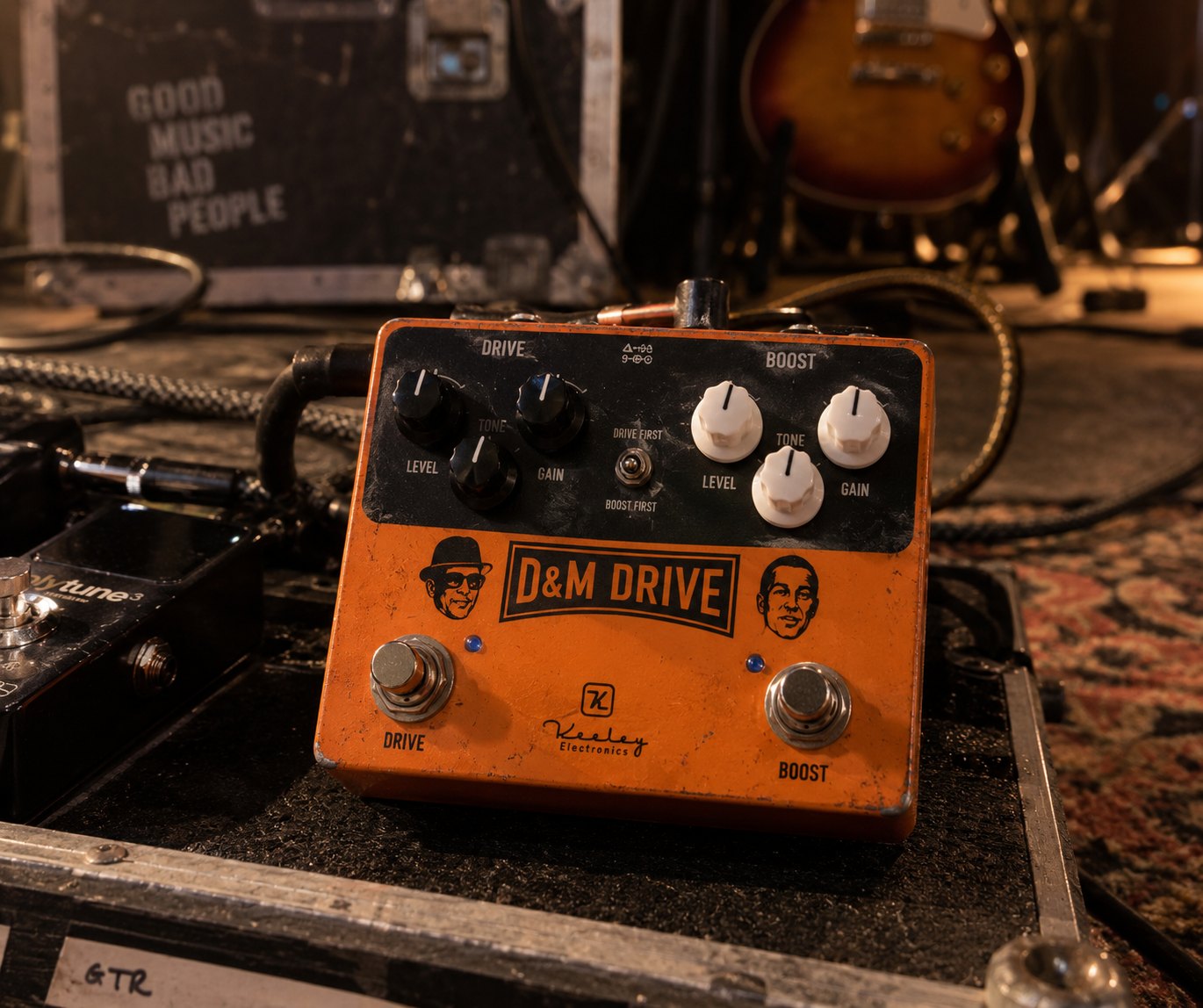
Keeley D&M Drive Overdrive and Boost Pedal. AI-generated reference illustration, not a photograph.
Keeley D&M Drive review guide: That Pedal Show's dual overdrive, its verified players, tone settings, limited editions and 2026 buying advice.
Almost every signature pedal on the market is named after somebody who plays guitar for a living. The Keeley D&M Drive is named after two people whose day job is talking about guitar pedals on the internet.
That should have been a disaster. The gear world has a long, unhappy history of merch-adjacent products that trade on an audience rather than on a circuit — the pedal equivalent of a branded coffee mug. Instead, the D&M Drive landed in mid-2017, immediately won an armful of awards from magazines that had no obligation to be nice about it, and is still sitting on Keeley’s active product list in 2026, nine years later, with a resale market that refuses to soften.
The reason is not marketing. It is that Daniel Steinhardt and Mick Taylor had, between them, spent years on camera doing the single most useful thing a pedal designer can do: publicly failing to find the drive sound they wanted, over and over, in front of an audience of hundreds of thousands. By the time they walked into Robert Keeley’s shop, they had an unusually precise brief. Not “make us a nice overdrive.” More like: this exact kind of mid-hump, this exact amount of headroom, this exact interaction with a Strat, and by the way it has to work inside a professional loop switcher.
What came back was a dual overdrive that does something most dual overdrives do not: it puts two genuinely different pedals in one enclosure instead of two mild variations on the same one. Here is the whole story — where it came from, what is actually inside, who is really using one, how to dial it, and where its reputation is more complicated than the internet suggests.
The Origin Story: When the Reviewers Became the Designers
That Pedal Show launched in 2015 as a long-form YouTube channel with an unusual premise: instead of a two-minute demo with a backing track, Daniel Steinhardt and Mick Taylor would sit down for an hour and actually argue about what a pedal does, why, and whether it earns its place. The format worked because the two hosts want completely different things from a dirt pedal, and neither one pretends otherwise.
Steinhardt is the founder of TheGigRig, the British company that builds high-end loop switching systems for touring pedalboards. His ear runs toward rich, harmonically dense, amp-like gain — the kind of overdrive that sounds like a big valve amp being pushed rather than a box in front of a clean one. Taylor is a former magazine editor and a lifelong devotee of the mid-hump: high-voltage boosters, germanium-modded overdrives, the whole tradition of pedals that make a Stratocaster sound like it has grown a second, thicker voice.
Robert Keeley, meanwhile, had been building pedals in Oklahoma since 2001 and had made a career out of exactly this kind of collaboration — taking a specific artist’s very specific complaint and turning it into a circuit. Keeley’s shop is a genuine American manufacturer, not a badge on an overseas board, and by 2017 it had the engineering depth to build something with real switching complexity rather than just another two-knob box.
The result reached reviewers in July 2017. Guitar.com’s Ed Oleszko ran it through a Strat, a Tele and a PAF-loaded Les Paul into a range of valve amps and came away describing the boost side’s Texas blues tones as good enough that “owners of certain famous green and gold pedals might consider retiring their prized vintage units” — a fairly loaded thing to say in print about a pedal from a YouTube channel.
The awards followed fast: a 2017 Guitar Player Magazine Editor’s Pick, Gear of the Year 2017 from The Guitar Magazine, second place in MusicRadar’s “12 Best New Guitar Effects of 2017,” and a top-five finish in Reverb’s pedals of the year. For a debut product from two broadcasters, that is a genuinely unusual sweep.
Specifications
What Each Side Actually Is
The single most important thing to understand about this pedal is that the two halves are not siblings. They were voiced by two people who disagree, and the disagreement survived into the circuit.
Mick’s Boost
Despite the name, calling it a “boost” undersells it. Keeley’s own description positions it as the answer to a specific question: what sits between a high-voltage clean booster like the Keeley house-style Katana and a germanium-modded professional overdrive? The answer is a booster with enormous headroom and a dialable midrange hump.
Set the Gain low and it behaves like a very loud, very clean level lift with a mid emphasis that helps a Strat or Tele cut. Wind the Gain up and it turns into a dynamic, uncompressed, vocal overdrive with a slight roll-off at both frequency extremes — a shape that is deeply familiar to anyone who has ever loved a Tube Screamer, except with far more available volume and far less compression. Guitar.com’s reviewer found it turned a mid-scooped vintage Strat into exactly the Texas blues voice players spend years chasing.
Where it really earns its keep is as a solo lift after the drive side. Placed second, it trims low-end mud and pushes precisely the frequencies that get a lead line over a loud band, without adding much extra dirt.
Dan’s Drive
This is the multi-stage side, and it covers considerably more ground than the name suggests. At low Gain settings with the Level up, it is a broad, essentially flat-EQ overdrive with a soft, forgiving feel — noticeably rounder under the fingers than the boost side. Push the Gain past noon and it stops being polite. Keeley describes it as multiple gain stages, and it reads that way: fast attack, plenty of low and high end, long sustain, and a distortion character that thickens without smearing complex chords.
Turn the Tone up toward two o’clock with the Gain high and it lands somewhere in nineties riff territory — the kind of tight, mid-forward crunch that suits Foo Fighters rhythm parts or alt-metal without needing a separate distortion box.
The Switching Trick That Justifies the Price
Two footswitches, three states — off, one, the other, or both — is standard for a dual dirt pedal. The D&M Drive adds two things that are not.
The first is the order toggle. When both sides are on, a small switch on the face decides which comes first. This is not a subtlety. Boost into Drive gives you a fatter, more compressed, more saturated lead voice with blooming sustain, because you are hitting the drive circuit with a hotter, mid-shaped signal. Drive into Boost gives you the same core distortion with a cleaner, louder, more articulate lift on top. Two completely different solo sounds from the same two circuits, selectable without rewiring anything.
The second is Steinhardt’s TheGigRig fingerprint: use TRS insert cables in the input and output jacks and the pedal splits into two electrically separate effects that can be assigned to different loops in a professional switcher such as TheGigRig G2. That means a pro board can call up “Boost only,” “Drive only,” or both, in any order, as part of a preset — while the pedal still occupies one enclosure’s worth of real estate. Very few dirt pedals at any price offer that.
The trade-off is that this is a pedal designed by someone who thinks in loop switchers. If you have never used one, roughly a third of the D&M Drive’s engineering is a feature you will never touch, and you are still paying for it.
Famous Players: What Is Verified and What Is Not
Signature pedals attract inflated artist lists, and this one is no exception. Here is what actually holds up against primary sources.
Daniel Steinhardt and Mick Taylor are the obvious ones, and they are documented on camera demonstrating “their” respective sides of the pedal on That Pedal Show. A note for anyone searching: the Mick Taylor who co-designed this pedal is the British broadcaster and former magazine editor, not the Mick Taylor who played with John Mayall and the Rolling Stones. The name collision causes real confusion online, and the two are unrelated.
Simon McBride — now Deep Purple’s guitarist — is listed on Keeley’s own artist roster, and the D&M Drive appears on his official Keeley artist page. Worth flagging honestly: the Keeley artist roster is brand-wide and does not itself specify which pedal each player uses, so the per-artist pages are the source that matters here, not the roster landing page.
Joey Landreth of The Bros. Landreth and Daniel Donato both appear on Keeley’s roster with the D&M documented on their individual artist pages. Chris Turpin of Ida Mae is on the roster too, and Keeley publishes a quote from him in which he says the D&M “is now cemented to my pedalboard” alongside praise for the Keeley Caverns and the Monterey.
Beyond the official roster, the photographic and video evidence is decent. Rick Beato shows a D&M Drive in his 2025 studio tour video. Johnny Stevens of Highly Suspect has one visible on his board in a rig rundown. Hugo Silvani of Pale Waves was photographed with one circa early 2022, and Cathal Roper of The Murder Capital had one on his board on a 2023 US run. Peter “Danish Pete” Honoré, himself a familiar face in British guitar media, has posted his in a pedal selection. Producer and composer Junkie XL listed one for sale on Reverb in 2020, which confirms ownership rather than use.
What you should not conclude: that this is a stadium-headliner pedal. The verified user base skews toward working professionals, session players, blues-rock specialists and the UK/Ireland gigging scene rather than arena names. That is not a knock — it arguably tells you more about how the pedal performs on a real stage than a marquee endorsement would — but the honest picture is a well-respected working musician’s tool, not a pedal you can point to on a famous record.
Tone Recipes
Strat, Texas Blues Lead — Boost Only
Boost Level 2 o’clock, Boost Gain 1 o’clock, Boost Tone noon. Amp clean and loud. The mid-hump fills in the Strat’s scoop and the headroom means you get level as well as grit. Roll your guitar volume to 7 and it cleans up almost completely.
Les Paul, Vintage Southern Rock — Boost Only, Amp Cooking
Boost Level 11 o’clock, Boost Gain 10 o’clock, Boost Tone 11 o’clock. Into an already-driven tweed-voiced amp. Keep the Boost Level modest so you are adding character rather than volume; the amp is doing most of the distortion.
Telecaster, Neutral High-Headroom Boost — Drive Only
Drive Level 2 o’clock, Drive Gain fully counter-clockwise or just above, Drive Tone noon. Into a clean, high-headroom valve amp this is a nearly flat EQ lift with a soft, pillowy feel. Useful as an always-on.
Humbuckers, Modern Blues Lead — Drive Only
Drive Level noon, Drive Gain 1 o’clock, Drive Tone 11 o’clock. Into an amp at the edge of breakup. This is the pedal’s signature liquid sustain: harmonically rich, dynamic, and it clears up dramatically if you pick lighter or roll back the guitar volume.
Nineties Riff Crunch — Drive Only
Drive Level 1 o’clock, Drive Gain 2 o’clock, Drive Tone 2 o’clock. Bridge humbucker, amp clean-ish. Tight, mid-forward, and aggressive enough for alt-rock and lighter metal without a dedicated distortion pedal.
Solo Lift — Drive into Boost
Order toggle set to Drive first. Drive as above for your rhythm sound; Boost Level 1 o’clock, Boost Gain 9 o’clock, Boost Tone 1 o’clock. The boost adds volume and cuts low-mid clutter so the line sits above the band instead of inside it.
Blooming Lead Sustain — Boost into Drive
Order toggle set to Boost first. Boost Level 1 o’clock, Boost Gain 11 o’clock; Drive Level noon, Drive Gain noon. Fatter, more compressed, and considerably more saturated than the reverse order. This is the setting people buy the pedal for.
Taming a Boomy Room
If the Drive side sounds undefined — a common complaint, addressed below — pull the amp’s bass down two notches, put the Drive Tone at 1 o’clock or above, and stay on the bridge pickup. An EQ pedal in front, in the mould of an EQD Tone Job, is a widely reported fix among owners.
All settings are clock positions. Start with your amp at the edge of breakup unless stated otherwise.
How It Compares
The obvious rival is the Analog Man King of Tone, and the comparison is instructive. The KoT is the transparency benchmark — two channels of the same broadly clear, low-compression voice, famous for a waiting list measured in years. The D&M is the opposite philosophy: two channels that are deliberately different, with more colour and more saturation on tap. Owners who have used both tend to describe the D&M as harmonically richer and less polite. If you want your dirt pedal to be invisible, the KoT is the target. If you want it to have a personality, this is.
The JHS Double Barrel V4 is the closest direct competitor in concept — two distinct drive circuits, order switchable — and it costs less. The Double Barrel’s two sides are recognisable homages, which makes it more predictable; the D&M’s sides are original voicings, which makes it harder to guess but arguably more useful as a single-pedal gain rig.
A recurring shorthand among owners is that the D&M is “an OCD and a Tumnus in one box.” That is a rough approximation rather than a claim about circuits — nothing here is a Klon or an OCD clone — but it captures the pairing: an amp-like multi-stage drive next to a mid-pushed, high-headroom booster. If you currently run a TS808 into an OCD, the D&M covers most of that ground on one power supply and one patch cable.
Against the transparent-overdrive school — the MXR Timmy, the JHS Morning Glory V4 — the D&M is louder, dirtier and considerably more opinionated. Against the Klon Centaur lineage, the Boost side shares the mid-forward, high-headroom brief but does not chase that specific germanium-clipping voice.
One competitor that comes up repeatedly in owner discussions is the Boss/JHS Angry Driver, which some players moving from an OCD preferred for versatility and pedalboard integration. Worth trying both before you commit.
Buying Guide
The standard production model is the sparkle candy apple orange one, and it remains the version to buy for pure function. Keeley’s own store lists it at $229 with an “Active” product tag as of September 2026 — but showing out of stock, and Sweetwater’s listing has moved to a permanently-unavailable state. Read that carefully: Keeley has not archived the product, so it is not confirmed discontinued, but the supply chain is clearly thin. Stock still exists across roughly eight tracked retailers at prices from around $120 to $306, with an average near $211.
Limited editions are collector territory. The D&M “Stealth” Drive arrived in December 2019 in a run of 100 with a stealth finish, a numbered card signed by Dan and Mick, and a That Pedal Show badge. The “Label Maker” edition followed in October 2020 in a run of 200, stripping the orange paint and D&M graphics in favour of old-school Dymo styling and Marshall-type knobs, with 10 “Naked” versions that shipped with an actual Dymo embossing machine and Dan and Mick’s signatures on the base. Both are internally standard.
The “Altered History” Custom Shop edition is the one that is genuinely different. A run of 50, hand-modded and signed by Robert Keeley, in Nergal Red and Ninazu Purple, with artwork depicting Ereshkigal and a cuneiform-styled logo. The circuit changes are real but modest: an A-taper pot on the Boost volume and a 1M gain pot on the Drive side in place of the standard 500K. The sounds are broadly the same; they simply arrive at different points on the dial. It retailed at $259. Owners generally report preferring the standard version for stacking nuance, and buying the Altered History for the object.
Used is where most people should shop. Secondhand examples have long hovered around the $170 mark, and current tracking shows units well below that. Given the pedal’s construction — an American-made box with no battery door to break and no digital section to age — a used one is a low-risk purchase.
Do not buy it if you need battery power. There is no battery compartment. This was Guitar.com’s stated downside in 2017 and it has never changed. The 9V jack position can also foul angled patch plugs on a tight board, so check your cabling.
Living With One
The build is Keeley’s usual standard: American-made, solid, gig-ready, and reported as reliable by working players. The glow-in-the-dark knobs and blue LEDs sound like a gimmick until the first dark stage, at which point they become the reason you can find your settings.
The two complaints that come up consistently in owner discussions are worth taking seriously because they are specific rather than vague. The first is footswitch spacing — two switches on a compact enclosure means players with larger feet, or crowded boards, occasionally hit both. The second is more substantive: a minority of owners find the Drive side grainy or boomy, particularly with a Les Paul bridge humbucker into a cranked amp in a band mix. One much-discussed Reddit thread documented exactly that with a Fender Hot Rod Deluxe and a Marshall Astoria Custom.
Read those reports carefully, though, and a pattern emerges: the complaint clusters around darker amps and darker pickups. The Drive side is voiced with real low-end weight, and it stacks that weight on top of whatever your rig already has. Players on brighter amps — Fender blackface-voiced cleans, brighter Vox-style circuits — rarely report the problem. If your rig is already bass-heavy, the D&M Drive will make it more so, and the Tone control alone may not be enough to fix it. That is a genuine limitation, not a defect.
The order toggle itself drew one mild criticism at launch: Guitar.com called the micro switch “slightly flimsy.” It is a face-mounted mini toggle, not a footswitch, and it is not designed for mid-song stomping. Set it and leave it.
One last piece of context worth knowing in 2026. Keeley marked its 25th anniversary in September 2026 by launching the Tube Drive Twin Triode — a dual overdrive with a real 12AX7 preamp on one side, a Super Phat Mod on the other, stackable, with a switchable order. That is, structurally, the D&M Drive’s format nine years on. Whatever else the D&M did, it established a template that its own maker is still building on.
Frequently Asked Questions
Is the Keeley D&M Drive discontinued?
Not officially. As of September 2026 Keeley’s own product page still carries the “Active” tag rather than moving it to the archive, though it is showing out of stock, and at least one major US retailer has flagged it as no longer available. Stock persists at other dealers. Treat it as a product with uncertain supply rather than a confirmed discontinuation.
Who are the D and the M?
Daniel Steinhardt and Mick Taylor, the hosts of That Pedal Show. Steinhardt also founded TheGigRig, which is why the pedal has professional loop-switcher integration built in. Mick Taylor here is the British broadcaster, not the former Rolling Stones guitarist.
Can I run the two sides in separate loops of a switcher?
Yes, and this is one of the pedal’s defining features. Use TRS insert cables in the input and output jacks and the Drive and Boost become electrically independent effects that a system like TheGigRig G2 can assign to separate loops.
Does it take a battery?
No. It requires a 9V DC centre-negative power supply. There is no battery compartment.
Which order should I run, Boost into Drive or Drive into Boost?
Both, at different moments. Boost into Drive gives fatter, more compressed, more saturated lead sustain. Drive into Boost keeps the core distortion intact and adds a cleaner, louder, more articulate solo lift that cuts low-end mud. The face toggle switches between them.
How does it compare to the Analog Man King of Tone?
The King of Tone is the transparency reference — two channels of essentially the same clear, low-compression voice. The D&M Drive deliberately does the opposite, pairing two distinctly different circuits with more colour and saturation. It is also actually purchasable, which the KoT historically has not been.
Why do some players say the Drive side sounds boomy?
Because it is voiced with genuine low-end weight and adds it to whatever your rig already has. The complaint clusters around dark amps and Les Paul bridge pickups in loud band settings. On brighter amps it rarely surfaces. Lowering amp bass, raising the Drive Tone, or putting an EQ pedal in front are the standard fixes.
Is the Altered History version worth the extra money?
Only if you want the object. The Custom Shop modifications — an A-taper Boost volume pot and a 1M rather than 500K Drive gain pot — change where sounds land on the dial rather than what sounds are available. It was a hand-signed run of 50 at $259. For pure tone, the standard orange model is the sensible buy.
Image credits
- A guitarist using an effects pedal on stage: Shixart1985, Wikimedia Commons, CC BY 2.0.
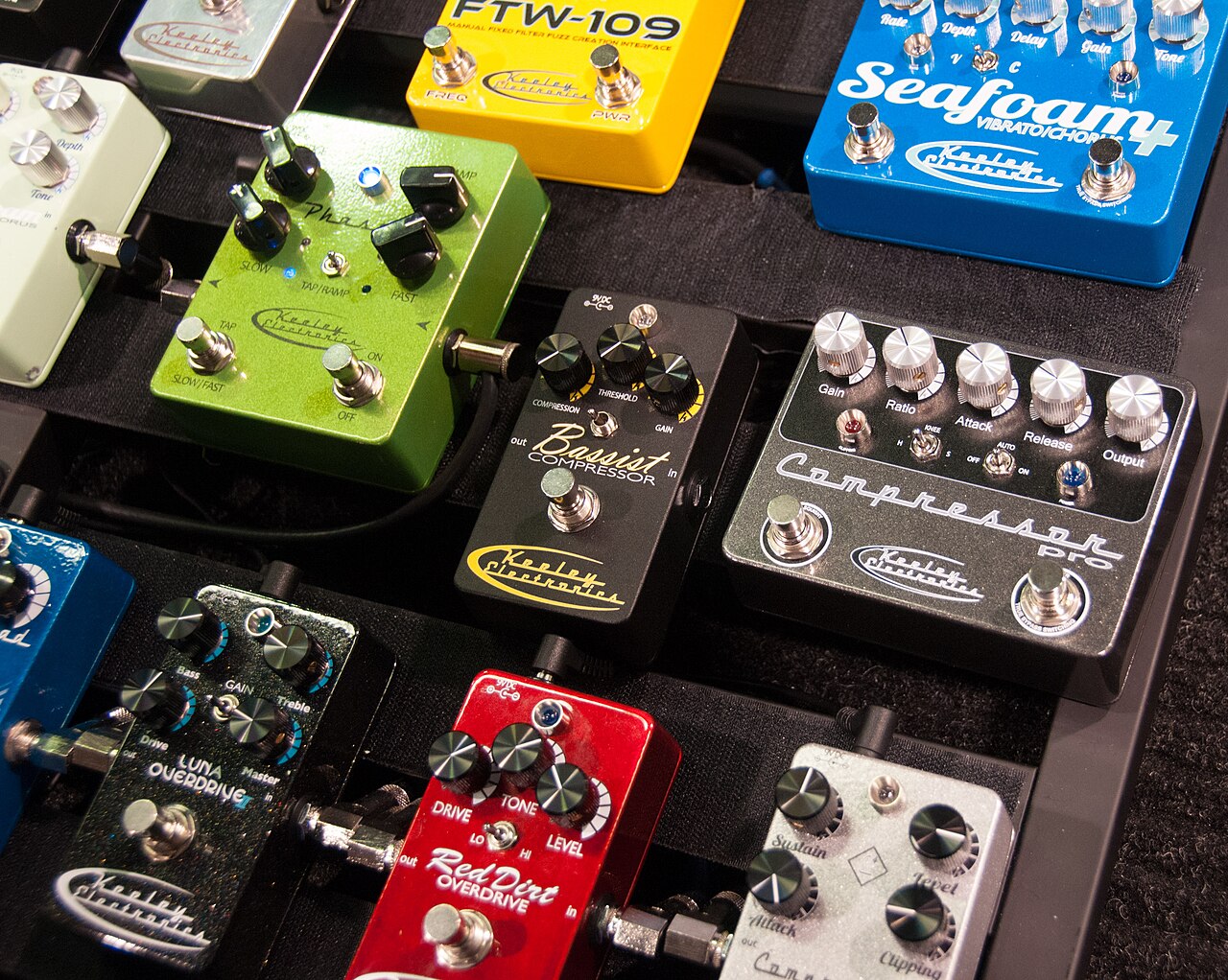
- A display of Keeley pedals on a board: ArtBrom from Seattle, Wikimedia Commons, CC BY-SA 2.0.
- Two Keeley compressor pedals: ArtBrom from Seattle, Wikimedia Commons, CC BY-SA 2.0.
- Top image: GuitarGangsters AI-generated reference illustration, not a photograph.
Latest News
Related
On This Day
Monday 9 November
From this week: