Source Audio EQ2 Programmable Equalizer: The Pedal That Replaced David Gilmour’s Boss GE-7s
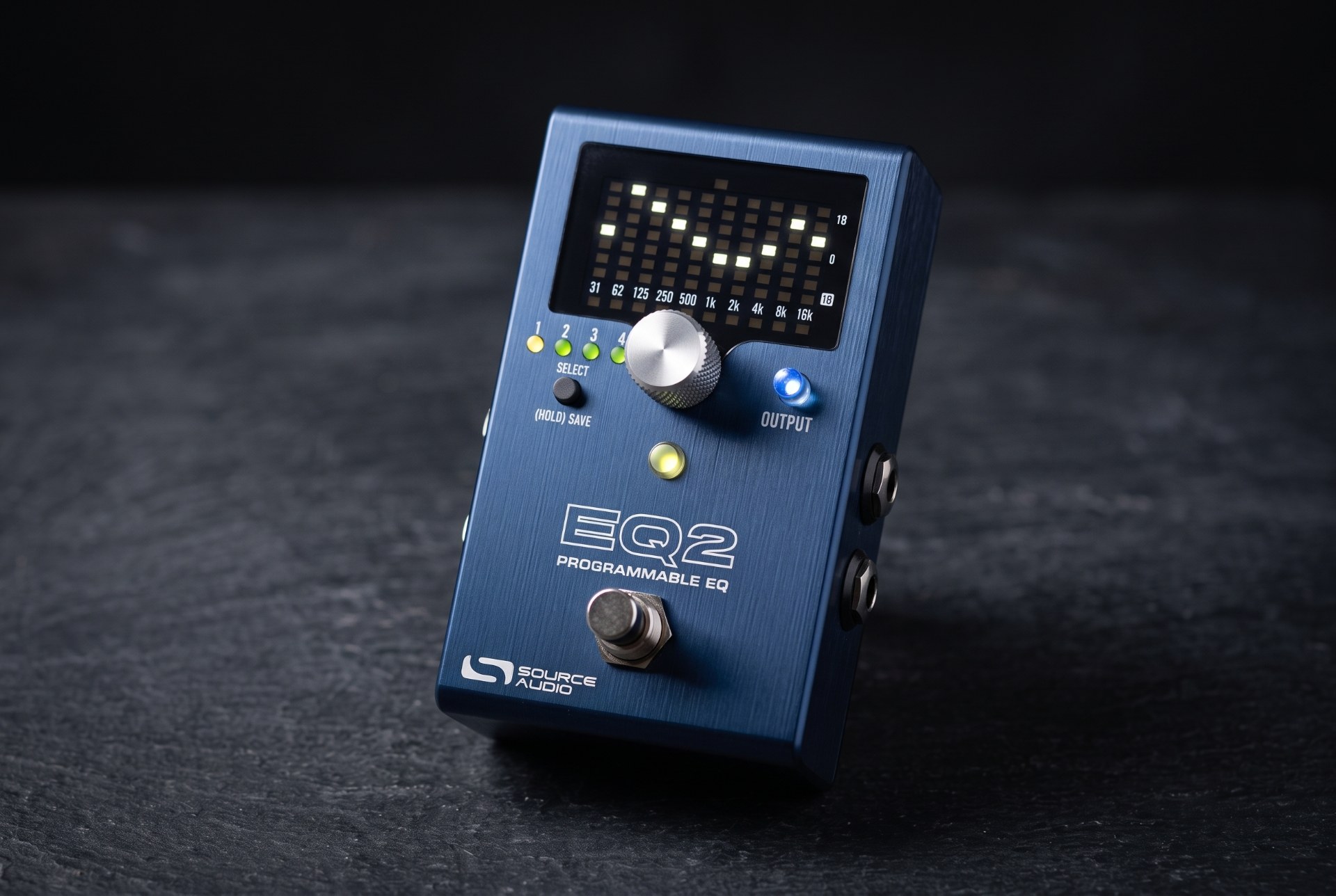
An AI-generated illustration of the Source Audio EQ2 Programmable Equalizer.
The Source Audio EQ2 Programmable Equalizer: 10 bands, 128 presets, true stereo. Full specs, verified players, tone recipes and honest buying advice.
In September 2015, David Gilmour walked onto a stage in Brighton with a rack of effects that included three Boss GE-7 graphic equalizers, one assigned to each of his Tube Drivers. By September 2016, at the Royal Albert Hall, all three were gone. In their place sat three Source Audio Programmable EQs.
That is not marketing copy. It is a documented, photographed, tour-by-tour substitution, tracked by the Gilmour research site Gilmourish across the whole Rattle That Lock run: one unit swapped in for South America in December 2015, two by Pompeii in July 2016, all three by the Albert Hall shows that autumn. A man with more or less unlimited access to any equalizer ever built systematically replaced the most famous EQ pedal in rock with a small digital box from Woburn, Massachusetts.
The pedal Gilmour swapped in was the SA170 Programmable EQ, the Toolblox-era original. The EQ2 Programmable Equalizer is its successor — a 2020 redesign that took the same idea and made it stereo, gave it a display screen, and expanded it into something closer to a studio channel strip with a footswitch on it.
This is a feature, not a review. What follows is where the EQ2 came from, what is actually inside it, who has genuinely been documented using one, exactly what the “famous players” claims get wrong, and how to make it earn its board space.
Where the EQ2 Came From
The EQ pedal has an image problem. It has no cult, no clone scene, no boutique mystique. Nobody has ever queued outside a shop for an equalizer. Premier Guitar’s Dave Hunter opened his September 2020 review by conceding the point directly — that it may not seem as cool as a raging fuzz or a complicated modeler — before arguing that this programmable wonder can unlock literally thousands of tones lurking within your existing rig. MusicRadar made the same move in March 2022, calling the EQ pedal potentially your board’s MVP, the missing link between good tone and great, and noting with some amusement that Source Audio itself filed the EQ2 under “Utility” on its own website, next to tap-tempo switches.
So the EQ2 arrives carrying a category’s worth of indifference. Its answer to that indifference is to be absurdly over-specified.
The SA170 Legacy
Source Audio’s own EQ2 user guide describes the pedal as a modern update to its predecessor, the SA170 Programmable EQ, which it says landed onto the boards of pros such as David Gilmour and John Mayer among many others. That is a manufacturer claim, and manufacturer claims are exactly the kind of thing this series treats sceptically — except that in Gilmour’s case it is independently corroborated by dated tour photography and by a specialist archive that has been documenting his rig since the 1990s.
The SA170 was a compact digital graphic EQ with programmable presets and no screen. Its pitch was simple: a graphic EQ you could store and recall, rather than one you set once and left. For a player like Gilmour, running three separate Tube Drivers each needing its own frequency correction, a recallable EQ per channel is not a luxury. It is the only way the rack makes sense.
What Changed for the EQ2
The EQ2, released in 2020 and reviewed by Premier Guitar that September as part of its Pedal Issue and 2020 Gear Award coverage, kept the recall concept and rebuilt everything around it:
- A luminous display screen that shows the live EQ curve as a bar graph — the single biggest usability change over the SA170.
- True stereo I/O with four automatic routing modes and a Split Mode that lets each channel run a completely different curve.
- Full parametric control — every one of the ten bands can be moved anywhere from 20 Hz to 20 kHz, with adjustable Q.
- 128 presets, recallable by MIDI program change.
- An onboard chromatic tuner, using the band LEDs to spell out the note.
- A noise gate and a clipping limiter, both configurable in the Neuro editor.
The price in 2026 is $289 direct. MusicRadar’s 2022 review listed £285 / €315 / $265. That is a modest rise over four years and, in real terms, a cut — the same “the price barely moved” pattern already visible across the Ventris Dual Reverb and Nemesis Delay. It is a Source Audio house habit at this point.
What the EQ2 Actually Is
Calling the EQ2 a “10-band EQ” is technically true and practically misleading. A conventional ten-band graphic equalizer gives you ten sliders at ten fixed frequencies with fixed bandwidths. The EQ2 gives you ten filters, each of which you can place anywhere in the audible spectrum, at any width, in either peaking or shelving form on the outer two, with an independent high-pass on top.
The Default: A Graphic EQ
Out of the box the EQ2 behaves like a familiar graphic EQ. The ten bands sit at 31, 62, 125, 250, 500 Hz, 1, 2, 4, 8 and 16 kHz — the standard octave-spaced set. Each has ±18 dB of boost or cut, displayed on the screen as a column of LEDs with the centre position representing flat. You push and turn the encoder to select a band, then turn it to move the level. That is the entire basic workflow, and a player who never opens the editor still has a very good graphic EQ with presets.
The Real Machine: Parametric
Hold the encoder and an Options menu appears on the same screen. From there each band gains:
- Frequency — anywhere from 20 Hz to 20 kHz. The manual’s own worked example is moving the 4 kHz band to 5 kHz to chase a specific piercing frequency.
- Q factor — measured in octaves, default 1.0, adjustable up to 10.0. At 10.0 the filter becomes a surgical notch; at low values it is a broad tilt.
- Shelving — the lowest and highest bands can be switched from peaking to shelving, which is what you want for a genuine treble roll-off or bass lift rather than a bump.
- High-pass filter — per channel, adjustable 10 Hz to 80 Hz, sitting ahead of the ten bands.
- Series or parallel filter topology — the default is parallel, as most graphic EQs are, but series is available for a more dramatic, interactive response.
That last item is the giveaway. Selectable filter topology is a mixing-console feature, not a stompbox feature. It is also the single most under-used control on the pedal.
Split Mode: Two EQs in One Box
By default both channels share one curve. Enable Split and Channel 2 becomes fully independent — its own frequencies, levels, Q values and channel gain. Scrolling the encoder past the 16 kHz band walks you straight into the right channel’s settings.
This unlocks the EQ2’s most interesting trick, the External Loop 2 → Loop 1 routing available in the Neuro editors. In that mode, Input 2 and Output 2 become a send and return, with a loop for external pedals sitting between the two EQ channels. You are placing one equalizer before a chunk of your board and a second one after it, from a single enclosure. For a player who wants to shape what hits the drive section and then re-shape what leaves it, that is two pedals’ worth of function in 4.6 inches.
Source Audio EQ2 Programmable Equalizer — Full Specifications
Famous Players: What Actually Checks Out
This is the section where most gear writing goes wrong, and the EQ2 is a textbook case. Four names are attached to it — Josh Homme, Tom Morello, David Gilmour and “session guitarists.” Three of those four do not survive contact with a primary source, and the one that does survives in a more interesting form than the claim suggested. Here is what independent research turned up.
Ray Toro — My Chemical Romance (two units, print-confirmed)
The strongest documented EQ2 user is Ray Toro, and he is not using one. He is using two.

Premier Guitar’s Chris Kies filmed My Chemical Romance’s rig at Soldier Field in Chicago during the 2025 Long Live the Black Parade stadium run, published 1 October 2025. Toro’s backstage system runs a Shure Axient wireless into a Radial JX44 and a pair of RJM Effect Gizmos feeding a multi-drawer rack. The written gear list is unambiguous:
- Drawer one: MXR Duke of Tone, MXR Custom Badass ’78 Distortion, Boss GE-7, Boss CH-1, Kernom Moho, Kernom Ridge, Wampler Gearbox.
- Drawer two: two more Boss GE-7s, two Bowman Overdrives, a Death by Audio Fuzz War, a Source Audio EQ2, a Bowman Bellyacher, a Keeley Compressor Mini.
- Drawer three: EHX POG2, 1981 Inventions DRV, Chase Bliss Preamp MKII, Boss TR-2, MXR Carbon Copy, Keeley Loomer, MXR EVH Phase 90.
- Fourth level: Strymon TimeLine, Strymon BigSky and a second Source Audio EQ2.
Note what that rack tells you. Toro is running three Boss GE-7s alongside two EQ2s. This is not a player who replaced his graphic EQs with a digital one; it is a player who decided he needed five separate equalizers and picked different tools for different jobs — the GE-7s buried in with the drive pedals doing per-amp voicing, the EQ2s at the switching and time-effects level where preset recall and stereo actually matter. That distinction is the most instructive thing in the whole rig, and it is a direct rebuttal to the idea that one EQ pedal replaces another.
The rack also contains a POG2, a Carbon Copy, a TimeLine and a BigSky, and Toro’s onstage board adds a TC Electronic PolyTune and an EHX Micro POG. Bandmate Frank Iero’s rack, by contrast, has a Mesa Boogie 5-Band Graphic EQ and no Source Audio at all.
James Cornelison — Lake Street Dive
Premier Guitar’s Lake Street Dive Rig Rundown, filmed at the Ryman Auditorium and published 22 February 2023, documents touring guitarist James Cornelison‘s two-drawer rack, designed and built by longtime Jason Isbell tech Michael Bethancourt. First item on the list is a Source Audio EQ2 Programmable Equalizer, followed by a JHS SuperBolt V2, a Behringer US600 Ultra Shifter/Harmonist, a JHS Colour Box V2, a Keeley Katana Clean Boost, a JHS Morning Glory, and a Strymon Flint and Deco. Everything is switched from an RJM Mastermind GT, with an RJM Mini Effect Gizmo handling signal paths and a pair of Strymon Zumas supplying power.
Cornelison’s use case is the classic one and worth spelling out. He plays a rotating cast of extremely different instruments across a single set — a ’50s Les Paul Standard inherited from founding guitarist Mike “McDuck” Olson, a D’Angelico Excel SS with a Teisco gold-foil in the neck, a D’Angelico Deluxe DC with stacked P-90s, a ’90s Squier Wayne’s World Stratocaster, a rubber-bridge Harmony H165 — into one Magnatone Twilighter. A gold-foil pickup and a ’50s humbucker do not want the same amp. A programmable EQ, switched by the same MIDI command that selects the rest of the patch, is how one amp serves both.
Billy Strings
Premier Guitar’s Pro Pedalboards 2024 gallery, published 1 February 2024 and drawn from his Rig Rundown, lists the contents of Billy Strings’ rack drawers. The top-left drawer reads: Voodoo Lab Sparkle Drive, EHX Micro POG, MXR Bass Envelope Filter, Source Audio EQ2, Boss DD-8, Source Audio C4 Synth and Strymon Lex. Other drawers hold a Source Audio Nemesis, an Eventide H9, a Chase Bliss Mood and an EHX Freeze, among a great deal else. Power comes from four Strymon Zumas; switching is an RJM Mastermind GT.
Strings is an acoustic flat-top player, and an acoustic instrument through a pickup is arguably the single most EQ-dependent signal in live music. Feedback control, boominess in the low-mids, quack around 2 kHz — all of it is EQ work, and all of it changes by room. Preset recall is not a convenience there. It is the job.
The Gilmour Question — Honest Answer
David Gilmour is a real Source Audio user. He is not a documented EQ2 user, and the distinction matters.
The pedals in his Rattle That Lock rack are SA170 Programmable EQs, the previous generation, photographed on tour between December 2015 and September 2016. The EQ2 did not exist until 2020. Attributing the EQ2 to Gilmour is the same species of error as attributing an Eventide H9 to Eddie Van Halen because he used an H949 — the lineage is genuine, the ownership is not.
What is genuinely true, and better than the false version, is this: three Boss GE-7s came out of the rack of one of the most tone-obsessed guitarists alive, and three Source Audio Programmable EQs went in, one at a time, over roughly nine months of touring. That is a working professional’s verdict delivered in the only currency that counts. The EQ2 is the direct descendant of the pedal that won that argument.
John Mayer is named alongside Gilmour in Source Audio’s own EQ2 manual as an SA170 user. That is a manufacturer claim without independent photographic confirmation in our research, so treat it as exactly that.
Claims That Did Not Hold Up
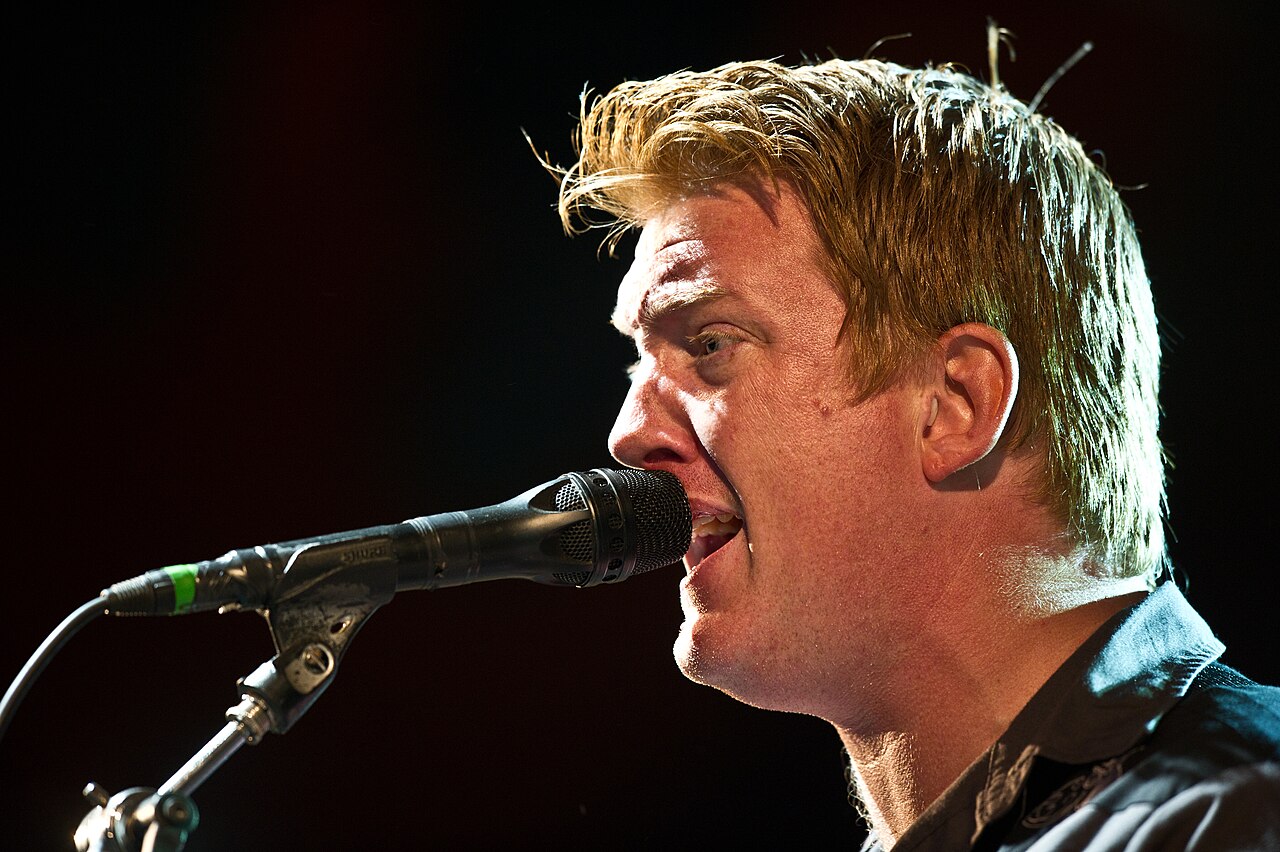
Two names attached to the EQ2 produced no supporting evidence whatsoever: Josh Homme and Tom Morello. No Rig Rundown, no pedalboard gallery, no interview, no manufacturer artist page. Both are extensively documented players with well-known rigs, and neither rig contains a Source Audio EQ2. They are named here only so the correction is on record.
The fourth entry on that list — “session guitarists” — is the one that is quietly accurate, and it is why the EQ2’s roster looks thin relative to its sales. This is a pedal bought by people whose job is to sound correct on someone else’s record, in someone else’s room, through someone else’s amp. Those players do not headline gear features. Cornelison, a touring sideman with a rack full of borrowed and inherited guitars, is the archetype.
Tone Recipes and Settings
1. The Mid-Push Solo Boost (the “Arrow”)
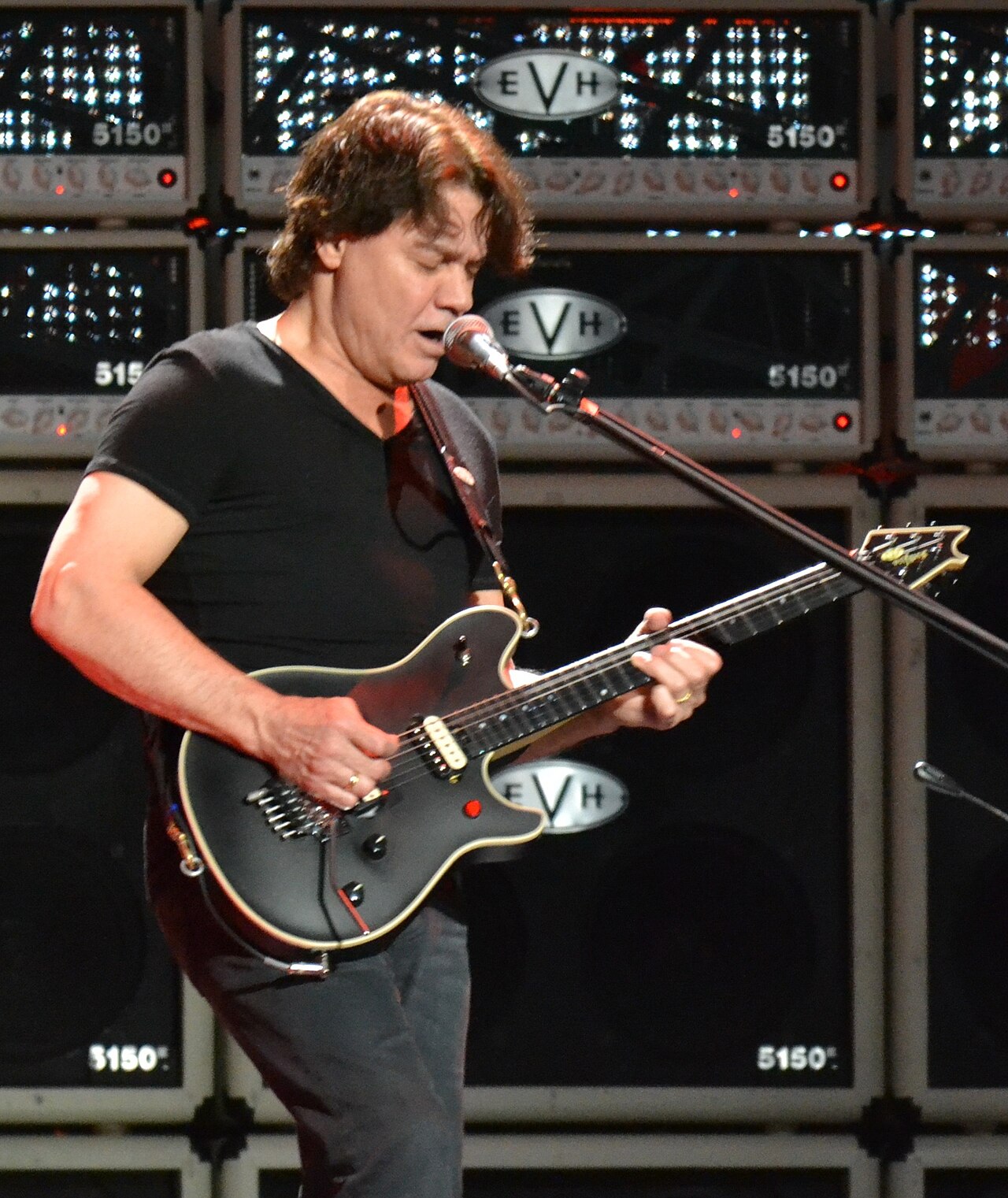
Source Audio’s own manual documents this one and correctly credits the shape to Eddie Van Halen’s use of graphic EQ pedals in the 1970s. Build a rising slope: cut 31 and 62 Hz by 4–6 dB, leave 125 and 250 flat, then climb — 500 Hz +4 dB, 1 kHz +8 dB, 2 kHz +10 dB — before dropping 8 and 16 kHz by 3 dB. Set master output to unity so the boost comes from the curve, not the volume. Into an already-distorting amp this is a lead sound, not a level change.
2. Single-Coil Sanctuary (humbucker to Strat)
Also from the manual, and the best-value preset on the pedal. Cut every band by 1–2 dB, then spike a single band by +8 dB somewhere between 5 and 7 kHz — you will need to move the 4 kHz band up to get there. Narrow the Q on that band to about 4.0. On a Les Paul into a clean amp this does a startling impression of a bridge single-coil. It works because it is subtractive everywhere except one deliberate window.
3. The Acoustic Feedback Killer
For a piezo or magnetic-equipped flat-top. Set the high-pass filter to 80 Hz first — that alone removes most stage rumble. Then find the room’s howl frequency by boosting a narrow band (Q at 10.0) and sweeping until it screams, then invert that band to −18 dB. Typically it lands between 180 and 320 Hz. Save it as a venue preset; the frequency will move with the room, the technique will not.
4. Guitar-Change Compensation (the Cornelison patch)
Set your main guitar flat on preset 1. Plug in the second guitar and, without touching the amp, correct it back to the first: a gold-foil usually needs 2 kHz pulled 3–4 dB and 125 Hz lifted 2 dB; a bright Tele wants 8 kHz shelved down; a P-90 hollowbody usually needs the high-pass at 40 Hz. Save each as its own preset and switch them from the same MIDI command that changes your amp channel.
5. The Amp-in-a-Room Fix (series topology)
Switch filter topology from parallel to series in the Neuro editor, then apply a gentle tilt: −3 dB at 31 and 62, +2 dB at 500 and 1 k, −2 dB at 8 and 16 k. In series mode the filters interact, so the result is a smoother, more amp-like curve than the same numbers produce in parallel. This is the setting that makes an EQ2 sound less like an EQ.
6. Two-Point EQ (the loop trick)
Enable Split, then set routing to External Loop 2 → Loop 1 in the editor. Patch your drive pedals into Input 2 / Output 2. Use Channel 2 (pre-drive) to trim lows before the dirt — high-pass at 60 Hz, 250 Hz down 3 dB — and Channel 1 (post-drive) to tame fizz: 4 kHz down 4 dB, 8 kHz shelved down 3 dB. Tight drive tone, no mud in, no ice-pick out, one enclosure.
7. Stereo Width Without a Modulation Pedal
Mono in, stereo out, Split ON. On Channel 1 lift 2 kHz by 3 dB and cut 500 Hz by 2 dB. On Channel 2 do the exact opposite. Feed two amps. The result is a wide, phase-coherent image with no chorus, no delay and no smearing — genuinely useful in front of a stereo reverb.
8. The Effects-Loop Master Curve
The EQ2 handles up to 8.76 dBu, so it sits happily in most amp loops. Put it there, leave the bands flat, and use the master output as a clean solo boost of +3 dB, with a single narrow cut wherever your cabinet honks. This is the most boring preset on the pedal and the one most likely to still be there in five years.
All positions below assume the default 31 Hz – 16 kHz band layout unless a frequency move is specified. The onboard display shows the curve, so you can read every one of these off the pedal.
How the EQ2 Compares
vs. Boss GE-7 Equalizer
The Boss GE-7 is the reference point: seven fixed bands, ±15 dB, analog, sliders you can read at a glance from standing height, and a price a fraction of the EQ2’s. Its advantages are real — no menus, no presets to forget, instant visual state. Its limits are equally real: no recall, mono only, a noise floor that has irritated players for four decades, and no ability to move a band. Ray Toro’s rack contains both, which is the most honest verdict available.
vs. MXR M108S Ten Band EQ
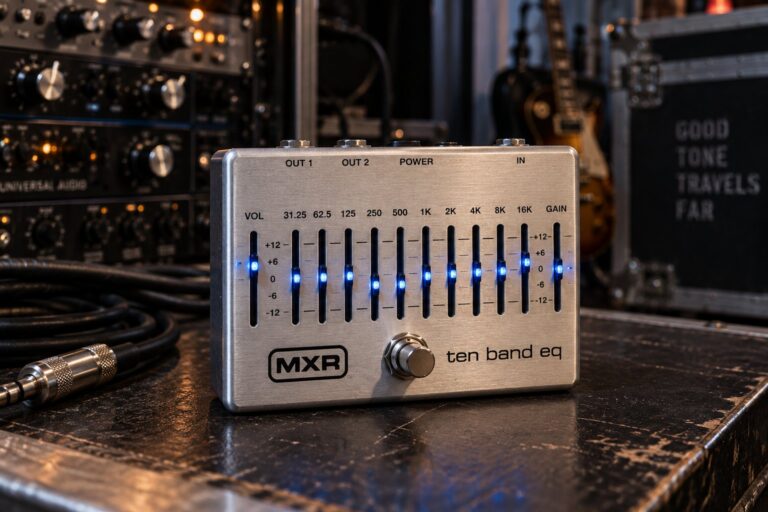
The MXR Ten Band is the EQ2’s closest conceptual rival: same ten bands, same octave spacing, ±12 dB, plus separate gain and volume sliders and true stereo output in the S revision. It is analog, it is quiet, and its LED-lit sliders are the best-looking control surface in the category. It has no presets and no parametric control. If you set one curve and live with it, the MXR wins on immediacy. If you need three curves in one set, it cannot compete.
vs. Empress ParaEQ MkII Deluxe
The Empress ParaEQ MkII Deluxe is the analog answer to the same question: three fully parametric bands with sweepable frequency and Q, a high-pass and low-pass, and a genuinely excellent boost. Three bands sounds thin next to ten, but three well-placed parametric bands do most of what anyone needs, and the Empress does it with no conversion stage and no menus. Choose the Empress for tone-first simplicity and analog signal purity; choose the EQ2 for recall, stereo and surgical precision.
vs. Empress ZOIA
The Empress ZOIA can build an equalizer, and a compressor, and a delay, and a sequencer, in the same grid. It can do everything the EQ2 does and a hundred things it cannot. It is also a modular environment that demands you become its programmer. The EQ2 is a single-purpose tool with a screen that shows you the one thing it does. That constraint is the product.
vs. the rest of the Source Audio One Series
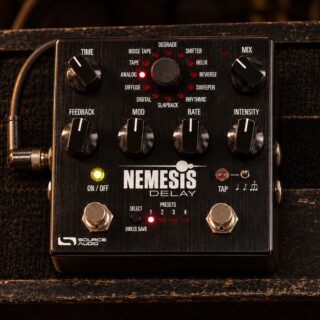
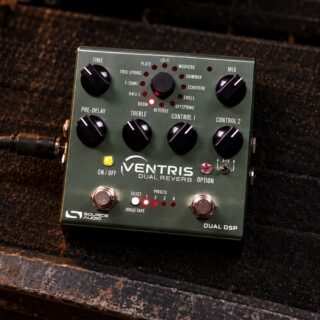
The EQ2 shares its enclosure, its Neuro editor, its Universal Bypass and its MIDI implementation with the Collider, Nemesis, Ventris and C4 Synth. Note one genuine spec difference worth knowing: the EQ2 and Ventris both run a 110 dB dynamic range and a +6.54 dBV maximum input, while the C4 is specified slightly lower at 108 dB and +6 dBV. These are per-SKU figures, not a platform constant — do not assume across the range.
vs. an amp’s own tone stack
Worth stating plainly: an amplifier’s bass, mid and treble controls are an interactive, mostly subtractive network placed inside the preamp, and they cannot be recalled, cannot be moved, and cannot be bypassed. The EQ2 is additive and subtractive, placeable anywhere, and switchable. It is not a replacement for the amp’s tone stack. It is the thing you reach for when the tone stack has run out of range.
Buying Guide
Who Should Buy One
- Multi-guitar players. If more than two very different instruments go into one amp in one set, this is the pedal that makes that work. This is the single strongest case for the EQ2.
- Acoustic and electro-acoustic players. Feedback control plus per-venue presets. Nothing else in this price bracket does both.
- Anyone with a MIDI switcher. The EQ2’s 128 presets are only fully available over MIDI. If you already run an RJM, a Boss ES-8 or similar, the pedal roughly triples in usefulness.
- Stereo rigs. True stereo with independent per-channel curves is rare at any price.
- Session and depping players. The unglamorous core market, and the one the pedal was clearly designed for.
Who Should Not
- Players who want one curve forever. Buy an MXR Ten Band or a GE-7 and spend the difference on something else. MusicRadar’s only listed con is that these features come at a price, and that is a fair criticism if you will not use them.
- Purely analog signal chains. The EQ2 is a 24-bit converter in your path. The conversion is excellent, but if the whole point of your rig is that nothing is sampled, this is not your pedal.
- Anyone unwilling to open the editor. The pedal is usable standalone, but half of what you paid for lives in the Neuro Desktop Editor.
Used Buying Checklist
- Confirm it is an EQ2, not an SA170. They are different pedals with a shared idea and a decade between them. The EQ2 has the display screen; the SA170 does not. Sellers conflate them.
- Check the display. Every LED in every band column should light. A dead segment is not user-serviceable.
- Test both channels. Plug into Input 2 and Output 2 specifically — a stereo pedal used mono for four years may have a jack that has never been exercised.
- Do a factory reset before judging it. Hold the footswitch, connect power, wait for the control LED to blink. A used unit is full of somebody else’s presets and hardware options, including possibly a non-default footswitch mode that makes the pedal seem broken.
- Confirm the mini-USB cable and USB-C adapter are present. Not expensive to replace, but their absence tells you the previous owner never used the editor — which usually means the pedal was under-used rather than abused.
Ownership Notes
The Power Supply Trap
The EQ2 needs 180 mA at 9 V DC, centre negative, 2.1 mm / 5.5 mm barrel. Two things follow. First, 180 mA is a lot — many older supplies offer 100 mA per output and will produce noise or erratic behaviour rather than an honest failure. Source Audio warns explicitly that an unregulated or insufficient supply can damage the unit. Second, note that this is centre negative, Boss standard — the exact opposite of Eventide’s centre-positive 2.5 mm convention. If your board mixes brands, label the cable.
There is no battery option, and you cannot power the pedal over USB. USB supplies 5 V; the pedal needs 9 V. The 9 V supply must be connected even when you are only editing over USB.
No Presets From the Factory
The manual states it plainly and it catches people out: no presets are saved from the factory, Split Mode is OFF and Preset Extension Mode is OFF. A new EQ2 has four empty slots. If you were expecting a browsable factory library like the C4’s, this is not that pedal — your presets are the ones you build.
The Four-Preset Reality
The “128 presets” headline is true only over MIDI. On the pedal itself you have four, or eight in Preset Extension Mode, cycled with the SELECT button or by holding the footswitch while bypassed. Note that default behaviour only allows footswitch scrolling while bypassed — you can change this in the Neuro Hardware Options so you can scroll while engaged, and most gigging owners do.
USB Ground Loops
Source Audio documents this at length, which suggests it comes up. Connecting the EQ2 to a computer over USB while both run on separate mains supplies can inject noise. Their own remedies: run the laptop on battery with its charger unplugged, and power down external display monitors, which they name as the most common culprit. Also keep the pedal on the same mains circuit as the amp.
Recording Interface Input Choice
A subtle one from the FAQ: the EQ2’s output is low impedance when engaged or in buffered bypass, but high impedance in true bypass with passive pickups. Source Audio therefore recommends a Hi-Z input on your interface or mixer to avoid signal loss. If you record through the pedal bypassed and it sounds dull, this is why.
Unity Gain Is Signposted
The blue-lit OUTPUT knob flashes twice — both the knob LED and the activity LED — the moment you cross unity. Unity is the knob’s mid-point. This is a small piece of design that removes an entire category of “is my boost actually boosting?” doubt, and it deserves more credit than it gets.
The Tuner Is Real
The band LEDs rearrange to spell the note, with arrows either side indicating direction, and the on/off LED runs orange when sharp or flat and green at pitch. It is accessible by double-tap or footswitch hold depending on which of the eight footswitch modes you choose, or by setting the Control Input to mode 4. It is not as fast as a dedicated Canvas Tuner or as readable as a TU-3, but on a cramped board it may buy back a slot.
Frequently Asked Questions
Did David Gilmour use a Source Audio EQ2?
No — he used the SA170 Programmable EQ, the EQ2’s predecessor. Photographic documentation from the Rattle That Lock tour shows him progressively replacing three Boss GE-7s with three Source Audio Programmable EQs between December 2015 and September 2016, finishing the swap by the Royal Albert Hall shows. The EQ2 was not released until 2020. The connection is real but it is a lineage, not an ownership.
How many presets does the EQ2 actually have?
Four accessible from the pedal itself, eight if you enable Preset Extension Mode, and 128 total via MIDI program change over the 5-pin DIN, USB, or a Neuro Hub. None are saved from the factory — you start with empty slots.
Is the EQ2 a graphic EQ or a parametric EQ?
Both, and that is the point. It ships behaving as a ten-band graphic EQ at standard octave frequencies. Every band can then be moved anywhere from 20 Hz to 20 kHz with adjustable Q, and the outer two can be switched to shelving, which makes it a ten-band parametric. There is also a per-channel high-pass filter from 10 to 80 Hz.
Do I need the Neuro app to use it?
No. Band selection, level, frequency, Q, Split, limiter, noise gate, high-pass, shelving, filter topology and MIDI channel are all reachable from the encoder’s Options menu on the pedal. But routing modes beyond auto-detect, the External Loop 2 → Loop 1 mode, hardware footswitch options, preset burning and factory reset are editor territory — and the desktop editor makes curve-drawing dramatically faster than turning an encoder.
Where should the EQ2 go in the signal chain?
There is no single answer, which is why the loop routing exists. Before your drives, it shapes what the distortion reacts to and is more musically dramatic. After them, it corrects the result and is more of a repair tool. In the amp’s effects loop it becomes a master tone control and a clean boost. Its input handles 8.76 dBu, so all three positions are electrically fine.
Can the EQ2 work as a clean boost?
Yes, and it is one of its best uses. The master output knob provides up to +12 dB above unity with the bands left flat, and it signals unity by flashing. As a boost it is transparent in a way a drive-based boost is not, because nothing is being clipped — only amplified.
Is it noisy?
It should not be. The audio path is specified at 110 dB dynamic range with 24-bit conversion and a 56-bit internal data path, and there is an optional noise gate with a threshold adjustable from −100 dB to −60 dB if you are boosting high frequencies aggressively. If you hear hum, check the power supply’s current rating and whether a USB cable is connected — those are the two documented causes.
Is the EQ2 worth $289 when a Boss GE-7 costs a fraction of that?
Only if you will use the presets, the stereo, or the parametric control. If you set one curve and never change it, the GE-7 or an MXR Ten Band does that job for less money with a better control surface. If you switch guitars mid-set, play rooms that fight you, or run a MIDI-switched rig, the EQ2 does things the analog pedals cannot do at any price. Ray Toro’s rack, which contains three GE-7s and two EQ2s, suggests the honest answer is that they are not really competing products.
Image credits
- Eddie Van Halen: Joe Bielawa, Wikimedia Commons, CC BY 2.0.
- Josh Homme: Bill Ebbesen, Wikimedia Commons, CC BY 3.0.
- Top image: GuitarGangsters AI-generated reference illustration, not a photograph.
- MXR M108S Ten Band EQ: GuitarGangsters AI-generated reference illustration, not a photograph.
- Ray Toro: Ollip182, Wikimedia Commons, CC0.
Latest News
Related
On This Day
Monday 9 November
From this week: