DOD Carcosa: The Fuzz Named After a City That Was Never Built
DOD Carcosa Analog Fuzz guide: Maestro FZ-1S origins, full specs, Demhe vs Hali explained, nine tone recipes, verified players and buying advice.
Most fuzz pedals are named after violence. Destruction, war, muff, rat, hoof, meat, blood. The vocabulary is small and it is loud, and it exists because fuzz is the one effect that a guitarist buys with their gut rather than their ears. You do not read a spec sheet and decide you need a fuzz. You hear one, somewhere, and something in the back of your skull goes yes, that, immediately.
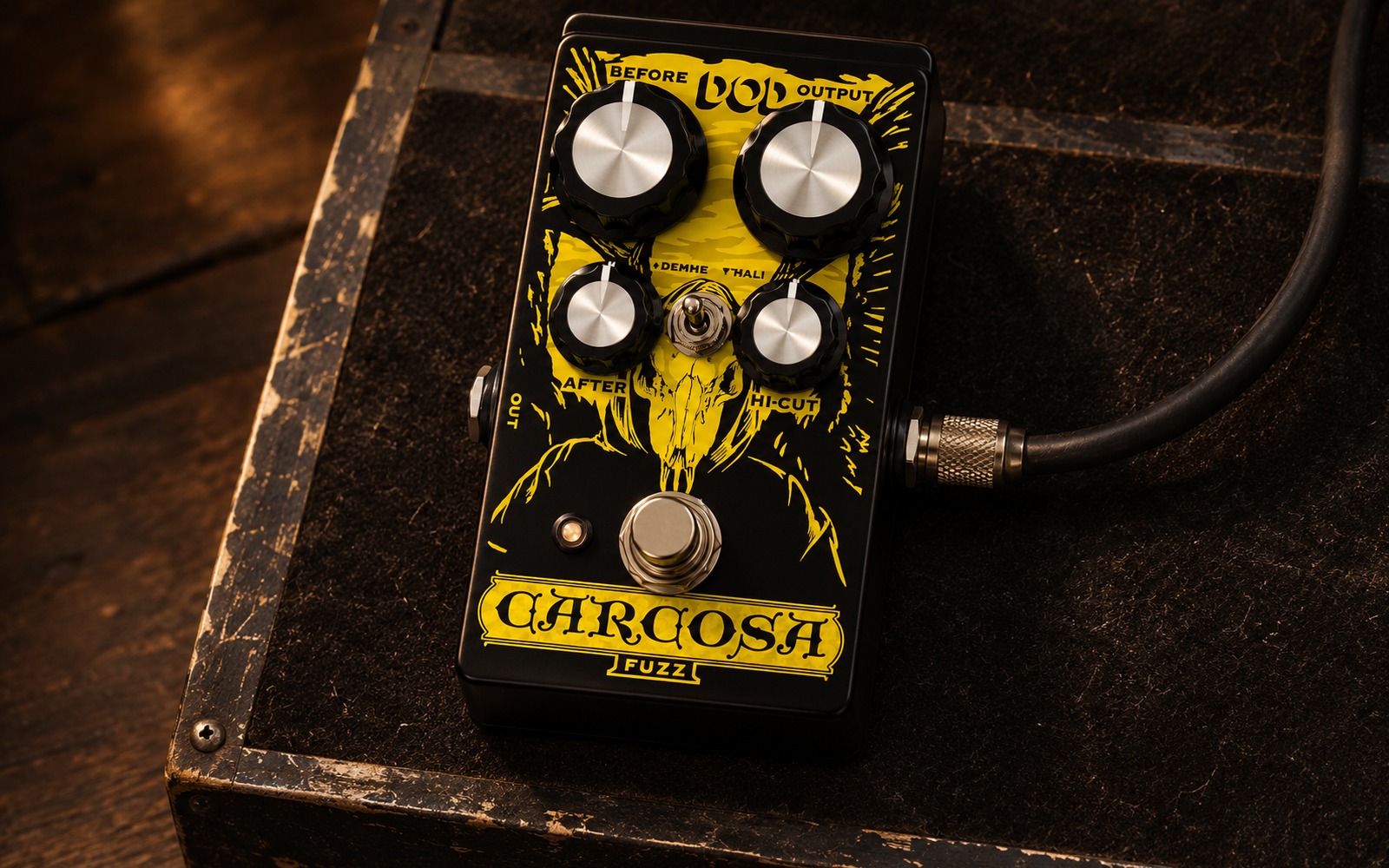
So it means something that DOD named theirs after a place in a book. Carcosa is a lost city — first a throwaway name in an Ambrose Bierce short story from 1886, then the dreaming, twin-sunned, black-starred capital of Robert W. Chambers’ 1895 collection The King in Yellow. Chambers’ book is about a play so beautiful and so wrong that reading the second act destroys you. The two voicing modes on this pedal, Demhe and Hali, are the lake and the cloud-waves of that same imagined geography. The figure on the enclosure, hooded and pallid and yellow, is the King himself.
It is a genuinely literate piece of pedal design, and it is also — and this matters far more — one of the most usable fuzz boxes ever built at its price. That is the argument of this article: that the Carcosa’s forbidding graphics have actively cost it sales, because players look at a black box with a death-cult figure on it and assume it does one thing very loudly, when in fact it does about nine things and several of them are polite.
This is a feature article, not a review. What follows is where the circuit came from, what DOD’s own documentation says, which players have actually been photographed with one, how to set it, and where it sits against the rest of the fuzz world.
Housekeeping: Two Corrections Before We Start
Two things get repeated about this pedal constantly, and both are wrong.
First, the literary source is not Lovecraft. A remarkable number of retail listings and blog posts attribute Carcosa, Hastur and Cassilda to H. P. Lovecraft’s cosmic horror. They are Chambers’, by way of Bierce. Lovecraft borrowed Hastur as a name and dropped it into “The Whisperer in Darkness” decades later, which is how the confusion started, but the city, the King, the Yellow Sign and the lake of Hali are all The King in Yellow, published in 1895 — a full six years before Lovecraft was born. If you are going to buy a pedal for its mythology, get the mythology right.
Second, this is not a distortion pedal, whatever your local shop’s category filter says. The Carcosa is a silicon fuzz with a bias control, and its behaviour at high settings — gating, sputtering, dying-battery collapse — is unambiguously fuzz behaviour. It can be dialled to sound like a hard-clipping overdrive, which is where the category confusion comes from, and we will get to exactly how. But the architecture is fuzz.
Origin: A Dead-Mint Maestro Nobody Could Afford
The Carcosa was designed by Tom Cram, who for years ran the DOD side of the DOD/DigiTech operation in Sandy, Utah, and designed the new product while he was at it. Cram is the reason the modern DOD line exists in the shape it does — his revived overdrive-era reissues and his contemporary take on the DOD 250 preamp are the brand’s spine.
The story he has told about this pedal starts at a trade show, with a dead-mint Maestro FZ-1S he could not afford. The FZ-1S is the silicon-transistor descendant of the germanium FZ-1 Fuzz-Tone — the pedal that put fuzz on the radio via “(I Can’t Get No) Satisfaction” — and by the 1970s Maestro had rebuilt it around silicon with a rather different, brighter, snarlier character. Cram could not buy the mint one. He eventually found a beaten one he could, and the obsession turned into a year-long project alongside engineer Parker Coons.
What came out the other end is not a clone. Cram added a clipping stage, cleaned up the power filtering, and — the decisive move — put the transistor bias voltage on an external knob. That is the whole pedal in one sentence: a 1970s silicon Maestro with its bias brought out to the front panel.
Bias-on-a-knob is not a new idea; ZVEX had been doing it since 1995. But the ZVEX approach hands you a Fuzz Face-derived circuit and four interacting controls and tells you to go and find the oscillation. The Carcosa’s version is domesticated. Every point on the sweep is playable, and the sweep is arranged so that the useful sounds arrive in a logical order rather than at random.
The Timeline, Honestly Stated
The Carcosa is routinely described as a 2015 introduction, and that is probably right, but we could not confirm a launch date from a first-party DOD source and we are not going to invent one. What we can date: a pedalboard photograph from September 2016 showing one on a very famous board (more on that below), a collector’s post in December 2016, and the first UK magazine review — Trevor Curwen, writing for Guitarist, published on MusicRadar on 18 May 2017 at £89 / €99 / $99. DigiTech and DOD were acquired by Cort in 2022, and the brand’s manufacturing was subsequently restarted with much of the original personnel. The Carcosa survived all of it, unchanged, which is more than most pedals of its era managed.

Specifications
| Model | DOD Carcosa Fuzz (analog silicon fuzz) |
|---|---|
| Designer | Tom Cram, with engineer Parker Coons |
| Circuit lineage | Based on the Maestro FZ-1S silicon Fuzz-Tone, with added clipping stage, revised power filtering and external bias |
| Controls | Before (fuzz amount), After (bias), Output (level), Hi-Cut (lowpass filter) |
| Toggle switch | Demhe (up) = bass and low-mid boost / Hali (down) = bass cut |
| Footswitch | Single, true bypass |
| Input impedance | 1/4″ TS unbalanced, 500 kΩ |
| Output impedance | 1/4″ TS unbalanced, 1 kΩ |
| Current draw | 4 mA |
| Power | 9 V DC adapter (DOD PS0913DC, optional) or 9 V alkaline battery, not included |
| Bypass | True bypass |
| Dimensions | 119 × 67 × 57 mm (per guitar.com’s measured review figures) |
| Country of manufacture | China |
| Launch price | $99 / £89 / €99 (2017 magazine review figures) |
| Street price, September 2026 | From roughly $114; typical new around $150 |
That 4 mA current draw deserves a sentence of its own. It is one of the lowest figures on any dirt pedal in this entire guide. A crowded board running an isolated supply near its limit will not notice the Carcosa at all, and a 9 V alkaline battery will last a genuinely absurd length of time in it. If you play with a small board and no power brick, this is meaningful.
The Controls, and Why They Are Named That Way
Four knobs, and only one of them is named what you expect. This is the single biggest barrier to people getting on with the Carcosa, so we will take them one at a time using DOD’s own descriptions.
Before
The large left-hand knob. This is the fuzz amount. DOD’s own copy is one line long: “Increases/Decreases the amount of fuzz.” It is called Before because it sets the level going into the fuzz stage — the same logic as a Fuzz Face’s Fuzz knob, or your guitar’s volume pot working into a treble booster. Low settings give you clean-to-crunchy boost. High settings give you saturation.
After
The small left-hand knob, and the reason to own this pedal. This is the transistor bias. DOD’s description is unusually vivid and worth quoting in full because it is also an accurate map of the sweep: counter-clockwise gives “loud ‘woody’ fuzz tones that clean up with the guitar volume knob”; full clockwise gives “splatty ‘broken’ fuzz tones and ‘horn-like’ vowel sounds and sustain”; the middle “go from familiar classic to more modern ‘wall-of-sound’ fuzz voicings.”
What is happening electrically is that you are starving the transistor of the operating voltage it wants. As you turn After up, the waveform stops being symmetrically clipped and starts being crushed against one rail, then starts failing to recover between notes. That failure-to-recover is what players call gating or velcro, and it is the sound of every dying nine-volt battery in every garage since 1966 — except that here it is stable, repeatable and available at will.
Hi-Cut
The small right-hand knob. A lowpass filter — clockwise removes high-frequency detail. DOD recommend starting at 9 o’clock and going counter-clockwise for bright pickups, clockwise for dark ones, and they explicitly encourage using the extremes because the After control changes the fuzz’s own tonality so drastically that the filter has to move with it.
Note the mild contradiction across sources here: DOD’s product page frames the extremes as fair game and links Hi-Cut position to output level, while guitar.com’s reviewer describes it the opposite way round — left for single-coils to take out bite, right to brighten dark humbuckers. Both descriptions are workable in practice because the control interacts so heavily with After; the honest answer is that this is a knob you set by ear on the day, not by rule.
Output
The large right-hand knob. Level. There is far more of it than the circuit needs, which is deliberate: with Before and After both at zero and Output up, the Carcosa is a clean-to-crunchy boost that will drive the front of an amp hard. Reviewers at both MusicRadar and guitar.com independently arrived at the same observation, and so did the pedal’s most detailed user review on Equipboard.
Demhe / Hali
The toggle. Demhe (up) boosts bass and low-mids and is intended for a clean amp channel. Hali (down) cuts bass and is intended for an already-dirty amp, where a bass-heavy fuzz turns into an undefined woof. MusicRadar’s summary is the clearest: “Hali is the leaner-sounding of the two modes with a tightly controlled low-end, while Demhe comes across as fuller-sounding in the bass and mids.”
An honest limitation, raised by an owner rather than a reviewer: the toggle is a two-position switch, not a pot. One long-term user reports that Demhe’s low-end boost, which is glorious into a small practice amp, is simply too much into a Fender Twin Reverb at stage volume, with nothing in between to reach for. That is a fair criticism and worth knowing before you buy. If you play loud through a big clean amp, expect to live in Hali.
Famous Players
The Carcosa is often described as a pedal with no reliable artist connection. That turns out to be wrong, and pleasingly so — there is photographic evidence for a spread of players, and one of them is about as famous as British guitar music gets. As always in this guide, evidence is tiered and stated.
Noel Gallagher
The strongest and most surprising credit. Noel Gallagher‘s pedalboard, photographed and posted by pedalboard builder Daniel Steinhardt in September 2016, includes a DOD Carcosa Fuzz. Steinhardt is not a random fan account — he builds and documents boards professionally, which puts this in the highest evidence tier available short of the artist saying it themselves. It also puts a $99 Chinese-made DOD alongside whatever else was on that board, which tells you something useful about how little the price of a fuzz correlates with whether a professional will use it.

Adrian Belew
Adrian Belew — King Crimson, Talking Heads, Bowie, Nine Inch Nails, and the most consistently inventive noise-maker in the business — appears with a Carcosa in the film Stompbox: 100 Pedals of the World’s Greatest Guitarists. For a player whose entire vocabulary is built from finding sounds nobody else has bothered to look for, a bias knob with a gating range is exactly the kind of tool you would predict he would reach for.
Mike Moya (Godspeed You! Black Emperor)
Visible on a documented board photograph — the black and yellow box on the left. Godspeed’s guitar sound is built almost entirely out of slow accumulation and controlled collapse, and a fuzz that can be biased to the edge of failure is a natural fit for it.

Ace (Skunk Anansie)
Ace posted a studio setup on Instagram that includes the Carcosa. Skunk Anansie’s guitar tone lives on the boundary between heavy alternative rock and something considerably more aggressive, which is Hali-mode territory almost by definition.
Christian Lembach (Whores)
Photographed in a December 2016 post showing his collection. Whores are noise rock at its least apologetic; the Carcosa’s broken settings are close to a house sound for that genre.
Also credited
Oliver Amberg (Celtic Frost) — who is the only owner in this list to describe it in his own words, calling it “a great and unique fuzz” that appears on his recordings. Kristian Niemann (Therion), via his own Instagram photo. Mylets, whose 2017 pedalboard post includes one. Twooba, shown in his own video.
What the list tells you: nine credited users, spanning Britpop, art rock, post-rock, noise rock and extreme metal, with essentially nothing in common except that all of them needed a fuzz that could be pushed somewhere unusual. That is a much better argument for the pedal than any single famous name would have been.
Nine Tone Recipes
1. Clean boost (the one nobody expects)
Before 0, After 0, Hi-Cut 9:00, Output 2–3 o’clock, Demhe. No fuzz at all. Just level and a low-mid lift into the front of the amp. Use it as a solo boost on a clean or edge-of-breakup platform.
2. Overdrive impostor
Before 1–2 o’clock, After fully down, Hi-Cut 10:00, Output to taste, Demhe. This is the setting that gets the Carcosa mislabelled as a distortion pedal. Hard clipping stacked on a preserved clean core, articulate on chords, no fuzz sputter. It genuinely replaces a conventional overdrive for some players — one long-time owner reports having removed theirs from the board entirely.
3. Woody vintage fuzz
Before 12:00, After 9:00, Hi-Cut 9:00, Output 12:00, Demhe. DOD’s own “woody” zone. Thick, warm, dynamically alive, and it cleans up properly on the guitar volume knob — the single test that separates a real fuzz from a distortion with a marketing problem.
4. Satisfaction, the long way round
Before 1:00, After 10:00, Hi-Cut 11:00, Output 12:00, Hali. The FZ-1S ancestry surfacing. Nasal, mid-forward, cutting, with the bass trimmed so the line sits on top of the band instead of underneath it. Play single-note lines on the neck pickup.
5. Blues rock, Tele into a clean Fender
Before 11:00, After 9:00, Hi-Cut 8:00, Output 1:00, Demhe. guitar.com’s review path exactly: single-coils, Fender clean base, low Before and After. Warm, thick, defined even on complex chords.
6. Stoner and doom
Before 2:00, After 12:00, Hi-Cut 12:00, Output 12:00, Hali, humbuckers into a dirty amp. Drop-tuned, slow, gnashing. This is the setting the artwork promised. Compare directly with the EarthQuaker Devices Hizumitas if you want the Japanese doom take on the same job.
7. Velcro and gate
Before 2:00, After 2–3 o’clock, Hi-Cut 1:00, Output 12:00, Hali. The bias starved into partial collapse. Notes tear open and then choke off. Riffs only — chords will not survive this, and are not supposed to.
8. Horn-like sustain
Before 3:00, After maxed, Hi-Cut 2:00, Output 11:00, Demhe. DOD’s “vowel sounds” description. Bend into the sustain and let the harmonics do the work. Closest cousin in this guide is the ZVEX Fuzz Factory at its most unstable, but with far less chance of the pedal running away from you.
9. Treble booster into an already-cooking amp
Before 10:00, After 0, Hi-Cut fully counter-clockwise, Output 3:00, Hali. Bass cut, treble open, level high. DOD explicitly claim treble-booster territory for this and they are right. Rangemaster-adjacent, without owning a Rangemaster.
Positions are given clock-face. Start every one of these with Hi-Cut at 9 o’clock, DOD’s own recommended home position, and adjust from there.
How It Compares
Versus the Big Muff
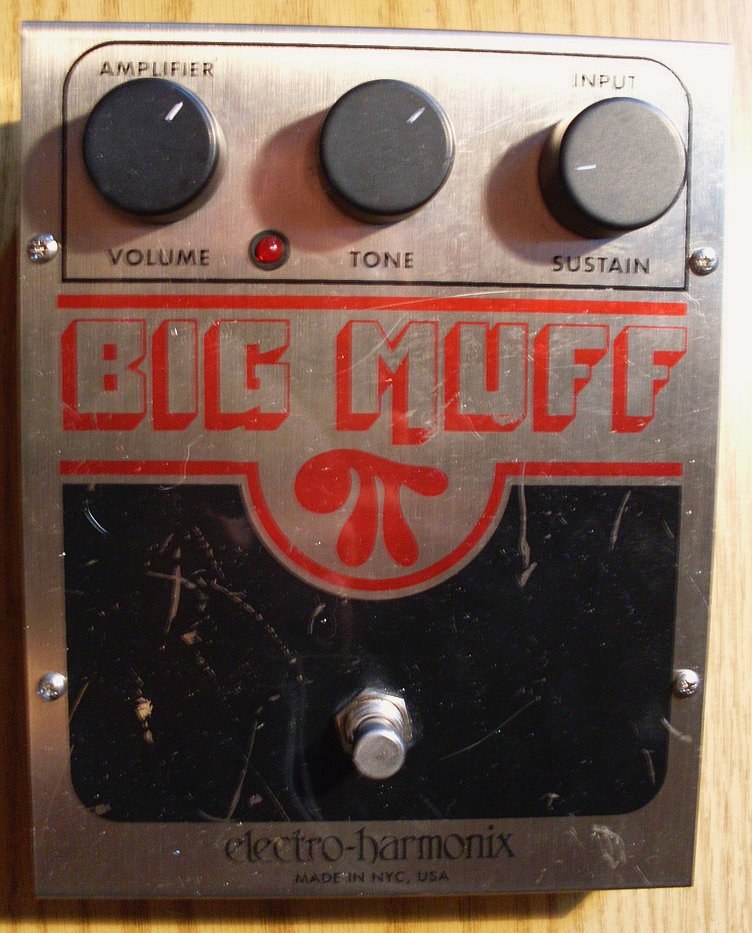
The Electro-Harmonix Big Muff Pi is a wall — enormous sustain, scooped mids, one magnificent idea executed perfectly. The Carcosa is the opposite temperament: mid-forward, dynamic, and it does not want to be a wall. If your riff needs to be the whole room, buy the Muff. If it needs to sit inside a three-piece and still be audible under a vocal, the Carcosa is the more practical instrument.
Versus the Fuzz Factory
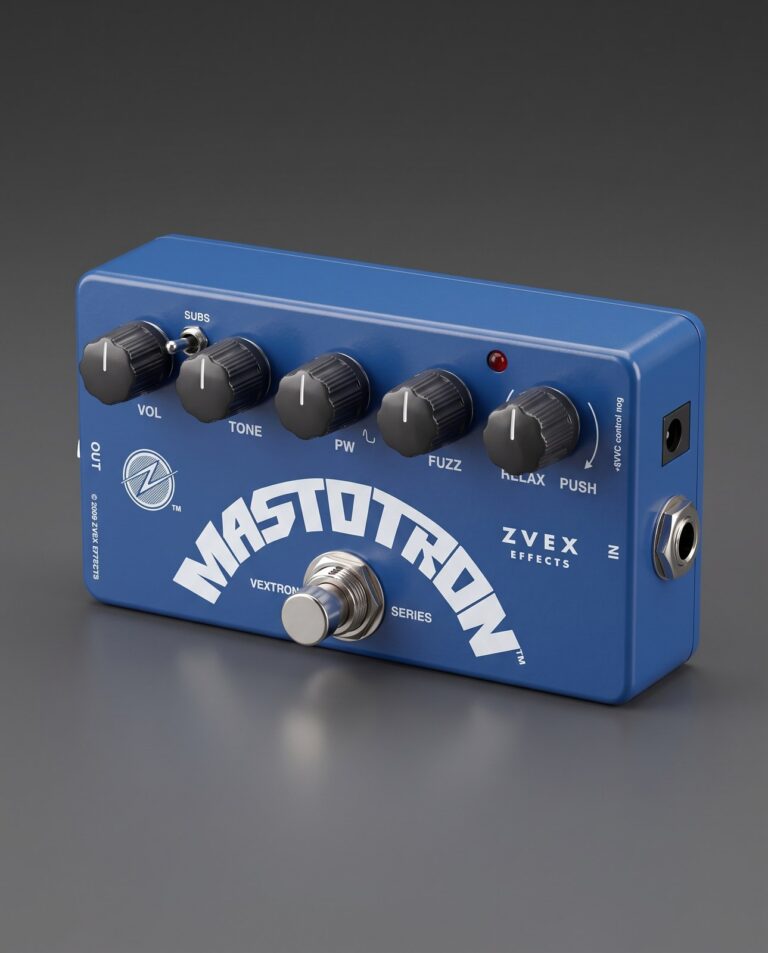
The best available comparison comes from an owner of both: the Carcosa is FZ-1S-derived, the Fuzz Factory is essentially a Fuzz Face with external bias, and they are “apples and oranges.” The practical difference is temperament. The Fuzz Factory rewards obsessive knob archaeology and will happily oscillate at you; the Carcosa’s controls interact just as much but every landing spot is a usable sound. One is an instrument to be studied. The other is a tool to be used.
Versus a Fuzz Face
The Dunlop JH-F1 Fuzz Face and its germanium relatives are about touch, bloom and cleaning up. The Carcosa cleans up well at low After settings but its ceiling is far higher and far nastier, and unlike a germanium Fuzz Face it does not care what the temperature is or what pedal precedes it. Silicon plus modern power filtering equals a pedal that behaves the same in a cold van and a hot club.
Versus the Swollen Pickle
The Way Huge Swollen Pickle MkII is the other great “more knobs than a fuzz has any right to” pedal, complete with internal trimpots. It is a Muff derivative, so it is voiced fat and low. The Carcosa is voiced bright and present. Owning both is not redundant.
Versus the RAT
The Pro Co RAT 2 is the reference point for a lot of players who want dirt with a filter knob, and the Carcosa’s Hi-Cut invites the comparison. The RAT is tighter, more compressed and more distortion-shaped; the Carcosa is looser, fuzzier and has a far wider character range. The RAT does its one thing better. The Carcosa does five things well.
Versus the Boss FZ-1W
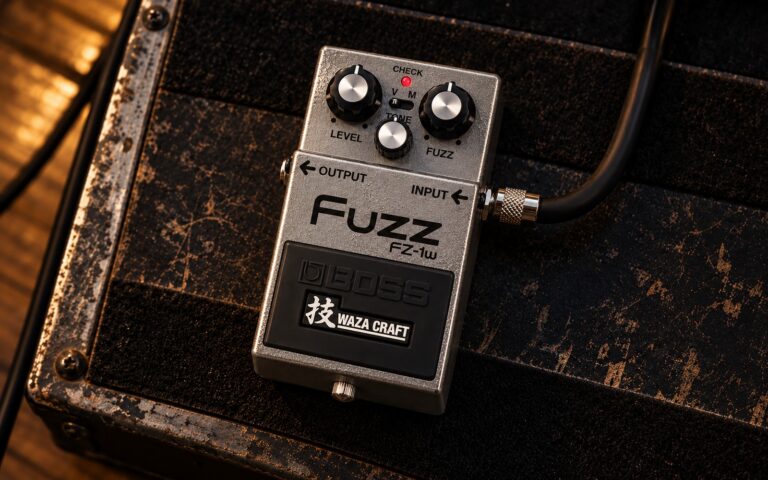
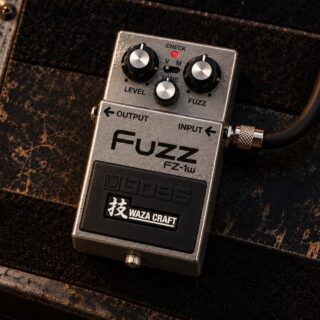
Boss’s Waza Craft FZ-1W offers two carefully modelled vintage voicings with the safety rails welded on. The Carcosa offers a continuous bias sweep and lets you fall off. Choose according to whether you want curation or exploration.
Versus the Hoof and the Acapulco Gold
The EarthQuaker Devices Hoof is a germanium/silicon hybrid Muff variant with a shift control; the Acapulco Gold is a one-knob cranked-Sunn simulator. The Carcosa sits between them in philosophy — more adjustable than the Gold, more aggressive and less Muff-shaped than the Hoof.
Buying Guide
Buy the Carcosa if: you want one fuzz that covers vintage, modern, gated and boost duties; you are working with a small board and a tight power supply; you like pedals whose controls interact and reward experimentation; or you specifically want a silicon fuzz with an accessible bias control that will not run away from you.
Look elsewhere if: you want a two-knob plug-and-play fuzz — MusicRadar’s only stated criticism of the pedal is that “those who like a simple two-knob setup may be perplexed by the knobs when dialling in a sound,” and that is fair. Also look elsewhere if your primary need is a scooped, monolithic Muff wall, or if you play loud through a big clean amp and think you will resent the two-position bass switch.
New or used? Used, if you can find one — but note that this pedal holds its value unusually well for a sub-$150 mass-produced box, and the spread between the cheapest new price and the typical used price is narrow. There are no known revisions, no internal trimpots and no documented reliability problems, so a used unit carries very little risk. Community ratings sit at 4.6 out of 5 across dozens of ratings, which is high for a fuzz — a category where people usually either evangelise or complain.
Watch the availability. The Carcosa has been through a corporate handover (DigiTech and DOD to Cort) and a manufacturing restart. It survived, but pedals in that situation can vanish from distribution regionally for months at a time without ever being formally discontinued. If you see one at a good price and you want one, that is a reasonable moment to act.
Living With One
Where to put it. Early. Fuzz circuits with low input impedance want to see your pickups directly, and while the Carcosa’s 500 kΩ input is friendlier than a vintage Fuzz Face’s, it still sounds most alive first in the chain. If you must put a buffer or wah in front of it, audition the result rather than assuming.
Stacking. The Carcosa’s abundant output makes it a good driver of other dirt. Into a Boss BD-2 or a low-gain overdrive it turns the second pedal into an amp-shaped compressor. Reverse the order and the Carcosa mostly overwhelms whatever came before it. Fuzz first is the usual answer here.
Noise. It is a bright silicon fuzz with a bias control, so yes, it hisses at extreme settings — one owner’s summary is “a little noisy, but come on, it’s a fuzz.” It is not badly behaved by the standards of the category, and Cram’s added power filtering means it is noticeably cleaner on a shared supply than most vintage-derived circuits.
Bass players. Demhe mode’s low-mid boost and the pedal’s overall headroom make the Carcosa a legitimate bass fuzz, and it is used as one. If you play bass and you have been eyeing it, this is not a stretch.
Batteries. At 4 mA, a good alkaline will outlast your interest in the settings. Remember that leaving a cable plugged into the input is what drains it, not playing.
Frequently Asked Questions
What circuit is the DOD Carcosa based on?
The Maestro FZ-1S — the silicon-transistor version of the Fuzz-Tone from the 1970s. Tom Cram added a clipping stage, improved power filtering and, critically, brought the transistor bias out to the front panel as the After control. It is a reimagining rather than a clone.
What do Demhe and Hali actually do?
Demhe (toggle up) boosts bass and low-mids, intended for clean amp channels. Hali (toggle down) cuts bass, intended for already-overdriven amps where a bass-heavy fuzz would turn to mush. Both names come from the geography of Robert W. Chambers’ The King in Yellow.
Is the After knob a tone control?
No. It is a bias control — it changes the operating voltage of the fuzz transistor. Turning it up moves the pedal from warm and dynamic through classic and wall-of-sound voicings into splatty, gated, dying-battery territory. It changes the fuzz’s tonality as a side effect, which is why the Hi-Cut filter usually needs adjusting alongside it.
Can the Carcosa be used as a clean boost?
Yes, and it is genuinely good at it. Set Before and After to zero and turn Output up. There is far more level available than the circuit needs, so you can drive an amp’s front end hard with no fuzz at all. Adding a little After back in gives it an overdrive-like character.
Is it good for doom and stoner metal?
How much power does it draw?
4 mA at 9 V DC, which is exceptionally low. It runs happily on a 9 V alkaline battery or any standard pedal supply, and it will not stress a crowded isolated brick.
Which famous players actually use one?
Photographically documented users include Noel Gallagher (board photo by Daniel Steinhardt, September 2016), Adrian Belew (visible in the film Stompbox: 100 Pedals of the World’s Greatest Guitarists), Mike Moya of Godspeed You! Black Emperor, Ace of Skunk Anansie, Christian Lembach of Whores, Oliver Amberg of Celtic Frost, Kristian Niemann of Therion, Mylets and Twooba. Nine credits across wildly different genres.
Is the artwork a True Detective reference?
No — and DOD have said as much. The pedal and the first season of that show simply drew on the same source, Chambers’ The King in Yellow, which had a general cultural revival in the mid-2010s. The Carcosa’s hooded yellow figure is the King, not Rust Cohle’s antagonist.
Image credits
- Top image: GuitarGangsters AI-generated reference illustration, not a photograph.
- Adrian Belew: Kevin Dooley, Wikimedia Commons, CC BY 2.0.
- Noel Gallagher: Freddyballo, Wikimedia Commons, CC BY-SA 4.0.
- Electro-Harmonix NY Big Muff Pi: Roadside Guitars, Flickr, CC BY-SA 2.0.
- Mike Moya: Martijn van Exel, Wikimedia Commons, CC BY-SA 2.0.
Latest News
Related
On This Day
Monday 9 November
From this week: