EarthQuaker Devices Acapulco Gold: One Giant Knob, One Very Angry Sunn Model T
EarthQuaker Devices Acapulco Gold: one giant knob, a cranked Sunn Model T in a box. History, verified players, tone recipes and buying advice.
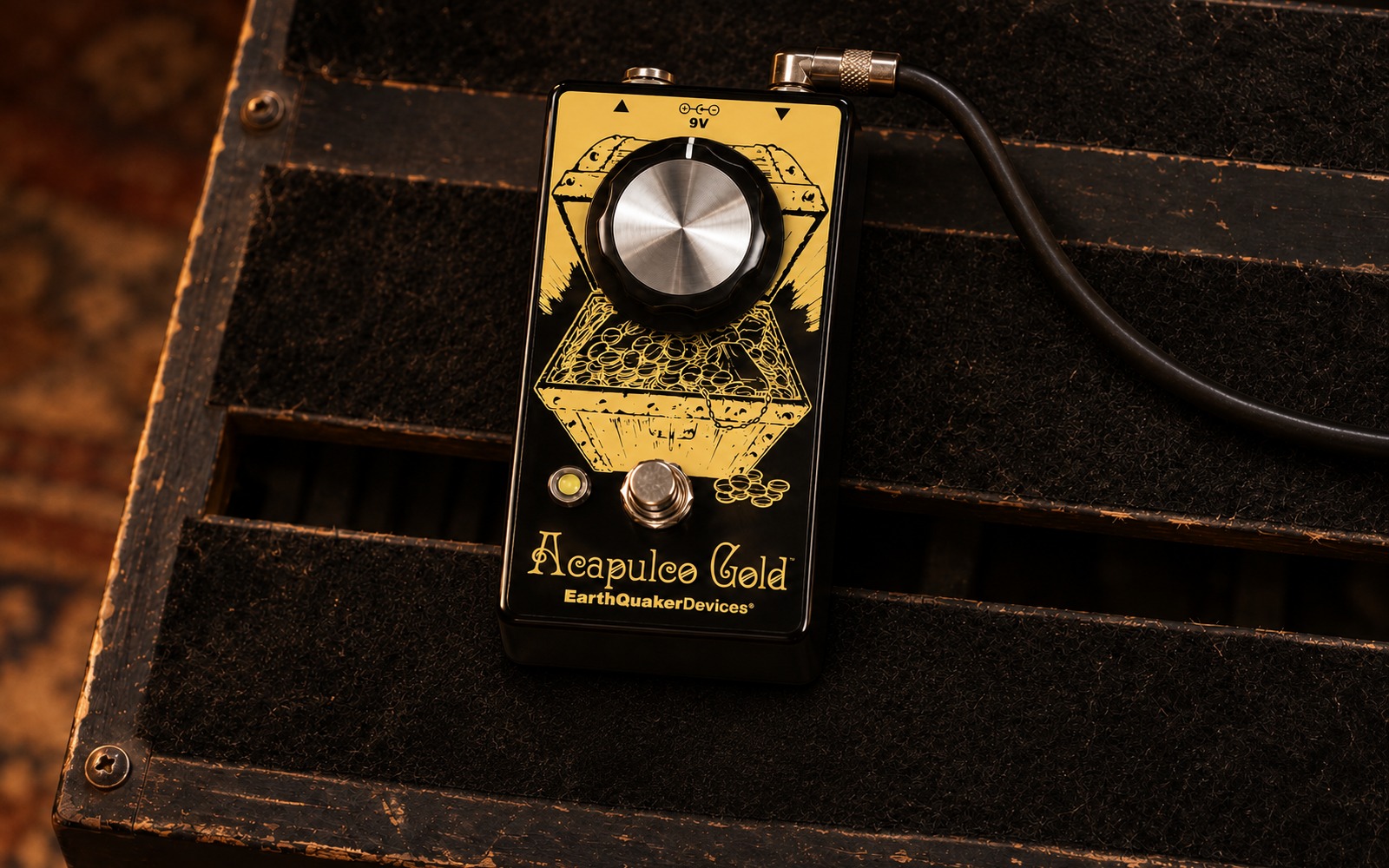
There is a moment, the first time you plug into an Acapulco Gold, when you look down at the pedal and assume something is missing. There is no gain knob. There is no tone knob. There is no toggle, no clipping selector, no internal trimmer under the backplate. There is one enormous chrome-topped dial roughly the diameter of a shot glass, one footswitch, and two unlabelled jacks that EarthQuaker Devices did not even bother to mark as input and output on the earliest units, on the reasonable assumption that anyone buying a one-knob distortion pedal can figure out which end the cable goes in.
Then you play a chord and the missing knobs stop mattering, because they were never missing. They are on your guitar. That is the entire thesis of the Acapulco Gold, and it is the reason a pedal originally built as a short limited run in Akron, Ohio ended up on pedalboards belonging to Sonic Youth, IDLES, Guided by Voices, Cherry Glazerr, Bully, CHVRCHES and Mdou Moctar, and on a Chelsea Wolfe record where it turned out to be the only dirt pedal she needed.
This is a feature, not a review. We are not here to hand out stars. We are here to explain what this pedal actually is, where the sound comes from, who has genuinely used one, and how to get the good stuff out of a device that gives you precisely one thing to turn.
Power Amp Distortion: What EarthQuaker Actually Means By That Phrase
Almost every dirt pedal ever built is a preamp emulator. The Tube Screamer, the Klon, the Bluesbreaker, the DOD 250 — all of them are imitating what happens at the front end of an amplifier, where a small signal gets amplified and clipped by a couple of gain stages before it ever reaches the output section. That is why so many overdrives sound best in front of a clean amp: they are doing the amp’s job for it, one stage earlier.
The Acapulco Gold is chasing a different animal. EarthQuaker calls it a power amp distortion, and the target is not a cranked preamp but a cranked output section — specifically a Sunn Model T with everything buried. That kind of distortion behaves differently. It is looser and more open in the lows, less compressed and less mid-humped than preamp clipping, and it sags and blooms rather than snapping shut. It is the sound of tubes and a transformer being asked to do something they would rather not.
EarthQuaker’s own copy is blunt about the design logic: “Since tone is in the hands, we decided to keep the controls of the Acapulco Gold as simple as possible. The footswitch turns the pedal on and off, and the giant knob controls the output volume. That’s it. The rest is at your fingertips.” Want less gain? Turn down your guitar. Want a darker rhythm sound? Roll back your guitar’s tone. The pedal is designed around the assumption that you already know how to use the controls you have been ignoring for years.
Founder and lead designer Jamie Stillman has been consistent about where this sits in his own taxonomy. In EarthQuaker’s Compendium Distortium primer he draws the line like this: “To me, an overdrive is softer and blends in with the amp more to create a warmer sound. It has more character and doesn’t obliterate the tone.” Distortion, by contrast, “typically uses hard clipping, which squares off the signal more. It delivers more sustain and compression and will produce a heavy tone even if the amp is set to clean.” The Acapulco Gold sits at the far end of that scale, and Stillman is happy to admit the boundary is fuzzy: “there is a really fine line between most overdrive and distortion pedals. Distortion is usually just anything that has higher gain.”
The Amp Behind The Pedal: A Short Sunn Model T History
To understand why anyone would build a pedal with no tone control, you have to understand the amp it is aimed at.
Sunn began as a family problem. The Kingsmen, out of Portland, Oregon, had a hit with “Louie Louie” in 1963 and were suddenly booked into rooms far bigger than their backline could fill. Bassist Norm Sundholm could not be heard, so he turned to his brother Conrad — a high-school physics teacher with a working knowledge of vacuum tubes — and the two of them formally founded Sunn Amplification Equipment in 1965. Sunn’s founding brief, in other words, was not tone. It was loudness, as a solution to a specific logistical emergency.
The Model T arrived in the early 1970s and took that brief to its logical conclusion: a big tube head running 6550 output tubes, quoted around the 150-watt mark, designed to stay clear and enormous behind both guitarists and bassists in large venues. Sunn’s reputation in that first decade was built on sheer output — Pete Townshend and The Who were among the late-’60s acts who leaned on Sunn’s ability to be heard over a room, though Townshend has no connection whatsoever to the pedal we are discussing here.

The Model T’s second life is the one that matters for the Acapulco Gold. In the 1990s and 2000s the amp became the reference point for doom, drone and stoner rock — heavy enough that the band Sunn O))) named themselves after it. That is the cultural weight EarthQuaker was reaching for. The Acapulco Gold is not a pedal that mimics a rare amp for the sake of collectors. It mimics a rare amp that an entire genre had already agreed was the sound.
It is worth noting that EarthQuaker’s current product page describes the pedal as “modeled after the sound of a cranked vintage Model T amplifier” — dropping the Sunn brand name that appeared in the original 2015 launch copy. The circuit did not change when the wording did.
From Limited Run To Permanent Fixture: The Acapulco Gold Timeline
The Acapulco Gold surfaced in September 2015 as a limited release. The launch copy is pure EarthQuaker: “You know what’s awesome? Simplicity. One button, one knob. How loud would you like it? Just move the knob.” And, further down, a line that tells you exactly what the pedal is not: the guitar’s volume control cleans it up “pretty well; not completely, this ain’t your daddy’s Fuzz Face.”
It sold. On 11 January 2016, EarthQuaker announced the reversal: “The Acapulco Gold was originally intended to be a limited release but, due to demand, we have decided to give it a face lift and add it to our permanent line up!” The relaunched version shipped in April 2016 at a $117 MAP. It was demoed at Winter NAMM 2016 alongside the Spatial Delivery, Avalanche Run and Gray Channel.
Guitar World’s Chris Gill reviewed it in February 2016 and gave it a Gold Award, opening with the observation that the dirt market is crowded with variations on a theme and that “the Earthquaker Devices Acapulco Gold comes from an entirely different place and is truly unlike any other distortion device out there.” His description of the knob remains the best sentence written about this pedal: it is “the size of a channel changer on a 1965 Philcomatic color TV.”
The V2 followed as part of EarthQuaker’s line-wide move to relay-based soft-touch switching, replacing the mechanical stomp with a silent, click-free footswitch. That is the headline change; the circuit is the same one-knob power-amp distortion. There is one important behavioural consequence, covered in the ownership section below, and it catches people out.
Specifications
The One Thing The Knob Actually Does
EarthQuaker’s control notes are precise about how the pedal responds to your volume control rather than its own:
- Guitar volume all the way up: the Acapulco Gold “roars like a wide-open Model T on the verge of explosion.”
- Guitar volume just barely backed off: “the Gold becomes a raunchy overdrive.”
- Guitar volume at minimum: “a hazy, Nashville-sounding spank.”
EarthQuaker also flags the trick that most owners eventually discover for themselves: if your guitar has separate volume and tone controls per pickup plus a three-way switch, “this little one-knob banger becomes a three-channel tone monster at the flick of your wrist.” Set the neck pickup’s volume for clean, the bridge for full roar, and the middle position for something in between, and you have a footswitchless channel switcher built out of parts you already own.
And the manufacturer’s own warning, printed in capitals: PLEASE BE CAREFUL, the Acapulco Gold is extremely loud! This is not marketing. Multiple owners report unity gain somewhere between 9:30 and 11:00 on the dial, which means roughly three-quarters of the knob’s travel is dedicated to being louder than your amp expected.
Famous Players: What Holds Up, And What Doesn’t
Most boutique dirt pedals have a thin, recycled artist list assembled from gear databases. The Acapulco Gold is a genuine exception — the roster is broad, well documented, and skews toward the noise-rock, indie and heavy end rather than the usual blues-rock names. Here is what we could actually verify, and how.
Chelsea Wolfe — the strongest connection, and it comes from her own mouth
Wolfe’s 2017 album Hiss Spun was recorded with Kurt Ballou of Converge at his GodCity Studio, and in an interview about the record she credited the Acapulco Gold directly: “Kurt helped guide me on this journey, finding the right amps and pedals. I ended up just using this EarthQuaker [power amp distortion] pedal called Acapulco Gold, though; it weirdly fit on a lot of songs.” That is a first-person quote, tied to a specific record, from an artist whose sound — heavy, low, doomy, sung over guitars that behave more like weather than like riffs — is exactly what this circuit is for. It is also the only album credit currently logged for the pedal in the major gear databases, which tells you something about how under-documented studio pedal use generally is.

The Ballou connection is not incidental. EarthQuaker’s own blog ran a Studio Series feature on GodCity, and Ballou’s production discography — High on Fire, Helms Alee, Torche, Converge — is a fairly precise description of the Acapulco Gold’s natural habitat.
Lee Ranaldo — documented by EarthQuaker themselves
Lee Ranaldo of Sonic Youth was photographed with an Acapulco Gold during a tour of his Hoboken studio, Echo Canyon West, in footage EarthQuaker published on their own channels. That is about as clean a chain of custody as gear verification gets: the manufacturer filmed it in the artist’s own room.

It also makes sense on the merits. Sonic Youth built a career on guitars that sound like large objects being moved, and Ranaldo’s approach — alternate tunings, prepared strings, sustained detuned noise — rewards a pedal that stays open in the low end rather than scooping it out. His bandmate Thurston Moore is a useful reference point for the same aesthetic, though we found no evidence of Moore using this specific pedal and are not going to invent any.
Mark Bowen, IDLES
Bowen has listed the Acapulco Gold among his past and current pedals in interview. IDLES’ guitar sound — abrasive, mid-forward, more about texture and impact than about notes — is a good argument for a pedal with no tone control: when the guitar is functioning as a percussion instrument, tone-shaping is the amp’s job.
Mdou Moctar
The Tuareg guitarist’s Ilana-era touring rig included an Acapulco Gold, visible in live footage from the Star Theater in Portland, Oregon in April 2019. This is the most interesting name on the list, because Moctar plays fast, melodic, single-note lines with enormous sustain — proof that the pedal’s “wall of doom” reputation undersells it. What Moctar gets out of it is the sustain and the compression, not the sludge.
The indie and noise contingent
- Doug Gillard (Guided by Voices) — pedal visible in rig footage.
- Alicia Bognanno (Bully) — photographed on her board, and EarthQuaker’s own blog interview with Bognanno is filed under the Acapulco Gold tag.
- Clementine Creevy (Cherry Glazerr) — visible on her pedalboard in live photography, and mentioned in a 2019 Premier Guitar interview.
- Martin Doherty — an Acapulco Gold sits on his studio pedalboard, documented in his own social post about finishing a studio guitar rig. Note that at least one major gear database files Doherty under the wrong band; he is a member of CHVRCHES, and his own caption references that band’s fourth record.
- Reba Meyers — photographed with a batch of EarthQuaker pedals including the Acapulco Gold. Meyers is the guitarist and co-vocalist of Code Orange; the same database lists her under an unrelated act, which is a good reminder to check the band field, not just the name.
- Natsuko Miyamoto (Mass of the Fermenting Dregs) — discussed the pedal in a post about her current board, where she notes it was a gift.
- Andrew Huang — the pedal appears in his posted rig footage.
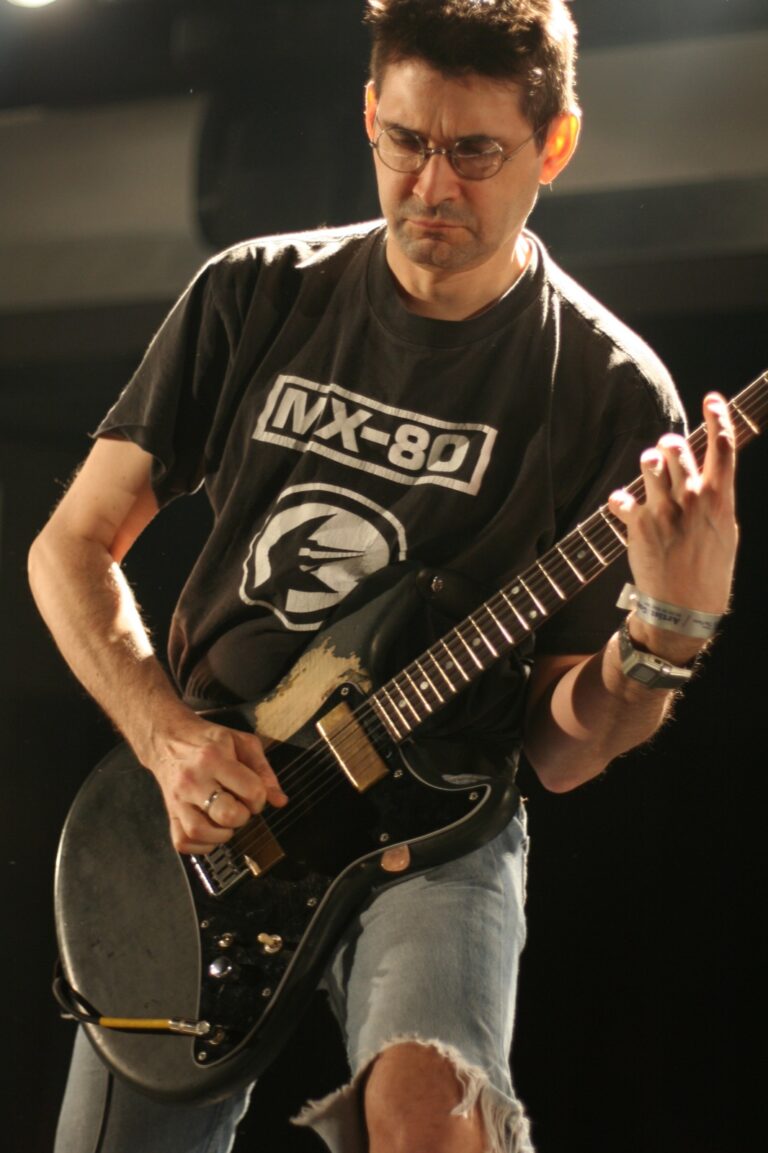
Steve Albini — an honest asterisk
An Acapulco Gold appears in a walkthrough of Electrical Audio, but the sighting is explicitly of studio equipment rather than Albini’s personal rig. We are including it because a pedal earning a slot in the collection at Electrical Audio is a meaningful endorsement of a different kind, but calling Albini “an Acapulco Gold user” would overstate the evidence.
Names you will see attached to this pedal that we could not stand up
EarthQuaker’s own Compendium Distortium primer says that cranking the Acapulco Gold’s knob clockwise puts you “in Tony Iommi territory.” That is the manufacturer’s tonal shorthand for a certain kind of thick, downtuned heaviness — it is not a claim that Iommi uses the pedal, and we have found nothing to suggest he does. Similarly, the pedal’s association with Sunn O))) is an association with the amplifier, not with the band’s actual signal chain; EarthQuaker did later collaborate with Sunn O))) on separate, entirely different pedals, but the Acapulco Gold is not one of them and does not share a circuit with them.
If a list tells you Matt Pike, Stephen O’Malley or Josh Homme are Acapulco Gold players, ask it for a photo. We could not find one.
Tone Recipes: Eight Ways To Use A Pedal With One Knob
1. The Default: Wide-Open Model T
Pedal: 1:00. Guitar volume: 10. Guitar tone: 10. Amp: clean, bass at noon, mids at noon, treble slightly down.
This is the sound on the box — enormous, open, sustaining, with the low end intact. Bridge humbucker for weight, and be ready for the volume jump. Owners report that anything past 1:00 can literally vibrate the pedal off the top of an amp cabinet.
2. Raunchy Overdrive
Pedal: 11:00. Guitar volume: 7–8. Guitar tone: 8.
EarthQuaker’s “just-barely-backed-off” setting. The compression relaxes, the note attack comes back, and chords start to separate. This is the always-on rhythm sound that a lot of owners build a small board around.
3. Nashville Spank
Pedal: noon. Guitar volume: 3–4. Guitar tone: 10. Single-coil bridge pickup.
The manufacturer’s own description of the low-guitar-volume setting, and it is real: hazy, spiky, slightly broken country-into-garage territory. Nobody buys this pedal for this sound, and it is one of the best things it does.
4. Three-Channel Wrist Switching
Pedal: 1:00. Neck volume: 4. Bridge volume: 10. Selector: your right hand.
On a Les Paul-style guitar with independent volume controls, the pickup selector becomes a three-way channel switch: clean-ish neck, roaring bridge, hybrid middle. EarthQuaker suggest this themselves and it is genuinely the most useful thing in the manual.
5. Doom / Stoner Wall
Pedal: 3:00. Guitar: everything on 10, tuned down. Amp: clean channel, bass up, mids at noon, treble down.
Owners consistently name 3:00 as the aggressive setting for hitting the amp hard, and the pedal’s ability to retain low frequencies without a clean blend is what makes this work where a mid-scooped fuzz would collapse. Stack it with a Ram’s Head Big Muff and you are, in one owner’s phrase, firmly in Dopesmoker territory.
6. Boosted Lead
Pedal: noon. In front of it: an EarthQuaker Plumes set as a light mid-hump boost, gain low, level high.
The Plumes tightens the low end and pushes the mids that the Acapulco Gold deliberately leaves flat. Owners who have run this stack report preferring it to RAT-style pedals for heavier gain and low-end weight. This is the closest the pedal gets to a conventional lead voice.
7. Fuzz Stack
Pedal: 11:00, second in the chain. Before it: a Fuzz Face-style germanium fuzz, both knobs up.
The Acapulco Gold is unusually good at stacking with fuzz without turning to mush, because it is not adding a second mid-scoop on top of the first. Articulation survives. Watch your output level.
8. Effects Loop Trick
Pedal: 10:00, placed in the amp’s effects loop rather than the front end.
A minority technique that shows up repeatedly in owner discussion: running the Acapulco Gold in the loop gives a less “trembly,” more controlled result than slamming a clean channel’s input. Worth trying if the pedal sounds unstable in your rig. It also, appropriately, puts a power-amp distortion closer to the actual power amp.
The trick to writing settings for the Acapulco Gold is that the settings mostly are not on the pedal. Each recipe below specifies the pedal knob, the guitar’s controls, and what the amp should be doing — because on this circuit, all three are part of the same instrument.
How It Compares
Versus the Big Muff family
The most common shorthand is that the Acapulco Gold is “a Muff with mids,” and that is roughly right. Where the Big Muff Pi scoops the midrange as a design feature — which is why Muffs famously vanish in a band mix — the Acapulco Gold passes the full frequency spectrum, keeping the mids that let a guitar sit in front of a bass player. Owners describe it as covering similar ground to a tone-bypassed Muff at mid gain, but with noticeably less compression.
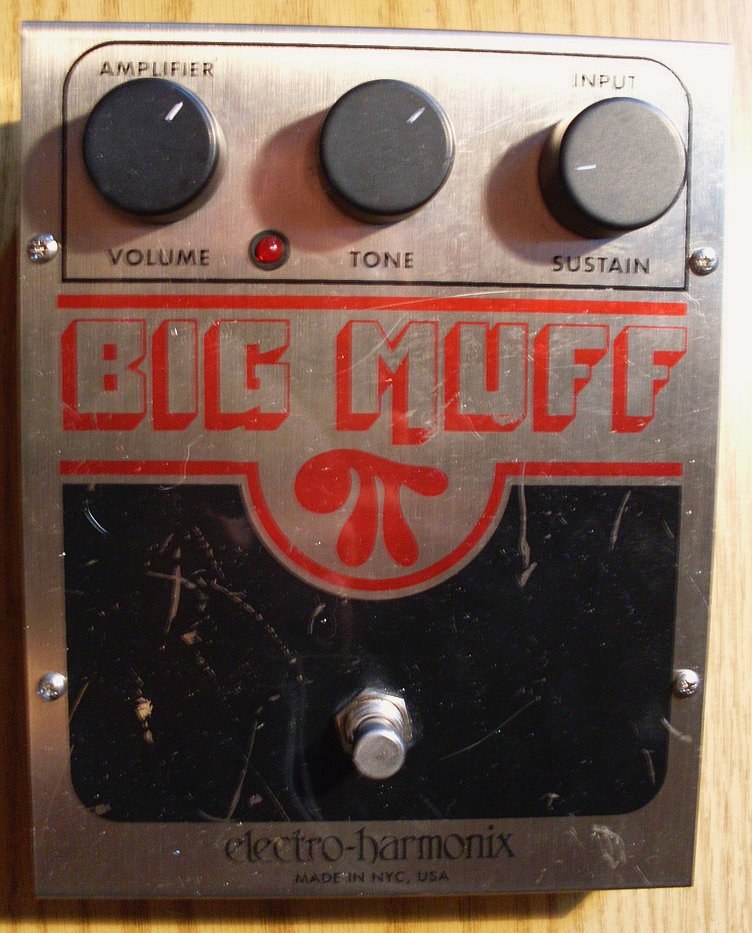
Against the Green Russian specifically, the Acapulco Gold is looser, less woolly and less obviously “circuit-shaped”; against the Triangle it trades the vintage sparkle for sheer output. And unlike any Muff, it gives you no tone control at all, which is either the point or a deal-breaker depending on temperament.
Versus the RAT
The Pro Co RAT 2 is the other great “one pedal that does a lot” distortion, and it is the more sensible purchase. The RAT has a filter control, cleans up more predictably, and works at sane volumes. The Acapulco Gold has more low end, more output, more sustain and less discipline. Players who have compared them directly for heavy material tend to prefer the Gold’s weight; players who need one dirt pedal for a covers gig should buy the RAT.
Versus the EarthQuaker Hoof
Within EarthQuaker’s own line, the Hoof Fuzz is the obvious sibling comparison and the two are genuinely different tools. The Hoof is a hybrid germanium/silicon Muff derivative with fuzz, tone, level and — crucially — a Shift control that sweeps the midrange from scooped to boosted. It is the versatile one. The Acapulco Gold is the committed one: no shaping, no compromise, more output, and a fundamentally different clipping character because it is emulating an output stage rather than a fuzz circuit. If you can only have one EarthQuaker dirt box and you play in a band, the Hoof is the safer answer. If you want the specific sound of an amp about to fail, this is it.
Versus the Plumes and the rest of the EQD dirt line
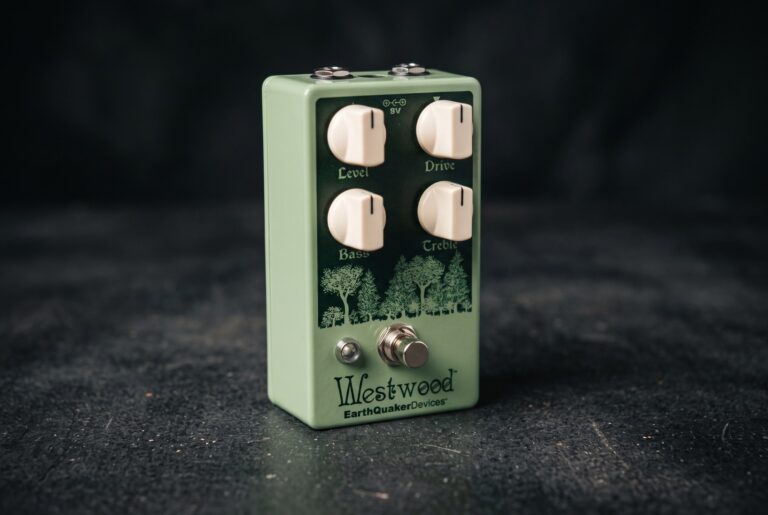
EarthQuaker’s Compendium Distortium frames its own overdrive and distortion range clearly: the Westwood is the low-to-medium-gain amp-breakup pedal, the Plumes is the tight, mid-forward, budget-friendly workhorse, the Palisades is the multi-voiced Tube Screamer laboratory with roughly 500 possible configurations, and the Acapulco Gold is the one where “pedal make amp sound mean!” Stillman’s own board, for the record, runs the Plumes and the discontinued Speaker Cranker — not the Acapulco Gold, which is a refreshingly honest thing for a company to publish.
Versus a real Sunn Model T
A vintage Model T costs several thousand dollars, weighs what a small motorcycle weighs, needs a tech on retainer, and cannot be turned down to a level that any modern venue will tolerate. The Acapulco Gold costs a bit over a hundred, weighs nothing, and gets close enough that a lot of people who own both keep the pedal on the board for travel. It is not the amp. It does not have the amp’s power-supply sag, its speaker interaction or its physical air movement. It captures the harmonic character and the attitude.
Versus mainstream distortion boxes
Against the Boss DS-1, the MXR Super Badass or the Metal Muff, the comparison barely works. Those are shaped, EQ-equipped, gig-flexible distortions designed to give you a usable sound in any room. The Acapulco Gold is a character pedal. It is closer in spirit to the Boss HM-2 — another pedal defined by one extreme setting and a genre that grew around it — than to any general-purpose distortion. And if what you actually want is modern high-gain precision, the honest answer is that you want an amp like the Revv Generator 120 MkIII, not this.
Buying Guide
V1 or V2?
V1 (2015–2016 limited run, then the 2016 permanent-line version) uses a mechanical true-bypass footswitch. It clicks. Some people like that, because a mechanical switch will pass signal even with no power supply attached.
V2 (current) uses EarthQuaker’s relay-based soft-touch switching. It is silent, requires far less force underfoot, and is built to outlast a mechanical switch. The trade-off is stated plainly by the manufacturer: audio will not pass without power. If your power supply dies mid-set, a V2 does not fall back to bypass — it falls silent. Plan accordingly.
The circuit is the same. Buy on price and switch preference, not on tone mythology. As of September 2026 the V2 lists at $139 and is routinely discounted to around $118, which is remarkable stability for a pedal that launched at a $117 MAP a decade ago.
Who should buy one
- Anyone playing doom, sludge, stoner rock, noise rock, shoegaze or heavy psych.
- Players who already use their guitar’s volume knob as a gain control, or who want to learn to.
- Anyone building a deliberately small board around one always-on dirt sound.
- Bassists — the pedal retains low frequencies unusually well for a dirt box with no clean blend, though some owners find it thins certain bass tones, so try before you commit.
- Studio users who want one pedal that immediately sounds like a big amp in a small room.
Who should skip it
- Anyone who needs a tone control. There isn’t one, and no amount of technique substitutes for it.
- Players who need one dirt pedal to cover clean boost through lead. It is, in the words of one owner review, a “one trick pony with one great trick.”
- Anyone playing thrash, djent or modern metal that needs tight, fast, scooped precision — the Acapulco Gold is too loose and too open.
- Anyone with an amp they do not like. This pedal is unusually dependent on what it is plugged into; it amplifies the amp’s character rather than replacing it.
- Bedroom players with volume constraints and no attenuator. The useful range starts loud.
Living With It: Ownership Notes
It is louder than you think. Unity gain lands somewhere between 9:30 and 11:00 depending on the individual unit, which means most of the knob is boost. Set your amp with the pedal engaged, not bypassed, or you will spend the first song backing everything off.

It will physically move. Owners report that above roughly 1:00, sympathetic vibration can shake the pedal off the top of an amplifier. Put it on a board and secure it.
The minimum setting is not useful. Fully counter-clockwise produces no sound at all. Near-minimum is thin and unpleasant. This is a pedal with a working range, not a sweep.
The V2 needs power to pass signal. Repeated because it matters: no power, no audio. Carry a spare cable.
Do not run it at 18V. EarthQuaker’s documentation is explicit and capitalised about this. Use a 9V, centre-negative, isolated supply — at 18 mA it is undemanding, but it will pass through any ripple or noise your daisy chain contributes.
Place it thoughtfully. Front of the chain into a clean amp is the default. Into an already-dirty amp it becomes a wall. In the effects loop it becomes more controlled. If you want to shape what comes out of it, put a graphic EQ after it — that is the standard fix for the missing tone control, and it works better than fighting the amp.
Small amps are not automatically a bad idea. A low-wattage combo like a Fender Pro Junior IV hit with an Acapulco Gold gets you a very large sound at a survivable volume; a clean, headroom-rich head such as a Hiwatt Custom 50 lets the pedal’s character come through undiluted. Both work, differently.
Frequently Asked Questions
Is the Acapulco Gold a fuzz or a distortion?
EarthQuaker classify it as a distortion, and technically it is a power-amp distortion emulation rather than a fuzz circuit. In practice it lands in between: Guitar World’s reviewer said it “sounds a lot like fuzz Jim, but not as we know it,” and owners frequently describe it as the middle ground between fuzz and distortion. It has fuzz-like sustain and thickness without a fuzz’s sputter or raspiness.
Why doesn’t it have a tone knob?
Because your guitar has one. That is not a joke — it is the design philosophy. EarthQuaker deliberately moved the gain and tone controls onto the instrument, on the reasoning that a player’s hands and knobs produce more musical variation than a fixed tone stack. If you want post-pedal shaping, use an EQ pedal or the amp.
What is the actual amp it copies?
A cranked Sunn Model T, the early-1970s Sunn tube head that became the standard reference amp for doom and stoner rock. EarthQuaker’s current product copy drops the brand name and says “vintage Model T amplifier,” but the target is unchanged.
Does it clean up with the guitar’s volume knob?
Yes, but partially — and EarthQuaker say so themselves: it cleans up “pretty well; not completely, this ain’t your daddy’s Fuzz Face.” Expect to go from roaring to raunchy overdrive to hazy and spanky, not to genuinely clean.
Will it work for bass?
Often, yes. The Acapulco Gold retains low frequencies better than most dirt pedals that lack a clean blend, and EarthQuaker have historically argued against dividing pedals into “guitar” and “bass” categories at all. Some owners do report it thinning certain bass tones, so it depends on your instrument and rig. Try it before you commit.
What’s the difference between the V1 and V2?
Switching. V1 has a mechanical true-bypass footswitch; V2 has silent relay-based soft-touch switching that requires power to pass audio. The distortion circuit is the same.
Can I use it at bedroom volume?
With difficulty. Unity gain is around 10 o’clock and the pedal is designed to hit an amp hard. It works better than you might expect into a small low-wattage combo, but if quiet practice is your main use case, this is the wrong pedal.
Does it stack well with other pedals?
Very well, and unusually so. Because it does not scoop the mids, it stacks with fuzz without losing articulation, and it takes a boost or a mid-forward overdrive in front of it cleanly. Owners commonly run a Plumes or similar into it for leads, and pair it with a Muff for maximum weight. Modulation and ambience after it work fine — a reverb and a delay are the two most common companions on boards that include one.
Is it worth buying in 2026?
If you want what it does, yes — and unusually, the price has barely moved in a decade. It launched at a $117 MAP in 2016 and sits around $118–139 today, which in real terms makes it cheaper now than at launch. It remains one of very few pedals doing power-amp distortion rather than preamp emulation, and nothing else on the market offers this specific combination of simplicity and character.
The Verdict That Isn’t A Verdict
The Acapulco Gold was supposed to be a limited run. It is still in the catalogue a decade later, unchanged apart from a footswitch, at essentially the same price, having quietly turned up on records and boards belonging to Sonic Youth, IDLES, Cherry Glazerr, Guided by Voices, CHVRCHES, Code Orange, Bully and Chelsea Wolfe, and on a stage in Portland underneath one of the fastest guitar players alive.
That is not what happens to gimmick pedals. It is what happens when a company builds one thing extremely well and refuses to add knobs to it. EarthQuaker’s own designer does not even keep one on his board, and says so publicly — which somehow makes the whole thing more convincing, not less. The Acapulco Gold does not want to be your only pedal. It wants to be the one you turn on when the song needs to get bigger than the room.
Image credits
- Top image: GuitarGangsters AI-generated reference illustration, not a photograph.
- Lee Ranaldo: Guido van Nispen, Wikimedia Commons, CC BY 2.0.
- Lee Ranaldo: Bertrand, Wikimedia Commons, CC BY 2.0.
- Lee Ranaldo: DSCF4708-Edit by Guido van Nispen, Wikimedia Commons, CC BY 2.0.
- Electro-Harmonix NY Big Muff Pi: Roadside Guitars, Flickr, CC BY-SA 2.0.
- Chelsea Wolfe: Henry W. Laurisch, Wikimedia Commons, CC BY 2.5.
- Steve Albini: Original uploader was Freekorps at en.wikipedia, Wikimedia Commons, CC BY 3.0.
Latest News
Related
On This Day
Monday 9 November
From this week: