The 6505+ Head: Same Bloodline, Better Channels — Peavey’s Smartest High-Gain Head
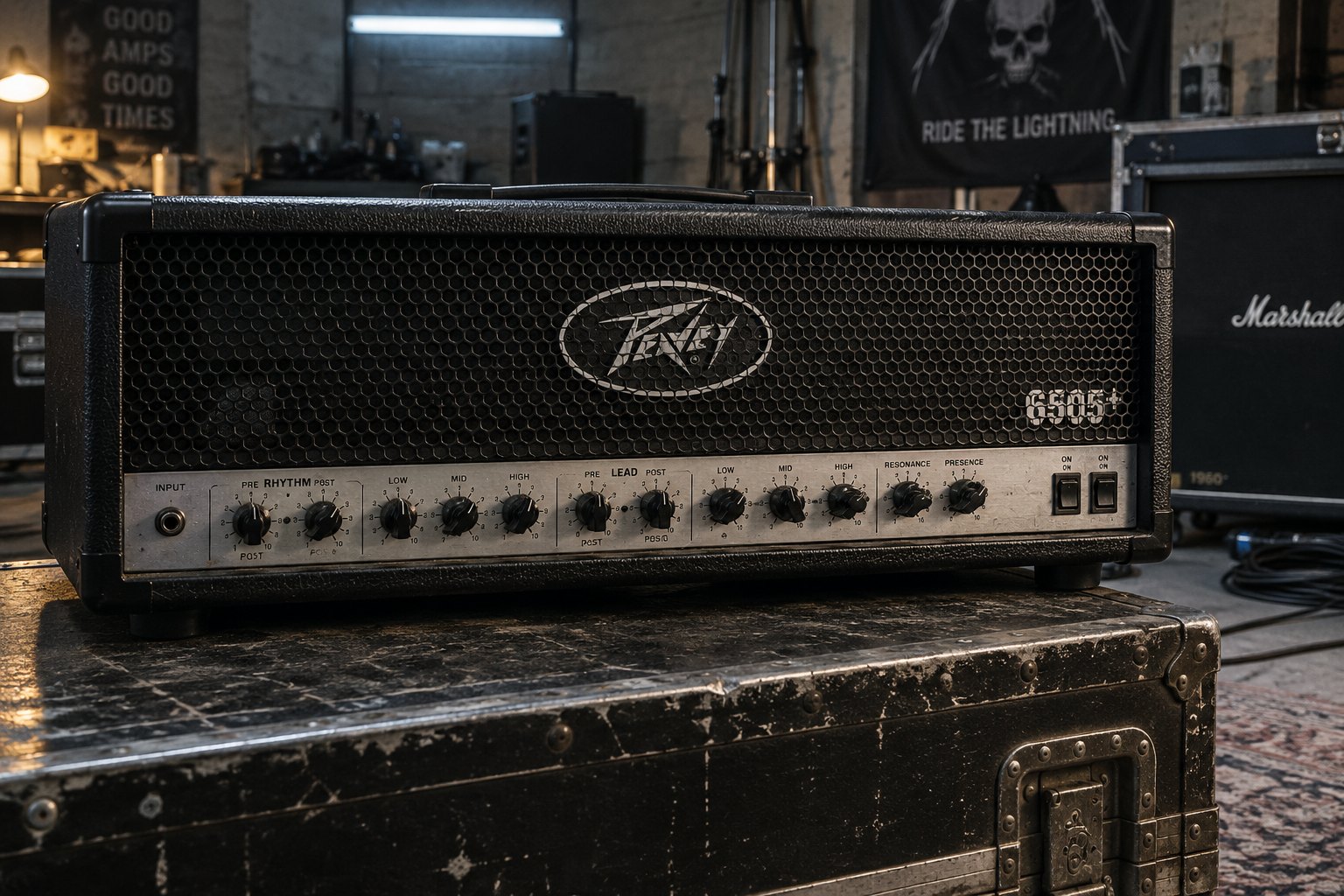
Peavey 6505+ Head. AI-generated reference illustration, not a photograph.
The Peavey 6505+ (renamed 5150 II) has per-channel EQ, six 12AX7s and 120W of 6L6GC power. Verified players, tone recipes, and a used-market buying guide.
In the summer of 2005, Peavey Electronics faced a naming crisis. Eddie Van Halen had left the building — actually left the company, taking the “5150” trademark with him as part of a legal settlement that would eventually birth the EVH 5150 III under Fender’s umbrella. Peavey had two extraordinary amplifiers with names they could no longer use. Their solution was both pragmatic and retrospective: they would celebrate their own first 40 years in business, 1965 to 2005. The original 5150 became the 6505. The 5150 II became the 6505+. The “+” was not decoration. It marked a real architectural upgrade, the reason those two models got two separate names rather than one name with two variants.
The Peavey 6505+ is the amp that Periphery’s entire guitarist trio — Misha Mansoor, Jake Bowen and Mark Holcomb — trusted as their power amp section when they were running Fractal Audio Axe-Fx II processors on stage. Think about what that means. Three of the technically sharpest guitarists in modern progressive metal, each with access to any amp on earth, each running boutique digital preamps capable of modelling everything from a ’59 Bassman to an EVH 5150 III — and they bypassed all of those preamp models and fed their digital output directly into the power section of a $1,699 Peavey. The 6505+ power amp was that good. The output transformer, the four 6L6GC tubes, the bias, the feel: the hardware that turns signal into sound, not the hardware that makes the signal dirty in the first place.
That context makes the 6505+ a more interesting amp than its reputation as a simple “metal head” would suggest. Yes, it is a high-gain monster. Yes, its Lead channel can generate enough saturation to detune the air. But it is also a finely engineered piece of valve circuitry that professional guitarists chose for the quality of its power stage even when they were not using its preamp at all. That is not the story you typically hear. This is the full story.
The Family Tree: 5150, 5150 II, 6505, 6505+
In 1992, Eddie Van Halen and Peavey engineer James Brown collaborated on an amplifier head built around a novel concept: pile on the preamp gain stages to approximate the harmonic compression and “brown sound” sag you would get from a cranked Marshall with EL34 power tubes, even when the power amp section was running the American-voiced 6L6GC tubes that EVH preferred. The result was the 5150 — five 12AX7 preamp tubes, four 6L6GC power tubes, 120 watts, two channels sharing a single three-band EQ. It defined modern high-gain tone and set the template for virtually every metal amp that followed.
By 1999, Van Halen and Peavey revisited the design. The refinements for the 5150 II were substantive: a sixth 12AX7 was added to the preamp chain; the two channels were given completely independent three-band EQ sections plus their own resonance and presence controls; and the clean performance of the Rhythm channel was significantly improved. The shared-EQ single-channel architecture of the original 5150 was the loudest engineering complaint working players had raised. The 5150 II answered it. Rhythm and Lead now lived in genuinely separate tonal spaces you could dial independently, then recall instantly by foot.
When EVH left and the names changed in 2005, the relationship between the amps was preserved in the model numbers: the simple 6505 is the original architecture (shared EQ, five preamp tubes); the 6505+ is the evolved architecture (independent EQ per channel, six preamp tubes). The + sign means exactly what it says. In 2023, Peavey updated the line again: the 6505 II replaced the 6505+, with the same per-channel independent EQ architecture but new transformers wound to match the character of the most sought-after original 5150 units. The 6505+ itself is now discontinued, which makes the used market the territory for buyers — and for anyone who has been hunting for one, the used prices are fair.
Specifications
The exterior aesthetic has not changed in thirty-odd years: a rack of chicken-head knobs on a punched steel faceplate, LED indicators for each channel and the FX loop, a simple row of inputs and controls that reads left to right without ambiguity. It is not beautiful in the boutique sense but it looks exactly like what it is — a working tool built to be toured. The rear panel’s bias terminals are a practical feature often overlooked: when the 6L6GC power tubes eventually need replacement (expect 18 to 36 months of regular use, less with heavy gigging), you can rebias the amp with a multimeter and a screwdriver rather than shipping it to a tech.
The Critical Difference: Why the + Matters
The most common confusion in the 6505 family is treating the 6505 and 6505+ as the same amp in different trims. They share the same DNA but the architectural difference is significant in practice, not just on paper. With the original 6505, both channels share a single Bass/Mid/Treble EQ stack. If you dial in a crunchy rhythm tone with the mids scooped and the bass punchy, your lead tone inherits those same settings — your only lever for changing character between channels is the gain and presence controls. Players who need a genuinely different sonic identity for clean versus dirty passages find themselves compromising: either the rhythm tone is wrong or the lead tone is wrong.
The 6505+ solves this completely. Each channel has its own three-band EQ, its own presence and resonance controls, and its own pre/post gain pair. You can set the Rhythm channel as a full, warm platform with modest scooping and then program the Lead channel with a pushed midrange and a tighter resonance for clarity in the low end during solos. Recalling either by foot gives you two genuinely different guitars’ worth of tone from the same instrument. The sixth preamp tube adds gain headroom — you reach saturation earlier, the ceiling is higher — but the real upgrade is the channel independence, not the extra glass.
MusicRadar’s Simon Bradley, reviewing the 6505+ for Guitarist magazine in September 2009, identified this trade-off accurately: the power is extraordinary, the walls of gain available from the Lead channel are “brutal,” but getting a clean tone and a filthy crunch simultaneously requires patience. “Hard to get all the tones you need at once” was his stated limitation, and it is an honest one. The 6505+ is not a pristine clean amp with a dirty channel added as an afterthought. The Rhythm channel at pre-gain positions past four starts to break up. Using the bright switch helps projection in clean settings but makes crunch tones excessively toppy. This is not a criticism so much as a fact about the design brief: this amp was built to be the most aggressive high-gain head of its era, and within that brief it succeeds emphatically.
Famous Players
The Peavey 5150 family as a whole accumulated an enormous roster of users across three decades, and the 6505/6505+ generation inherited those associations. Sorting genuine 6505+ connections from generic “5150-family” conflations requires the same per-SKU discipline applied throughout this series.
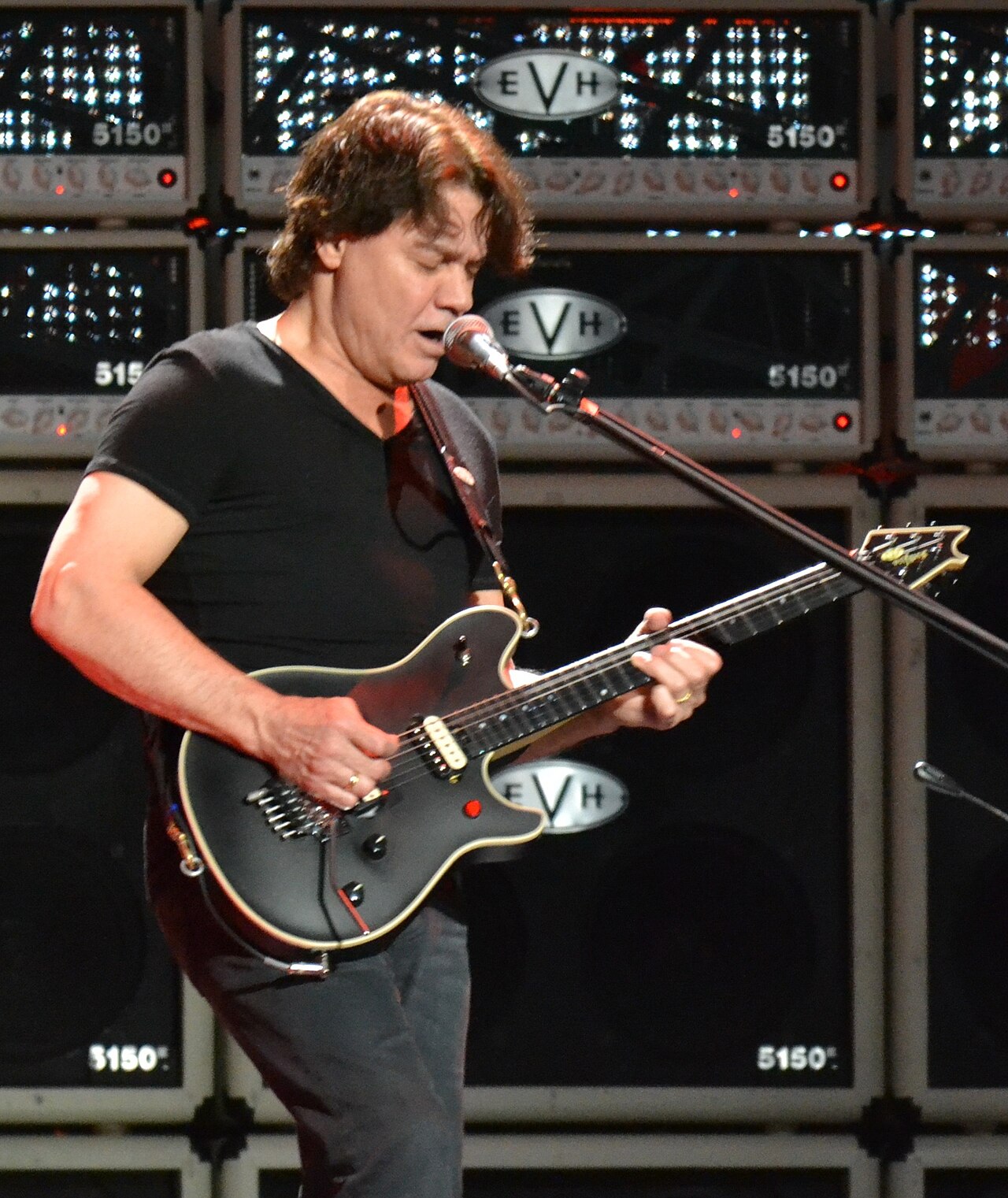
Eddie Van Halen is the father of this circuit. He designed both the 5150 and 5150 II with Peavey engineer James Brown and used the 5150/5150 II as his primary live and studio amp throughout the 1990s and into the early 2000s. But the name “6505+” did not exist during his time at Peavey. He was gone before the rename. Crediting EVH as a 6505+ user is a category error — he designed the circuit; he never endorsed or played a head with that name on the faceplate. The accurate framing: the 6505+ is the 5150 II in a different shirt, and EVH played the original.
Misha Mansoor, Mark Holcomb and Jake Bowen of Periphery are the cleanest per-SKU 6505+ story in this amp’s history. In documented live performance footage (YouTube, referenced on Equipboard), all three guitarists simultaneously ran Fractal Audio Axe-Fx II processors through Peavey 6505+ heads used exclusively as power amplifiers — plugged into the effects return, bypassing the preamp entirely. The choice was deliberate. Misha Mansoor later described the experience of building his signature Peavey Invective amplifier as starting from his vintage 6505 as a reference point: the early units he owned sounded different from newer production runs, and the Invective project was partly an attempt to codify what made those older transformers and components special. The Periphery connection with the 6505+ is not about the Lead channel’s gain; it is a professional endorsement of the power amp’s character.
Robb Flynn of Machine Head has been associated with the 5150 family since Machine Head’s debut record, Burn My Eyes, in 1994. Peavey’s own platform confirms Flynn’s connection to the 6505+ line specifically. Flynn is one of the few players who can credibly claim to have been with the circuit through its entire commercial life — from 5150 through 5150 II through 6505+ — and who has spoken publicly about what those amps meant to him at each stage. The association is real, consistent and primary-source documented.
Matt Heafy and Corey Beaulieu of Trivium appear on Equipboard’s 6505+ roster. Heafy has stated publicly that Trivium’s sound through multiple eras has been built on “5150-style amps” — Peavey 5150, EVH 5150 III, and Peavey 6505 — with Beaulieu’s 2010 rig diagram confirming 6505 use. The 6505+ specifically versus the base 6505 is less consistently pinned in primary sources for Trivium; the Equipboard listing reflects community evidence that has not been contradicted.
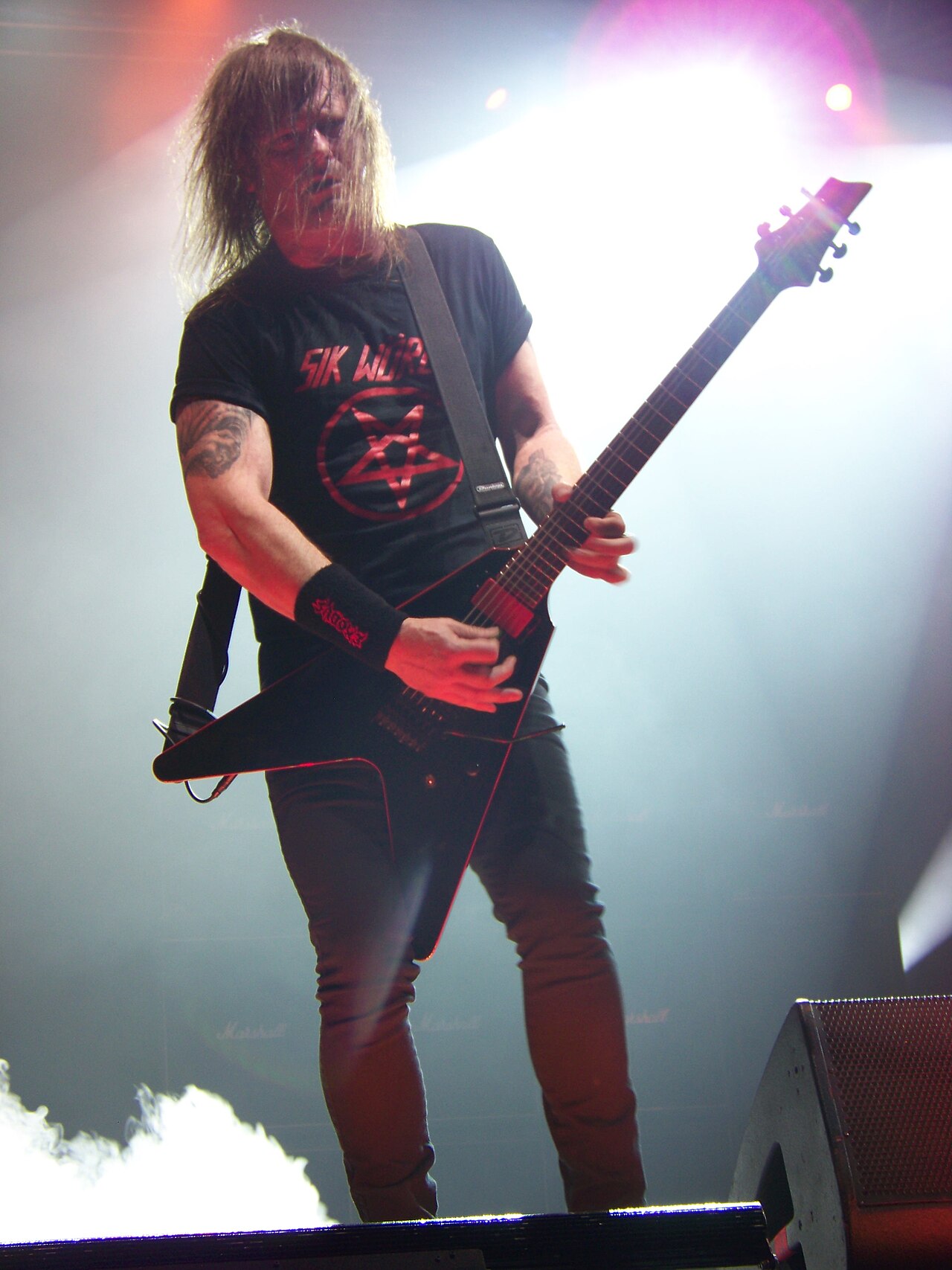
Gary Holt of Exodus — and, during the 2010s, a live touring member of Slayer following Jeff Hanneman’s illness — appears in Equipboard’s 6505+ artist list. Holt’s association with the 5150 family as a studio and touring tool is well documented in the metal press. The specificity to the 6505+ rather than the base 6505 is consistent with the timeline of Slayer’s touring years during Holt’s tenure.
Max Cavalera used a Peavey 6505+ head in the Cavalera Conspiracy rig photographed and documented in 2014, with the source being the band’s own documentation at gloriacavalera.com. This is a photo-level confirmation of the specific head in active use.
Joe Satriani appears in Equipboard’s 6505+ list. Satriani’s primary Peavey association is the JSX signature amplifier developed with the company during the 2000s. His early adoption of the 5150 head in the 1990s is documented; whether subsequent 6505-family use extended to the 6505+ specifically is less clearly pinned in primary sources. Stated honestly: the connection exists at the brand-and-family level, with the JSX as his signature platform.
Ted Nugent has explicitly stated in interview that he uses Peavey 6505 heads onstage, and has been listed on both the 6505 and 6505+ Equipboard pages. Like Flynn, his 5150-family association predates the rename, and he remained a consistent Peavey user through the 6505 era.
Tone Recipes and Settings
The Signature Wall: Modern Metal Rhythm
Lead channel. Pre Gain: 7. Post Gain: 4.5. Bass: 6, Mid: 5.5, Treble: 6. Resonance: 7. Presence: 5.5. This is the setting MusicRadar’s reviewer identified as the sweet spot for the 6505+’s most celebrated sound — a “huge metal rhythm crunch” with “sheer depth, aggressive overdrive and brutal tone in a single package.” The resonance at 7 is the key lever: it adds low-end authority without muddying the attack. Running it past 8 starts to obscure note definition; below 5 you lose the amp’s most distinctive quality. Pair this with a humbucker-equipped guitar with a bolt-on maple neck and you are in the center of the 6505+’s design intent.
Djent Platform: Tight Modern Metal
Lead channel used as power amp stage (via FX return) OR: Pre Gain 5.5, Post Gain 4, Bass 5, Mid 6.5, Treble 5.5, Resonance 5, Presence 6. With a Tube Screamer (TS-9 or TS-808) in front — Gain at minimum, Volume at maximum, Tone at noon — the 6505+ Lead channel becomes the foundational djent/progressive metal tone. The overdrive pedal tightens the input, focuses the low-mid response, and adds definition to palm mutes. Gate the input before the amp and the FX loop after. Periphery used a variation of this approach. The 6505+ power section at this gain setting produces a tight, fast transient response that many digital modellers are still chasing.
Lead Tones: The Crunch Channel Trick
The 6505+’s Lead channel can become too dense for solos at high gain settings — a wall of saturation is magnificent as a rhythm platform but reduces pitch definition for melodic lead work. MusicRadar’s reviewer documented an effective workaround: the Crunch channel with Pre Gain fully open delivers a tighter, more articulate lead sound than the Lead channel at equivalent gain. Rhythm channel, Crunch engaged, Pre Gain: 10, Post Gain: 4.5, Bass: 5.5, Mid: 7, Treble: 6, Resonance: 5, Presence: 6.5. Brighter, more forward, better string separation for solos without the density of the Lead channel at full tilt.
Hard Rock Rhythm: Semi-Clean Foundation
Rhythm channel, Crunch off, Bright on. Pre Gain: 3.5, Post Gain: 5, Bass: 6, Mid: 5.5, Treble: 6, Resonance: 5, Presence: 5.5. The Bright switch improves cut and feel in clean settings at the cost of making the crunch tones overly toppy — keep it for clean passages only. Roll back the guitar’s volume pot to 7 or 8 for cleaner headroom; return to 10 for crunch. This is the 6505+’s most versatile clean-to-crunch range, though getting a genuinely clean sound at anything past Pre Gain 4 requires restraint.
Power Amp Platform: Digital Preamp Direct
For Axe-Fx II, Kemper, Quad Cortex, or any modeller with a power amp output: plug into the rear-panel effects return (bypassing the preamp entirely). Run the 6505+’s Post Gain of whichever channel you’ve selected at 4 to 5 — this is now your master volume, not a gain stage. The 4× 6L6GC power section and output transformer add organic sag, harmonic texture and pick-dynamics response that most digital power-amp simulations do not fully capture. This is the mode Misha Mansoor, Jake Bowen and Mark Holcomb used on tour. The 6505+ is a legitimate studio and live tool for a hybrid rig even if you never touch its preamp.
Thrash Rhythm: Classic Bay Area
Lead channel. Pre Gain 6, Post Gain 4, Bass 7, Mid 5, Treble 6, Resonance 6, Presence 5.5. Reduce the mid relative to recipe one and push the bass — you trade some of the articulate modern metal clarity for the more scooped aggressive low-mid push associated with Bay Area thrash. Gary Holt’s documented preference for the 5150 family as a thrash-era workhorse points directly here: enough gain for tight downstroke riffing, enough low-end weight to sit against a heavy bass register, presence kept in check so the highs don’t become shrill in a live room.
The 6505+ repays careful attention to gain staging. The following settings are documented starting points; your specific cabinet, speaker, and guitar will shift them, often meaningfully.
How the 6505+ Sits in the Family
The logical comparisons for the 6505+ are its own family members and its direct commercial rivals.
Against the Peavey 6505 Head, the “+” distinction is the most important buying question. The base 6505 has five 12AX7 preamp tubes and one shared EQ section covering both channels. It has a slightly heavier low-mid character — community A/B comparisons consistently describe it as “bigger,” “more bottom-heavy” and “more raw.” If you play a single-channel style, using the gain knob as your clean-dirty switch and never really needing two differentiated sounds, the 6505 is the simpler tool. If you genuinely need a clean-ish rhythm tone and a different lead tone stored in memory and recalled by foot, the 6505+ is clearly the right choice.
Against the Peavey 5150 II, the 6505+ is identical in circuit and architecture. Same tubes, same topology, same controls. The difference is the faceplate graphics and the production year: 5150 II was built 1999–2004; 6505+ was built 2005–c.2023. Tonal differences between units of each type exist but are unit-to-unit variation in components, not intentional design changes.
Against the original Peavey 5150, the 6505+ is the refined, more versatile successor. The 5150’s shared EQ and five preamp tubes give it a slightly rawer, less controllable quality that some players prefer precisely because of its less-tamed character. Vintage 5150 heads in good condition on the used market are now comparable in price to used 6505+s, which makes this a genuine choice rather than an automatic upgrade path.
Against the Mesa/Boogie Dual Rectifier, the 6505+ sits in a different tonal quadrant. The Rectifier is warmer in the low end, creamier in its gain character, and more responsive to guitar-volume roll-back — it cleans up more meaningfully. The 6505+ is tighter, more aggressive in the attack, and less musical at lower gain settings. In a genre context: Rectifier for doom, sludge, certain nu-metal; 6505+ for thrash, djent, metalcore. Many bands have owned both and committed to one based on specific song requirements.
Against the Marshall JCM800 2203, the comparison is almost across two different centuries of metal tone. The JCM800 is leaner, brighter, and requires an overdrive pedal in front to achieve what the 6505+ does natively. The JCM800 has a ceiling — there is a specific saturation point beyond which it stops sounding better — whereas the 6505+ appears to have no ceiling at all, just more gain until the fizz becomes unmanageable.
Against the Soldano SLO-100, the 6505+ wins on raw gain and loses on cleanliness and tonal sophistication. The SLO-100 has a genuinely useable clean channel, a beautiful crunch, and a Lead channel that is both high-gain and harmonically complex. The 6505+ is a blunter instrument at higher gain, a more purposeful one. The SLO-100 is the boutique player’s high-gain head; the 6505+ is the professional touring metal rig that has survived thirty years of abuse without complaint.
Buying Guide
The Peavey 6505+ is discontinued and was replaced by the 6505 II, which uses new transformers and a revised feature set. If you want the 6505+ specifically, the used market is the only route. Reverb’s August 2026 pricing shows used units from $825 upward; good condition heads with included footswitch run $900 to $1,000. Amazon lists new or NOS units at $1,999, which is significantly above the used market and only makes sense if you specifically need an unmolested unit with original warranty documentation.

The key used-market inspection points for a 6505+:
First, the power tubes. Retube the 6505+ with fresh 6L6GCs when you buy it used unless the seller can prove they were recently replaced. Used tube sets are the single biggest source of tone inconsistency and reliability problems in the 6505 family. Matched quartets of JJ 6L6GC or Tung-Sol 5881WXT are the most common and reliable replacements; expect to pay $80 to $120 for a matched quad, plus rebias time (you can do this yourself using the rear-panel bias terminals with a multimeter).
Second, the preamp tubes. All six 12AX7 positions are not tonally equal — the first position (V1) in the preamp chain has the most influence on tone and noise floor. A microphonic tube in V1 will give you audible ringing under high gain. Tap each preamp tube with a pencil (amp running, volume low) and listen for ringing that sustains. Replace only microphonic tubes; the others can run until failure.
Third, the effects loop. Test it. Plug a patch cable from send to return. The 6505+ effects loop is series (not parallel) and footswitchable; a failing relay in the loop switching circuit can cause signal drop or tonal changes when the loop is engaged. This is a documented failure point on high-mileage units.
Fourth, the transformers. A dead or shorted output transformer is the most expensive repair on any tube head — budget $300 to $600 for parts and labour if a transformer has failed. Power up the amp (into a load, never without a speaker connected or a dummy load in place), listen for hum beyond what is normal for a high-gain head, and check for DC voltage at the speaker outputs if you have the test equipment to do so. If the seller will not let you power the amp up through a cabinet before buying, that is a reason for caution.
The 6505 II is the current production alternative and is worth comparing before committing to a used 6505+. The 6505 II uses the same per-channel independent EQ architecture as the 6505+ and adds transformer specifications informed by Peavey’s study of the “best” original 5150 units. Street pricing for new 6505 II heads puts them within the range of good-condition used 6505+ heads; the decision is between known provenance (new 6505 II) and potential unit-to-unit character variation (vintage 6505+).
Ownership Notes
The 6505+ is a 120-watt head and it is genuinely, physically loud. At bedroom volumes — Post Gain below 2 — the amp is in its most compressed and least tonal state. The power stage does not behave well until the output transformers and power tubes have some current running through them. A good-quality attenuator (Rivera RockCrusher, Two Notes Torpedo) makes the 6505+ usable in home and studio contexts without sacrificing the power-section character that defines its sound. Running it at full tilt through a 4×12 at a reasonable stage volume is the intended operating range.
The non-calibrated preamp out on the rear panel is useful but the “non-calibrated” caveat matters: its output level varies with your channel and gain settings, unlike a buffered DI or a load box output. Do not rely on it as a consistent direct signal for front-of-house without verifying levels at soundcheck. Use a dedicated load box or speaker simulator for more predictable direct recording.
Tube maintenance is the primary ownership discipline. Beyond the retubing and biasing notes above: let the amp warm up for two to three minutes before playing (most head units have a standby switch for exactly this purpose). After playing, switch to standby before powering down fully; let the amp cool for several minutes before transporting it. Thermal shock — playing hard, then immediately moving into a cold van — is harder on tubes than sustained high-volume playing.
At ~50 lbs, the 6505+ is a two-person lift when loaded into cases. Road cases add another 15 to 25 lbs. Budget accordingly for loading duties or invest in a lightweight cabinet pairing — the 6505+ is not a backline element you can move solo without risking back injury on a regular tour.
FAQ
What is the difference between the Peavey 6505 and the 6505+?
The 6505+ has six preamp tubes (vs five in the base 6505) and completely independent EQ, resonance and presence controls per channel. The 6505 has a shared three-band EQ that applies to both channels. In practice this means the 6505+ allows two completely different voicings recalled by foot; the 6505 requires compromise settings that work reasonably for both channels simultaneously. The 6505+ is also slightly tighter and more cutting in the mids; the 6505 has a heavier, slightly rawer low-mid character.
Is the Peavey 6505+ the same as the 5150 II?
Yes. The 6505+ is the Peavey 5150 II with a new name on the faceplate, applied in 2005 when EVH left Peavey and took the “5150” trademark. The circuits, tubes, controls and specifications are identical. Unit-to-unit variation exists in all production runs; some players claim vintage 5150 II heads sound different from later 6505+ units, but Peavey made no documented circuit changes at the rename.
Was the 6505+ designed by Eddie Van Halen?
The underlying circuit was designed by EVH and Peavey engineer James Brown as the 5150 II, released in 1999. By the time the head was renamed to 6505+ in 2005, EVH had left Peavey. He co-designed the circuit; he did not design or endorse the 6505+ as a branded product. The accurate statement: the 6505+ runs the circuit EVH built, not the circuit EVH endorsed.
Why did Periphery use the 6505+ as a power amp only?
Misha Mansoor, Jake Bowen and Mark Holcomb used Fractal Audio Axe-Fx II processors for their preamp and modelling needs — the Axe-Fx offered amp model switching, effects chains, and recall precision that was not achievable with a hardware preamp alone. But they fed the Axe-Fx output into the effects return of their 6505+ heads rather than into an external power amp, because the 6505+’s 4× 6L6GC power section and output transformer added organic sag, transient response and harmonic character that full digital solutions had not yet captured. It was the best of both approaches: digital flexibility, analogue power stage feel.
Is the 6505+ good for anything other than metal?
The Lead channel is purpose-built for high gain and is not genuinely versatile beyond the hard rock to death metal range. The Rhythm channel has more range — at low gain settings and with the Bright switch engaged it produces a useable clean tone with cut and presence, suitable for funk-adjacent rock passages. It is not a jazz amp, a country amp, or a blues amp. Players who cover those genres in a set will want a separate clean channel solution. The 6505+ is, by design, a specialist tool that excels at what it does and does not apologise for the other things.
What cabinet pairs best with the 6505+?
The 6505+ is voiced to work with Celestion-loaded 4×12 cabinets. The most commonly paired cabinet historically is the Peavey 6505 412 (later the Orange PPC412 or similar), loaded with Vintage 30s or Sheffield 1200s. Vintage 30s add a honky upper-mid spike at around 1–2kHz that complements the 6505+’s aggressive midrange. Creambacks are a popular modern alternative for players who find the V30+6505+ combination too nasal in a live room. A 2×12 cabinet is workable for smaller venues and saves significant weight.
What tubes should I replace when I buy a used 6505+?
Always replace the power tubes (4× 6L6GC, matched quad) in a used unit unless you have documentation of recent replacement. For preamp tubes, test for microphonics before spending money — tap each tube with a pencil while the amp runs at low volume, listen for ringing that sustains. The V1 position (first preamp tube) most affects tone and noise. JJ 6L6GC, Tung-Sol 5881WXT and Electro-Harmonix 6L6GC are the most trusted replacements. Rebias after power tube replacement using the rear-panel terminals.
What replaced the 6505+ in Peavey’s current lineup?
The Peavey 6505 II replaced the 6505+ approximately in 2023. The 6505 II maintains the per-channel independent EQ architecture of the 6505+ and adds new transformer specifications informed by Peavey’s analysis of the “best” original 5150 unit characteristics. It is the current production option for players who want the same channel-independent architecture in a new amp.
Image credits
- A Peavey Rage 158 amplifier: Auge=mit, Wikimedia Commons, CC BY-SA 4.0.
- Gary Holt: Narcoticq, Wikimedia Commons, CC BY 3.0.
- Eddie Van Halen: Joe Bielawa, Wikimedia Commons, CC BY 2.0.
- Top image: GuitarGangsters AI-generated reference illustration, not a photograph.
Latest News
Related
On This Day
Monday 9 November
From this week: