The Whole World’s Amps on One Switch: Inside the IK Multimedia TONEX One
The IK Multimedia TONEX One packs AI Machine Modeling into a 160g mini pedal for $179.99. Specs, honest player verification, tone recipes, and buying guide.
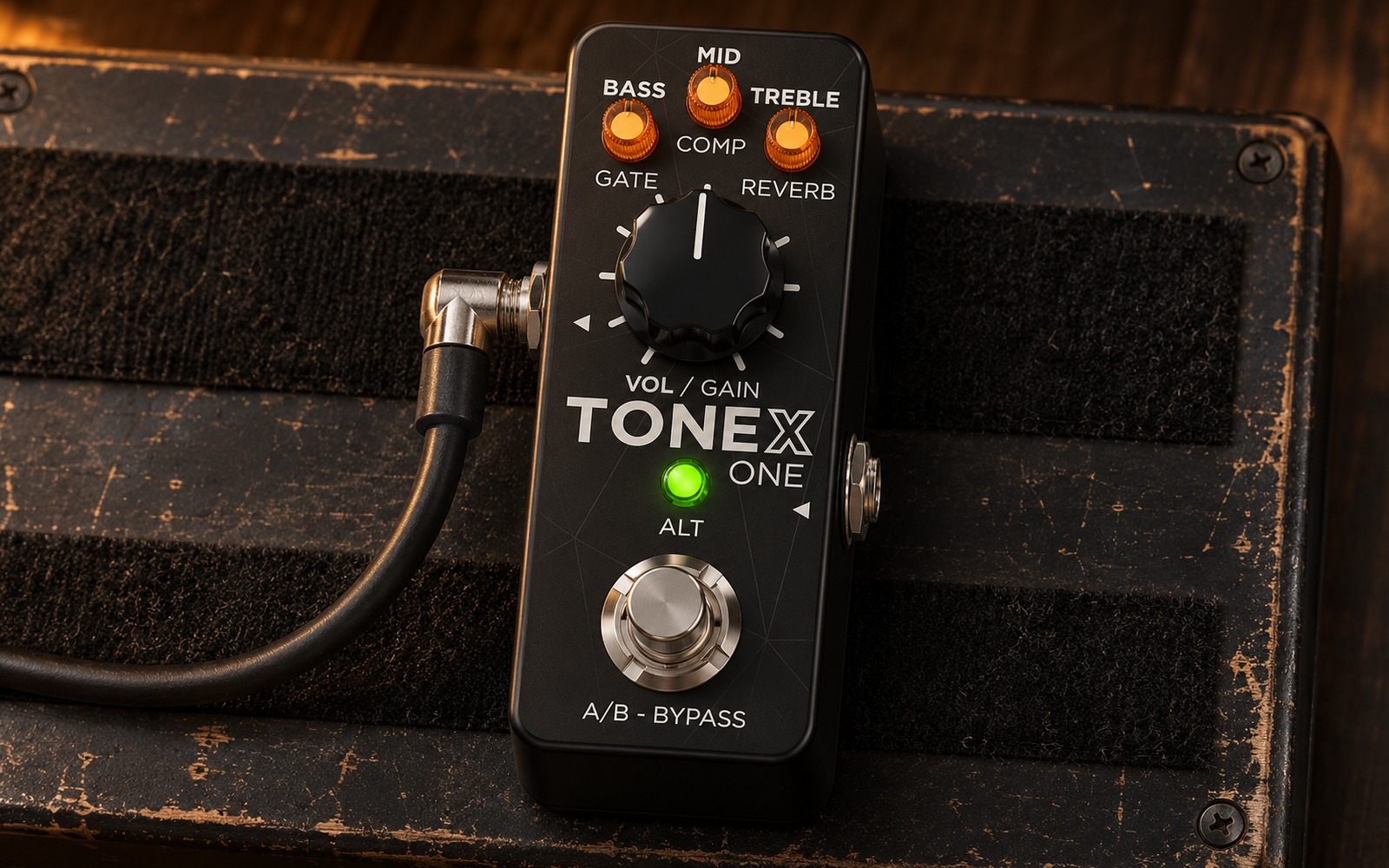
There is a version of the future where every amp ever built still exists — captured, compressed, and waiting on a pedal the size of a pack of cards. IK Multimedia made that version real in 2024 when it shipped the TONEX One: a mini modeler that weighs 160 grams, draws 120 milliamps, and contains the same neural-network amp-modeling engine that powers rigs costing three times as much. At $179.99, it is not the cheapest stomp on the market. It is, however, the most affordable entry point into IK’s TONEX ecosystem — a platform where over 60,000 user-captured amp models circulate freely on the ToneNET marketplace, and where Joe Satriani has his own co-branded version of the hardware itself. That is a peculiar thing for a pedal this small to claim. It earns it.
The TONEX One is not a simplified toy derived from the larger TONEX Pedal. It runs the same AI Machine Modeling engine, loads the same Tone Model format, and connects to the same ToneNET library. What it gives up is quantity: 20 preset slots instead of 150, one footswitch instead of three, no MIDI I/O, and a simpler effects section. What it gives back is a form factor that fits in a jeans pocket, a USB-C port instead of the older USB-B, and a price point low enough to justify buying two and running them in stereo. The trade-offs are honest, the strengths are real, and the result is one of the most legitimately useful compact modelers the guitar market has seen.
From Modena to the Mini Format: The TONEX Ecosystem Story
IK Multimedia was founded in 1996 in Modena, Italy by Enrico Iori and Davide Barbi. The company’s first major product was AmpliTube in 1999, one of the earliest commercial amp simulators, which established IK’s identity as a software-first guitar company. The iRig followed at NAMM 2010: the first widely available cable that connected a guitar directly to an iPhone’s headphone jack, a $40 gadget that seeded an entire category. For the next decade, IK expanded AmpliTube into a sprawling physics-informed simulation platform covering hundreds of amp, cabinet, and effects models.
Then, in 2022, IK launched TONEX as a parallel ecosystem built on a different premise. Where AmpliTube uses DSP modeling, TONEX uses AI Machine Modeling: a neural network training process that captures the behavior of a real piece of hardware — its gain response, frequency character, compression, feel — by passing test tones through the device and back through a computer. The result is a Tone Model, a file that re-creates not just the static sound of the amp but the way it responds to pick attack, playing dynamics, and volume knob position. The capture process runs in TONEX software on Mac or Windows with a standard audio interface. No proprietary hardware required, and no limit on what can be captured: tube amp, solid-state combo, overdrive pedal, boutique preamp, vintage unit found at a pawnshop on a Tuesday morning.
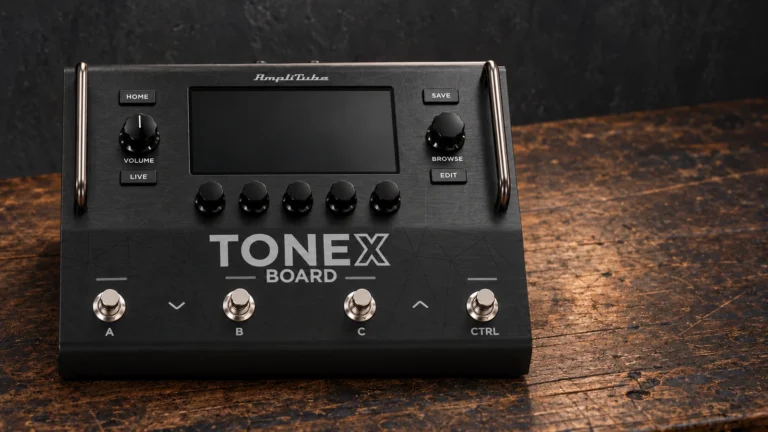
TONEX hardware began with the TONEX Pedal in 2023, a full-size triple-footswitch unit at $399. The TONEX One arrived in 2024 as the mini-format entry point: same engine, same Tone Model compatibility, dramatically smaller chassis and lower price. The TONEX One+ followed as a further iteration, adding MIDI I/O and a larger included model library while keeping the same physical footprint. The ecosystem now also includes the TONEX Cab (a powered FRFR speaker optimized for TONEX output) and TONEX Plug (a plug-in version for DAW use). Everything shares the same Tone Model format, which means any capture you buy, download, or create yourself runs on any TONEX device.
TONEX One Specifications
| Feature | Specification |
|---|---|
| Street price | $179.99 USD |
| Announced / shipping | 2024 |
| Dimensions | 48 mm W × 94 mm D × 53 mm H (1.89″ × 3.7″ × 2.09″) |
| Weight | 160 g (0.35 lb) |
| Input | 1 × ¼″ TS mono (instrument level) |
| Output | 1 × ¼″ TRS (stereo / dual mono / headphone) |
| USB | USB-C (audio interface + preset editor) |
| USB audio | 24-bit / 44.1 kHz |
| MIDI | None (MIDI available on TONEX ONE+) |
| Footswitch modes | Stomp (on/off bypass) or Dual (A/B preset switching) |
| Preset slots | 20 (3 active slots: 2 in Dual mode, 1 in Stomp mode) |
| Included Tone Models | 320+ Premium Tone Models |
| Onboard effects | 3-band EQ, compressor, noise gate, reverb (spring/room/plate); chorus, flanger, tremolo, phaser, rotary, digital delay, tape delay via TONEX FX firmware update |
| IR loader | VIR™ multi-IR cab emulation + custom IR loader |
| LED micro-knobs | 9 assignable RGB colors per preset |
| Power | 9V DC center-negative, 120 mA (NOT included) or USB-C |
| Included software | TONEX SE ($99.99 value) + AmpliTube 5 SE ($99.99 value) |
| Connection type | USB-C |
What AI Machine Modeling Actually Means at This Price
It is worth being precise about what TONEX’s AI Machine Modeling is and is not, because the marketing copy is dense with superlatives and the guitar world has been burned by oversold modeling claims before.
Traditional amp simulation — the kind AmpliTube and earlier-generation modelers use — works by describing the circuit mathematically. Engineers analyze the topology of a Marshall Plexi or a Fender Deluxe Reverb, model the transformer, tubes, tone stack, and speaker with differential equations, and run those equations in real time on a DSP chip. The results can be excellent, but the model is only as accurate as the engineer’s analysis of that specific unit, and circuit-level modeling is expensive to produce.
AI Machine Modeling works differently. TONEX’s software sends a standardized sweep of test signals through the real amp, records the output, and feeds both sides of that recording into a neural network. The network is trained to predict the amp’s output given any input — which means it captures not just the frequency response but the nonlinear behavior: the way the amp compresses differently at different gain levels, the way the power section starts breaking up at higher volumes. What the network does NOT capture is stereo information (the amp has one output), speaker movement caused by room interaction, or microphone placement character. Those things are addressed separately: TONEX’s IR loader handles cabinet and mic simulation, and the TONEX One can output to your own cab or PA for the room element.
The process requires a computer running TONEX software and a standard audio interface. You can capture your own amps, download captures from ToneNET (where over 60,000 user models exist at no cost), or purchase Premium Tone Models from IK’s own library or from Tone Partner collections. The TONEX One ships with 320+ Premium Models pre-loaded, which is more than enough to establish whether this approach works for your rig before spending another cent on the platform.
One operational point Premier Guitar’s review (Jason Shadrick, October 2024) makes clearly: the EQ section is the most powerful real-time corrector in this type of modeler, and the TONEX One keeps it front and center with its three dedicated micro-knobs. Being able to reach bass, mid, and treble without diving into menus is a practical advantage the editor specifically calls out. The same review notes the high-gain tones as a particular strength: “combining the humbuckers in a PRS SE DGT with a few hot-rodded Marshall emulations… the growl offered tones nearly as good as those from much more expensive modelers.” Rating: 4.1 out of 5. Verdict: “at $179 it’s a steal.”
Famous Players: Honest Verification
The TONEX ecosystem’s artist relationships require careful separation between three distinct things: players who use TONEX hardware live, players who have IK Signature Tone Model Collections (captured amp presets sold through ToneNET), and players whose tones inspired IK’s internally produced model collections. Those are not the same thing, and conflating them is how gear marketing usually gets away with implying endorsements that do not exist.
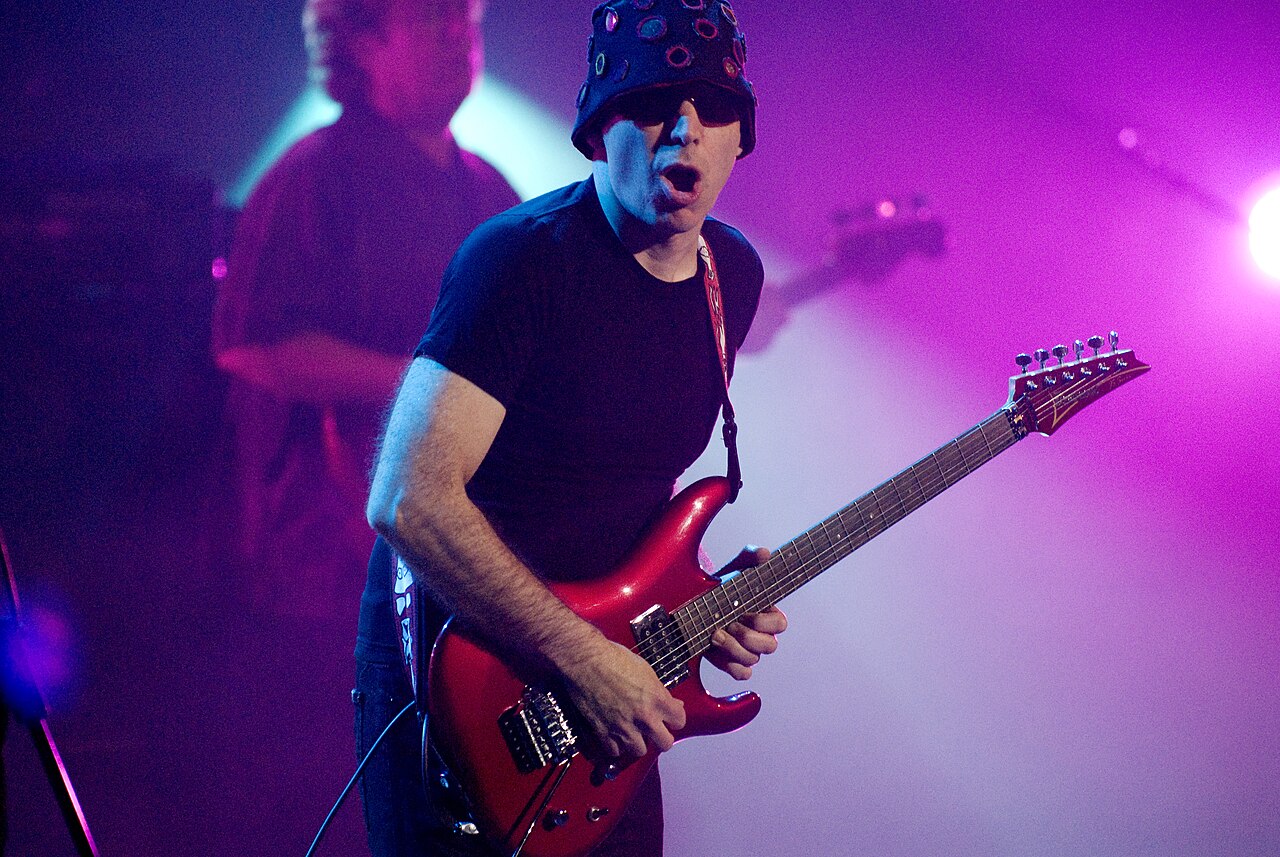
Joe Satriani is the most directly TONEX One-specific connection in IK’s artist roster. IK released a co-branded limited-edition TONEX One Joe Satriani unit — actual hardware in a custom finish — which makes this a hardware-level endorsement rather than just a software collection. The Joe Satriani Amp Vault, separately available on ToneNET, contains 67 Tone Models captured from 28 different amplifiers that Satriani has used across his career. That depth of capture reflects a serious archiving project, not a logo licensing deal. Satriani’s tone priorities — ultra-smooth sustain, wide dynamic range, note-by-note articulation in legato runs — stress the TONEX capture engine in ways that expose poor modeling fast. The fact that IK put his name on the hardware box suggests a level of mutual confidence in the results.
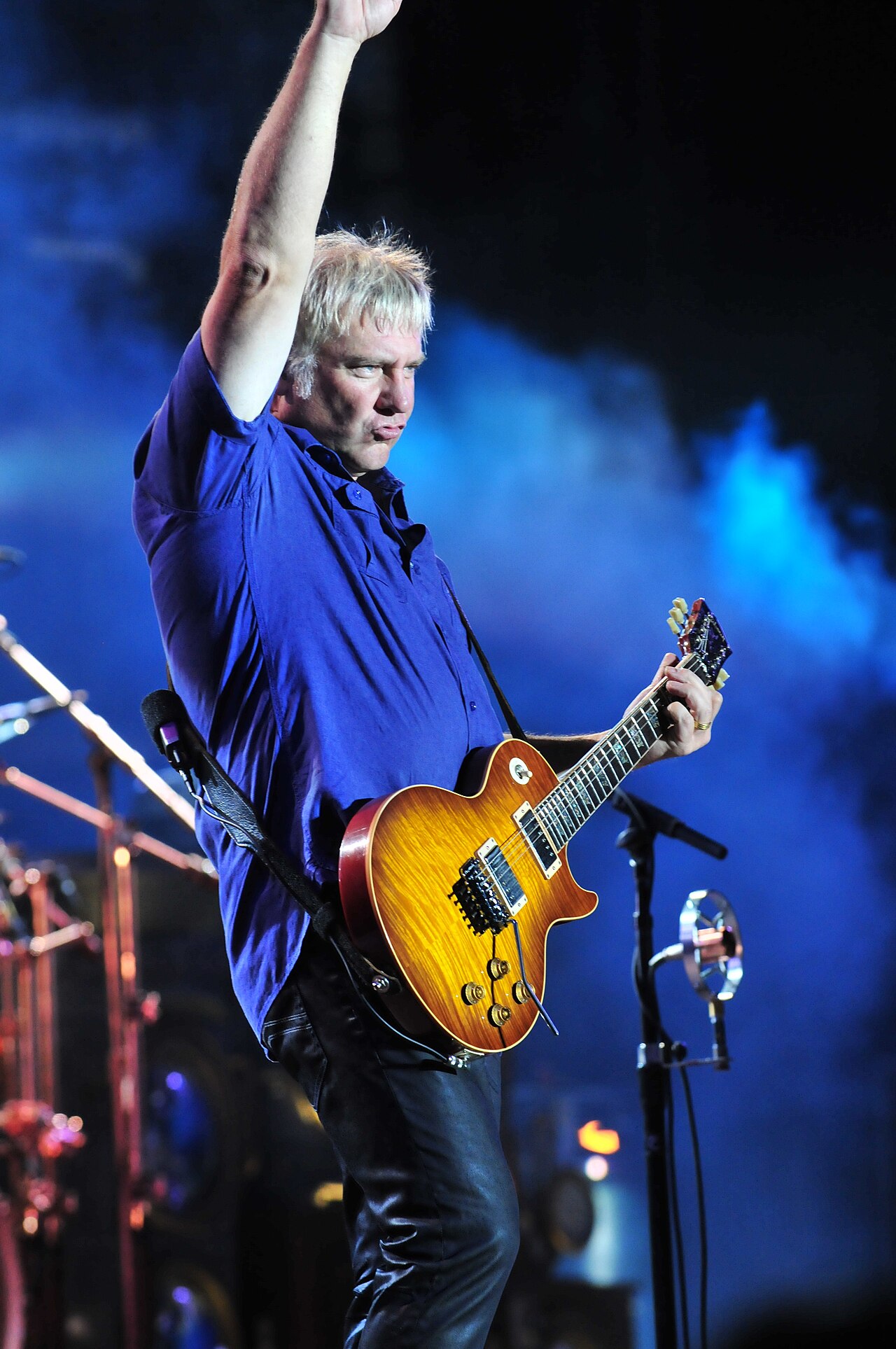
Alex Lifeson has an Alex Lifeson Legacy Tone Model Collection available through ToneNET: 25 Tone Models captured from 4 of the amps he used to define Rush’s guitar sound across five decades. Those models are fully compatible with the TONEX One. What should be stated honestly: Lifeson’s documented live use of TONEX hardware — confirmed by Guitar World in May 2026 during the Rush Fifty Something reunion tour — is of the larger TONEX Pedal, used alongside a Fractal unit for modulation and effects. His Tone Model collection plays fine on the TONEX One; his touring setup does not use one.
Gus G. is an official IK artist with the Gus G. Tone Asylum collection: 27 Tone Models from 7 amplifiers including a Blackstar HT-5 Metal, Engl Powerball, EVH 5150 III, and Mesa Triple Rectifier. Gus G. is documented through MusicRadar as an active IK partner. The collection works on TONEX One and covers the full spectrum of modern metal tones from bedroom-crunch to arena-grade roar.
The TONEX One Double Special is a limited-edition co-branded hardware variant whose included tone collections reference the tonal worlds of Robben Ford and Larry Carlton — smooth jazz-fusion players historically associated with Dumble amplifiers and compressed clean-to-bluesy tones. Carlos Santana’s lyrical sustain and mid-forward character is also cited in Double Special promotional material. What IK does not explicitly state is whether any of those three played into the capture process themselves or whether the reference is to their tonal style. Given that Dumble amplifiers are exceptionally rare, treat these collections as IK’s best reconstruction of those tones rather than certified captures from the players’ personal rigs.
Beyond the ecosystem’s high-profile names, the ToneNET community is the TONEX One’s most honest famous-players section: tens of thousands of individual captures of real amps shared by real players, searchable by genre, style, and amp name. At $179.99 for the hardware, the community library is what makes the platform economically logical at scale.
Tone Recipes
Classic British Crunch
Load a Marshall JTM45 or JCM800-based Tone Model. Set Gain around 60%, Volume to taste. EQ: Bass 50%, Mid 65%, Treble 55%. Compressor light (20-25%). Noise Gate at 30%. No reverb, or Spring 1 at 15% for a touch of ambience. Use the neck pickup for a brown-sound warmth, bridge for cutting classic rock rhythm. The TONEX One’s VIR cab emulation paired with a Greenback-style IR gives the correct sag and low-mid push a real 412 creates.
American Clean with Edge-of-Breakup
A Fender Deluxe Reverb or Twin Reverb capture at 45-50% gain sits right on the edge. Mid knob slightly back (45%) keeps the classic scooped American voicing. Run the guitar volume at 7 to stay clean, then push to 10 for the first hint of hair. Set the TONEX One’s 3-band EQ flat and let the Tone Model do the work. Room reverb at 20-25% from the onboard reverb completes the picture without needing an external pedal.
Modern High Gain
Mesa Boogie Rectifier or Peavey 5150 capture. Gain 75-80%. Bass 45% (crucial to tighten the bottom on any high-gain capture — boosting bass on a heavy amp model creates flub). Mid 55%, Treble 60%. Noise Gate at 60-70% to clean up the palm mutes between notes. Compressor off — high-gain captures already compress heavily. This is the TONEX One’s strongest zone per Premier Guitar’s review: the platform handles high-gain response with dynamic accuracy that surprises players used to entry-level modeling.
Jazz and Fusion Clean
Grab a Dumble-style or Jazz Chorus capture. Gain at 20-30%. Bass 55%, Mid 60%, Treble 45% — warm, dark, compressed. The compressor at 35-40% adds the squash that fusion players want when digging in with a thick pick. Set the headphone output for a direct studio check; the TONEX One doubles as a recording interface, so this recipe works equally as a direct-to-DAW setup for home recording sessions. This is the tonal territory the Double Special collection addresses with its Dumble-adjacent captures.
Fly Rig Blues Pedalboard
TONEX One in Dual mode with a vintage Fender Tweed capture in slot A and a slightly dirtier British combo capture in slot B. Run upstream pedals — a tube screamer-style overdrive and a fuzz — before the TONEX One to push the captures into breakup. The neural network responds to upstream pedal coloring the same way a real amp responds to it: the gain structure shifts, the harmonic content changes, and you get authentic stacking behavior. The footswitch toggles between the clean Tweed (A) and the grittier British (B) without any tap-dancing required. The entire fly rig fits in a carry-on bag.
Comparisons and Where the TONEX One Sits
vs. IK Multimedia TONEX Pedal: The obvious comparison. The TONEX Pedal offers 150 presets vs. 20, MIDI I/O, three footswitches with bank navigation, a dedicated display, and 1,480+ included Premium Tone Models. It runs on a 320mA supply that is included in the box. The TONEX One’s 9V 120mA supply is NOT included — account for this in your first purchase. If you play regular gigs requiring fast bank switching or MIDI integration for preset automation, the Pedal justifies its $220 premium. If you want a fly rig, a home recording interface, or a second modeler to add to an existing pedalboard, the TONEX One’s form factor is the correct choice.
vs. Neural DSP Quad Cortex: These products are not in the same tier. The Quad Cortex is a $1,599 multi-effects floor unit with onboard touchscreen capture, four footswitches, stereo I/O, and a full effects engine. The TONEX One at $179.99 is about a tenth of the price and does none of the multi-effects work. What it does do — pure amp modeling quality — competes more closely with the Quad Cortex than its price suggests. If you already own analog effects and just want a high-quality amp-modeling endpoint, the TONEX One replaces the modeling layer at a fraction of the cost of a floor multi-effects unit.
vs. Kemper Profiler: The Kemper pioneered hardware amp profiling in 2012 and still produces excellent results, but the hardware costs $1,599+ and the profiling workflow requires direct miking of a real amp through a speaker and microphone. TONEX’s capture process is more accessible — you capture direct through an interface without microphones — and the ToneNET library now dwarfs any single platform’s commercial model count. The TONEX One is not a Kemper replacement for a full live rig, but for the working player who wants professional capture quality without the investment, it closes the gap more than any previous entry-level device.
vs. Line 6 Helix Floor: The Helix is a $1,499 multi-effects unit with a routing engine, stereo I/O, multiple footswitches, and a deep effects library built on circuit modeling. The TONEX One is a single-footswitch amp modeler. These are different tools. Many players run a TONEX One within a Helix rig: the Helix handles routing, effects, and switching; the TONEX One provides the amp-modeling endpoint through an effects loop or parallel path. The integration is clean because the TONEX One accepts and passes signal like any other pedal.
vs. Fractal Audio Axe-Fx III Mark II: The Axe-Fx III is a $2,299 professional touring unit with circuit-level DSP modeling of extraordinary depth. Fractal’s approach and TONEX’s neural-network approach produce different strengths: Fractal is often preferred for mathematical accuracy of clean simulations and complex signal routing, while TONEX captures are frequently cited for feel and dynamic response in overdriven territory. Alex Lifeson’s documented live setup on the Rush 2026 tour uses both: TONEX for amp tones and Fractal for modulation and effects. That combination is more indicative of where TONEX fits in the professional signal chain than any direct head-to-head comparison.
Buying Guide
The TONEX One’s $179.99 price is the stated street price at Sweetwater, Guitar Center, and most US authorized retailers. Buy from an authorized IK dealer to ensure warranty support and legitimate software registration codes — both the TONEX SE and AmpliTube 5 SE software bundles are tied to your IK account, and grey-market units may ship with already-registered codes.
The 9V DC center-negative power supply is NOT included. IK sells its own IK PSU-9/175, and any quality isolated pedalboard power supply output rated at 120mA or higher will work. Do not daisy-chain the TONEX One from a shared power supply rail with other pedals — the digital circuitry is sensitive to ground noise from shared power.
Download the TONEX Editor on Mac or Windows before your first session. On-device preset management using only the footswitch and knobs is possible but slow. The desktop editor makes loading Tone Models, organizing presets, and updating firmware straightforward. It is free and connects via USB-C.
The TONEX One+ — IK’s current-production iteration — adds MIDI I/O (1/8″ TRS Type A) and ships with 420+ Premium Tone Models instead of 320+. If you use MIDI for preset automation or want an external controller to access all 20 presets live, the One+ is the correct purchase at a modest price premium. If you are building a simple two-tone pedalboard with no MIDI, the original TONEX One is cheaper and identical in audio quality.
The Joe Satriani and Double Special limited-edition hardware variants carry the same electronics as the standard TONEX One with custom cosmetics and co-branded Tone Model collections. Buy them for the bundled collections or the aesthetics; pass on them if you plan to build your own ToneNET library from scratch.
Living with the TONEX One
The TONEX One’s single footswitch is its most significant operational constraint. In Stomp mode, the switch toggles the unit in and out of bypass — useful for inserting a modeled amp tone as an effect in an otherwise clean signal chain. In Dual mode, the switch toggles between two presets (A and B), which covers most live scenarios: rhythm tone and lead tone, or clean and dirty. Accessing the other 18 presets in your library requires pressing the knob to enter preset navigation or connecting the TONEX Editor before the gig.
For players who need rapid access to many different sounds mid-song, the TONEX One is not the right tool. That player needs the TONEX Pedal’s three-switch bank system, or a MIDI controller feeding the TONEX One+ for hands-free access to all 20 presets. For players with a stable two-tone live setup — which describes most working guitarists who are not playing prog rock or theatrical setlists — two presets per gig is plenty.
The direct recording use case is underrated. The TONEX One plugs into any Mac or PC via USB-C and appears as a 24-bit/44.1kHz audio interface. You can track through any Tone Model, switch presets while recording, and monitor through headphones from the TRS output. This is a $179.99 guitar interface with professional-grade amp simulation built in — a setup that previously required a separate interface and separate modeling software costing several times as much.
Firmware updates have historically added significant new features at no cost. The TONEX FX update added 8 new effects including chorus, flanger, tremolo, phaser, rotary, spring reverb, digital delay, and tape delay, expanding the onboard effects suite to 15 FX across 7 configurable slots. IK’s post-release firmware development track record suggests the TONEX One will continue gaining features over its lifespan, which means the hardware you buy today will be meaningfully more capable in two years without any additional cost.
The customizable RGB LED micro-knobs are more functional than they look. Each preset can be assigned one of 9 colors, which means if you stack two TONEX Ones on a pedalboard — one for rhythm tones, one for leads — you can tell them apart at a glance on a dark stage without reading the unit. IK’s own marketing leans hard on the stacking scenario, and it is genuinely useful: two TONEX Ones in a stereo rig costs $360, which is less than a single TONEX Pedal and gives you discrete stereo control over two completely independent amp models.
Frequently Asked Questions
Does the TONEX One come with a power supply?
No. Unlike the larger TONEX Pedal, which includes a 9V 320mA supply, the TONEX One ships without one. You need a 9V DC center-negative supply rated at 120mA or higher, or you can power it via USB-C from a laptop or USB power bank. Purchase IK’s own IK PSU-9/175 or any quality isolated pedalboard power supply to avoid ground-loop noise from shared rails.
What is the difference between the TONEX One and the TONEX One+?
The TONEX One+ adds MIDI I/O (1/8″ TRS Type A, supporting both MIDI In and Out), ships with 420+ Premium Tone Models vs. 320+, and includes the TONEX SE + Signature+ Collection software bundle. The hardware footprint is physically identical: same dimensions, same weight, same single-footswitch layout. Audio quality is the same between both units. The decision comes down entirely to whether you need MIDI integration.
Can I capture my own amps with the TONEX One?
Yes, but the capture process happens on a Mac or Windows computer running TONEX SE software, not on the hardware pedal itself. You connect your amp’s output (via a speaker attenuator or load box) to an audio interface, run the capture sweep in the TONEX software, and the resulting Tone Model file transfers to the TONEX One via USB-C. The hardware plays back models but does not create them. This is a key difference from the Neural DSP Quad Cortex, which performs onboard capture without a computer.
How many presets can I access live without a computer?
Three active slots are available without menu diving: two in Dual A/B mode, one in Stomp on/off mode. The other 17 slots require pressing the main knob to enter preset navigation and scrolling through. For live performance with more than two tones, either use the TONEX Editor before the gig to load the right two presets into the active slots, or use the TONEX One+ with a MIDI controller for hands-free access to all 20.
Does the TONEX One work as a USB audio interface?
Yes. Connect via USB-C and the TONEX One appears as a 24-bit/44.1kHz audio interface on Mac or PC. You can record through any active Tone Model and switch between the two active presets while tracking. The TRS output doubles as a headphone monitor out. This makes the TONEX One a viable direct-recording solution for home studios without any additional interface hardware required.
Are the Signature Tone Model Collections (Satriani, Lifeson, Gus G.) compatible with the TONEX One?
Yes, all three are compatible with the TONEX One, the TONEX One+, and the TONEX Pedal. They are sold separately through ToneNET or bundled with specific hardware editions. Note that the collections are downloadable Tone Model files that occupy preset slots within the TONEX One’s 20-slot library. If you plan to run multiple signature collections simultaneously, you will need to curate your 20 slots carefully rather than loading everything at once.
Will the TONEX One work into a real amplifier rather than going direct?
Yes, with one important setting change. Disable the cabinet emulation (via the TONEX Editor or the device’s global settings) and connect the TONEX One to your amplifier’s effects return, bypassing the amp’s own preamp. This sends the TONEX One’s amp model through the amp’s power section and speaker, preserving the physical speaker’s character while using the TONEX model for all preamp and gain work. It is an effective solution for touring players who cannot guarantee amp quality at every venue.
How does the TONEX One handle bass guitar?
IK released a TONEX One Bass Edition with a bass-focused Tone Model library, and the standard TONEX One works with bass guitar input without modification. The mono input handles both guitar and bass frequency ranges. ToneNET has a growing library of bass amp captures. The onboard noise gate and EQ work equally well for bass. There is no frequency-range restriction in the hardware itself.
Image credits
- Top image: GuitarGangsters AI-generated reference illustration, not a photograph.
- Amplifiers and a speaker cabinet on a stage: Kuba Bożanowski from Warsaw, Poland, Wikimedia Commons, CC BY 2.0.
- Alex Lifeson: Adrian Buss, Wikimedia Commons, CC BY-SA 3.0.
- Joe Satriani: livepict.com, Wikimedia Commons, CC BY-SA 3.0.
Latest News
Related
On This Day
Tuesday 10 November
From this week: