EHX Metal Muff: When “A Little Gain” Just Won’t Cut It
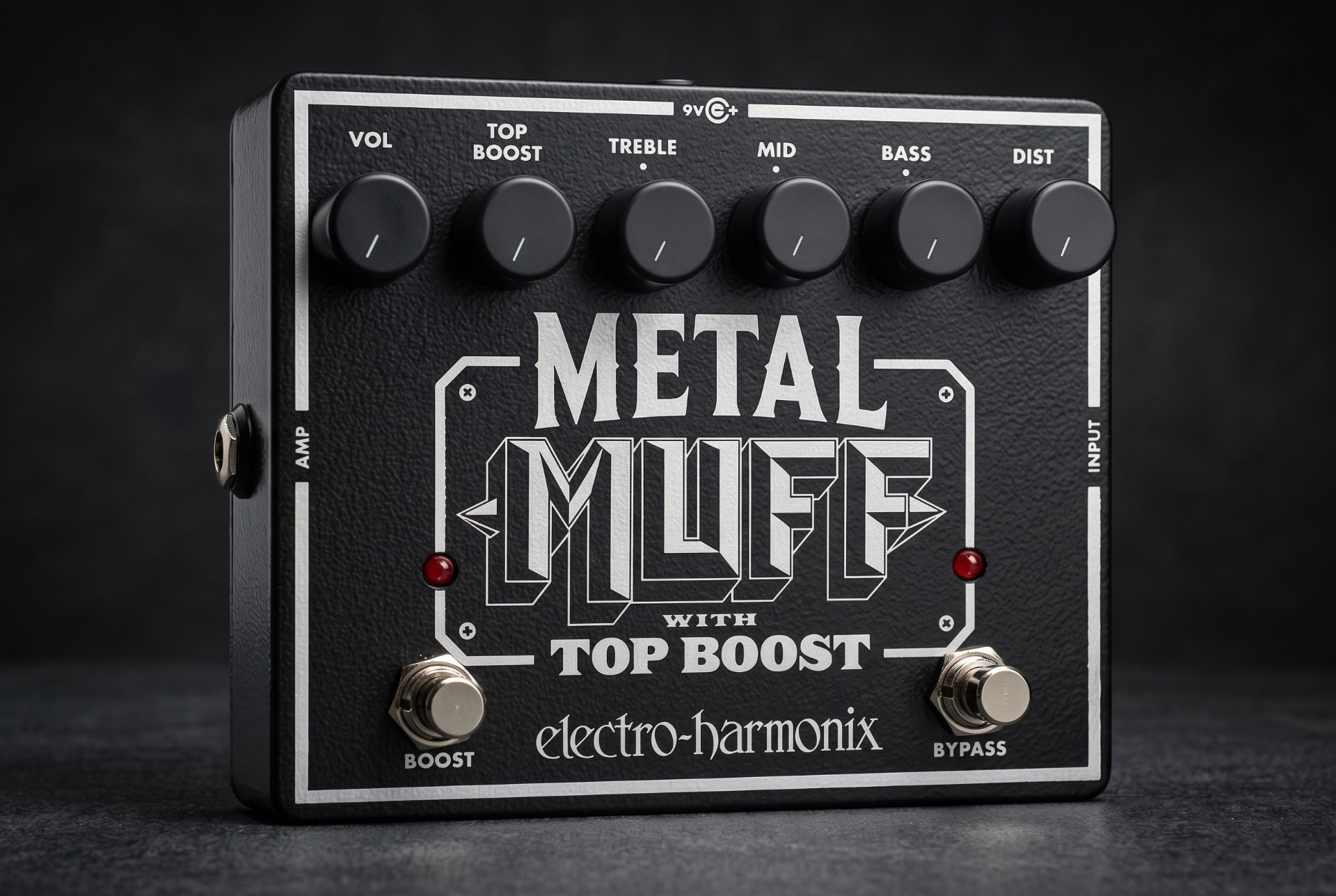
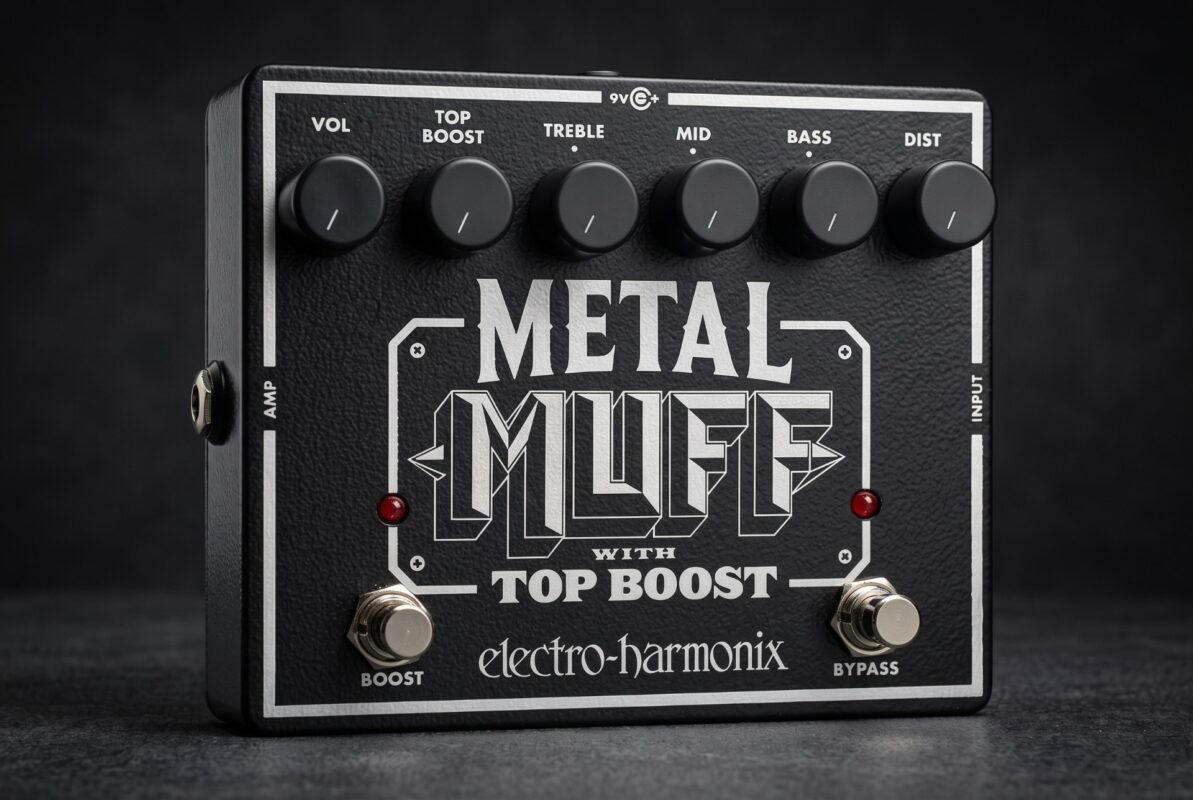
An AI-generated illustration of the Electro-Harmonix Metal Muff with Top Boost.
The EHX Metal Muff packs a 3-band EQ and footswitchable Top Boost into one heavy distortion pedal. Tone recipes, specs, and comparisons.
There’s a moment in every heavy guitarist’s journey when they plug into their setup, hit a power chord, and realize the distortion isn’t ugly enough. The Big Muff Pi is a wonder of fuzz engineering. The Tube Screamer is a midrange sculptor’s dream. But neither of them was built to rattle teeth. The Electro-Harmonix Metal Muff with Top Boost was.
Released in 2006 as EHX’s unambiguous entry into the dedicated high-gain distortion market, the Metal Muff makes no apologies for what it is. The tagline on the product page reads “The ultimate metal distortion pedal!” — and for once, a marketing claim that doesn’t need heavy qualification. This is a pedal built for drop-tuned guitars, low-end chunk, screaming leads, and three-band EQ control deep enough to contour tone across the entire metal subgenre spectrum. From NWOBHM crunch to modern djent-adjacent saturation, the Metal Muff’s 15dB midrange cut-and-boost range alone separates it from any distortion pedal at this price point.
This is not a Big Muff variant. It doesn’t share a circuit with the Nano Big Muff Pi, the Op-Amp Big Muff, or any of the transistor fuzz reissues EHX has released in recent years. The Metal Muff is its own machine — a dedicated analog distortion circuit designed from the ground up for gain levels the Big Muff topology was never intended to reach. If you’ve been using a fuzz pedal for metal and wondering why your rhythm tone goes soft in a mix, you’ve been using the wrong tool.
Origin and Design Intent
Electro-Harmonix has always been a New York City company more comfortable making singular, eccentric tools than chasing market trends. The Metal Muff is the exception that proves the rule. By 2006, the high-gain distortion pedal segment was well-established: the Pro Co RAT 2 had been a working musician’s standard for two decades, the BOSS DS-1 had shipped in numbers too large to count, and boutique builders were producing expensive alternatives at premium prices. EHX’s answer was to build something more feature-complete than any of them — specifically, a pedal with three independently controllable EQ bands and a secondary footswitchable boost circuit — and price it at the working-guitarist tier.
The result was a full-size die-cast chassis with a control layout that would look at home on a rack preamp: Volume, Distortion, and a full three-band EQ (Bass, Mid, Treble) arranged across the face, plus a dedicated Top Boost knob and a secondary footswitch to engage it. That secondary footswitch is the Metal Muff’s most distinctive hardware feature and the element most commonly overlooked by guitarists who dismiss the pedal as a simple gain box. More on that in a moment.
EHX later released the Nano Metal Muff, which added a noise gate (with variable threshold control) to a compact enclosure — the same three-band EQ minus the Top Boost footswitch, priced at around $84 USD. For pedalboard-space-conscious players, the Nano is the practical choice. For players who use leads and rhythms at different EQ contours within a live set, the full-size unit with its dedicated Top Boost footswitch is the more complete instrument.
Specifications
Famous Players: An Honest Assessment
The Metal Muff has no confirmed major famous-player connection, and any search that suggests otherwise is conflating the EHX brand with this specific pedal. No Premier Guitar Rig Rundown, Guitar World feature, or manufacturer artist page documents a definitively confirmed A-list artist using the Metal Muff as a primary drive pedal. The Equipboard community lists approximately 20 working professional musicians who have documented it on their boards — a respectable number for a pedal at this price point, but not the kind of name-brand endorsement history that puts a pedal in the conversation alongside the RAT or the DS-1.
That said, the metal genre context is worth framing honestly. The guitarists who define the sounds the Metal Muff is built to approximate — Dimebag Darrell (Pantera’s amp-driven brutal midrange crunch), James Hetfield (Metallica’s scooped rhythm wall), Dave Mustaine (Megadeth’s precision-picked articulation), Tony Iommi (Black Sabbath’s proto-doom low-end thickness), Zakk Wylde (the pinched-harmonic shriek above a scooped bottom) — achieved their tones primarily through high-gain amp channels, not stompboxes. Dimebag’s sound came from the Randall Warhead head. Hetfield’s rhythm tone on the Black Album was the Mesa/Boogie dual-rectifier into a studio setup. Mustaine used various amp preamps and rack units. Iommi built his sound around modified Marshall stacks and occasionally a treble booster.
The Metal Muff is what you reach for when you don’t have a high-gain amp — or when you want to push a cleaner amp into that territory without replacing the amp. It approximates the genre without requiring a $3,000 head. For working musicians who gig with club-friendly medium-wattage combos, it fills the role that rack preamps filled for the guitarists who built the genre. That’s the honest positioning, and it’s a genuine use case.
The Top Boost Footswitch: The Metal Muff’s Secret Weapon
Most players who dismiss the Metal Muff haven’t used the Top Boost footswitch correctly — or at all. The Top Boost circuit is a narrow-band high-frequency boost with its own dedicated knob. It sits on a secondary footswitch so you can toggle it independently of the main bypass. This gives the Metal Muff a two-voice architecture: one EQ contour for rhythm and a second, brighter, more articulate contour for leads, all within one pedal and controlled by a single additional footstep.
The practical applications are significant. Set your Bass, Mid, and Treble for a scooped, chunky rhythm tone — the kind that sits in a band mix without stepping on the kick drum or the bass guitar — then engage the Top Boost for leads to add definition and presence without having to reach down and turn a knob. In a live context, this is the kind of functionality that would otherwise require a separate boost pedal or a volume pedal in the chain. The Metal Muff handles it natively.
For studio recording, the Top Boost’s narrow-band character is useful for dialing in the presence peak that gives single-note runs cut on tape without the harshness that comes from simply cranking the Treble control. The distinction between “bright” and “present” matters when you’re recording: bright adds top-end energy across the full spectrum, while a narrow boost adds articulation in the frequency range where pick attack and note definition live.
Tone Recipes and Settings
Classic Metal Rhythm (Scooped, Chunky)
This is the thrash-era scooped tone — the one Les Paul humbuckers or an Ibanez RG550 with active pickups were built to deliver into a stack. Start with: Volume at unity (around 12 o’clock), Distortion at 3 o’clock, Bass at 2 o’clock, Mid at 8–9 o’clock (significant cut), Treble at 1–2 o’clock, Top Boost off. This gives you the classic scooped metal rhythm voice — a deep V-shaped EQ with the mids out and the lows and highs emphasized. Works best into a Marshall-type amp with the amp’s own mid control set relatively flat; the Metal Muff’s Mid cut does the scooping work.
NWOBHM / Classic Heavy Metal Lead
For leads in the Iron Maiden/Judas Priest register — not scooped, but present and aggressive — try: Volume up around 2 o’clock for extra push, Distortion at 2 o’clock, Bass at 11 o’clock, Mid at 1 o’clock (boost, not cut), Treble at 12 o’clock, Top Boost engaged. This is a mid-forward voice that cuts through a live mix without the low-end mud of the scooped setting. The Top Boost adds the upper presence that makes melody lines readable in a full-band context.
Doom / Stoner Rock (Maximum Thickness)
For the kind of tone that puts the room’s foundation at risk: Volume at 1 o’clock, Distortion at 2 o’clock, Bass at 3 o’clock, Mid at 12 o’clock (flat), Treble at 9 o’clock (significant cut), Top Boost off. This creates a wall of low-mid weight that works for slower tempos where note definition is less important than physical pressure. Best through a vintage-voiced amp or a combo with a 12″ speaker — the low-end boost can overwhelm small cab speakers if pushed too hard.
Low-Gain Alternative / Grungy Overdrive
Contrary to the name, the Metal Muff at minimum Distortion with Volume compensated upward produces a raunchy, compressed overdrive character that suits rock and grunge contexts. Try: Volume at 2 o’clock, Distortion at 8 o’clock, Bass at 12 o’clock, Mid at 12 o’clock, Treble at 11 o’clock, Top Boost off. Guitar volume rolled back to 7 or 8 cleans the pedal up further. This setting angles into territory more commonly associated with the DS-1 or RAT at lower Distortion settings — a good entry point for players who want to explore what the pedal’s EQ control does without the full-gain experience.
Metal Muff vs. the Competition
Metal Muff vs. Pro Co RAT 2
The Pro Co RAT 2 is the standard against which all rock/metal distortion pedals at this price point are measured. The RAT uses a LM308 or equivalent op-amp with a single Filter (tone) control — one EQ parameter that goes from dark and woolly to bright and aggressive as you turn it up. The Metal Muff’s advantage is obvious: three separate EQ bands versus one. But the RAT’s simplicity is also its strength. The Filter control on a RAT is exceptionally musical and fast to dial in. The Metal Muff requires more thought — five controls beyond Volume means more variables to manage. For players who want a one-knob-and-go experience, the RAT wins. For players who want to shape tone specifically for their amp and room, the Metal Muff’s EQ flexibility is the advantage.
Circuit character differs too: the RAT has a soft-clip op-amp voicing that has a particular upper-harmonic texture, especially at moderate gain settings. The Metal Muff is designed for higher sustained gain with less of that harmonic texture and more of a flat, wall-of-gain character. The RAT is more touch-sensitive at lower gain; the Metal Muff is more consistent at high gain.
Metal Muff vs. BOSS DS-1
The BOSS DS-1 is the most-sold distortion pedal in history, and it earns its place on the list through sheer utility and reliability. The DS-1 has one Tone control and one Level control alongside Distortion — simpler even than the RAT. Its buffered bypass (like the Metal Muff) means it plays well with downstream effects. The DS-1’s character is brighter and more aggressive in the upper frequencies than the Metal Muff, which can be an advantage for cutting through a mix at moderate gain but a liability at high gain where it can become harsh with single-coil pickups. The Metal Muff’s three-band EQ gives you control the DS-1 simply doesn’t offer. At similar street prices, the Metal Muff delivers more for the money if EQ control is important to you. The DS-1 wins on pedalboard footprint (the Metal Muff is significantly larger) and on the BOSS build reputation for tour-grade durability.
Metal Muff vs. EHX Big Muff Pi Family
This is the most commonly confused comparison. The Big Muff Pi family — whether the Nano, the Ram’s Head, the Triangle, or the Green Russian — is a fuzz pedal with a specific four-stage silicon transistor circuit that produces a compressed, sustain-heavy, mid-scooped fuzz texture. The Metal Muff is an analog distortion circuit with an entirely different topology. The Big Muff sounds open and expansive at high gain; the Metal Muff sounds tighter and more defined. The Big Muff has a characteristic “bloom” to its sustain that is identifiable across all its variants; the Metal Muff has a more immediate attack and a flatter sustain plateau. If you want to sound like Gilmour or Mascis, you want a Big Muff. If you want to sound like the genre of metal broadly construed, you want the Metal Muff.
Buffered Bypass: What You Need to Know
The Metal Muff uses buffered bypass — a meaningful distinction from the true bypass found on most of the Big Muff reissue family. Buffered bypass means the pedal’s input buffer is always active, even when the effect is bypassed. This keeps your signal impedance consistent throughout the chain regardless of whether the pedal is engaged, which is an advantage for long cable runs and for pedalboards with many true-bypass pedals in series (which can cause high-frequency loss). The practical consequence for most players is neutral to positive. The exception: if you’re running a vintage germanium fuzz earlier in your chain, germanium fuzzes are famously sensitive to the output impedance of whatever is upstream. Placing the Metal Muff after a germanium fuzz in your chain changes how that fuzz responds. In most modern pedalboard contexts — silicon fuzz, overdrive, distortion, modulation — the buffered bypass is a non-issue and arguably an asset.
Buying Guide: Full-Size vs. Nano, New vs. Used
The decision between the full-size Metal Muff with Top Boost and the Nano Metal Muff comes down to one question: do you need the Top Boost as a switchable second voice during performance? If yes, the full-size unit is the answer. If you want maximum EQ flexibility in minimum space and don’t need the second footswitch, the Nano Metal Muff — with its added noise gate, useful for high-gain applications where hiss accumulates — is the better pedalboard choice at roughly the same price.
Both pedals are available new at street prices well under $100 USD. Used examples of the full-size unit in excellent condition trade for $40–60, which makes the used market one of the best value entries in the entire distortion pedal category. There are no rare variants or collector-grade versions of the Metal Muff to navigate — it’s been consistently in production since 2006 with no circuit revisions that significantly alter the character. Buy used, save money, use the savings on cables or a better power supply.
25mA current draw on the full-size unit (24mA on the Nano) means any standard isolated power supply output handles it without issue. The standard 9V battery is included, and the optional 9.6VDC-200mA adapter is sold separately — the same supply that works with any EHX pedal works here.
Frequently Asked Questions
Is the EHX Metal Muff the same circuit as the Big Muff Pi?
No. The Metal Muff uses a dedicated analog distortion circuit designed specifically for high-gain heavy metal applications. The Big Muff Pi family uses a four-stage silicon transistor fuzz topology. They are entirely different circuits with different sonic character. The Big Muff produces a fuzz texture with bloom and sustain; the Metal Muff produces a tighter, more defined distortion with more low-end control.
Does the Metal Muff have true bypass?
No. The Metal Muff uses buffered bypass. The buffer is active even when the pedal is bypassed. This is generally an advantage for signal integrity on long cable runs and complex pedalboards, but it may affect vintage germanium fuzzes placed earlier in the chain, which are sensitive to upstream impedance. In most modern pedalboard contexts, buffered bypass is neutral to beneficial.
What does the Top Boost footswitch actually do?
The Top Boost adds a narrow-band boost in the high frequencies on top of your existing EQ setting. It’s controlled by a separate knob that sets the amount of boost and a dedicated footswitch that engages it independently of the main bypass. The practical use is as a two-voice system: one EQ contour for rhythm (Top Boost off) and a brighter, more articulate contour for leads (Top Boost on), without reaching down to adjust knobs during a performance.
How does the Metal Muff compare to the Pro Co RAT 2?
The RAT 2 has a single Filter (tone) control and a different op-amp character that is more touch-sensitive and harmonically textured at lower gain settings. The Metal Muff’s three-band EQ gives more precise tone sculpting across Bass, Mid, and Treble independently. The RAT is faster to dial in; the Metal Muff is more flexible. Both are in the same price range. Players who want simplicity favor the RAT; players who want control favor the Metal Muff.
What guitar works best with the Metal Muff?
Humbuckers — passive or active — are the most natural match. The extra low-end output of humbuckers drives the Metal Muff’s input more fully and fills out the low-end EQ range. The Ibanez RG550‘s hot single-coil-in-humbucker-configuration pickups work well. The Gibson Les Paul Standard‘s PAF-style humbuckers drive the circuit with authority. Single coils work but require more careful Treble management — back off the Treble control and use the Top Boost sparingly to avoid the upper-frequency harshness that high gain can amplify with single coils.
What amp pairs well with the Metal Muff?
A clean-to-slightly-dirty amp with a flat frequency response gives the Metal Muff’s three-band EQ the most control. The Marshall JCM800 2203 at moderate master volume — clean-to-edge-of-breakup — provides an amp character the Metal Muff was designed to work with. Fender-style amps with their natural mid-scoop pair well with the Metal Muff’s ability to boost the Mid control to compensate. Avoid pairing with high-gain amp channels; the extra gain-on-gain interaction typically produces a compressed, undefined wall of noise rather than a usable metal tone.
Is the Nano Metal Muff a downgrade from the full-size Metal Muff?
No, it’s a different tool. The Nano Metal Muff loses the Top Boost footswitch but adds a variable-threshold noise gate — a useful feature for high-gain applications where noise floor management matters. At similar street prices, the Nano is the better pedalboard choice for players who don’t need the Top Boost as a live switchable voice. The full-size unit is the better choice for players who want two distinct EQ contours available mid-set via footswitch.
What are the key advantages of the Metal Muff over cheaper distortion pedals?
The three-band EQ with up to 15dB of midrange cut or boost is the primary advantage. No distortion pedal in this price range offers that level of frequency control. The footswitchable Top Boost is a secondary advantage specific to the full-size unit. Together, they give the Metal Muff a versatility that stretches from classic rock crunch to modern high-gain metal without requiring a separate EQ pedal in the chain.
Image credits
- A pedalboard full of colourful pedals: Skimel, Wikimedia Commons, CC BY-SA 4.0.
- Top image: GuitarGangsters AI-generated reference illustration, not a photograph.
- Electro-Harmonix Metal Muff with Top Boost: AI-generated illustration by GuitarGangsters, based on the manufacturer’s product design (not a photograph).
Latest News
Related

On This Day
Friday 13 November
From this week: