Catalinbread Belle Epoch: The Echoplex That Never Needs a Tape Change
Catalinbread Belle Epoch. AI-generated reference illustration, not a photograph.
The Catalinbread Belle Epoch recreates the Maestro Echoplex EP-3 in stompbox form. History, specs, verified players, settings and FAQ.
There is a moment in the 2018 Premier Guitar Rig Rundown with Eric Johnson that ought to be more famous than it is. Johnson is touring Ah Via Musicom, and he has hauled out his original late-eighties pedalboards to do it. Sitting on a shelf behind the amps are two Maestro Echoplexes — the real thing, the wooden-cased tape machines that made his lead tone what it is. Except a technician named Bill Webb has been inside them and removed the tape loops entirely. The transport is gone. The heads are gone. What is left is the preamp, and the signal now passes straight through it into other boxes.
One of those boxes is a Catalinbread Belle Epoch.
Read that arrangement twice, because it is the whole argument of this article in one photograph. The most obsessive tone chaser in American guitar, a man who reputedly hears the difference between battery brands, decided that the part of an Echoplex worth carrying on tour was the preamp — and that the echo itself could be delegated to a pedal the size of a pack of cards. He is on record about which pedal. Catalinbread print the quote on their own product page: “The Catalinbread Belle Epoch is the closest thing to a real EP-3 that I’ve ever played.”
That endorsement has been doing heavy lifting for a decade, and the Belle Epoch has earned it the hard way — by being an unglamorous, un-updated, tap-tempo-less little box that keeps turning up on the boards of players who could afford anything.
What the Belle Epoch Actually Is
The Belle Epoch is a hybrid pedal: a discrete analog preamp and mixer wrapped around a digital delay line. It is designed to reproduce one specific machine — the Maestro Echoplex EP-3, the solid-state, transistor-based generation of the Echoplex that arrived at the tail end of the 1960s and became, by a wide margin, the most-recorded tape echo in rock.
The important word in that sentence is specific. Catalinbread’s entire design philosophy, going back to the founding of the company, has been to replicate identifiable pieces of vintage gear rather than to build generic effects. Their overdrive line models named amplifiers. Their reverb models a named Fender unit. The Belle Epoch models a named delay unit. This is a different exercise from building “a tape delay pedal,” and it produces a different result — narrower, less flexible, and considerably more convincing inside its own lane.
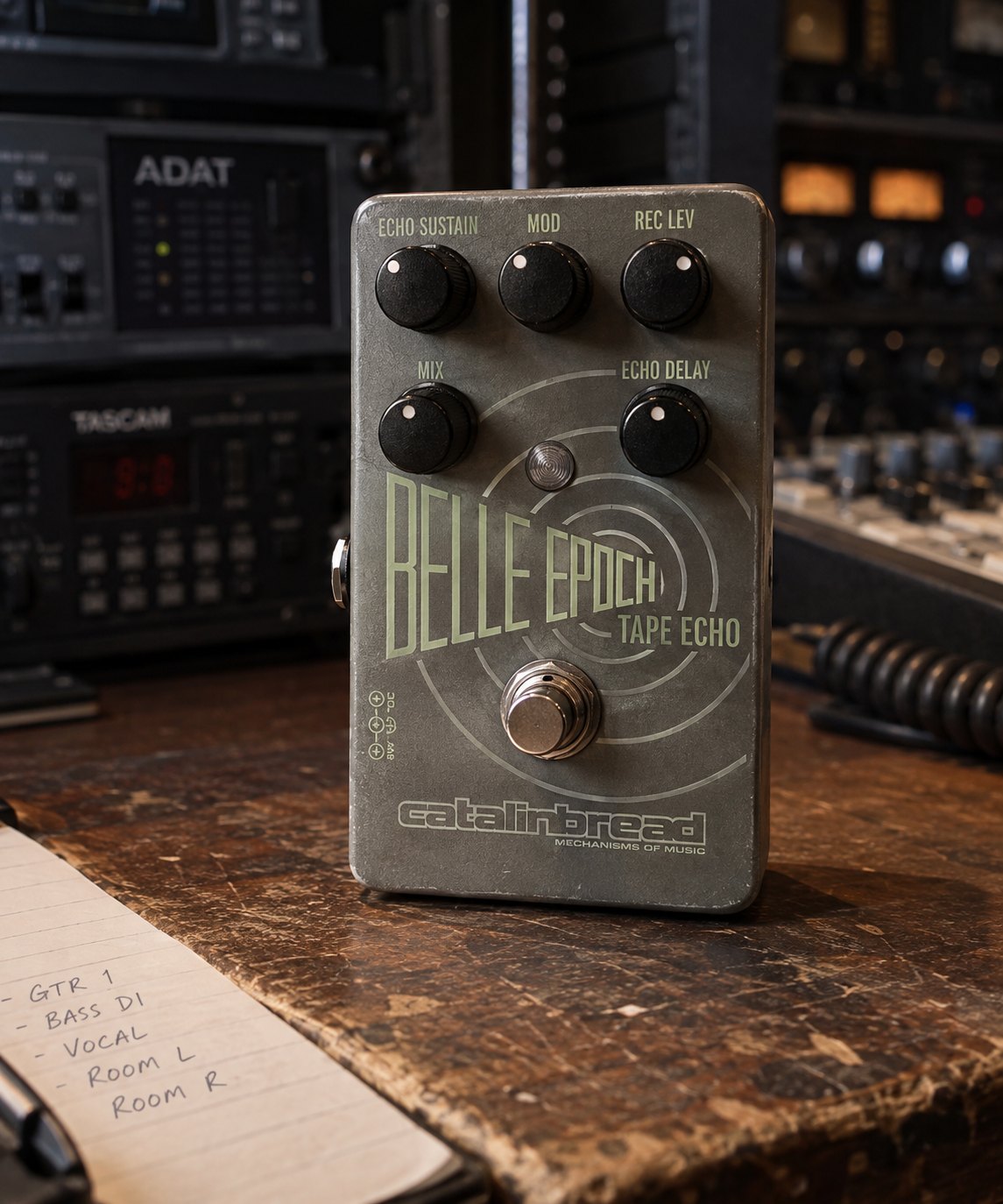
The controls tell you immediately which machine you are operating. There are five knobs, and four of them are the EP-3’s own controls under their own names:
- Echo Sustain — the feedback control. The number of repeats. Minimum to roughly noon gives you a fixed number of repeats with a decay curve that tapers rather than stops; past noon you move into floating, near-infinite repeats and then into self-oscillation.
- Echo Delay — delay time. On the original this was a sliding lever that physically moved the record head along the tape path, and it was designed to be grabbed mid-song. The Belle Epoch’s knob is meant to be treated the same way.
- Rec Level — record level, the amount of signal being driven into the “tape.” On a real EP-3 this was a screwdriver-adjusted internal trim. Catalinbread put it on the face, which is arguably the single most useful decision in the design.
- Mix — the EP-3’s Echo Volume, running through the same style of passive mixer topology. Fully counter-clockwise is dry only; fully clockwise is wet only.
- Mod (labelled Sway on some literature) — the amount of wow and flutter. At minimum there is none.
That fifth knob is where the pedal wins. Almost every tape-echo emulation on the market generates its warble with a low-frequency oscillator, which means the pitch drift is periodic and, once you have heard it a few times, predictable. Real tape does not do that. Real tape drifts because a rubber pinch roller is slightly out of round, because a motor bearing has forty years of dust in it, because the tape itself has stretched unevenly. The result is quasi-random. Catalinbread modelled the randomness, and reviewers noticed immediately: writing in Guitar Magazine in June 2015, Huw Price called the Mod control “the Belle Epoch’s crowning glory,” observing that it “shifts the pitch in a seemingly random fashion” and generates “quirky little surprises — almost as if there’s something unexplained going on inside.”
Ten years later, that is still the differentiator. It is not the delay quality. Everyone can do a dark repeat now. It is the fact that the wobble does not loop.
Where It Came From: Portland, a Kitchen Table, and a Tragedy
Catalinbread was born in 2003 on Nic Harris’s kitchen table in Seattle, in the years just before “boutique” became a category with a marketing budget attached. The company’s own account is refreshingly unromantic about how it got going: the first Catalinbread-branded pedal was the Super Chili Picoso, a fur-lined overdrive built exclusively for a Seattle guitar shop called ToneFactor, and the money from that first run paid for the more adventurous designs that followed. By 2006 the operation had outgrown both its business model and its premises and relocated to Portland, Oregon, where it has stayed. The company today lists over thirty pedals, all assembled by hand, one at a time.
The Belle Epoch arrived in the first half of 2015. Catalinbread do not publish a launch date, but the review record gives a firm anchor: Guitar Magazine ran a joint review of the Belle Epoch and the Topanga spring reverb on 29 June 2015, treating both as new products, which places the release in the NAMM-to-summer window of that year. The two pedals were designed as a matched pair in more than marketing terms — both are hybrid designs with discrete front ends, both offer a switchable buffered mode with an always-on preamp, and both target one named vintage box rather than a category.
Then, on 9 March 2016, Nicholas Harris was killed. He was driving on U.S. 26 in Portland during a windstorm when a tree came down onto his car. He was 37. The news was carried by Vintage Guitar, MusicRadar, Reverb and Portland’s Willamette Week, all of which reached for the same two pedals when they needed to explain to a general readership what the man had built: the Echorec and the Belle Epoch. Less than a year after release, the Belle Epoch was already the pedal his company was known for.
Catalinbread continued. In March 2020 the company announced new ownership — Kyle Sears and Brandon Rush, Pacific Northwest natives, touring musicians and studio owners, who bought the brand with a stated commitment to keeping it hand-built and locally run. Under that ownership the Belle Epoch has stayed in the catalogue unchanged, at a price that has crept up only modestly, while the family around it has grown.
The Family: Belle Epoch, Deluxe, and the Belle Epoch +
This is the part where buyers get confused, and where a lot of secondhand listings are quietly wrong. There are three distinct products with similar names, and they are not interchangeable.
The Belle Epoch — the subject of this article — is the compact one. Standard-ish enclosure, five knobs, one footswitch, 9 V to 18 V, internal trimpot, internal bypass-mode switch, $209.99 direct at time of writing. It is a hybrid: analog preamp and mixer, digital delay line, EP-3 voicing.

The Belle Epoch Deluxe (catalogued as the CB-3) is a substantially larger machine, and Catalinbread’s claim for it is not “inspired by” but a part-for-part reproduction of the EP-3’s circuitry — the 22-volt rail, the later-spec JFET preamp, the mixer stage, the high-gain silicon record and playback amplifiers, the feedback loop — with a 24-bit delay line standing in for the tape cartridge. It generates that 22 V rail internally from a 9 V supply, which is why it demands at least 200 mA where the compact model is content with 60 mA. It adds six Echo Programs (only the first is stock EP-3; the rest give dark analog, rotary, resonant-filtered and two Memory Man-flavoured modulation voices) and takes an expression pedal.
The Belle Epoch +, announced 15 November 2025, is the compact format again with the feature the original conspicuously lacked: full tap tempo, entered by holding the footswitch. Catalinbread also list more headroom, a redesigned Mix control, improved buffered bypass, light noise gating, better impedance specs, and — the genuinely new idea — three modes corresponding to virtual tape wear, from a pristine unit fresh off the line to one that has been “sitting in an attic for 40 years.”
All three remain relevant. Want the sound and the smallest footprint: the original. Want the circuit and the modes: the Deluxe. Want the sound plus tap tempo: the +. The original is the one with ten years of stage history behind it, and it is the one this article is about.
Specifications
A note on the delay-time discrepancy
Catalinbread’s own literature does not agree with itself on maximum delay time, and it is worth flagging rather than papering over. The current spec table on the product page states a maximum of approximately 700 ms. The launch-era documentation, the manual and every contemporary review state that the pedal covers the Echoplex range of 80 ms to 800 ms — the 800 ms figure being the whole point, since it is the EP-3’s own maximum with the head slid fully back.
Both figures are first-party. Our reading is that 800 ms is the design target quoted at launch, while ~700 ms is a more conservative measured figure that crept into the later spec sheet — a production tolerance, or a different definition of where the knob’s usable travel ends. In practice you will notice the difference only if you are matching a click. If your use case genuinely depends on the last hundred milliseconds, buy from a dealer with a return policy and measure it yourself.
Why the Preamp Is Half the Pedal
Most people buy a tape-echo pedal for the echo. With an Echoplex, the echo was arguably the less influential half.
The EP-3’s preamp — a discrete, transistor-based stage the signal passed through whether or not the echo was engaged — adds a broad push in the upper midrange and a little harmonic thickening. Players in the seventies discovered that leaving an Echoplex switched on with the echo turned all the way down made an amp sound better, and that doing it in front of an already-cooking amp made it sound a great deal better. That is the origin of the entire “Echoplex preamp boost” genre, and it is why the Xotic EP Booster exists as a standalone product with a level control and no delay whatsoever.
Catalinbread built that preamp into the Belle Epoch, discretely, with no op-amps or buffer stages in the dry path — then gave you a way to keep it running when the delay is off. Flip the internal switch from true bypass to trails and two things change: repeats decay naturally instead of being guillotined, and your dry signal routes through the preamp permanently. Huw Price described the effect in 2015 as adding “warmth” and enhancing “the upper mids.”
That changes where the pedal belongs. In true bypass it is a delay and lives wherever your delays live. In trails mode it is a delay and a permanently-engaged tone stage, and it should sit where you want that colour applied — for many players earlier than they would normally put an echo.
And it explains Eric Johnson’s rack. He kept the Echoplex chassis because he wanted the preamp; he removed the tape because tape on tour is a nightmare; he added a Belle Epoch because it does both jobs in a box that weighs six and a half ounces. The Belle Epoch is not replacing the Echoplex in that rig. It is doing the same two jobs the Echoplex does, in parallel with it.
Famous Players — Verified, and Honestly Qualified
Delay pedals attract dubious artist lists. Ours is short because we only count a player when the pedal is named in body copy next to a photographed or filmed board in a published rundown, on a manufacturer artist page, or in a direct interview quote. Here is what survives that bar.
Eric Johnson — named, quoted, and the reason the pedal sells
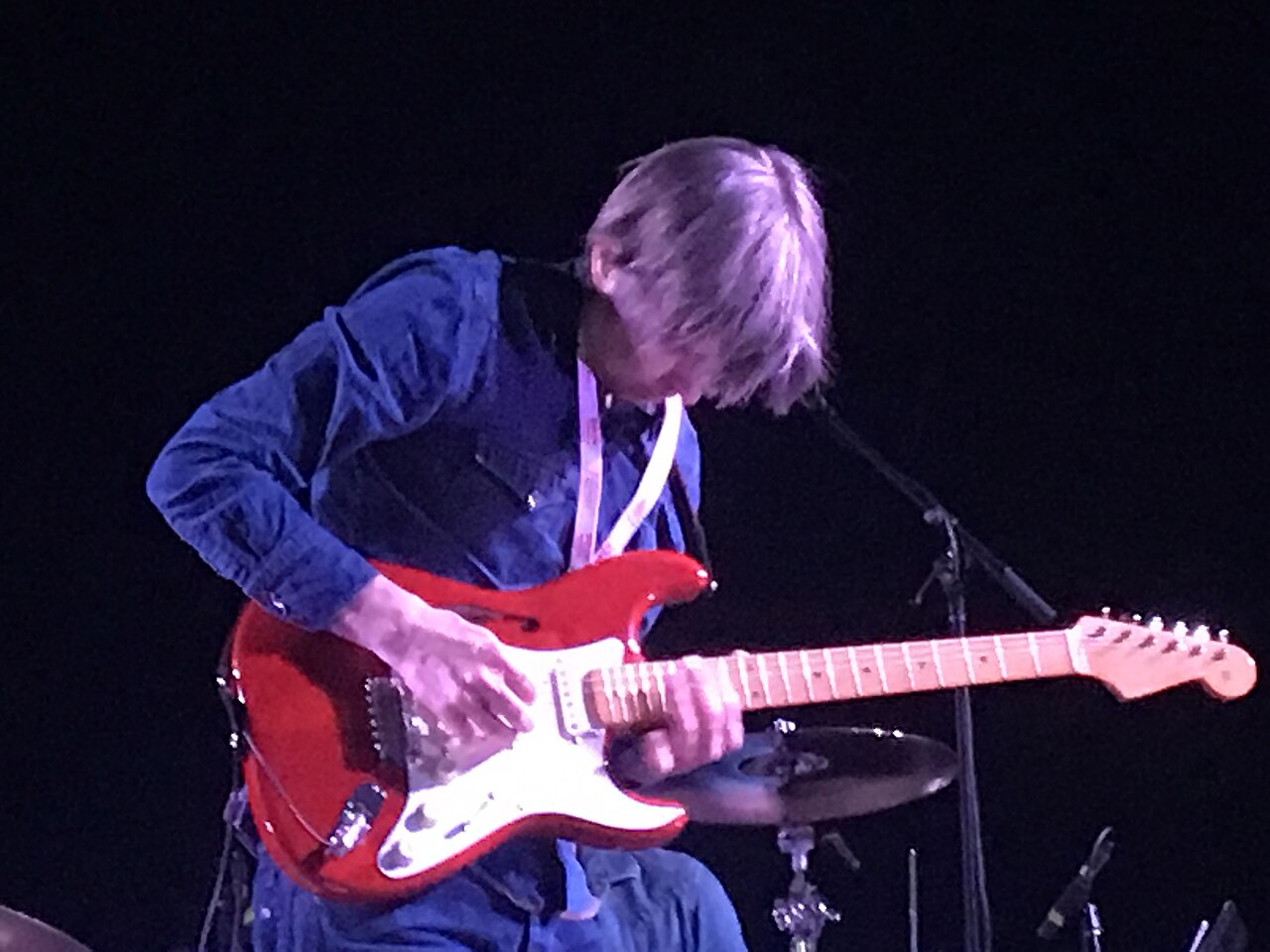
Eric Johnson‘s association with the Belle Epoch is the strongest artist link any Catalinbread product has, and it is documented twice over. Catalinbread publish his endorsement verbatim on the product page: “The Catalinbread Belle Epoch is the closest thing to a real EP-3 that I’ve ever played.” Separately and independently, Premier Guitar‘s Ted Drozdowski documented the pedal in Johnson’s touring rig in a Rig Rundown filmed at Nashville’s City Winery and published on 4 April 2018.

The detail in that Rundown is what makes it valuable. Johnson was on the road reproducing Ah Via Musicom and had revived his original late-eighties pedalboards to do it. Behind the amps sat two Echoplexes modified by Bill Webb of Austin Vintage Guitars, who had removed the tape loops and bypassed them so that Johnson could route other effects through the Echoplex chassis and still get, as PG put it, “the sweetening the devices’ preamps deliver.” Into that arrangement went a Catalinbread Belle Epoch Tape Delay and a pair of MXR Digital Time Delays, plus a TC Electronic Stereo Chorus+ Pitch Modulator & Flanger.
The rest of the rig, for context, is a museum: two signature Thinline Stratocasters, a 1954 Strat carrying the bridge pickup from the guitar used on the original “Cliffs of Dover,” a Two-Rock Traditional Clean and a 1969 50-watt Marshall plexi among four amps, and boards holding a Dunlop Cry Baby, a B.K. Butler Tube Driver, a sixties Dallas-Arbiter Fuzz Face, a vintage Ibanez TS-808 and a loop box for an Electro-Harmonix Deluxe Memory Man.
A player who will fly two gutted Echoplexes across America for their preamps, and who owns the pickup out of the “Cliffs of Dover” guitar, does not add a $200 pedal casually. That is the endorsement, and it is not a paid one in any sense we can detect — it reads as a man reporting a finding.
Doug Pettibone — a working board, in 2025
Ten years after launch, the Belle Epoch is still being brought to gigs by people who make their living at it. In a Rig Rundown filmed at Nashville’s Basement East ahead of Lucinda Williams’ 15 December fundraiser show and published on 24 December 2025, Premier Guitar‘s John Bohlinger documented Doug Pettibone’s pedalboard: a Sarno Earth Drive, a Durham Electronics Crazy Horse, a Keeley-modded Boss BD-2, a Boss TR-2, a Mad Professor Silver Spring Reverb, and a Catalinbread Belle Epoch, all powered by a Strymon Zuma.
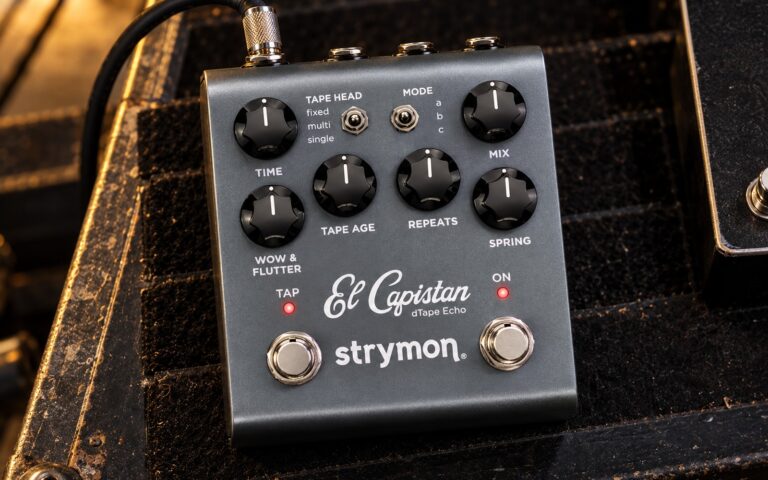
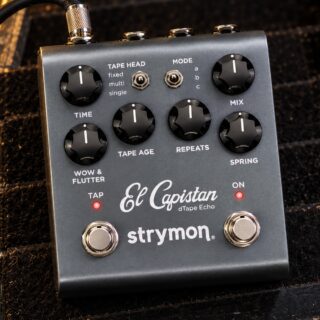
Pettibone plays both six-string and pedal steel in Williams’ band — a 1999 Emmons he ordered new while working with Jewel, run through a ’64 Fender Twin Reverb with a seventies JBL fifteen, with a Strymon El Capistan for delay duty on that side of the rig. His guitars go into a ’68 Deluxe Reverb with a Celestion Greenback. Note the split: El Capistan on steel, Belle Epoch on guitar. That is a working professional choosing two different tape emulations for two different jobs on the same stage, and it is a more informative data point than any amount of marketing copy.
Marc Ford — same stage, different pedal
In that same Rundown, Marc Ford’s board is documented running a D’Addario tuner, BMF Effects Marc F’n Ford and Ge Spot, an Analog Man Sun Face, a Satellite Fogcutter, a White Amp Emulator, a Jonny Two Bags, an MXR Phase 45, an Analog Man ARDX20 — and a Catalinbread Belle Epoch Deluxe.
We are naming him because the distinction matters. The source specifies the Deluxe, which is a different pedal with a different circuit, a different power requirement and six echo programs the compact Belle Epoch does not have. It would be easy and slightly dishonest to fold Ford into a list of Belle Epoch users. He is a Belle Epoch Deluxe user, and if you are buying a compact Belle Epoch on the strength of his tone, you are buying the wrong box. This is a recurring trap with any pedal that has version variants, and the fix is always the same: check whether your source named the exact version.
What we could not verify
The Belle Epoch turns up constantly in social-media board shots and crowd-sourced gear databases attached to far more famous names than the three above. We have included none of them. An undated photograph on an aggregator tells you a pedal was on a board at some unknown point — possibly a rehearsal, possibly borrowed, possibly the tech’s — not that the player uses it, and certainly not which version it was.
What we can say is broader and more useful: the Belle Epoch’s constituency is not the ambient-soundscape crowd. It is Americana, country, blues and classic rock — players who need slapback and short echo to sit inside a band mix unnoticed, working next to a pedal steel or a Deluxe Reverb rather than a modular synth. Both verified users fit that profile exactly.
The Echoplex Lineage — and an Important Distinction
Be precise about the claim: the players below used actual Echoplexes. They are ancestors of this sound, not owners of this pedal, and nothing here should be read as an artist endorsement of a Catalinbread product.
Jimmy Page ran an Echoplex for both its echo and its preamp gain, and the Rec Level knob is your route to that chewy, slightly fizzy repeat. Eddie Van Halen‘s use of an EP-3 as a permanently-engaged front-end boost is the most influential piece of “leave it on and turn the echo down” folklore in the instrument’s history. The Edge built an architecture out of tape-style repeats, though his rhythmic precision needs the tap tempo this pedal lacks. Andy Summers, Brian May, David Gilmour, Alex Lifeson and Duane Allman all worked in a period when a tape echo was simply what you used, and the wobble in their recorded repeats is what the Mod knob exists to reproduce.
What the Belle Epoch gets you is the quality those records share: repeats that lose top end progressively rather than all at once, that drift in pitch just enough to smear against the dry note, and that sit down in a mix instead of on top of it.
Tone Recipes and Settings
Nashville slapback (the everyday setting)
Echo Delay 8 o’clock (roughly 90–130 ms) · Echo Sustain 7–8 o’clock (one repeat, maybe a ghost of a second) · Rec Level 11 o’clock · Mix 9 o’clock · Mod 8 o’clock.
The setting this pedal is best in the world at, and the one both verified users are almost certainly running most of the night: a single repeat arriving fast enough to read as thickening rather than echo. Keep Mod low but not off — a little drift is what stops the repeat phasing against the dry note. If it sounds like doubling rather than delay, you have it right.
Eric Johnson lead trail
Echo Delay 1 o’clock (400–500 ms) · Echo Sustain 11 o’clock · Rec Level 10 o’clock · Mix 9–10 o’clock · Mod 9 o’clock · internal switch set to trails.
Three or four repeats falling away smoothly behind a violin-y lead tone, with the preamp permanently in circuit doing the upper-mid lift. Keep Mix low — the classic mistake is making the delay audible as an effect when it should register as depth. Keep Rec Level conservative too, since you are feeding this from an overdrive and the repeats grit up fast.
Broken tape machine
Echo Delay 3 o’clock · Echo Sustain 1 o’clock · Rec Level 3 o’clock · Mix noon · Mod maximum.
Long, saturated, seasick repeats that pitch-drift unpredictably. This is where the random modulation earns its keep: an LFO-based emulation at this depth sounds like a chorus pedal, while the Belle Epoch sounds like something is physically wrong with the machine. Excellent under sustained chords, unusable under fast lines.
Ambient bloom (the reverb impersonation)
Echo Delay 9–10 o’clock · Echo Sustain 2 o’clock · Rec Level 9 o’clock · Mix 11 o’clock · Mod 11 o’clock.
Short delay time plus high sustain equals a dense, three-dimensional wash that reads as a small dark room rather than as discrete repeats. Price described it in 2015 as “a short and bathroom-y reverb that’s eerily three-dimensional,” which is exactly right. Useful if you want ambience without adding a reverb pedal to the board.
Preamp only
Mix fully counter-clockwise · internal switch set to trails · internal trimpot adjusted to taste · pedal engaged.
Everything else is irrelevant. This is the EP-3-boost trick — a permanently-on upper-mid lift with the delay muted — and it is a legitimate use of the pedal.
Self-oscillation, played as an instrument
Push Echo Sustain past 2 o’clock until the pedal starts feeding on itself, then sweep Echo Delay by hand. The pitch of the runaway repeats follows the knob, producing dive-bombs and sci-fi swoops. Set Rec Level high to make it dirtier as it builds. It is the same trick people played on real Echoplexes with the head slider, and it is the reason the Belle Epoch’s delay knob has a smooth, unstepped taper.
The Belle Epoch has no presets, no menus and no display, which means every setting below is a starting point you dial by ear in about fifteen seconds. Clock positions assume a standard sweep with noon at twelve.
How It Compares
Belle Epoch vs Strymon El Capistan
The Strymon El Capistan is the obvious rival and the two are not really competing. El Capistan models tape echo as a category, offering fixed, multi-head and single-head modes with deep secondary parameters for tape age, bias, wow and flutter — plus tap tempo, presets on the V2, and stereo. It is a toolkit. The Belle Epoch is one machine, done convincingly, with five knobs and no menu. If you need three different tape sounds across a set, El Capistan. If you need one, live in it, and want to grab the delay time mid-solo without thinking, Belle Epoch. Doug Pettibone runs both on the same stage for different instruments, which tells you they coexist rather than replace each other.
Belle Epoch vs Strymon Volante
The Volante models drum, tape and studio machines with multiple virtual heads and a looper. It is bigger, dearer and far more capable — and it demands far more of your attention. The Belle Epoch does one narrow thing at a quarter of the size.
Belle Epoch vs Boss RE-2 Space Echo
The Boss RE-2 models a different machine entirely — the Roland RE-201 drum echo, with its multiple playback heads and its own spring reverb. The RE-201 sound is bouncier and more rhythmically complex; the EP-3 sound is a single, dark, singular repeat. Neither is a substitute. If you have heard both and cannot decide, the honest test is whether the delay you hear in your head has one repeat pattern or several overlapping ones.
Belle Epoch vs Boss DM-2W and MXR Carbon Copy
The Boss DM-2W and the MXR Carbon Copy are genuine bucket-brigade analog delays. They are darker still, shorter, and their character comes from BBD noise and filtering rather than from tape mechanics. Neither has a record-level control, and neither can do the Belle Epoch’s specific chewy preamp saturation. Conversely, neither has a digital delay line to argue about, and both are cheaper. If your objection to the Belle Epoch is philosophical — you want no conversion in the delay path at all — those are your pedals.
Belle Epoch vs Electro-Harmonix Deluxe Memory Man
The Deluxe Memory Man is the other great analog delay with modulation, and its chorus-vibrato is lush and periodic where the Belle Epoch’s is random and mechanical. The Memory Man swims; the Belle Epoch wobbles. Eric Johnson, tellingly, carries both.
Belle Epoch vs Belle Epoch +
If tap tempo matters to you at all, buy the +. That is the entire analysis. The compact Belle Epoch’s absence of tap tempo is its one genuine functional limitation, and Catalinbread spent a decade before addressing it. The + also brings the tape-wear modes and the improved bypass. The original’s counter-argument is price on the used market and ten years of proven reliability.
Belle Epoch vs a real EP-3
A working EP-3 in good order costs multiples of the pedal and needs servicing, tapes and a plan for when it eats one at a gig. It will also do things no model fully captures. The counter-argument is Eric Johnson’s, and it is a strong one: he owns real Echoplexes, had them modified by a specialist, and still put a Belle Epoch in the rig.

Buying Guide
Power it properly, and consider 18 volts
The Belle Epoch draws 60 mA and accepts 9 V to 18 V DC, centre negative, on a standard 2.1 mm barrel. That range is not decoration. At 18 V the discrete preamp and mixer have more headroom, which matters when you feed the pedal from a boost, an overdrive or active pickups; at 9 V with Rec Level high it grits up sooner. Neither is wrong — they are two voicings, and trying both costs nothing but an output on your supply. Avoid a daisy chain shared with digital pedals: it is a quiet box by nature, and most noise complaints trace back to unisolated power.
Decide the bypass question before you glue it down
The true-bypass-versus-trails switch is inside the enclosure, so you will need a screwdriver and you will need to lift the pedal off your board. Decide before you commit to a layout. Our recommendation for most players is trails: natural decay when you switch off, and the preamp permanently in circuit, which is closer to how an Echoplex behaved in a real seventies rig. Choose true bypass if you run a long chain of unbuffered vintage pedals and need the pedal to vanish completely.
The internal trimpot is not optional
There is a second internal adjustment: a gain and volume trimpot that sets the level of the preamp stage. Out of the box it is set to a sensible middle value, but the correct setting depends entirely on what is feeding the pedal and what it is feeding. If you use trails mode and find the pedal is pushing your amp harder than you want when it is “off,” this is the control that fixes it. Adjust in small increments with the pedal powered and the amp at playing volume.
Placement
Delays generally go late, but because of the preamp the Belle Epoch in trails mode is also a tone stage — there is a real argument for placing it after your dirt but before modulation and reverb, so the preamp colours the guitar rather than a wash of other effects. It works in an amp effects loop too, where the preamp behaves more like a level control than a boost.
New, used, or a different version
At $209.99 direct, with a three-year warranty and free domestic shipping from Catalinbread’s own store, there is little reason to chase a marginal used saving on a current-production pedal — though the used market is worth watching for the discontinued colourway variants, which are electrically identical. Be alert on listings: sellers routinely describe a compact Belle Epoch as a “Deluxe” and vice versa. The Deluxe is visibly much larger and has a mode selector. Count the knobs and read the faceplate before you bid.
Living With One
The Belle Epoch is one of the least demanding pedals you can own, and that is genuinely part of its appeal. It weighs 0.40 lbs, occupies a footprint smaller than a Boss compact is deep, has no firmware, no menu, no MIDI, no battery door to lose and nothing to update. Catalinbread’s warranty is three years, the company is small enough to answer email, and repairs go back to Portland.
The maintenance story is where it beats the machine it models by an embarrassing margin. A real EP-3 needs tape cartridges, head cleaning, head alignment, motor servicing, and a tolerance for the fact that it will eventually fail in front of an audience. The Belle Epoch needs a power supply.
Two things to know. First, the pedal is unashamedly mono — one input, one output, no stereo mode in any version of the compact model. Second, at the extremes it is loud: self-oscillation with Rec Level high produces output well above unity, so if you are prone to grabbing the sustain knob mid-song, know where your master volume is. Resale has been steady, which is not a small consideration when you are buying a pedal that deliberately does one thing.
Frequently Asked Questions
Is the Catalinbread Belle Epoch analog or digital?
Both, deliberately. Preamp, mixer and dry path are discrete analog with no op-amps or buffer stages; the delay line is digital. Catalinbread confine the digital section to the one task it does best — storing and replaying audio without tape maintenance — and build everything that gives the EP-3 its character in analog. If you want a fully analog bucket-brigade delay instead, look at the DM-2W or the Carbon Copy.
Does it have tap tempo?
No. Catalinbread addressed this in November 2025 with the Belle Epoch +, which adds full tap tempo entered by holding the footswitch. If you play to a click, buy the +. Reviewers of the original argued that tape echo sits in a mix without needing to match tempo, so you miss it less than you expect — true, and also not much help if your band uses in-ear clicks.
What is the actual maximum delay time?
Catalinbread’s launch documentation and every contemporary review state 80 ms to 800 ms, matching the EP-3. The current spec sheet on the product page says approximately 700 ms. Both are first-party figures and we have flagged the discrepancy rather than pick one. Assume you have somewhere between 700 and 800 milliseconds and treat the top of the range as approximate.
What does the Rec Level knob actually do?
It sets how hard the signal hits the virtual tape. Low settings give cleaner, defined repeats; high settings drive the record stage into a chewy, slightly fizzy saturation instantly recognisable from seventies records. On a real EP-3 this existed but was buried inside as a screwdriver trim. Putting it on the front panel is the control that separates the Belle Epoch from generic tape emulations.
Should I run it at 9 V or 18 V?
Either is safe. 18 V gives more headroom in the preamp and mixer, which keeps repeats cleaner and more defined when you are feeding the pedal from boosts and overdrives. 9 V breaks up sooner, which some players prefer. Current draw is 60 mA in both cases. Try both — it is free.
True bypass or trails: which should I use?
Trails, for most people. The repeats decay naturally instead of being cut off, and the discrete preamp stays in your signal path permanently, adding the upper-mid lift that made players leave Echoplexes switched on in the first place. Use true bypass if you need the pedal to be electrically invisible when off. The switch is internal, so decide before you mount the pedal.
Can I use it as a preamp or boost on its own?
Yes. Set Mix fully counter-clockwise, switch to trails, adjust the internal trimpot, and you have a permanently-engaged Echoplex-style preamp with the echo silent — the trick that spawned the Xotic EP Booster. If boost is all you want, a dedicated pedal is cheaper; if you want boost and delay from one enclosure, this works well.
Who actually uses one?
Two players are documented by Premier Guitar with the compact Belle Epoch named next to a photographed rig: Eric Johnson (2018 Rig Rundown, alongside two tape-less modified Echoplexes) and Doug Pettibone of the Lucinda Williams band (December 2025 Rig Rundown). Johnson is also quoted directly on Catalinbread’s product page. Marc Ford, on the same 2025 Rundown, uses the larger Belle Epoch Deluxe — a different pedal, which we have not counted as a Belle Epoch credit.
Belle Epoch or Belle Epoch Deluxe?
The Deluxe is a part-for-part reproduction of the EP-3 circuit with a 22 V internal rail, six echo programs, expression control and a 200 mA appetite. The compact model delivers the core EP-3 voice in a fraction of the space on 60 mA. Board space tight, or only want the one sound: compact. Want rotary and filtered repeat modes plus expression: Deluxe.
The Verdict Nobody Asked For
The Belle Epoch is a pedal with one idea, executed with unusual conviction, and left almost entirely alone for ten years. It has no presets because the machine it models had none. It has no tap tempo because the machine it models had none. It has a record-level knob on the front panel because the machine it models buried that control inside and Catalinbread decided that was a mistake worth correcting. Every design choice in it is an argument about a single 1970s tape unit, and the arguments are good ones.
What makes it endure is not the endorsement, though the endorsement helps. It is that the pedal solved a problem completely and then stopped. Eric Johnson still tours real Echoplexes for their preamps and lets a Belle Epoch handle the echo. Doug Pettibone puts one on a working country board in 2025 next to a Strymon and gives them different jobs. That is what a finished design looks like: not the most capable delay on the shelf, but the one you stop thinking about.
Image credits
- Eric Johnson: Jud McCranie, Wikimedia Commons, CC BY-SA 4.0.
- Eric Johnson: Ejmerch, Wikimedia Commons, CC BY-SA 4.0.
- Top image: GuitarGangsters AI-generated reference illustration, not a photograph.
- Eric Johnson: Ian Abbott, Wikimedia Commons, CC BY 4.0.
- Marc Ford: Michiel1972, Wikimedia Commons, CC BY-SA 3.0.
Latest News
Related
On This Day
Monday 9 November
From this week: