Marshall Origin 50H: Fifty Watts of Vintage Truth in a Modern Box
Marshall Origin 50H guide: specs, Powerstem modes, Tilt control explained, tone recipes, honest artist info, buying tips for the 50W EL34 tube head.
There’s a moment in every serious guitarist’s life when the chase ends. When you stop hunting for the amp with a thousand features and realize what you actually needed was something simpler — an amp that breathes with you, responds to your fingers, and sounds like a Marshall is supposed to sound. The Marshall Origin 50H is built for that moment. Fifty watts of pure EL34 power, a single channel with a killer gain boost, a Tilt control that conjures the blended voicings of the original four-input Marshalls, and Powerstem technology that lets you crank the thing at civilized volumes. No digital frills, no modeling, no compromise. Just the voltage, the valves, and you.
Released in April 2018 alongside the Marshall Origin 20H, the Origin 50H occupies the upper tier of Marshall’s purist return-to-form Origin series — a line that declared, loud and clear, that the company knew exactly what people loved about its classic amps and intended to deliver precisely that in a practical, giggable package. While the 20H sibling targets practice rooms and recording studios with its whisper-quiet 0.5W mode, the 50H is unambiguously a stage animal. Its lowest Powerstem setting is still 5 watts — enough for a rehearsal room, but designed by a company that expects this amp to be heard over a drum kit.
It is not a high-gain amp. It is not a Swiss Army knife. What it is, is the purest distillation of vintage British tone available at its price point in 2026 — a head that rewards players who understand that the amp is only half of the sound equation and that the other half lives in your hands.
The Origin of the Origin: Why Marshall Built This Amp
By the mid-2010s, Marshall’s lineup had grown complex. The JVM series offered multiple channels and MIDI switching. The DSL and TSL families covered gain stages from clean to scorching. The CODE series added digital modeling to the mix. All of it served genuine market needs. But a vocal and passionate corner of the guitar world kept returning to a different question: what happened to the amp that Eric Clapton used on those Bluesbreakers sessions? What happened to the JTM45 that plugged into a 4×12 and made Jimi Hendrix sound like the most dangerous man alive?
The Origin series was Marshall’s answer. Designed to capture the essential architecture of those early models — the four-input input stage, the EL34 power section, the simple EQ topology, the harmonic interaction between preamp and power amp that made vintage Marshalls alive in a way that spec sheets still struggle to capture — the Origin line strips away everything that isn’t absolutely necessary. No reverb tank. No effects loop switching matrix. No channel footswitching. One input, one channel, a handful of controls, and an enormous amount of soul.
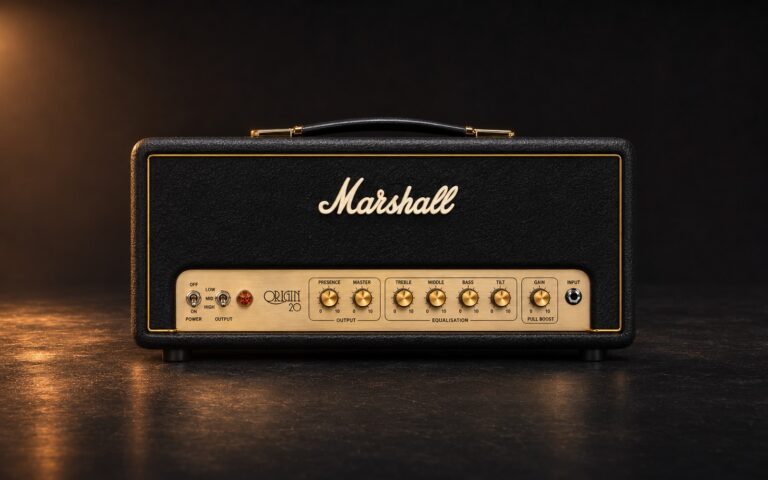
The 50H arrives in the classic black tolex and chrome trim that Marshall has used since the 1960s. It looks, visually, like it belongs on a stage next to a Gibson Les Paul Standard and a stack of 4×12 cabs — because that’s exactly the context it was designed for. The front panel is clean and immediately legible: Gain, Tilt, Bass, Middle, Treble, Presence, and Master, with the Powerstem selector and the Boost footswitch indicator rounding things out. No mystery knobs, no unlabeled trim pots. You know what everything does the moment you look at it.
Under the Hood: Circuit Architecture and Specifications
The Marshall Origin 50H runs three ECC83 tubes in the preamp section and two EL34 tubes in the power amp section. EL34s are the quintessential British power tube — they push differently than the American 6L6, with a vocal midrange character, earlier compression, and a particular harmonic richness in the upper partials that defined the sound of classic rock, hard rock, and blues for five decades. The ECC83s (identical to the American 12AX7) drive the preamp stages including the Gain Boost circuit and the send side of the series effects loop.
The power output is switchable via the Powerstem system, a rear-panel toggle that offers three positions: High (50W), Mid (approximately 10W), and Low (approximately 5W). Like the system in the Origin 20H, Powerstem works by reducing the voltage rails around the power amp section rather than switching between pentode and triode configurations. The result is that the EL34s maintain their push-pull configuration and their characteristic saturation behavior across all three settings — you’re getting genuine power amp compression and EL34 character at 10W and 5W, not an approximation of it through a resistive load. This is a mechanically and sonically different approach from using a power attenuator, and the difference is audible: the amp feels alive at lower wattages in a way that passive attenuators typically can’t fully replicate.
The speaker outputs consist of three 1/4″ jack sockets supporting 8-ohm and 16-ohm loads, plus a speaker-emulated DI output on a 1/4″ jack for direct recording or PA feed. The footswitch included is the PEDL-90016, a two-button unit that controls the Gain Boost and the effects loop — both on/off functions, making the Origin 50H genuinely controllable for live performance without spending extra on switching gear. The effects loop itself is series-type with standard 1/4″ Send and Return jacks.
The Controls Explained: Tilt, Boost, and Powerstem in Depth
Three of the Origin 50H’s controls deserve special attention because they’re either unique to the Origin series or frequently misunderstood in online discussions.
The Tilt control is the Origin’s most distinctive feature. It blends between two voicings derived from the classic four-input Marshall input stage. Fully counterclockwise, you’re in Normal channel territory — warm, bass-forward, compressed, the tone of a vintage Bluesbreaker at moderate gain. Fully clockwise, you’re in High Treble mode — bright, presence-forward, cutting, the sound of a Plexi with the treble input selected. The middle position blends both, which is exactly what players who jumped cables between inputs on 1960s Marshalls were after. The clever engineering here is that you get continuous control over that voicing blend with a single knob, rather than rearranging cables mid-set. It gives the amp a tonal flexibility that belies its single-channel simplicity.
The Gain Boost is a footswitchable second gain stage that adds significant dirt and sustain on top of whatever the Gain control is already doing. Its character leans toward warm harmonic saturation rather than modern high-gain compression — think lead tones and pushed-crunch rather than metal territory. At lower Gain settings with the Boost engaged, you get a convincing approximation of a cranked vintage Plexi sound without needing to live at stage-destroying volume levels. This is probably the most-used feature of the amp live.
Powerstem is best understood by what it isn’t. It is not a power attenuator placed after the power amp — those devices absorb power after amplification and convert it to heat, and they can affect the feel and dynamics of the amp. It is not a pentode-to-triode switch, which would halve your power tubes but change their operating class. Powerstem reduces the DC voltage supplied to the power amp section, which reduces the available headroom and lowers the wattage while keeping the EL34s in their normal push-pull configuration. The tubes still compress and saturate in the same way — you’re just pushing them to that point at a lower volume. At 5W, the Origin 50H is usable in a loud rehearsal room. At 10W, it’s workable for smaller venue gigging with careful speaker matching. At 50W, it’s a full stage amp that will project clearly in medium to large venues.
The Sound: What Does the Origin 50H Actually Do?
The Origin 50H’s core identity is clean-to-crunch British. With the Gain at nine o’clock and the Boost off, you get a remarkably transparent clean tone with just enough hair to remind you there are valves in the circuit — the kind of clean that responds to how hard you pick. Push the Gain to noon and Tilt toward the treble side, and you’re in classic British crunch territory: chimey, articulate, with that EL34 midrange bark that made Angus Young‘s SG-through-Marshall sound identifiable from thirty feet away.
Engage the Boost, and the character shifts considerably. The amp’s saturation deepens, sustain stretches out, and single-note lead lines start to bloom. This is the territory where the Origin 50H earns its stripes as a serious gigging amp — the Boost transforms it from a sparkling rhythm machine into a committed lead voice without requiring a separate channel or an overdrive pedal in the signal chain. That said, the amp responds beautifully to pedals too: a clean boost like the Boss SD-1 or an overdrive like the Ibanez TS-9 in front of it will push the front end into compressed, singing lead tones that rival amps costing three times as much.
The EQ section has enough range to dial in everything from scooped, airy Hendrix-adjacent cleans to midrange-forward classic rock crunch. The Presence control is particularly responsive — it affects the feedback path in the power amp and can dramatically shift the perceived attack and top-end sparkle without changing the fundamental tonal character. Bass-heavy single-coil players will find a different amp than Les Paul players, but both will find something to love.
What the Origin 50H does not do is high gain. If you want a convincing metal tone, a tight modern rhythm sound with aggressive palm muting, or the kind of crushing saturation you get from a Mesa Dual Rectifier or a Marshall JCM2000 DSL100, the Origin 50H will leave you wanting more. It is a vintage-voiced amp, and its gain topology reflects that lineage honestly. Boosted, it can get aggressive, but its character is always fundamentally warm and British rather than clinical and crushing.
Famous Players: An Honest Assessment
This is where transparency is more useful than mythology, so let’s be direct: the Marshall Origin 50H does not have a roster of major touring artists who have made it their primary live amp. Equipboard, which cross-references artist rigs against photos, videos, and documented sources, lists two confirmed users of the Origin 50H head — Keyan Zand and Nate Punty — neither of whom are stadium-level headliners. The Origin series as a whole leans toward working musicians, club-circuit players, and recording guitarists rather than the gear of choice for arena tours.
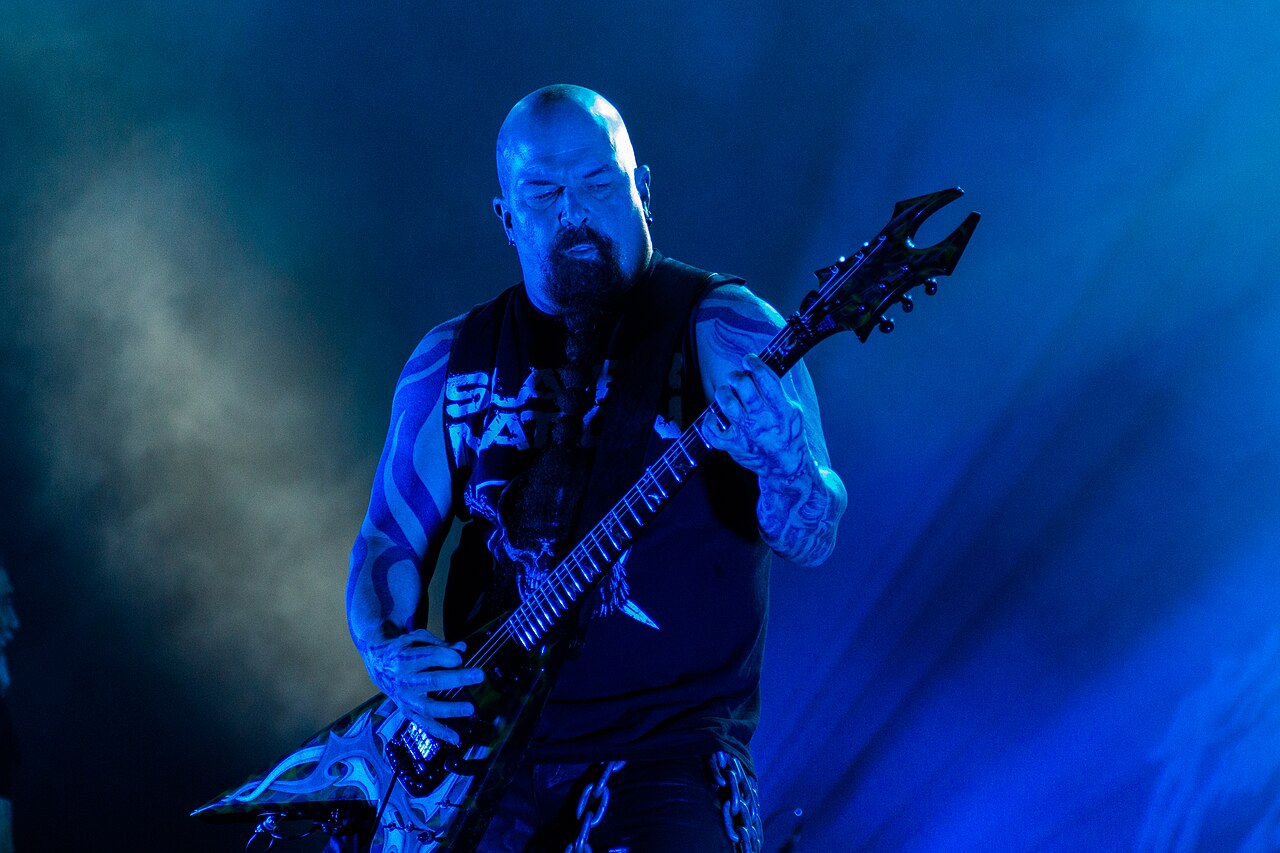
The spreadsheet of artist claims that floats around gear databases frequently lists Slash, Zakk Wylde, Kerry King, Gary Moore, and Tom Morello as Origin 50H users. None of these attributions hold up to independent verification. Slash is a documented Silver Jubilee and AFD100 player. Zakk Wylde has been playing JCM800 2203s and Wylde Audio signature models for decades. Kerry King built his sound on JCM800 2203s with active pickups and parametric EQ. Gary Moore passed away in February 2011, more than seven years before the Origin series was launched — a player cannot use an amp that postdates his death. Tom Morello’s rig is built around a JCM800 and custom signal processing that bears no resemblance to a single-channel vintage-voiced head.
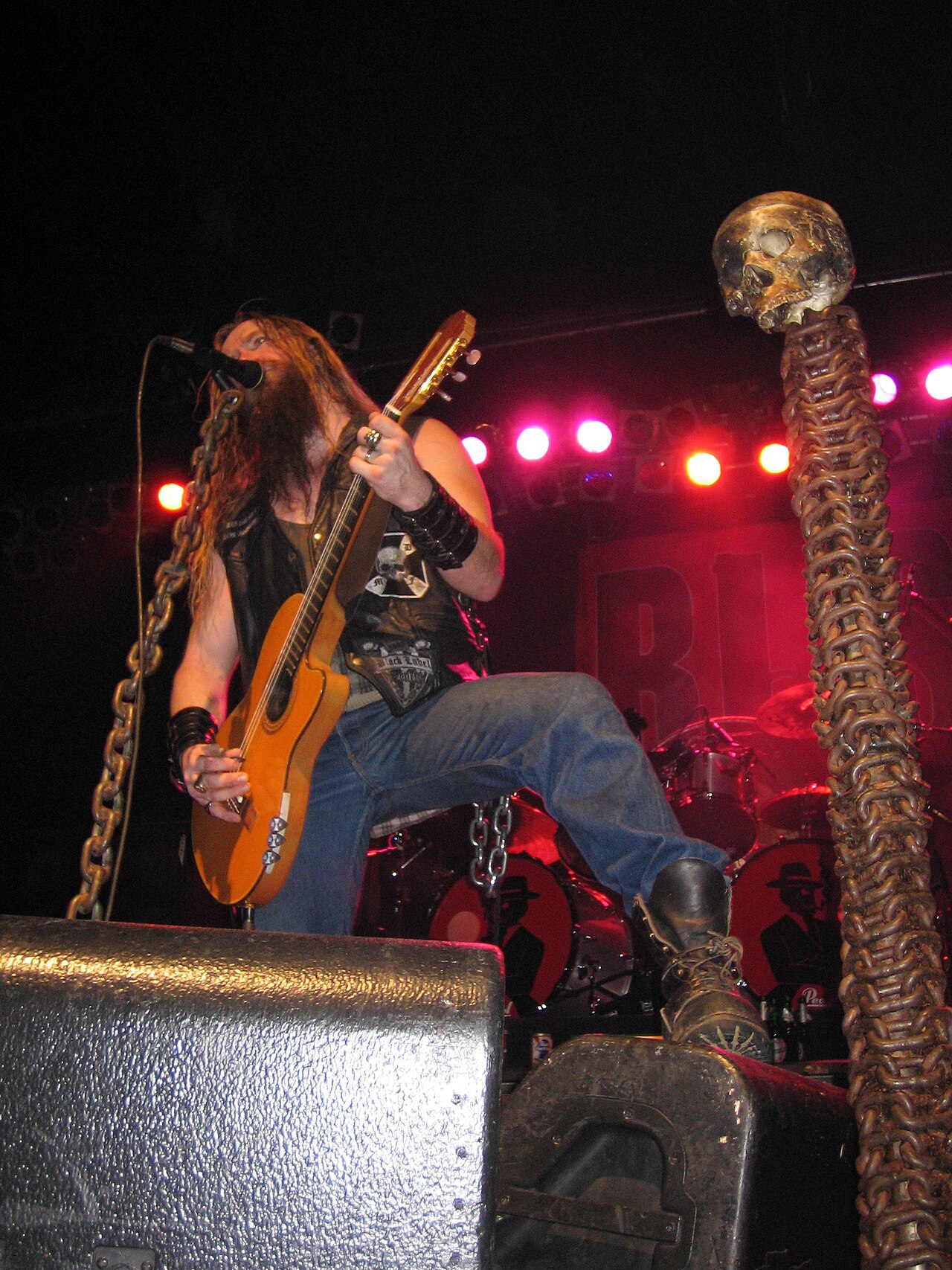
What matters more for context is the lineage the Origin 50H explicitly invokes. The amp’s circuit architecture is derived from the same family of early Marshall designs that gave Eric Clapton his Bluesbreakers tone, that Jimi Hendrix famously used at full volume at Woodstock and the Isle of Wight, that Pete Townshend wired through stacks of 4x12s to create the sonic devastation of early Who recordings, and that Jimmy Page used to build Zeppelin’s titanic sound from the first album onward. The Origin 50H is not those amps, but it speaks the same tonal language. It is a gateway to that lineage at a price point and practical format that those vintage originals could never offer.
Tone Recipes and Settings
Classic British Crunch (Rhythm)
Set Gain to 10 o’clock, Boost off, Tilt at 12 o’clock, Bass 6, Middle 7, Treble 7, Presence 6, Master to taste. Run at 50W into a 4×12 with Greenbacks. This is the sound of a late-1960s rock rhythm track — chimey, slightly dirty, picking-responsive. Works beautifully with a humbucker-equipped guitar in the neck position.
Plexi-Style Lead (Boost Engaged)
Gain at 11 o’clock, Boost on, Tilt fully clockwise (High Treble), Bass 5, Middle 6, Treble 8, Presence 7. Master at whatever volume the room demands. This pushes the front end hard and opens up that EL34 snarl that defined classic British lead playing — singing, harmonically rich, with sustain that decays naturally rather than getting choked by compression.
Warm Blues Clean (Normal Voice)
Gain at 8 o’clock, Boost off, Tilt fully counterclockwise (Normal), Bass 7, Middle 6, Treble 5, Presence 4. This coaxes the warmest, most compressed clean voice the amp has — think Clapton Bluesbreakers period, pre-feedback territory. Use the Powerstem at 10W or 5W to make this manageable in a recording context. The amp will clean up further if you roll your guitar’s volume back to around 7.
Studio Crunch at Rehearsal Volume
Set Powerstem to Low (5W), Gain at 12 o’clock, Boost off, Tilt at 1 o’clock, Bass 6, Middle 7, Treble 6, Presence 5. Use an IR loader — or the built-in DI out into a DAW with a cabinet sim — rather than running through a speaker at low volume. The power reduction keeps the amp working its tubes while the DI output handles the monitoring. This is how a lot of home recording guitarists are capturing Origin 50H tones without microphones or unhappy neighbours.
Stacked Lead Tone (With Overdrive Pedal)
Gain at 9 o’clock, Boost on, Tilt at 12 o’clock, Bass 6, Middle 7, Treble 7, Presence 6. Run an Ibanez TS-9 in front with the Level at 12 o’clock, Drive at minimum, and Tone at 9 o’clock. The TS-9 tightens the low end and adds sustain without changing the amp’s fundamental character — it just makes everything a little more saturated and focused. This is the sweet spot for lead playing in a full-band context.
Mid-Forward Classic Rock Rhythm
Gain at 11 o’clock, Boost off, Tilt at 2 o’clock, Bass 5, Middle 8, Treble 6, Presence 7. The boosted midrange cuts through a dense band mix without getting nasally — this is the EL34’s native habitat, and the Tilt leaning toward the treble channel opens up the upper midrange in a way that sits perfectly in a track with bass and drums. Think AC/DC rhythm work, early Aerosmith, Cream’s live recordings.
Full-Stage Power Chord Crunch
Powerstem at High (50W), Gain at 12 o’clock, Boost on, Tilt at 11 o’clock, Bass 7, Middle 6, Treble 7, Presence 6, Master at stage volume. Pair with a Pro Co RAT 2 for additional compression and saturation when needed, RAT off for cleaner chord work. At 50W this amp fills a room naturally and the power amp compression kicks in at performance volumes in a way that the lower Powerstem settings simply cannot replicate.
How Does the Origin 50H Compare to Its Siblings and Rivals?
Marshall Origin 50H vs. Origin 20H
The Origin 20H and the 50H share the same circuit topology, the same Tilt architecture, and the same Powerstem concept — but the differences in practice are significant. The 20H’s Powerstem reaches down to 0.5W, making it genuinely bedroom-friendly. The 50H’s lowest setting is 5W, which is quiet enough for a rehearsal room but not really a couch-playing amp. The 50H is also heavier (26 lbs vs. 21 lbs) and louder in its natural habitat. If you gig regularly and need a head that carries power amp saturation into a live room, the 50H is the right choice. If your primary use case is home practice or recording with a microphone, the 20H’s lower minimum power is a genuine practical advantage. The 20H also does not include a footswitch in the box, while the 50H includes the PEDL-90016 — a meaningful difference at their respective price points.
Marshall Origin 50H vs. Marshall DSL20HR
The DSL20HR is a fundamentally different amp — two channels (Clean/Crunch and Ultra Gain), a built-in reverb, MIDI switching, and a high-gain channel capable of modern distortion that the Origin 50H cannot approach. The DSL20HR is the right choice for players who need versatility across genres. The Origin 50H is the right choice for players who specifically want the single-channel, vintage-voiced, respond-to-your-touch character of early British amp design. The DSL20HR does more. The Origin 50H does less, but does that specific thing more purely and more expressively.
Marshall Origin 50H vs. Marshall DSL100HR
The DSL100HR is a 100-watt two-channel amp with dual gain modes per channel, Softube emulated output, MIDI control, and a feature set designed for comprehensive professional touring use. At 53 lbs versus the Origin 50H’s 26 lbs, the DSL100HR is also twice the physical challenge to load in and out. The Origin 50H wins on portability, simplicity, and vintage character. The DSL100HR wins on power, versatility, and modern feature access. They serve different players with different priorities.
Marshall Origin 50H vs. Marshall JCM800 2203
The JCM800 2203 is the amp this one spiritually descends from — 100 watts, EL34-powered, single channel, and the defining British rock amp of the 1980s. Tonally they share DNA, but the JCM800 has considerably more headroom at full power and a slightly different gain structure that leans harder into classic rock crunch. The Origin 50H is more affordable, more portable, and has the Powerstem flexibility for lower-volume work. A vintage JCM800 is a professional touring head with decades of proven stage history. The Origin 50H is a modern interpretation of that philosophy in a practical contemporary package.
Buying Guide: New, Used, and What to Look For
The Marshall Origin 50H has a street price in August 2026 of approximately $799.99 new from authorized dealers. Sweetwater and Guitar Center carry it at around that price point. The used market on Reverb shows examples in excellent condition selling in the $500–$650 range, with well-played examples going for $400–$500. The amp was made in Vietnam from 2018 onward, and construction quality is consistent across production years — this is not a case where early examples are significantly better or worse than recent ones.

When buying used, the main things to verify are the condition of the tubes and the function of the Powerstem selector. The EL34 power tubes are the most expensive to replace — budget $80–$120 for a matched pair of quality EL34s with biasing. Ask the seller when tubes were last replaced. The Powerstem selector should switch cleanly between all three positions without crackling or losing signal. If it crackles, it likely just needs cleaning with contact cleaner, which is a straightforward job. Check that the effects loop send and return jacks work correctly by running a cable through the loop with nothing connected — the loop should bypass cleanly via the footswitch. The DI out is worth checking as well if you plan to use it for recording.
The PCB construction means that any serious repairs require soldering skill and access to the schematic. Major failures should be diagnosed by a qualified amp tech. That said, the Origin 50H’s reliability track record is solid across its production run, and user community reports across forums and Reverb reviews are largely positive.
Ownership Notes: Living With the Origin 50H
The Origin 50H rewards simplicity. Players who plug in with a Les Paul or an SG, set the controls, and play will get more out of it than players who spend every session second-guessing the EQ. The amp has a relatively narrow gain range by modern standards — it goes from clean to vintage crunch with the Boost, but it doesn’t cover modern metal territory, and that’s by design. Working within those parameters rather than fighting them is the path to sounding great.
The effects loop is series, which means everything you put in it sits between the preamp and power amp. This is the correct placement for time-based effects — reverb, delay, chorus — but not necessarily the right choice for drives and distortions, which are better in front of the amp. Use the loop for ambience effects and keep your drive pedals on the floor before the input jack.
The built-in DI output is adequate for live PA feed or scratch recording, but it’s not world-class — it’s a passive speaker-emulated output that lacks the cabinet simulation sophistication of a dedicated load box with professional impulse responses. For serious recording, pair the DI output with a quality cabinet IR in your DAW for significantly better results. Alternatively, mic the cabinet you’re running — a well-positioned SM57 on the Origin 50H through a good 4×12 with Celestion Vintage 30s or Greenbacks will give you recording tones that the DI alone cannot match.
At 26 lbs, the Origin 50H is a manageable solo load-in — meaningfully heavier than the 20H’s 21 lbs, but considerably lighter than the 53-lb DSL100HR. A padded head bag is a worthwhile investment for regular transport. The PEDL-90016 footswitch included in the box is a basic two-button unit: toggle the Boost, toggle the effects loop. It does exactly what you need for live use. If you want LED indicators or a heavier-duty enclosure, third-party replacements are available, but the included unit is reliable and functional.
FAQ
What are the exact power modes on the Marshall Origin 50H?
The Origin 50H offers three power settings via the rear-panel Powerstem toggle: High (50W), Mid (approximately 10W), and Low (approximately 5W). These are different from the Origin 20H, which reaches down to 0.5W in its low setting. The 50H is designed for stage use — its minimum power is appropriate for rehearsal rooms rather than late-night bedroom playing.
How does Powerstem differ from a power attenuator?
A power attenuator sits between the amplifier output and the speaker cabinet and converts excess power to heat. Powerstem reduces the voltage rails inside the amp, which changes the operating conditions of the EL34 power tubes themselves — lowering headroom and inducing saturation at a lower volume threshold. The sonic result is that the amp compresses and saturates like a cranked amp at reduced volume, which a passive attenuator cannot fully replicate. Both approaches have trade-offs; Powerstem is generally preferred by players who value power amp character at lower stage volumes.
Does the Origin 50H have reverb?
No. The Origin 50H deliberately omits built-in reverb, consistent with the vintage design philosophy of the series. Players who need reverb can use the series effects loop to integrate an external reverb pedal or rack unit. If you need built-in reverb, the DSL20HR or the DSL40CR are worth considering instead.
What is the Tilt control and how should I use it?
The Tilt control blends between two preamp voicings derived from the classic four-input Marshall input stage. Fully counterclockwise gives you the Normal channel sound: warm, bass-forward, compressed. Fully clockwise gives you the High Treble channel sound: bright, presence-forward, cutting. The middle position blends both — the same effect guitarists in the 1960s achieved by bridging the inputs with a patch cable. Start at noon and adjust to taste: if the amp sounds too muddy, rotate clockwise; if it sounds too bright, rotate counterclockwise.
Can the Origin 50H do heavy metal tones?
Not convincingly. The Origin 50H is a vintage-voiced amp with a gain range that extends to classic rock crunch but not to modern metal saturation. With Gain maxed and Boost engaged, you get aggressive vintage distortion — but it’s the compressed, harmonically rich distortion of a cranked Plexi, not the high-gain, tight, scooped-mid sound of a modern metal amp. Pairing it with a high-gain pedal like the Pro Co RAT 2 can push it further, but if metal is your primary genre, a DSL series head or a JVM will serve you better.
What speaker cabinets pair best with the Origin 50H?
The Origin 50H has a British voice that suits British-voiced speakers. Celestion Vintage 30s or G12M Greenbacks in a 4×12 are the canonical pairing. For smaller stage rigs, a quality 2×12 with Vintage 30s or Creambacks works well. The amp also runs into 1×12 open-back cabs if you want a smaller footprint — the sonic character will be airier and less compressed, suiting clean and light crunch playing particularly well.
Is the Origin 50H still in production in 2026?
Yes. The Marshall Origin 50H remains in production as of August 2026 and has been in continuous production since its April 2018 launch. It remains part of Marshall’s standard lineup at approximately $799.99 street price. Marshall has not announced any planned discontinuation of the Origin series.
How does the Origin 50H compare to the original 1960s Marshalls it draws from?
The Origin 50H captures the tonal DNA of the early four-input Marshalls — the harmonic character, EL34 compression, midrange bark — in a practical and affordable package. Original JTM45s and early Plexis command prices of $5,000 to $20,000 or more on the vintage market and require specialist maintenance after six decades of use. The Origin 50H uses PCB construction, benefits from consistent quality control, and comes with a manufacturer warranty. It doesn’t replicate the exact circuit topology of the originals, but it speaks the same musical language at a price and reliability level that makes it accessible to working musicians rather than just collectors.
Image credits
- Kerry King: Alfred Nitsch, Wikimedia Commons, CC BY-SA 3.0 AT.
- Tom Morello: deep ghosh, Wikimedia Commons, CC BY 2.0.
- Zakk Wylde: Joanna Corwin, Wikimedia Commons, CC BY-SA 3.0.
Latest News
Related
On This Day
Monday 9 November
From this week: