Vox AC30 Top Boost: The British Chime That Two of Its Most Famous Players Never Actually Switched On
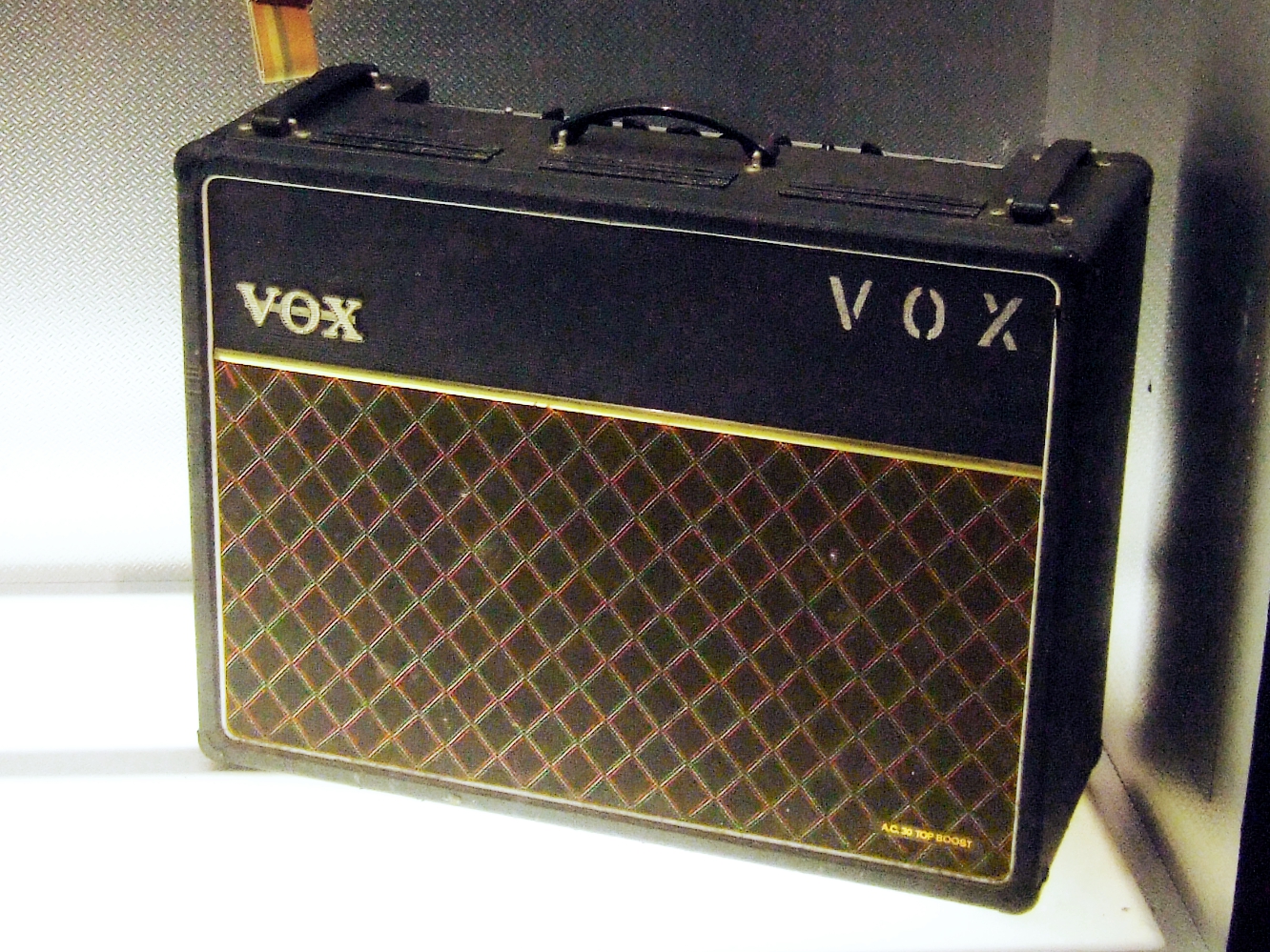
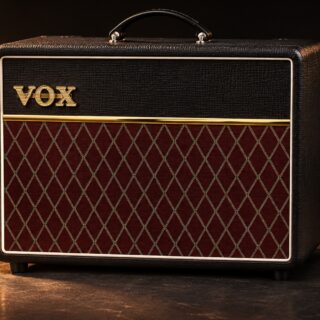
Vox AC30 Top Boost at Born to Rock, Harrods, photographed 10 February 2007. Photo: wetwebwork; existing crop and contrast/color adjustments: Clusternote, 18 June 2013. CC BY-SA 2.0 (https://creativecommons.org/licenses/by-sa/2.0/). Complete amplifier retained; existing derivative used unchanged. Resized web versions: CC BY-SA 2.0. Source: https://commons.wikimedia.org/wiki/File:VOX_AC30_Top_Boost_(Born_to_Rock)_clipped.jpg
The full story of the Vox AC30 Top Boost — its Gibson-derived circuit, era-by-era dating guide, verified players, tone recipes and 2026 buying advice.
There is a sound that runs like a copper wire through seventy years of British music. It is in the Shadows’ twang and the Beatles’ Cavern-era jangle. It is in Queen’s guitar orchestras and U2’s cathedral delay. It is in the Smiths’ arpeggios, Radiohead’s tremolo shimmer and half the indie records that ever mattered. It is bright without being brittle, loud without being polite, and it has a specific texture on the top end that engineers have spent six decades trying to describe: glassy, chimey, bell-like, British.
That sound is a Vox AC30 with the Top Boost circuit. And here is the thing nobody tells you: the two players most closely welded to the AC30 in the public imagination — Brian May and Rory Gallagher — both went out of their way to avoid the Top Boost channel. They plugged into the Normal channel, the dull one, the one with no treble control at all, and used a treble booster pedal instead. The most celebrated tone circuit in British amplification, and the two men who made it famous ran around it.
That paradox is the best possible way into this amp, because it tells you something true about the AC30 that spec sheets do not. This is not an amplifier with one sound. It is a platform with several personalities, a bolt-on tone circuit that started life as an afterthought, and a power section so unusual that it behaves less like a Fender and more like a musical instrument in its own right. Understanding which AC30 people mean when they say “AC30” is the whole game.
So let’s take it apart properly: where it came from, what Top Boost actually is (and where Vox stole it from), why it chimes, who really used it, how to set it, and what to look for if you’re buying one — vintage or new — in 2026.
Before Top Boost: How the AC30 Got Here
The AC30 was not born great. It was born loud, which in 1959 was almost the same thing.
Jennings, the AC2/30 and the AC15
Tom Jennings registered the “VOX” trademark on 2 August 1951, and it was granted in October 1952. His company, Jennings Musical Industries, spent the mid-fifties on accordion amps and general-purpose PA gear before turning to electric guitar. The AC2/30 was reviewed in September 1957 and advertised from November of that year in Melody Maker and Accordion Times: a 30-watt 1×12 combo running a pair of EL34s. It never went into serious mass production. JMI’s energy went instead into the 15-watt AC1/15 — the AC15 — first advertised in December 1957 and released in January 1958.
The AC15 worked. It worked so well that Hank Marvin and the Shadows made it a national institution. And then it stopped working, not because of any fault in the amp but because of a problem no designer can engineer around: audiences got louder. Screaming teenagers drowned out 15 watts. Jennings needed more.
The 1×12 AC30, and the Fender Twin problem
In spring 1959 a 30-watt AC30 appeared, sharing the AC15’s square TV-front cabinet and single 12-inch speaker but running EL34s in the power section rather than EL84s. It was advertised from June 1959 through May 1960. It was also, frankly, a stopgap. One 12-inch speaker being fed 30 watts is a speaker under duress.
The solution came, as so often in this era, from looking across the Atlantic. JMI became the UK agent for Fender amplifiers, guitars and accessories in early 1960 — meaning Jennings’ engineers were unpacking, servicing and studying Fender Twin Reverb ancestors in their own workshop. The two-speaker format was the obvious answer, and the AC30 Twin followed.
29 April 1960: the day both circuits were drawn
This date matters, because it kills a common myth. The circuit diagrams for the AC30/4 and the AC30/6 are both dated 29 April 1960 — as is OA31, the AC15 schematic. The AC30/4 reached the market first and the AC30/6 followed, but they were not sequential design generations. They were designed together.
- AC30/4 — two channels, four inputs, 2×12, four EL84s in the power section, TV-front cabinet, cream diamond covering, brown diamond grille cloth. First referenced in the spring 1960 pricelist at 100 guineas.
- AC30/6 — three channels, six inputs, split-front cabinet, fawn covering. First advertised in two Melody Maker ads on 30 July 1960 at 89 guineas — cheaper than the /4, which tells you how quickly JMI was iterating on cost.
The extra channel on the /6 was the Brilliant channel, sitting alongside Normal and Vibrato. It was Vox’s first attempt to solve the same problem Top Boost would later solve properly: making the amp cut through.
The EF86 that shook itself to death
The early AC15 and its relatives used an EF86 pentode in the preamp — a beautiful-sounding valve with a fatal flaw in this application. Bolt it to a chassis sitting directly above a pair of 12-inch speakers being driven by 30-odd watts and the mechanical vibration destroys it. EF86s went microphonic, howled, rang and failed. Vox’s answer in the AC30/6 was to replace the EF86 with a bank of ECC83s (12AX7s) — more rugged, less characterful, and the reason the AC30’s preamp voice differs from the EF86-equipped AC15 lineage that boutique builders still chase today.
Reusable rule for vintage-amp shopping: if a spec sheet from this era brags about an EF86, ask how the chassis is mounted. The valve is not the problem. The vibration is.
Speakers: Rola, Oyster Hammer, and the Vox Blue
The first AC30 Twins shipped with a pair of 12-inch Rola B024 speakers, which proved insufficiently sturdy. Vox and Celestion settled on a bespoke design in August 1960: the T.530, first produced in a silver-pink finish nicknamed “Oyster Hammer,” and then, somewhere between December 1960 and January 1961, in the azure blue that became one of the most recognisable objects in guitar amplification. Summer 1964 brought the silver Celestion alnico T1088 as a further variant.
The Celestion Alnico Blue is not a neutral component. It is a low-power-handling, alnico-magnet, early-breakup speaker whose compression and top-end sparkle are inseparable from what people call “the AC30 sound.” Put a modern high-power ceramic driver in an AC30 and you have changed the amp more than a valve swap ever would.
What Top Boost Actually Is — And Where Vox Got It
Here is the part that surprises people who assume Top Boost is the AC30’s defining feature: it was not part of the amplifier at launch, it was not designed by Vox, and for its first years it was an accessory.
The Gibson connection
The Top Boost tone network is, essentially, a direct lift of the tone circuit from the mid-1950s Gibson Vanguard GA-77, whose circuit diagram dates to 1953/54. Glen Lambert identified the borrowing years ago, and the schematics sit side by side without much ambiguity. Quite how Dick Denney encountered a GA-77 is not documented, but Denney was a working musician as well as JMI’s designer, and working musicians spend their lives standing next to other people’s amplifiers. Something in that Gibson caught his ear.
What he took was a proper interactive treble-and-bass network driven by its own ECC83 gain stage — a genuine tone stack, replacing the single “tone cut” control the original AC30 circuit offered. The tonal range on offer went from “one knob that removes treble” to something a player could actually shape.
“Stereophonic,” “Brilliance,” “Top Boost”: three names, one circuit
Vox’s own marketing muddled this from day one, and the confusion persists on forums to this day. In July 1961 JMI announced a new “Stereophonic Series” of amplifiers — which in practice meant the AC30 Super Twin, a separate amplifier head with one or two closed-back speaker cabinets. “Stereophonic” was JMI’s initial name for what we now call Top Boost. The October 1961 pricelist described the Super Twin as having “a special tone unit with extra controls at rear.” By the September 1964 “Precision in Sound” catalogue, Vox had quietly retreated to calling it a “pseudo stereo effect.” It was, of course, neither stereo nor pseudo-stereo. It was a tone stack.
The name “Brilliance unit” was also used, which collides messily with the AC30/6’s existing Brilliant channel — a completely different thing. If you take one piece of terminology away from this article, take this: Brilliant channel ≠ Top Boost.
The dates, the bracket and the kit
The Top Boost circuit diagram, JMI drawing OS/010, was first drawn out formally by John Bell on 11 December 1961 (some sources give 12 December; the discrepancy is a day, and I flag it rather than pick a side). The circuit itself was in amps before the drawing existed — surviving AC30s from 1962 carry factory-installed units with component date codes going back to 1961.
Physically, early Top Boost was an add-on assembly built on an L-shaped steel bracket, mounted through a cut-out in the amp’s back panel, carrying two 1-megohm logarithmic pots (treble left, bass right) and an extra ECC83. It was fitted at the factory to batches of Super Twins and, on request, to standard Twins. From 1963 it was sold as a retrofit kit for owners and repair shops. Only later did Vox integrate the controls into the front panel, which is the layout every modern reissue copies.
Three consequences follow, and all three matter when you’re looking at a vintage amp:
- Back-panel Top Boost is not a modification — it is the original configuration. A 1962 AC30 with treble and bass knobs on the rear is more period-correct than one with them on the front.
- Retrofits are extremely common and extremely hard to date. The site voxac30.org.uk documents a late-1962 chassis that appears to have gone back to the factory for a Top Boost fit in 1965, judging by January ’65 pot date codes — or was done by a repairman from a JMI kit. Nobody can tell which.
- The circuit’s DNA spread. Denney liked it enough to build the same voicing into the front ends of the AC50 and AC80/100, designed in parallel in mid-1963 (Denney on preamps, Derek Underdown on power sections). Top Boost is therefore the tonal ancestor of most of what Vox did afterwards.
The drawback Vox never advertised
Top Boost controls are violently interactive. Move the treble and you change what the bass control does; move the bass and the treble’s centre frequency shifts under your fingers. Set too fast, the result is over-brightness and a peculiar sort of glazed, waxy quality on the top end. This is not a fault. It is why the amp rewards patient dialling and punishes the “everything on 7” approach that works fine on a Fender Deluxe Reverb. Budget twenty minutes with an AC30, not two.
Why an AC30 Chimes: The Engineering Behind the Voice
Four design choices, none of them individually exotic, combine into a voice nothing else quite replicates.
1. Cathode bias — the amp is always working
The AC30’s quad of EL84s is cathode-biased (self-biasing), not fixed-biased like the 6L6s in a Twin Reverb or the EL34s in a Marshall JCM800 2203. Class A-ish operation means the valves idle hot and stay in conduction across far more of the waveform. Practical result: the amp compresses earlier, sags more musically under a hard pick attack, and produces a dense harmonic bloom instead of a clean-then-clipped cliff edge. It also means there is no bias adjustment to set — you fit a matched quad and go — which is one of the AC30’s few genuinely convenient features.
2. EL84s, not EL34s or 6L6s
The EL84 is a small, cheap, nine-pin power pentode with a pronounced upper-midrange character and a fast, slightly grainy distortion. Four of them make around 30 watts. That number is worth pausing on, because Rory Gallagher pointed at it himself in a November 1974 interview: “Somebody worked it out once that they give closest to the true wattage; they give 28 watts of real power, whereas some other makes only give 55 that are supposed to be one hundred watts.” An AC30 is honest about its output in a way that most of its contemporaries were not — and 28 real watts through two efficient alnico 12s is genuinely loud.
3. The GZ34 rectifier
Unlike a Twin Reverb, which has always been solid-state rectified precisely to eliminate sag, the classic AC30 runs a GZ34/5AR4 valve rectifier. Under a heavy chord the high-tension supply droops and recovers, producing the compression-and-bloom that players describe as the amp “breathing.” Combine that with cathode bias and you have an amplifier whose dynamic response is a large part of its identity.
4. Alnico speakers with modest power handling
The Celestion Alnico Blue was never designed as a high-headroom driver. It compresses, it distorts, and its top end has a specific glassy ring. It is also fragile relative to modern ceramic drivers — one reason Vox’s standard modern AC30C2 ships with Celestion G12M Greenback-family ceramics and reserves the Blues for the premium X-suffix models.
What this adds up to
Everything about the AC30 is calibrated toward early, gradual, harmonically rich breakup with an aggressive upper-midrange push. The contrast with the blackface Fender formula is almost perfectly inverted: fixed-bias 6V6s or 6L6s with a scooped midrange and late, hard clipping versus cathode-biased EL84s with a forward midrange and early, soft clipping. That is why a Telecaster into a Deluxe Reverb sounds like Nashville and the same Telecaster into an AC30 sounds like Manchester.
Specifications
| Spec | Vintage JMI AC30/6 Top Boost (c. 1963-65) | Vox AC30C2 (current) | Vox AC30C2X (current) | Vox AC30HW2 / HW2X (hand-wired) |
|---|---|---|---|---|
| Power | ~30 W (measures close to 28 W) | 30 W | 30 W | 30 W |
| Power valves | 4 x EL84, cathode-biased | 4 x EL84 | 4 x EL84 | 4 x EL84 |
| Rectifier | GZ34 valve | Solid-state | Solid-state | GZ34 valve |
| Preamp valves | ECC83s (EF86 in earlier related circuits) | 3 x 12AX7 | 3 x 12AX7 | 3 x 12AX7 + 1 x 12AX7 (hand-wired turret board) |
| Speakers | 2 x 12″ Celestion T.530 alnico (“Vox Blue”); silver alnico T1088 from summer ’64 | 2 x 12″ Celestion G12M Greenback family (ceramic) | 2 x 12″ Celestion Alnico Blue | HW2: Greenback-family / HW2X: Celestion Alnico Blue |
| Channels | Normal, Brilliant, Vibrato (AC30/6); Top Boost adds Treble + Bass | Normal + Top Boost | Normal + Top Boost | Normal + Top Boost |
| Onboard effects | Vibrato/tremolo on the Vibrato channel; no reverb (reverb models offered from Dec 1962) | Reverb + tremolo, footswitchable | Reverb + tremolo, footswitchable | None — deliberately stripped |
| Effects loop | No | Yes | Yes | No |
| Master volume / attenuation | No | Master volume; output-level control | Master volume; output-level control | No master volume |
| Construction | Hand-wired, JMI/Westrex/Burndept chassis, Woden transformers | PCB | PCB | Hand-wired |
| Weight | ~70 lb / 32 kg | ~70 lb / 32 kg | ~70 lb / 32 kg | ~70 lb / 32 kg |
| Street price (July 2026) | ~$3,000-4,300 depending on year and originality | from ~$1,024 | ~$1,500-1,700 | HW2 ~$1,880 / HW2X ~$2,800 |
Pricing note: figures above reflect July 2026 US street listings and completed vintage sales. The AC30 has no factory attenuator or power-scaling option in any current model, which is the single most important thing to know before buying one.
Era by Era: A Buyer’s Chronology
Vox changed the AC30 constantly and documented the changes inconsistently. This timeline is drawn from JMI advertising, surviving amps and component date codes, and it is the fastest way to place an amp you’re looking at.
- Autumn 1957: AC2/30 reviewed and advertised. 1×12, 2 x EL34. Never mass-produced.
- December 1957 / January 1958: AC1/15 (AC15) advertised and released.
- Spring 1959 – May 1960: 1×12 30-watt AC30, TV-front, EL34s. Discontinued 1960.
- 29 April 1960: AC30/4, AC30/6 and AC15 circuits all drawn.
- Spring/May 1960: AC30/4 Twin — TV-front, 2×12, 4 x EL84, cream diamond covering, 100 guineas.
- Summer 1960: Celestion T.530 “Oyster Hammer” replaces the Rola B024.
- 30 July 1960: AC30/6 first advertised — split-front, fawn covering, three channels, 89 guineas. No TV-front AC30/6 is known to exist.
- December 1960: The Shadows receive three new TV-front AC30s with custom stands.
- Dec 1960 – Jan 1961: Azure “Vox Blue” T.530 introduced.
- February 1961: Minor circuit revision to both AC30/4 and /6.
- May 1961: New circuit with a documented “List of Changes.” Westrex contracted to build the new AC30/6 chassis from May/June.
- July 1961: “Stereophonic Series” announced — the Super Twin, and JMI’s first name for Top Boost.
- 23 September 1961: Final AC30/4 advertisement. Officially phased out in October.
- Last quarter 1961: Copper panels appear, on serials in the high 4000s. Previously black.
- 11/12 December 1961: Top Boost circuit OS/010 drawn by John Bell.
- 1962: Copper panels, beige then black cabinets. Burndept (Erith) contracted for chassis from autumn 1962, using Woden transformers with green shrouds. Black “dimpled”/”pebble” vinyl predominates from late 1962, serials in the high 6000s.
- December 1962: Super Reverb/Twin models advertised — reverb arrives in the range.
- 1963: Retrofit Top Boost kits sold. New injection-moulded handles. Basket-weave vinyl introduced in the last quarter. Black vents replace brass at the end of the year. 29 January 1963: Tom Jennings sells JMI’s shares to Royston Industries.
- January 1964: AC30 Extended Frequency / AC30X with 15-inch speakers advertised — Top Boost fitted as standard.
- Early spring 1964: First grey panels. Treble model introduced, chassis mostly by Burndept. Normal, Treble and Bass variants now catalogued.
- Summer 1964: First silver Celestion alnico T1088 speakers. New simplified Woden transformers with plain metal shrouds.
- August 1964: Black grille cloth announced at the Russell Hotel Trade Fair.
- 1967: Tom Jennings ousted from the company he built. The classic JMI era ends.
The single most useful dating shortcut: panel colour. Black panel = 1960 to late 1961. Copper panel = late 1961 through 1963. Grey panel = spring 1964 onward. Cross-check against transformer date codes (Woden “AU” = January 1963, “HU/JU/KU” = August/September/October 1963, “MU” = December 1963, “AV” = January 1964) and speaker codes before you believe a seller’s year.
Famous Players — and Two Corrections Worth More Than the Rest of This Article
The AC30’s artist list is so long it becomes meaningless. What is not meaningless is the specific configuration each player used, because on this amp the configuration changes everything.
Brian May — verified, and he doesn’t use the Top Boost channel
Brian May‘s association with the AC30 is total and lifelong. It is also, in a very precise sense, not an association with the Top Boost circuit.
May’s amp of choice is the AC30TBX — the Top Boost model with blue alnico speakers — and he has also used the AC30TB with Greenbacks. But he plays the Normal channel, driving it with a treble booster in front, both amp and booster essentially flat out. The treble booster is doing the job the Top Boost circuit was invented to do, and doing it differently: a treble booster is not really a treble control at all but a mid-and-treble-weighted gain stage that trims bass before it reaches the input, so the amp clips on a signal that is already voiced. That is why May’s tone has that vocal, cello-like sustain rather than the glassy jangle you get from a cranked Top Boost channel.
His amps are largely stock, but he has them modified to strip out the circuitry and valves he doesn’t use — which makes them more robust for touring and, by his account, raises overall gain by roughly 6 dB while slightly altering the tone. He is also notoriously picky about valve selection, because running EL84s flat out destroys anything mediocre.
The other half of the May story is the Deacy amp, a tiny battery-powered amplifier with no controls whatsoever, built by Queen bassist John Deacon from salvaged parts fitted to a small hi-fi speaker. May plugs the Red Special into it via the treble booster, overloading the input stage into a smooth saturation he used to build the famous guitar orchestrations — cello, trumpet and clarinet imitations — often with a coat thrown over the amp to tame the treble. Vox’s Brian May Special (spring 2003, 6.5-inch speaker, 10 W, solid-state, $199 / £139) was built to emulate the Deacy, with an output tapped after its treble booster section so it can feed a real AC30. Vox later produced an AC30 Brian May Custom Limited Edition — 500 units worldwide, blue alnico speakers, internal treble booster, and a 15-watt switch on the back panel.
May’s modern touring rig is a rack system built largely by Nigel Knight of Knight Audio Technologies with input from Mike Hill Services, centred on a strap-mounted KAT treble booster, TC Electronic G-Major 2 processors, a Dunlop DCR-2SR Cry Baby and a Shure Axient digital wireless system (upgraded from Sennheiser analogue in March 2022). The signal chain has been digitised at the front and middle. The output has never stopped being multiple AC30s at full volume.
Rory Gallagher — verified, same finding, in his own words
Rory Gallagher started on an AC30 in 1963 when he turned professional with the Fontana Showband, borrowing one from the band’s bass player after buying a Strat. He owned several across his life, and while his rig rotated through Fender, Marshall and Ampeg amps roughly every six months, the AC30 was almost always in it. A 1960s AC30 Top Boost of his went through Bonhams.
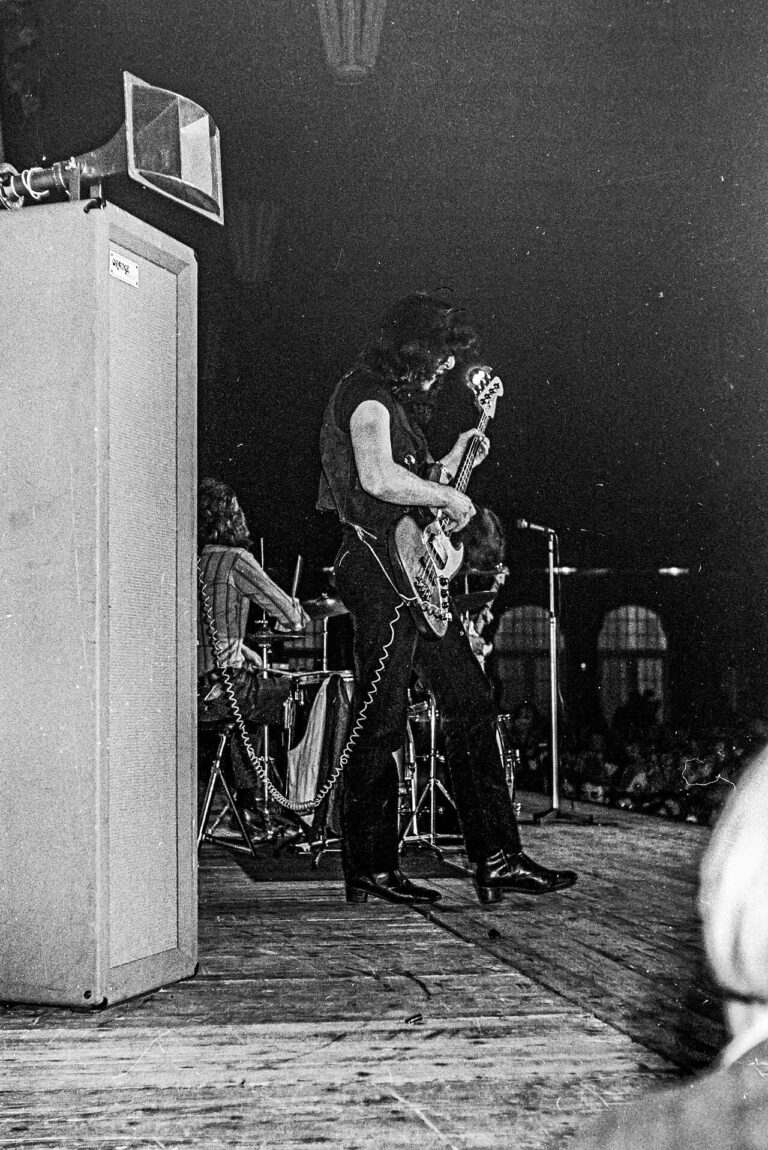
And yet, in his own words: “I used to use the normal input in the Vox, which was not known as the brilliance input. It wouldn’t be bright enough; therefore I used the Rangemaster.”
That is the second-most-famous AC30 player in the world explicitly documenting the same workaround as the first. His verdict on the amp is worth quoting at length too, from November 1974: “They are the most reliable amp … really, very loud, and solid – although they do need a little bit of something … like a treble booster, I reckon… And they have a certain arrogant kind of tone, particularly if you get a nice treble booster like a Rangemaster. You can get amazing sounds out of them. Anyway, of course, The Shadows were using them, and that was an instant encouragement, an endorsement.”
From the Taste era to the mid-1970s he ran a Dallas Rangemaster; from the mid-seventies he switched to a US-made Hawk Booster, which he felt paired better with his Fender amps. By November 1988 he described his setup as the AC30 plus a Vox 50-watt combo as a third amp, with a Marshall 4×12 driven by a converted 100-watt bass head “to give my sound some body,” while he monitored himself primarily through the Vox.
The pattern is now a rule. When two of the three most iconic AC30 players independently bypass the Top Boost channel in favour of a booster into the Normal channel, that is not a quirk. It is a legitimate second way to use this amplifier — arguably the older, more British way — and any tone chase that starts by cranking the Top Boost treble knob is chasing a different sound entirely.
The Edge — verified, and the most specific AC30 in rock
The Edge‘s main amp is a genuine Top Boost, and his tech Dallas Schoo has been unusually forthcoming about it. The chassis is from 1964, housed in a 1970s cabinet — which is how Edge bought it, not a later swap. Schoo’s line in the Rig Rundown was that the amp “had to have the top boost,” and that this specific amp made “all the big hits,” naming “Bullet the Blue Sky” and “With or Without You.”
The speakers are mismatched and have been since 1986: a 1960s Jensen-badged blue alnico 12 and a silver alnico 12, the latter fitted by Schoo in early 1986 when the blue one blew and the silver was simply what U2’s Dublin store had on the shelf. Over decades of repairs the amp has acquired Marshall capacitors alongside Fender capacitors and resistors. Schoo describes it as “totally one-of-a-kind, a real Frankenstein” — and irreplaceable.
This is the most honest lesson in the article. The most influential Top Boost tone of the last forty years comes from an amp that is not stock in any respect: wrong-decade cabinet, mismatched speakers, three brands of replacement components. Chasing it by buying a period-correct 1964 AC30 is chasing a target that does not exist.
George Harrison — verified, but the dates need discipline
George Harrison‘s Vox history is real and specific, and it is short. By August 1962 he had a beige AC30 Twin with Top Boost controls on the back panel — one of the earliest documented Top Boost users anywhere, and a reminder that back-panel controls are the original layout. In late December 1962 / early January 1963, Harrison and John Lennon were issued new AC30s in black covering.
But the Beatles outgrew 30 watts faster than anyone. Late December 1963 was the last time the band used AC30s on stage as their main amps: Paul McCartney was issued an AC80/100 and Lennon and Harrison received AC50s. (An AC30 returned to the stage in 1965, but as an amplifier for the Vox Continental organ, not guitar.) Denney had designed those AC50 and AC100 front ends in mid-1963 around the same Top Boost voicing, so the tonal thread continues even as the model number changes — but if you want Harrison through an AC30, your window is roughly 1962 to the end of 1963, which is the Cavern-to-early-Beatlemania period and no further.
Tom Petty — heavily qualified, and the credit mostly belongs to Mike Campbell
This is where the standard artist list starts to fray. The Heartbreakers’ AC30 connection is genuine but it is not primarily Tom Petty’s, and the band’s early years actively contradict the chime narrative: Mike Campbell has said in Guitar World that when the Heartbreakers started out they used 100-watt Vox Super Beatles — huge solid-state amps roughly four feet tall — and that he still doesn’t know how Petty sang over them.
The AC30 arrives later, as part of a deliberate retreat from stage volume. Campbell moved down to an AC30, then further down to a Fender Princeton Reverb and a fifties tweed Deluxe. His AC30 is a brown Top Boost example, run with a wah, Roland delays and a Danelectro Daddy-O, and on later tours it lived in an isolation cabinet mic’d for front-of-house while the amps physically on stage were Fenders. Petty is frequently credited with a seventies AC30 as a primary recording and touring amp, and that claim circulates widely, but Petty himself told Vintage Guitar in 2006, “I play the Vox AC30 quite a bit,” calling it a late-’70s model, though the claim that it was his primary amp is less firmly documented.
Honest verdict: the Heartbreakers are an AC30 band through Mike Campbell. Naming Petty as an AC30 player is not wrong, but it is a good deal softer than the Brian May, Rory Gallagher and Edge attributions, and it should be stated that way.
Others worth naming
The Shadows are the foundational AC30 band — they received three TV-front AC30s in December 1960 and were on split-front /6s by March 1961, which is exactly the endorsement Gallagher cited as his own reason for buying one. Beyond them, the AC30 lineage runs through Johnny Marr, Peter Buck, Paul Weller, Will Sergeant, Graham Coxon, John Squire, Noel Gallagher, Jonny Greenwood, Tom Verlaine, Andy Summers, Matt Bellamy and Tom DeLonge. Institutionally, it is the amplifier that defines British guitar recording the way a Fender Twin Reverb defines American — and most well-stocked studios on either side of the Atlantic keep one of each.
Tone Recipes: Seven Starting Points
1. The Jangle (Rickenbacker 12-string, sixties British pop)
Top Boost Volume 4, Treble 7, Bass 4, Cut 2, Master 5-6. Bridge or both pickups. Just below breakup, with the note attack sharp enough to hear each string in a chord voicing. Add a touch of tremolo from the Vibrato channel or the modern reverb/tremolo section if you want the full period effect.
2. The Edge (delay-driven arpeggios)
Top Boost Volume 5, Treble 6.5, Bass 5, Cut 3, Master 6. Almost clean but with the amp under mild compression so the delay repeats bloom. The magic here is not the amp setting — it is a dotted-eighth delay at unity-ish level with the amp doing the sustaining. Try a Strymon El Capistan or an Electro-Harmonix Deluxe Memory Man for the smearier vintage version.
3. Brian May (Normal channel + treble booster)
Normal channel Volume 10, Cut 0-1, Master (if fitted) 8-10, Top Boost channel unused. Treble booster in front, level high. This one genuinely does not work at low volume — the whole point is the power section being driven into compression. If you cannot get loud, this is the recipe to attempt with an attenuator or a lower-wattage sibling like an AC15C1.
4. Rory Gallagher (Rangemaster grit)
Normal channel Volume 8-10, Cut 2, treble booster in front with the level around 2 o’clock. Strat, middle or neck pickup, guitar volume backed to 7 for the verses and rolled up for solos. The amp should be right on the edge, so that pick attack alone moves it across the threshold.
5. Crunch rhythm (Les Paul, British hard rock)
Top Boost Volume 7.5, Treble 5, Bass 6, Cut 4, Master 6-7. Humbuckers push the EL84s into a thick, midrange-forward crunch that sits very differently from a Marshall — less scooped, more compressed, faster to bloom. Roll the guitar volume back and it cleans up more readily than a Marshall Super Lead at the same gain level.
6. Chimey clean with humbuckers
Top Boost Volume 3, Treble 8, Bass 3, Cut 1, Master 5. The trap with humbuckers into an AC30 is mud; the fix is counterintuitive — cut the bass hard and lean on the treble, because the Top Boost bass control is doing more low-mid work than you think. Set Cut low to keep air on top.
7. Pedal platform (the modern indie approach)
Top Boost Volume 3.5, Treble 6, Bass 5.5, Cut 3, Master 5-6. Clean and slightly compressed with room above it. A transparent overdrive like a Klon Centaur or a light Tube Screamer setting works beautifully here because the amp’s midrange already has the forward push a Screamer normally supplies — so back the pedal’s tone control down from where you’d set it into a Fender.
A few ground rules before the numbers. AC30 controls are interactive to an unusual degree, the Top Boost bass control removes low end as much as it adds it, and Cut — the control everyone ignores — is a post-phase-inverter treble roll-off that works on the whole amp. Treat Cut as a master presence control and set it last. All settings assume the vintage-style layout (Volume per channel, Treble, Bass, Cut, Master where fitted) on a scale of 0-10.
How It Compares
vs. Fender Deluxe Reverb
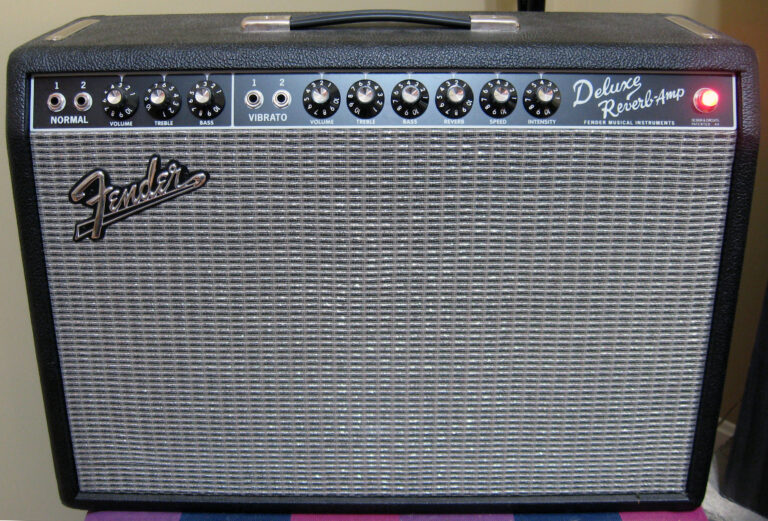
The clearest A/B in guitar amplification. The Deluxe Reverb is fixed-bias 6V6, scooped midrange, sparkling clean headroom and a lush spring reverb. The AC30 is cathode-biased EL84, forward midrange, earlier and grainier breakup, more compression. The Fender flatters single-coil country and blues; the Vox flatters chords, jangle and anything that needs to cut through a dense band mix. Neither is more versatile — they are versatile in opposite directions.
vs. Fender Twin Reverb
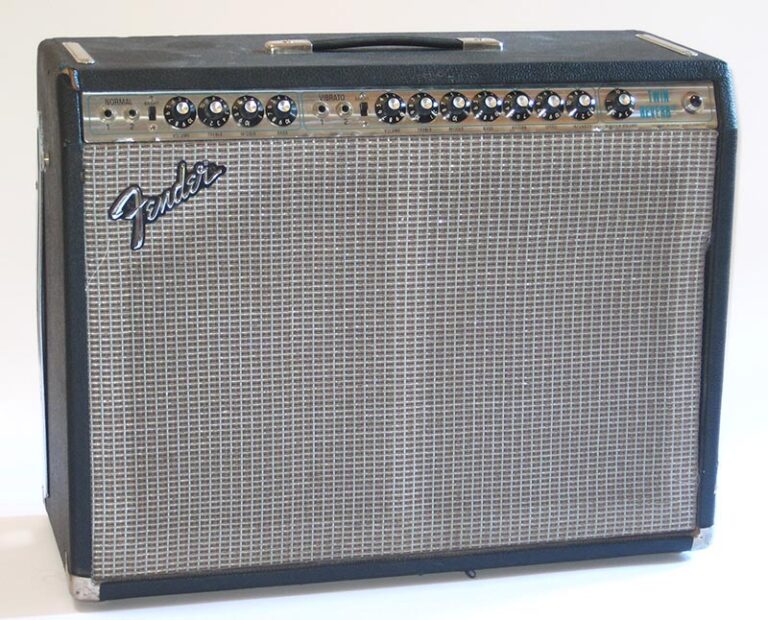
The Twin Reverb is louder, cleaner, heavier and fundamentally uninterested in distorting. If you want a pristine platform for pedals at stage volume, the Twin wins. If you want the amp itself to be part of the distortion, the AC30 wins — and it does it 55 watts earlier.
vs. Vox AC15
The AC15C1 is the AC30’s practical sibling: same family voice, roughly half the power, dramatically more usable in a small room or a home studio. It is also lighter, which is not a trivial point given the AC30’s 70 lb. The AC30 has more headroom, more low end and a bigger 2×12 spread; the AC15 gets to breakup earlier and is easier to record. For most players in 2026 who are not playing arenas, the AC15 is the more honest recommendation.
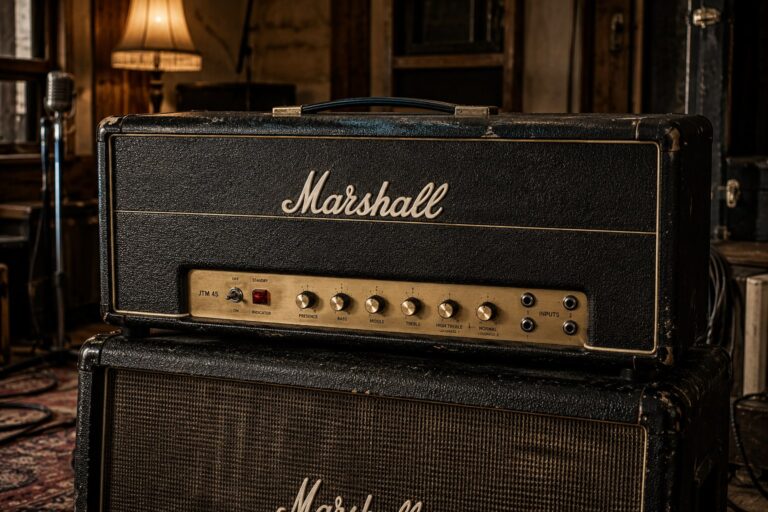
vs. Marshall JTM45
Both are British, both descend from an early-sixties workshop culture, and they diverge completely. The JTM45 is a fixed-bias, larger-bottle, higher-headroom design descended from the Fender Bassman; the AC30 is cathode-biased and pushes upper mids. A JTM45 sounds like a blues rock record. An AC30 sounds like a pop record.
vs. Matchless DC-30
The Matchless DC-30 is the most famous of the boutique AC30 descendants, built around the EF86 pentode channel the AC30 abandoned in 1960 plus a Top Boost-style channel. It is better built, better appointed, quieter, and considerably more expensive. What it is not is a Vox — the EF86 channel is a different, thicker, more compressed animal, and that is the point of it.
vs. Morgan AC20 Deluxe / Dr. Z
The modern boutique route — the Morgan AC20 Deluxe and various Dr. Z designs — takes the EL84 cathode-biased formula and solves the AC30’s two real ergonomic problems: weight and volume. You get most of the chime at a wattage you can actually use, in a box you can carry. What you give up is the specific 2×12 alnico interaction and the historical thing itself. If your goal is to make records, this is often the smarter buy. If your goal is that sound at that volume, nothing substitutes.
Buying Guide
Buying new
Vox’s current range covers the ground thoroughly, and the choices come down to speakers, wiring and whether you want onboard effects.
- AC30C2 — from roughly $1,024. PCB construction, Greenback-family ceramic speakers, solid-state rectifier, footswitchable reverb and tremolo, effects loop, master volume. The sensible working musician’s AC30 and by far the best value in the line.
- AC30C2X — roughly $1,500-1,700. Same amp with Celestion Alnico Blues. Whether the upgrade is worth the premium depends entirely on whether you play loud enough to make alnico speakers compress. If you gig at moderate volume, you are paying for a characteristic you will never hear.
- AC30HW2 — around $1,880. Hand-wired, valve rectifier, no reverb, no tremolo, no effects loop, no master volume. Deliberately stripped to the original architecture.
- AC30HW2X — around $2,800. The HW2 with Alnico Blues. The closest current-production amp to a vintage Top Boost, and priced accordingly.
- AC30CH — head format, for players who want to choose their own cabinet or run an isolation cab the way Mike Campbell has.
- AC15C1 — the amp most AC30 shoppers should actually audition first.
Buying vintage
A genuine JMI-era AC30 Top Boost in honest condition runs roughly $3,000 to $4,300 in the current market, with copper-panel examples with original blue alnicos at the top of that band and grey-panel or heavily serviced amps below it. Before you commit:
- Establish the era from the panel colour, then verify it. Black, copper, grey — then cross-check transformer and pot date codes. Sellers routinely round years in whichever direction helps.
- Assume the Top Boost may be a retrofit and price accordingly. Back-panel units were factory-fitted, dealer-fitted and owner-fitted from a 1963 kit, and there is often no way to distinguish them. This is not a defect, but it is not a premium either.
- Check the speakers against the chassis date. Original Vox Blues are a large part of the value. A pair of correct-era T.530s can be worth four figures on their own — and a “vintage AC30” with modern ceramics is a substantially cheaper amp.
- Demand a dated recap receipt naming the tech. Sixty-year-old filter capacitors are a liability, not patina. Budget $400-700 for a proper job if it hasn’t been done.
- Look for gain modifications. Master volume mods, cascaded gain stages and “improved” tone circuits were widespread in the seventies and eighties and cut value hard. Reversible mods are tolerable; drilled chassis are not.
- There is no effects loop and no master volume on an original. That is a rig-design decision to make before purchase, not after.
- Pick it up before you buy it. Seventy pounds, awkward handle position, and no wheels. More AC30s have been sold on because of stairs than because of tone.
Living With One
Valves. Cathode bias means no bias adjustment — fit a matched quad of EL84s and go. That convenience comes with a cost: EL84s run hot, work hard, and in an amp routinely played flat out they are a consumable. Expect to replace them more often than the 6L6s in a Fender, and buy quality, because cheap EL84s in a cranked AC30 fail fast. Brian May’s obsessive valve selection is not affectation; it is a rational response to the operating conditions.
Heat and ventilation. Four EL84s and a GZ34 in a closed-ish 2×12 cabinet generate serious heat. Do not gig one on a carpeted riser pressed against a back wall, and give it several minutes to cool before it goes into a flight case.
Volume. This is the AC30’s defining practical problem. There is no factory attenuator, no power scaling, and no half-power switch on standard models — the Brian May limited edition’s 15-watt switch is the exception that proves the rule. The amp’s best tones live above the point where a small club will complain. Your options are an external attenuator, an isolation cabinet, a load box with cab simulation, or accepting a slightly cleaner sound and using pedals.
The Cut control. Learn it. It sits after the phase inverter and rolls off high frequencies for the whole amp, which makes it the single most effective tool for taming a cranked AC30’s top end without dulling the Top Boost stack. Most players leave it at zero for a decade and then discover it.
Speaker choices. If your AC30 has ceramics and you want more of the classic character, swapping to Celestion Alnico Blues changes the amp more than any valve swap. Be honest about your playing volume first: alnico Blues are lower-power-handling drivers whose compression only appears when they are being pushed.
Safety. Valve amplifiers store lethal voltages in their filter capacitors long after being unplugged. Speaker cables are not instrument cables. Never run a valve amp without a load connected. If you are not trained to work inside one, don’t.
Frequently Asked Questions
What is the difference between an AC30 and an AC30 Top Boost?
Top Boost is an additional tone circuit — a dedicated ECC83 gain stage driving interactive treble and bass controls — that the original AC30 did not have. The base amp had only a simple tone-cut control. Top Boost appeared in 1961 as a factory-fitted or dealer-fitted extra mounted through the back panel, was sold as a retrofit kit from 1963, and only later became integrated into the front panel. Every modern AC30 has it built in.
Is the Top Boost channel the same as the Brilliant channel?
No, and this is the most common AC30 confusion. The Brilliant channel was one of the three channels on the AC30/6 from 1960 (alongside Normal and Vibrato) and is simply a brighter-voiced input. Top Boost is a separate tone stack added later. Vox’s own marketing made this worse by sometimes calling the Top Boost unit a “Brilliance unit.”
Did Vox invent the Top Boost circuit?
Not really. The tone network is essentially lifted from the mid-1950s Gibson Vanguard GA-77’s circuit, whose diagram dates to 1953/54. Dick Denney adapted it for the AC30; JMI’s John Bell drew the formal schematic, OS/010, in December 1961. Denney then reused the same voicing in the front ends of the AC50 and AC80/100 designed in mid-1963.
Does Brian May use the Top Boost channel?
No. May uses an AC30TBX — a Top Boost model with blue alnico speakers — but plays the Normal channel, driving it with a treble booster and running everything flat out. Rory Gallagher documented the identical approach, explicitly saying he used the normal input rather than the brilliance input and relied on a Dallas Rangemaster for brightness.
How many watts is an AC30, really?
Nominally 30 watts from four cathode-biased EL84s. In practice it measures very close to that — Gallagher cited a figure of 28 real watts and contrasted it favourably with “100-watt” amps of the period that delivered around 55. Because the speakers are efficient and the midrange is forward, an AC30 is far louder in a band mix than the number suggests.
Why is my AC30 so loud before it sounds good?
Because there is no master volume on the original architecture and the amp’s character comes from driving the power section. Every design decision — cathode bias, valve rectifier, low-power-handling alnico speakers — pushes the good tone upward in volume. The realistic fixes are an attenuator, a load box with cab simulation, an isolation cabinet, or stepping down to an AC15 or a lower-wattage boutique EL84 amp.
Should I buy the Alnico Blue version?
Only if you play loud enough to hear the difference. Alnico Blues compress and sparkle when driven hard; at bedroom and small-club volumes their advantage over the ceramic Greenback-family drivers in the standard AC30C2 is largely theoretical. The upgrade costs roughly $500 on the C2 and roughly $900 on the hand-wired models.
How do I date a vintage AC30?
Start with the panel: black to late 1961, copper from late 1961 through 1963, grey from spring 1964. Then verify with component date codes — Woden transformer codes such as “AU” (January 1963), “HU/JU/KU” (August/September/October 1963), “MU” (December 1963), “AV” (January 1964) — plus speaker codes, cabinet covering (cream diamond, fawn, black pebble from late 1962, basket-weave from late 1963) and vent material (brass until the end of 1963, black thereafter). Serial numbers help but the ranges overlap.
Is a vintage AC30 a better buy than a hand-wired reissue?
Financially, a vintage copper-panel example at $3,000-4,300 and a new AC30HW2X at around $2,800 are close enough that the question is real. The vintage amp holds value better and has the speakers, transformers and mojo. The new one has a warranty, fresh capacitors, no restoration risk and no dating uncertainty. For a working player who intends to gig it, the reissue is the lower-anxiety choice. For a collector or a studio, the JMI amp is the one that matters.
Image credits
- Top image: Vox AC30 Top Boost at the Born to Rock exhibition, Harrods, photographed 10 February 2007. Photo: wetwebwork; existing crop and contrast/color adjustments by Clusternote (18 June 2013). Original photograph · Existing derivative · CC BY-SA 2.0. Complete amplifier retained. Existing derivative used unchanged; resized web versions are licensed under CC BY-SA 2.0.
- Rory Gallagher: Herbert Weber, Hildesheim, Wikimedia Commons, CC BY-SA 4.0.
- Fender Deluxe Reverb: DlxReverbFront, Wikimedia Commons, CC BY-SA 3.0.
- Fender Twin Reverb: Micahmedia, Wikimedia Commons, CC BY 3.0.
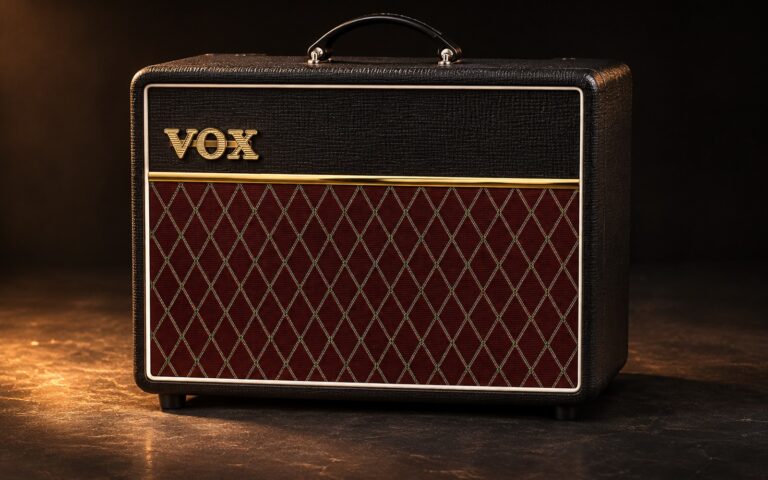
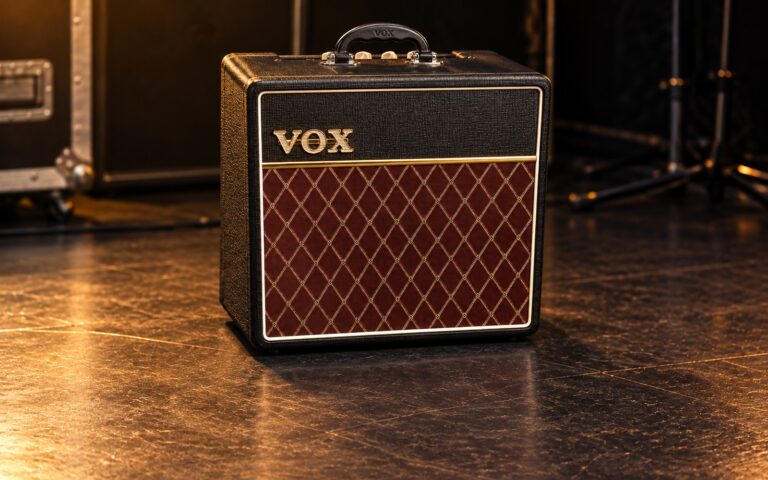
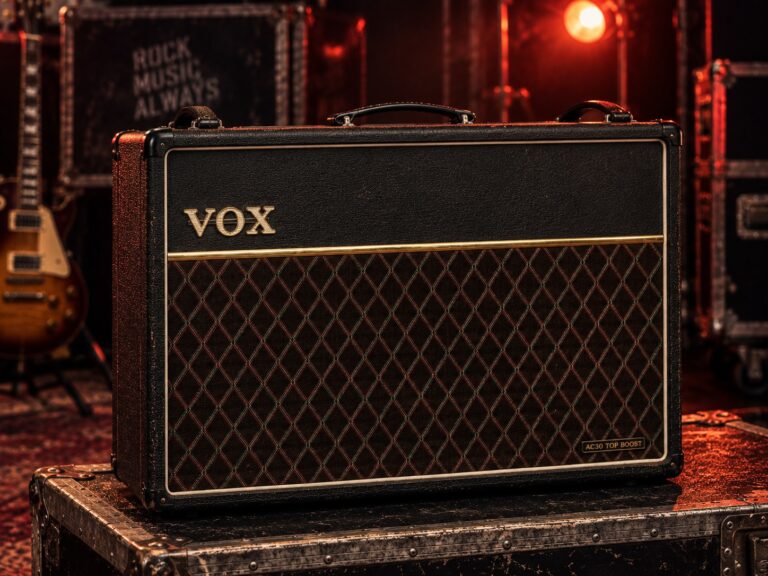
- Vox AC30 Top Boost: GuitarGangsters AI-generated reference illustration, not a photograph.
Latest News
Related
On This Day
Tuesday 10 November
From this week: