Fender ’57 Custom Deluxe: The 12-Watt Tweed Box That Made More Hit Records Than Any Stack Ever Built
Inside the Fender '57 Custom Deluxe: 5E3 history, specs, why it breaks up early, verified players from Neil Young to Don Felder, tone recipes and buying tips.
There is a particular sound that shows up on records made sixty years apart, by players who agree on almost nothing else. It is fat in the middle, slightly loose at the bottom, and it starts to come apart the second you dig in — not politely, not gradually, but with a kind of grinning collapse that sounds like the amp is enjoying itself. Neil Young has it. Larry Carlton has it on a Steely Dan record. Don Felder has it on the most-played guitar solo in American radio history. Billy Gibbons has it every time a pinched harmonic squeals off the end of a phrase.
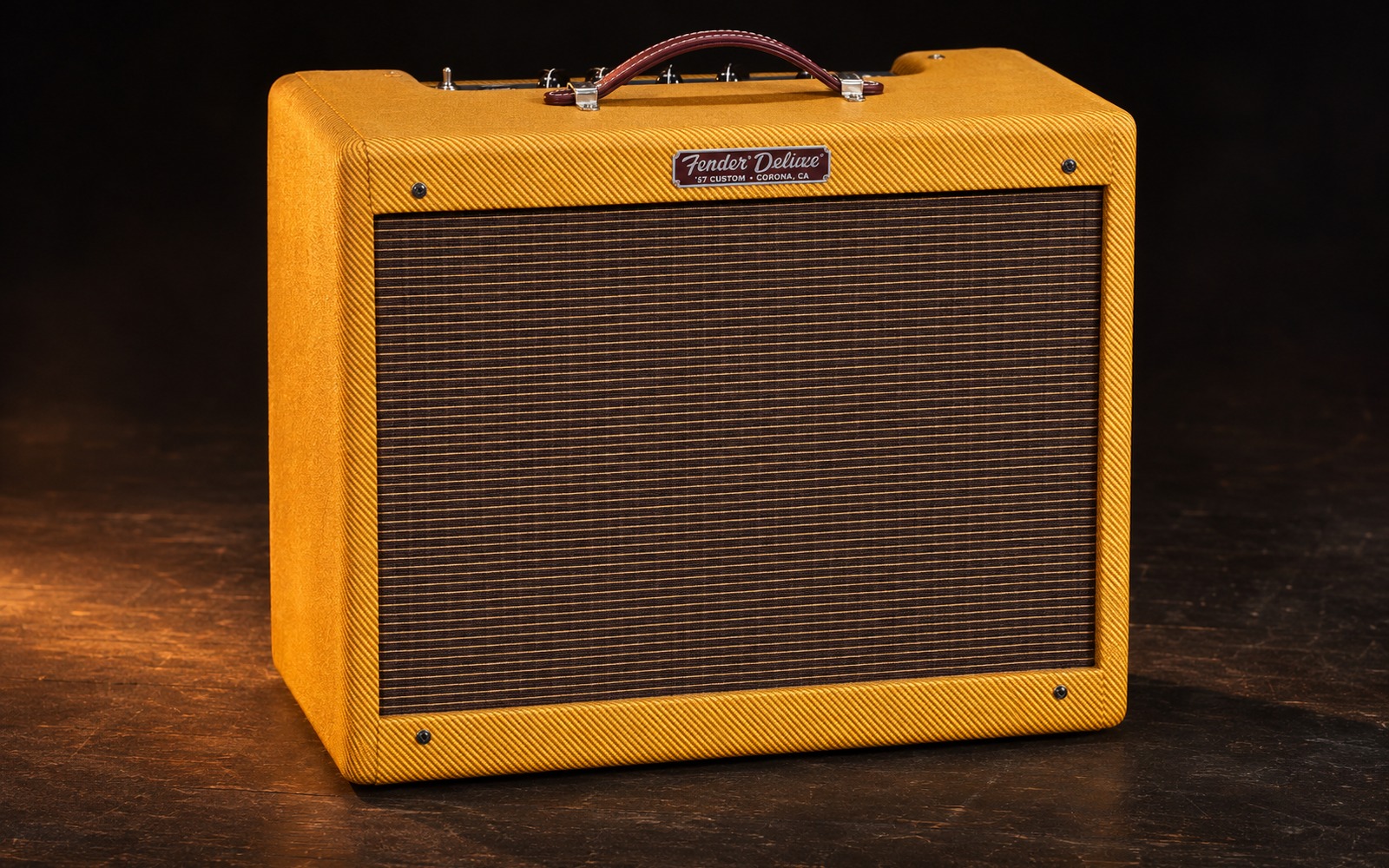
It is a 12-watt combo with three knobs, four jacks, and no reverb, no tremolo, no master volume, no effects loop, and no channel switching. It is the Fender tweed Deluxe — specifically the narrow-panel 5E3 built between 1955 and 1961 — and the Fender ’57 Custom Deluxe is the company’s hand-wired, eyelet-board, current-production answer to the fact that almost nobody can responsibly gig a seventy-year-old one anymore.
This is not a review. This is the story of what the amp is, where it came from, who actually used one (and who didn’t, despite what the internet insists), and what you need to know before you spend the better part of three thousand dollars on something with fewer controls than a toaster.
From Woodie to Narrow Panel: How Fender Arrived at the 5E3
The Deluxe is one of the oldest continuously evolving ideas in Fender’s catalogue, and its family tree is worth walking properly, because almost every myth about this amp comes from collapsing two different circuits into one.
It starts in 1946, with the first Fender-branded amplifiers — the so-called “woodie” amps, named for their natural hardwood finish and identifiable by red, blue or gold grille cloth and chrome-plated vertical front strips. The range consisted of the Princeton, the Deluxe (badged Model 26 on the control panel) and the Professional, fitted with eight-, ten- and fifteen-inch speakers respectively. The Model 26 already had the DNA that would define the Deluxe for the next fifteen years: two inputs labelled “instruments,” one labelled “microphone,” a separate volume control for each, and a single tone control. That is the entire user interface of the amp you can buy new in 2026.
In 1947 Fender added the V-front Dual Professional 2×10 — later renamed the Super — and with it introduced tweed covering, which would set the visual standard for Fender amps until Tolex arrived at the end of the fifties. By 1948 the whole range had gone tweed, including the upgraded 1×12 Deluxe, now the 5A3, in the “TV-front” cabinet style that looked like a 1950s television set.
- 1946 — Model 26 “woodie”: natural hardwood, 10-inch speaker, three inputs.
- 1948 — Model 5A3: tweed covering, TV-front cabinet, top/rear chrome control panel, 12-inch speaker.
- 1953 — 5B3 and 5C3: wide-panel format arrives; the 5C3 adds a negative feedback circuit.
- 1954 — 5D3: still wide panel; negative feedback removed again.
- 1955 — 5E3: narrow-panel design, four inputs, cathodyne phase splitter. The one everybody means.
- 1961 — 6G3: brown Tolex, brown front panel, tremolo circuit. The tweed era ends.
- 1963 — AA/AB763: the blackface Deluxe Reverb is born, and the story branches permanently.
- 1967: tweed-lineage Deluxe long gone; Deluxe Reverb moves to the silver panel.
- 1982: Deluxe Reverb discontinued, superseded by the Deluxe Reverb II.
- 2007: Fender Custom Series ’57 Deluxe — the first modern hand-wired 5E3 reissue.
- 2016: ’57 Custom Deluxe debuts at Summer NAMM as part of a four-amp Custom tweed range.
The 5E3 is the sixth version of the Deluxe, released in 1955 and built until 1961, and it is the one that gets reissued, cloned, kit-ified and modelled, because it is the one that sounds like that. It runs a pair of cathode-biased 6V6GT power valves and a 5Y3GT rectifier, was advertised at 15 watts, and left the Fullerton factory with a 1×12 Jensen P12R.
Two Reissues, Not One — And People Confuse Them Constantly
Here is a distinction worth getting right before you go shopping, because the used market is full of listings that blur it. The ’57 Deluxe launched in 2007 as part of Fender’s Custom Series, hand-wired, with a Jensen P12Q alnico speaker. The ’57 Custom Deluxe arrived at Summer NAMM 2016 alongside the ’57 Custom Champ, ’57 Custom Pro and ’57 Custom Twin, and its headline change was a move to a new Eminence Special Design alnico 12-inch, along with revised valve choices and reworked volume-pot tapers.
The player consensus on that swap — and it is player consensus rather than a manufacturer statement, so treat it accordingly — is that the Eminence is smoother when the amp is cranked and holds its bottom end together better, where the Jensen-equipped version could go thin and fizzy at the top when pushed hard. Some players prefer exactly that fizz. The point is that “’57 Deluxe” and “’57 Custom Deluxe” are not interchangeable names for the same amp, and if a listing uses them loosely, ask for a photo of the speaker.
Specifications: What You Actually Get
| Specification | Fender ’57 Custom Deluxe (current) | Original 5E3 (1955-61) |
|---|---|---|
| Rated output | Approx. 12 watts | Advertised as 15 watts |
| Circuit | Hand-wired 5E3 on black eyelet board | Hand-wired 5E3 on eyelet board |
| Preamp valves | 1x 12AY7, 1x 12AX7 | 1x 12AY7, 1x 12AX7 |
| Power valves | 2x 6V6, cathode-biased | 2x 6V6GT, cathode-biased |
| Rectifier | 1x 5Y3 | 1x 5Y3GT |
| Negative feedback | None | None |
| Phase inverter | Cathodyne (split-load) | Cathodyne (split-load) |
| Speaker | 12-inch, 8-ohm Eminence Special Design alnico | 12-inch Jensen P12R |
| Controls | Instrument Volume, Mic Volume, Tone — chickenhead knobs numbered to 12 | Identical |
| Inputs | Four 1/4-inch: two Instrument, two Mic | Four 1/4-inch |
| Cabinet | Finger-jointed solid pine, lacquered tweed, gold/brown grille cloth | Finger-jointed solid pine, tweed |
| Chassis | Chrome-plated steel, slotted side panels for strength and ventilation | Chrome-plated steel |
| Hardware | Leather strap handle, nickel mounting hardware, metal glide | Leather strap handle |
| Weight | Approx. 30 lb / 13.6 kg | Approx. 26-30 lb depending on year |
| Reverb / tremolo / FX loop / master volume | None of the above | None of the above |
Note the one deliberate departure from period authenticity: modern safety wiring, including the deletion of cloth-covered hook-up wire and a properly earthed mains configuration. Original tweeds were built for 1950s US power and, in stock form, are not properly grounded. That is not nostalgia, it is a hazard.
Why the 5E3 Sounds Like That: Four Design Decisions
1. There Is No Negative Feedback Loop
This is the big one. Fender added a negative feedback circuit to the 5C3 in 1953 and then took it back out of the 5D3 in 1954, and it never came back for the tweed Deluxe. Negative feedback tightens an amplifier: it reduces distortion, flattens frequency response, increases apparent headroom and makes the amp behave more predictably as it is pushed. The 5E3 does not have it, which is why it sounds sweet and harmonically dense even at low volume, and why it doesn’t so much distort as bloom when you turn it up.
If you want the direct contrast, listen to a blackface Fender Deluxe Reverb next to a 5E3. Same wattage class, same 6V6 pair, completely different manners — the blackface has feedback, fixed bias and a proper tone stack, and it stays composed for far longer.
2. Cathode-Biased 6V6s
The 5E3’s output pair self-biases through a shared cathode resistor rather than being fixed-biased from a negative supply. Practically, that means the amp compresses earlier, sags more under a hard pick attack, and never has that abrupt “wall” that fixed-bias Fenders hit. Guitarists frequently note that cathode-biased 6V6s have a chime that sits closer to a Vox AC15 than you would expect from a Fender — the mechanism is the same self-biasing behaviour that makes the EL84 Voxes so elastic, even though the valve type and the voicing are different.
3. A 5Y3 Rectifier That Sags on Purpose
The 5Y3GT is a relatively soft valve rectifier, and it lets the supply voltage dip when the amp is asked for a big transient. The result is that slightly spongy attack — the note arrives a hair late, swells, and then settles. Players either describe this as “feel” or “mush” depending on the day. It is the reason the amp rewards a heavy right hand and the reason it can be exhausting to record if you need machine-gun precision.
4. The Cathodyne Phase Splitter
The 5E3 uses a cathodyne — also called a split-load — phase inverter rather than the long-tailed pair that Fender fitted to most blackface amps. It is a tweed-era holdover, it clips earlier than a long-tailed pair, and it contributes a thick, textured midrange that is audible even when the amp appears to be clean. It is exactly the same design choice that gives the Fender Princeton Reverb its unusual midrange thickness, and it is one of the strongest through-lines connecting the small Fender amps across two decades.
Bonus: The Volume Controls Fight Each Other
The Instrument and Mic volumes on a 5E3 are interactive by design, which is not a bug and is the single most underused feature of the amp. The channel you are not plugged into still loads the circuit and still affects the channel you are using. Neil Young explained the mechanism to Guitar Player as clearly as anyone ever has: “The volume on the channel you’re not using will affect the volume of the channel you are using, even when you’re not plugged into it, because of the drain on the power amp.”
You can also jumper the two channels together with a short patch cable, the way people do with a Marshall JTM45, and get a third voice again. And the two inputs are genuinely different: the Instrument input has a noticeable treble lift, the Mic input is much flatter. An archtop through the Mic input gives you a startlingly convincing bebop tone with just a hint of growl — very Barney Kessel. A Les Paul into the Instrument input with both volumes up is blues-rock central.
Famous Players: What Holds Up and What Doesn’t
An honesty note first. Our source list for this entry named Stevie Ray Vaughan, John Mayer, Eric Johnson, Mike Campbell and Paul Gilbert as the tweed Deluxe’s signature players. That list is byte-identical to the one attached to the Fender Princeton Reverb entry, and overlaps almost entirely with the Twin Reverb and Deluxe Reverb entries. It is not a tweed Deluxe roster. It is a generic “famous people who have played Fender amps” list, and we are throwing it out and starting again.
For the record: Stevie Ray Vaughan built his sound on 1964 Vibroverbs, mid-sixties Super Reverbs and later a Dumble Steel String Singer. Eric Johnson‘s canonical rig is a 100-watt Marshall for leads and a Twin Reverb for clean rhythm. Paul Gilbert has been running Tone Master Twin Reverbs. None of those are tweed Deluxe stories. Mike Campbell, though, is the one name on the list that survives contact with the evidence — and he survives it twice over.
Neil Young — the most documented 5E3 on earth
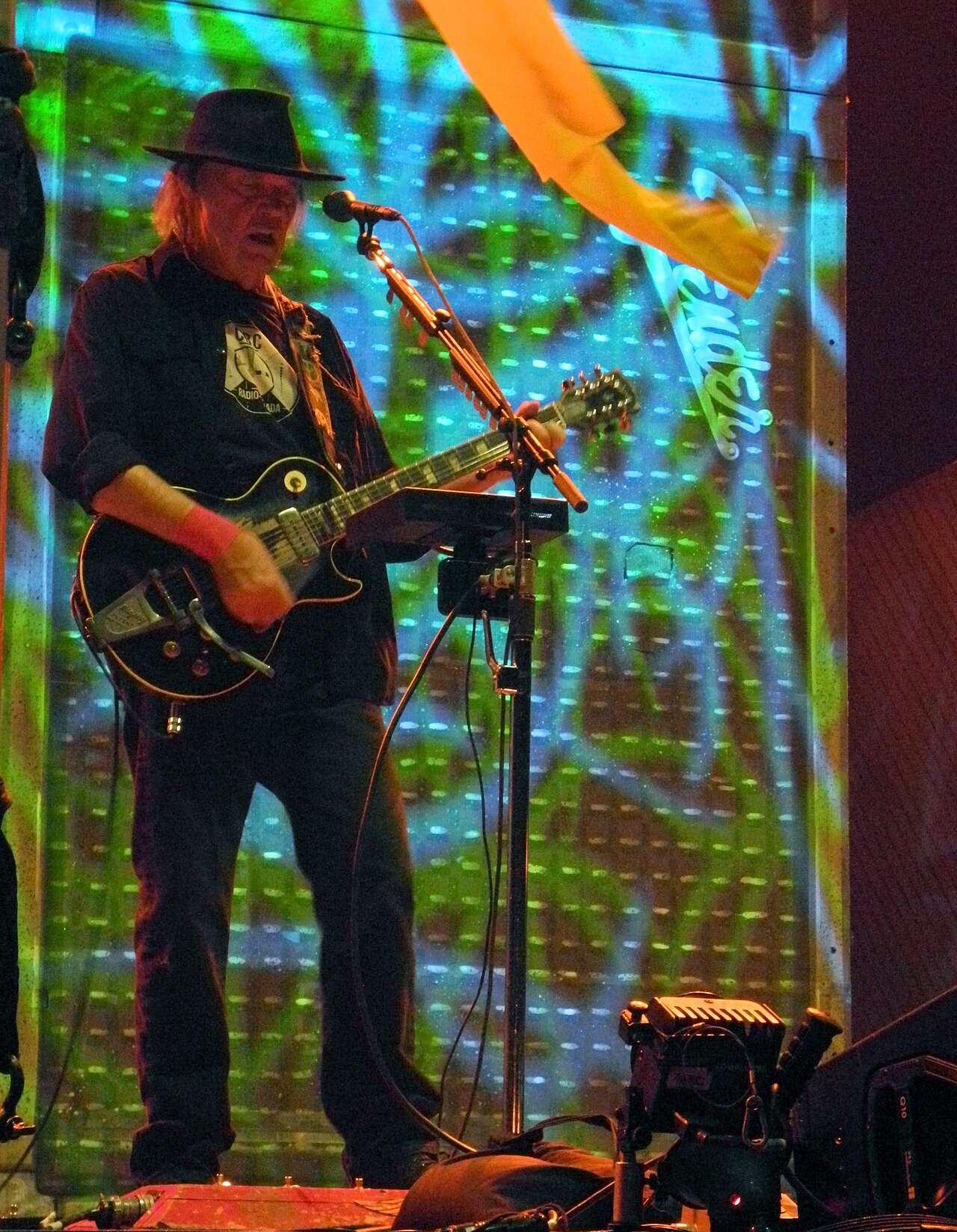
If one amp deserves to be called the tweed Deluxe, it is Neil Young‘s. He bought a four-input 1959 tweed Deluxe for $50 at Saul Bettman’s Music on Larchmont in Los Angeles in 1967, and it has been the heart of his live rig ever since — roughly six decades of one amplifier. His account of buying it, from a Guitar Player interview, is the best single description of what a 5E3 does in a room: “Took it home, plugged in this Gretsch guitar, and immediately the entire room started to vibrate. The guitar started vibrating, and I went, ‘Holy shit!’ I turned it halfway down before it stopped feeding back.”
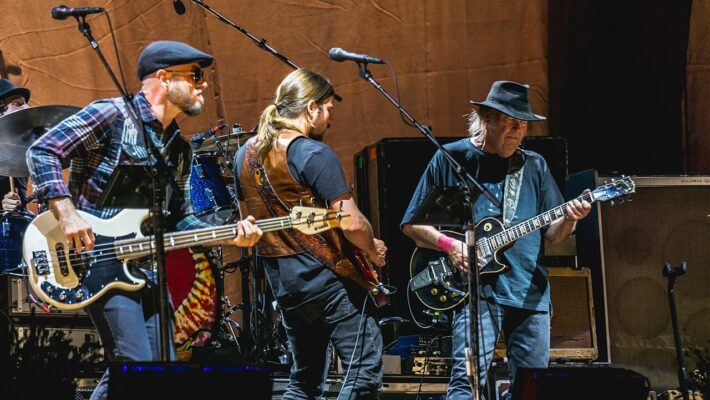
The honest details matter here, because they cut against the “stock vintage amp” romance. Young’s Deluxe is described as essentially stock except that its output valves have been replaced with 6L6s rather than the 6V6s the 5E3 was designed around. Rebiased for those valves, the amp went from about 15 watts to roughly 19, and it runs hot enough that tech Larry Cragg told Guitar Player in March 1992 he keeps “fans pumping a lot of air into the back of the Deluxe.” So the most famous tweed Deluxe in the world is not running the tube complement that defines the circuit. Worth knowing before you chase the tone with a period-correct amp.
Then there is the Whizzer — a bespoke robot that physically turns the amp’s three knobs when Young stamps a footswitch on a red box onstage. Young conceived it in the 1970s; tech Sal Trentino built the first two-preset version, which Young began using in 1978 on Rust Never Sleeps; tech Rick Davis built the four-preset version in 1991. It exists because there is no master volume, no channel switching and no gain control on a 5E3, so the only way to change the sound is to change the knobs. Young’s description of what the presets are for is a masterclass in 5E3 behaviour: “The Deluxe goes up to 12 — not 11 — and with everything floored, if you back it down to 10 and a half from 12, all of a sudden it’s chunky sounding on the attack. If you have it up on 12, then it just saturates completely and opens up after the attack. But if you back it down, it’ll catch the attack.”
And on where his distortion comes from, unambiguously: “There is no amp gain. We don’t use a distorted effect at all. Just the Fender Deluxe.” Old Black — his modified 1953 Les Paul Goldtop with a rehoused 1972 Firebird mini-humbucker in the bridge and a Bigsby — goes into that amp, and the amp does the rest. He tours with it rather than leaving it home: “I couldn’t go without it. There is no spare. I’ve got 10 spares, but none of them sound like it.”
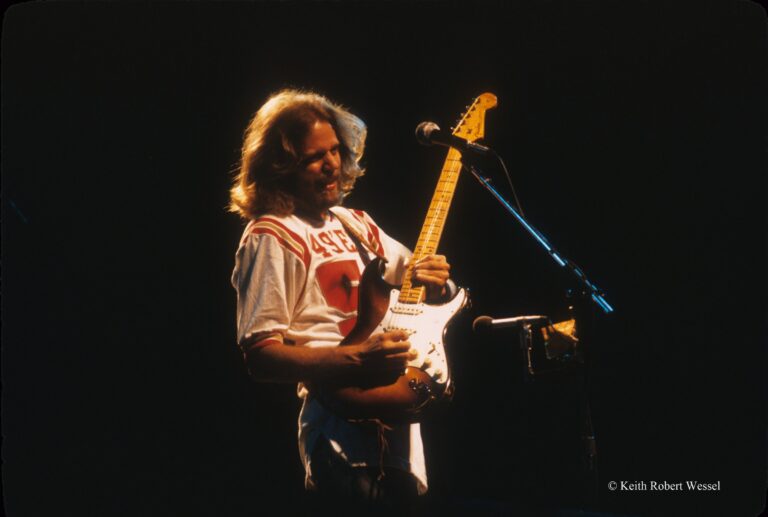
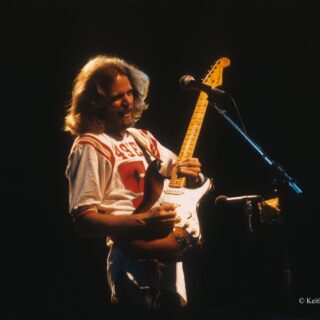
Don Felder — “Hotel California”
The most-heard tweed Deluxe solo in the world is probably the outro of “Hotel California.” Don Felder has described the setup repeatedly across interviews with MusicRadar and Guitar World: a 1959 Les Paul sunburst into a narrow-panel 1950s tweed Deluxe, cranked, with an Echoplex in the chain, tracked at Criteria Studios in Miami. He has estimated the amp as probably a ’55 or ’56 — which, note, would make it a wide-panel 5D3 rather than a narrow-panel 5E3 if taken literally, and he says “narrow-panelled” elsewhere in the same breath. That is a small internal inconsistency in a recollection about a session from 1976, and we are flagging it rather than smoothing it over.
What is not in dispute: guitar straight into a small cranked tweed combo with tape echo, no pedals, no boost. If your mental model of that solo involves a big amp, recalibrate.
Larry Carlton — Steely Dan, The Royal Scam
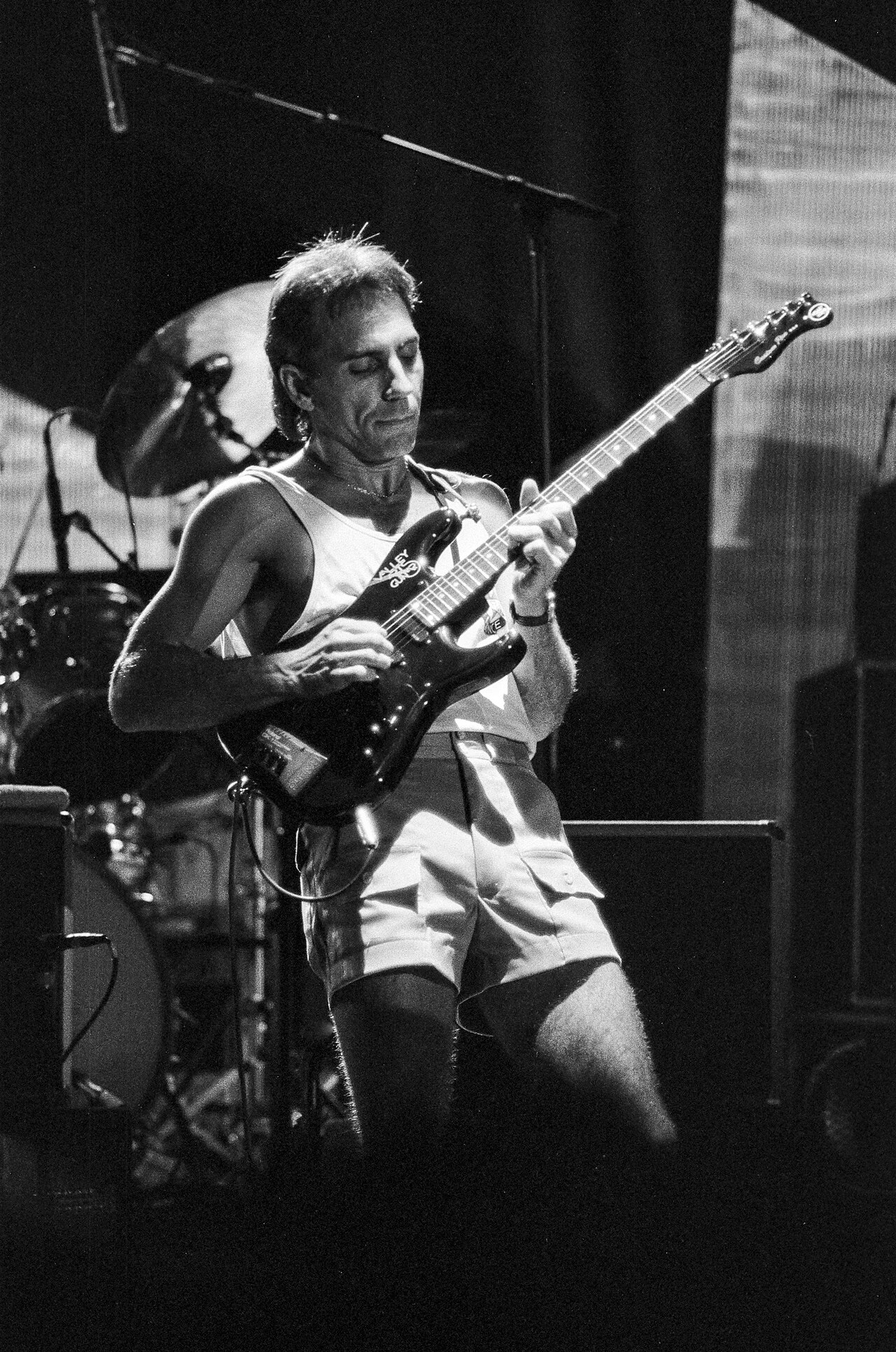
Larry Carlton‘s Steely Dan lead sound — “Kid Charlemagne,” “Don’t Take Me Alive” — came from a wide-panel Fender tweed Deluxe with his ES-335, tweaked so that his picking dynamics controlled the amp’s attack. Carlton has confirmed this in his own words to MusicRadar: “I decided to take my little Tweed Deluxe with my 335 and that became my lead sound with Steely Dan.”
This is worth stating carefully, because it is one of the most commonly misattributed rigs in guitar journalism. Aggregator pages regularly credit that sound to a Princeton Reverb. It was a tweed Deluxe. A Princeton Reverb and a tweed Deluxe are both small, low-wattage Fender combos, which is precisely how attributions drift between them — and a player’s own on-record statement outranks any secondary summary. Note also Carlton’s wide-panel specification: that is a 5D3 or earlier, not a 5E3, though the two share the no-feedback voicing.
Billy Gibbons
Billy Gibbons is closely associated with the 5E3, and the specific thing the amp does for him is the “edge of the pick” harmonic squeal — those pinched harmonics that leap out of the top of a phrase. That is not coincidence: an amp with no negative feedback, early cathodyne clipping and a sagging rectifier will happily amplify the tiny high-order overtone you produce by grazing a string with your thumb, where a stiffer amp buries it. If pinched harmonics are the sound you are after, this circuit is the shortcut.
Mike Campbell and the volume retreat
Mike Campbell‘s career is one long, documented retreat from stage volume: 100-watt Vox Super Beatles in the early Heartbreakers days, then a Vox AC30, then a Princeton, then a 1950s tweed Deluxe. He is the rare name that appears legitimately on multiple small-amp rosters, because he genuinely worked his way down through them in sequence.

Scotty Moore
Scotty Moore‘s name is inseparable from tweed Fenders in the early rock ‘n’ roll era, and the Deluxe was a studio and stage staple through that period. His most-discussed amp is the EchoSonic, with its built-in tape echo, so treat “Scotty Moore played a tweed Deluxe” as a real association with the tweed range rather than a claim that any specific Sun-era part was tracked through a 5E3.
Also in the tweed Deluxe orbit
The 5E3 shows up constantly in the rigs of players who value dynamic response over headroom: Joe Walsh, Keith Richards, Jack White, Dan Auerbach, Ry Cooder, John Fogerty and Bill Frisell among them. We are naming these as genre-and-era associations rather than verified per-amp claims — the difference matters, and most gear lists pretend it doesn’t.
Tone Recipes: Seven Settings That Actually Work
1. The Hotel California — cranked Les Paul lead
Instrument Volume 10-12, Mic Volume 0, Tone 6-7. Humbucker bridge pickup, guitar volume full. Add tape echo after the amp in your recording chain, or a Strymon El Capistan in front if you must have it live. This is loud. There is no polite version.
2. Neil Young’s “catch the attack”
Instrument Volume 10.5 (not 12), Mic Volume 0, Tone 10-12. Backing off that last notch and a half is the difference between saturation that blooms after the pick and a chunky, percussive front edge. Try it with the amp already flat out and creep down — the change is sudden, not gradual.
3. Steely Dan session lead
Instrument Volume 7-8, Mic Volume 2-3, Tone 7. Semi-hollow with the neck pickup, guitar tone rolled to about 7. The point is that you control the breakup with your right hand: soft passages stay clean, hard ones bark. If you can’t get that window, your guitar’s output is wrong for the amp, not the other way around.
4. Bebop archtop
Plug into the Mic input. Mic Volume 4-5, Instrument Volume 0, Tone 4-5. Flat, warm, faintly growling. This is the setting nobody demos on YouTube and it is one of the amp’s best voices.
5. Jumpered both channels
Patch Instrument input 2 to Mic input 1 with a short cable. Instrument Volume 6, Mic Volume 6, Tone 8. Fuller and louder than either channel alone, with a slightly different midrange. Adjust the two against each other rather than treating one as a master.
6. Pinched-harmonic blues rock
Instrument Volume 9, Mic Volume 3, Tone 8-9. Bridge humbucker, pick close to the bridge pickup with a bit of thumb contact. The Tone control past 8 is where those overtones stop being subtle.
7. Clean-ish country and rockabilly
Telecaster into the Instrument input. Instrument Volume 4-5, Mic Volume 0, Tone 9. Swap the 12AX7 back for the stock 12AY7 in V1 if it has been changed — the 12AY7 buys you meaningful clean headroom on this circuit and is the single most effective way to make a 5E3 stay clean longer.
Reminder: the knobs go to 12, not 10, and the two volumes interact. All settings below assume nothing is plugged into the second channel unless stated.
How It Compares
vs. the Fender ’57 Custom Champ
The Champ is the single-ended, one-valve, 8-inch answer to the same question. It is quieter, simpler, and the classic recording amp for people who want total saturation at a volume that won’t bleed into other microphones. The Deluxe is a push-pull amp with a 12-inch speaker and real low end, and it will hold its own on a small stage. If the amp only ever sees a microphone, consider the Champ. If it ever has to face a drummer, the Deluxe.
vs. the Fender Deluxe Reverb
Same name, opposite philosophy. The blackface Deluxe Reverb has negative feedback, fixed bias, a proper three-knob tone stack, spring reverb and tremolo. It stays clean much longer, it scoops the mids, and it is far more versatile as a pedal platform. The tweed Deluxe has more midrange, less headroom, and more character per watt. Most working players who own both use the Deluxe Reverb for gigs and the tweed for records.
vs. the Fender Princeton Reverb
The Princeton Reverb shares the cathodyne phase inverter and the small-amp attitude, but it is fixed-biased with a 10-inch speaker and it has reverb and tremolo onboard. It is the more practical amp and the more polite one. The tweed Deluxe is louder in the mids, looser at the bottom and considerably ruder.
vs. the Vox AC15
The closest non-Fender relative in feel, because both are cathode-biased and both compress early. The differences are the valve type and the voicing: EL84s push the upper mids forward with a fast, grainy clip, where the 5E3’s 6V6s are thicker and more chocolatey through the middle. If you want jangle, go Vox. If you want fat, go tweed.
vs. the Fender ’59 Bassman
The 4×10 tweed Bassman is the other tweed icon and is often mentioned in the same breath, but it is a fundamentally different tool — far more headroom, 40-odd watts, and the direct template for the first Marshalls. The Deluxe is the intimate one. Nobody has ever described a Bassman as intimate.
vs. a real vintage 5E3
An original narrow-panel 5E3 in honest condition is a five-figure conversation in 2026 and a maintenance commitment. Capacitors dry out and short, transformer winding insulation is not resistant to overheating, repeated heat cycling opens dry solder joints, and overheated resistors drift out of spec. Add non-grounded 1950s US mains wiring. The ’57 Custom Deluxe exists precisely to give you that circuit without those problems — hand-wired, eyelet board, modern earthing, current parts availability.
Buying Guide: 2026
Street pricing on a new ’57 Custom Deluxe in mid-2026 clusters around $2,700, with major US retailers listing about $2,729 and occasional promotions dipping toward $2,400. Outliers above $3,800 exist at some dealers and are worth walking away from. The 2016 UK launch price was £1,639 / $1,999, so this amp has drifted upward substantially — normal for a hand-wired US-built product over a decade.
- Confirm which reissue you’re looking at. “’57 Deluxe” (2007, Jensen P12Q) and “’57 Custom Deluxe” (2016, Eminence alnico) are different amps at different prices. Ask for a speaker photo on any used listing.
- Check the V1 valve. Stock is a 12AY7. Many owners fit a 12AX7 for earlier breakup. Neither is wrong, but it changes the amp’s entire personality and it is a five-minute, ten-dollar reversal. Know which one you’re auditioning.
- Play it at the volume you will actually use. This amp is not linear. A 5E3 at 3 and a 5E3 at 10 are two different products. If the shop won’t let you get it loud, you have not heard it.
- Bring your own guitar. In circuits this simple, the instrument dominates. Single-coils and humbuckers produce genuinely different amps here, far more so than through a modern high-gain design.
- Be realistic about the gig. Twelve cathode-biased watts through one 12 will keep up with a considerate drummer in a club and will not keep up with a loud one. There is no attenuator, no power scaling and no half-power switch.
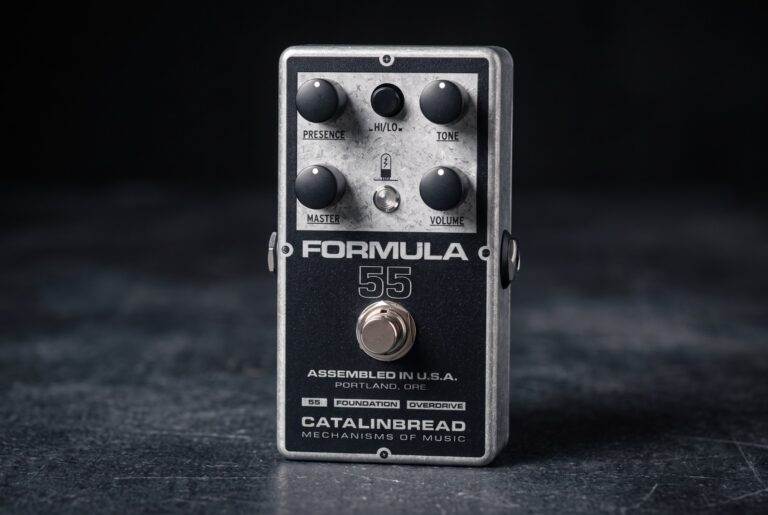
- No effects loop. Time-based effects go in front, into an already-compressing amp. If your rig depends on a pristine delay tail after the preamp, this is the wrong amp.
- Used market: hand-wired amps hold value well, and clean used examples typically sit a few hundred dollars under new. Because there are so few components, condition questions are mostly about the speaker, the valves and whether anyone has drilled the chassis.
Living With It
The valve rectifier means voltages take a minute or two to stabilise; the small amount of hum you hear at switch-on settles. That is normal, not a fault.
Valve choices are the whole modification story on this amp, and they are all reversible. 12AY7 in V1 is stock and gives the most clean headroom at the cost of overall volume. 12AX7 in V1 pushes breakup to well under halfway on the volume dial. Some owners go further down to a 12AU7 for a very early, very compressed voice. Power-valve brand matters more here than on a fixed-bias amp because the cathode-bias arrangement is more forgiving of variation but more revealing of character.
Speaker swaps are the other high-impact, low-risk change — the amp is 8 ohms, and the difference between an alnico and a ceramic 12 in a cabinet this small is enormous. Owners of the earlier Jensen-equipped ’57 Deluxe frequently move to the Eminence or to a Celestion alnico for exactly the reasons Fender changed it in 2016.
What you should not do is try to modify a 5E3 into a bigger amp. Adding negative feedback, chasing headroom, or fitting a bigger output transformer turns it into a less good version of an amp Fender already sells. The early breakup is not a limitation of the design; it is the design.
Practically: it weighs about 30 pounds, has a leather strap handle and no wheels, and the pine cabinet dents if you look at it wrong. Buy a cover. Lacquered tweed does not enjoy rain, beer, or the back of a van.
Frequently Asked Questions
Is the Fender ’57 Custom Deluxe loud enough to gig?
For small clubs and pubs, yes — that is precisely the volume band the design lands in. It has enough output to handle a moderate stage with a drummer who is listening. For loud rock volumes, or anything with a heavy-handed drummer, you will be micing it through the PA, which is fine and is how most people gig one.
Why do the knobs go to 12?
Because the original 5E3 control plate was numbered 1 to 12, decades before Spinal Tap made 11 a joke. Fender reproduced the panel faithfully. Functionally it is a full-rotation control like any other.
What’s the difference between the Instrument and Mic inputs?
The Instrument input has a pronounced treble boost; the Mic input is comparatively flat. The Mic input is the secret weapon for archtops, hot humbuckers and anything that sounds shrill through the Instrument side.
Should I run a 12AY7 or a 12AX7 in V1?
The 12AY7 is the original specification and gives more clean headroom with less overall volume. The 12AX7 has more gain, is far easier to buy, and makes the amp break up well before halfway on the dial. Try both — it is the cheapest and most dramatic change you can make to this amp, and it takes minutes.
Can I use it as a pedal platform?
Within limits. Low-gain overdrives and boosts work beautifully into an amp that is already leaning; a Tube Screamer or a Klon-style boost is a natural fit. High-gain distortion into a cathode-biased amp with no feedback loop tends to turn to mush. Reverb and delay must go in front, because there is no effects loop.
Is it the same as the amp on “Hotel California”?
Same circuit family, and the ’57 Custom Deluxe is Fender’s hand-wired recreation of the narrow-panel 5E3. Felder’s own recollections describe a 1950s narrow-panel tweed Deluxe with a ’59 Les Paul and an Echoplex, though he has also estimated the amp as a ’55 or ’56, which would technically place it a model earlier. Either way you are in the right neighbourhood; the Echoplex and the Les Paul are as much of that sound as the amp.
Should I buy this or a vintage 5E3?
If you want to play it, buy the reissue. A seventy-year-old amp needs dried-out capacitors replaced, has transformer insulation that was never designed for modern duty cycles, has solder joints opened by decades of heat cycling, and in original form is not properly earthed. Vintage ownership is a fine hobby; it is a poor way to guarantee you have an amp that works on Friday night.
Does the ’57 Custom Deluxe have reverb?
No. No reverb, no tremolo, no master volume, no effects loop, no channel switching. Three knobs and four jacks. If you need reverb onboard, the Deluxe Reverb or Princeton Reverb is the amp you actually want.
Why does it sound different every time I change guitars?
Because there is almost nothing between your pickups and the speaker. In simple circuits like this one, the instrument’s character is far more audible than it is through an amp with more gain stages and a complex tone stack. That is a feature, and it is why the amp has survived seventy years of fashion.
Image credits
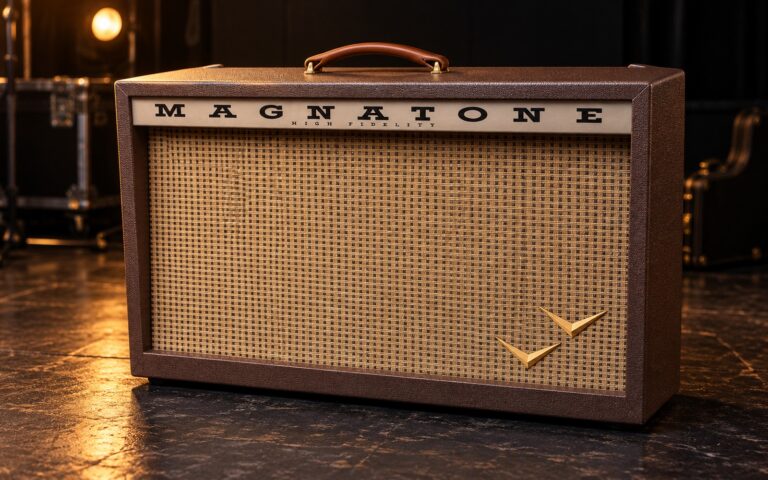
- Top image: GuitarGangsters AI-generated reference illustration, not a photograph.
- Larry Carlton: Kenneth C. Zirkel, Wikimedia Commons, CC BY-SA 4.0.
- Mike Campbell: Brian R. Grubb, Wikimedia Commons, CC BY-SA 3.0.
- Neil Young: Gorupdebesanez, Wikimedia Commons, CC BY-SA 3.0.
- Neil Young: Raph_PH, Wikimedia Commons, CC BY 2.0.
Latest News
Related
On This Day
Tuesday 10 November
From this week: