Sixty Years of Fuzz in a White Box: The JHS 3 Series Fuzz at $99
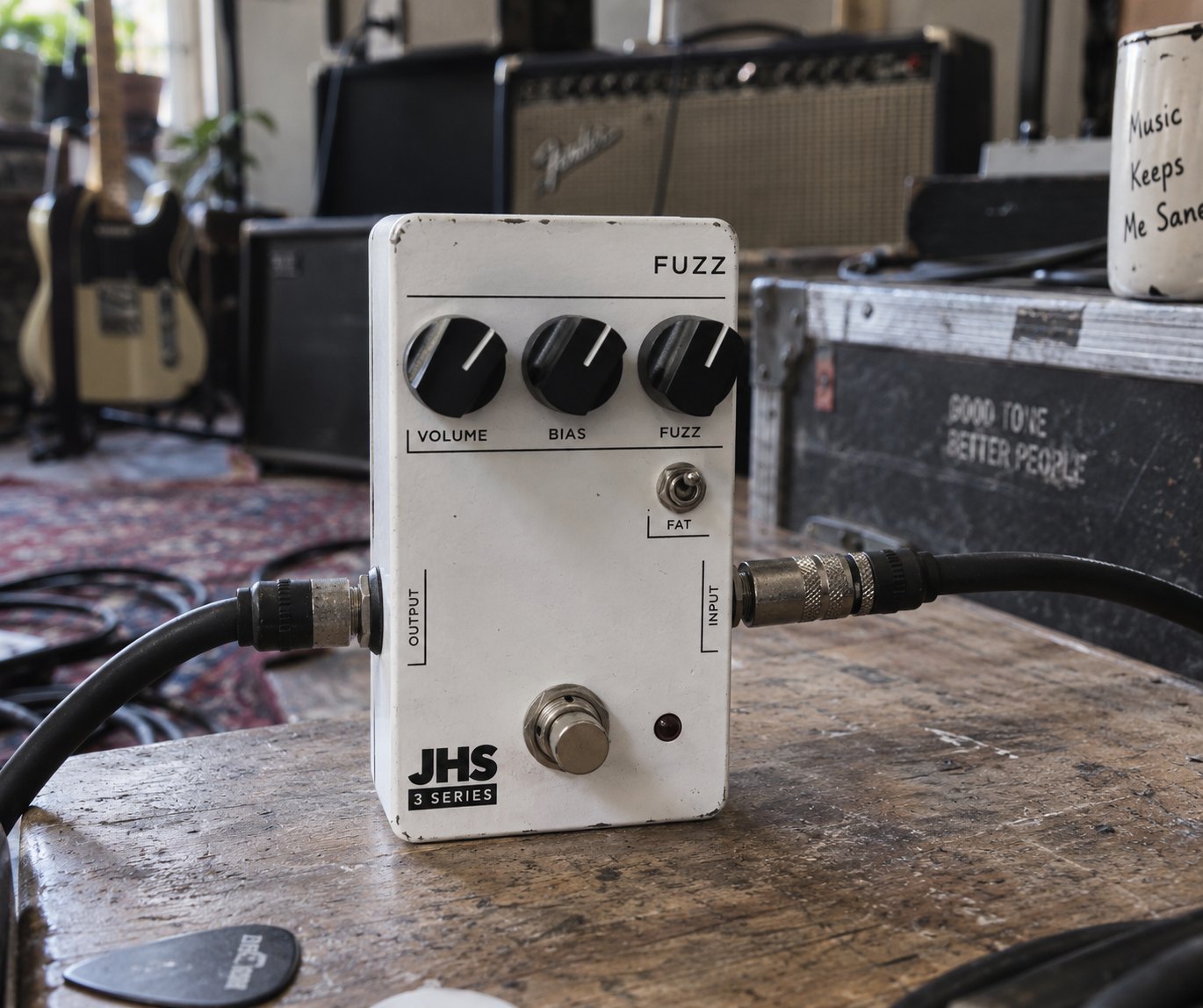
JHS 3 Series Fuzz Pedal. AI-generated reference illustration, not a photograph.
JHS 3 Series Fuzz: silicon Fuzz Face circuit with bias and fat switch for $99, made in Kansas City. Gated sputter or smooth sustain — all in one box.
The dying-battery trick is one of the oldest secrets in rock. Starve a fuzz pedal of voltage, and instead of smooth sustain you get a sputtering, velcro-ripping, gated chaos that sounds like nothing else in the pedal universe. The problem is that coaxing that sound out of a classic two-transistor fuzz requires either a genuinely dying battery or a boutique pedal with a bias control — features that usually cost real money. JHS decided to put that control on a $99 circuit built in Kansas City, Missouri, alongside three other very deliberate choices: a Fat toggle, a Fuzz knob usable across its entire sweep, and a design honest enough to clean up beautifully when you roll off your guitar’s volume. The JHS 3 Series Fuzz is not a comprehensive fuzz toolkit. It is a Fuzz Face-lineage silicon circuit executed with unusual clarity, priced where bedroom players and touring professionals can both reach it without hesitation.
The 3 Series line launched in 2020, and the Fuzz was one of the original seven pedals in the range alongside the Overdrive, Distortion, Compressor, Chorus, Delay, and Reverb. The premise was simple: take the Kansas City factory quality and build discipline that JHS applies to their $199–$299 boutique line and strip each design to its essential three controls plus one toggle. No unnecessary features, no complexity tax, same components, same QC. The JHS 3 Series Overdrive clones a discontinued HAO Rumble Mod. The JHS 3 Series Distortion replicates the Pro Co RAT circuit. The Fuzz goes back further — to the two-transistor silicon fuzz topologies of the mid-1960s that gave rock and roll its first truly dangerous sound.
The Circuit: Two Transistors, One Big Idea
The JHS 3 Series Fuzz is built around a classic two-transistor silicon fuzz circuit in the Fuzz Face family, with circuit architecture that JHS describes as drawing from 1960s Tonebender-era designs. Two transistors — Q1 and Q2 — form the gain structure. The Bias control is a voltage regulator tied directly to Q2, the output transistor. Lower voltage to Q2 means the transistor is starved: it cannot fully process the signal, and the result is compression, gating, sputtering, and that velcro-rip character that defines so many classic recordings. Full voltage to Q2 means smooth, sustained, harmonically rich fuzz of the kind that Jimi Hendrix pulled from his Dallas Arbiter Fuzz Face on “Purple Haze” and “Foxey Lady.”
Silicon transistors produce a brighter, tighter fuzz character than the germanium transistors used in some vintage units. The tradeoff is that silicon circuits are far more temperature-stable — they sound the same at a winter outdoor festival as they do in a humid summer club. Germanium fuzz pedals are famously sensitive to heat, sometimes requiring warm-up time and behaving differently across seasons. The JHS 3 Series Fuzz delivers its character consistently, every show, every session.
The Fuzz knob is one of the circuit’s most notable design decisions. On most Fuzz Face-style circuits, the Fuzz control functions as an input level adjustment — and at lower settings the signal is often too clean or too undefined to be useful. JHS tuned the 3 Series Fuzz so the knob is genuinely playable across its full sweep. At low Fuzz settings you get a pushed-amp overdrive texture, slightly compressed and harmonically dense. Mid-sweep delivers classic vintage fuzz with good note definition. Maximum Fuzz produces sustained, thick saturation with long decay. This full-sweep usability is unusual in the category and genuinely expands the pedal’s range beyond what the three-knob count suggests.
The Fat toggle engages a bass boost that thickens the low-frequency content of the signal. In standard mode the circuit leans toward the leaner, more articulate character of a classic Fuzz Face — appropriate for cutting through a band mix with single-coil guitars. With Fat engaged, the low end expands significantly, approaching Big Muff Pi territory in terms of sonic weight. This makes the pedal significantly more versatile with humbucking guitars or when playing clean, bass-heavy riffs that need sustain behind them.
Specifications
| Parameter | Specification |
|---|---|
| Brand | JHS Pedals |
| Model | 3 Series Fuzz |
| MSRP | $99.00 USD |
| Street price new (2026) | ~$85–$99 |
| Street price used excellent (2026) | ~$50–$70 |
| Circuit type | Two-transistor silicon fuzz (Fuzz Face / Tonebender lineage) |
| Controls | Volume, Bias, Fuzz (3 knobs) + Fat toggle |
| Power | 9V DC, center negative |
| Current draw | 9mA |
| Dimensions | 4.42″ × 2.38″ × 1.22″ |
| Weight | ~0.4 lbs |
| Made in | Kansas City, MO, USA |
| Year introduced | 2020 |
| Production status | Current |
| Battery operation | No (DC adapter only) |
Famous Players: Who Actually Uses the JHS 3 Series Fuzz
There is one confirmed primary-source user worth discussing properly, and a broader tradition of Fuzz Face-lineage players worth acknowledging for what they are: sonic context, not endorsements.
Madison Cunningham — Confirmed
The strongest documented case is Madison Cunningham, the Grammy-winning singer-guitarist whose fingerpicking-meets-alt-rock approach has made her one of the most discussed guitarists of her generation. A Premier Guitar Rig Rundown of Cunningham’s pedalboard shows the JHS 3 Series Fuzz clearly on her board — confirmed visual evidence from one of the industry’s most reliable primary sources. Cunningham also has a deep relationship with JHS: her signature pedal, the JHS Artificial Blonde, is a JHS Emperor Chorus/Vibrato variant developed in collaboration with the company. The fact that she runs the $99 3 Series Fuzz alongside her signature-level JHS gear is instructive — it suggests she uses the pedal because she likes what it does, not because she had to.

Cunningham’s playing style — open-voiced jazz-influenced chords, melodic single-note runs, and dynamic picking — represents an interesting use case for this circuit. The 3 Series Fuzz’s ability to clean up with guitar volume makes it compatible with the kind of dynamic playing she does: fuzz for intensity, backing off the guitar volume for clean passage work, without swapping pedals. The Fat toggle off keeps the circuit articulate enough for complex chord voicings. That is a real-world application worth understanding.
The Fuzz Face Tradition: Sonic Lineage, Not Endorsements
Beyond Cunningham, Equipboard lists four professional users of the JHS 3 Series Fuzz, though none of the others carry Premier Guitar Rig Rundown or major magazine interview confirmation. The broader story of what this pedal sounds like is better told through the Fuzz Face tradition it descends from — with honest framing that those artists play Fuzz Faces, not the JHS 3 Series specifically.
Jimi Hendrix (jimi-hendrix.html) is the undisputed patriarch of the silicon Fuzz Face sound. His Dallas Arbiter Fuzz Face — loaded with BC183 and BC108 silicon transistors on later units — produced the searing, sustaining fuzz of “Purple Haze,” “Foxy Lady,” and “Manic Depression.” The JHS 3 Series Fuzz operating in its standard mode with Bias dialed back for full voltage and Fuzz at three-quarters sweep is the closest modern equivalent to that sound at this price point. Not identical — the exact transistor pairing matters in fuzz circuits — but recognizably from the same family.
David Gilmour (david-gilmour.html) used a Dallas Arbiter Fuzz Face in the early Pink Floyd years, heard on “Interstellar Overdrive” and parts of “A Saucerful of Secrets.” His use was rhythmically unusual — thick, sustained, and more atmospheric than Hendrix’s explosive approach. The 3 Series Fuzz with Fat engaged and Fuzz at maximum approaches the kind of thick, wall-of-fuzz sustain associated with Gilmour’s early period.
Eric Johnson (eric-johnson.html, s4-015-eric-johnson-gear-guide.html) has been one of the most dedicated Fuzz Face practitioners in contemporary rock, known for running vintage germanium units and for his meticulous approach to fuzz-in-chain placement. Johnson’s well-documented preference for placing fuzz early in the chain — before wah, before any modulation — is the right approach for the JHS 3 Series Fuzz as well. Fuzz circuits in general, and this one in particular, respond poorly to buffered inputs before them: the interaction between the high-impedance fuzz input and the guitar’s pickups is part of the sound.
Jack White (jack-white.html) is the best contemporary reference for the dying-battery/high-Bias sound that the JHS 3 Series Fuzz’s Bias knob replicates. White has used various fuzz circuits with starved power supplies throughout his career — the Electro-Harmonix Big Muff variants, cheap vintage units, deliberately underpowered supplies — to achieve the gated, sputtering, velcro-rip quality on recordings with The White Stripes, The Raconteurs, and his solo work. He does not use the JHS 3 Series Fuzz. But the Bias control at its upper range is the closest affordable, repeatable path to that sound — a texture that White spent years hunting through dying batteries and unreliable vintage gear.
Tone Recipes and Settings
Classic Silicon Fuzz Face (Hendrix / Purple Haze)
Volume at unity with your clean signal (roughly noon). Bias at 9 o’clock or lower — full voltage to Q2, no gating. Fuzz at 2–3 o’clock. Fat toggle off. Roll your guitar’s volume down slightly from maximum — about 8 or 9 out of 10 — to let the circuit breathe and give you some headroom to dig in. Guitar in the neck pickup position with single coils. The result is the classic Fuzz Face voice: fat, harmonically rich, sustaining without being compressed or gated.
Gated Velcro (Jack White / Ty Segall Style)
Volume up to compensate for output drop. Bias at 3–4 o’clock or fully clockwise — starved Q2 voltage. Fuzz at maximum. Fat toggle off. The sound will sputter, gate, and rip. Note attack becomes percussive and aggressive. Single-note riffs benefit more than chords in this mode; complex harmonics fight the gating and produce unpredictable results, which can itself be the point. This setting works best into a slightly dirty amp that adds some additional gain behind the sputter.
Fat Sustain (Gilmour-Style Wall of Fuzz)
Volume at unity or slightly above. Bias at 9 o’clock (full voltage). Fuzz at maximum. Fat toggle engaged. The bass boost plus maximum Fuzz produces a thick, sustained, sustained wall of gain that sustains long after the note dies. Works particularly well for slide playing or slow, melodic lead lines where the full-frequency sustain of the Fat-on circuit can breathe without muddying chord work. Humbuckers respond especially well to this setting.
Pushed Amp Overdrive (Low Fuzz, Mid-Dynamic)
Volume above unity — use this as a boost. Bias at 9 o’clock. Fuzz at 7–9 o’clock (low end of sweep). Fat toggle off. At low Fuzz settings the circuit produces a compressed, harmonically dense overdrive that is less obviously a fuzz than a pushed amp. This is the setting that makes the 3 Series Fuzz useful for mid-gain tones without committing to full fuzz saturation. Stacked before the JHS Morning Glory V4, this low-Fuzz setting adds grit to the Morning Glory’s transparent overdrive without the combined result becoming indistinct.
Cunningham-Style Clean/Dirty Dynamic
Volume at or slightly above unity. Bias at 9–10 o’clock. Fuzz at 1 o’clock. Fat toggle off. Guitar volume at around 7–8. This setting keeps the circuit on the edge of heavy saturation but not over it — so that rolling the guitar volume down to 4–5 produces a noticeably cleaner tone while rolling it back up to 10 pushes the fuzz back into full effect. This is the dynamic playing approach confirmed by Madison Cunningham’s use case: one pedal, two functional gain states, controlled by the guitar rather than the foot.
How It Compares
JHS 3 Series Fuzz vs. Dunlop JHF1 Jimi Hendrix Fuzz Face
The Dunlop JHF1 Jimi Hendrix Fuzz Face is also a silicon Fuzz Face circuit, tuned to replicate the BC183/BC108 transistor combination of Hendrix’s later Dallas Arbiter units. It costs approximately the same as the JHS 3 Series Fuzz. The JHF1 is a more accurate historical replica: no bias control, no fat switch, exactly two controls (Fuzz and Volume). The JHS 3 Series Fuzz offers more flexibility — the Bias knob alone is worth more than the price difference on a versatility basis — but the JHF1 may have a slight edge in pure Fuzz Face authenticity for players who want exactly that sound and nothing more. If you know you want Hendrix tones and only Hendrix tones, the JHF1. If you want a broader canvas, the JHS.
JHS 3 Series Fuzz vs. Electro-Harmonix Big Muff Pi
The Electro-Harmonix Big Muff Pi is the other dominant $99-range fuzz architecture — four transistors instead of two, a longer gain chain, a more pronounced mid scoop, and the sustained, woolly character associated with David Gilmour’s “Comfortably Numb” solo and Billy Corgan’s Siamese Dream wall-of-sound. The Big Muff Pi and the JHS 3 Series Fuzz are fundamentally different circuits chasing different sounds: the Big Muff scoops mids and produces a sustained, almost ambient fuzz character; the 3 Series Fuzz Face is mid-present and more interactive with pick attack. For single-note lead lines, solos, and articulate fuzz playing, the JHS. For wall-of-sound, thick, layered fuzz ideal for heavy riffs or ambient drone, the Big Muff.
JHS 3 Series Fuzz vs. Z.Vex Fuzz Factory
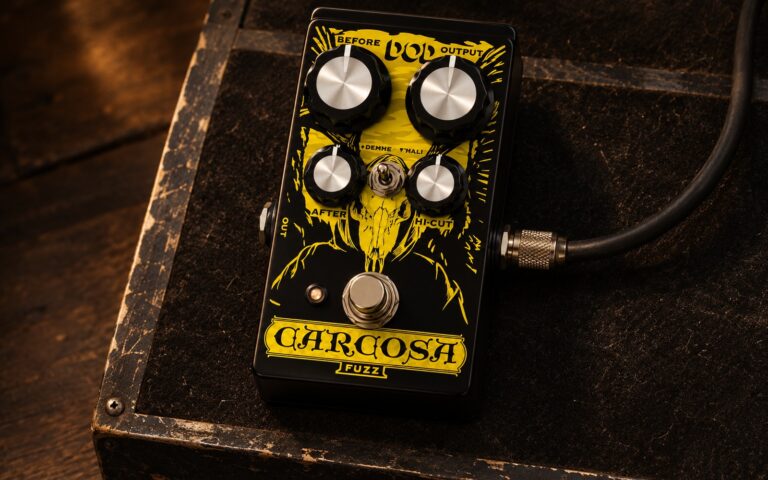
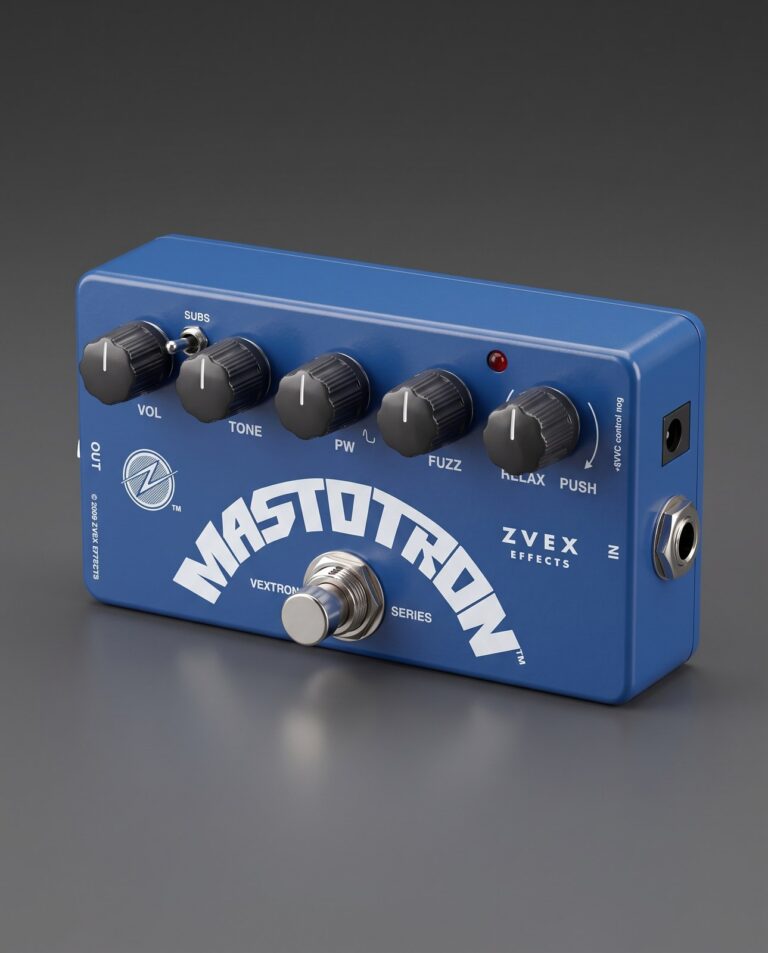
The Z.Vex Fuzz Factory puts five controls — Gate, Comp, Drive, Volm, Stab — on a circuit that covers everything from smooth sustain to full oscillation, chaos, and self-generating noise. It costs approximately $200 and is designed for players who want maximum control over every parameter of fuzz behavior. The JHS 3 Series Fuzz covers the Stab/bias-starvation territory of the Fuzz Factory’s most famous trick at $99, without the learning curve or the risk of setting something accidentally. The Fuzz Factory rewards deep tweaking and has more extreme range. The JHS is more immediately usable on a live pedalboard. They are not direct competitors — they serve different players — but the Fuzz Factory is the natural upgrade path if the Bias knob on the JHS makes you want even more starved-voltage control.
JHS 3 Series Fuzz vs. Boss FZ-1W Fuzz
The Boss FZ-1W Fuzz is Boss’s Waza Craft take on vintage fuzz, covering multiple classic fuzz topologies in a single unit with a Standard/Custom switch. It costs approximately $150–$200. The FZ-1W is buffered (Boss’s output buffer is always present) and covers more tonal ground via its two modes. The JHS 3 Series Fuzz is unbuffered, which matters: unbuffered fuzz circuits respond to the impedance of your pickups in a way buffered circuits do not. If you’re running a pedalboard where the fuzz can go first in chain with a direct cable from guitar, the JHS’s interaction with pickup impedance is part of the sound. If you need the fuzz to work consistently in any chain position, the buffered Boss FZ-1W is more predictable.
JHS 3 Series Fuzz vs. Way Huge Swollen Pickle
The Way Huge Swollen Pickle Jumbo Fuzz MKII is a Big Muff-derived circuit with six controls and dramatically more tonal range. It costs approximately $130 and occupies a larger physical footprint. For players who need a Big Muff-style circuit with more fine-tuning control, the Swollen Pickle is the answer. For players who want a Fuzz Face-style circuit with essential features at the lowest reasonable price point, the JHS 3 Series Fuzz is the answer. They are operating in adjacent but distinct sonic territories.
The Pedalboard Placement Question
Fuzz Face-lineage circuits are the most placement-sensitive category in pedals. The reason is impedance. A traditional Fuzz Face circuit is designed to be driven directly by the high impedance output of a guitar’s pickups. When a buffered pedal precedes the fuzz in the chain — a Boss tuner, a Boss compressor, any standard true-bypass pedal with a buffer in bypass mode — the buffer converts the guitar signal from high impedance to low impedance before it reaches the fuzz. Low-impedance input changes how the fuzz circuit’s transistors respond. The result is typically brighter, thinner, and less interactive with pick dynamics.
For the JHS 3 Series Fuzz, the practical recommendation is simple: put it first in the chain, connected directly to the guitar with the shortest reasonable cable run. If you must put something before it — a polyphonic tuner is the most common reason — use one with a high-impedance input or a bypass mode that genuinely disconnects the buffer from the signal path. JHS does not explicitly state whether the 3 Series Fuzz has true bypass or a buffered output (the product page does not specify, and the 3 Series Overdrive had the same ambiguity). If true bypass is critical to your rig, verify with a retailer before purchasing.
After the fuzz, almost anything works cleanly. The fuzz’s output impedance is low enough to drive wah pedals (which it should precede for the wah-then-fuzz sound, though fuzz-then-wah produces its own interesting textures), drive modulation pedals, and drive delay and reverb effects without issue.
Power and Pedalboard Integration
At 9mA, the JHS 3 Series Fuzz is one of the lowest current-draw quality fuzz pedals available. This is the same 9mA figure as the JHS 3 Series Overdrive and Distortion — the result of JHS’s consistent circuit design approach across the 3 Series range. A standard isolated 9V 100mA supply output powers the Fuzz with 91mA to spare. Even a modest pedalboard power supply with multiple 100mA outputs can run several 3 Series pedals simultaneously without strain.
The pedal accepts no battery — DC adapter only, same as other JHS 3 Series units. This is a minor inconvenience for busking or amp-only practice situations but is standard practice for the category. One practical advantage: the Bias control eliminates the temptation to use a dying battery for its gating effect, since you can reproduce that sound precisely and repeatably without relying on an unpredictable power source.
The enclosure dimensions — 4.42″ × 2.38″ × 1.22″ — put the 3 Series Fuzz in the standard compact-pedal footprint used by the entire 3 Series range. JHS designed the line for pedalboard efficiency, and three 3 Series pedals occupy roughly the same footprint as two mid-size boutique pedals.
Buying Guide: New vs. Used
The JHS 3 Series Fuzz is current production and available new through authorized JHS dealers at $99 MSRP. Discounting below that price is uncommon for JHS products at authorized dealers, so $85–$99 represents the realistic new street price in 2026. Gray-market pricing occasionally undercuts this, but JHS’s warranty (voided for unauthorized dealer purchases) is worth the few dollars of premium at a reputable retailer.
Used prices on Reverb and Guitar Center used listings have been running $50–$70 in excellent condition, $40–$55 in good condition. Given the pedal’s $99 new price and the 3 Series range’s reputation for reliability, a used 3 Series Fuzz in excellent condition is an excellent value proposition — you’re paying roughly half price for a pedal that is straightforward to inspect (three knobs, one switch, no complex electronics to check).
There is no vintage or collector premium on the 3 Series Fuzz. Every unit from 2020 onward is effectively the same circuit. If the enclosure is undamaged and the controls function smoothly, condition is essentially cosmetic. Buy used without hesitation at the right price.
Ownership Notes: The Details That Matter
The Bias control is an inverted experience compared to most knobs: more clockwise means less voltage to Q2, which means more gating and more starvation effects. This is physically counterintuitive — turning something up to reduce it — and it catches players off guard on first use. The Bias behavior is not a flaw; it reflects how voltage-starvation circuits actually function. But expect to spend thirty minutes learning which direction produces which character before the knob becomes intuitive.
The Fuzz knob’s full-sweep usability is genuine, but the circuit’s character changes significantly across the sweep range. Below 9 o’clock, the pedal functions more like a light overdrive than a fuzz. Between 9 o’clock and noon, classic fuzz territory begins. Above noon, the sustain and saturation increase without the kind of dramatic change in character that some circuits produce. The transition from overdrive to fuzz character is gradual rather than switched, which rewards slow-turning experimentation more than rapid setting changes.
The Fat toggle is binary — on or off — but its effect is substantial enough that it functions as two distinct tonal modes for the pedal. Fat off: Fuzz Face. Fat on: closer to Big Muff territory in low-end weight. Matching the toggle position to your guitar and amp combination is worth time in soundcheck. Humbuckers into a clean amp usually benefit from Fat off (the pickups already provide low-end body). Single coils into a clean amp may benefit from Fat on (the added bass compensates for the inherent thinness of the fuzz circuit in single-coil territory).
The pedal cleans up with guitar volume reduction in an authentic Fuzz Face fashion. Rolling the guitar volume from 10 to 6 or 7 produces a noticeably cleaner texture while retaining the fuzz circuit’s harmonic complexity. This is not simply a volume reduction — it changes the character of the overdrive. Single-note lines played at guitar volume 6 with the Fuzz at maximum will sound and sustain differently than playing the same line at volume 10 with Fuzz at 10 o’clock. Learning to use the guitar volume as a dynamic control rather than a set-and-forget knob doubles the effective range of the pedal without touching the enclosure.
Frequently Asked Questions
What circuit is the JHS 3 Series Fuzz based on?
It is based on a two-transistor silicon fuzz circuit in the Fuzz Face / early Tonebender family. JHS describes it as drawing from classic 1960s two-transistor fuzz designs. The Bias control directly adjusts voltage to Q2, the output transistor, allowing the circuit to reproduce the dying-battery starvation effect that characterized the most aggressive vintage fuzz sounds.
Does the Bias knob gate the fuzz?
Yes, at higher Bias settings (more clockwise, more voltage starvation to Q2), the circuit produces gated, sputtering fuzz that cuts off abruptly rather than decaying naturally. This is the same effect as running a classic fuzz on a nearly depleted battery. At lower Bias settings (counterclockwise, full voltage), the circuit produces smooth, sustaining fuzz with long decay.
What does the Fat toggle do exactly?
The Fat toggle engages a bass boost that adds significant low-frequency content to the signal. In standard mode (Fat off), the circuit leans toward the leaner, mid-present character of a classic Fuzz Face. With Fat on, the low end expands substantially — thicker body, more weight, closer to Big Muff territory in frequency content. It works particularly well with humbucking guitars or when the playing context calls for more sonic mass.
Where should the JHS 3 Series Fuzz go in my signal chain?
First in chain, directly after the guitar cable, before any buffered pedals. Fuzz Face-lineage circuits interact with the high impedance of guitar pickups in ways that change when a buffer precedes them. Running it first preserves that interaction. After the fuzz, signal chain order follows normal conventions — wah, modulation, delays, reverb. If a tuner must precede it, use one with a high-impedance or true-bypass mode that doesn’t introduce a buffer.
Does the JHS 3 Series Fuzz have true bypass?
JHS does not explicitly confirm true bypass on the 3 Series Fuzz’s product page. The broader JHS line uses true bypass on most designs, but the 3 Series was designed for simplified specs. If true bypass is a critical requirement for your rig — particularly if you’re running long cable runs where a buffer would help — verify with your retailer before purchasing. This ambiguity is the same across several 3 Series models.
Can the JHS 3 Series Fuzz work with humbucking guitars?
Yes, and with the Fat toggle off it is more versatile than you might expect. Humbuckers input a higher output signal into the fuzz circuit, which can push the Fuzz and Bias controls into different sweet spots than single coils — you may find yourself using lower Fuzz settings and more conservative Bias positions for the same effective saturation level. The Fat toggle off is generally recommended for humbuckers into clean amps; Fat on with humbuckers into a slightly dirty amp can become very dense and may require backing off the Fuzz knob significantly.
How does the Fuzz knob differ from a standard Fuzz Face?
On a standard Fuzz Face, the Fuzz control is often genuinely useful only in the upper half of its range — below noon, the sound becomes thin, undefined, or just slightly gritty in ways that aren’t musically useful for most players. JHS tuned the 3 Series Fuzz so the control is playable across the full sweep: low settings produce a pushed-amp overdrive, mid settings produce classic fuzz, high settings produce full saturation. This full-sweep usability is one of the more significant practical advantages of the 3 Series Fuzz over a stock Fuzz Face clone.
Is the JHS 3 Series Fuzz the same circuit as the JHS Legends of Fuzz pedals?
No. The JHS Legends of Fuzz series — the Smiley (Big Muff), Bender (Tonebender), and Crimson (Fuzz Face variant) — are separate, more expensive designs with different circuit architectures, different transistor selections, and different historical references. The 3 Series Fuzz is a JHS-originated circuit in the Fuzz Face family designed for the $99 price point with maximum simplicity. The Legends of Fuzz pedals are vintage-replica oriented designs at higher price points. The 3 Series Fuzz is not a simplified version of any Legends pedal — it is its own thing within the same broad Fuzz Face tradition.
Image credits
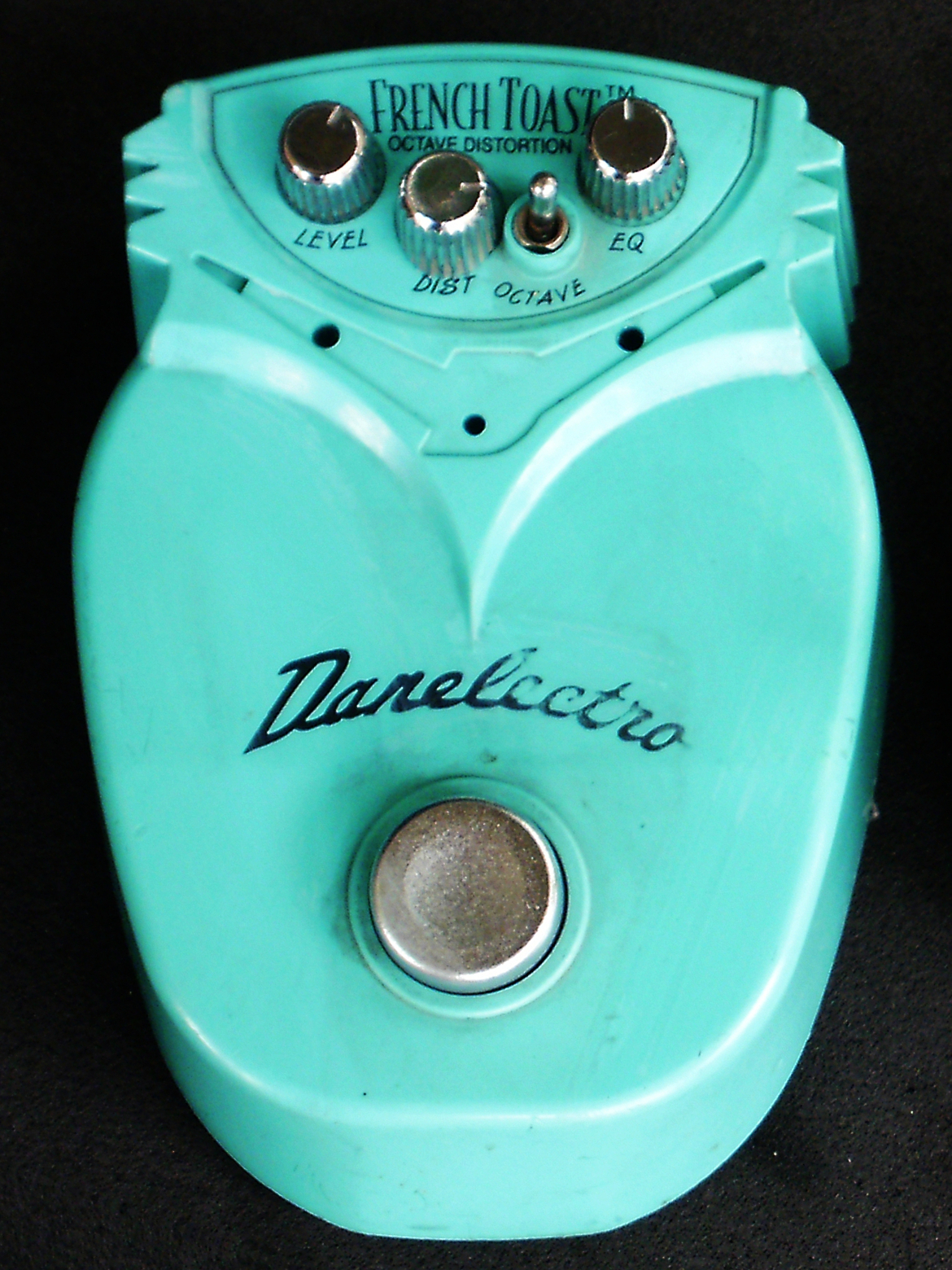
- A mint green distortion pedal: Danelectro French Toast octave distortion rehouse on metal case (2011-10-03 by Andrés Galeotti).jpg: Andrés Galeotti fro, Wikimedia Commons, CC BY 3.0.
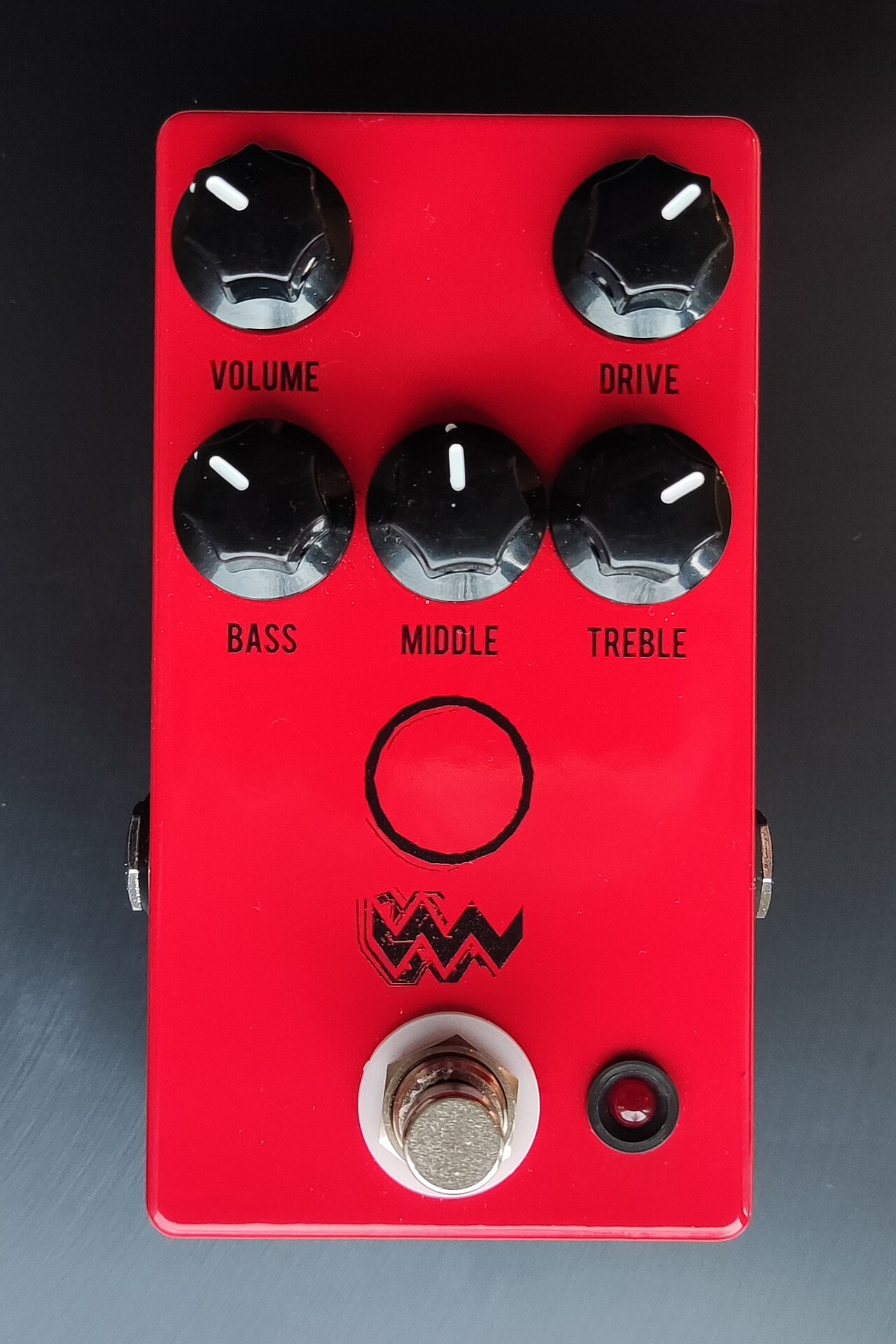
- A JHS Angry Charlie pedal: El Grafo, Wikimedia Commons, CC BY-SA 4.0.
- Top image: GuitarGangsters AI-generated reference illustration, not a photograph.
- Madison Cunningham: Justin Higuchi from Los Angeles, CA, USA, Wikimedia Commons, CC BY 2.0.
Latest News
Related
On This Day
Monday 9 November
From this week: