Chasing the Brown Sound: Inside the Wampler Pinnacle Deluxe V2
The Wampler Pinnacle Deluxe V2 puts EVH's brown sound, classic rock crunch, and screaming metal gain into one pedal with a 3-band EQ and independent boost.
Eddie Van Halen’s tone from the late 1970s is the most analysed, obsessed-over, and frequently attempted sound in the history of rock guitar. Guitarists have spent four decades chasing the combination of a modded Marshall plexi, a Variac transformer, a bias tap, and a specific brand of physics that only existed in one studio on one afternoon. Most pedals that promise “the brown sound” deliver a reasonable facsimile. The Wampler Pinnacle Deluxe V2 is one of the rare ones that earns the comparison — and then keeps going, covering classic rock, high-gain metal, and everything in between with the kind of analogue authority that boutique builders in Indiana apparently have in the water supply.
This is a pedal built by a tone obsessive, for tone obsessives. It started life as Brian Wampler’s personal challenge to himself: capture the Marshall magic in a stompbox without sacrificing touch sensitivity, dynamics, or the organic bloom of a real high-voltage amp. Fourteen years and two major revisions later, the Pinnacle Deluxe V2 sits at the premium end of the Wampler distortion line — bigger, more versatile, and more comprehensively tooled than any Pinnacle that came before it.
The Origin Story: Brian Wampler Takes on a Legend
Brian Wampler launched Wampler Pedals from Centerville, Indiana in 2004, initially focused on helping guitarists modify their existing pedals before moving into original designs. By the late 2000s, he had developed a reputation as one of the most technically credible boutique builders in the United States — someone who wrote extensively about circuit design rather than simply repeating received wisdom about “mojo” and “magic parts.”
The original Wampler Pinnacle arrived around 2009, conceived as a genuine attempt to capture what made the Van Halen tone so compelling: the low-midrange thickness, the harmonic saturation that bloomed rather than compressed, the pick attack that cut through without becoming thin, and the dynamic range that rewarded light picking with near-clean touch and aggressive strumming with full-frequency aggression. It was not a subtle or versatile pedal. It was a brown-sound machine, and it was exceptionally good at that one thing.
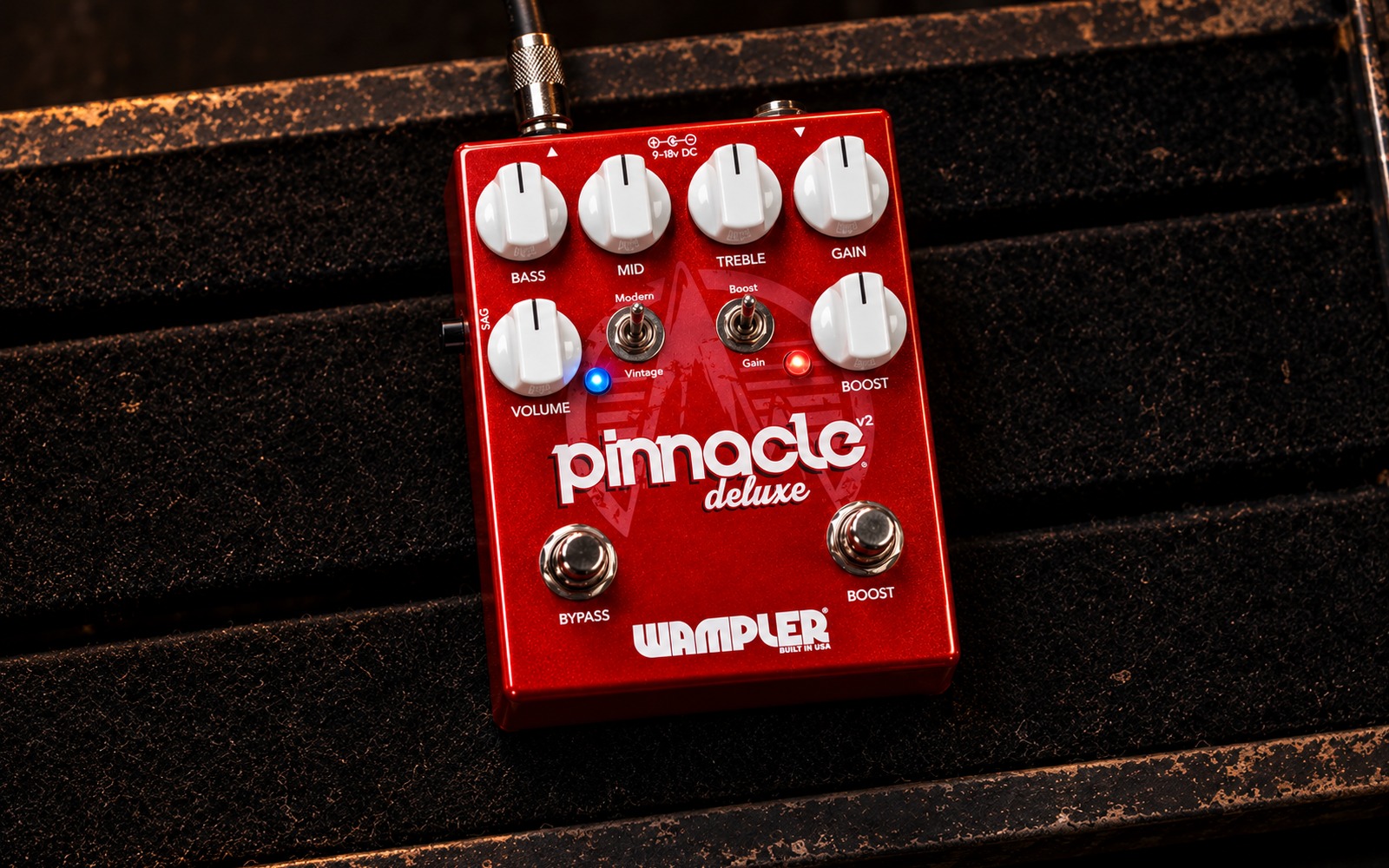
The Pinnacle Deluxe followed, essentially the same circuit but with the boost moved from a side switch to a dedicated footswitch — a significant practical improvement for live use. Then came the V2, which was a substantive redesign rather than a cosmetic refresh. Where the original was a single-voice high-gain pedal with a boost, the V2 arrived with a proper three-band EQ architecture, a Vintage/Modern character switch, a side-mounted SAG control, independent Bright and Bass boost toggles, and a significantly reworked “Valve Screamer” boost circuit that operates independently from the main distortion — including when the main distortion is bypassed. The V2 was Wampler taking everything players had requested for a decade and building it properly into the enclosure.
The notable endorsement on the Wampler website comes from Zeke Clark, who served as Eddie Van Halen’s guitar technician for many years. Clark’s comment — that the Pinnacle “NAILS” the brown sound better than anything he has heard — is worth reading carefully. He is a guitar tech, not a performing guitarist, and his frame of reference is one of the most demanding in rock history. He was not endorsing the pedal on the basis of general distortion quality but on the specific basis of whether it matched the actual amp tones he maintained and managed throughout a career working alongside the originator. That is a different kind of credibility, and it is worth more than a celebrity photograph holding the box.
What Makes the Pinnacle Deluxe V2 Tick
The Pinnacle Deluxe V2 runs two footswitchable circuits simultaneously available to the player: the main high-gain distortion, and an independent “Valve Screamer” TS-style boost that operates as a separate signal path. The boost can be engaged on its own, run through the main distortion as a gain-staging tool, or used while the main circuit is bypassed as a standalone overdrive pedal. This dual-circuit architecture gives the Pinnacle Deluxe V2 flexibility that single-footswitch distortions simply cannot match.
The character of the main circuit divides across two distinct voicings controlled by a side-mounted toggle. Vintage mode delivers the warm, organic, slightly looser feel of classic 1970s Marshall gain — that elastic response where the low end blooms rather than tightens, chords breathe rather than compress, and the pick attack has mass rather than sharpness. Modern mode tightens the response, hardens the attack, and pushes more aggressive midrange presence forward — think late-1980s and 1990s high-gain amplifier territory, where the bottom end is controlled and the midrange cuts rather than blooms.
The SAG switch on the side of the enclosure addresses the tightness of the low-frequency response independently of the Vintage/Modern character choice. SAG engaged introduces a degree of dynamic sag into the bottom end — the amp-like feeling where the power supply slightly droops under heavy pick attack, giving a natural compression that vintage tube players describe as “giving.” SAG disengaged removes that sag entirely, producing a tighter, more controlled response that works better with high-output pickups and drop-tuned contexts. The combination of Vintage/Modern and SAG creates four distinct low-end and character combinations before touching a single knob.
Specs and Controls
Gain: Controls distortion depth, from edge-of-breakup at minimum to thick, compressed saturation at maximum. The sweep is usable across the full range — low settings produce Marshall crunch rather than undefined muddiness, and high settings retain note definition rather than dissolving into noise.
Volume: Sets the output level of the main distortion circuit. At moderate gain settings, this can push significantly above unity and into boost territory. At maximum gain, volume needs to be managed to avoid overwhelming a clean amp.
Tone: Rolls off high-frequency content clockwise, similar to a standard treble control. Unlike some distortion pedals where the tone sweep is practically limited to a narrow usable range, the Pinnacle’s tone sweep is genuinely wide — extreme counterclockwise settings retain definition rather than going woolly, and extreme clockwise settings are darker without becoming honky.
Contour: Controls midrange content — scoop counterclockwise for a scooped metal EQ response, push clockwise for a more forward, cutting midrange presence suited to blues-rock and lead work. This is the most important EQ control for fitting the pedal into a band context; it determines whether you sit in the mix or cut above it.
Bright Boost Toggle: Side-mounted switch that adds a treble boost to the overall response, particularly useful with darker-sounding amplifiers or in contexts where the fundamental distortion character needs additional presence and air.
Bass Boost Toggle: Side-mounted switch that adds low-frequency weight, emulating the thump of a 4×12 cabinet. Particularly useful for bedroom or recording contexts where the physical air movement of a large cabinet is absent.
Vintage/Modern Toggle: Side-mounted. Vintage = looser, warmer, classic 1970s Marshall character. Modern = tighter attack, harder clip response, contemporary high-gain amplifier voicing.
SAG Switch: Side-mounted. Controls the dynamic sag of the circuit’s response. Engaged adds natural power-supply-style compression to the low end. Disengaged tightens the response for high-output pickups and drop-tuned applications.
Boost Footswitch: Independent TS-style “Valve Screamer” pre-gain boost. Can be used as a standalone light overdrive (main circuit bypassed), as a lead boost in front of the main distortion, or as a gain-staging tool. Works at any combination with the main circuit.
Famous Players — An Honest Assessment
The Wampler Pinnacle Deluxe V2 has a complicated relationship with famous-player association. The pedal is unarguably built around the sonic territory of some of the most celebrated guitarists in hard rock and heavy metal history — but confirmed documentation of those players actually using this specific pedal is thin on the ground.
Equipboard’s database lists three professional musicians associated with the Pinnacle Deluxe V2, though their specific identities and the nature of that documentation were not publicly verifiable at time of writing. No Premier Guitar Rig Rundown featuring the Pinnacle Deluxe V2 in a confirmed live signal chain was located during research for this article.
What we can say with certainty is that the pedal’s sonic design is entirely oriented toward the Marshall-lineage players who defined hard rock and heavy metal. Eddie Van Halen‘s brown sound from 1977–1984 is the explicit design brief — the modified Marshall, the controlled midrange bloom, the pick attack that rings rather than spikes. Brian Wampler built this pedal to answer one question: what would it take to get that tone on a pedalboard rather than inside a vintage amp head?
Dimebag Darrell‘s Pantera era represents the Modern-mode end of the Pinnacle’s range — the tight, aggressive midrange punch that made “Vulgar Display of Power” sound like it was recorded live inside a 4×12. Dimebag ran modified Randall solid-state amplifiers rather than Marshalls, so the parallel is tonal rather than equipment-based, but the Pinnacle Deluxe V2 on Modern with SAG disengaged gets into that sonic neighbourhood convincingly.
Randy Rhoads‘s work with Ozzy Osbourne on “Blizzard of Ozz” and “Diary of a Madman” exemplifies the Vintage mode’s classic-rock saturation character — thick, harmonically complex, with a sustain that trails beautifully without compressing the pick attack. Rhoads played modified Marshall JMP heads, and the Pinnacle’s Vintage mode is the closest a stompbox gets to that character without an actual transformer in the loop.
Zakk Wylde‘s wall-of-sound approach — sustained, heavily picked, almost operatic in its loudness — represents the Pinnacle’s maximum-Gain, Vintage-mode character pushed through a clean amp or a loud Marshall. Slash‘s Les Paul-into-Marshall crunch from the Appetite era is the pedal’s mid-gain, Vintage-mode, Contour-at-noon sweet spot.
These are sonic parallels and tonal lineage notes, not confirmed player associations. The article is honest about that distinction because the distinction matters. What the Pinnacle Deluxe V2 offers is not “use the pedal that [famous player] uses.” It offers access to the tonal vocabulary that those players built over decades — the vocabulary that defined hard rock guitar, now contained in a box the size of a paperback novel.
Tone Recipes and Settings
Brown Sound: Edge-of-Eruption
Toggle to Vintage mode. SAG disengaged (tight bottom end). Gain at approximately 3 o’clock. Volume at unity. Tone at 11 o’clock (slightly below noon to prevent harshness). Contour at noon (balanced midrange). Bright boost off, Bass boost off. Use a humbucker-equipped guitar. Boost footswitch off. The result is a thick, harmonically saturated tone with natural pick attack bloom — the fundamental EVH brown-sound character before effects processing. Add light chorus pedal after for the “Panama” spatial width.
Classic Rock Crunch: AC/DC Territory
Vintage mode. SAG engaged (slightly loose low end). Gain at 1–2 o’clock. Volume slightly above unity (lets the amp breathe). Tone at 1 o’clock (present but not bright). Contour slightly counterclockwise from noon (just touching midrange scoop). Boost footswitch off for rhythm, on for lead lines. This setting works equally well with single-coil and humbucker instruments and translates across amplifier types.
Modern Metal: Controlled Aggression
Toggle to Modern mode. SAG disengaged. Gain at 4 o’clock (near maximum). Volume at unity. Tone at noon. Contour at noon (forward midrange — don’t scoop for live use). Bright boost off. Bass boost disengaged (Modern mode already has controlled low end; bass boost pushes it further than most amplifiers handle cleanly). Boost footswitch on for lead passages only. Works best with active pickups (EMG 81/85 or similar) and a clean, powerful amplifier with a full-range cabinet.
British Lead: JCM800 Voice
Vintage mode. SAG disengaged. Gain at 2–3 o’clock. Contour slightly clockwise from noon (forward mids for lead cutting). Tone at 11 o’clock. Boost footswitch on. Bass boost toggle engaged for additional cabinet warmth. This setting covers the lead tone from British hard rock’s golden era — the sound of a cranked JCM800 on a good night in a medium-sized venue, captured at any volume level.
Boost-as-Overdrive: Clean-Amp Grit
Main distortion bypassed. Boost footswitch only. Volume on main circuit irrelevant (bypassed). The Valve Screamer boost operates independently — TS-style character, mid-emphasis, ideal for a light overdrive texture into a clean or slightly dirty amplifier. This effectively turns the Pinnacle Deluxe V2 into a two-voice pedal: full distortion on demand, and a standalone light overdrive available without the main circuit.
Where the Pinnacle Deluxe V2 Fits on Your Pedalboard
In a standard pedalboard signal chain, the Pinnacle Deluxe V2 sits after tuner and wah and before time-based effects. Its Relay True Bypass means no signal coloration in the bypass state — there is no buffer when the pedal is disengaged. For players with long cable runs or complex passive setups, a buffer placed earlier in the chain (or an active pickup system) ensures the bypass signal stays clean and defined.
The independent boost footswitch changes the pedalboard arithmetic significantly. Rather than requiring a separate overdrive or boost pedal for lead work, the Pinnacle delivers a two-footswitch system in a single enclosure. Rhythm players who want clean-channel grit for verses and full distortion for choruses, or players who need a lead boost above the main distortion for solos, can manage both voices without requiring additional real estate on the board.
Compression placed before the Pinnacle — such as the Wampler Ego Compressor — changes the pick attack and sustain character without altering the fundamental distortion voicing. At low Gain settings, this combination can produce a more amp-like bloom. At maximum Gain, the compressor simply increases the evenness of the sustain tail.
The Pinnacle Deluxe V2 runs cleanly into any amplifier type. With a clean, full-range amplifier (Mesa Boogie used clean, Marshall JCM800 clean channel, Fender Twin), the pedal’s full EQ range is available and audible. With a dirty or crunch amplifier channel, the pedal stacks rather than replaces — the combined gain of pedal and amp producing a thick, saturated result that loses some of the pedal’s EQ precision but gains the organic complexity of two analogue gain stages in series.
Pinnacle Deluxe V2 vs the Competition
vs Pro Co RAT 2: The RAT 2 and Pinnacle Deluxe V2 occupy the same high-gain distortion category but from opposite directions. The RAT is a compressed, filter-based design with a single Filter control whose inverted sweep (CW = darker, not brighter) produces a specific throaty midrange character. The Pinnacle is warmer, more Marshall-voiced, with far more EQ flexibility via the 3-band architecture and side toggles. The RAT costs less than half the price and has decades of professional endorsement from players across punk, grunge, and metal. The Pinnacle costs more, does more, and specifically targets the Plexi/Marshall end of the gain spectrum rather than the RAT’s more neutral high-gain voice. Neither replaces the other; they are genuinely different tools.
vs Boss DS-1 Distortion: The DS-1 is the world’s best-selling distortion pedal, which says something about its price and ubiquity and less about its tonal range. Against the Pinnacle Deluxe V2, the DS-1 sounds brighter, thinner, and less Marshall-like — it cuts rather than saturates, and its gain structure is relatively compressed. The DS-1’s single Tone control has a notoriously narrow usable range. The Pinnacle costs roughly four times as much and delivers a genuinely different distortion character. They are not competitors for the same tone goal.
vs Boss MT-2 Metal Zone: The MT-2’s infamous scooped-mid character and high-gain fizz represent the opposite end of the distortion philosophy from the Pinnacle. The MT-2 achieves massive apparent gain through frequency boosting that can make individual notes sound enormous and chords sound hollow. The Pinnacle’s gain is genuinely high-voltage analogue saturation rather than frequency manipulation — it sounds bigger at lower gain settings than the MT-2 at maximum. The MT-2 is cheaper and arguably more genre-specific to 1990s-era metal. The Pinnacle is more versatile across rock styles.
vs Wampler Belle Overdrive: The Belle is Wampler’s transparent, Nobels ODR-1-inspired overdrive — low-to-medium gain, full frequency, designed to let the amplifier and guitar character come through. The Pinnacle Deluxe V2 is the opposite in intent: it imposes a Marshall character onto any amplifier, running the full gain spectrum from crunch to metal. These are complementary rather than competing pedals, and players who run both — Belle for clean-tone preservation, Pinnacle for saturation — are operating two fundamentally different tools from the same manufacturer.
Buying Guide
The Pinnacle Deluxe V2 retails new at $239.97 MSRP, with street prices typically landing between $200 and $240 depending on retailer and promotional pricing. Sweetwater has occasionally offered the pedal at around $204 with periodic discounts. At this price it sits in the premium boutique-tier distortion category, above the Boss and MXR flagship distortions and below the multi-channel amp-simulation pedals in the $300–$500 range.
Used examples in excellent condition typically sell between $130 and $170, making the V2 a reasonable secondhand proposition for players who want the full feature set without the new price. When buying used, verify that you are purchasing the V2 specifically — the original Pinnacle Deluxe had the same visual form factor but lacked the 3-band EQ architecture, SAG switch, and improved boost circuit of the V2. The V2 is identifiable by its two footswitches (main distortion and independent boost) and the full suite of side-mounted controls.
The Pinnacle Deluxe V2 is the right pedal for players who primarily need a single high-gain distortion voice and want maximum control over how that voice sits in a band context. The Vintage/Modern switch, SAG control, and full EQ architecture make it more adaptable than any fixed-voicing distortion in its class. It is a less sensible choice for players who need multiple radically different distortion characters — for that, a multi-mode pedal or separate distortion pedals on a loop switcher is a more appropriate solution.
Ownership Notes
The SAG switch behavior is worth internalising before the first gig. SAG engaged adds low-end softness and a natural compression quality that feels amp-like and organic. SAG disengaged tightens the bottom end significantly and is generally the better choice for high-output humbuckers (particularly active pickups), drop-tuned guitars, or any context where low-end definition is critical — live metal applications, for example. The choice is not about better or worse; it is about what the specific guitar, pickup, and amp context requires.
The Contour control’s midrange interaction is the most important EQ decision on this pedal. A fully scooped Contour (counterclockwise) sounds enormous in isolation and disappears in a band mix. A fully forward Contour (clockwise) cuts through anything but can feel harsh in isolation. The working range for most band contexts is between 10 o’clock and 2 o’clock, with fine adjustments determined by the specific amplifier and stage volume. Set the Contour at rehearsal volume, not bedroom volume.
The independent boost footswitch works in bypass, which means the Pinnacle Deluxe V2 can function as a two-pedal system: a standalone light TS-style overdrive for clean passages that need a touch of grit, and a full high-gain distortion for heavier moments — without requiring any other pedal on the board. Players who have only used the main distortion mode are missing half the instrument.
The Relay True Bypass means the pedal passes the input signal directly to the output with no circuit interaction when both footswitches are off. This is transparent and quiet. However, it also means the Pinnacle provides no buffering for a passive guitar signal in long cable runs. If your rig uses long cables and entirely true-bypass pedals, consider placing a buffer early in the chain.
Power draw is 19mA at 9V and 23mA at 18V — modest enough to run from any quality isolated power supply output, including 100mA isolated slots on standard pedalboard power units. A battery is included and will power the pedal if DC power is unavailable. The LED flashes three times when battery power is running low — the same low-battery indicator system used across the current Wampler range.
The pedal runs at 9V by default and also accepts 18V from a DC supply. Unlike some pedals where 18V operation is a meaningful headroom upgrade, the difference in the Pinnacle Deluxe V2 is subtle due to the nature of the high-gain circuit — the internal voltage rails are not the primary limiting factor for headroom when the circuit is intentionally running deep into saturation. Nine volts is the recommendation for most applications.
Frequently Asked Questions
What exactly is the “brown sound” and can the Pinnacle Deluxe V2 actually deliver it?
The “brown sound” refers to Eddie Van Halen’s guitar tone from the first six Van Halen albums, characterised by thick low-midrange saturation, pick attack with natural harmonic bloom, a specific combination of warmth and aggression, and a sustain that trails without compressing. The name comes from an EVH interview where he described aiming for a warm, brownish rather than bright or fizzy distortion quality. The Pinnacle Deluxe V2 on Vintage mode, SAG disengaged, moderate Gain, and Contour balanced at noon is the closest a stompbox gets to that character. The caveat is that the original tone also involved a modified Variac-lowered Marshall plexi, specific speakers, a studio recording chain, and a guitar player with unique physical technique — no pedal replicates every element. The Pinnacle gives you the harmonic character. The rest is still your job.
What is the difference between Vintage and Modern mode?
Vintage mode produces a warmer, slightly looser gain character with more low-midrange bloom — aimed at classic 1970s Marshall plexi and early JCM800 territory. Modern mode tightens the response, hardens the attack, and produces more aggressive upper-midrange presence — aimed at late-1980s and 1990s high-gain amplifier territory. In practical terms: Vintage for classic rock and blues-rock applications, Modern for metal and aggressive hard rock. Both modes share the same gain range and EQ architecture; the character difference is a fundamental circuit voicing change rather than just an EQ adjustment.
What does the SAG switch actually do to the tone?
SAG mimics the natural behaviour of a high-powered tube amplifier’s power supply under heavy load. When a real tube amp is pushed hard, the power supply voltage droops slightly, causing a musical compression in the low-end response — a slight give or sag that players describe as “feeling alive.” SAG engaged introduces this character into the Pinnacle’s response, particularly noticeable in the bottom end of power chords and low-string riffs. SAG disengaged removes that compression, producing a tighter, more controlled low-end response. For high-output pickups and down-tuned applications, SAG disengaged is generally preferable. For vintage-voiced single-coils or P-90s into a clean amp, SAG engaged may produce a more amp-like feel.
Can the boost footswitch be used independently when the main distortion is off?
Yes. The boost operates as a completely independent signal path. With the main distortion bypassed, the boost footswitch engages a TS-style “Valve Screamer” overdrive that acts as a standalone light overdrive pedal — mid-emphasis character, modest gain, the kind of overdrive that pushes an already-dirty amplifier into saturation or adds texture to a clean tone. This dual-mode operation means the Pinnacle Deluxe V2 is effectively two pedals in one enclosure: a high-gain distortion and a light overdrive, manageable independently via two footswitches.
Does it work well with single-coil guitars?
Yes, though single-coil guitars interact with the Pinnacle Deluxe V2 differently from humbuckers. The lower output and brighter fundamental character of single-coils typically requires Gain to be set higher than with humbuckers to reach the same saturation level. The Contour should be advanced clockwise slightly to compensate for the naturally thinner midrange. Bass Boost toggle engaged adds weight that single-coils naturally lack. SAG engaged helps the single-coil response feel more organic under pick attack. The pedal is fully usable with single-coil instruments; it simply requires different settings than the EVH humbucker context for which it was originally designed.
What is the difference between the Pinnacle Deluxe V2 and the original Pinnacle Deluxe?
The original Pinnacle Deluxe was the Pinnacle Standard circuit with the boost moved to a second footswitch — the same distortion voice, more convenient boost control. The V2 is a substantive redesign: it adds a three-band EQ architecture (Tone, Contour, plus Bright and Bass boost toggles) that replaces the original’s simpler tonal controls, a new Vintage/Modern character switch, the SAG side control, and a reworked boost circuit. The V2 is significantly more versatile and tonally adjustable than the original Deluxe. For players who bought the original Deluxe and found themselves wanting more tonal shaping options, the V2 is a meaningful upgrade rather than a cosmetic revision.
How does it compare to running a real Marshall JCM800?
The JCM800 2203, run at appropriate volume through a proper 4×12, has physical attributes that no pedal can fully replicate: air movement, speaker compression, the interaction between the output transformer and the speakers, and the physical sensation of controlled loudness in a room. What the Pinnacle Deluxe V2 provides is the harmonic character, the pick response, and the gain structure of that amp at any volume level. It is an excellent option for players who need JCM800 tones at bedroom volume, studio recording direct, or in live rigs where full amplifier volume is impractical. It is not a replacement for the actual experience of a cranked Marshall in a room with proper acoustics — but neither is any other pedal at any price.
What power supply do I need?
Any quality isolated DC power supply with a 9V output and at least 100mA capacity handles the Pinnacle Deluxe V2 comfortably — the 19mA draw at 9V is modest. Standard pedalboard power supplies (Strymon Zuma, MXR DC Brick, Truetone CS6/CS7, Cioks DC5) all have appropriate outputs for this pedal. Daisy-chain power is technically possible given the low current draw, but isolated power is preferable for noise floor reasons, particularly since this is a high-gain circuit where noise amplification is a real consideration.
Image credits
- Top image: GuitarGangsters AI-generated reference illustration, not a photograph.
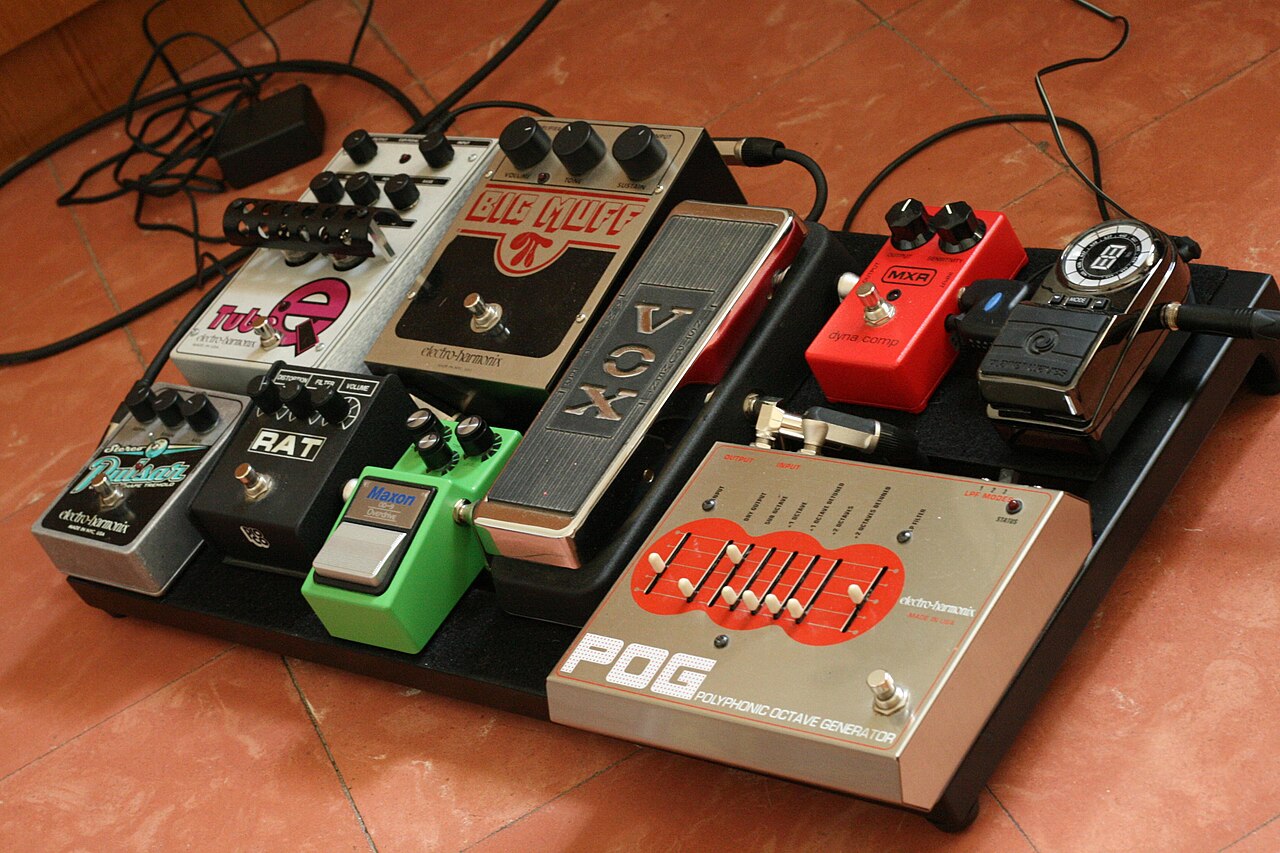
- A pedalboard with overdrive, wah and fuzz pedals: Michael Morel from Barcelona, Spain, Wikimedia Commons, CC BY 2.0.
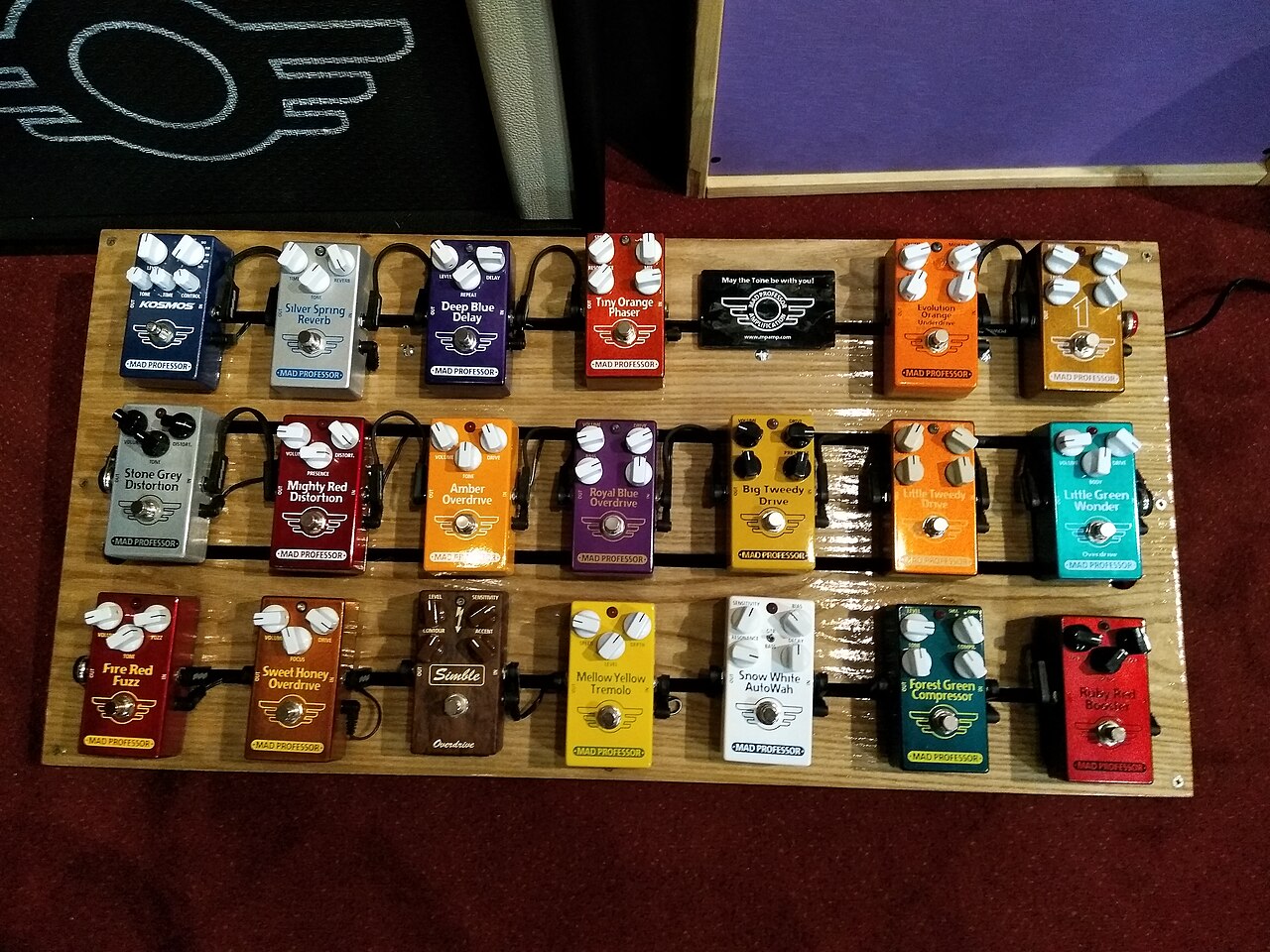
- A pedalboard full of colourful pedals: Skimel, Wikimedia Commons, CC BY-SA 4.0.
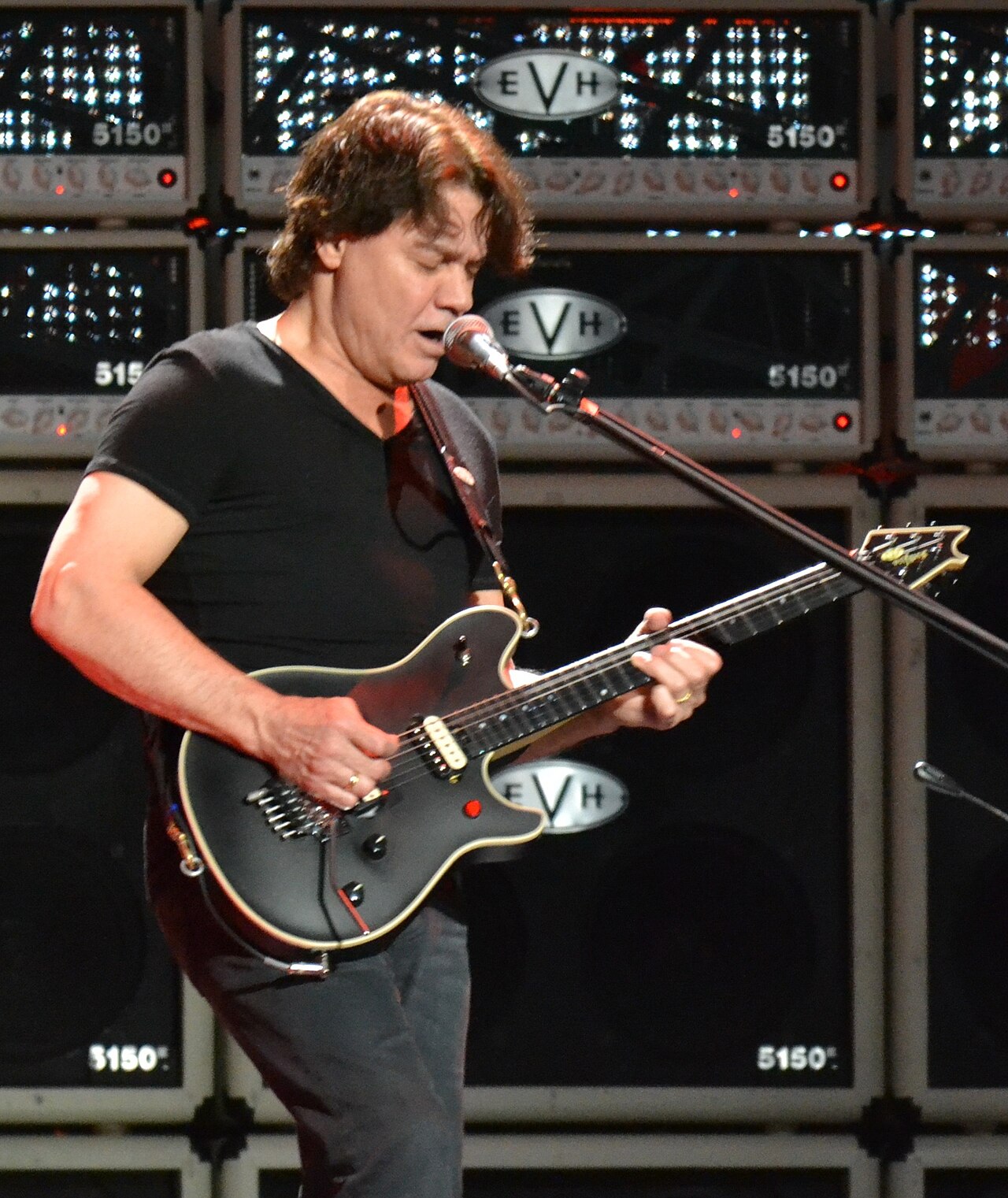
- Eddie Van Halen: Joe Bielawa, Wikimedia Commons, CC BY 2.0.
Latest News
Related
On This Day
Monday 9 November
From this week: