ZVEX Box of Rock: One Man’s Favourite Amp, Nailed Shut in a Painted Box
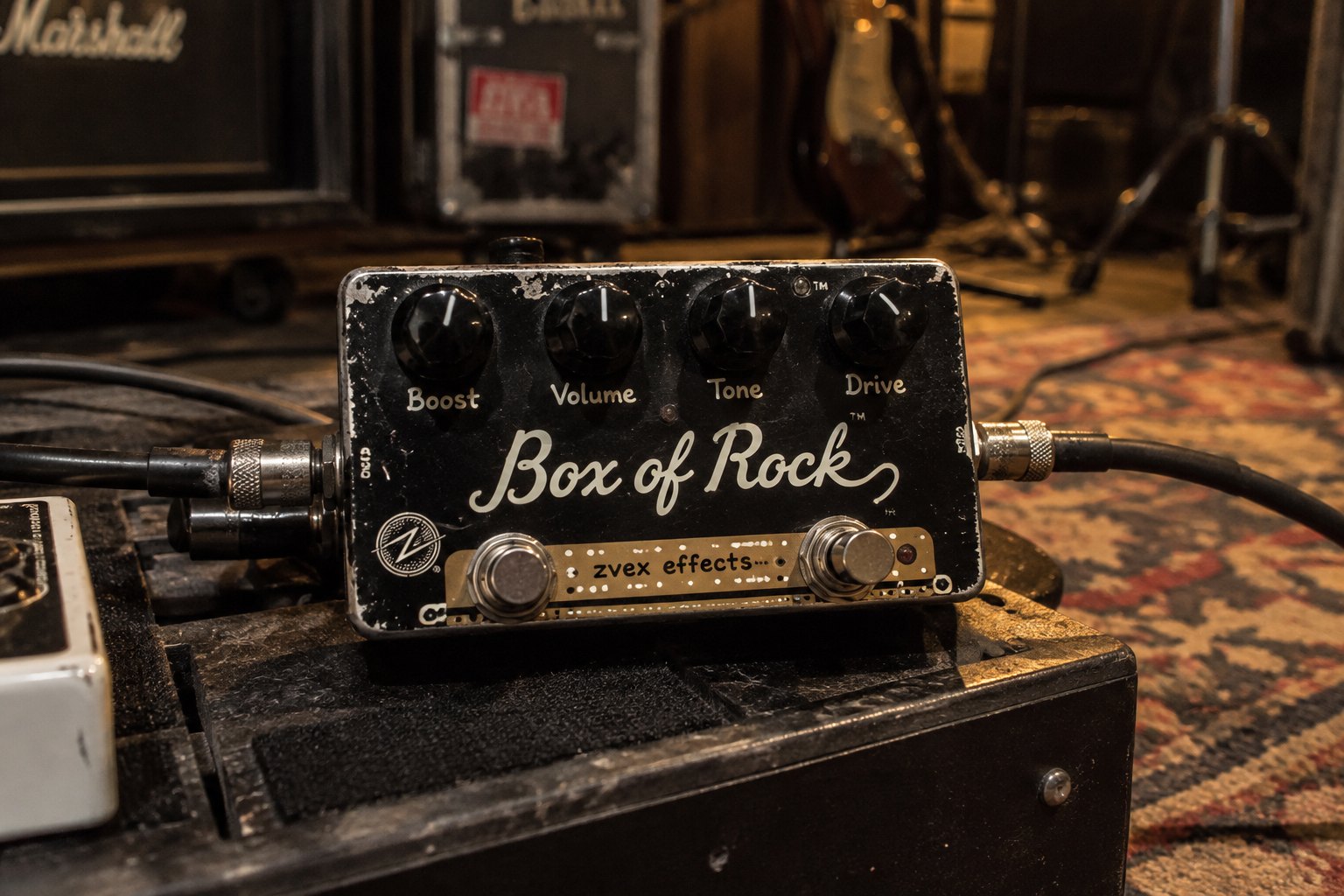
ZVEX Box of Rock Distortion and Boost Pedal. AI-generated reference illustration, not a photograph.
The ZVEX Box of Rock turns a maxed 1966 Marshall JTM45 into four knobs and a 50x boost. Specs, settings, verified players and buying advice.
Every amp-in-a-box pedal is an argument about memory. The builder heard something once — a specific amp, in a specific room, with the volume where the landlord starts writing letters — and then spent a year or two with a soldering iron trying to get that memory out of his head and into a piece of folded steel small enough to velcro to a board. Most of them fail politely. They give you a mid-hump and a name with the word “Plexi” in it and hope you were not listening very hard the first time.
The ZVEX Box of Rock is not that. It is one of the very few pedals in this category where the memory being chased is not a genre, not a decade, not “British crunch” as an abstraction — it is one amplifier that one man owns. Zachary Vex’s own 1966 Marshall JTM45, with everything on 10. ZVEX has never described the pedal any other way. Every version of the product page, going back nearly twenty years, says the same sentence in the same flat, un-marketed voice: “simulates Zachary’s favourite amp turned up all the way, a 1966 Marshall JTM45.”
That specificity is the whole story. It explains why the pedal has only four knobs when its competitors have seven. It explains why the Drive control behaves so strangely with your guitar’s volume pot. It explains why a pedal released in the middle of the 2000s — before the boutique dirt-pedal boom really got going, before Wampler built the Plexi-Drive Deluxe, before every third builder had a Marshall-in-a-box in the catalogue — is still in production, still being bought new in 2026, and still turning up on pedalboards belonging to people who could afford to just bring the actual amplifier.
The Box of Rock is often filed under “Overdrive pedal.” ZVEX files it on their own website under Distortion. The manual — Zachary’s own words — puts the word in scare quotes: “Z.Vex Effect’s first ‘distortion’ pedal.” All three are defensible and all three are incomplete, because the thing is genuinely a two-in-one: a distortion channel and an independent, absurdly powerful clean boost, each on its own footswitch, wired so the boost sits after the dirt. Calling it an overdrive is like calling a Swiss Army knife a corkscrew. We are going to treat it as what it is — a two-channel amp emulator with a solo lift bolted on — and the category argument will resolve itself by the end of the specs section.
Origins: Minneapolis, a JTM45, and a Man Who Paints His Own Pedals
ZVEX Effects has been operating since 1995, which makes Zachary Vex one of the genuine founding fathers of the American boutique pedal industry — not a follower of the wave but one of the people who caused it. The company’s self-description on its own site is worth quoting because it is unusually honest about what the business actually is: “a unique blend of no-rules engineering and artistic whim, from our affordable Vexter series to our hand painted and custom designed items.” That is not a mission statement written by an agency. That is a man describing his workshop.
The pedals that made ZVEX famous first were the weird ones. The Fuzz Factory, with its five interactive controls and its capacity for self-oscillating chaos, became a modern classic partly because it was uncontrollable — we covered that circuit in detail in our piece on the ZVEX Fuzz Factory, and it remains the brand’s signature product in most people’s minds. The Super Hard On, a one-knob boost with an unusually high input impedance and a comically rude name, became a cult item among players who wanted volume without colour. The Box of Metal, the Wooly Mammoth, the Lo-Fi Loop Junky — the catalogue reads like the notebook of somebody who builds circuits to answer questions rather than to fill product categories.
The 2006 prototype
The Box of Rock arrived in the middle of that run, and it arrived as something of a departure: ZVEX’s first attempt at a straight, useful, meat-and-potatoes rock sound. The dating is worth being precise about, because the internet is vague on it. Delicious Audio, which has tracked this pedal for years, places the release “in the mid aughts” and correctly identifies it as “one of the early Plexi-style pedals.” A stronger data point exists: Prototype #1 — serial number 1, the first Box of Rock ever built — has surfaced on the secondhand market with a verification letter from Zach Vex himself, and both the seller’s description and the listing’s own year field state it was hand built by Vex in 2006. The same listing notes the prototype was subsequently carried to NAMM exhibitions, official release shows and artist-relations events, which is exactly the life cycle you would expect of a demonstrator unit for a new flagship.
So: a 2006 build for the first unit, a mid-decade release, and twenty years of continuous production since. In an industry where the average boutique dirt pedal has a shelf life somewhere between a hype cycle and a haircut, that is remarkable, and it is the single strongest argument in the pedal’s favour. Nothing survives two decades on a pedalboard market this crowded by accident.

Why the JTM45 specifically
It matters which Marshall Vex was copying. The JTM45 is the first Marshall — the 1962-onward design that started life as a fairly close relative of the Fender 5F6-A Bassman and then diverged, via a different output transformer, different speakers, and the switch to KT66 valves, into something recognisably British. It is a non-master-volume amplifier, which is the technical fact that governs everything about this pedal. There is no gain stage you can crank while keeping the room quiet. The only way to get a JTM45 to distort is to turn the whole amp up until the output section gives in, at which point you are producing roughly the sound pressure of a small aircraft.
A JTM45 on 10 is therefore not a sound most people have ever actually heard in a controlled setting. It is the sound on records — the tweed-era handoff into the British sixties, the amp behind an enormous amount of the blues-rock canon. Eric Clapton‘s Bluesbreaker tone came from a JTM45 combo. Jimmy Page and Jeff Beck both passed through the same family of amplifiers on their way out of the Yardbirds. It is a foundational sound, and it is almost impossible to use at civilised volume.
That is the problem the Box of Rock exists to solve, and it is worth stating the obvious limitation up front: none of those players used this pedal. They used the amplifier. The Box of Rock is an argument about their sound, not a piece of their history. We will come back to who has actually used it, and the list is better than you might expect.
What Is Actually Inside: The Distortron Engine and the SHO Derivative
The Box of Rock is two independent circuits sharing an enclosure, a power supply and a signal path. ZVEX’s documentation is refreshingly plain about both.
Channel one: the “distortron engine”
The dirt side carries a name printed on the Vexter enclosure that reads like a typo and is not one. From the manual: “You will notice the words ‘distortron engine’ on the Vexter version of this pedal (no, that’s not a misprint) on the pedal. This is what I named my distortion circuit… call me crazy.” That parenthetical tells you a great deal about the house style. There is no engineering white paper here, no talk of proprietary transfer functions. There is a man who named his circuit something silly and then wrote it on the box.
What it does is more interesting than what it is called. The stated design goal is the everything-on-10 JTM45, and the manual immediately follows that claim with the usage instruction that defines the pedal: “Once you’ve set your maximum needed drive on the pedal, use your guitar’s volume control to adjust for the exact amount of distortion you need, all the way down to very clean and clear with most drive settings.”
Read that twice, because it is not standard pedal advice. It is amplifier advice. That is precisely how you play a cranked non-master-volume amp: you set the amp once at the start of the night and then spend the rest of the gig conducting the gain from the guitar. A pedal that responds to your volume knob the way an overdriven output section does is a pedal that has got the important part right, and it is the single most consistent thing reviewers and owners say about the Box of Rock. Delicious Audio’s assessment is blunt: “the mojo in this pedal is really in the interaction between the Drive knob and your guitar’s volume control – just like old Marshalls. Even when maxed, it never seems to get smeary or harsh.”
Channel two: a refined Super Hard On
The boost side is not a bolt-on afterthought and it is not a simple volume trim. The manual describes it as “an extremely high-headroom, unity-to-50X gain booster with nominal input impedance and low hiss. It is very similar to the SHO boost circuit, with refinements to make it sound more like a standard amp input and less glassy.”
Three things are hiding in that sentence.
- Unity to 50x. Fifty times. That is roughly 34 dB of available gain from a knob most players will never turn past nine o’clock. The manual issues an explicit warning about it: “Careful with the Boost setting when using a high-powered amp with lots of headroom… you may be shocked at how loud it can get!” This is not a marketing exaggeration; it is a genuine hazard to your ears and your bandmates’ goodwill.
- “Nominal input impedance.” The stock Super Hard On is famous for an extremely high input impedance, which is why it sounds bright and open and slightly glassy in front of a guitar. Vex deliberately backed that off here so the boost presents something closer to what a real amplifier input looks like. This is a tone decision disguised as a spec.
- “Less glassy.” The stated goal was warmth, not sparkle. If you have used an SHO and found it a bit too clinical, the boost in the Box of Rock is the same idea with the edges sanded.

The ordering — and why it matters
The crucial architectural decision: the boost channel follows the distortion channel. The manual explains the intent directly — “so that the distortion is able to hit your amp harder (at a higher volume) when both switches are engaged, for boosting solos and what-not. Look out when boosting what-not.”
That ordering makes the Box of Rock a rhythm/lead machine rather than a stacking pedal. A boost placed before a dirt circuit pushes it into more distortion and more compression; a boost placed after makes the same distortion louder without changing its character. ZVEX chose the second. When you stomp the left switch mid-song, the tone does not change — the volume does, and if you are running into a valve amp that is already working, the extra level drives the amp’s own front end and you get a second helping of saturation from the amplifier rather than from the pedal. It is exactly what a lead boost should do, and it is the reason so many players leave the dirt on all night and treat the boost as a solo button.
Specifications
| Parameter | Detail |
|---|---|
| Model | ZVEX Box of Rock (Vexter, hand-painted and Vertical variants) |
| Type | Two-channel: “distortron engine” distortion + independent high-headroom boost |
| Voicing target | 1966 Marshall JTM45, non-master-volume, all controls at maximum |
| Controls | Drive, Tone, Volume (distortion channel); Boost (boost channel) |
| Footswitches | Two — left engages Boost, right engages distortion |
| Boost range | Unity to 50x gain (approx. 34 dB), high headroom, low hiss |
| Boost circuit lineage | Derived from ZVEX Super Hard On, revised for lower input impedance and warmer voicing |
| Signal order (internal) | Distortion channel first, boost channel second |
| Current draw | Approximately 3 mA |
| Power — battery | One 9 V battery; alkaline recommended (ships with carbon-zinc) |
| Power — adaptor | 9 V DC jack, standard Boss configuration, centre negative |
| Battery access | Four screws on the base; battery seated on edge in the centre of the enclosure |
| Dimensions (horizontal) | 4.70″ × 2.38″ × 1.82″ (L × W × H) |
| Dimensions (Vertical) | 4.3125″ × 2.625″ × 2″ (L × W × H) |
| Price — Vexter (2026, direct) | $249.00, in stock |
| Price — Vertical (2026, direct) | $249.00, in stock |
| Price — hand painted (2026, direct) | $399.00, listed sold out |
| Warranty — Vexter | 1 year from purchase; 2 years if the warranty card is returned |
| Warranty — hand painted | Lifetime |
| Country of origin | USA — Zachary Vex Effects, Minneapolis / St. Louis Park, Minnesota |
| Manual revision cited | Vexter instructions, last updated August 2011 |
Two notes on that table. First, the 3 mA figure is genuinely tiny — this is one of the most power-frugal dirt pedals you will ever put on a board, and battery life is correspondingly enormous. That is a consequence of the all-discrete, low-parts-count design philosophy rather than an efficiency feature anybody engineered on purpose. Second, note the centre-negative polarity, standard Boss-style. This is worth stating explicitly because ZVEX’s own catalogue is not uniform on this point across its history and because the manual adds a pointed instruction: “Use a high-quality 9V adaptor for all high-gain effects!” An unregulated wall wart with a noisy transformer will be audible through a circuit with this much available gain.
The Four Controls, and How ZVEX Says to Set Them
The Box of Rock’s manual is one of the few that gives actual clock positions as a starting point rather than a diagram of a smiling knob. Here is the first-party guidance, verbatim in substance, with our commentary.
Drive — start around 1:00
“Sets the amount of distortion.” The recommended starting point is unusually high, and deliberately so: the whole design intent is that you set Drive to your maximum needed gain and then back off from the guitar. Setting Drive at noon and reaching for the pedal every time you want a cleaner verse is fighting the instrument.
The important behavioural note is the crackle. From the manual: “The Drive and Boost controls are based on my original Super Hard On gain control, so they may crackle when turned. This is perfectly normal.” This catches out a lot of new owners, who assume they have a dirty pot or a failing unit. They do not. The SHO gain topology puts DC across the control, and DC across a moving wiper makes noise. It is a design consequence, it does not indicate a fault, and no amount of contact cleaner will remove it.
Tone — start around 2:00
“Adjust for treble content.” That is the entire specification, and it is honest: this is a simple treble control, not a three-band stack and not a mid-shift. The Box of Rock does not let you rearrange the JTM45’s midrange, because the JTM45’s midrange is the point. Set it by ear against your speaker — a bright open-back combo will want it lower, a closed-back 4×12 will take it higher.
Volume — start around 9:00
“Adjust for distortron engine volume level.” The low recommended start point tells you how much output is on tap. There is plenty of level here; unity with a clean amp typically lands lower on the dial than players expect.
Boost — start around 11:00
“Sets the boost level, which is engaged with the left stomp switch.” Eleven o’clock on a 50x control is already a substantial lead lift. Treat the upper half of this knob as a special-effects range rather than a working one.
ZVEX’s own recommended rig setting
The manual closes with a specific and rather charming instruction that is easy to miss: “The best way to complete this pedal is to run it through a tube amplifier on a warm clean setting (try strapping the channels, setting the volumes below 3, and setting all other controls to 6 as a start point), which has the proper voicing to reveal the ‘rock’ in the Box of Rock.”
“Strapping the channels” is a piece of vintage-amp vocabulary that has largely fallen out of everyday use — it means jumpering the two inputs of a four-input Marshall-style amp together with a short patch cable so both preamp channels are fed at once and blend. That ZVEX assumes you know what that means, in a manual for a $249 pedal, is a fair indication of who the pedal was designed for.
Famous Players — With the Sourcing Shown
Regular readers of this series know we do not simply repeat artist lists. Brands recycle rosters, aggregators launder brand pages into “usage” claims, and a photograph of somebody holding a box is not evidence that they recorded with it. So here is the Box of Rock’s player list with the citation chain visible, sorted by how much weight it actually carries.
The good news first: this is one of the strongest, best-evidenced player lists we have encountered in this entire pedal block. Equipboard catalogues 99 artist entries for the pedal — an order of magnitude more than the boutique dirt boxes we have covered recently — and, unusually, a large share of them are sourced to photographs of actual pedalboards or to video interviews rather than to the manufacturer’s own artist page. That distinction matters enormously and it is the reason this section can be written with some confidence.
Strongest evidence: video and interview
- Ben Gibbard (Death Cab for Cutie) — sourced to a Premier Guitar Rig Rundown video in which Gibbard identifies the pedal himself and, per the catalogued timestamp at 16:35, says of it: “This stays on all the time.” An artist naming his own pedal on camera is the highest grade of evidence available in this field.
- Kurt Vile (Kurt Vile & the Violators, formerly The War on Drugs) — sourced to Premier Guitar’s Rig Rundown: Kurt Vile & The Violators, filmed by Chris Kies before a sold-out show at Nashville’s Marathon Music Works on 25 February 2016 and published 9 March 2016. Honesty note: we fetched that Premier Guitar page directly and the gear detail lives in the embedded video, not in the article text, so we can confirm the Rundown exists and is correctly dated but cannot independently transcribe the moment the pedal is named. The citation is to a first-rank source; we simply cannot re-verify the timestamp from text.
- Miles Kane (The Last Shadow Puppets, solo) — sourced to Kane declaring his gear to Total Guitar in an interview published in the February 2013 issue. A print interview in a major guitar magazine is solid, if unverifiable from our end without the physical issue.
- Jeordie White (Nine Inch Nails, Marilyn Manson) — sourced to a video in which he explains his effects setup specifically in his capacity as a guitarist rather than a bassist for Manson.
Strong evidence: photographs of working boards
- Noel Gallagher (Oasis, Noel Gallagher’s High Flying Birds) — sourced to a photograph of his pedalboard from the 2016 touring rig, with the Box of Rock visible in the frame. A photograph of a board in service is meaningfully better than a brand roster, though it does not tell you what the pedal was doing on it.
- Kevin Shields (My Bloody Valentine) — sourced to a photograph of Shields’ main pedal board published in a 2011 effects-board feature. Given how idiosyncratic and heavily documented Shields’ rig is, its presence there is notable. We wrote about the wider Shields aesthetic when covering the EarthQuaker Devices Hoof.
- Stone Gossard (Pearl Jam) — sourced to a pedalboard photograph, catalogued with the terse note that the Box of Rock sits next to a Green Rhino. A JTM45 emulator on a Pearl Jam rhythm board is about as on-brief as gear gets. Gossard’s bandmate Mike McCready is documented separately in our archive.
- Isaac Wood (Black Country, New Road) — sourced to a photograph posted to Twitter showing Wood with the pedal in his setup.
- William Reid (The Jesus and Mary Chain) — sourced to a Reddit discussion of Reid’s current board, describing a transition from multiple Shin-Ei fuzz units to a Box of Rock. This is the weakest source class in this list — forum reporting of a photograph — and we flag it as such.
- Gustavo Cerati (Soda Stereo) — sourced to a tour-gear summary. Cerati is a genuinely major figure in Latin American rock and it is worth noting how far outside the Anglo-American guitar press this pedal travelled.

Weaker or non-usage evidence — stated plainly
- Moby — this entry is not usage evidence in the normal sense, and we include it because it is a nice piece of history rather than because it proves anything about a live rig. A hand-painted Box of Rock from Moby’s private collection was sold for charity through his official Reverb store in 2016, described in the listing as “well used but works without any issue,” with velcro on the base and a signed certificate of authenticity. Velcro on the bottom of a well-worn pedal is decent circumstantial evidence that it did some work at some point.
- Ian D’Sa (Billy Talent) — sourced to D’Sa listing his Box of Rock for sale on Reverb, which establishes ownership and, arguably, a verdict.
Album credits
Equipboard additionally catalogues the pedal as heard on a handful of records, including Low’s HEY WHAT (2021), Iceage’s Beyondless (2018), The Sidekicks’ Happiness Hours (2018), Wand’s Plum (2017) and Ganglion Reef (2014), and King Charles’ Gamble for a Rose (2015). Album-credit entries are the softest evidence class of all — they are frequently inferred rather than documented — so treat them as a genre indicator rather than a fact. What they do usefully show is the pedal’s centre of gravity: catalogued usage skews rock, then pop, then alternative and indie rock, with a meaningful tail in electronic and neo-psychedelia.
The honest summary: the Box of Rock has a real, broad, independently photographed user base spanning Britpop, shoegaze, grunge, Argentine rock, indie and industrial — which, for a pedal whose only stated ambition is “one specific amplifier, loud,” is a considerably wider church than anyone could have designed for.
Tone Recipes: Nine Settings Worth Dialling
1. ZVEX factory start
Drive 1:00 · Tone 2:00 · Volume 9:00 · Boost 11:00. The manual’s own recommended settings. Start here every time you plug into an unfamiliar amp, then move one knob at a time. Into a valve amp set warm and clean with the volumes below 3, this is the intended sound of the product.
2. Bluesbreaker, at a volume that will not evict you
Drive 11:00 · Tone 12:00 · Volume 10:00 · Boost off. Roll the guitar volume to about 7. This is the pedal’s most historically literal setting — a JTM45 breaking up rather than a JTM45 screaming. Neck humbucker, medium pick attack. Turn the guitar volume up for the chorus and let the pedal do what the amp used to do.
3. The Gibbard “on all the time”
Drive 9:00 · Tone 1:00 · Volume 11:00 · Boost off. Barely-there grit that functions as a permanent tone shape rather than an effect — thickening the midrange and adding an edge to the pick attack without ever announcing itself. This is how a great many of the pedal’s documented users actually run it: not as a distortion, as a slightly better amplifier.
4. Rhythm and lead, one stomp apart
Drive 1:00 · Tone 2:00 · Volume 10:00 · Boost 10:00. Set the distortion channel for your rhythm sound at gig volume, then set Boost so the left switch adds level without changing the tone. Because the boost sits after the dirt, the character stays identical and only the size changes — and if your amp is working at all, it will add its own saturation on top. This is the pedal’s core use case and the reason it has two footswitches.
5. Clean amp, dangerous solo
Distortion channel off · Boost 1:00. With the dirt bypassed, the boost is a standalone SHO-derivative clean lift with enormous headroom. Into a big clean amp this is a genuinely useful transparent volume pedal. Into a small valve combo it is a way of making the amplifier distort on your command. Approach the upper half of the knob with respect — the manual’s warning about high-powered amps is not decorative.
6. Stacked into a Screamer
Box of Rock: Drive 12:00 · Tone 1:00 · Volume 11:00. Tube Screamer in front: Drive 8:00 · Level 2:00 · Tone 12:00. A TS9 used as a mid-focused boost tightens the Box of Rock’s low end and pushes the midrange forward — the classic Marshall-plus-Screamer arrangement, in miniature. Keep the Screamer’s own drive low; you want its EQ curve, not its distortion.
7. Doom rhythm
Drive 3:00 · Tone 10:00 · Volume 12:00 · Boost off. Tone rolled well back, drive high, bridge humbucker, downtuned. The Box of Rock does not become fuzzy at high drive settings the way a Big Muff does — it stays articulate — which makes it surprisingly good for heavy riffing where you still need the individual notes of a chord to be audible.
8. Shoegaze wash
Drive 2:00 · Tone 3:00 · Volume 11:00 · Boost off, into a modulated delay and a long reverb. Bright, saturated and dense, with the guitar volume used to fade in and out of the wall. This is roughly the territory implied by its presence on the boards documented above, and it pairs naturally with the kind of long DL4 or Carbon Copy repeats those players favour.
9. Bass through a Box of Rock
Drive 11:00 · Tone 11:00 · Volume 10:00 · Boost off, blended with a clean DI if your rig allows. The circuit does not scoop the low end aggressively, so it works better on bass than most guitar distortions. Keep the Tone low and let the amp handle the top.
All positions given as clock face. Drive, Tone and Volume belong to the distortion channel; Boost is independent.
How It Compares
Versus the Wampler Plexi-Drive Deluxe
The most direct comparison in our archive. The Plexi-Drive Deluxe is the modern approach to the same problem: more controls, a proper EQ section, a switchable bright cap, considerably more tonal flexibility. It will get closer to more Marshalls. The Box of Rock will get closer to one Marshall. Which you want depends entirely on whether you are trying to cover a repertoire or chase a specific memory.
Versus the Fulltone OCD
The OCD is the other great amp-like drive of the same era and it is the more versatile of the two by a wide margin — the HP/LP switch alone gives it two distinct personalities. But the OCD’s voice is its own thing, a slightly harmonically odd creature that does not sound like any single amplifier. The Box of Rock is narrower and more specific, and it does the guitar-volume trick considerably better.
Versus the JHS Angry Charlie V3
Different Marshall. The Angry Charlie chases the JCM800 — twenty years later in the Marshall timeline, master volume, far more gain, a hard-edged eighties voice with a three-band EQ to shape it. If you want Marshall-as-metal-platform, that is your box. If you want Marshall-as-blues-rock-origin-story, this one.
Versus the Catalinbread Formula No. 55
Formula No. 55 is the same design philosophy applied one decade earlier in amplifier history — tweed Deluxe rather than JTM45. Comparing the two is genuinely instructive about what changed when Marshall diverged from the Fender circuit: the tweed is looser, browner and earlier-breaking; the JTM45 is tighter, brighter in the upper mids and considerably louder before it gives in.
Versus the ZVEX Fuzz Factory
The brand’s own other famous box, and its opposite in every respect. The Fuzz Factory is unstable by design, five interactive knobs of controlled misbehaviour. The Box of Rock is the most conventional pedal ZVEX has ever built. Owning both tells you that Vex is not a one-trick eccentric but somebody who can build a straight tool when the job calls for one.
Versus a Klon-style transparent drive
Not really a competitor, but a common shortlist pairing. The Klon Centaur and its descendants exist to preserve your amp’s voice while adding a little more of it. The Box of Rock exists to replace your amp’s voice with a different one. If you already love your amp’s dirt, buy the transparent drive. If you bought your amp for its clean channel and want a British sixties rock sound sitting on top of it, buy this.
Versus the ProCo RAT 2
The RAT is the cheaper, angrier, more scooped-and-then-boosted option with a filter that goes usefully dark. It is a distortion pedal that sounds like a distortion pedal, gloriously. The Box of Rock is a distortion pedal that is trying not to sound like one. Both are correct answers to different questions, and plenty of boards carry both.

Buying Guide: Which Box of Rock, and at What Price
The three versions
ZVEX has run the same three-tier structure on its flagship pedals for years, and Delicious Audio summarises it accurately: a very expensive hand-painted version, a much cheaper Vexter version that is not hand painted, and a vertical version priced the same as the horizontal one.
- Vexter — $249.00 direct, in stock as of this writing. UV-printed graphics; the current run commemorates the company’s 25th anniversary. ZVEX’s own copy is explicit that “the parts inside Vexters are identical to the hand painted pedals.” Warranty: one year, or two if you post the card. This is the version almost everybody should buy.
- Vertical — $249.00 direct, in stock. Identical circuit in a taller, narrower enclosure: 4.3125″ × 2.625″ × 2″ against the horizontal 4.70″ × 2.38″ × 1.82″. Same price. Buy this one if your pedalboard is depth-constrained rather than width-constrained, which on a modern crowded board is increasingly the case.
- Hand painted — $399.00 direct, currently listed sold out. The circuit is the same. What you are paying the extra $150 for is a hand-painted enclosure — ZVEX warns that “colors and details may vary,” which is the point — and a lifetime warranty instead of one or two years. There is one charming production detail worth knowing: on the hand-painted version the right footswitch is labelled simply “ROCK,” because the brushes used are too wide to paint the number of small letters the Vexter graphic carries.
The secondhand market
Twenty years of production means there are a lot of these about, and a Box of Rock from 2008 does the same thing as a Box of Rock from 2024 — this is not a circuit that has been quietly revised under players’ feet. Buy on condition and price rather than on year. Hand-painted examples carry a collector premium that has nothing to do with the sound; if you want the tone rather than the artwork, the Vexter is the rational purchase and always has been.
What else you need
A quality isolated 9 V supply, centre negative, standard Boss barrel. At 3 mA it will not tax any power brick ever made — a single output on a tuner-adjacent supply chain is plenty — but the manual’s insistence on adaptor quality is well founded for a circuit with this much gain available. If you prefer batteries, alkaline, and expect a very long life from it.
Living With It: Ownership Notes
The crackling pots are not a fault
To repeat the most common false alarm: the Drive and Boost controls will crackle when turned, because both derive from the Super Hard On gain topology which puts DC across the pot. ZVEX documents this explicitly. Do not spray contact cleaner into a working pedal to chase a noise the manufacturer told you to expect.
The boost is louder than you think
Fifty times unity gain is not a number most players have any intuition for. If you are setting up at soundcheck, set the Boost knob low and walk it up, rather than starting at noon and discovering the ceiling with a full room in front of you. Sound engineers have long memories.
It wants a valve amp — but not only a valve amp
ZVEX’s stated ideal is a tube amp on a warm clean setting, and that is where the pedal is most convincing, because half the sound is the amplifier responding to what the pedal is doing. But the manual also acknowledges the reality of the working musician: “You may use the Box of Rock effectively with many different amplifiers.” Into a clean solid-state amp it still works; it just becomes a distortion pedal rather than half of an amplifier.
Battery changes are a screwdriver job
Four screws on the base, and — this detail matters — the battery goes back on edge, in the centre of the enclosure, so the lid grips it when the screws go back in. Put it in flat or off-centre and you will either not get the lid on or hear it rattle.
Placement on the board
Front of chain, after a wah and a tuner, before time-based effects. Because it is a two-channel unit with the boost already internally after the drive, resist the temptation to place a separate boost after it — you already have one, and it is better than most.
Frequently Asked Questions
Is the ZVEX Box of Rock an overdrive or a distortion?
ZVEX files it under Distortion on their own website, and the manual calls it the company’s first “distortion” pedal — with the quotation marks in the original. Calling it simply an overdrive or a distortion pedal is incomplete, because the pedal contains two circuits: a distortion channel voiced after a maxed JTM45, and an independent clean boost. In practice it covers everything from mild edge-of-breakup to thick rock distortion depending on where Drive sits and where your guitar volume is.
What amp is the Box of Rock based on?
A 1966 Marshall JTM45 — specifically Zachary Vex’s own, with every control at maximum. The JTM45 is a non-master-volume amplifier, so “turned up all the way” is the only setting at which it distorts, and that is the sound the pedal reproduces.
Why do the Drive and Boost knobs crackle?
Because both are based on ZVEX’s Super Hard On gain control, which passes DC through the potentiometer. The manual states plainly that they may crackle when turned and that “this is perfectly normal.” It is not a sign of a dirty pot or a failing unit.
How much boost does it actually have?
Unity to 50 times gain — roughly 34 dB at maximum. The manual explicitly warns that with a high-powered, high-headroom amp “you may be shocked at how loud it can get.” Most players find useful lead-boost levels somewhere between nine and eleven o’clock.
Can I use the boost on its own without the distortion?
Yes. The two channels have independent footswitches and can be used separately or together. Used alone the boost is a high-headroom, low-noise clean lift derived from the Super Hard On but revised for a lower input impedance and a warmer, less glassy voice.
Does the boost go before or after the distortion?
After. ZVEX designed it that way deliberately so that engaging both switches drives your amplifier harder without changing the distortion’s character — the manual’s phrasing is that the distortion “is able to hit your amp harder (at a higher volume).” This makes it a lead-volume boost rather than a gain-stacking boost.
What power supply does it need?
A 9 V DC adaptor in the standard Boss configuration, centre negative, or a single 9 V battery. Current draw is approximately 3 mA, which is exceptionally low. ZVEX recommends a high-quality adaptor, which is sound advice for any high-gain circuit.
Is the hand-painted version worth the extra money?
Only if you want the artwork or the warranty. ZVEX states outright that the parts inside a Vexter are identical to those in a hand-painted pedal. The differences are cosmetic — hand painting versus UV printing, plus the “ROCK” footswitch label — and contractual: a lifetime warranty on the hand-painted version against one or two years on the Vexter. At $399 versus $249, the Vexter is the better instrument purchase and the hand-painted is the better object.
Which famous guitarists have used it?
Documented users with photographic or video evidence include Ben Gibbard of Death Cab for Cutie (who names it on camera in a Premier Guitar Rig Rundown and says it stays on all the time), Kurt Vile, Noel Gallagher, Kevin Shields of My Bloody Valentine, Stone Gossard of Pearl Jam, Miles Kane, Gustavo Cerati of Soda Stereo, Jeordie White of Nine Inch Nails and Isaac Wood of Black Country, New Road. Note that the JTM45’s own famous users — Clapton, Page, Beck — used the amplifier, not the pedal.
Is it still in production?
Yes. As of 2026 both the Vexter and Vertical versions are listed in stock direct from ZVEX at $249.00; the hand-painted version at $399.00 is listed sold out. The pedal has been in continuous production for roughly two decades.
Image credits
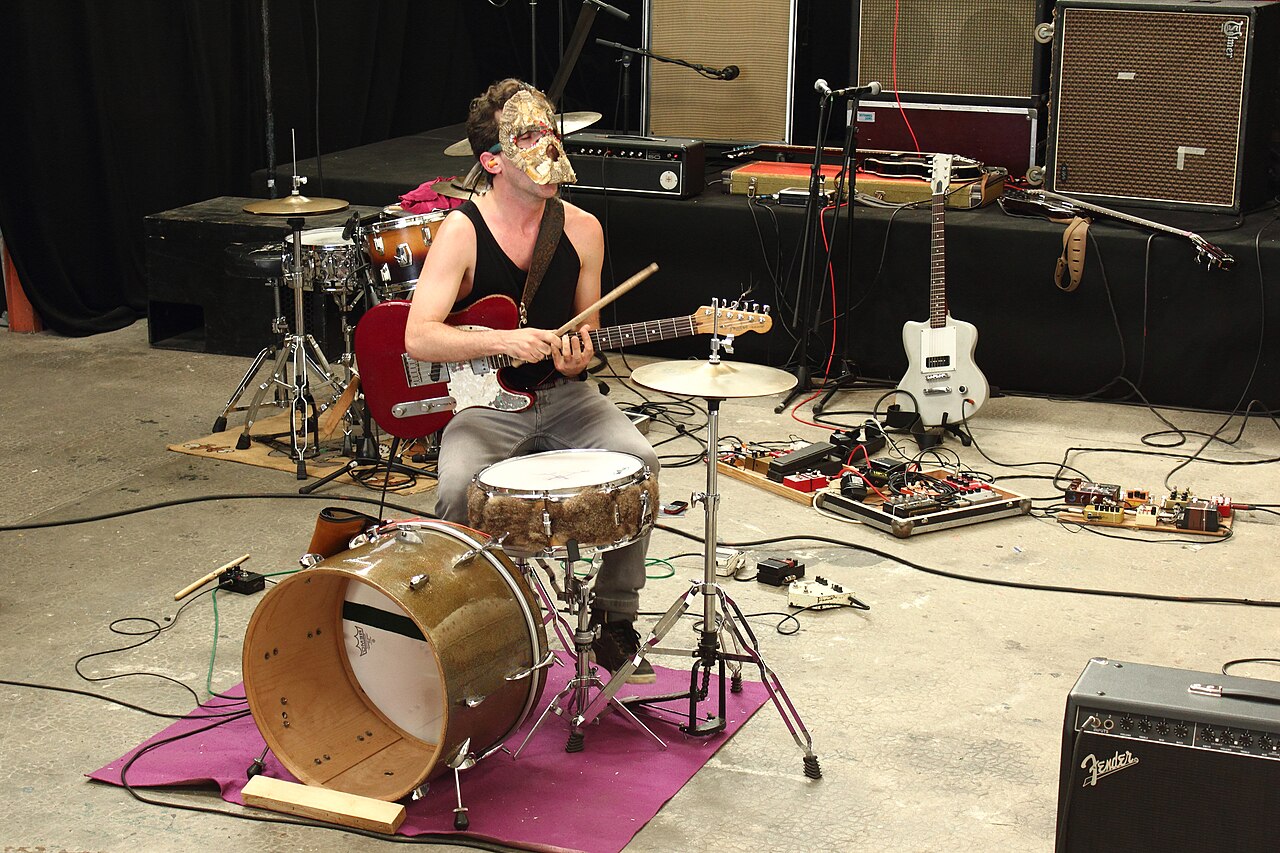
- A drummer and guitarist on a small stage: Xi WEG from Poitiers, France, Wikimedia Commons, CC BY 2.0.
- A guitarist on stage with an amp behind: Bex.Walton, Wikimedia Commons, CC BY 2.0.
- Kevin Shields: Julio Enriquez, Wikimedia Commons, CC BY 2.0.
- Stone Gossard: Lugnuts, Wikimedia Commons, CC BY-SA 4.0.
- Noel Gallagher: Freddyballo, Wikimedia Commons, CC BY-SA 4.0.
- Top image: GuitarGangsters AI-generated reference illustration, not a photograph.
Latest News
Related
On This Day
Monday 9 November
From this week: