Catalinbread Katzenkönig: The Cat King That Bolted a Tone Bender MkII to a RAT
The Catalinbread Katzenkönig grafts a silicon Tone Bender MkII onto a RAT output stage. Full specs, controls, tone recipes, honest player facts and FAQ.
Most hybrid pedals are a marketing idea wearing a circuit. Two famous names on one enclosure, a blend knob in the middle, and a press release that hopes you won’t ask which half is doing the work. The Catalinbread Katzenkönig is not that. It is a genuine graft: the front end of a Tone Bender MkII — three transistors of escalating violence — wired directly into the back end of a ProCo RAT, clipping diodes, single-knob filter, output buffer and all. No blend. No switch. No way to have one without the other. You get a single circuit that behaves like an animal neither parent could produce.
Catalinbread’s own copy sums it up in one line: something that “sings like a fuzz but is tight like a distortion.” Premier Guitar’s Joe Gore, reviewing it in December 2015, put it the other way round and arrived at the same place — “fiery fuzz with uncommon tightness—or, to put it another way, tough distortion with a strong dose of explosive fuzz.” Both descriptions are trying to name a sound that didn’t have a name before this box existed.
Catalinbread themselves sell the Katzenkönig as a distortion pedal in the Boost, Fuzz & Distortion series. That’s true but incomplete — a bit like calling a wolfhound “a dog.” Premier Guitar tagged their review under fuzz. Equipboard files it under Fuzz Pedals, where it currently sits at number 99. The pedal is genuinely both, and which one it sounds like on any given night depends almost entirely on where you set the Input knob. Keep that in mind as you read the settings section; the category argument is the whole point of the design.
Where the Katzenkönig Came From
Catalinbread announced the Katzenkönig from Portland, Oregon on 29 September 2015, shipping immediately to dealers worldwide at $169.99 street. The press copy described the circuit as all-discrete — “a trio of silicon transistors in a modified Tone Bender MkII arrangement with the output section of a Rat, including its clipping section, filter, and output buffer” — and promised a range running “from a really beautiful singing tone, to tight, harmonically-rich crunch, all the way to fuzz mayhem.”
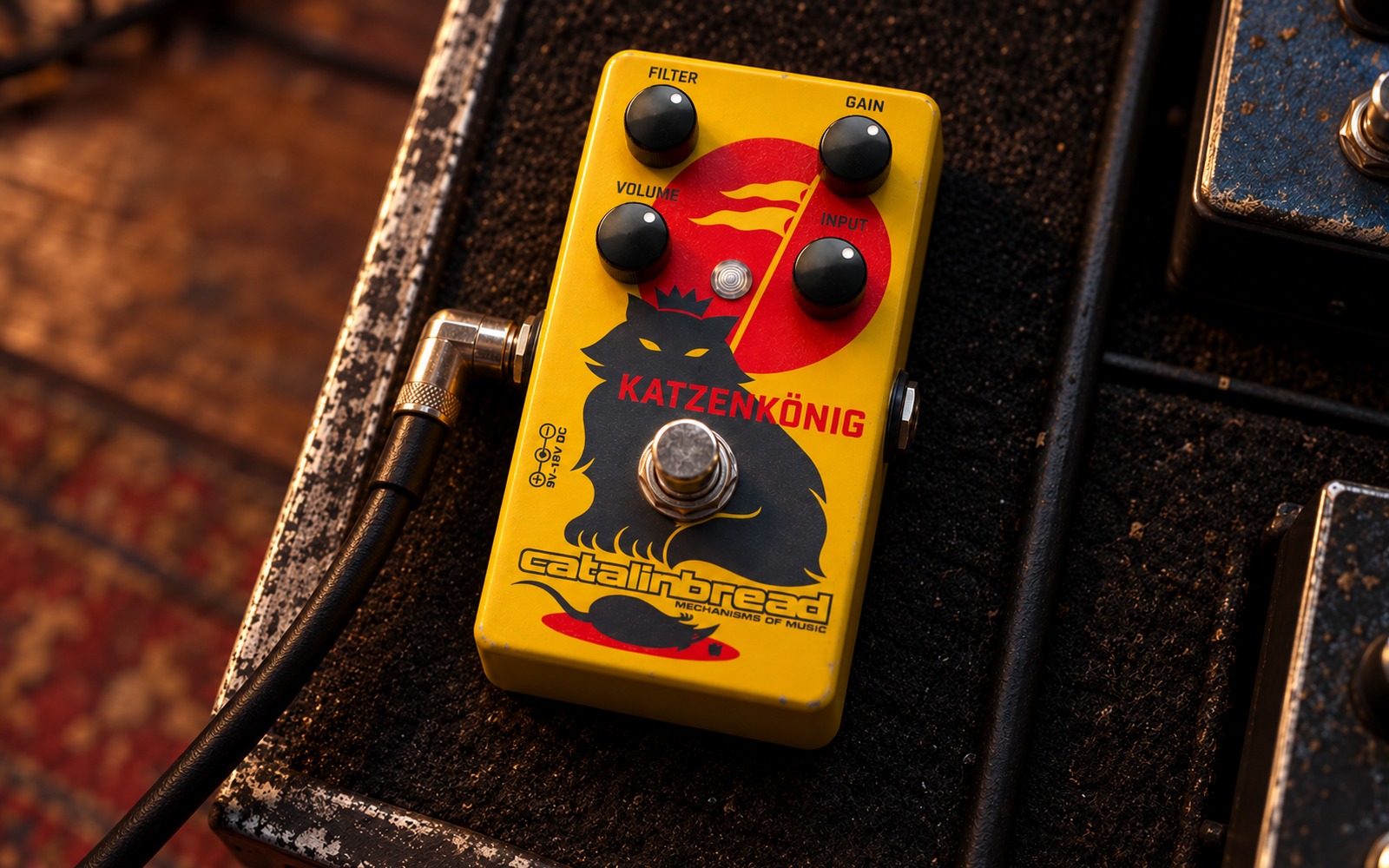
The name is German for Cat King, and the graphic — a crowned cat presiding over a fresh kill, rendered in a style Joe Gore correctly identified as Vienna Secession, the Klimt-era Austrian design movement — is one of the best-looking enclosures Catalinbread has ever shipped. Gore, who by his own admission “seldom dwells on stompbox cosmetics,” opened his review by admitting the thing simply looks cool.
Why a Tone Bender MkII Front End?
The Sola Sound Tone Bender MkII Professional of 1966 is the most fetishised of the four Tone Bender generations, largely because of who used one. It works by brute force: a germanium transistor makes the signal loud, a second makes it very loud, and a third makes it ridiculously loud. There is no tone control. There are two knobs — level and gain — and lowering the gain knob on an original tends to neuter the pedal rather than clean it up, which is why players of that era learned to control a Bender from the guitar’s volume pot instead.
It is also one of the hottest fuzzes ever built, capable of bludgeoning almost any preamp tube into overdriven submission. That was the point in 1966, when the amplifier was the effect and the pedal’s job was to force it into a state it wouldn’t reach on its own. The same logic drives the treble-booster family we covered in the Catalinbread Naga Viper, another Catalinbread take on a British sixties circuit that assumed a cranked amp on the other end.
Why a RAT Back End?
The ProCo RAT, born in Kalamazoo in the late seventies, solves the problems the Bender ignores. An op-amp generates the gain, a pair of clipping diodes to ground caps and shapes it, and a single, clever Filter control — a lowpass that you turn up to get darker — sets the final voice. The diodes are the crucial part here. They impose a ceiling. Where a Bender splatters, a RAT compresses and focuses, and the low end stays defined instead of collapsing into wool. We covered that circuit in full in our ProCo RAT 2 feature, and its many descendants in the JHS PackRat and the Wampler Ratsbane.
Catalinbread’s insight was that these two circuits are complementary rather than competing. The Bender supplies chaos and enormous gain; the RAT’s output stage supplies discipline and a usable tone control. Bolt them together and the fuzz stops splattering without becoming polite.
The Silicon Decision
The Katzenkönig uses silicon transistors, not germanium. On its own that usually means a louder, nastier, more brittle Bender — germanium’s soft, temperature-sensitive clipping is precisely what people romanticise about the originals. But silicon here is not a cost decision, it’s a system decision: the RAT’s diodes are doing the tone-shaping downstream, so the front end’s job is gain and character, not final texture. Silicon also means the pedal behaves the same in a cold van and a hot club, which germanium famously does not.
Specifications
The Controls, and Why Two of Them Are Cleverer Than They Look
Input
This is an input trim, and it is the single most important knob on the pedal. On a real Bender, the effective way to reduce gain is your guitar’s volume control, not the pedal’s gain knob. The Katzenkönig gives you that same function as a set-and-forget pot on the box. Turn it down for humbuckers or hot pickups; turn it up for weaker single-coils. Gore noted the control is “perfectly scaled to compensate for output variations between pickup types” — which means you can leave your guitar volume on 10 and still get the Bender’s clean-up behaviour, or set the pedal for one guitar and swap instruments without the whole thing falling apart.
Practically: Input is where the fuzz-versus-distortion argument gets settled. Wound back, the pedal is a tight, articulate distortion. Wound up with a hot bridge humbucker, it is a fuzz having a bad day.
Gain
Not a conventional gain control. Instead of altering a transistor’s voltage to ground — the usual approach, and the reason vintage Benders crap out at low settings — the Katzenkönig’s Gain knob adjusts the resistance in a negative feedback loop between two transistors. Gore was able to state this with confidence because Catalinbread’s manual includes the schematic. The practical result is that the knob delivers useful, musical tones across its entire sweep, which is emphatically not true of a MkII.
Filter
The RAT’s tone control, and according to both Catalinbread and Premier Guitar the star of the show. Catalinbread: “The filter control works wonders, enabling shades you’d never obtain from a Tone Bender MKII.” Bright settings sizzle without turning into ice picks; dark settings stay heavy instead of going flabby. If you have only used a Big Muff’s tone stack — see our Big Muff Pi feature for that particular mid-scooping headache — the RAT filter is a revelation, because it never removes the midrange you need to be audible.
Volume
Output level from the RAT-derived recovery stage. There is far more than unity available.
Famous Players — and an Honest Accounting
This is the section where we have to be careful, because the evidence here is thinner than the internet suggests. Equipboard lists three artists for the Katzenkönig: Joe Perry, Bill Frisell, and Carrie Brownstein of Sleater-Kinney. Two of those three entries are sourced to nothing more than “Catalinbread” — that is, the brand’s own artist page.
We fetched that page. Catalinbread’s artists page is a wall of photographs with no per-pedal attribution whatsoever. It shows Joe Perry, Carrie Brownstein, Nels Cline, Billy Corgan, Noel Gallagher, Ed O’Brien, Dan Auerbach, Phoebe Bridgers, Andy Summers, Wes Borland, Misha Mansoor and several dozen others. It does not say that any of them plays a Katzenkönig. It says they are Catalinbread artists. Those are different claims, and the second does not imply the first.
Worse for the citation trail: Bill Frisell does not appear on Catalinbread’s current artists page at all, despite Equipboard’s note reading “Listed on Bill’s official Catalinbread page.” Rosters change, and he may well have been listed once. But as of this writing the stated source does not support the claim.
The Carrie Brownstein entry is slightly better because it is sourced to a photo rather than a roster — an Instagram post reading “Thank you @catalinbread for these beautiful effects pedals! Excited to try them out. #madeinoregon.” That establishes that Catalinbread pedals reached her hands. It does not establish which pedals, nor that any of them stayed on a board, nor that one was used on a record.
Our verdict: there is currently no independently verified famous user of the Catalinbread Katzenkönig. No Premier Guitar Rig Rundown features it. No interview we could find names it. This is not a knock on the pedal — it is a knock on the way gear databases launder brand rosters into “artist usage.” The same trap caught us on the Naga Viper, where the manufacturer’s own manual named Iommi, May, Bolan and Clapton as Rangemaster players and the internet promptly reported them as Naga Viper users.
The Lineage Is Real Even Where the Usership Isn’t
What can be stated without hedging is whose sounds are encoded in this circuit. The Tone Bender MkII half descends directly from the box that Jimmy Page and Jeff Beck used in the mid-sixties, and that Mick Ronson made into a defining glam-era voice. The RAT half is the sound of Kurt Cobain‘s rhythm tracks and of David Gilmour‘s later lead tone. None of these players used a Katzenkönig — it did not exist until 2015 — but every one of them is audible in its DNA. If your reason for buying is “I want that,” the lineage is the honest argument, not a roster photo.
Tone Recipes
1. Tight Modern Distortion
Input 10 o’clock · Gain 11 o’clock · Filter 1 o’clock · Volume to taste. With Input backed off, the Bender front end never reaches full splatter and the RAT diodes do most of the shaping. Palm mutes stay separated; power chords keep their root note. This is the setting that makes the “it’s a distortion” argument.
2. Full Fuzz Mayhem
Input maxed · Gain maxed · Filter 11 o’clock · Volume 1 o’clock. Everything the Bender has, focused by the diodes. Expect noise — Gore’s single listed “con” was exactly that, and both parent circuits are famously hissy at high gain. Ride your guitar volume or gate it.
3. Singing Lead
Input 2 o’clock · Gain 2 o’clock · Filter noon · Volume above unity. The “beautiful singing tone” from the launch copy. Sustain from the fuzz, note definition from the diodes. Bends hold without the pitch smearing that afflicts a raw MkII.
4. Strat Fattener
Input 3 o’clock · Gain 1 o’clock · Filter 11 o’clock. Gore found the pedal fattened single-coil tones and smoothed the highs — “imagine a tighter-sounding Fuzz Face with a snappier attack.” If you own a Fuzz Face and love it but wish it tracked chords, this is the setting.
5. Humbucker Heavy
Input 11 o’clock · Gain 3 o’clock · Filter 1 o’clock. Gore’s Trini Lopez test: “heavy but tight, with nicely balanced lows.” Pulling Input down keeps the front end from overloading while Gain supplies saturation from further along the chain.
6. Harmonic Clarity for Intervals
Input noon · Gain 10 o’clock · Filter 2 o’clock. The setting that justifies the whole hybrid concept — low-register fifths and complex harmonies retain a clarity you would never get from a MkII. Lower gain plus darker filter equals audible voice-leading under distortion.
7. Punk Rhythm Machine
Input 1 o’clock · Gain noon · Filter 3 o’clock (darker) · Volume high. Aggressive, midrange-forward, no ice pick. Downstrokes for two minutes and out.
8. Amp Bludgeon
Volume maxed, Gain low, Input to taste. Use the pedal the way a MkII was used in 1966: as a level bomb into an already-breaking-up amp. The Katzenkönig has far more output than unity and will push a tube preamp hard on its own terms.
Knob positions are given as clock face. Input is listed first because it is the master variable.
How It Compares
Versus a Real Tone Bender MkII
Tighter, heavier, more modern. You lose the germanium bloom and the temperature drift; you gain a tone control, a usable gain sweep and an input trim. Gore, comparing it against a homemade MkII clone, concluded the Katzenkönig is “vastly more versatile than either of its inspirations.”
Versus a RAT
You do not quite get the RAT’s low-end tightness, and there is less of the eighties metal feel. What you get instead is explosiveness — the Bender’s front end refuses to sit still in a way a RAT’s op-amp never does. If you want a pure RAT experience with switchable eras, the JHS PackRat is the correct pedal; if you want a RAT that bites back, this is.
Versus a Big Muff
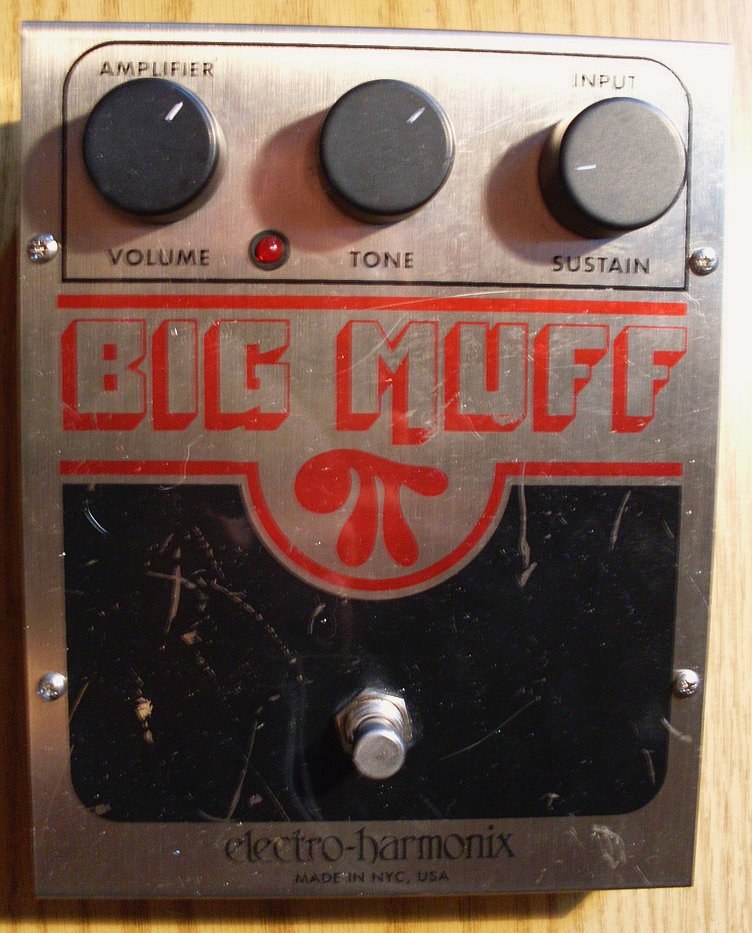
The Big Muff Pi scoops mids and swallows chords; the Katzenkönig keeps mids and separates notes. In a loud band, that difference is the difference between being heard and not.
Versus Other Hybrid Dirt
The Keeley Fuzz Bender is the closest philosophical cousin — another modernised Bender with added tone shaping, though Keeley’s approach adds a bias control and germanium/silicon blending rather than grafting on a second circuit’s output stage. The Vemuram Myriad Fuzz chases refinement; the EarthQuaker Devices Hoof chases hybrid transistor character; the Death By Audio Fuzz War chases collapse. The Katzenkönig is the only one of the group whose stated goal is to be tight and unhinged simultaneously.
Within the Catalinbread Line
Catalinbread’s dirt catalogue is unusually well differentiated. The Formula No. 55 is a tweed Deluxe in a box; the Naga Viper is a Rangemaster treble booster with escape hatches; the Katzenkönig is the aggressive end of the range. They stack in that order, too — Naga Viper into Katzenkönig is a period-correct sequence, since a treble booster wants to see pickups first and a fuzz wants a hot signal. Pair any of them with a Belle Epoch or an Echorec for the full Portland-built signal chain.
Buying Guide
Buy it if: you want one dirt box that spans crunch to fuzz mayhem without a preset menu; you play in a band loud enough that mid-scooped fuzz disappears; you like fuzz but hate how badly most fuzzes handle chords; you swap between single-coils and humbuckers and want a pedal that adapts via one knob.
Think twice if: you specifically want vintage germanium warmth and sag — this is silicon and it is not pretending otherwise; you record quiet, high-gain overdubs where noise floor matters, because both parent circuits are noisy and this one inherits that honestly; you need a low-gain edge-of-breakup sound, which is not what this box is for.
Price reality: launched at $169.99 street in 2015, currently $179.99 direct from Catalinbread, with B-stock units at $152.99 and street prices across major retailers ranging roughly $149.99 to $188.00. For a hand-built, all-discrete US-made pedal with a three-year warranty, that is genuinely fair — Gore said as much in 2015 and inflation has only made the argument stronger.
Ownership Notes
Power
9–18V DC, 6 mA — trivially low, so it will run off anything. It also takes a 9V battery. Higher voltage gives more headroom and a slightly stiffer feel; 9V is the more compressed, more classic setting. Power supply is sold separately.
Placement
Standard fuzz-adjacent rules apply, but less strictly than usual. Because the Input trim compensates for signal level, the Katzenkönig is far less fussy about what sits in front of it than a true vintage Bender or a Fuzz Face. Still, it prefers to be early in the chain — after wah, before overdrives, well before time-based effects. Modulation, delay and reverb belong after it.
Noise
Take the warning seriously. High-gain settings can be genuinely noisy, and that noise is a property of the circuits being modelled, not a defect. Rolling back the guitar volume works; a noise gate works; single-coils in fluorescent lighting will be worse.
Build
Standard B-sized enclosure, modern hand-populated circuit board, described by PG as solid and damage-resistant. Portland-built, three-year warranty, free domestic shipping over $50, ships within 1–2 business days from Catalinbread direct.
The Manual — Genuinely Worth Reading
Catalinbread’s Katzenkönig manual is unusual: it includes the full circuit schematic, published under a Creative Commons licence. Aion FX, whose Poseidon PCB is a direct adaptation of it, notes that Catalinbread reasoned that since so much of the silicon Tone Bender’s development and the RAT’s tracing and analysis came from the DIY community in the first place, they wanted to give something back. That is a rare posture in an industry that usually pots its boards in epoxy.
Frequently Asked Questions
Is the Katzenkönig a fuzz or a distortion?
Both, and the Input knob decides. Catalinbread and most retailers file it under distortion; Premier Guitar and Equipboard file it under fuzz. Structurally it is a fuzz front end feeding a distortion output stage, so both filings are defensible.
What does the name mean?
“Cat King” in German. The artwork depicts a crowned cat over its kill, in a Vienna Secession graphic style.
Does it use germanium transistors?
No. Three silicon transistors in a modified Tone Bender MkII arrangement. Silicon here buys consistency and works with the downstream RAT clipping rather than against it.
Why does the Gain knob still sound good turned down, when a real Tone Bender doesn’t?
Because it works differently. Rather than altering a transistor’s voltage to ground, it varies the resistance of a negative feedback loop between two transistors. That keeps the circuit in a musical operating region across the whole sweep.
Do I still need to use my guitar’s volume knob?
You can, and it works. But the Input trim exists precisely so you don’t have to — it is scaled to compensate for pickup output differences, which suits players who prefer to keep the guitar on 10.
Is it noisy?
At high gain settings, yes. That was the one “con” in Premier Guitar’s otherwise very positive review. Both a MkII and a RAT are noisy at high gain, and this pedal inherits the trait.
Which famous guitarists actually use one?
Honestly: none that we can independently verify. Equipboard lists Joe Perry, Bill Frisell and Carrie Brownstein, but two of those entries trace only to Catalinbread’s artist roster page — which carries no per-pedal attribution — and Frisell is not currently listed there at all. Brownstein’s entry comes from an Instagram photo thanking Catalinbread for pedals, without specifying which. Treat all three as unconfirmed.
Can I power it with 18V?
Yes. Catalinbread specifies 9–18V DC. Higher voltage yields more headroom and a tighter response; 9V is more compressed. Current draw is only 6 mA either way.
Is there a DIY version?
Yes — Aion FX’s Poseidon Silicon Fuzz is a direct adaptation from Catalinbread’s Creative Commons schematic, with one addition: a diode clipping switch offering higher-threshold options for more headroom and volume than the stock set.
How does it compare to just buying a RAT and a Tone Bender clone?
Two pedals give you two sounds plus whatever happens when you stack them. The Katzenkönig gives you one sound that is neither, tuned deliberately as a single circuit with tapers chosen so that, as Gore put it, it “provides genuinely useful sounds at nearly every setting — something you certainly can’t say about Benders or Rats.”
Image credits
- Top image: GuitarGangsters AI-generated reference illustration, not a photograph.
- Electro-Harmonix NY Big Muff Pi: Roadside Guitars, Flickr, CC BY-SA 2.0.
Latest News
Related
On This Day
Monday 9 November
From this week: