Browne Amplification Carbon: What Happens When a Boutique Builder Cuts His Own Flagship in Half
Browne Amplification Carbon guide: the modified Bluesbreaker circuit inside, V1 vs V2 hi-cut, verified players, settings and 2026 buying advice.
There is a particular kind of confidence involved in taking your most successful product, sawing it down the middle, and selling one half of it for two-thirds of the price.
Most builders would not do it. The dual-drive pedal is the whole pitch. Two circuits, one enclosure, one power draw, one patch cable saved — that is the argument, and the argument is why the pedal costs what it costs. Break it into pieces and you have just told every customer that they never needed the expensive version.
Dave Brown did it anyway, and he announced he was going to do it in a magazine interview two years before the pedal appeared. In May 2021, asked what was coming next from his Kansas City workshop, he said plainly that the plan was to do the blue side of the Protein on its own. In early 2023 that pedal arrived in a powder-blue box with a small metal name badge on it, and it turned out that a great many players had been waiting for exactly that.
The Carbon is not a lesser Protein. It is the half of the Protein that most people were already leaving on.
The short version
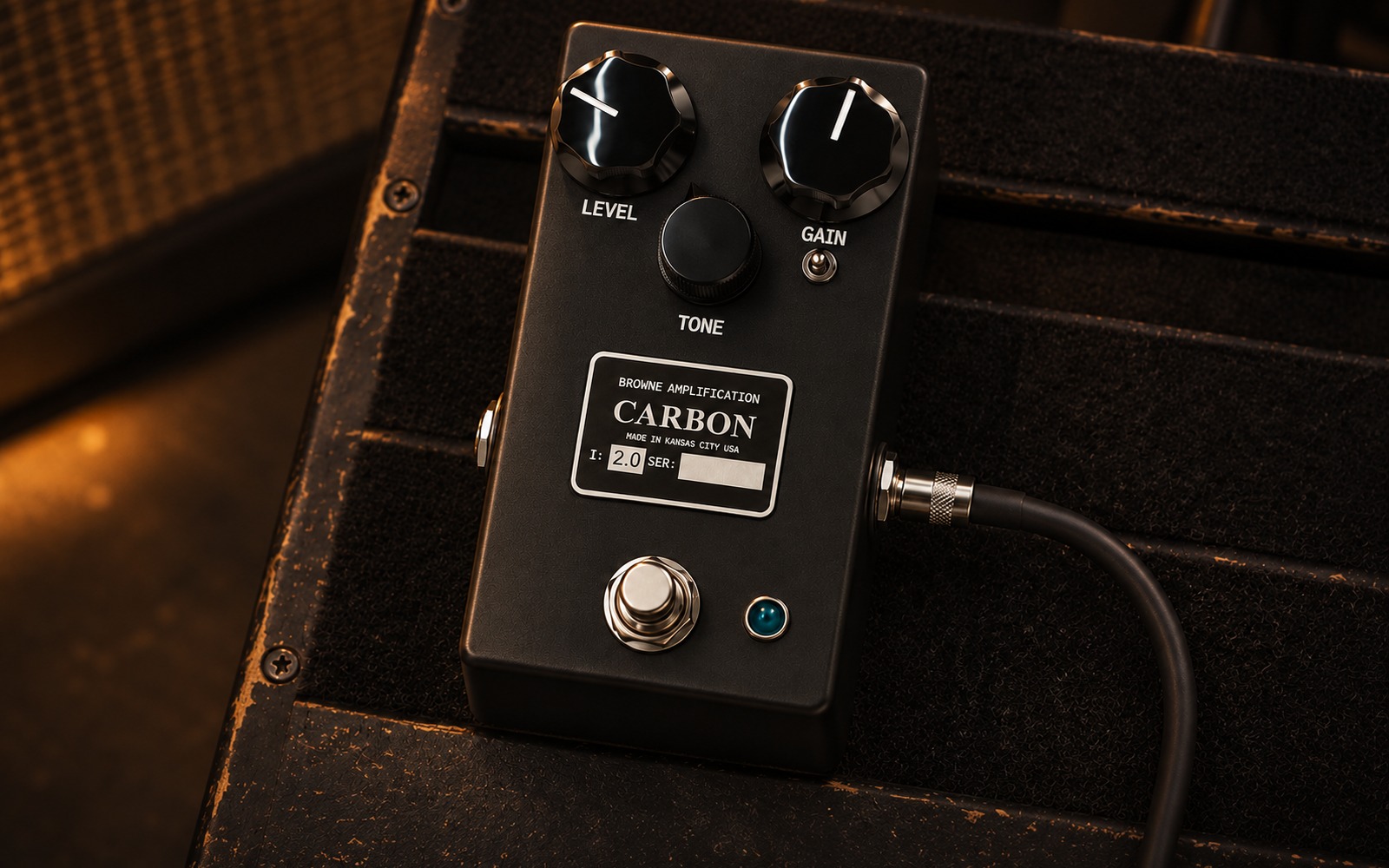
The Browne Carbon is a single-channel overdrive, built in the USA, that takes the blue channel of the Browne Protein — a heavily modified 1990s Marshall Bluesbreaker circuit — and puts it in a small enclosure with three knobs: Volume, Gain and Tone.
Browne’s own store copy is refreshingly blunt about what it is: the standalone blue side of the Protein, “a heavily modified BB style pedal,” designed to avoid the complicated options found in other pedals built on the same circuit. The company’s suggested use case is equally direct — it calls the Carbon “a pedal you might never turn off.”
The current version, the V2, adds one thing to the original: a three-position hi-cut toggle. Left is a subtle treble cut, centre is the original Carbon voicing, right is a more pronounced cut. That toggle was invented here and later carried across into the Protein V4, which makes the Carbon the rare side-project that fed a feature back into the flagship.
Pricing as of September 2026: $229 at US dealers such as Russo Music and Mass Street Music, from $189 direct from Browne when stock and blem units allow — though the direct store was showing Sold Out at the time of writing, which is an extremely Browne state of affairs. UK and European buyers go through the international dealer network; the pedal reviewed at £219–£239 when it landed in Britain in 2023.
The one-line verdict: if you have ever looked at a Protein and thought “I only ever use the blue one,” this is the pedal, and by several accounts it sounds slightly better in this box than it did in the big one.
Where the circuit comes from
The Carbon’s ancestor is the Marshall Bluesbreaker, a black wedge-shaped pedal Marshall built between roughly 1991 and 1992 and then quietly discontinued. It was named after the JTM45 combo Eric Clapton used on the 1966 Blues Breakers with Eric Clapton album — the record that also made a Les Paul through a cranked British amp the default sound of blues rock for the next sixty years, and which Peter Green then had to follow when he took Clapton’s chair in John Mayall’s band.
The pedal itself was not a hit. Nobody rioted when Marshall killed it. What happened next is one of the strangest second acts in stompbox history: pedalboard photographers noticed, years later, that a Bluesbreaker was doing serious work at the feet of John Mayer, particularly around the Continuum era. Demand for a discontinued pedal spiked, prices followed, and an entire sub-genre of “transparent” boutique overdrives grew up around the circuit.
It is worth being precise about what that means for the Carbon, because Browne’s own marketing and several dealer listings put John Mayer’s name near this pedal. Mayer is cited as a famous user of the circuit — the original Marshall unit, decades ago. He is not documented as a Carbon user, and this article does not claim he is. The Mayer connection is genealogical, not personal.
What Browne actually changed
An original Bluesbreaker has three well-known problems. Its overall output is low, so it struggles to push an amp. Its gain sweep has a narrow sweet spot with a lot of dead travel either side. And its tone control is awkwardly voiced, going from harsh to blanket with not much usable ground between.
Browne addressed all three. The Carbon has a genuinely useful volume range with headroom well past unity, a gain knob that does something across its whole rotation, and a tone control that — as Guitar.com’s reviewer noted — can be wound all the way to minimum without becoming unusably dark. Dave Brown has been unusually open about the lineage in his own FAQ, describing the blue circuit as a Bluesbreaker with modifications and an added output section rather than hiding behind vague talk of proprietary designs.
Specifications
| Specification | Browne Amplification Carbon (V2) |
|---|---|
| Type | Single-channel overdrive |
| Circuit basis | Heavily modified 1990s Marshall Bluesbreaker; identical to the blue side of the Browne Protein |
| Controls | Volume, Gain, Tone |
| Switching | Three-position hi-cut toggle (V2 only): Left = subtle cut, Centre = OG Carbon, Right = more cut |
| Bypass | Soft (relay) switching with adjustable start-up state — see spec conflict below |
| Power | 9V DC centre-negative, external supply only (no battery compartment) |
| Dimensions | 120 x 72 x 59 mm (published; includes knobs and jacks) |
| Jacks | Top-mounted from V1 onwards |
| Finishes | Sky Blue, Midnight Black (V2); powder blue only on V1 |
| Origin | Hand-assembled in Kansas City, Missouri, USA |
| Indicator | Blue LED |
| Street price (Sept 2026) | $229 US dealer; from $189 direct incl. blem stock; £219–£239 UK at launch |
Three published spec conflicts worth knowing about
The Carbon has been described inconsistently across otherwise reliable sources, and if you are shopping used you will run into all three.
1. True bypass or soft switching?
Guitar.com’s 2023 review lists the Carbon as true bypass. Guitar World’s review, published three weeks later, describes soft switching. Equipboard’s product description repeats the true-bypass claim. Browne’s own current store page settles it: the Carbon uses soft switching, and the V2 adds an adjustable start-up state so you can choose whether the pedal wakes up on or off. Soft switching is correct. The true-bypass listings appear to be an early press-kit error that has been copied outward ever since.
2. £219 or £239?
Guitar World’s spec box gives $/£219. Guitar.com’s gives £239. Both are April 2023. This is almost certainly the difference between a US-dollar price converted at parity for a UK spec box and an actual UK dealer price with VAT and distributor margin applied — a routine discrepancy in British gear journalism, not a sign that two different pedals were reviewed.
3. The “unique JFET circuit” claim
Equipboard’s automatically generated product description states that the Carbon features a “unique JFET circuit” that emulates tube warmth. There is no supporting evidence for this from Browne, from either magazine review, or from the pedal’s documented ancestry. The Bluesbreaker family is an op-amp design with diode clipping in the feedback loop. Treat the JFET line as marketing filler generated from a template, which is what most of that page’s descriptive copy reads like.
The broader lesson, and it applies well beyond this pedal: aggregator product descriptions are written to fill a page, not to describe a schematic. Verify circuit claims against the builder.
V1 versus V2: how to tell them apart in a listing
There are only two generations, and the difference is visible from a phone photo.
V1 (2023): powder blue enclosure, three knobs, no toggle. Top-mounted power input — Browne got that right from the start, which is more than can be said for a lot of boutique builders in 2023. Guitar World’s review of this version explicitly notes there are no internal or external switches to fiddle with.
V2 (from late 2023): adds the three-way hi-cut toggle above the knobs, and comes in Sky Blue or Midnight Black. The toggle is not a tone control in disguise. Centre is the original voicing untouched; left and right progressively shave the top end. It exists for two reasons: bright amps, and stacking. If you run the Carbon into another drive, or run two of them, the accumulated top end can get glassy fast, and the hi-cut is the fix.
If you are buying used and the seller has typed a version number into the description, ignore it and look at the photo. Browne’s product pages have a documented history of carrying stale version information after a new model launches, and sellers copy from those pages.
Who actually plays one
The Carbon has a shorter and more honest player list than the Protein, which is what you would expect from a pedal that is two and a half years old rather than seven. Here is what is documented, in descending order of evidential strength, with the gaps left visible.
Confirmed on the standard Carbon
Chris Turpin (Ida Mae, formerly Kill It Kid) is the most substantial name attached to this specific pedal. Turpin is a British slide and fingerstyle player whose duo has been through a Premier Guitar Rig Rundown and whose board has been photographed extensively; a Carbon appears on it in his own social posts. His wider pedal choices tell you something about where the Carbon sits — the same board has carried an Analog Man Sun Face and a Keeley D&M Drive, which is a company of pedals chosen by someone who wants dynamics and touch response rather than saturation.
Chad Waldrup (Hopesfall) is documented with a Carbon on a 2022 board photograph. This one is interesting mainly because Hopesfall are a post-hardcore band, and a heavily modified Bluesbreaker is not the obvious choice for that genre. It is a good corrective to the assumption that this circuit only belongs to blues players — a low-gain, amp-like drive stacked in front of an already-loud rig does something very specific in heavy music, and it is not the thing a distortion pedal does.
Confirmed on the Carbon X — a related but different pedal
The Carbon X is two Carbon circuits in one enclosure, priced around $339–$359. Its user list is more famous than the single Carbon’s, and it deserves flagging clearly rather than being quietly absorbed into the main list.
Mateus Asato is documented using a Carbon X in the standard red finish on stage as recently as 2026. Asato’s touch-heavy, chord-melody style is close to a textbook argument for this circuit: he needs something that thickens and compresses very slightly without flattening the difference between a fingertip and a nail.
Devin Malone is documented with a Carbon X in an Instagram rig post, with a line that sums up the whole proposition: he describes it as everything he loved about the Protein and more.
Joey Jones names the Carbon X as an essential part of his setup in a pedal-selection video, comparing it directly to the Analog Man King of Tone — which is the comparison almost every Carbon X owner reaches for, since both are dual low-gain drives in one box with a waiting-list reputation.
What we are not claiming
John Mayer, for the reasons set out above. Also worth stating plainly: the Protein’s much longer artist roster does not transfer to the Carbon. A player documented with a Protein is documented with a Protein. The circuits overlap; the evidence does not. Browne’s brand page on Equipboard aggregates nineteen artists across the whole catalogue, and it would be trivially easy — and wrong — to present that number as a Carbon user list.
Six settings that actually work
Three knobs is a small space, but the Carbon’s usable range is wider than it looks because the gain knob’s first half does something completely different from its second half.
1. Always-on enhancer
Gain 9 o’clock, Tone 11–12 o’clock, Volume set to unity or a hair above, hi-cut centre. This is the setting Browne is describing when it says you might never turn the pedal off. It does not change your fundamental voice; it adds a slight grain and a small amount of compression that makes an amp feel more responsive. Set it, forget it, and treat the amp’s clean channel as your new clean.
2. Clean boost into a cooking amp
Gain fully off or nearly so, Volume 2–3 o’clock, Tone 12 o’clock. The Carbon has enough output on tap to work as a straight level push. Because the tone stack is gentler than a Tube Screamer’s, you get a volume lift without the mid-hump — useful if you want the solo louder rather than different.
3. The JTM crunch
Gain 1–2 o’clock, Tone 1 o’clock, Volume to taste, hi-cut left. This is the setting Guitar World’s Paul Riario described as sounding like a jumped JTM Marshall. Humbuckers, bridge pickup, an amp already at the edge of breakup. It is the most classically “Bluesbreaker” thing the pedal does.
4. Cutting solo lift
Gain maxed, Volume around 10–11 o’clock, Tone backed off slightly, hi-cut centre. Russo Music’s write-up of the V2 arrives at almost exactly this and calls it a ripping solo tone that cuts without being obnoxious. The tone rollback is doing the work: at full gain the top end crisps up considerably, and taking a little off keeps it from becoming brittle.
5. Stacked in front of a mid-focused drive
Carbon first with Gain at 10 o’clock and hi-cut right, into an Ibanez TS9 or a Wampler Tumnus. The Carbon supplies body and a little compression, the second pedal supplies focus. The hi-cut on the right position is doing something specific here: it stops the two pedals’ top ends from stacking into ice-pick territory.
6. Bright single coils, dark room
Gain 11 o’clock, Tone 9–10 o’clock, hi-cut right, Volume at unity. A Telecaster into a blackface-voiced amp on a bright stage is one of the situations the hi-cut was invented for. Owners of the V1 have to do this entirely with the tone knob, which works — the tone control’s whole range is usable — but the V2 gives you a second, independent stage of the same medicine.
How it compares
Carbon versus the Protein
Identical circuit, different box, and — according to Guitar World, which had both — not identical results. Their reviewer’s verdict was that the Carbon sounds more organic as its own pedal, blooming with more liveliness and presence and coming across bigger. Whether that is a real electrical difference (different output loading, no adjacent channel sharing a power rail) or a reviewer hearing what a standalone flagship encourages you to hear is impossible to settle from the outside. What is not in dispute is the practical argument: if you have never used the Protein’s green side, you are paying roughly $110 for a channel you do not play.
Carbon versus the Carbon X
Two Carbons in one box, for around $339–$359 against $229. The X makes sense if you want a rhythm setting and a lead setting on independent footswitches, or if you want to stack the same circuit into itself — which is a genuinely different sound, thicker and more compressed than one Carbon at higher gain. It is also, on the evidence above, where the better-known players ended up.
Carbon versus the King of Tone and Prince of Tone
The King of Tone is the other famous Bluesbreaker descendant, and the Prince of Tone is its single-channel version — which makes the Prince the Carbon’s most direct structural rival. The comparison that gets made most often by Browne owners is that the blue circuit is smoother and less biting than a King of Tone. The other difference is availability: Analog Man’s waiting list is a legend in its own right, while the Carbon is a pedal you can generally order and receive.
Carbon versus the JHS Morning Glory
The JHS Morning Glory is the most widely owned Bluesbreaker derivative on the market and the natural budget comparison. Owners who have moved from one to the other consistently cite two reasons: the Browne circuit has more usable gain range at the top, and it has more headroom, which matters if you want the pedal to push an amp rather than just recolour it.
Carbon versus the transparent-drive field
Against a MXR Timmy, the Carbon is warmer and less surgical — the Timmy’s independent bass and treble cuts give you more precise control, the Carbon gives you a voice. Against a Klon Centaur or its descendants, the Carbon is the more amp-like of the two and the Klon the more mid-forward and boost-oriented. Against the Vemuram Jan Ray, you are comparing a Bluesbreaker to a Fender-blackface voicing; the Jan Ray flatters, the Carbon reports. Against a Boss BD-2, the Carbon is smoother and less spiky, and roughly four times the price.
One comparison from the owner community is worth reporting because it is unflattering and specific: the Carbon V2 has been described as less transparent than a Greer Lightspeed, offering a distinct tonal character rather than pure invisibility. That is a fair criticism and arguably not a criticism at all — the Carbon has a voice, it is a warm and slightly bright one, and if what you want is a genuinely colourless clean boost this is not the pedal.
Carbon versus its own siblings
Browne’s catalogue has a trap in it. The ATOM — later reissued as the Alkene — is the Protein’s green side standalone, derived from the Nobels ODR-1 that has been Nashville session furniture for decades, in the hands of players like Brent Mason. The Gritador is a separate Tube Screamer-derived design, not a Protein channel, despite at least one dealer brand-spotlight article claiming otherwise. The Ethane ($359) is a Carbon V2 and a Gritador in one box — a different pairing from the Protein’s, and worth understanding before you buy what looks like a Protein alternative.
Buying guide
New
US dealers list the V2 at $229 in either Sky Blue or Midnight Black. Browne’s own store shows the Carbon from $189, which reflects blem pricing — cosmetically imperfect units sold with full warranty — but the direct store frequently shows Sold Out, and has done through much of 2026. This is the normal condition of a Browne product, not a sign of trouble; demand has outrun supply since the company’s first hundred-unit run.

International buyers cannot order direct. Browne routes overseas customers to its dealer network, so UK and EU pricing depends entirely on who is importing.
Used
Four checks before you send money.
Look for the toggle. Toggle above the knobs means V2. No toggle, powder blue, means V1. Do not trust the listing text.
Check the switch behaviour, not the switch feel. The Carbon uses soft switching, so there is no mechanical click. A seller describing the pedal as true bypass is repeating a magazine error, not necessarily lying — but it does tell you they are working from web copy rather than the pedal in front of them.
Confirm it is a Carbon and not a Carbon X. The X is visibly wider with two footswitches. This sounds obvious until you see how many listings use a stock photo of the wrong one.
Ask about the power supply the previous owner used. There is no battery option; this pedal has lived its whole life on a board with an isolated supply or a daisy chain, and daisy-chain noise complaints usually follow the supply rather than the pedal.
Who should not buy a Carbon
Anyone chasing high gain. Guitar.com’s reviewer was direct about this: pushed to maximum, the Carbon tends to thin out rather than get heavier, and its low-gain character will feel limiting if you want saturation. This is a pedal that lives between clean and crunch.
Anyone who wants a truly transparent boost. See the Lightspeed comparison above. The Carbon colours.
Anyone who already owns a Protein and uses both sides. You would be buying a channel you already have.
Anyone who needs a battery option or a mechanical bypass for a specific rig requirement. Neither exists here.
Living with one
Practical notes from owners and from the pedal’s design.
Placement. Browne’s own recommendation for the Protein’s blue side applies here: because the Carbon has real headroom, it absorbs whatever is in front of it rather than being overwhelmed by it. That makes it a good candidate for the last position in a drive chain — the opposite of where most players instinctively put their lowest-gain pedal.
Unity gain. Some V2 owners report a perceived bass reduction at unity that requires small compensating moves on the volume knob. Set the gain first, then hunt for unity, then adjust the tone last. Doing it in the other order produces a lot of unnecessary knob-twiddling.
The hi-cut is a rig control, not a song control. Set it once for the amp and the room. It is not meant to be swapped between numbers, and on the V2 it is a small toggle that is not comfortably reachable with a boot anyway.
Start-up state. The V2’s adjustable start-up state is genuinely useful if you are running this as an always-on pedal — you can have it come up engaged when the board powers on, which removes one thing from the list of pre-gig checks.
Build. Both magazine reviews independently described the build as tank-grade. The industrial name badge divides opinion; owner comment describes it as subtle and high quality, and the aesthetic comes from Browne’s co-designer, who wanted a vintage ham-radio military look for the whole line.
Frequently asked questions
Is the Carbon exactly the same as the Protein’s blue channel?
Electrically, by the manufacturer’s own description, yes — it is the standalone blue side. Guitar World’s reviewer, having played both, felt the Carbon sounded more open and present as its own pedal. Take that as a real but small difference, not a different circuit.
What does the hi-cut toggle actually do?
It reduces high frequencies in two fixed steps. Left is a subtle cut, centre is the original Carbon voicing with no cut, right is a more pronounced cut. It works alongside the tone knob rather than replacing it, and it exists mainly for bright amps and for stacking situations where accumulated treble becomes a problem.
Does the Carbon have true bypass?
No. It uses soft relay switching, and the V2 adds an adjustable start-up state. Several published reviews and product listings say true bypass; the manufacturer’s own current store page says otherwise, and the manufacturer wins.
Can I run it on a battery?
No. It requires a 9V DC external supply. There is no battery compartment.
Is it worth $229 when a JHS Morning Glory costs less?
That depends on whether you need headroom. Both are Bluesbreaker derivatives and both do the core job. The Carbon offers more output on tap and a broader usable gain range, which matters if the pedal’s job is to push an amp into breakup rather than to supply the breakup itself. If you only ever use the first third of a Morning Glory’s gain knob, the upgrade is hard to justify on sound alone.
Carbon or Carbon X?
Buy the Carbon if you want one voice and one footswitch. Buy the Carbon X if you want independent rhythm and lead settings, or if you want to stack the circuit into itself. The X costs roughly $110–$130 more and takes up meaningfully more board space.
Does John Mayer use a Browne Carbon?
There is no documentation that he does. Mayer’s name is attached to the original Marshall Bluesbreaker, which he used prominently around the Continuum period and which is the reason that circuit became valuable. Browne’s marketing cites this as the circuit’s provenance. It is not a claim about the Carbon, and anyone presenting it as one is overreading the copy.
Why is the direct store always sold out?
Because Browne has never taken outside investment and builds to capacity rather than to forecast. The company’s first Protein run was a hundred units funded from the founder’s savings and it sold out immediately; the pattern has not changed. If the direct store is empty, check the dealer network, where stock circulates more predictably.
Image credits
- Top image: GuitarGangsters AI-generated reference illustration, not a photograph.
- Eric Clapton: MerleEllaPatsy, Wikimedia Commons, CC0 1.0.
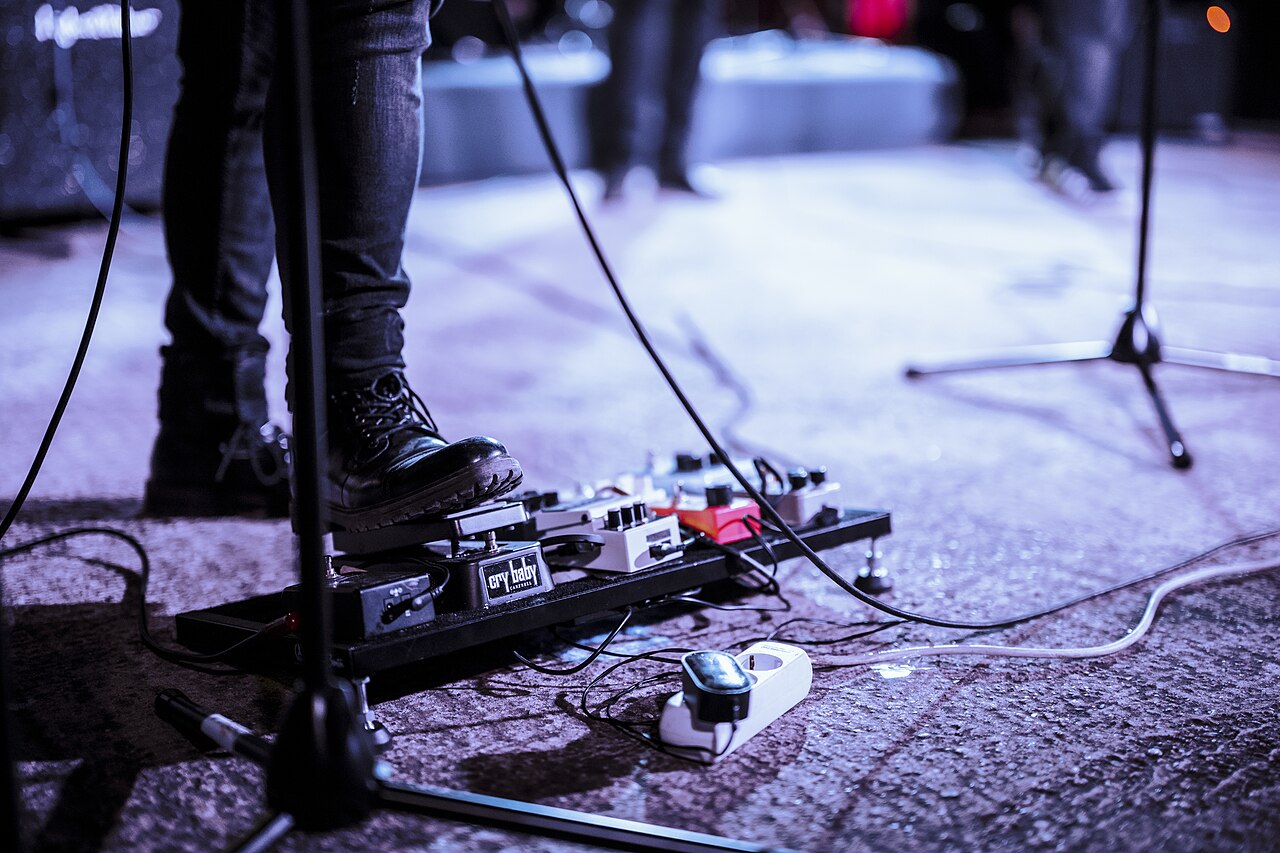
- A guitarist using an effects pedal on stage: Shixart1985, Wikimedia Commons, CC BY 2.0.
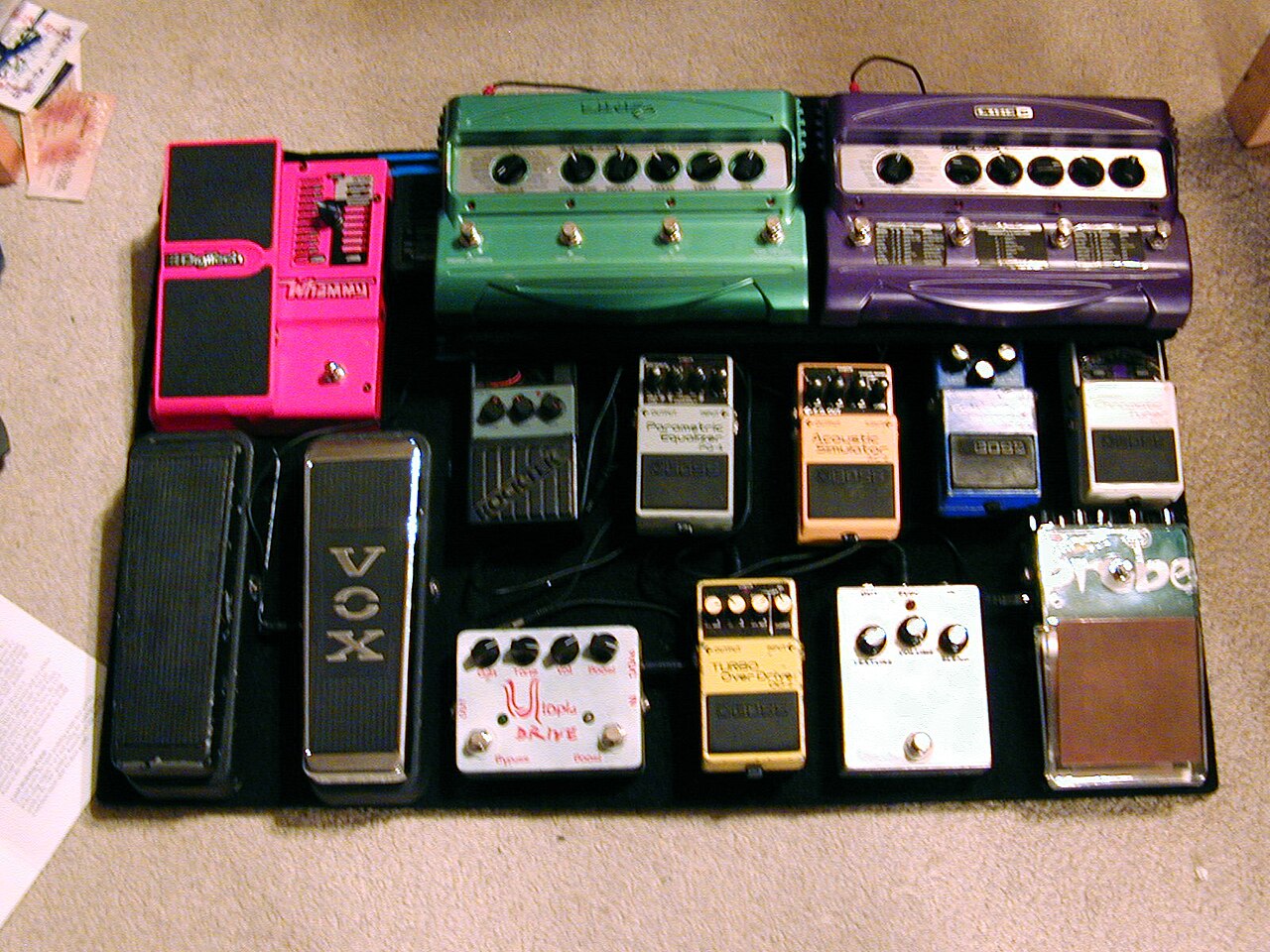
- A pedalboard with wah and effects pedals: John Athayde, Wikimedia Commons, CC BY 2.0.
Latest News
Related

On This Day
Monday 9 November
From this week: