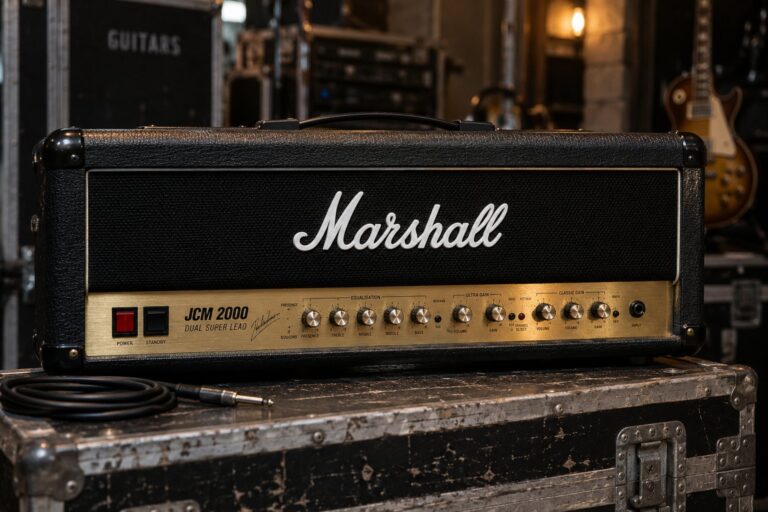
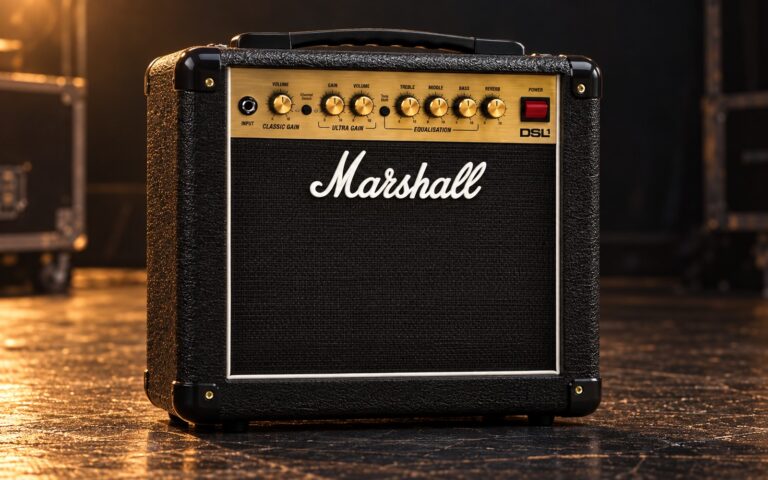
Marshall Studio Classic SC20C: The JCM800 Combo That Fits in Your Car and Sounds Like a Stack
The Marshall Studio Classic SC20C packs an authentic JCM800 2203 circuit into a 20W 1x10 combo. Full specs, tone recipes, and honest buying advice for 2026.
There is a particular kind of frustration that belongs exclusively to guitarists. You know the tone you want — you’ve heard it a thousand times, on records, on stages, in your bones. It is the tone of Hammersmith Odeon nights, of Festival Hall chaos, of those early-Eighties arenas where the PA was almost irrelevant because the backline alone could rattle fillings loose. It is the sound of a Marshall JCM800 2203 running full tilt through four-by-twelve feet of Celestion-loaded air. It is absolutely the sound that has defined British hard rock for four decades straight.
And then reality intrudes. The original JCM800 2203 runs 100 watts. It needs a big cab. It needs to be cranked to sing properly. It needs a venue large enough that your drummer’s kit doesn’t rattle off the stage from the backwash. Most of us don’t live in that world. Most of us live in terraced houses, practice rooms with thin walls, and play stages that politely request you keep it under 40 watts or they’ll put a noise limiter on your channel. The gap between the tone in your head and the tone you’re allowed to make has historically been enormous.
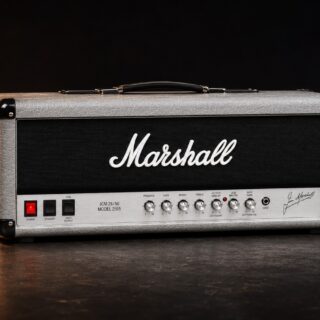
Marshall’s answer to this decades-long problem arrived at Winter NAMM 2019 in the form of the Studio Series, and the Marshall Studio Classic SC20C is the combo version of that answer. It packs a 20-watt/5-watt switchable JCM800 2203 circuit into a 1×10 closed-back combo that weighs 14.55 kilograms, fits in the boot of any reasonably sized car, and delivers what reviewers and players have broadly agreed is a convincing distillation of that immortal Marshall crunch at volumes that won’t get you evicted, arrested, or deafened. That is a remarkable engineering proposition. Whether it fully delivers on the promise is what we’re here to examine.
The Road From Bletchley to NAMM 2019: Why This Amp Exists
The JCM800 2203 — which forms the direct circuit basis for the SC20C — entered production in 1981 as Jim Marshall’s response to guitarists demanding more preamp gain than the earlier JMP models could supply. Where the original Plexi and JMP designs relied primarily on power-amp distortion at high volumes, the 2203 added a second preamp stage, creating what became the defining sound of the Eighties hard rock and metal canon: that particular combination of tight low-end punch, mid-focused crunch, and harmonically rich sustain that makes a Les Paul through a cranked JCM800 sound like the guitar and amp were specifically designed for each other.
The 2203 ran for years in its original 100-watt configuration, with a 50-watt sibling (the 2204) offering slightly earlier breakup. Both became standard equipment in virtually every rock and metal backline from the early Eighties through the mid-Nineties. Even when players moved on to other amplifiers — Mesa/Boogie, Soldano, EVH — the JCM800 2203 remained the reference point, the standard against which British rock amp tone was measured.
Fast forward to the mid-2010s. Marshall had been through a period of corporate turbulence, had launched a range of digital modeling products, and had been working to re-establish its credentials with the purist valve amp community. In 2018 the company launched the Origin series — a deliberate step back toward simple, single-channel, valve-driven simplicity. Those amps were warmly received. Encouraged, Marshall went further. For NAMM 2019, the company announced the Studio Series: four amplifiers — the Studio Vintage SV20H head, Studio Vintage SV20C combo, Studio Classic SC20H head, and Studio Classic SC20C combo — that would apply the same downsizing logic to two of the most iconic circuits in the company’s history, the 1959 Super Lead Plexi and the JCM800 2203. Crucially, all four were to be built in Marshall’s Bletchley factory in England. Not in Vietnam like the Origin series. Not outsourced. Made in the UK, same as the originals.
Marshall’s Product Director Luke Green explained the 10-inch speaker choice for the combo models in an interview with Guitarist magazine: the company did extensive testing with different speaker sizes and cabinet configurations and concluded that the 10-inch Celestion V-Type was “so much more honest in its tone” for a small combo at that power level. It is a defensible position. A 10-inch speaker in a small closed-back enclosure behaves very differently from the same driver in a larger baffle, and the SC20C’s closed-back cabinet gives the 10-inch considerably more bottom-end authority than an open-back design would.
The SC20C officially launched at $1,499 USD and £999 GBP and immediately attracted attention from players who had been waiting for exactly this product: the authentic JCM800 preamp and power-amp circuit, without the power plant and speaker real estate requirements of the 100-watt original.

Architecture and Circuit: What You’re Actually Getting
The SC20C is built around a faithful reproduction of the JCM800 2203 preamp topology. That means a single-channel design with a high-sensitivity and a low-sensitivity input (both quarter-inch jacks on the front panel), a preamp volume control, a three-band EQ stack with presence, and a master volume — the 2203 having been one of the first Marshall designs to include a master volume as standard. There are no effects, no reverb, no second channel, no built-in footswitch loop for channel switching. This is a one-trick amp, and the trick is one of the most celebrated in the history of the instrument.
The valve complement is three ECC83 (12AX7) preamp valves and two EL34 power valves. The ECC83 count breaks down as two valves handling the gain stages in the preamp and one functioning as a phase splitter ahead of the power stage — the same arrangement as the original 2203. The EL34s run in class AB push-pull configuration. Marshall’s PCB layout is characteristically neat, with the main board holding all the valve sockets and smaller daughter boards handling front and rear panel controls, connected via ribbon cables with Molex connectors. Smaller-than-standard transformers reduce weight without, Marshall contends, compromising transformer tone character.
The power reduction system works via voltage-rail scaling — dropping the B+ voltage to reduce the idle plate dissipation and consequently the output power from 20 watts to approximately 5 watts. This is not pentode/triode switching (which changes the fundamental operating class of the power valves), and it is not a passive attenuator. It works by reducing the voltage available to the power stage. The sonic effect is that the amp gets meaningfully quieter while broadly retaining its tonal character, though the power-amp compression and saturation naturally reduce with the lower voltage. On the front panel this is a three-position toggle: 20W, Standby (centre), and 5W — with a push upward selecting 5W and downward selecting full power.
The speaker is a Celestion V-Type in the 10-inch configuration, rated at 60 watts and 16 ohms. The V-Type driver is a modern Celestion designed to split the difference between the American-voiced Alnico Blue and the classic British Greenback — warmer and less aggressive than a G12T-75, more present and articulate than a G12M-25 Greenback. Whether it’s the ideal complement to a JCM800 circuit is a question that generates genuine debate, but Celestion’s 10-inch V-Type is a more capable driver than most critics expect from its compact format.
The rear panel is well-equipped. Five quarter-inch speaker output jacks offer full flexibility across 16 ohm, 8 ohm, and 4 ohm loads, meaning the SC20C can drive an external speaker cabinet instead of or in addition to the internal driver. A series effects loop with a push-button bypass switch sits alongside a fixed-level DI output for direct recording or PA routing. No footswitch is included — the effects loop bypass requires you to reach around to the rear panel, a minor inconvenience that several reviewers have noted.
Specifications at a Glance
Famous Players: The JCM800 Legacy and the SC20C Specifically
Here is where we need to be precise in a way that the marketing materials typically are not. The JCM800 2203 circuit that the SC20C reproduces has one of the most celebrated player rosters in amplifier history. The original 100-watt version passed through the hands of artists who collectively defined the sound of hard rock and metal for a generation. Angus Young ran JCM800s as his primary Marshall platform through much of the Eighties before gravitating toward his JTM45 and Plexi preferences in later years. The twin-guitar attack of Adrian Smith and Dave Murray ran through JCM800 heads on Iron Maiden’s classic Eighties records. Slash has cited the JCM800 as foundational to his early tone development. Zakk Wylde leaned heavily on JCM800 architecture before developing his own Wylde Audio designs. Kerry King of Slayer was a confirmed JCM800 user through the band’s most brutal early years. And Eric Clapton‘s use of Marshall amplification through the Bluesbreakers and Cream periods established the template that the 2203 circuit ultimately evolved from.

However — and this is an important qualification — none of the above artists have been independently verified as specifically using the SC20C studio combo. Slash, Zakk Wylde, Kerry King, Gary Moore, and Tom Morello are listed as associated artists. This is the same recycled brand-level roster that appears on virtually every Marshall JCM800-family product page. These are artists with documented relationships to the JCM800 platform generally, not to this particular 2019 Studio Series combo specifically.
We need to address the Gary Moore claim directly: Gary Moore was born April 4, 1952, and died February 6, 2011. The Marshall Studio Classic SC20C was announced at NAMM in January 2019 — eight years after Moore’s death. He cannot have used this amplifier.
When we searched Equipboard’s verified setups for the SC20C specifically, we found no confirmed famous artist entries — only community user setups from enthusiast players who own and play the amp regularly. The head version, the SC20H, had a confirmed association with Doug Aldrich of Whitesnake via a verified Marshall artist playthrough video. That documentation is model-specific to the head, not the combo.
What the SC20C does represent, and what is genuine and worth celebrating, is democratic access to the circuit topology that those canonical artists made legendary. The JCM800 2203 preamp is here, in this box, at a weight and price point that makes it accessible to any serious player. The amp serves as a practical portal to that lineage, even if no famous name is documented as their go-to combo. In terms of real-world uptake, the SC20C has become a firm favourite in the pub and club circuit across the UK and Europe, where the pick-it-up-and-go combo format combined with authentic Marshall valve tone makes it an obvious choice for gigging guitarists who want legitimate tube tone without a drum riser’s worth of equipment. The Equipboard genre breakdown confirms Rock, Hard Rock, Metal, Blues, and Punk as the amp’s natural habitat among its community of documented users — exactly the genres you’d expect from a miniaturised 2203.
Tone Recipes and Recommended Settings
Tone Recipe 1: Classic JCM800 British Crunch (High Sensitivity Input)
This is the bread-and-butter JCM800 setting that most players come to the amp for. Plug into the High Sensitivity input. Set Preamp Volume to 6, Master Volume to 4-5, Bass to 6, Middle to 7, Treble to 6, Presence to 5, power to 20W. Run a Gibson Les Paul Standard or SG Standard with humbuckers for maximum authenticity. This produces that characteristic mid-forward crunch with authority on the low strings and a slightly compressed, singing quality on the upper strings. Back off the guitar volume to 6-7 for a semi-clean platform that cleans up beautifully, then dig in for the overdrive.
Tone Recipe 2: Home Practice Grind (5W Mode)
Switch to 5W and High Sensitivity input. Bump the Preamp Volume to 7-8 and pull the Master Volume back to 3-4 to keep neighbours on speaking terms. Bass 5, Middle 7, Treble 5, Presence 4. At these settings the amp still produces genuine valve-generated clipping at the preamp stage, and the character is unmistakably Marshall even at low absolute volume levels. This is the setting that separates the SC20C from solid-state modelling gear — the touch-sensitivity and dynamic response remain fully intact even when quiet.
Tone Recipe 3: Clean Marshall Platform (Low Sensitivity Input)
The Low Sensitivity input on the SC20C is significantly underrated. Plugging in here with Preamp Volume at 4, Master at 5-6, Bass 5, Middle 6, Treble 6, Presence 5, and power at 20W produces a clean-ish Marshall tone with real punch and harmonic richness. It doesn’t do Fender sparkle — this is not a blackface clean — but it delivers a thick, vocal platform that gives pedalboard players enormous headroom. Drive pedals absolutely love this input and these settings.
Tone Recipe 4: Tube Screamer-Boosted Lead
Run an Ibanez TS-9 Tube Screamer into the High Sensitivity input. Set the TS-9 with Drive at 9 o’clock, Tone at noon, Level at maximum to hit the amp hard. SC20C settings: Preamp Volume at 5, Master at 4-5, Bass 5, Middle 8 (the mid boost stacks beautifully with the TS-9’s inherent mid hump), Treble 5, Presence 4. This combination produces the kind of saturated, focused lead tone that defined the classic rock and metal solo sound of the Eighties. The combination of the Tube Screamer’s mid-forward EQ curve and the SC20C’s own midrange character creates a singing sustain that feels almost effortless.
Tone Recipe 5: Punk Rock Snarl (Low Sensitivity, Pedal-Assisted)
Into the Low Sensitivity input: SC20C set for Preamp at 5, Master at 6, Bass 4, Middle 5, Treble 8, Presence 7, power 20W. This is a brighter, more aggressive setting that captures the early British punk and new wave relationship with Marshall tone — present, cutting, not as mid-saturated as the classic rock tones. A Boss SD-1 Super Overdrive in front adds just enough grit without overwhelming the amp’s natural character.
Tone Recipe 6: Blues Rock Warmth
Back off to Low Sensitivity input. Preamp Volume 5, Master 6, Bass 6, Middle 7, Treble 5, Presence 4, power at 20W. Run a slightly rolled-back guitar (volume at 7-8) with the neck pickup for the verse, roll up to full bridge pickup for the chorus. This setting reveals a smoother, warmer side of the SC20C that connects it to the pre-2203 Marshall lineage — the Bluesbreakers-era tone that Eric Clapton made iconic, the territory that Jimmy Page staked out with earlier JMP designs. The 2203 circuit is inherently brighter than those predecessors, but dialled back and run warm it nods convincingly in their direction.
Tone Recipe 7: Recording Direct (DI with Cabinet Simulation)
Use the fixed-level DI output into your audio interface, with Preamp Volume at 7, Master at 6, Bass 5, Middle 7, Treble 6, Presence 5, power at 5W (to reduce amp volume while maintaining preamp saturation). The DI output captures the post-preamp signal and requires an impulse response loader or cabinet simulator plugin in your DAW to complete the signal chain. This is an excellent approach for recording at minimal physical volume. The DI output on the SC20C is usable, though some players prefer a separate load box attenuator in the speaker circuit for the most authentic character.

The SC20C rewards a methodical approach to dialling in. The relationship between the preamp volume and master volume controls is the core of what makes this amp work, and understanding that relationship before blindly cranking knobs will save considerable frustration.
SC20C vs SC20H vs the Original JCM800 2203: Which is Right for You?
The most immediately relevant comparison is between the SC20C combo and its head-format sibling, the SC20H. The circuit is identical — same preamp, same power stage, same voltage-rail scaling, same rear panel connectivity. What differs is the enclosure. The SC20H is a head that requires a separate speaker cabinet, giving you full control over the speaker size, cabinet type (open or closed back), and speaker voicing. The SC20C makes that decision for you: 10-inch Celestion V-Type, closed-back enclosure, permanently integrated.
Guitar.com’s review noted that running the SC20C through a Marshall SV212 2×12 extension cabinet produced “extra volume, huge but tight lows and wide open clarity” — markedly different from the 1×10 combo configuration. This underscores an important consideration: the SC20C, while sonically capable through its internal speaker, reveals a significantly different character when fed through a larger external cabinet. The five speaker output jacks on the rear panel make this easy to explore. If you anticipate regularly wanting that larger sound, the SC20H head paired with a 4×12 or 2×12 cab may serve you better. If the self-contained 1×10 combo format suits your use case, the SC20C delivers excellent value for its integration and portability.
Against the original JCM800 2203, the SC20C inevitably represents trade-offs. Henning Pauly of the EytschPi42 YouTube channel compared the two directly and noted that the Studio Classic head was “a bit more mid-focused” and that the “low-end chunk is not quite there” compared to the original. This is consistent with what physics would predict: a 100-watt amp with large transformers running into a 4×12 cabinet develops low-end authority that a 20-watt amp with smaller transformers into a 1×10 cannot fully replicate. For home, studio, and small-gig use the SC20C is an extremely capable approximation. For full-stack backline work, nothing replaces the full-scale original.
Against Marshall’s own DSL20HR, which is a two-channel, modern-voiced Marshall at a lower price point, the SC20C offers a simpler, more vintage-correct circuit in exchange for less tonal versatility. The DSL20HR has switchable clean and crunch channels, onboard reverb, and a more contemporary voicing. The SC20C has one channel, no reverb, and sounds like 1982. Which is better depends entirely on what you need.
The Origin 20H and Origin 50C represent Marshall’s simpler, lower-gain end of the Studio-era reissue family. Where those amps emphasise clean headroom and natural power-amp breakup based on earlier Marshall topology, the SC20C is explicitly the high-gain, preamp-distortion machine of the range. If your priority is classic Sixties-era British crunch through power-amp saturation, the Origin series is the better fit. If your priority is that defined, articulate, mid-focused JCM800 overdrive, the SC20C is the clear choice.
Buying Guide: New vs Used, and What to Check
The SC20C has been in continuous production since 2019 and is readily available new through authorised Marshall dealers. Current new pricing in the US sits in the $1,399-$1,599 range depending on retailer and availability. UK pricing remains around £999-£1,099 new. Marshall has also released a limited White Elephant Grain cosmetic variant (the SC20CWH) at similar pricing for those who want something that stands out visually.
Used market prices on Reverb and similar platforms typically range from $700 to $900 for units in good condition, with pricing dependent on whether original packaging and documentation are present. The amp is robustly built — PCB construction with Molex connectors and quality point-to-point wiring for the heavier components — and typical used units from the 2019-2023 production run are well within their valve service life. The EL34 power valves in this circuit, running at reduced voltage in a relatively low-power application, can exceed 3,000 hours before noticeable degradation.
When buying used, verify the following. First, check the Celestion V-Type speaker for voice-coil condition — play a clean tone at low volume and listen for buzzing or asymmetric break-up which indicates a failing speaker. Second, verify the effects loop bypass push-button functions correctly. Third, run both High and Low Sensitivity inputs and confirm both function without noise or reduced output. Fourth, confirm the 20W/5W power reduction switch clicks positively between positions and that the amp measurably gets quieter on 5W. Fifth, check that all five speaker output jacks function without static or dropout.
The SC20C is UK-manufactured at the Bletchley factory. Build quality is noticeably above the Origin series and DSL entry-level lines — tighter construction tolerances, better quality vinyl finishing, and more rigorous QC. For buyers who care about provenance and want the closest possible connection to the original JCM800 manufacturing tradition, this is the real deal.
Owning the SC20C: Real-World Observations
Several points of practical experience consistently emerge from the SC20C owner community. The amp is louder than its 20-watt rating implies — a characteristic of efficient EL34 power stages in a closed-back cabinet that projects sound forward effectively. At 20W with Master Volume at 5, this amp can comfortably fill a 200-person venue. At 5W with master at 4, it sits on the right side of the living-room volume boundary for most households, though you will still be playing over an acoustic drum kit without effort.
The High Sensitivity input can be genuinely challenging to manage with bright-sounding guitars — single-coil instruments with strong treble presence can push the SC20C into fizzy territory at mid-to-high settings. The Low Sensitivity input solves this in most cases, and many SC20C owners report preferring the Low Sensitivity input as their default, which is the opposite of the conventional wisdom about using the high input first. The two-input design effectively provides two gain character options without a second channel.
The fixed-level series effects loop introduces a slight volume drop when engaged without any external effects in the chain. This is a characteristic of the design, not a fault. A power attenuator — the Bugera PS1 is a commonly cited companion — in the speaker output chain is a popular accessory for SC20C owners who want to record at very low volumes while maintaining full power-amp saturation.
The Celestion V-Type in 1×10 format performs well across the gain range but benefits from EQ adjustment if you are used to larger speakers. The 10-inch driver physically cannot reproduce sub-80Hz content with the same authority as a 12-inch in a larger box. Rolling the Bass control back slightly from where you would set it for a 4×12 rig and adding a touch of Middle compensates well and produces a more focused, articulate low end that records cleanly.
At 32 pounds (14.55kg), weight distribution is manageable but you will notice this amp on a long loading-in walk. The handle is robust and well-positioned. For regular gigging, a padded combo cover is a worthwhile investment; the vinyl covering is good quality but not impervious to routine scuffing. The effects loop defeat switch is rear-panel mounted with no footswitch option, which means switching effects in and out during a set requires either pre-planning or a true bypass looper at the pedalboard level. It is a minor workflow point but worth planning for before your first gig.
FAQ
How does the SC20C differ from the SC20H head?
The circuits are identical — same JCM800 2203 preamp, same EL34 power stage, same rear panel connectivity. The SC20C is a self-contained 1×10 combo with a closed-back cabinet housing a Celestion V-Type driver, while the SC20H is a standalone head requiring a separate speaker cabinet. The SC20C weighs more (14.55kg vs 9.4kg for the head alone) but eliminates the need for a separate cab. The SC20H offers more flexibility in speaker pairing; the SC20C offers more portability and convenience for players who want a single piece of gear.
Is the SC20C loud enough for real gigging?
Comfortably. At 20W through the internal Celestion V-Type, the SC20C produces enough volume to hold its own against a live drummer on a small-to-medium stage. Most reviewers and owners confirm it is adequate for pub and club-sized venues without PA support. For larger stages a DI to the front-of-house desk from the rear-panel output, with the amp serving as a personal stage monitor, is the practical solution and works well.
Does the 5W mode significantly affect tone?
The 5W mode reduces volume meaningfully without completely collapsing the character, but some power-amp compression and the sense of EL34 saturation do decrease with the lower voltage. The amp is still recognisably JCM800-flavoured on 5W, and the tone at equivalent listening volumes is arguably slightly more controlled and polite. For home practice and recording at low physical volume, 5W is excellent. For capturing full EL34 power-amp character, a power attenuator in the speaker circuit is more effective than the 5W mode.
Can I use the SC20C for recording?
Yes, in multiple ways. The rear-panel fixed-level DI output feeds a post-preamp signal that can be processed through a cabinet impulse response plugin in a DAW. Alternatively, place a microphone in front of the 1×10 speaker — the closed-back enclosure focuses the dispersion pattern helpfully, and the 10-inch speaker mics up cleanly at moderate volume levels. Many engineers prefer close-miking the SC20C on 5W with the mic positioned slightly off-axis to reduce the nasal quality that some 10-inch speakers can produce on-axis at high output.
What is the power reduction mechanism — pentode/triode switching or something else?
Neither. The SC20C’s power reduction operates through voltage-rail scaling — reducing the B+ supply voltage to lower the power dissipation of the EL34 output valves. This is not pentode/triode switching (which changes the fundamental operating configuration of the power valves) and is not a passive speaker attenuator. It delivers a genuine reduction in output power at the amplifier stage, with the sonic trade-off of somewhat less EL34 saturation character at lower voltage settings.
Is the SC20C better than the original JCM800 2203?
That is the wrong question, but it is frequently asked. The SC20C is a purpose-built low-power version of the 2203 circuit that solves the volume problem without fully replicating the large-transformer, high-wattage character of the 100-watt original. For home, studio, and small venue use, the SC20C is significantly more practical. For full-scale live performance through a 4×12 cabinet at large venue volumes, the original 100-watt 2203 has a mass, authority, and three-dimensional character that physics prevents the SC20C from fully recreating. Both are legitimate tools for different contexts.
Does the SC20C take pedals well?
Very well, particularly into the Low Sensitivity input. The clean platform available through that input with the preamp volume backed off has considerable headroom that drives and overdrives interact with naturally. Overdrive pedals including the TS-9, SD-1, and Pro Co RAT 2 all respond excellently ahead of the SC20C, and the series effects loop handles time-based effects at fixed unity-ish level. The DI output also enables a wet/dry setup where the SC20C handles the dry Marshall crunch while external wet effects route through a separate monitor or recording channel.
Where is the SC20C made, and does it matter?
The SC20C is manufactured in Marshall’s Bletchley, England factory — the same facility that has produced the company’s flagship valve amplifiers for decades. This distinguishes it from the Origin series (made in Vietnam) and from lower-priced Marshall solid-state and hybrid models produced elsewhere. Whether UK manufacture matters sonically is a separate question, but the build quality reflects the factory standards: tighter construction tolerances, better quality vinyl finishing, and more rigorous quality control than the offshore budget lines. For buyers who care about provenance and manufacturing heritage, it is the real deal.
Image credits
- Eric Clapton: MerleEllaPatsy, Wikimedia Commons, CC0 1.0.
- Kerry King: Alfred Nitsch, Wikimedia Commons, CC BY-SA 3.0 AT.
- Zakk Wylde: Joanna Corwin, Wikimedia Commons, CC BY-SA 3.0.
Latest News
Related
On This Day
Tuesday 10 November
From this week: