

In this guide
“In 1986 he declared that the main influences for his compositions and guitar solos came from the work of Deep Purple’s guitarist Ritchie Blackmore and from Japanese music for koto.” This dual influence declaration — the Western heavy rock tradition and the classical Japanese stringed instrument tradition — is the specific intersection that gives Akira Takasaki’s guitar playing its particular character: the pentatonic speed and compositional structure of Blackmore’s Deep Purple work filtered through the specific melodic sensibility of the koto’s tradition. The koto (a thirteen-string Japanese zither with a specific modal vocabulary and a specific approach to melodic ornamentation) contributes to Takasaki’s approach the same thing that a classical background contributes to Western rock guitarists — a specific melodic language that transcends pure blues-scale improvisation. He won a TV talent contest for young musicians at age fourteen. At fourteen. He was subsequently signed to be part of the pop-rock band Lazy. His career since then has been one of the most specifically pioneering in Japanese heavy metal history: founding Loudness in 1981, breaking into the American market with Thunder in the East (1985, produced by Max Norman, endorsed by Mike Varney of Shrapnel Records), influencing Paul Gilbert’s tapping technique, founding the Killer Guitars company with ESP, and remaining the only original Loudness member across the band’s entire history. His primary guitar: the ESP Random Star signature. His primary amps: Lee Jackson-modified Marshall Super Leads (early 1980s), Marshall JMP-1 preamp (center of his rig, 1990s-2000s), Marshall JVM410H (late 2000s-present). Friedman BE-100 and Brown Eye also documented. He is sixty-four years old. He is still playing. The Random Star is still pointing at the sky.
Akira Takasaki (高崎 晃) was born on February 22, 1961, in Osaka, Japan. He showed extraordinary musical ability at a young age, winning a TV talent contest for young musicians at fourteen and being signed to the pop-rock band Lazy, which released five successful albums in the late 1970s. His musical inclinations were toward hard rock and heavy metal, and in 1981 he co-founded Loudness with Lazy drummer Munetaka Higuchi. Loudness released several albums in Japan before the American breakthrough with Thunder in the East (1985), becoming the first Japanese heavy metal band to chart in the United States. The album peaked at No. 74 on the Billboard 200. Subsequent albums — Lightning Strikes (1986), Hurricane Eyes (1987), Jealousy (1988) — continued the American push. He founded the Killer Guitars company with ESP. He is the only original Loudness member to appear on every album. He is sixty-four years old.
Background: Osaka Japan, TV Talent Contest at 14, Lazy Pop-Rock Band Late 1970s, Loudness 1981, Thunder in the East 1985 USA Breakthrough Billboard 200, Paul Gilbert Tapping Influence, Killer Guitars Co-Owner, Only Original Member
Takasaki’s specific path — from TV talent contest winner to pop-rock band session guitarist to co-founder of Japan’s most internationally successful heavy metal band — reflects the specific structure of the Japanese music industry in the late 1970s, where talent was identified young and channeled into commercial pop-rock contexts before musicians could pursue the harder-edged music that the international heavy metal community was developing. His four years in Lazy (1977-1981) gave him professional recording and performance experience that most heavy metal musicians acquire more slowly through the club circuit; when he co-founded Loudness, he was already a seasoned professional rather than a developing musician.
The American breakthrough with Thunder in the East (1985) is one of the most historically significant events in Japanese heavy metal history. Loudness was the first Japanese heavy metal band to achieve mainstream American commercial success — reaching No. 74 on the Billboard 200, appearing on American TV programs, and touring with American acts. The specific credentialing of this breakthrough: produced by Max Norman (who had produced Ozzy Osbourne’s albums), with distribution on Elektra Records and endorsement from Mike Varney of Shrapnel Records (the label most associated with technical guitar mastery in the American heavy metal community). Varney’s endorsement was particularly significant: Shrapnel Records’s specific credibility in the technical/speed metal community gave Takasaki’s approach the specific American acknowledgment that made the Thunder in the East success possible.
His influence on Paul Gilbert — one of the most celebrated technical guitarists in the history of rock — is specifically documented through the tapping technique. Batiksoul Guitar: “His innovative tapping style influenced international guitarists, including Paul Gilbert.” Gilbert, who emerged in the mid-1980s with the band Racer X (and later as a member of Mr. Big), has acknowledged Takasaki as an influence on the specific tapping approach that became central to Gilbert’s own vocabulary. The direct line from Takasaki’s early-1980s Japanese recordings to Gilbert’s 1985-1986 Shrapnel Records debut is one of the more specifically documented international guitar influence relationships in heavy metal history.
The Rig: Akira Takasaki’s Guitars, Amps, and Effects
Guitars
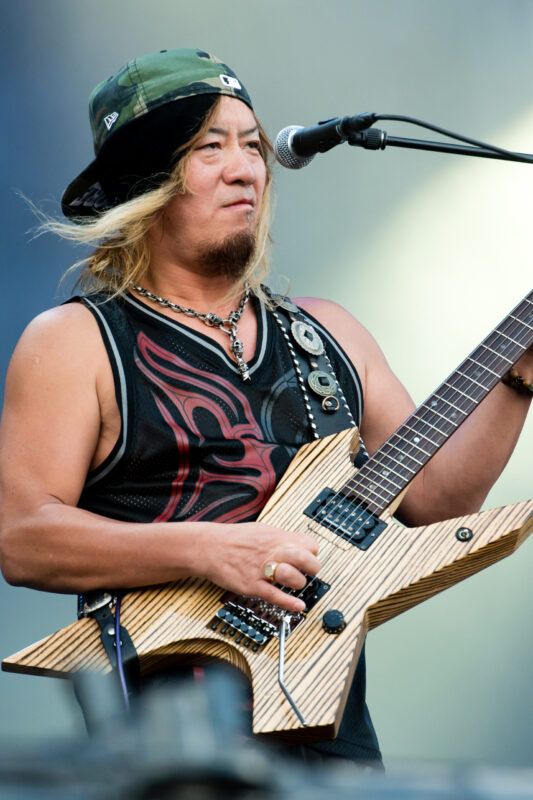
Akira Takasaki’s primary guitar is the ESP Random Star — a custom ESP signature model with a distinctive angular body shape (the “Random Star” design, which resembles a stylized multi-pointed star) associated exclusively with Takasaki. The Equipboard documentation: “Akira Takasaki uses the RANDOM STAR -THE BLACK STAR- guitar by ESP, as highlighted on the ESP Guitars website” and “Akira Takasaki RANDOM STAR TARAKU signature guitar by ESP JP.” The Random Star design is uniquely Takasaki’s — not based on any existing guitar shape but created specifically for his aesthetic and playing requirements. ESP’s custom shop built this as his signature instrument, and it has remained his primary guitar throughout his career with Loudness.
The Random Star’s specific construction: typically mahogany or alder body, through-neck or set-neck construction, with high-output humbuckers (Seymour Duncan, DiMarzio, or ESP/Killer custom pickups depending on the specific model and period). The angular star shape provides a specific visual identity on stage — unmistakably Takasaki, unmistakably Loudness — and the through-neck construction provides the specific sustain and resonance that his tapping and shred approach requires.
The Equipboard documentation: “Takasaki uses ESP Signature Random Star guitars and several Killer guitars, mostly the KG Prime model. He is co-owner of the Killer Guitars label, which are made and distributed by ESP.” The Killer Guitars company — co-founded by Takasaki and his guitar technician Ichizo Araki, distributed through ESP — produces its own line of guitars including the KG-Prime model. Batiksoul Guitar: “The name ‘Killer’ comes from rearranging three Japanese characters from Akira’s first name and his guitar technician Ichizo Araki’s last name.” The Killer brand is both a personal instrument company and a commercial guitar line, with multiple signature models and production guitars distributed through ESP’s network. A Friedman Amplification video documents “Akira Takasaki is seen using the Killer KG-PRIME Signature 2014 guitar while showcasing the Friedman BE-100 amplifier.”
Batiksoul Guitar: “His collection of vintage and custom guitars is also famous.” Beyond the ESP Random Star and Killer KG-Prime primary instruments, Takasaki maintains a documented collection of vintage guitars — specific models not detailed in available sources but described as “famous” within the guitar community. His decades of professional activity at the highest level of Japanese heavy metal have given him both the financial means and the specific knowledge to build a significant vintage collection.
Amps
The Equipboard and Alchetron documentation: “Throughout Loudness’ tenure, he has mostly used Marshall amps, ranging from Lee Jackson-modified Super Leads in the early-mid ’80s.” Lee Jackson — the American amp modifier who built custom-wired Marshall Super Lead modifications for numerous 1980s heavy metal guitarists — modified Takasaki’s Marshall Super Lead heads for the specific requirements of the Thunder in the East era. Lee Jackson modifications typically involved additional gain staging, modified EQ, and enhanced high-gain characteristics that gave the modified Super Leads more of the tight, precise high-gain response that 1980s metal required. The Lee Jackson connection also links Takasaki to the specific network of American metal professionals who endorsed his transition to the US market.
The Equipboard documentation: “Starting in the early 1990s, after the release of Loudness, Takasaki began using the Marshall JMP-1 preamp, which would be the center of his rig ever since, with other amps being along the side.” The Marshall JMP-1 — the rack-mounted tube preamp that appeared in this guide for Michael Weikath and Neal Schon — became Takasaki’s primary amplification platform for the most sustained period of his career. The JMP-1’s specific character: Marshall’s EL34 tube preamp character in a MIDI-controllable rack format, allowing channel switching and precise gain adjustment throughout a live performance.
The Equipboard documentation: “the JCM2000 DSL100, TSL100… in the early-mid 2000s.” The Marshall JCM2000 series — the dual-channel DSL100 and three-channel TSL100 — provided updated Marshall high-gain amplification for the early 2000s period, supplementing or replacing the JMP-1 preamp for specific applications.
The Equipboard documentation: “the JVM410H in the late 2000s, which is currently his main amp.” The Marshall JVM410H — the 100-watt, four-channel, all-valve Marshall with the most extensive channel-switching and gain-staging options in the Marshall production line — is his current primary amplification. The JVM410H’s four channels provide Clean, Crunch, OD1, and OD2 gain stages, covering the full range from clean to extreme high gain within a single amplifier.
The Equipboard documentation: “Modefour MF350 in the early-mid 2000s.” The Marshall Modefour MF350 — a high-gain Marshall head from the 2000s — appears in the documented amplifier history alongside the JCM2000 series for that period.
The Gemtracks documentation: “The Friedman Brown Eye is a classic guitar amplifier head produced by Friedman Amplification.” The Equipboard documentation: “In a video by Friedman Amplification, Akira Takasaki is seen using the Killer KG-PRIME Signature 2014 guitar while showcasing the Friedman BE-100 amplifier.” Both Friedman models — the BE-100 (high-gain, Marshall-influenced) and Brown Eye (modified Marshall-plexi inspired) — appear in his more recent documented amp usage alongside the Marshall JVM410H.
The Akira Takasaki facts documentation: “In 1992, Akira began using Peavey amps, specifically their Supreme 160 heads. These amps can be heard on the Loudness album and the live album Once and for All. Peavey was the last company he endorsed before he went back to using Marshall amps.” A brief Peavey period (1992, one album cycle) before returning to the Marshall-centered approach that has defined the rest of his career.
Effects
The Equipboard documentation: “Guitarist Akira Takasaki uses the CAT’s Factory AT-222 AKIRA TAKASAKI Signature Pedal, as shown on his pedal board in a photo shared by progbusters on Instagram.” The CAT’s Factory AT-222 is a Japanese boutique guitar effects pedal designed in collaboration with Takasaki — “designed to provide a wide range of tonal options, with a range of controls that allow players to shape their sound to their liking” and with “a high-quality and transparent signal path.” CAT’s Factory (a Japanese boutique effects company) produced this signature model for his specific tone-shaping requirements.
Takasaki’s most important “effect” is not a pedal but a technique: the two-handed fretboard tapping approach that he developed and applied to heavy metal lead playing in the early 1980s, before it became universally known through Van Halen’s commercial popularization. Batiksoul Guitar: “His innovative tapping style influenced international guitarists, including Paul Gilbert.” The specific tapping vocabulary he developed — applied to the pentatonic and minor scale patterns of heavy metal lead playing, combined with the speed and precision of his alternate picking approach — created the specific Takasaki lead guitar character that Paul Gilbert and other Shrapnel-era guitarists absorbed.
Alchetron: “His guitar playing style is characterized by complicated heavy metal riffs executed at great speed and with extreme precision, often using alternate picking technique and little vibrato.” The emphasis on “little vibrato” is significant: where many heavy metal guitarists use wide, dramatic vibrato as a primary expressive tool, Takasaki’s approach prioritizes speed and precision over vibrato expression — consistent with the koto influence (koto music uses specific ornamental techniques rather than continuous vibrato) and with the Ritchie Blackmore influence (Blackmore’s specific vibrato is characteristically narrow and precise).
Playing Style & Tone Philosophy
Akira Takasaki’s playing style is the most technically precise in the Japanese heavy metal context — the approach of a guitarist whose specific combination of Blackmore influence (the pentatonic minor scale, the dramatic composition, the fast alternate picking), koto influence (the specific modal melodic vocabulary of Japanese classical music), and the technical innovations he developed (the tapping approach that influenced Paul Gilbert) created a guitar identity that is both internationally comprehensible (heavy metal’s universal language) and specifically Japanese (the koto’s modal vocabulary, the specific melodic contours of traditional Japanese music).
His tone philosophy is the Marshall-centered philosophy that has defined his approach across forty-plus years: the Marshall preamp character (whether from Lee Jackson-modified Super Leads, the JMP-1 rack preamp, or the JVM410H) provides the foundational drive character, with the Friedman amps and the CAT’s Factory signature pedal supplementing and shaping specific aspects of the signal. The consistent Marshall-centered approach across multiple specific Marshall products reflects both brand loyalty and the specific quality that Marshall EL34 tube amplification provides for his playing approach.
How to Sound Like Akira Takasaki
Guitar: ESP Random Star (or Killer KG-Prime) with high-output humbuckers for the foundational Takasaki character. The angular star body and through-neck construction provide the visual identity and the sustained resonance his tapping and shred approach requires.
Amp: Marshall JVM410H (current primary) or Marshall JMP-1 rack preamp + Marshall power amp (classic period). Lee Jackson-modified Marshall Super Lead for the early Thunder in the East character.
Amp Settings (Marshall JVM410H — Loudness Heavy Metal):
| Control | Setting (0–10) | Notes |
|---|---|---|
| Gain (OD2) | 7–8 | High — Takasaki’s precision technique benefits from controlled high gain |
| Bass | 5–6 | Present — the Random Star’s through-neck needs bass support |
| Mid | 6–7 | Forward — melodic precision requires midrange presence |
| Treble | 6–7 | Bright — alternate picking articulation needs treble definition |
| Presence | 6 | Moderate — projects the fast runs clearly through the mix |
Essential approach: Alternate picking technique developed at extreme speed — “complicated heavy metal riffs executed at great speed and with extreme precision.” Two-handed tapping for scalar passages that exceed single-hand range. Little vibrato — precision over expressiveness. Apply the koto’s modal vocabulary alongside the Blackmore pentatonic minor: the unexpected scale choice is often a Japanese-music-inflected interval, not the conventional Western rock interval.
Influence & Legacy
Akira Takasaki’s influence on heavy metal guitar is specifically the influence of the first Japanese heavy metal guitarist to achieve international commercial recognition — the breakthrough that demonstrated that the technical and creative quality of Japanese heavy metal could compete directly with American and British metal at the highest level. His influence on Paul Gilbert’s tapping technique connects the Japanese heavy metal tradition directly to one of the most celebrated technical guitarists in American metal history.
His connection to Jeff Hanneman as a fellow heavy metal guitarist of the same generational moment — both Loudness and Slayer releasing their defining albums in 1985-1986 — reflects the shared historical period. His connection to Mille Petrozza as a fellow heavy metal pioneer of the same era who defined a national extreme metal tradition reflects the shared role as genre-founder for their respective countries (Petrozza for Teutonic thrash, Takasaki for Japanese heavy metal). His connection to Jeff Waters as a fellow highly technical metal guitarist reflects the shared technical-metal tradition.
Frequently Asked Questions: Akira Takasaki Loudness Guitars & Gear
What guitar does Akira Takasaki use?
Takasaki’s primary guitar is the ESP Random Star signature — “a distinctive angular body shape (the ‘Random Star’ design, which resembles a stylized multi-pointed star) associated exclusively with Takasaki.” He also uses Killer KG-Prime guitars from the Killer Guitars company he co-owns with ESP. Batiksoul Guitar: “Several signature models have been released with Killer Guitars and Seymour Duncan.” His vintage guitar collection is also “famous.”
What is the Killer Guitars company?
“Takasaki uses ESP Signature Random Star guitars and several Killer guitars, mostly the KG Prime model. He is co-owner of the Killer Guitars label, which are made and distributed by ESP.” The name “Killer” comes from rearranging three Japanese characters from Akira’s first name and his guitar technician Ichizo Araki’s last name. Killer Guitars produces Takasaki’s signature KG-Prime model alongside a commercial line of guitars distributed through ESP’s international network.
What amplifiers does Akira Takasaki use?
His amp history spans: Lee Jackson-modified Marshall Super Leads (early-mid 1980s, Thunder in the East era), Marshall JMP-1 rack preamp (early 1990s through 2000s — “the center of his rig ever since”), Peavey Supreme 160 (briefly in 1992), JCM2000 DSL100/TSL100 (early-mid 2000s), Modefour MF350, Marshall JVM410H (late 2000s — current primary), Friedman BE-100 and Brown Eye (documented more recently). “Throughout Loudness’ tenure, he has mostly used Marshall amps.”
What were Akira Takasaki’s primary guitar influences?
“In 1986 he declared that the main influences for his compositions and guitar solos came from the work of Deep Purple’s guitarist Ritchie Blackmore and from Japanese music for koto.” He also cited Hideki Ishima. His playing style reflects these dual influences: Blackmore’s pentatonic minor vocabulary and alternate picking precision, and the koto’s specific modal melodic language and approach to ornamentation. His guitar playing style is “characterized by complicated heavy metal riffs executed at great speed and with extreme precision, often using alternate picking technique and little vibrato.”
How did Loudness break into the American market?
Thunder in the East (1985) was produced by Max Norman (who had produced Ozzy Osbourne albums) and distributed on Elektra Records in the United States, with Mike Varney of Shrapnel Records providing specific endorsement. The album peaked at No. 74 on the Billboard 200 — “the first Japanese heavy metal band to chart in the United States.” The band subsequently appeared on American TV programs and toured with American acts, establishing the foundational Japanese heavy metal presence in the American market.
How did Akira Takasaki influence Paul Gilbert?
Batiksoul Guitar: “His innovative tapping style influenced international guitarists, including Paul Gilbert.” Gilbert, who emerged in the mid-1980s with Racer X (on Shrapnel Records), acknowledged Takasaki as an influence on the tapping technique that became central to Gilbert’s vocabulary. The direct line from Takasaki’s early-1980s Japanese recordings — which circulated in the Shrapnel/speed metal tape-trading community before the Thunder in the East commercial breakthrough — to Gilbert’s debut recordings in 1985-1986 is one of the more specifically documented international guitar influence relationships.
How did Akira Takasaki start his music career?
He won a TV talent contest for young musicians at age fourteen. He was subsequently signed to the pop-rock band Lazy, which released five successful albums in the late 1970s. His musical inclinations were toward hard rock and heavy metal, and in 1981 he co-founded Loudness with Lazy drummer Munetaka Higuchi. He is the only original Loudness member to appear on every album across the band’s entire history.