Epiphone Flying V: The Arrow That Blues Fired First — and Metal Never Gave Back
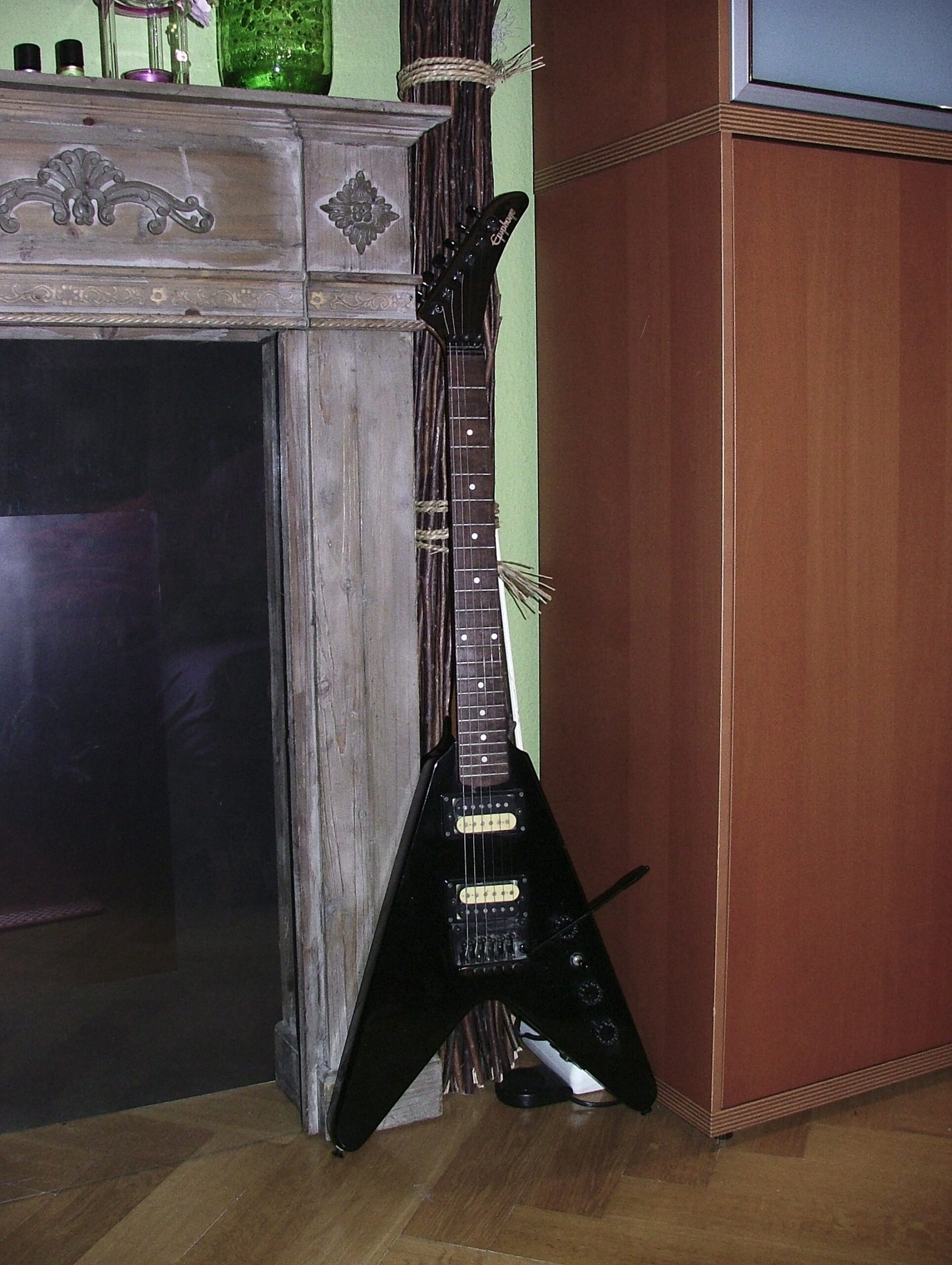
Epiphone Flying V. Photo: Dietmar B, CC BY-SA 3.0, via Wikimedia Commons (File:Epiphone Flying V.JPG).
The Epiphone Flying V story: Albert King's blues weapon, Hendrix's Love Drops V, Kirk Hammett's thrash machine — specs, tones, and buying guide.
Here’s a fun exercise. Close your eyes and picture a Flying V. Who’s holding it? Odds are you conjured someone in leather, mid-windmill, in front of a wall of Marshalls. Fair enough — the V has been heavy metal’s official silhouette for fifty years. But that mental image skips the first and arguably most important chapter of the story. Before the V became metal’s battle axe, it was a bluesman’s secret weapon. Albert King bent strings on one upside-down and left-handed. Lonnie Mack bolted a Bigsby to his and invented an entire vocabulary of whammy-drenched instrumental rock while he was at it. The arrow flew through the blues long before it hit the mosh pit.
The Epiphone Flying V is where that whole tangled inheritance lands today. For roughly $599, the Inspired by Gibson version hands you the 1958 blueprint — mahogany body, string-through V tailpiece, ProBucker humbuckers, CTS electronics — at a price the original’s creators could never have imagined charging. And around that core model, Epiphone has quietly built the most interesting V ecosystem in the business: an official recreation of Jimi Hendrix’s hand-painted “Love Drops” V, a Gibson Custom Shop-designed Kirk Hammett 1979 model, korina versions with genuine Gibson Burstbuckers, and Fishman-loaded Prophecy variants for the modern metal crowd. One shape, six decades of arguments about who it really belongs to.
Now, about the famous players usually listed for this one: Albert King, Michael Schenker, Jimi Hendrix, Lonnie Mack, K.K. Downing. Every single one of those five played Gibson Flying Vs, not Epiphones. It’s a family-level list pasted onto the budget sibling. But there’s a genuinely delicious twist: two of those exact guitars now officially exist as Epiphones. Epiphone, in partnership with Gibson Custom and the Hendrix estate, sells a meticulous recreation of Jimi’s psychedelic Love Drops V. And Kirk Hammett — who isn’t even on the list but should be — has his own Epiphone 1979 Flying V, built to the specs of the guitar that played on Metallica’s first five albums.
1958: The Arrow That Nobody Wanted
If you read our Epiphone Explorer feature, you already know the setup. In 1958, Gibson president Ted McCarty — stung by Fender’s “old-fashioned” jabs — commissioned a trio of radical “Modernistic” guitars built from African limba wood, marketed as korina. The Explorer was one. The Flying V was another. (The third, the Moderne, never made it past the drawing board, becoming guitar mythology’s Loch Ness Monster.)
The V was, if anything, the boldest of the bunch. A guitar shaped like an arrowhead, with a string-through-body tailpiece where the strings pass through a V-shaped metal plate, no waist to rest on your leg, and a headstock that looked like it had been sharpened. Gibson’s salesmen reportedly loved showing it off at trade shows — it drew crowds — and then couldn’t sell it to save their lives. Shipping records suggest fewer than a hundred left the factory in the original run, with leftover parts assembled into a handful more into the early ’60s. Dealers used them as window decorations. The V outsold the Explorer, but that’s like saying you outran a glacier.
By 1959 the model was effectively dead. And this is where the V’s story splits decisively from the Explorer’s — because while the Explorer went into hibernation until the 1976 reissue turned it into a metal machine, the Flying V got adopted. By bluesmen. Almost immediately.
The Blues Years: Lucy, Number 7, and the Wham of That Memphis Man
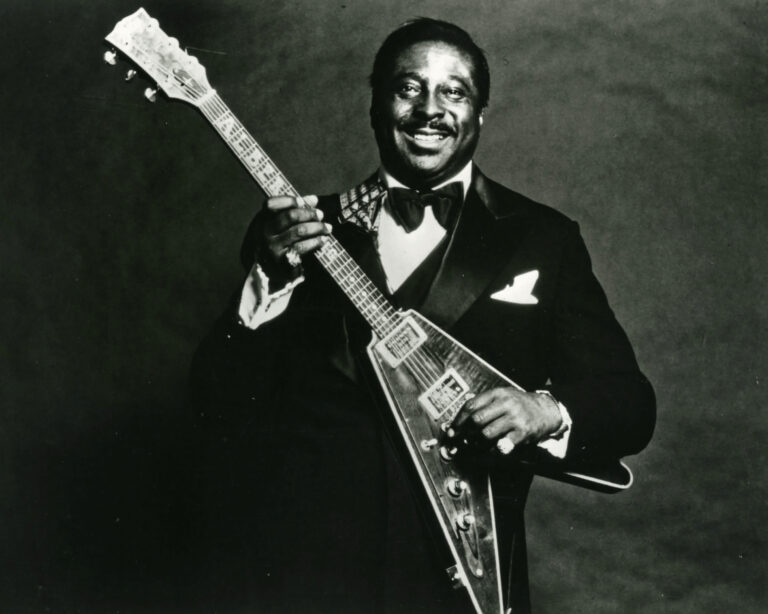
Somewhere in the late 1950s, a left-handed Mississippi-born giant named Albert King got his hands on a 1958 Flying V. He flipped it over, kept the strings in right-handed order (so his treble strings sat on top), named it “Lucy,” and proceeded to build one of the most influential lead guitar styles in history around it. King’s massive, vocal string bends — pulling down on those flipped strings with fingers the size of bratwursts — became the direct source code for Eric Clapton, Stevie Ray Vaughan, and pretty much everyone who’s ever bent a note and held it until the audience made a face. “Born Under a Bad Sign” is a Flying V record. Let that reframe your mental image of the shape.
Meanwhile in Indiana, Lonnie Mack bought the seventh Flying V ever made — literally, he called it “Number 7” — in 1958, when he was a teenager. He had a Bigsby vibrato grafted onto it, which required an extension bar on the V’s tail because the geometry didn’t want to cooperate, and in 1963 he used it to record “Memphis” and “Wham!” — instrumentals so fast, so aggressive, and so drenched in whammy that guitar historians routinely cite them as the missing link between ’50s rock and roll and what would later be called blues rock. Mack played Number 7 for the rest of his life. When people talk about the Flying V’s sustain and midrange snarl, they’re describing sounds Mack found in it while Elvis was still in the Army.
So when the V finally got its 1967 relaunch — mahogany instead of korina, a shrunken headstock, repositioned controls — it wasn’t reviving a failure so much as catching up with a cult. And the most famous member of that cult was about to paint his.
Jimi’s Love Drops — The V’s Psychedelic Chapter
Jimi Hendrix is so completely welded to the Stratocaster in public memory that his Flying V years get treated as a footnote. They shouldn’t be. Hendrix acquired a 1967 Gibson Flying V — one of the new mahogany models — and played it extensively from 1967 through 1969, particularly when he wanted the thicker, darker humbucker voice the Strat couldn’t give him. Slow blues was V territory: live versions of “Red House” and his monumental readings of “Hear My Train A Comin'” frequently featured the V, its neck pickup delivering a fat, singing sustain that let him hold vocal-like notes forever.
And because Jimi was Jimi, he couldn’t leave the guitar stock. Originally sunburst, he had it refinished black, then hand-painted it himself with swirling psychedelic designs — flowers, hearts, curlicues — that fans later dubbed the “Love Drops” graphics. The guitar’s afterlife is a saga of its own: Hendrix gave it to Mick Cox of Eire Apparent, who stripped Jimi’s artwork off entirely, and the anonymous-looking black V knocked around England for years until guitarist Dave Brewis identified it in a Newcastle shop and rescued it from oblivion.
In 2024, Epiphone — working with Gibson Custom and the Hendrix family — released the Epiphone Jimi Hendrix “Love Drops” Flying V, recreating the hand-painted artwork brushstroke by brushstroke. And this is no cosmetic cash-in: it carries genuine Gibson Custombucker pickups, CTS pots, a Mallory tone capacitor, a Switchcraft toggle, a Maestro Vibrola tailpiece, and a 1967-style headstock, and it comes in both right- and left-handed versions — the latter a proper tribute to the man himself. It’s the strongest Hendrix-to-Epiphone connection imaginable: not a vague family association, but his actual guitar, reissued under the Epiphone name with the estate’s blessing.
Then Metal Took the Arrow
The 1970s is when the V’s public image flipped for good. A generation of hard rock and metal players discovered that a guitar shaped like a weapon photographed like one too — and that the mahogany body and humbuckers underneath the theatrics delivered exactly the aggressive midrange their music demanded.
Michael Schenker turned the V into a lead guitar religion. With UFO and later MSG, the German virtuoso — famously playing black-and-white Vs with the wah pedal half-cocked as a tone filter — produced some of the most lyrical hard rock soloing ever recorded. “Rock Bottom” remains a Flying V masterclass. His brother Rudolf Schenker of Scorpions owns Vs by the literal dozen, making the shape a family crest.
K.K. Downing made the V half of Judas Priest’s twin-guitar attack, its pointed silhouette practically a Priest logo in its own right through the British steel years. And in early-’80s San Francisco, a young Kirk Hammett bought a used 1979 Flying V — his first Gibson — because he wanted a fuller sound than his previous guitars could deliver. That guitar ended up on Kill ‘Em All, Ride the Lightning, Master of Puppets, …And Justice for All, and the Black Album, which is about as consequential as a single instrument’s résumé gets in metal. In 2023, Epiphone and the Gibson Custom Shop released the Epiphone Kirk Hammett 1979 Flying V at $1,299 — a fraction of the $15,000 Custom Shop version — with Gibson USA Calibrated T-Type humbuckers, CTS pots, an Orange Drop cap, and Grover spade-button tuners. Alongside James Hetfield‘s Explorer obsession, it means both halves of Metallica’s guitar team have their formative weapons in the Epiphone catalog.
Epiphone’s own V history has its metal signatures too: Jeff Waters of Annihilator ran his Annihilation-V signature through the 2010s, and Robb Flynn of Machine Head fielded a baritone “Love/Death” V with EMGs. The budget arrow has been drawing metal blood under its own name for a long time.
The Epiphone Flying V Today: What $599 Buys
The core model — the one this article orbits — is the Epiphone Flying V from the Inspired by Gibson collection, introduced in 2020. It recreates the 1958 original’s format: the string-through V tailpiece (a detail many V reissues skip in favor of a stopbar), three-knob control layout with two volumes and a master tone, and the big original-style arrow headstock. Epiphone didn’t cheap out where it counts: you get CTS potentiometers, a Graph Tech NuBone nut, and era-appropriate wiring — spec-sheet details that used to be boutique upgrade territory.
Full Specifications — Epiphone Flying V (Inspired by Gibson)
The Wider Epiphone V Family
Beyond the standard model, the current and recent lineup sprawls impressively. The 1958 Korina Flying V steps up to actual korina wood — the same limba the ’58 originals used — with Gibson Burstbucker 2 and 3 pickups, gold hardware, and a hardshell case, landing around $1,299 and earning consistent praise as the closest-to-1958 Epiphone ever built. The Flying V 70s (in finishes like Maui Blue) chases the 1967-and-later mahogany era with an ebony board and pearloid dots. The Flying V Prophecy goes full modern: AAA flame maple veneer, asymmetrical SlimTaper neck, ebony board with block-and-triangle inlays, and Fishman Fluence pickups with push-pull access to three distinct voices — vintage PAF, hot modern, and single-coil shimmer. And the two artist crowns: the Hendrix Love Drops V (~$1,499) and the Kirk Hammett 1979 Flying V ($1,299), both developed with Gibson Custom.
How It Sounds: Midrange with a Point on It
Every V player eventually tries to describe the shape’s sound, and the words that keep coming back are snarl and bloom. The all-mahogany construction pushes a thick, forward midrange — darker than a maple-capped Les Paul Standard, more compressed and vocal than the airy spank of a Stratocaster. The V’s peculiar geometry contributes something real too: with the bridge and tailpiece sitting in that big uninterrupted spread of body wood between the wings, notes have a way of swelling after the pick attack rather than just decaying. That bloom is exactly what Albert King exploited on his held bends and what Schenker rode through every soaring UFO solo.
The ProBucker-2/ProBucker-3 pairing is Epiphone’s proven take on vintage PAF territory — the same set that anchors their Explorer and SG Standard. The bridge ProBucker-3 is slightly overwound, giving crunch rhythm work a bit of extra push without tipping into modern-metal ceramic brightness. The neck ProBucker-2 is the sleeper: warm and clear, it’s the Albert King / Hendrix slow-blues position, and it takes fuzz beautifully. The two-volume layout means you can preset a rhythm and lead balance and swap between them with the toggle — an old trick the ’58 wiring was practically designed for.
Tone Recipes
The Velvet Bulldozer (Albert King)
Neck pickup, tone rolled to about 7. Into a clean-to-edge-of-breakup amp with plenty of headroom — a Fender Deluxe Reverb pushed to where single notes just barely hair over. Play with your fingers, bend everything, and hold the bends longer than feels polite. The V’s sustain does the rest.
Love Drops Slow Blues (Hendrix)
Neck pickup, volume backed to 8, into a cranked amp with a fuzz in front — germanium if you have it. Roll the guitar volume to clean up, dig in to explode. This is “Hear My Train A Comin'” territory: the humbucker thickness giving the fuzz a rounder, woodier core than a Strat would.
Rock Bottom (Schenker)
Bridge pickup into a hot British-voiced amp, with a wah pedal parked halfway as a midrange filter — Schenker’s signature trick. The result is a honking, focused lead voice that cuts through any mix. Add an Ibanez TS9 Tube Screamer with the level high and gain low to tighten the low end for faster runs.
Ride the Lightning (Hammett-era thrash)
Bridge pickup, high-gain amp, Tube Screamer in front as a tightener with gain near zero. Palm-mute hard and keep the tone control wide open. The V’s mahogany midrange is what keeps ’80s thrash rhythm parts sounding thick instead of fizzy.
Epiphone Flying V vs. the Alternatives
Vs. Gibson Flying V: Gibson’s current versions of the V start well north of $1,500 and climb steeply into Custom Shop korina territory. The construction recipe — mahogany body and set neck, 24.75″ scale, Tune-O-Matic — is the same. You’re paying for the headstock, USA pickups, nitro finish, and resale value. Blind through a loud amp, the gap is far smaller than the price suggests, which has been the entire Epiphone thesis since 2020.
Vs. Epiphone Explorer: Its 1958 sibling, one rank below it on our list, shares the ProBucker set and nearly all construction details. The Explorer has more body mass and a correspondingly bigger, thicker low end; the V is a touch more focused and mid-forward, and much easier to reach the top frets on — that lower wing puts nothing at all in your way. Sitting down is the Explorer’s win; every V player either adopts the classical between-the-legs stance or just stands up like the guitar wants.
Vs. Jackson Rhoads / ESP Arrow shapes: The pointy offspring. These are longer-scale (usually 25.5″), thinner-bodied, faster-necked shred machines with hotter pickups. They do modern metal better; they don’t do Albert King at all. The Epiphone V is the one that covers both church and battlefield.
Vs. a Telecaster: An absurd comparison, which is why it’s useful. These are the two poles of solid-body philosophy — one a work bench, one an arrowhead. If you already own something conventional, the V is the most sonically legitimate “second guitar that looks nothing like the first” purchase in the catalog.
Buying Guide: Which V, and What to Check
The standard Inspired by Gibson V (~$599) is the right call for most people reading this. It’s the ’58 format, the pickups are genuinely good, and the CTS/Graph Tech details mean there’s no urgent upgrade path. The 1958 Korina (~$1,299) is for the player who wants the actual 1958 wood and Gibson Burstbuckers — reviewers have consistently rated it among the best-value vintage recreations Epiphone makes. The Prophecy is the pick if your amp channel of choice says “lead” and you want Fishman flexibility. The Hendrix and Hammett models are self-selecting: you know if you’re that person.
Used-market notes: Epiphone V history runs deep and weird — Japanese-made Matsumoku versions from the ’80s, Korean ’90s models, the Jeff Waters and Robb Flynn signatures, even the tiny 19″-scale Flying Vee Wee. The 2020-onward Inspired by Gibson models are the sweet spot for consistency; they show up used around $400–450. On any V, new or used: sight down the neck (the long headstock makes Vs slightly more vulnerable to case knocks), check the wing tips for dings — those points find doorframes like heat-seeking missiles — and confirm the string-through ferrules on the tail plate haven’t been mangled by an over-enthusiastic restring.
Living with a Flying V: Practical Ownership
Let’s address the wings in the room. You cannot play a Flying V seated in the normal way; there is no upper waist to rest on your leg. Your options are the classical position (body between the knees — genuinely comfortable once you commit), a strap while seated, or standing like the guitar was designed for. Some Epiphone Vs have shipped with a rubber grip strip under the treble wing; the current standard model doesn’t, and aftermarket grip pads exist for a few dollars if the slide drives you mad.
Storage and transport need actual thought: the V shape fits no generic rectangular case, so budget for the fitted hardshell or the EpiLite case. Wall hangers work brilliantly (the V hangs like art, which, let’s be honest, is part of why you bought it). Weight is a pleasant surprise — most examples land around 6.5–7.5 pounds, lighter than the average Les Paul, and the body shape balances well on a strap with only mild neck dip. Set-neck repairs cost more than bolt-on swaps, so treat the neck joint kindly, and remember the 24.75″ scale means slinkier feel at any given string gauge — many V players run 10s where they’d run 9s on a Fender scale.
The Verdict: The Whole Argument in One Guitar
The Flying V is the rare design that won two completely different arguments. It proved, via Albert King and Lonnie Mack and Hendrix, that radical looks could serve deeply traditional music. Then it proved, via Schenker and Downing and Hammett, that the same guitar could soundtrack the heaviest music on earth. The Epiphone Flying V hands you both halves of that inheritance for $599 — with the string-through tail, the CTS pots, and the arrow headstock intact — and its family tree now includes official recreations of the exact Vs Hendrix painted and Hammett thrashed. Fair play to the arrow. It always finds its target eventually.
FAQ
Is the Epiphone Flying V good for beginners?
Sonically and playability-wise, yes — the SlimTaper neck and 24.75″ scale are friendly. Practically, the shape makes casual couch practice awkward since it can’t rest on your leg conventionally. If you practice seated a lot, factor that in honestly before buying your first guitar in this shape.
What pickups are in the Epiphone Flying V?
The standard Inspired by Gibson model uses Epiphone’s ProBucker-2 (neck) and ProBucker-3 (bridge) humbuckers with CTS potentiometers. The 1958 Korina version upgrades to Gibson USA Burstbucker 2 and 3; the Kirk Hammett model uses Gibson Calibrated T-Types; the Hendrix Love Drops carries Gibson Custombuckers.
Did Jimi Hendrix really play a Flying V?
Yes — extensively, from 1967 to 1969, especially for slow blues numbers. He hand-painted his 1967 Gibson V with psychedelic “Love Drops” graphics, and Epiphone now sells an official recreation of that exact guitar, developed with Gibson Custom and the Hendrix family, in both right- and left-handed versions.
What’s the difference between the Epiphone Flying V and the Explorer?
Same 1958 korina-series origins, same ProBucker pickups, same scale and construction philosophy. The Explorer’s larger body gives a slightly bigger low end and rests on your leg; the V is more mid-focused, lighter-feeling, and offers completely unobstructed upper-fret access — but must be played standing or classical-style.
Can the Epiphone Flying V handle blues, or is it just a metal guitar?
The V was a blues guitar before it was a metal guitar. Albert King built his entire style on one, and the neck ProBucker-2 into a clean amp is a legitimately great blues voice. The shape’s genre reputation is history and marketing; the sound underneath is classic mahogany-and-humbuckers versatility.
Is the Epiphone Kirk Hammett Flying V worth it over the standard model?
At $1,299 versus $599, you’re paying for Gibson USA pickups, upgraded electronics throughout, Grover spade tuners, a hardshell case, and the ’79-style body and headstock details. It’s genuinely upgraded, not just badged — but the standard model delivers most of the core sound for less than half the money.
Image credits
- Top image: Dietmar B, Wikimedia Commons, CC BY-SA 3.0.
- Albert King: Utopia Records; Distributed by RCA, Wikimedia Commons, Public domain.