Analog Man Mini Chorus: The Small Clone, Rebuilt Right
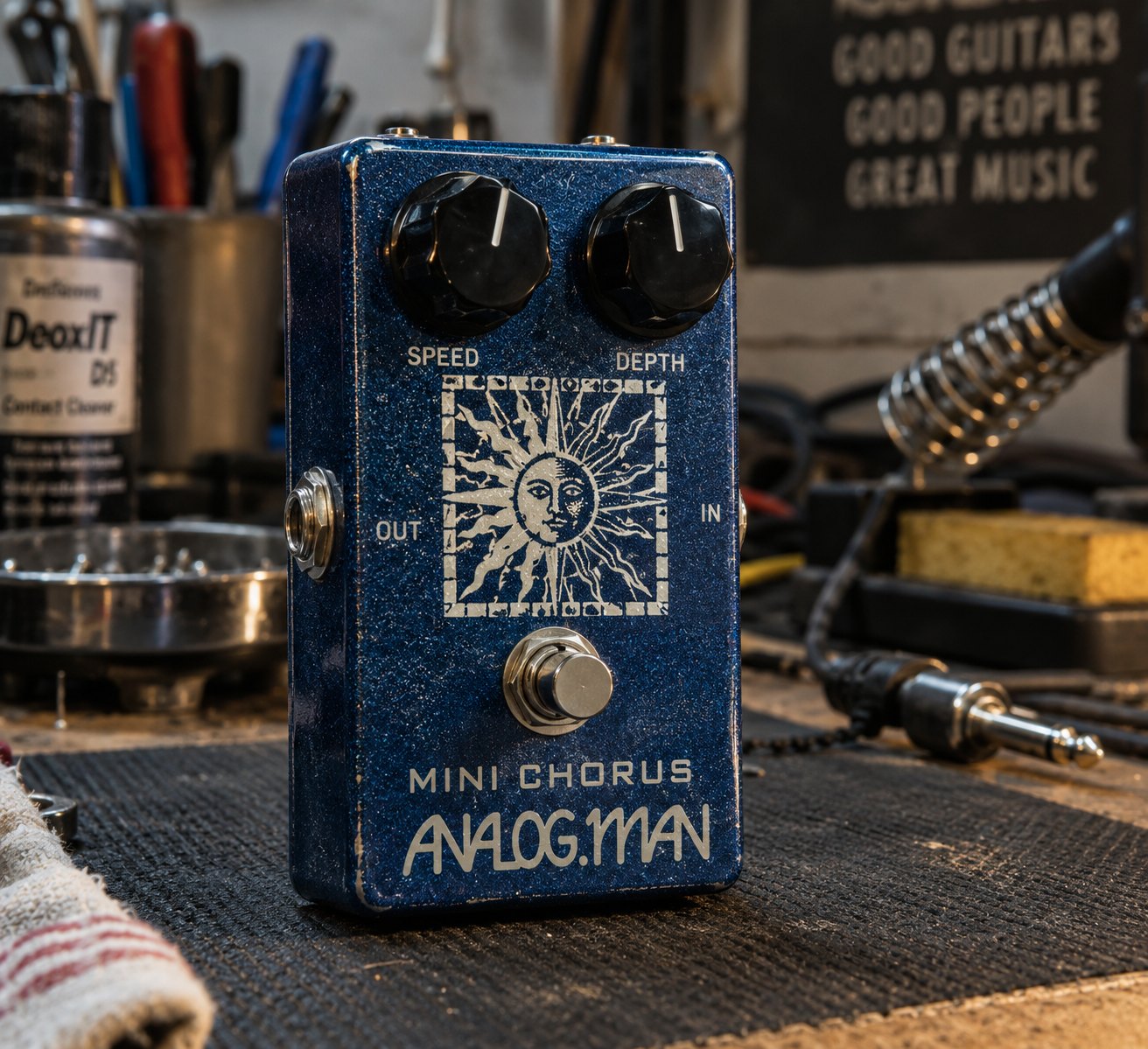
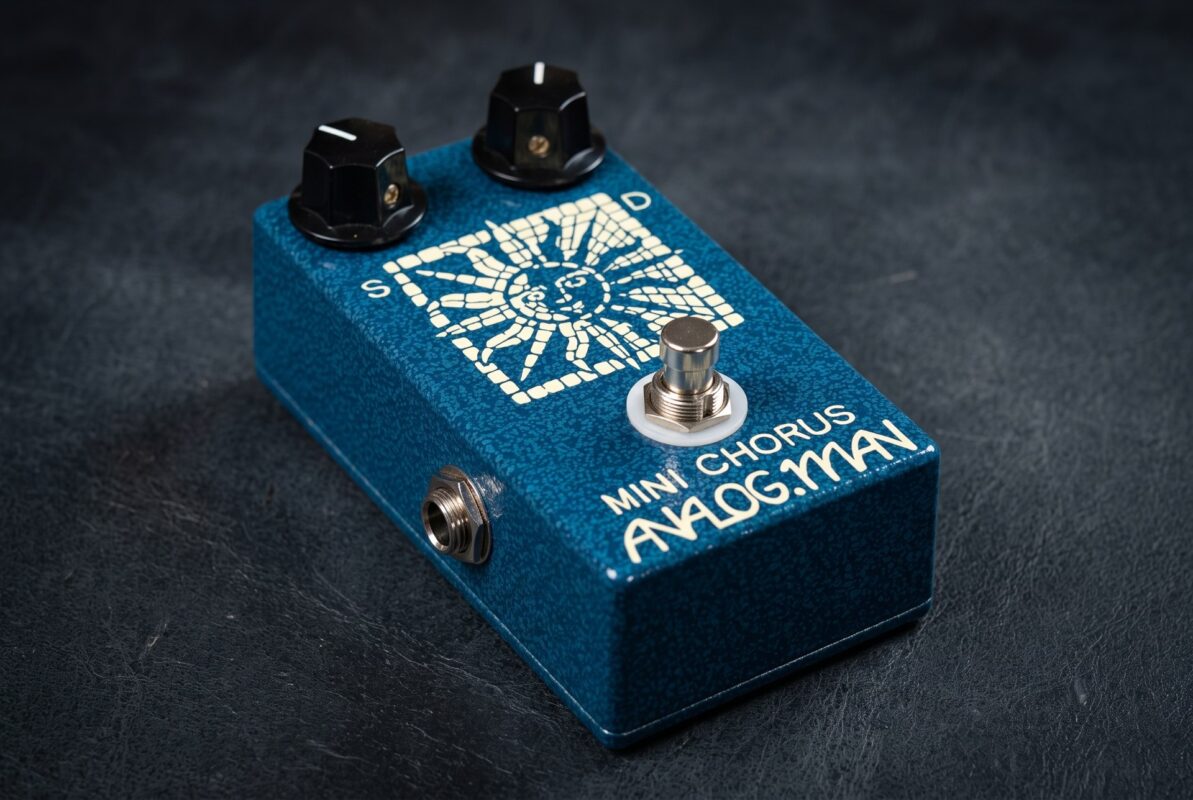
Analog Man Mini Chorus. AI-generated reference illustration, not a photograph.
Analog Man Mini Chorus guide: MN3007 chip, depth toggle and mix options decoded, verified players, Boss CE-2 comparisons and 2026 buying advice.
In 1993, at the Dallas vintage guitar show, a man named Mike Piera sold a mint, boxed Electro-Harmonix Small Clone for $115 and felt good about the transaction. He has been describing that moment as a mistake ever since. Within five years he had reverse-engineered the pedal, discovered that the factory schematic Electro-Harmonix published was wrong, and started building his own version in Bethel, Connecticut. Thirty years on, the Analog Man chorus is arguably the longest continuously refined boutique chorus circuit in existence, and the Mini Chorus is the version most people actually put on a board.
This is not a review. It is the map: where the circuit came from, why the chip inside it costs more than the entire parts list of most overdrive pedals, what the option list actually does to the sound, which players are genuinely documented on a Mini Chorus rather than one of its bigger siblings, and — because the internet has been repeating a very tidy set of names about this pedal for years — which famous chorus tones have nothing to do with it whatsoever.
The Ancestor: A Simple Pedal That Refused To Die
The Electro-Harmonix Small Clone arrived at the end of the 1970s and was, by the standards of what came after it, almost aggressively unsophisticated. Two controls — rate, and a two-position depth switch — feeding a single bucket-brigade delay line. No tone shaping. No mix. No stereo. Nothing between your pickups and the effect except the minimum circuitry required to make chorusing happen at all.
Piera’s own explanation for why it sounds so good is the same argument people make about tweed amps, Les Paul Juniors and the original Fuzz Face: simplicity. There is very little in the signal path to colour or thin the guitar before the modulation gets to work on it. The Small Clone does one thing, and it does it with a fullness that a lot of later, cleverer chorus pedals never recovered.
Electro-Harmonix stopped building it in the mid-1980s when the company collapsed. Analog Man’s own retelling of that collapse is characteristically colourful — it blames organised crime and a Japanese chip cartel — and while the real story of Electro-Harmonix’s mid-decade shutdown is a messier tangle of labour disputes and finances, the practical outcome for guitarists was the same: the pedal stopped existing, and originals became progressively harder to find and progressively more expensive.
They also, inconveniently, were not built to last. Piera has written about customers who tracked down an original while waiting for one of his first batches, only to email back saying the vintage unit had already needed repair. The Small Clone was a great-sounding pedal in a mediocre box.
1998: Dissecting Your Own Collection
In late 1998 Analog Man set out to build a duplicate in a smaller, tougher enclosure. Piera organised the project; electrical engineer and pedal designer Alfonso Hermida helped source the original components and settle the layout. The first batch went out — and immediately exposed a problem that has become one of the better-known pieces of boutique-pedal folklore.
The pedals built strictly to the published Electro-Harmonix schematic sounded weak. So Analog Man took apart his own original Small Clones and compared them component by component against the factory drawing. One part had a value in the real pedals that did not match the paperwork, and that single discrepancy accounted for most of the difference in sound.
Later refinements came from an unusually good source: Howard Davis, the Electro-Harmonix engineer behind several of the company’s most respected designs, consulted for Analog Man on improving the true bypass implementation and creating the stereo option. Between the corrected component value, Davis’s input and a couple of decades of incremental revisions, the pedal stopped being a clone in any meaningful sense. Analog Man says so themselves on their own site — it has been “developed and improved in every new version.”
The functional changes from the original are small in number and large in consequence. True bypass, standard since 2000. A depth knob in place of the original two-position switch, offering any setting from off to full and roughly 25% more depth available than the old switch allowed. Double-sided circuit boards with a ground plane for shielding, plated through-holes, and sockets for the chips. A JRC4558 op amp — the same part Analog Man specifies in its TS9/808 tube screamer mod — instead of a generic 4558.
Why The Chip Is The Whole Argument
Every claim Analog Man makes about this pedal sounding better than the modern competition traces back to one component: a New Old Stock Panasonic MN3007 bucket-brigade delay chip.
A bucket-brigade device is a chain of capacitors that passes an analogue signal along one stage at a time, like a fire brigade passing buckets. The MN3007 is a 1,024-stage device, which puts it in the right delay-time window for chorusing rather than echo. It is the chip that Electro-Harmonix used in the original Small Clone, and the same chip Boss put in the CE-2.

Almost nobody uses it now, because it has not been manufactured for decades. The industry standard replacement is the low-voltage MN3207, or more recently a Chinese-made equivalent — the part inside, among others, the Boss CE-2W Waza Craft and the DC-2W.
The specification difference is not marketing. Both chips are rated for a maximum 2.5% total harmonic distortion, but at very different input levels: 0.78V RMS for the MN3007 against 0.25V RMS for the MN3207. The 3007 will therefore swallow a signal roughly three times hotter before it starts misbehaving, which in practice means more headroom, more dynamic range and less noise — particularly if you are hitting the chorus with a boost, a hot humbucker or an overdrive already turned up.
Analog Man buys the chips whenever they surface and reports hundreds in stock. It is also the reason for the price: the delay chip alone costs more than the complete electronic parts list of most boutique overdrives.
2005: The Mini Arrives
In January 2005 Analog Man launched two new chorus pedals within about a week of each other. The Bi-Chorus, with two switchable sets of speed and depth knobs, got most of the attention. The Mini Chorus, which came out first, quietly became the version that sold.
The proposition is simple to the point of being unromantic: it is the same circuit board, in a smaller, hand-stamped box. Not a reduced version, not a simplified version, not a surface-mount redesign — the same board, the same chips, the same sound as the full-size Standard Chorus, in an enclosure the size of Analog Man’s small CompROSSor: 2.5 inches wide, 4.75 inches long and 1.5 inches tall, excluding jacks, knobs and switch. The Standard, by comparison, is a Hammond BB box measuring roughly 4 by 5 by 2 inches with everything attached.
It does not save money. Analog Man is explicit that the smaller box is cheaper but the extra labour needed to fit the circuit into it more than eats the saving, which is why the Mini has historically been priced identically to the Standard. What it saves is pedalboard real estate, and for a pedal that will spend most of its life switched on for a handful of songs, that is the trade most players are actually making.
The Mini has picked up options steadily. Top jacks became available in 2015, with metal jacks and nuts on both the top- and side-jack versions. A stereo option arrived in 2019 — side jacks only, with no room left inside for a battery. In late 2022 the enclosure was repainted in a deeper blue with white graphics, replacing the older hammertone finish. An LED is standard.
One warning that belongs early rather than buried: the bottom plate of the Mini has the circuit attached to it. Analog Man themselves recommend the Standard or Bi-Chorus if you intend to run on batteries, because you have to be careful every time you open the Mini up to swap one. Power it from a supply and the point becomes moot.
Specifications
A note on the price figure
Analog Man builds to order, does not publish a fixed retail price on the information page, and adjusts pricing over time. Published figures from the last few years cluster between $225 and $250 for a base Mini Chorus, with the Mix knob and the Depth toggle each adding $25 at the time of ordering — considerably less than the $50 Analog Man charges to retrofit the toggle to an existing pedal. Treat any single number you read, including this one, as a snapshot rather than a quote.
The Option List, And What It Actually Does
Analog Man describes itself as, in effect, a custom shop, and the chorus range bears that out: at various points the company has advertised somewhere between eighteen and twenty-plus distinct chorus configurations once every option is counted. Three of them matter enough to think hard about before ordering.

The Depth toggle
This is the option most reviewers push you toward, and it is not simply a stronger version of the depth knob. The three-position toggle changes the delay time, not the modulation depth. The DEEP position lengthens the delay, which thickens the chorus at every setting and shifts the frequency content of the effect downward, enhancing low end. The middle position is always THIN: a shorter delay, less low end, marginally less analogue hiss, and a lighter, slightly flanger-adjacent character that Analog Man compares to a TC Electronic chorus. The third position is NORMAL, identical to a standard pedal with no extra noise or tonal change.
If you never intend to use the toggle, Analog Man will set the pedal to a fixed DEEP or fixed THIN configuration at no charge. That free option is easy to miss and worth knowing about — although, as the Delicious Audio review put it, without having tried both it is genuinely hard to guess which you will prefer, which is an argument for paying the $25 and keeping the choice.
The Mix knob
A Mix (blend) trimpot is inside every pedal; the knob version simply brings it out to the top. It sweeps roughly 25% to 75% wet against the stock 50/50, with a detent at 12 o’clock so you can find the standard setting by feel. Turned up, you approach a vibrato-ish sound, though without waveform control you are not really getting what a dedicated Boss VB-2W gives you. Turned down, it becomes something more interesting: a thickening, faintly doubled clean boost that fattens the signal without announcing itself as chorus at all.
Two practical caveats. Mix affects the mono output only; the stereo output is unaffected. And moving the trimpot far from centre makes the pedal louder, which is a real consideration if you are switching it in and out mid-song.
Stereo
The stereo option came about because Eric Johnson asked for it. Analog Man built prototype number one for him, and it stayed. On the Mini it has been available since 2019, side jacks only, no battery space.
Analog Man’s implementation is true stereo: both outputs are chorused, rather than the common cheat of sending dry out of one jack and wet out of the other. That has a consequence worth understanding before you commit. Because both sides are effected out of phase with one another, a stereo recording summed back to mono will lose the chorus almost entirely — exactly as it does with a Boss CE-3, an Ibanez CS-9 or most other true-stereo choruses. Analog Man also notes that the top output on a stereo unit is sonically identical to the standard mono pedal, so there is no penalty to ordering stereo and running mono; the second output is slightly thicker and more heavily effected.
Expression control, and the pedal that became a wah
An expression jack for speed is available. It needs a 1 megohm controller, so a standard expression pedal will not work; Analog Man supplies a compatible metal Cry Baby-style controller for the purpose. The company has also built the chorus circuit into a wah shell — the Foot Chorus — with the rocker controlling speed and depth on a side-mounted knob. It is the kind of thing a two-room shop can do and a factory cannot.
Famous Players: What Actually Checks Out
This SKU comes with a persistent and very tidy list of famous names attached to it, and almost none of it survives contact with a source. Here is the sorted version.
Documented on a Mini Chorus specifically
Steve Rothery (Marillion) is the strongest case, and unusually he is documented in his own words. In a Premier Guitar feature he ran through his front-end stompboxes: “a Prince of Tone or King of Tone, Jester Overdrive, Analog Man Mini-Chorus, Keeley tremolo, and an Electro-Harmonix POG and Pitch Fork,” all in front of a GigRig G2. Analog Man’s own page adds that Rothery used the Mini Chorus for most of the Leslie-type sounds on his solo album The Ghosts of Pripyat and on a Marillion record of the same era, and that he also owns a Bi-Chorus. One correction: Analog Man’s page dates that solo album to 2016. It was released on 21 September 2014. The pedal claim stands; the year does not.
Lenny Kravitz has owned several of the two-knob Mini Chorus pedals, in live use from around 2008 onward. This is corroborated outside Analog Man’s own marketing: a Licklibrary rig video in which Kravitz’s guitar tech Alex Alvarez walks through the V Festival touring setup includes the Mini Chorus. Kravitz’s longtime guitarist Craig Ross had one of them in his rack, and has separately been filmed using a Mini Chorus in studio footage.
Vinnie Moore bought a Mini Chorus to take on tour with UFO in 2012 — a slightly startling entry on a list otherwise dominated by clean-tone players, and a reminder that the pedal’s headroom advantage exists precisely for people running it after gain.
Paul Waaktaar-Savoy of a-ha has the pedal visible in an Instagram post of his own setup. Peter Huss of the Swedish band Shining has posted about it as one of his favourite pedals. Neither is a household name in gear circles; both are photographically documented, which is more than can be said for the names in the next section.
Two bass players belong here too. Chris Maresh, who plays bass with Eric Johnson, ordered a Mini Chorus with the Mix knob and the DEEP option in late 2011, and Analog Man reports that specification became the most popular build among bassists. Lee Pomeroy picked up a Mini Chorus in 2017 while touring with Yes, running it in his amp’s effects loop with a Rickenbacker for Chris Squire-style tones.
Analog Man chorus users — but not necessarily the Mini
A much longer list of players uses an Analog Man chorus. The distinction matters, because the Standard, the Bi-Chorus and the Mini share a circuit but not a feature set, and a player who specifically chose a Bi-Chorus did so to get two switchable presets.
Tony Iommi has an older light-blue Analog Man chorus on his studio pedalboard and listed it among the gear used on Black Sabbath’s 2005 Fused project. Guthrie Govan has used the chorus for years and gave it two of its better press quotes, telling Premier Guitar in March 2010 that turning the speed up yields “this nice Leslie effect” and that too much depth gets you into John Scofield territory, and telling Guitar Player in July 2011 that the pedal does not rob the signal of low end. Neither quote specifies which model.
Kenny Wayne Shepherd has had one on his board since 2001, used it extensively on a 2004 blues documentary shoot, and added a Bi-Chorus in late 2007 when he wanted a slow chorus alongside his Leslie sounds. Brad Whitford used an Analog Man chorus on Aerosmith’s 2003 tour. Lee Ranaldo ran a Bi-Chorus in Sonic Youth in 2006 alongside his King of Tone. Andy Powell of Wishbone Ash has toured a stereo Chorus since 2003 — and is the reason the relay-based stereo switching option exists at all, having destroyed enough 4PDT switches to force a redesign. Mick Box of Uriah Heep took delivery of a Bi-Chorus in 2012. Dan Spitz of Anthrax got one in late 2005 and has been quoted at some length about not intending to ever remove it. Mick Jones of Foreigner uses the chorus pedals, and Reeves Gabrels added a stereo Bi-Chorus to his board with The Cure in 2023, writing to Analog Man that he had never realised how good chorus could sound with overdrive.
Also on the family list: Richard Williams of Kansas, James Bay, Al Schnier of moe., John Wesley, Jared Scharff of the Saturday Night Live band, Wolf Hoffmann of Accept, Pat Travers and Lloyd Cole. Treat all of these as Analog Man chorus users of unspecified model unless you find a photograph.
The names that do not belong here at all
Search results and product listings routinely attach Kurt Cobain, Andy Summers, Prince, John Frusciante and Robert Smith to this pedal. None of them used it, and in most cases they could not have — Cobain died in 1994, four years before Analog Man built its first chorus, and eleven years before the Mini existed.

The Cobain association is real but indirect, and it is worth stating precisely because it is the honest version of the story. Cobain bought an Electro-Harmonix Small Clone from Guitar Maniacs in Tacoma around 1990 and eventually owned five of them. It is the watery pulse under the verses of “Come As You Are,” the pre-chorus of “Smells Like Teen Spirit” and “Lithium,” sitting after a Boss DS-1 in a chain that was otherwise almost comically short. That is the ancestor circuit — the pedal Analog Man dissected — not this one. Guthrie Govan’s own description of the Analog Man chorus as “modeled on a Kurt Cobain kind of chorus” is exactly the right level of claim.
The others are simply the standard roster of famous chorus users, transplanted. Summers’s Police-era swirl came from a Boss CE-1 and an Electric Mistress; Robert Smith’s from the Mistress and Boss chorus units; Prince’s and Frusciante’s from period Boss and Electro-Harmonix boxes. The nearest thing to a genuine Cure connection is Reeves Gabrels bringing a Bi-Chorus into the band’s rig in 2023, which is a different pedal, a different decade and a different guitarist.

Tone Recipes
Leslie simulation
Speed: 3 to 4 o’clock. Depth: 12 to 1 o’clock. Mix (if fitted): centre. Toggle: NORMAL. High speed with moderate depth is the setting that fools people into thinking there is a rotating speaker in the room. This is the Rothery Ghosts of Pripyat territory and, per Analog Man’s own demo notes, close to the SRV-flavoured Leslie sample on their site, which uses speed around 4 o’clock and depth around 1. Best into a clean or edge-of-breakup amp with the chorus last in the chain.
Thick 1980s chorus
Speed: 8 to 10 o’clock. Depth: 2 to 4 o’clock. Toggle: DEEP. Slow and deep is the lush, shimmering setting the Small Clone lineage is famous for. On a Strat neck pickup through a blackface-voiced amp it is arpeggio music by default. Push the depth to maximum with DEEP engaged and higher speeds and you get into deliberately seasick, warbling territory that is more of an effect than a sweetener.
The one you only notice when it’s off
Speed: 9 to 10 o’clock. Depth: 11 to 12 o’clock. Analog Man’s third recommendation and probably the most useful of the three for anyone playing in a band. Medium depth, low speed: it fills out the sound without ever sounding like a chorus pedal, and the only way to hear what it is contributing is to switch it off mid-song. If you buy this pedal and only ever use one setting, statistically this will be it.
Fattening boost (Mix knob required)
Mix: 9 to 10 o’clock. Depth: 1 o’clock. Speed: to taste. With the blend down low, the chorus stops being modulation and becomes a doubling thickener with a slight volume lift. Excellent under a solo where full chorus would smear the attack.
Chorus into gain
Place the chorus after your dirt pedals, not before — Analog Man’s own recommendation. If your distortion comes from the amp rather than pedals, the chorus belongs in the effects loop, assuming the loop has send and return level controls. Loops without them are usually voiced for line-level rack gear and will not treat a stompbox kindly. This is the scenario where the MN3007’s extra headroom earns its keep: a hot, saturated signal into an MN3207-based chorus is exactly the condition under which the cheaper chip starts to compress and hiss.
Bass
Depth: higher than you think. Toggle: DEEP or fixed deep. Chorus is a weaker effect on bass, so the depth needs winding up, particularly at slow speeds. The DEEP option is Analog Man’s standing recommendation for bassists, and the Mix knob plus DEEP combination is what both Chris Maresh and most other bass customers order. High speed on bass gives a convincing Leslie or vibrato character.
Two knobs makes this a fast pedal to learn. Analog Man’s own two favourite settings are the obvious starting points, and both are good.
How It Compares
Versus the Electro-Harmonix Small Clone family
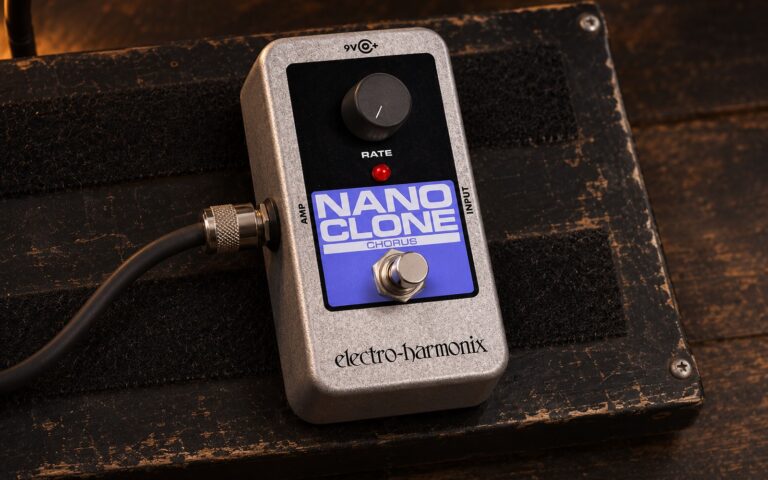
The Small Clone is the ancestor and is still made, along with the Nano Clone and Neo Clone variants, at a fraction of the price. What you give up relative to the Analog Man is the corrected component value, the high-voltage chip, true bypass, the continuously variable depth control and the build quality. What you gain is roughly $180. If you want the Cobain sound specifically and are not fussy about noise floor or bypass, the cheap route is a legitimate route.
Versus the Boss CE-2 and CE-2W
The original CE-2 uses the same MN3007 chip and is the other 1979-vintage benchmark everything gets measured against. Analog Man’s stated goal was never to make something new but to improve on that class of pedal, and the fairest summary of the result is that the Analog Man is fuller and richer, and whether that is better or merely different is a matter for your own ears. The CE-2W is the modern reissue and is an excellent pedal, but it uses the newer MN3207 and has no mix control — which, per the reviews, is a specific reason people go looking for the Analog Man in the first place.
Versus the Boss CH-1 and DC-2W
The CH-1 Super Chorus is brighter, more modern and considerably cheaper, with an EQ control the Analog Man does not have. The DC-2W Dimension C is a different effect entirely — a fixed, four-button spatial widener rather than an adjustable chorus. If you want something you can set precisely, neither is a substitute.
Versus the MXR M234 Analog Chorus
The M234 is the value proposition in analogue chorus: bucket-brigade, genuinely good, with high and low EQ controls, at around a third of the money. It is also not true bypass in its standard form and does not have the Analog Man’s headroom. For most players the M234 is the sensible purchase and the Mini Chorus is the one you buy after you have owned three other chorus pedals and stopped enjoying them.
Versus a Uni-Vibe
Worth clearing up because the pedals get conflated. A Uni-Vibe-style pedal is a phase shifter — it does not use time delay, and it is the Hendrix and Robin Trower sound. The Analog Man does true time-delay chorusing. Analog Man’s own view is blunt: a Uni-Vibe does not work well as a high-speed Leslie, and its “chorus” is not really chorusing. Different tools. If you want both, you need both.
Within the Analog Man range
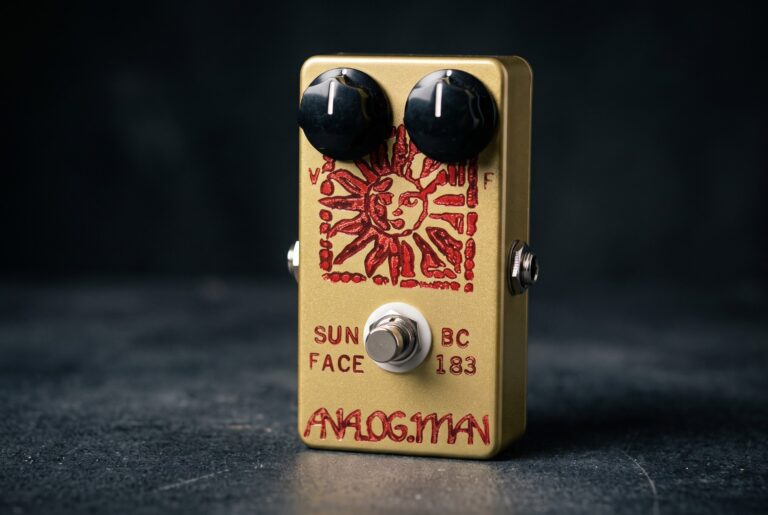
The Standard Chorus is the same circuit in a bigger box with an easier battery compartment. The Bi-Chorus adds an A/B footswitch selecting between two full sets of speed and depth knobs — not a second speed, two complete presets — plus blinking LEDs synced to the chorus rate and a mix trimpot as standard. The Mini exists because pedalboard space is finite. If you have the space and want two presets, the Bi-Chorus is the more capable pedal; if you have the space and want batteries, the Standard is the friendlier one. Elsewhere in the line, the King of Tone, the Prince of Tone and the Sun Face are the boxes this one most often shares a board with — Rothery’s rig, Ranaldo’s rig and Gabrels’s Cure board all pair a chorus with a King or Prince.
Buying Guide: Speccing Your Order
These pedals are built to order in a few days, which means you are not choosing between what is on a shelf; you are filling in a form. Get the form right.
Take the Depth toggle. It is the one option that changes what the pedal can do rather than how conveniently it does it, and at $25 at order time versus $50 to retrofit, the price of guessing wrong is double.
Think hard about the Mix knob. The Delicious Audio reviewer’s verdict — take the toggle, skip the mix unless you specifically want very subtle chorus — is reasonable advice for a guitarist. Bass players should ignore it; Mix plus DEEP is the standard bass build for a reason.
Order stereo if there is any chance you will run two amps. On the Mini it is an order-time decision only, with side jacks and no battery. On a Standard or Bi-Chorus, a later stereo modification is possible on Version 4 boards for around $75; there is no equivalent easy path on the Mini. Note also that pre-2006 pedals are not stereo-upgradeable at all, which matters if you are buying used.
Top jacks or side jacks. Top jacks save horizontal space on a crowded board and tidy the cabling. Side jacks are standard and leave the top clean. Purely ergonomic.
Buying used. Average secondhand transactions run around $244, with listings commonly in the low $200s and up. Check the finish to date the unit: hammertone blue is older, the deep blue with white graphics is late 2022 onward. Check whether the previous owner specified fixed DEEP or fixed THIN, since a pedal with no toggle is not necessarily set to normal. On stereo units, read the part number on the rectangular black relay — a TXS2-9V relay should not be run above 12V, while the 12V version is safe to 18V. And be aware of one documented quality blip: Analog Man has publicly acknowledged that a batch built by an outside contractor roughly a decade ago used machine soldering that did not work out well, and some of those pedals do not sound as good. They are the older, squarer, darker-blue boxes with pointed knobs and no chrome LED bezel.
Living With One
Power. Nine volts works and is what most people use. Analog Man is unusually direct that the chips prefer more: 15 to 16 volts is described as optimal, giving more clean headroom, more clarity and slightly deeper chorusing, with 18V the ceiling on mono pedals. No internal modification is needed to move between voltages. The Line 6 output on a Voodoo Lab Pedal Power 2 sits at about 16V and is a good match, though it is unregulated and can introduce hum in some rigs; the ACA output gives you 12V. Stereo pedals with the 12V relay must not exceed 18V.
Current. Around 7 mA mono, roughly 10 mA stereo. That is tube-screamer territory and means the pedal is a non-issue on any supply, and that an alkaline battery lasts over 70 hours.
Batteries. Covered above and worth repeating: the Mini’s circuit is attached to the bottom plate. Open it carefully or, better, do not open it.
If it distorts. There is an internal bias trimpot, factory set and marked with a black line. It should never need adjusting, but if the pedal starts distorting, the fix is to rotate it to the middle of the range where chorusing is audible. A tired battery is the other common cause.
Longevity. All chips are socketed, which makes the rare failure a five-minute repair rather than a desoldering job. The formal warranty is one year to the original purchaser, but Analog Man states publicly that it will do its best to keep the pedals working indefinitely, including for later owners — which, for a pedal built around a chip that stopped being manufactured decades ago, is the assurance that actually matters.
Frequently Asked Questions
Is the Mini Chorus the same as the standard Analog Man Chorus?
Electronically, yes. Analog Man states plainly that the Mini uses the same board and produces the exact same sounds as the full-size Chorus. The differences are the enclosure size, the awkward battery access on the Mini, and the fact that stereo on the Mini is side-jack only with no battery room.
Did Kurt Cobain use an Analog Man Mini Chorus?
No. He used an Electro-Harmonix Small Clone, the pedal Analog Man later reverse-engineered. Cobain died in 1994; Analog Man’s first chorus was built in late 1998 and the Mini did not appear until 2005. The circuits are related; the players are not.
Why does it cost so much more than a Boss chorus?
The NOS Panasonic MN3007 delay chip. It has been out of production for decades, is bought up wherever it surfaces, and costs more on its own than the complete electronic parts list of most boutique pedals. Everything else — hand assembly in Connecticut, double-sided shielded boards, socketed chips, true bypass — is on top of that.
Should I get the Depth toggle or the Mix knob?
If you can only take one, take the toggle. It changes the delay time, giving you a genuinely thicker DEEP voicing and a lighter, quieter THIN voicing on top of the standard sound. The Mix knob is a refinement of an effect you already have. Bass players are the exception and should take both.
Will it sound better on 18 volts?
It will sound cleaner and slightly deeper, and Analog Man recommends 15 to 16 volts as the optimum for mono pedals, with 18V the maximum. The benefit is most obvious if you are feeding the pedal a loud or already-distorted signal. Do not exceed 18V on any version, and be careful with older stereo units fitted with a 9V relay.
Where does it go in the chain?
After your dirt pedals. If your gain comes from the amp instead, put it in the effects loop — but only if the loop has send and return level controls, since loops without them are voiced for line-level gear.
Is the stereo version worth it?
If you run two amps or record in stereo, yes: it is true stereo, both sides chorused, and the top output is identical to the mono pedal so there is no compromise when you play in mono. The catch is that a true-stereo chorus summed back to mono largely cancels the effect, which is true of the Boss CE-3, the Ibanez CS-9 and most others in this category. Also remember there is no room for a battery.
What if I want two chorus sounds without bending down?
That is precisely what the Bi-Chorus is for: two complete sets of speed and depth knobs selected by footswitch, with the selected side’s LED blinking in time with the rate. It is the same circuit and the same sound, in a full-size MXR-style box. Kenny Wayne Shepherd went that route specifically because he wanted a slow chorus in addition to his high-speed Leslie setting.
Image credits
- Robert Smith: Christopher Johnson, Wikimedia Commons, CC BY-SA 2.0.
- Guthrie Govan: ArtBrom, Wikimedia Commons, CC BY-SA 2.0.
- Kenny Wayne Shepherd: Andreas Lawen (Fotandi), Wikimedia Commons, CC BY-SA 4.0.
- Robert Smith: Bill Ebbesen, Wikimedia Commons, CC BY-SA 3.0.
- Top image: GuitarGangsters AI-generated reference illustration, not a photograph.
- Analog Man Mini Chorus: AI-generated illustration by GuitarGangsters, based on the manufacturer’s product design (not a photograph).
Latest News
Related
On This Day
Tuesday 10 November
From this week: