EarthQuaker Devices Afterneath V3: The Reverb Algorithm Nobody Meant To Write
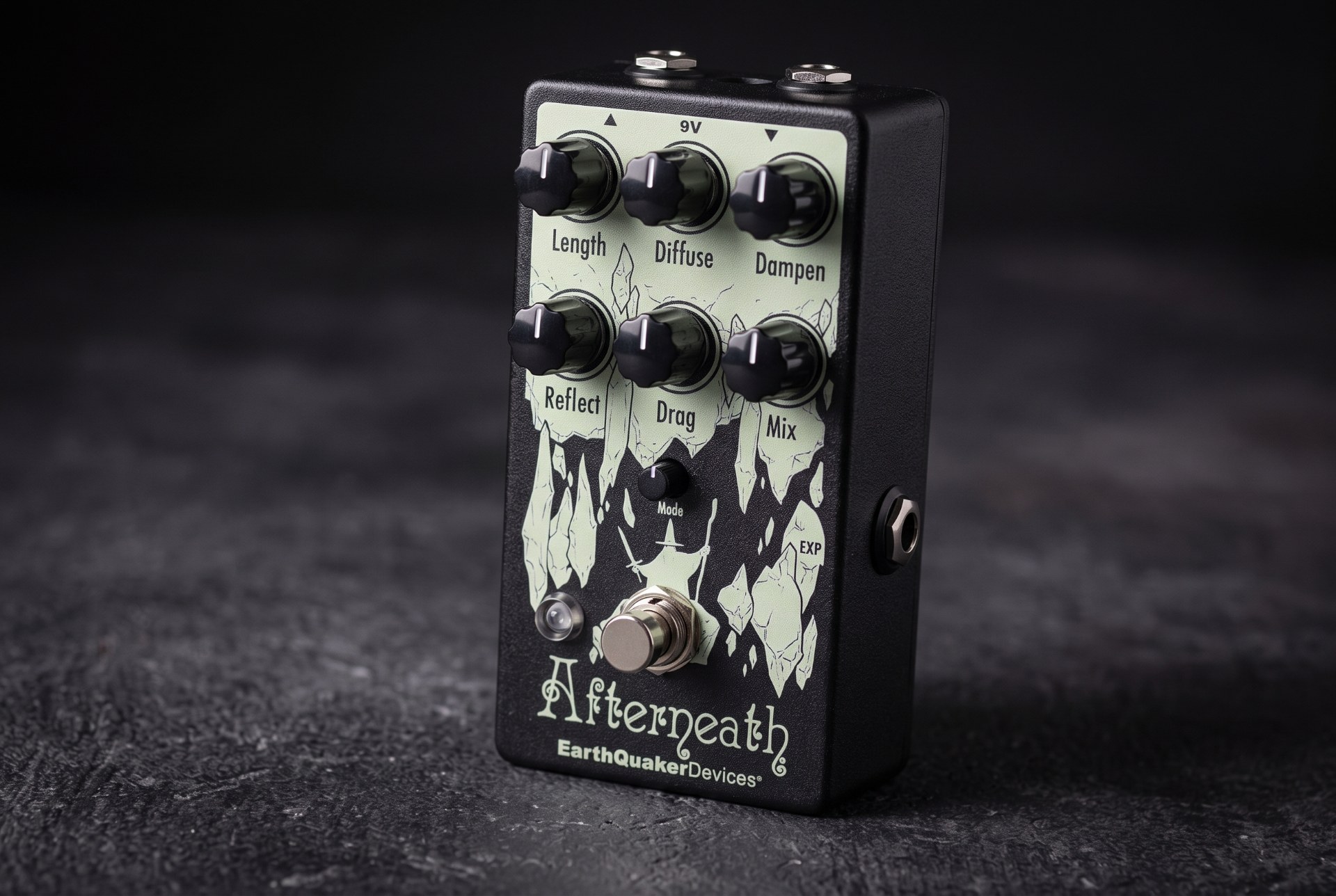
An AI-generated illustration of the EarthQuaker Devices Afterneath V3 Enhanced Otherworldly Reverberator.
EarthQuaker Devices Afterneath V3 guide: the Drag knob explained, all nine modes, V1 vs V2 vs V3, verified players and nine tone recipes.
Most great pedals are the result of somebody chasing a sound they already had in their head. The Afterneath is not one of those pedals. According to EarthQuaker Devices’ own account — told at length in an eighty-minute retrospective film the company released in March 2022 — founder and lead designer Jamie Stillman stumbled onto the algorithm by accident while messing with code that was supposed to be doing something else entirely. He heard what it did, and instead of fixing the mistake he built a pedal around it.
That origin explains almost everything about how the Afterneath behaves. It does not model a spring tank. It does not model a plate or a hall or a room. It does not model anything. It generates a swarm of very short digital delay lines and then hands you a knob that controls how far apart those lines sit in time. Squeeze them together and your ear reads the result as reverb. Pull them apart and the same circuit turns into a scattered, stuttering, ping-ponging delay that no reverb pedal has any business producing. There is no mode switch that does this. It is one continuous sweep between two entirely different effects, and the pedal never tells you where the boundary is.

Twelve years and three versions later it is still in the catalogue, still $199 list at launch price and still one of the two or three pedals people name when they are asked what makes EarthQuaker EarthQuaker. It has been on stages with Chelsea Wolfe, Boris, Converge, Deafheaven, Fu Manchu, My Chemical Romance’s Frank Iero and Wolfgang Van Halen. Steve Albini had one. It has also been mis-attributed to at least one very famous player in ways worth untangling, which we will do below.
This is a feature, not a review. We are not scoring it. What follows is where the Afterneath came from, what its seven controls genuinely do, which players have actually been documented using one and how strong the evidence is in each case, the settings worth stealing straight from EarthQuaker’s own demonstrations, how it stacks up against the reverbs you are probably cross-shopping, and the handful of practical facts that decide whether it belongs on your board.
Akron, 2014: An Accident That Became A Flagship
The EarthQuaker Devices story — Jamie Stillman, a touring musician in Akron, Ohio who put down the guitar and picked up a soldering iron, and the company that grew from a kitchen table into one of America’s largest pedal builders without ever leaving town — is told in full in our feature on the EarthQuaker Devices Hoof Fuzz, and we will not repeat it here. The shape of the dirt catalogue sits in the Acapulco Gold piece, the company’s long argument with the Tube Screamer in the Palisades feature, and its best-loved overdrive in the Westwood one.
What matters for the Afterneath is a narrower thread: EarthQuaker’s relationship with digital signal processing, and how quickly it went from defensive to confident.
When the Dispatch Master launched in 2011, the press release literally had to talk customers down off a ledge — “Even though it is a DSP based effect, the sound is warm and full. No sterile lifeless tones here!” Three years later the Afterneath arrived with no such apology, because it was not trying to sound like anything analogue. It was trying to sound like a cave that was slightly alive. By 2016 the company was building the Avalanche Run on a proprietary DSP platform and had stopped worrying about it altogether.
The Wizard And The Cave
You cannot write about this pedal without mentioning the artwork and the copy, because EarthQuaker made both load-bearing. Matt Horak’s illustration puts a wizard bursting out of an ethereal cavern, and the product page is written as a tabletop role-playing encounter. You are the wizard. Your guitar signal is the cave. “Do you go inside? Roll a D20 to proceed!” The seven controls are described as spells you cast. It is silly, it is committed, and it is also — this is the clever part — an accurate user manual. The Afterneath really does reward the mindset of poking a strange environment to see what it does, and it really does punish the mindset of dialling in a preset and never touching it again.
The narrative also contains the single best one-line description of the circuit that anybody has written, EarthQuaker’s included: the reverberations of your voice in the cave “are in fact a swarm of short digital delays which may be used to create wild and cavernous reverbs, or scattered, short, rhythmic delays with bizarre characteristics.”
V1, V2, V3: The Version Map
Three versions in twelve years, and the differences are not cosmetic. Getting them straight matters if you are buying used, because all three still circulate and the price spread between them is real.
V1 (2014). The original. Six knobs — Length, Diffuse, Dampen, Drag, Reflect, Mix — and a mechanical true-bypass footswitch. No expression jack. No modes. The Drag knob is fixed and unquantized; whatever you set by hand is what you get. This is the version that made the pedal’s reputation, and plenty of long-term owners argue it is still the purest expression of the idea, because there is nothing to think about except the six knobs.
V2 (November 2016). Part of a four-pedal batch update that also covered the Dispatch Master, the Acapulco Gold and the Speaker Cranker. The headline change was EarthQuaker’s soft-touch relay switching, which is silent onstage and enables Flexi-Switch operation — tap once for standard latching on/off, or hold the switch down for as long as you want the effect and it drops out the moment you release. There is a genuine conflict in the contemporary reporting about whether the Afterneath also received top-mounted jacks in this revision. Some coverage at the time described all four pedals as receiving new enclosures and top-mounted input and output jacks; other reporting drawn from the press release describes the top-jack change as applying only to the Dispatch Master and Speaker Cranker, with the Afterneath and Acapulco Gold getting the switching alone. We have not been able to resolve this from primary sources and we are not going to pretend otherwise. If jack placement matters to your board layout, ask the seller for a photo of the sides rather than trusting a version number.
V3 (announced NAMM, 20 January 2020; in stores from mid-April 2020, $199). This is the big one. Three substantive additions:
- An expression/CV input on the side of the enclosure, which takes control of the Drag parameter. It wants a 50k expression pedal — EarthQuaker specifically recommends the Mission Engineering EQD-1 — and it will work with a standard 10k pedal, but you will not get the full sweep of each mode. The jack also accepts control voltage, 0–5V, with tip as wiper, ring at 5V and sleeve at ground.
- The Mode control, a small knob sitting just under Drag, which changes what Drag does across nine settings. More on this below, because it is the thing people misunderstand most.
- Selectable tails / no tails. The pedal ships in tails mode. To switch, hold the footswitch down while inserting the power cable; the LED flashes three times to confirm. That is a trick worth writing on a piece of tape, because nobody remembers it.
There is also a visual tell that makes V3 identifiable from across a room, and it is not just the new graphics: on the V3, the Reflect and Drag knob positions were swapped. If you are trying to date a pedal from a live photo or a Rig Rundown freeze-frame, that swap plus the small Mode knob is the giveaway. Guitar Player’s Christopher Scapelliti reviewed the V3 on 19 May 2020 and gave it a Cons list consisting of the word “None,” which is not something that magazine hands out casually.
The 2022 Retrospective Edition
In March 2022 EarthQuaker put out a limited run of the Afterneath in a brushed-metal “Retrospective” finish, in both pedal and Eurorack formats, alongside the eighty-minute film about how the algorithm came to exist. The Eurorack module — which is a genuinely different device, with a dedicated send and return for the Reflect feedback path, nine controls, four CV-addressable parameters each with its own inverting attenuator, and a dry-kill switch the pedal does not have — carried an RRP of £239 against the pedal’s £199. Keep the module in mind. It becomes relevant when we get to the Thom Yorke question.
Specifications
One Spec Correction Worth Making
You will find the Afterneath V3 described as true bypass in a number of retail listings and aggregator descriptions — including, amusingly, in the same page on one large gear database whose own spec table three paragraphs earlier correctly says “Buffered with Flexi-Switch.” It is not true bypass. EarthQuaker’s own documentation is unambiguous: the pedal uses electronic buffered bypass, the buffer is always active, and it requires power to pass signal at all. Pull the plug mid-set and you do not get your dry tone back — you get silence. That is a normal consequence of relay switching and it is the same on the Dispatch Master and the Avalanche Run, but people are still caught out by it.
What The Seven Controls Actually Do
EarthQuaker’s own house blog once made an observation about the Afterneath that no other pedal in the line gets: the sonic possibilities are so open-ended that the company does not print suggested settings in the manual, which it normally does. You are expected to carve your own path. That is charming, and it is also the single biggest reason people bounce off this pedal in the first week. So here is the map.
Drag: The Only Knob That Matters Until It Isn’t
Drag controls the amount of separation between the individual delay lines. That is the whole trick. Fully clockwise, the lines bunch tightly together and your ear integrates them into something it recognises as reverb. Counter-clockwise, they pull apart, and at the extreme you get an odd, short, stuttering, ping-pong delay — rhythmic, articulate and completely unlike any reverb tail.
What makes it feel alive rather than merely adjustable is that turning Drag in real time drags the signal itself, in the same way the varispeed knob on a tape machine bends whatever is already on the tape. It is not a parameter change applied to future repeats. It warps what is already sounding. This is why the V3’s expression input is a bigger deal than a spec-sheet line suggests: it puts that warp under your foot.
If you are new to the pedal, do this before anything else. Set Length and Reflect around 10 o’clock, Diffuse at noon, Dampen at noon, Mix at 11 o’clock. Play one chord. Now sweep Drag slowly from full counter-clockwise to full clockwise and listen to the effect change species. Everything else on the pedal is a modifier of that one journey.
The Nine Modes, And The Thing People Get Wrong About Them
The Mode knob does not add nine reverb algorithms. It changes how Drag responds — and, crucially, it is mostly aimed at what happens when Drag is being swept by an expression pedal or a control voltage. The LED changes colour so you know where you are.
- 1. Unquantized — smooth, stepless response across the range. The V1/V2 behaviour.
- 2. Unquantized with slew — the same, but with a musical lag. Drag trails behind the knob or CV change and then catches up, exactly like riding the varispeed on a vintage British tape delay. For many players this is the mode that sells the pedal.
- 3. Unquantized volt/octave — stepless but scaled to the 1V/octave curve, so you can play melodic material with the buffer contents or treat self-oscillation like a voltage-controlled oscillator.
- 4. Chromatic scale — quantized to chromatic. Bell-like stepped sweeps.
- 5. Minor scale
- 6. Major scale (Lydian)
- 7. Pentatonic scale — modes 5 to 7 tune the delays and reverb to the named scale as you sweep. Guitar Player found these “fantastic for making tuneful, synthesizer-like arpeggiations out of the delays.”
- 8. Octaves & Fifths — everything but octaves and fifths is omitted. The most consonant of the quantized options.
- 9. Octaves — octaves only. The safest mode for building drones, and the one EarthQuaker’s own ambient demonstration uses.
The honest caveat, and it appears in owner discussions constantly: without an expression pedal or a CV source, the Mode knob’s practical impact is limited. It still changes the tonality of the other controls somewhat, and modes 8 and 9 will subtly re-pitch the tails even with Drag static. But if you buy a V3 over a V2 purely for the modes and then never plug anything into the expression jack, you have paid for a feature you are not using. That is not a knock on the pedal. It is a purchasing decision you should make with your eyes open.
Length
Decay time, from a short room to an effectively endless plate. EarthQuaker’s own guidance is blunt about the trap here: if you are setting and forgetting, do not make Length too long, because the accumulating reverberations turn into a heavy ringing tone. And if what you are playing is polyphonic, busy and mid-tempo or faster, those reverberations gather fast.
Diffuse
The spread of the reverb — how sharp or soft the individual reflections are. Counter-clockwise gives you attack, definition and a stuttering sputter of distinct early reflections. Clockwise smears them into wash. Think of it as focus, not tone.
Dampen
A tone control that runs backwards from what your hand expects. Counter-clockwise is brighter; clockwise is darker. The physical metaphor EarthQuaker uses is the hardness of the cavern walls. In practice, if the Afterneath sounds metallic and clangy to you, your instinct will be to turn Dampen down, and that will make it worse. Turn it up. Around noon takes off the worst of the high-end glare without killing the shimmer.
Reflect
Feedback and regeneration — the depth of the cave. Clockwise adds echoes and wash, and at the far end the pedal self-oscillates into a drone. Length and Reflect interact multiplicatively rather than additively, and this is where people accidentally make unpleasant noise. EarthQuaker’s own advice: watch how the two behave together, because if either is set high the other will tip you into ringing that most listeners hate.
Mix
Wet/dry balance, with an important asymmetry: the Afterneath does not go fully wet. Instead, as you raise Mix, it progressively lowers the level of the dry input signal to create the appearance of a fully wet reverb. For guitar this is almost always what you want. For anyone trying to use it as a pure send effect in a studio chain it is a genuine limitation, and it is why the Eurorack module got an explicit dry-kill switch that the pedal does not have.
Famous Players: What Holds Up, And What Doesn’t
The Afterneath has one of the better-documented user lists in the EarthQuaker catalogue, largely because EQD themselves have been filming players for a decade and tagging the footage by pedal. We have separated the evidence into tiers, because they are not equally strong, and we have flagged the ones that fall apart.
Tier One: On Camera Or On The Record, With The Player’s Own Words
Frank Iero (My Chemical Romance, Leathermouth, L.S. Dunes) is the strongest single testimonial the pedal has, because he named it, named its partner and explained why. In a statement carried by EarthQuaker: “EarthQuaker effects are a creators’ pedal company, the nuance and attention to detail really puts you in control of the effects as opposed to the other way around. I have Plumes and Afterneath on my board at every show. I love how they play off of each other. I really love gear that inspires, and I can write a new riff or song every time I put an EarthQuaker effect in my chain.” That Afterneath-plus-Plumes pairing is worth noting — a transparent-ish overdrive feeding an unpredictable reverb is a very different proposition from stacking two weird pedals, and it is a large part of why the Afterneath works in a punk context at all.
Carmen Vandenberg (BONES UK) demonstrated the pedal on camera in EarthQuaker’s own Board To Death series, discussing her evolving board and citing the Afterneath specifically for its otherworldly reverb.
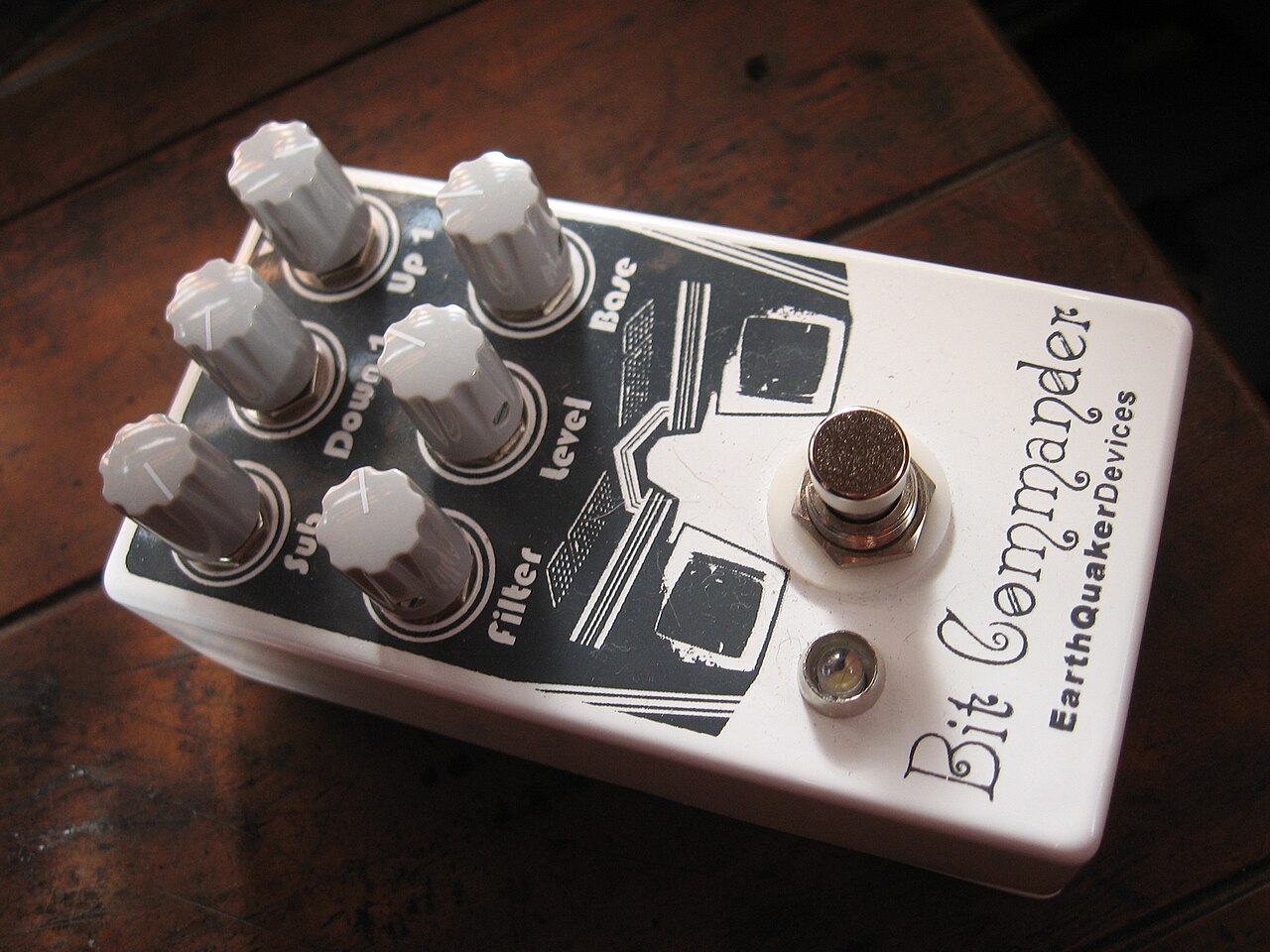
Takeshi (Boris) appeared in Board To Death Ep. 17, 16 August 2018, with a board EQD described as “stuffed to capacity with boutique fuzz pedals, one-off noisemakers, Afterneath, Bit Commander, and Palisades,” running into a wall of Sunn and Orange amplifiers. Boris are close to an ideal use case: enormous, slow, tonally maximalist music where a reverb that behaves erratically is a feature.
Justin Pearson and Joey Karam (the Locust, Dead Cross, Retox, Head Wound City, One Day As A Lion) in Board To Death Ep. 16, 2 August 2018, with the Afterneath alongside a Bit Commander, Bellows and Rainbow Machine. Pearson’s line in that piece — “It’s not musical and I like that” — is arguably the Afterneath’s mission statement.
Chelsea Wolfe, filmed at the Sargent House compound in Los Angeles for the EarthQuaker Session on “Survive,” published 2 February 2017, with the Afterneath among Speaker Cranker, Talons, Organizer and Abyss.
Kurt Ballou (Converge, GodCity Studio), in EQD’s Studio Series feature of 16 December 2016. Ballou’s studio has produced records for High On Fire, Helms Alee, Skeletonwitch, the Dillinger Escape Plan and Torche, which means the Afterneath has almost certainly ended up on more heavy records than its user list suggests.
Anthony Pirog (the Messthetics), interviewed by EarthQuaker on 5 May 2018. The Messthetics pair Pirog’s jazz-inflected virtuosity with Fugazi’s rhythm section — Joe Lally and Brendan Canty — and the Afterneath appears in a context that is improvisational rather than textural, which is unusual for this pedal and worth seeking out.
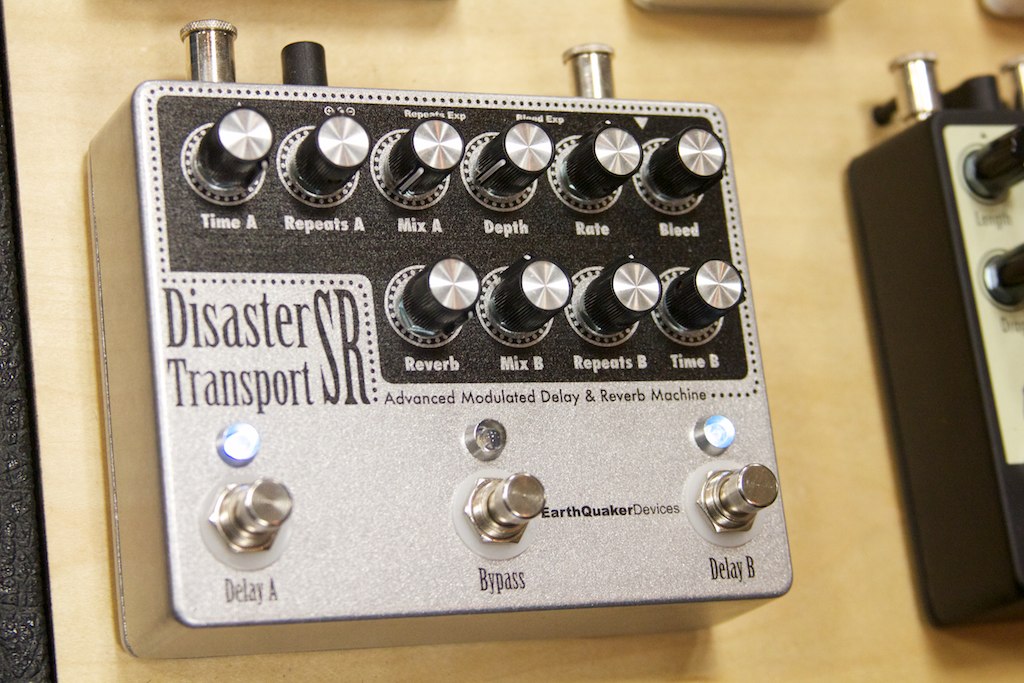
Whitney Petty (Thunderpussy), in EQD’s September 2017 interview, using the Afterneath alongside a Disaster Transport SR, Acapulco Gold, Organizer and Terminal. Petty counts Pearl Jam’s Mike McCready as a documented supporter of the band, and started out playing with Deerhunter.
Jonathan Nuñez (Torche), in EQD’s Roadie’s Corner of 22 July 2019, discussing the board behind Admission — Afterneath alongside Arpanoid, Avalanche Run, Disaster Transport SR and Space Spiral. Torche are a bass-forward band and Nuñez runs his own amp company, which makes his endorsement a useful data point for anyone wondering whether the Afterneath survives low frequencies. It does.
Taka Tozawa (Deltron 3030), Show Us Your Junk! Ep. 3, 12 June 2017. Mourning [A] BLKstar, EarthQuaker Session, 7 October 2019. Jaye Jayle, EarthQuaker Session Ep. 26, 5 May 2020. RYAT, EarthQuaker Session, 22 November 2017, running a Fender Rhodes rather than a guitar through it. Uno Lady (Christa Ebert), EarthQuaker Session, 13 March 2017, using it on looped voice. Warren Walker of the Kandinsky Effect, 17 April 2017, running it on saxophone. That last cluster is the useful one: four of EQD’s own films show the Afterneath processing something that is not a guitar, which is the clearest possible signal about what the pedal is for.
Tier Two: Photographic And Video Evidence, Independently Sourced
Steve Albini — the Big Black, Rapeman and Shellac guitarist and, far more consequentially, the recording engineer behind an enormous portion of American underground music until his death in May 2024 — is documented with an Afterneath V3 in video footage. Given how vocal Albini was about hating gear mystique and how he approached recording, an EQD reverb in his orbit is a small but genuinely interesting footnote.
Wolfgang Van Halen has an Afterneath V3 visible on his pedalboard in Guitar World photography. A note on attribution, because this is exactly the kind of thing gear databases get wrong: the aggregator that catalogues this entry files him under the band “Van Halen,” which is where his name comes from but is not the band whose records he makes. His own project is Mammoth, and the board in question is a Mammoth board. His father’s rig is a separate and much longer story, covered in our Eddie Van Halen guide.
Kerry McCoy (Deafheaven) — identified in video “next to the Grand Orbiter at 6:01,” with the observer noting “It’s the v3 based on the graphics,” which is precisely the right way to date one of these. Deafheaven’s blackgaze is close to the platonic use case for an Afterneath.
Bob Balch (Fu Manchu), shown with the pedal on EarthQuaker’s own site — so arguably Tier One. Lennart Bossu (Oathbreaker), documented in a Premier Guitar Rig Rundown. Mercedes Arn-Horn (Softcult), on video, using it as her second reverb. King Princess, from a pedalboard photograph, with the Afterneath sitting next to an EQD Sea Machine. Ella Feingold, from an Instagram post in which she thanks EarthQuaker and hashtags the pedal, with the enclosure graphics matching V3. Emily Hopkins, the harpist, running a Harmonious Monk through an Afterneath in a demo video — another non-guitar data point.
The Thom Yorke Question, Which Does Not Resolve The Way The Databases Say
Search for Afterneath users and the first name you will hit is Thom Yorke, on the strength of a single pedalboard photograph and a caption asserting the pedal is visible. We went looking for corroboration and found something more interesting than a simple yes or no.
Yorke is a genuine and long-standing EarthQuaker customer — that part is not in dispute. The exhaustively documented gear archives covering Radiohead and the Smile record him using an EQD Hoof fuzz, a Plumes, a Blumes for bass, a Grand Orbiter V3 phaser, a Disaster Transport and an Astral Destiny across the Smile’s 2022 and 2024 tours. What those same archives do not show is an Afterneath pedal on his board.
Where an Afterneath does appear in Yorke’s world is the Eurorack module, housed in a Doepfer suitcase case as part of the front-of-house effects rig that Sam Petts-Davies operated for Yorke’s solo ‘Everything’ tour. That is a real, documented Afterneath in a real Thom Yorke production — but it is a different physical device, in a different format, being played by a different person, at the mixing desk rather than on stage.
So: is the Afterneath part of the Thom Yorke sound? Plausibly yes. Is there good evidence that Thom Yorke steps on an Afterneath V3 pedal? Not that we could find, and the best-maintained archive of his rigs does not list one. If you want a documented Radiohead-adjacent EQD connection to hang a tone on, the Hoof is the safer bet — and Jonny Greenwood’s approach to processed guitar, covered in our Jonny Greenwood guide, is a better model for this kind of thinking anyway.
Reference Points Who Are Not Users
Because the Afterneath gets described as an “ambient” pedal and ambient guitar has a canon, a few names come up constantly in the same breath. To be clear: Robin Guthrie of the Cocteau Twins, Kevin Shields, Robert Smith, The Edge and David Gilmour are not documented Afterneath users. They are useful reference points for the results — Guthrie’s stacked, pitch-smeared washes are the closest thing in the recorded canon to what modes 8 and 9 do, and Shields’ approach to letting an effect destabilise a chord is the right frame of mind for the Drag knob — but nobody should walk away thinking any of them plugged into one. Similarly, Nels Cline is namechecked in EQD’s own Pirog interview as an influence, not as a user.
Tone Recipes
1. The Ordinary Reverb Nobody Believes It Can Do
Length 9:00 · Diffuse 12:00 · Dampen 12:00 · Drag 5:00 · Reflect 9:00 · Mix 10:00 · Mode 1
Drag fully clockwise packs the delay lines tight and the pedal behaves like a reasonably conventional spring-ish reverb. EarthQuaker demonstrate this exact configuration themselves, explicitly to prove the point. It will not fool anyone who is listening for a real tank — there is no drip and no crash — but as a “just add some space” setting it is entirely usable, and it is worth knowing that the pedal has this gear before you decide it is too weird for your band.
2. Noon (The One To Learn It On)
Everything at 12:00 · Mode 1
Straight from EQD’s own demonstration. You get an interesting bed of repeating reverb that does not wash out chords or gather enough energy to oscillate. Their warning applies: this is not a setting for 32nd-note runs or rhythmically complex progressions. Play slowly and let it breathe. If you only ever learn one Afterneath setting, learn this one, because it is the neutral position from which every other recipe is a deviation.
3. The Drone Builder
Length 2:00 · Diffuse 3:00 · Dampen 1:00 · Drag 4:00 · Reflect 1:00 · Mix 1:00 · Mode 9 (Octaves)
EQD’s ambient demonstration sits in mode 9 with Diffuse pushed towards soundcloud territory. Built for solo players constructing a drone from one instrument. Watch Length against Reflect obsessively — this is the exact combination where the pedal tips into unpleasant ringing, and the margin between “gorgeous” and “make it stop” is about fifteen degrees of knob.
4. Classic Rock Solo, With A Cave Behind It
Length 2:00 · Diffuse 11:00 · Dampen 12:00 · Drag 8:00 · Reflect 1:00 · Mix 11:00 · Mode 1
This is EarthQuaker’s own solo demonstration setting, and it is the most underrated thing the Afterneath does. Drag at 8 o’clock lets the delay lines stretch out and articulate, so the pedal functions as a diffused delay repeating your phrase-ends — EQD’s description is that it sounds like you are listening from the nosebleed seats of an arena. Length and Reflect are set high for drama because a single-note line will not muddy the way a chord progression does. Put a phaser and a big fuzz in front of it and you have EQD’s own demo chain.
5. Ping-Pong Stutter (The Non-Reverb)
Length 7:00 · Diffuse 7:00 · Dampen 7:00 · Drag 7:00 · Reflect sweeping · Mix 12:00 · Mode 1
Everything except Mix fully counter-clockwise. Long separations between delay lines, sharp attack, short decay, no damping. Now sweep Reflect clockwise across a chord progression and listen to the cave inflate. This is the setting that demonstrates the Afterneath is not a reverb pedal wearing a costume — it is a multi-tap delay that can be persuaded to act like one.
6. Big Damp Cave
Length 3:00 · Diffuse 2:00 · Dampen 3:00 · Drag 3:00 · Reflect 11:00 · Mix 12:00 · Mode 1
The setting owners describe most consistently when asked what the pedal is for: enormous, dark, physically large space. Dampen high is what makes it feel damp rather than glassy. Excellent behind a slow fuzz; poor behind anything with fast transients.
7. Tape Varispeed Under Foot
Length 1:00 · Diffuse 1:00 · Dampen 12:00 · Drag under expression · Reflect 12:00 · Mix 12:00 · Mode 2 (Unquantized with slew)
Plug in a 50k expression pedal, select mode 2, hold a chord and rock the treadle slowly. The slew makes Drag lag behind your foot and then catch up, which is exactly the behaviour of a varispeed control on an old tape delay. This is the single most convincing argument for buying a V3 over a V2, and it costs you the price of an expression pedal to unlock. EQD’s own demonstration of this uses a Moog EP-3.
8. Arpeggiator That Isn’t One
Length 2:00 · Diffuse 2:00 · Dampen 11:00 · Drag under expression · Reflect 2:00 · Mix 1:00 · Mode 5, 6 or 7
Quantized to minor, Lydian or pentatonic. Sweep the expression pedal under a sustained note and the delays re-pitch to the scale, generating synthesizer-like arpeggiations out of material you never played. Guitar Player singled this out as the highlight of the V3. Mode 4 (chromatic) does the same thing with bell-like stepped intervals, which is more dissonant and better for film-score work than for songs.
9. Self-Oscillation As An Instrument
Reflect 5:00, everything else to taste, Mode 3 (Unquantized volt/octave)
Reflect at maximum sends the pedal into resonant droning oscillation. In mode 3, that oscillation is scaled to the 1V/octave curve, so with a CV source you can play the oscillation frequency like a voltage-controlled oscillator. This is the deep end. Bring a volume pedal.
EarthQuaker famously refuses to print suggested settings for this pedal. They have, however, demonstrated it extensively on their own blog, and several of the recipes below are reverse-engineered directly from those demonstrations. Knob positions are clock references with the pedal in front of you.
How It Compares
Afterneath vs Dispatch Master
These are the two EarthQuaker reverbs people actually cross-shop, and they are opposites. The Dispatch Master is the plug-and-play one: smooth, warm, Fender-ish, forgiving, and specifically good at emulating the character of old amp reverb tanks. EarthQuaker’s own comparison describes it as the pedal for “vintage reverb purists,” and it is the company’s best seller for exactly that reason. The Afterneath is the opposite in every dimension — it is not plug-and-play, it does not sound like an amp, and it rewards hours rather than minutes. If your honest need is “some reverb, always on, never think about it,” the Dispatch Master is the correct pedal and the Afterneath will frustrate you. If your need is “I want the reverb to be part of the composition,” it is the other way round.
Afterneath vs Avalanche Run
The Avalanche Run is the big-box stereo delay-and-reverb with tap tempo, reverse and swell modes, and it is a substantially different proposition: it is a delay pedal with a very good plate reverb attached, and its reverb is lush and conventional where the Afterneath’s is strange. The Avalanche Run also draws 410 mA against the Afterneath’s 100 mA, which matters more than people expect when you are planning a power supply. EarthQuaker’s own reverb shootout explicitly excluded the Avalanche Run on the grounds that it is a more complex pedal at a higher price point — which tells you they consider them different categories, not competitors.
Afterneath vs Ghost Echo, Astral Destiny and Ledges
Within the EQD line, the Ghost Echo is the vintage outboard-tank pedal with just Attack, Dwell and Depth; Astral Destiny is the octave-reverb-modulation hybrid with eight modes and eight presets plus a Stretch footswitch; and Ledges is the classic Room/Hall/Plate box with presets and expression. EarthQuaker’s own shootout is candid: the Afterneath and Astral Destiny are both explicitly not for reverb traditionalists, and both demand time. If you want the strange and you want presets, Astral Destiny. If you want the strange and you want it to feel like an instrument rather than a menu, Afterneath.
Afterneath vs Strymon BigSky
The obvious step up in money and the obvious step down in personality. The Strymon BigSky gives you twelve superb, carefully voiced reverb machines with presets, MIDI and studio-grade polish. It will do more things well than the Afterneath ever will. What it will not do is the Drag knob — nothing in the BigSky lets you continuously morph a reverb into a scattered multi-tap delay in real time while the note is still sounding. Buy the BigSky if you need a reverb department. Buy the Afterneath if you need one specific thing that no rack can do.
Afterneath vs Keeley Caverns V2
The Keeley Caverns V2 is the value play in this space: delay and reverb together, three reverb modes, separate footswitches for each side. It is a more practical pedal and a less interesting one. The Caverns will get you a good spring, a good modulated reverb and a good analogue-voiced delay without any study. The Afterneath will get you something nobody else in your city has. They are not really rivals; a lot of boards have logic for both.
Afterneath vs Boss RV-6 and RV-500
The Boss RV-6 is the sensible default reverb of the last decade — eight modes, a genuinely good shimmer, indestructible, cheap. The RV-500 is its deep-programming sibling. Neither is trying to do what the Afterneath does. If you are choosing between an RV-6 and an Afterneath, you are asking the wrong question: the RV-6 is the reverb you have so that you can also have an Afterneath.
Afterneath vs Electro-Harmonix Oceans 11
The EHX Oceans 11 is the price-to-features champion — eleven algorithms, secondary modes under most of them, for well under half the Afterneath’s money. Its Polyphonic and Shimmer modes overlap with the ambient territory people buy Afterneaths for. What it lacks is a single continuous morph control and real-time playability. If budget is the constraint, the Oceans 11 gets you eighty per cent of the ambient sounds. It does not get you the twenty per cent that makes people write songs on the Afterneath.
Afterneath vs Walrus Slö, Neunaber Immerse MKII and OBNE Dark Star
These three come up in owner discussions more than any other rivals, and the consensus descriptions are consistent enough to report. The Walrus Slö is characterised as dreamier and more heavily modulated; the Afterneath is darker and shimmerier in a stranger way. The Neunaber Immerse MKII offers similar ambient reach with more modes — including genuinely good plate, hall and shimmer — and some owners do replace an Afterneath with one for that reason. The Old Blood Noise Dark Star is the closest philosophical relative, and players who have both tend to keep both, because the Afterneath’s synth-pad character and the Dark Star’s granular one do not overlap as much as the marketing copy suggests.
Afterneath vs a Multi-FX Unit
Worth stating plainly: Line 6’s HX Stomp and its single-block sibling the HX One contain reverbs that are objectively more versatile than the Afterneath. Neither contains an Afterneath. The pedal’s value is not in the breadth of what it does; it is that a specific, weird, accidental algorithm exists in exactly one place, and this is that place.
Buying Guide
Which Version Should You Buy?
Buy the V3 if you are going to plug something into the expression jack. That is the whole calculus. The modes are the V3’s reason to exist and they only fully come alive under expression or CV. If you already own a 50k expression pedal, or you are willing to buy one, the V3 is unambiguously the most capable Afterneath ever made.
Buy the V2 if you want relay switching and Flexi-Switch but have no interest in expression control. It does everything the V1 does with a quieter, more modern footswitch, and it will usually be meaningfully cheaper on the used market than a V3. You are giving up modes you would not have used.
Buy the V1 if you like mechanical true bypass, want the cheapest route in, and are happy with six knobs. Plenty of the pedal’s most-loved recorded moments were made on V1s. Note the practical difference: the V1’s true-bypass switch means the pedal passes signal with the power off, which the V2 and V3 do not.
How To Identify A Version From A Photo
The reliable tells, in order of usefulness: a small extra knob (Mode) beneath the Drag control means V3; the Reflect and Drag positions are swapped on the V3 relative to earlier versions; the V3 has an expression jack on the side of the enclosure; and the V3 carries redrawn graphics. Between V1 and V2 the visual difference is minimal, so if a seller cannot tell you, ask them whether the footswitch clicks mechanically (V1) or is silent and soft (V2).
Price
The V3 launched at $199 in April 2020 and held that price for years. As of September 2026 the list price sits at $249, with major retailers routinely discounting to around $211. Used V2s and V1s turn up regularly and are usually worth the saving if you have no expression plans. As with every EarthQuaker product, the limited lifetime warranty travels with the pedal, not with the original purchaser, which materially improves the case for buying used.
Power
100 mA at 9V DC, centre-negative, 2.1 mm. No battery compartment. This is a well-behaved draw that any decent isolated supply will handle without drama — a pleasant contrast to the Avalanche Run’s 410 mA. EarthQuaker’s warning is worth repeating in capitals as they print it: do not run it at higher voltages. There is no headroom benefit and you will damage it.
Who Should Skip It
Be honest with yourself about four things. First, the Afterneath is not suitable as your only, all-purpose reverb — it can do a passable spring, but if your gig needs reliable, invisible ambience across a whole set, buy something else and add this second. Second, it can produce overly washy results that suit some styles and actively sabotage others; fast, busy, polyphonic playing turns it to soup. Third, if you will never buy an expression pedal, the Mode knob is largely decorative and you should be shopping for a V2. Fourth, it is a pedal that demands time — EarthQuaker’s own house writer says outright that you should expect to put in real hours before it yields good results for you. If your relationship with gear is “plug in, works, done,” this is the wrong purchase and there is no shame in that.
Living With One
Placement. End of chain, after modulation, is the default and it is the default for good reason. EQD’s own demonstration chain runs compressor into octave into phaser into flanger into Afterneath into delay, which puts it second-from-last. In an amp’s effects loop it behaves more predictably with high-gain amp tones; in front of a clean amp it is more dramatic and more prone to mush.
Pick attack matters more than usual. EarthQuaker flag this explicitly and owners confirm it: the Afterneath’s reverberations respond to how hard you hit the string in a way most digital reverbs do not. Dynamics are a control on this pedal. Playing softer genuinely changes the character of the tail, not just its level.
Watch the Length-and-Reflect interaction. The failure mode is a rising, ringing, metallic tone that builds until it is the only thing anyone can hear. If it happens mid-song your fastest recovery is Reflect, not Length or Mix.
The LED is bright. Owners of the module in particular complain that the mode LED is dazzling enough that tape over it is a common fix. On a dark stage this is a minor irritation; in a home studio at 2 a.m. it is a real one.
Input level discipline. The module clips above roughly fifty per cent input level and the pedal, while more forgiving, is happiest with a sane signal in front of it. If you are stacking a loud boost into the Afterneath and hearing crunch you did not ask for, back off the boost before you start blaming the reverb.
Trails behaviour. The V3 ships with tails on, which is almost certainly what you want. If you need the effect to cut dead when you disengage — useful for hard stops — hold the footswitch while plugging in the power and watch for the triple LED flash. The setting persists.
Non-guitar instruments. EarthQuaker’s own audio samples for this pedal include Spitfire Albion, ANA 2, Omnisphere, a Moog Sub 37 and an OB-6, and their own films show it on Rhodes, voice, saxophone and bass. If you have a synth, put the Afterneath on it before you decide what the pedal is for. Several owners describe the synth application as the one that finally made it click.
Frequently Asked Questions
Is the Afterneath a reverb or a delay?
Both, and the Drag knob is the dial between them. Structurally it is a swarm of very short digital delay lines. When those lines sit close together your ear integrates them as reverb; when they are spread apart you hear discrete, scattered, rhythmic echoes. EarthQuaker’s own house description calls it “a kind of hybrid reverb and short delay pedal,” which is the fairest available answer.
What is the difference between V2 and V3?
Three things: the V3 adds an expression/CV input controlling Drag, a nine-position Mode knob that changes how Drag responds to that input, and a selectable tails/no-tails setting. The V3 also swapped the physical positions of the Reflect and Drag knobs and got new graphics. The core reverb voice is closely related across both, and the V2’s Flexi-Switch relay switching carried into the V3 unchanged.
Do I need an expression pedal to make the V3 worth buying?
Practically, yes. Without one, the Mode knob’s effect is limited, and you have bought a V2 with extra graphics. EarthQuaker recommend a 50k expression pedal — specifically the Mission Engineering EQD-1 — and note that a standard 10k unit will function but will not give you the full range of each mode. A CV source works too, over 0–5V.
Is the Afterneath true bypass?
No. It uses electronic buffered bypass with an always-active buffer, and it requires power to pass signal at all. You will find retail listings claiming true bypass; they are wrong. You may also notice a pop the first time the pedal is switched on after power-up, which EarthQuaker document as normal behaviour.
Why does the Dampen knob work backwards?
It is a design choice matched to the pedal’s cave metaphor rather than to guitar-amp convention. Counter-clockwise gives you brighter, harder reflections; clockwise gives you a darker, more absorbent room. If the Afterneath sounds clangy, turn Dampen up, not down. Around noon removes most of the metallic top end while keeping the shimmer.
Can it do a normal, boring reverb?
Yes, with Drag fully clockwise, Length short and Mix modest. EarthQuaker demonstrate exactly this themselves. It will get you room and hall-adjacent sounds and a serviceable spring-ish setting. It will not get you a convincing spring tank with real drip. Treat this as the pedal’s fallback, not its purpose.
Does it work on bass, synths and vocals?
Yes, and there is documented evidence for all three. Torche’s Jonathan Nuñez built a board around one for bass; EarthQuaker’s own audio samples cover Moog, OB-6, Omnisphere and orchestral libraries; and their films show it on Fender Rhodes, looped voice and saxophone. The 1 MΩ input and analogue dry path help. The Mix control’s inability to go fully wet is the main constraint for studio send use.
How much power does it need, and can I run it at 18V?
100 mA at 9V DC, 2.1 mm centre-negative, no battery option. Do not run it at higher voltages — EarthQuaker print that warning in capitals on the product page. There is no tonal upside and you risk damaging the pedal. Because switching is relay-based, an underpowered supply produces silence rather than degraded tone, which at least makes the fault easy to diagnose.
Is the Eurorack module the same thing?
No. It shares the algorithm but it is a meaningfully different instrument: nine controls, four CV-addressable parameters each with its own inverting attenuator, a dedicated send and return for the Reflect feedback path, and — importantly — a dry-kill switch that lets you get a genuinely 100 per cent wet signal, which the pedal cannot do. It launched alongside the V3 in 2020 at a higher price and appears in some notable rigs where the pedal itself does not.
Image credits
- A pedalboard with a mix of pedals: marcelodonati, Wikimedia Commons, CC BY 2.0.
- A pedalboard with overdrive, wah and fuzz pedals: Michael Morel from Barcelona, Spain, Wikimedia Commons, CC BY 2.0.
- An EarthQuaker Devices Disaster Transport SR pedal: Steve Castellano from Toronto, Wikimedia Commons, CC BY 2.0.
- An EarthQuaker Devices Bit Commander pedal: Victor Sounds, Wikimedia Commons, CC BY-SA 2.0.
- Top image: GuitarGangsters AI-generated reference illustration, not a photograph.
- EarthQuaker Devices Afterneath V3 Enhanced Otherworldly Reverberator: AI-generated illustration by GuitarGangsters, based on the manufacturer’s product design (not a photograph).
Latest News
Related
On This Day
Monday 9 November
From this week: