EarthQuaker Devices Westwood: The Overdrive Jamie Stillman Built For Himself, Then Accidentally Built For Everyone
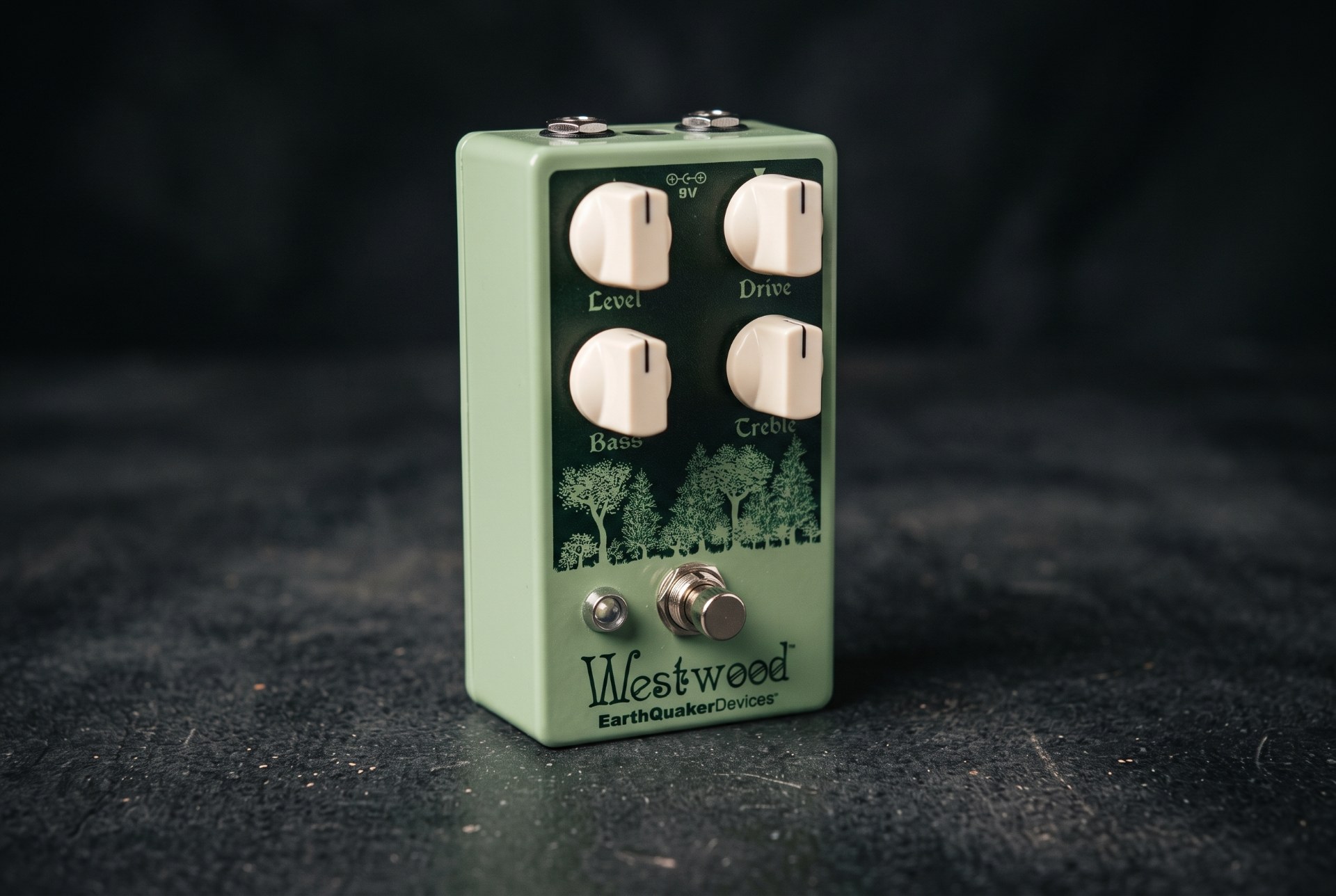
An AI-generated illustration of the EarthQuaker Devices Westwood.
EarthQuaker Devices Westwood overdrive: origin story, full specs, verified famous players, eight tone recipes, comparisons and used-buying advice.
Most pedals are designed for a market. The Westwood was designed for one guy in Akron, Ohio, who had a specific irritation with the way loudspeakers eat detail, and who happened to own the factory.
“It was sort of like an experiment that I made for me,” EarthQuaker Devices founder Jamie Stillman told MusicRadar in 2018, in what has to be one of the least promotional quotes ever given about a flagship product launch. The experiment shipped at NAMM in January that year with four knobs, an absurd Twin Peaks-themed subtitle — Translucent Drive Manipulator — and no obvious hook beyond “another transparent overdrive.” It went on to win a Premier Guitar Gear Award, land on the boards of Sonic Youth’s Lee Ranaldo, Russian Circles, Cherry Glazerr, Mdou Moctar and beabadoobee, and become one of the very few overdrives of the late 2010s that people bought and then simply stopped shopping.
Then EarthQuaker discontinued it. As of September 2026, the Westwood’s page on earthquakerdevices.com carries a single line above the photo: THIS DEVICE IS NO LONGER IN PRODUCTION. No retailer listing says so. No aggregator says so. The pedal is gone, and the used market has quietly noticed.
This is a feature, not a review. We are not scoring it. We are here to explain what the Westwood actually does, where the circuit idea came from, which players genuinely used one and which credits do not survive a date check, and whether the money now being asked for a discontinued four-knob overdrive is money well spent.
Akron, Douglas Firs, And A Damn Fine Cup Of Coffee
The EarthQuaker Devices origin story — Jamie Stillman, a basement, a touring musician who got tired of touring, a company that grew into one of the largest pedal builders in America without leaving Akron — is told in full in our feature on the EarthQuaker Devices Hoof Fuzz. The shape of EQD’s dirt catalogue, and why the company kept refusing to build ordinary pedals, is covered in the Acapulco Gold feature. And the long argument EQD had with itself about Tube Screamers is the whole subject of our Palisades piece. We will not repeat any of it.
What matters here is the naming. EarthQuaker product copy has always been a running joke about the language of gear marketing, but the Westwood is the company at its most committed to a bit. The official description calls it “as clean and pure as the breeze which blows through a grove of Douglas Fir trees, and as hot as a damn fine cup of coffee.” It promises that “each and every Westwood is a real Blue Rose case, hand built by a team of special agents in the Black Lodge of Akron, Ohio, USA, where the owls are not what they seem, there’s always music in the air, and the birds sing a pretty song.”
If none of that means anything to you: it is wall-to-wall Twin Peaks. Douglas firs, damn fine coffee, Blue Rose cases, the Black Lodge, the owls, the Roadhouse, Audrey’s line about music in the air — every phrase in that paragraph is a David Lynch reference, and the enclosure artwork by Matt Horak leans into the same aesthetic. Even the level control gets the treatment: EQD claims the Westwood has “enough output on tap to alert the proper authorities. Even the FBI.”
It is worth spending a paragraph on this because the joke tells you something real about the pedal. EarthQuaker did not name this thing after a diode, a frequency, or a mountain range. They named it after a mood — a warm, slightly uncanny, small-town-American mood — and the circuit is tuned to match. The Westwood is not aggressive. It does not want to be the loudest thing in the room. It wants to make your amp sound like the best version of itself, and then get out of the way.
The BBE Sonic Maximizer Story
The design brief is the genuinely interesting part, and it comes straight from Stillman. He told MusicRadar‘s Rod Brakes that the Westwood grew out of a specific rig experiment: running a BBE Sonic Stomp Sonic Maximizer into a Music Man HD-130, and being struck by the clarity and definition that combination produced.
A Sonic Maximizer is not an overdrive. It is a psychoacoustic processor built on the observation that loudspeakers smear a signal — amplitude and phase distortion mean that low frequencies arrive fractionally late relative to highs, and harmonic content that existed at the amplifier’s output does not survive the trip through the driver. BBE’s box attempts to pre-compensate. Stillman’s idea was to bottle some of that restored definition inside a dirt pedal: build an overdrive that gives you the grit and puts back the detail that the speaker is about to take away.
That is a fundamentally different starting point from every Tube Screamer derivative ever made. A TS808 is defined by what it removes: bass roll-off going in, a midrange hump, a little top-end softening on the way out. The result is a mid-focused voice that cuts through a band mix by narrowing. The Westwood is defined by what it restores. It is trying to widen.
Whether the circuit literally implements anything BBE-like is not something EarthQuaker has ever documented, and we are not going to pretend otherwise. What is documented is the intent, and the intent explains every design choice in the box — most obviously the EQ section.

What “Translucent” Actually Means
“Transparent overdrive” is the most abused phrase in pedal marketing. By the mid-2010s, roughly every second dirt box on the market claimed it. EarthQuaker’s response was to escalate the vocabulary: the Westwood is not transparent, it is translucent. Reviewers noticed immediately that this is a joke, and then noticed that it also happens to describe the pedal.
Here is the distinction that matters in practice. A truly transparent overdrive gives you your amp, plus gain, with a passive tone control that can only take things away. The Timmy is the canonical example — two passive cut controls, no boost, no addition. A translucent overdrive gives you your amp, plus gain, plus the ability to actively reshape the frequency response in both directions. You can still hear the guitar clearly through it. But the glass is tinted, and you choose the tint.
Mechanically, this is what the Westwood’s EQ does. Treble and Bass are active controls centred on roughly 2 kHz and 80 Hz, each offering up to 20 dB of boost or cut, with a detented centre notch so you can find flat by feel. That is an enormous amount of authority for a four-knob overdrive. It also means the controls are highly interactive: Premier Guitar‘s Shawn Hammond pointed out that middling Level and Drive settings are dramatically tamer with the EQ at noon than with the EQ pushed, because you are not just shaping the output, you are changing what the gain stage is being asked to do.
Richard Purvis, reviewing the Westwood for Guitar.com in May 2018, put the practical upshot better than anyone: with drive low and both tone controls notched off, the clean sound is “fluffed up around the edges,” with a slight softening of midrange spikes but the top and bottom of the EQ curve essentially intact. Push the gain and the crunch stays rich and valve-like. Then, having A/B’d it against a stack of high-class overdrives with multiple guitars and amps, he concluded it had “an uncanny knack of coming out on top for sheer likability.”
That word — likability — is the whole Westwood. It is not the most characterful overdrive, the most saturated, or the most unusual. It is the one that keeps winning shootouts by not annoying anybody.
Specifications
Two housekeeping notes on that table. First, the dimensions: EarthQuaker’s own page lists 121 x 64 x 57 mm with knobs, while Guitar.com‘s review printed 125 x 65 x 57 mm. The difference is a few millimetres of measuring convention and does not change how it fits on a board — call it a standard EQD medium enclosure, wider than a Boss compact, narrower than a Palisades.
Second, and more important for anyone buying used: the relay-based switching means the Westwood does not pass signal with the power disconnected. It is true bypass when powered, but it is not a passive mechanical switch. If your board loses power mid-set, the Westwood goes silent rather than going to bypass. Plan your power accordingly.
Famous Players: Who Genuinely Used One
EarthQuaker maintains something most manufacturers do not: a blog tag that collects every artist interview and studio session the company has published featuring a given pedal. It is effectively a manufacturer-curated user list with dates attached, and it is far more reliable than a crowd-sourced gear database. We used it as the primary source here, cross-checked against photo and video evidence on Equipboard, and we are going to be honest about what did and did not hold up.
Lee Ranaldo (Sonic Youth)
Lee Ranaldo is the highest-profile confirmed Westwood user, with the pedal visible on his board in video documentation. This is not a surprise: Ranaldo has a long-running relationship with EarthQuaker — he appeared in the company’s Show Us Your Junk! series in November 2018, a fortnight before the Westwood-tagged Lauren Larson episode — and the Westwood’s brief suits him exactly. Sonic Youth’s guitar language was never about saturation; it was about clarity inside chaos, alternate tunings ringing against each other, and a dirt sound that let overtones survive. An overdrive designed to restore harmonic detail rather than compress it away is close to purpose-built for that. His long-time bandmate Thurston Moore works in the same tonal territory, though we have found no evidence that Moore himself used a Westwood, and we are not going to invent one.

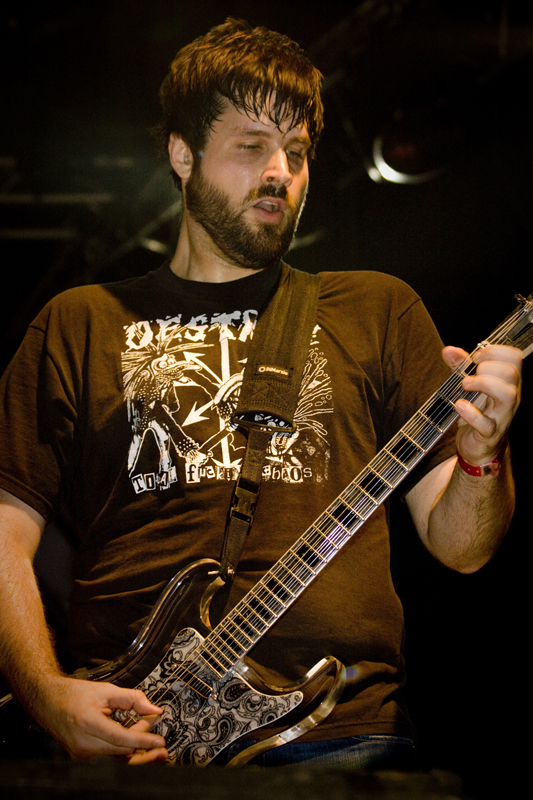
Kurt Ballou (Converge, GodCity Studio)
Ballou appeared in EarthQuaker’s Show Us Your Junk! Ep. 17 on 31 October 2018, and the Westwood is tagged on that episode. The specific credit is the useful part: Ballou discussed using the Westwood extensively during the production of Joyce Manor’s Million Dollars to Kill Me, the record he made with Robert Cheeseman and Rory Allen Phillips and released in September 2018. A pedal that arrived in January turning up on a September record from one of American hardcore’s most quoted producers is about as fast an endorsement as gear gets.
Lauren Larson (Ume)
The single best piece of Westwood documentation is EarthQuaker’s Board to Death Ep. 19, published 15 November 2018. Larson runs five gain stages: Speaker Cranker, Westwood, Palisades, an Iron Horse and a Big Muff. Her Speaker Cranker is on one hundred per cent of the time — “it makes a not-so-great amp sound better” — and the Palisades handles heavy single-note riffing, which leaves the Westwood as a middle tier. That is the most common real-world Westwood role, and worth remembering when you read shootout threads that treat it as a standalone lead sound.
Olivia Jean (Third Man Records)
Interviewed by EarthQuaker in October 2019 around her Night Owl album, Olivia Jean described a deliberately minimal board — fuzz, distortion, tuner, reverb — and named the Westwood as the constant: “I have a Westwood on there for sure. That’s a go to, that I’ll keep on for all of the songs.” Her reason is the clearest articulation anyone has given of why this pedal exists: “my melodies tend to be really busy and the notes can blend together a lot, so that distortion is great because I can hear every single note but it still has the dirt that I was looking for.” Into a Fender Twin, alongside an Erupter for fuzz solos and a Ghost Echo for reverb.

Vaughn Stokes (Uncle Acid & The Deadbeats)
In a March 2020 EarthQuaker interview, Stokes — with Uncle Acid since 2015 — described stacking the Westwood into a Night Wire harmonic tremolo and getting a result he could not fully explain: “something magical is happening that I don’t understand.” His wider board is a useful sanity check on the Westwood’s company: a Klon KTR, a Lovepedal Tchula, a Cloven Hoof, a Strymon El Capistan, into Dr. Z and Fender amps. This is not a bedroom rig, and the Westwood is holding its own in it.
Mike Sullivan (Russian Circles), Sarah Lipstate (Noveller), Hisako Tabuchi (Number Girl)
All three are photo- or video-confirmed. Sullivan’s inclusion tells you the Westwood works in front of genuinely heavy amps — Russian Circles is not a clean-tone band, and the Westwood’s job there is pushing an already-driven rig rather than supplying the distortion itself. Lipstate’s is the most specific: she has documented a piece where “all sounds created with the Mesmer, EarthQuaker Westwood overdrive, and EHX Pitchfork,” which puts the Westwood in an ambient, texture-first context rather than a rock-riff one. Tabuchi’s board with Number Girl puts it in the Japanese alt-rock lineage, alongside the EarthQuaker Session filmed in Japan in March 2020 with TOKIE, Hirohisa Horie and Shigekazu Aida of LOSALIOS, which is also Westwood-tagged.
Mdou Moctar, Cherry Glazerr, beabadoobee, King Princess
Mdou Moctar’s Westwood is visible in a session video. Clementine Creevy of Cherry Glazerr has both an Instagram photo and a 2019 Premier Guitar interview reference. beabadoobee’s board was photographed at KEXP on 21 November 2022 with a Westwood on it. King Princess’s is photo-identified by the distinctive cream knobs and green enclosure. Add Yvette Young and David Adamiak of Covet, who recorded an EarthQuaker Session in July 2019 that is Westwood-tagged, and a picture emerges: this pedal’s natural home is melodic, texture-conscious indie and alternative rock, played by people with busy right hands.
Where The Record Does Not Hold Up
Two “album usage” credits on Equipboard for the Westwood are impossible, and we are flagging them rather than repeating them. The database lists the pedal as heard on Supermachiner’s Rust (2009) and Kid Kilowatt’s Guitar Method (2004). The Westwood was announced in January 2018. Both records predate it by a decade or more. The likely cause is the same one that produces most bad gear-database entries: an artist page (in this case a Kurt Ballou-adjacent one) gets a piece of gear attached, and the site’s album linking then back-propagates it across that artist’s entire discography without a date check. The third listed credit — Spotlights’ Love & Decay (2019) — is chronologically plausible and consistent with Sarah Quintero having described using a Westwood extensively on that record.
We mention this because it is a pattern, not a one-off. If you are researching any pedal released after 2015, run the release date of the record against the release date of the pedal before you believe a database. The correction takes ten seconds and catches a startling amount of nonsense.
One more clarification, since it comes up: the Westwood has no connection to the Tube Screamer lineage that Stevie Ray Vaughan made famous, and nobody at EarthQuaker has ever claimed one. We link it here only because the TS is the reference point every transparent-overdrive conversation is measured against, not because there is any usership overlap.
Tone Recipes: Getting The Westwood To Do Its Job
1. The Always-On (Amp Opener)
Level 11:00 · Drive 8:30 · Bass 12:00 (notched) · Treble 12:00 (notched)
This is EarthQuaker’s own “Amp Opener” suggestion, and it is what most owners actually leave the pedal on. Barely any gain, both EQ controls detented flat, level pushed just past unity. The amp gets warmth, girth and a slight softening of midrange spikes, and the pedal’s clarity character does the rest. Owners on forums repeatedly describe the Westwood as an “always on” pedal used to maintain a desired clean signal rather than to add dirt — this is that setting. Kick it on at the start of the set, forget about it.
2. Total Freedom Rock (Single-Coil Jangle)
Level 1:00 · Drive 2:00 · Bass 1:00 · Treble 12:00
EarthQuaker’s second published suggestion, aimed at single coils: “add jangle and gravel to any single coil pickup and turn it up, man.” The modest bass boost fills in what a Strat or Jazzmaster bridge pickup does not have, while the treble stays flat so the high end never gets brittle. This is the setting that makes a thin guitar sound like a record.
3. Taming Spiky Single Coils
Level 12:00 · Drive 11:00 · Bass 2:00 · Treble 10:00
The inverse move, and one of the Westwood’s genuinely rare abilities. Cutting 2 kHz while boosting 80 Hz turns a brittle bridge pickup into something with body, without the woolliness you get from just rolling off the guitar’s tone control. Reviewers specifically praised this for keeping things tidy at higher gain — no ice-picking on solos.
4. Waking Up A Woolly Humbucker
Level 12:00 · Drive 12:00 · Bass 10:00 · Treble 2:00
Boosting treble adds presence and midrange honk, which is exactly the medicine for a muddy neck humbucker, while cutting bass stops the low end from collapsing into porridge. This is also the setting that rescues a low-output guitar in a rig otherwise voiced for hotter pickups — Premier Guitar singled that out as a killer application.
5. The Amp-Driver
Level 3:00 · Drive 9:00 · Bass 12:00 · Treble 12:00
Very little gain from the pedal, enormous output. The Westwood’s Level control has far more on tap than unity requires, and driving a low-wattage valve combo into its own breakup gives you an amp distortion that no pedal can imitate. This is the “call the neighbours first” setting EarthQuaker jokes about. Works best into a genuinely cranked amp; into a modelling front end it just gets loud.
6. Singing Lead
Level 2:00 · Drive 3:00 · Bass 1:00 · Treble 1:00
Drive high, both EQ bands boosted. This is the most saturated the Westwood gets, and it is still not a distortion pedal — expect articulate, sustaining lead tone with even-order harmonics rather than a wall. If you need more than this, you need a different box, and we would point you at the Pro Co RAT 2 or a Muff-family pedal rather than pushing the Westwood past its comfort zone.
7. Bass Guitar
Level 12:00 · Drive 9:00 · Bass 12:00 · Treble 11:00
An unusually well-supported use case. EarthQuaker described the Westwood as equally powerful on bass at launch, and owners consistently report it as a mild bass overdrive that enhances tone without swamping it. The 80 Hz bass control sits low enough to be genuinely useful on a four-string, and the 1 MΩ input impedance does not load a passive bass. Alex Brady of Julie has one on a bass board. Keep the drive low; the Westwood’s low end survives dirt better than most.
8. Stacking Notes
The Westwood plays well in front of other dirt. Vaughn Stokes runs it into a harmonic tremolo. Lauren Larson runs it between a Speaker Cranker and a Palisades. Owners report good results into ambient chains with an EHX Superego+, a Boss DD-500 and a Slow Engine. As a general rule, put the Westwood first if you want it to shape everything downstream, and last in the dirt chain if you want it as a level and EQ trim on whatever came before.
The Westwood’s four controls look simple and are not, because two of them are active. Every setting below assumes a clean or edge-of-breakup amp, guitar volume at 10, and the pedal running at 9V. Times are clock positions.
How It Compares
Westwood vs. Boss BD-2 Blues Driver
This is the comparison owners reach for most often, and it is the right one. The Boss BD-2 and the Westwood occupy the same tonal slot — open, uncompressed, amp-like, not mid-humped — but players who have owned both describe the Westwood as having less of the BD-2’s aggressive grittiness, better touch dynamics, and a far more useful EQ section. The BD-2 gives you one tone knob. The Westwood gives you two active bands with 20 dB of authority each. Several owners describe swapping a BD-2 out for a Westwood permanently on the strength of the more neutral voicing. The BD-2 is a third of the price and available new, which counts for something.
Westwood vs. Timmy
The MXR Timmy is the other constant reference. Both are low-gain, low-colour, EQ-forward overdrives. The difference is philosophical: the Timmy’s bass and treble controls are passive cuts, so the pedal can only subtract, and its transparency is a function of restraint. The Westwood’s are active, so it can add. If your ideal is “my amp, but louder and slightly angrier,” the Timmy is arguably the purer tool. If your ideal is “my amp, but I want to fix something about my guitar too,” the Westwood is the more capable one.
Westwood vs. Klon / Tumnus
People ask constantly whether the Westwood is EarthQuaker’s Klon. It is not. The Klon Centaur — and its accessible descendants like the Wampler Tumnus — work by blending a clean path with a gain path, which produces that characteristic firm low end and forward upper midrange. The Westwood has no clean blend. Its clarity comes from the EQ design and the gain structure, not from parallel signal paths. They land in adjacent territory by different routes, and they do not sound the same.
Westwood vs. Tube Screamer family
Not close. A TS9, a Maxon OD808 or a Boss SD-1 works by narrowing your signal into a mid-focused band that cuts through a mix. The Westwood works by widening. If you want the Screamer thing from EarthQuaker, the answer is the Plumes or, if you can find one, the Palisades. If you want the opposite of the Screamer thing, that is the Westwood.
Westwood vs. Nobels ODR-1 and Fulltone OCD
The Nobels ODR-1 is the closest thing to a rival in spirit — another famously natural, non-scooping overdrive with a genuinely powerful tone circuit, at a fraction of the money. The Fulltone OCD goes considerably further into distortion and has a much more assertive personality; it is a different job. If your budget is the deciding factor and you cannot stomach used Westwood prices, the ODR-1 is where we would look first.
Westwood vs. EQD’s own current line
This is the awkward one, and owners raise it themselves. The Westwood launched at $179. EarthQuaker’s current-line Plumes and Special Cranker sit around $99. The Zoar offers more front-panel functionality for less money, albeit with a passive EQ. A recurring criticism in owner discussions is that the Westwood was priced above what the market later decided a four-knob overdrive was worth — which is a fair point about value, and a completely separate question from whether it sounds good.
Buying Guide: A Discontinued Pedal With No Version Confusion
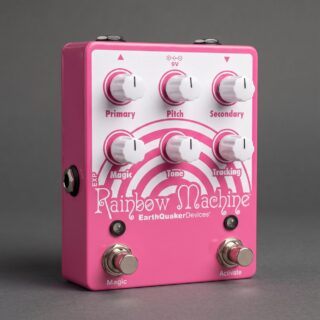
Good news first. Unlike most of EarthQuaker’s back catalogue, the Westwood has no V1/V2 split. It launched in January 2018 already fitted with relay-based soft-touch switching — the same upgrade EarthQuaker was simultaneously rolling out across the Avalanche Run, Spatial Delivery, Hoof Reaper, The Depths and Rainbow Machine as V2 revisions. There is one Westwood. Any unit you find is the unit.
What to pay
As of September 2026, listings across the major used marketplaces spread roughly from $140 to $300, with the top end representing sealed or as-new stock at dealers who never cleared their shelves. Anything at or below launch price ($179 US / £185 UK) for a clean used unit is a fair deal. Above $250, you are paying a discontinued-pedal premium for a pedal that, sonically, is not doing something no other pedal can do — it is doing a common thing unusually well.
What to check
- Power it up before you buy. Relay switching means a dead unit is silent, not bypassed — you cannot test “does audio pass” without a supply.
- Confirm the detents. Both EQ knobs should click positively into their centre position. A worn or damaged detent is a usability problem on this specific pedal, because finding flat by feel is half of how you set it.
- Check the barrel jack for play. Standard used-pedal advice, doubly relevant on a device that will not pass signal without power.
- Ask about the warranty. EarthQuaker’s limited lifetime warranty covers the device, not the owner, and the company has an established reputation for honouring repairs on discontinued models. That is a real part of the used value here.
- Beware clones. The circuit has been cloned in the DIY community, including a documented variant with the gain pot restricted to half its normal range to expand the low-gain sweep. Clones are not a problem in themselves, but they are not worth EQD money.
Who should buy one
You should be hunting a Westwood if you play a valve amp at real volume, you want a dirt pedal that leaves your guitar recognisable, and — this is the deciding factor — you have a specific EQ problem you need solved. Spiky single coils. Woolly humbuckers. A guitar that does not fit the rig you built for a different guitar. Nothing else in this price class fixes those problems while also being a good overdrive.
Who should skip it
Skip it if you want high gain — this is a light-to-medium-gain pedal and pushing it will not change that. Skip it if you play mostly through modelling or into a clean full-range system, because most of what makes the Westwood special is how it interacts with a real speaker being driven. Skip it if you already own a Timmy or an ODR-1 and are happy, because the overlap is substantial. And skip it if the used price has drifted north of $250, because at that point you are buying scarcity rather than tone.
Living With One
Three practical notes from long-term owners.
The LED is genuinely too bright. This is not a nitpick invented by one reviewer — MusicRadar listed it as a con, and independent reviewers said the same thing. On a dark stage the Westwood’s status LED is a small lighthouse. Owners have dealt with it by dimming it with a dab of nail varnish or a sticker. If you have a board full of EQD pedals, be prepared.
Engineers may fight you on the low end. The Westwood retains and can boost genuinely low frequencies for a dirt pedal. That is wonderful in a room and can be a problem in a mix, where a bass boost around 80 Hz sits directly on top of the bass guitar and the kick. MusicRadar flagged this explicitly. If you are tracking, expect the person behind the desk to want a high-pass on the guitar; set the Westwood’s bass control accordingly and save the argument.
Power it properly. 18 mA is nothing, but EarthQuaker is unusually insistent about isolated, transformer-based supplies, and the Westwood’s relay switching means it is more dependent on clean power than a passive-bypass pedal. Do not run it above 9V. There is no headroom benefit and there is a real risk of damage.
Frequently Asked Questions
Is the EarthQuaker Devices Westwood discontinued?
Yes. EarthQuaker’s own product page for the Westwood carries the line “THIS DEVICE IS NO LONGER IN PRODUCTION,” verified in September 2026. Discussion of the discontinuation appeared in guitar communities in 2024. Most retailer listings and gear databases do not reflect this, so check the manufacturer page before assuming you can buy one new.
Is the Westwood a Tube Screamer clone?
No, and it is not trying to be. A Tube Screamer rolls off bass going into the gain stage and adds a midrange hump, producing a focused, cutting voice. The Westwood has a flat baseline response with active bass and treble controls that can boost or cut 20 dB around 80 Hz and 2 kHz. EarthQuaker’s Tube Screamer-derived pedals are the Palisades and the Plumes, both covered separately.
Is the Westwood EarthQuaker’s version of a Klon?
It is not. The Klon architecture blends a clean signal path with a gain path, which is where its characteristic stiffness and forward midrange come from. The Westwood has no clean blend. The two do end up in adjacent territory — both are clear, both work as boosts — but the mechanisms are unrelated.
What does “translucent” mean on the Westwood?
It is EarthQuaker one-upping the overused word “transparent,” and it also happens to be descriptive. A transparent overdrive is meant to leave your tone untouched. The Westwood leaves your tone recognisable but hands you an active EQ powerful enough to deliberately tint it. Translucent rather than invisible.
Does the Westwood work on bass?
Yes, and unusually well. EarthQuaker promoted it as equally effective for bass at launch. The bass control is centred at 80 Hz, low enough to be genuinely useful on a four-string, and the pedal’s high input impedance does not load a passive instrument. Owners describe it as a mild bass overdrive that adds character without swamping the low end. Keep the drive low.
Why does the Westwood go silent when I unplug the power?
Because it uses electronic relay-based switching. The Westwood is true bypass when powered, but the relay needs power to hold the bypass path. With no supply, no audio passes. This is normal for the pedal and not a fault — but it does mean you should never rely on it passing signal if your board’s power fails.
What is a fair used price for a Westwood in 2026?
Listings run roughly $140 to $300. A clean used unit at or below the original $179 street price is a good deal. Sealed or as-new dealer stock commands the top of that range. Above about $250 you are paying for scarcity rather than for anything the pedal does.
Which famous guitarists actually used a Westwood?
Confirmed by photo, video or first-hand interview: Lee Ranaldo of Sonic Youth, Kurt Ballou of Converge (who used it producing Joyce Manor’s Million Dollars to Kill Me), Lauren Larson of Ume, Olivia Jean, Vaughn Stokes of Uncle Acid & The Deadbeats, Mike Sullivan of Russian Circles, Sarah Lipstate of Noveller, Hisako Tabuchi of Number Girl, Mdou Moctar, Clementine Creevy of Cherry Glazerr, beabadoobee, King Princess and Yvette Young of Covet. Be sceptical of database entries linking it to records released before 2018 — at least two such credits are chronologically impossible.
Should I buy a Westwood or a Plumes?
They do different jobs. The Plumes is a Tube Screamer-derived pedal with three clipping modes at around $99, currently in production. The Westwood is a flat-response overdrive with an active two-band EQ, discontinued, and typically costs more used than a Plumes costs new. If you want mid-focused drive, buy the Plumes. If you want an always-on tone-shaper that keeps your guitar’s character intact, hunt the Westwood.
The Verdict That Isn’t One
The Westwood’s story is unusually clean for a boutique pedal. A builder made something to scratch his own itch, the market turned out to have the same itch, the press liked it enough to give it awards, a good spread of working guitarists put it on their boards, and then — after roughly six years — the company discontinued it in favour of cheaper pedals that sell in larger numbers. Nobody was wronged. The Plumes is genuinely excellent and costs half as much. The Special Cranker does a different, dirtier job for the same money.
But nothing currently in EarthQuaker’s catalogue does what the Westwood did, which is give you a flat, honest overdrive and then hand you 20 dB of EQ authority in both directions to fix whatever your guitar is doing wrong. That combination — genuine transparency plus genuine control — is rarer than the number of “transparent overdrive” pedals on the market would suggest. It is why Olivia Jean left it on for every song, why Lauren Larson gave it a permanent slot among five gain stages, and why Richard Purvis found it beating better-known drives on likability alone.
If one turns up at sensible money, and you play a real amp, it is worth the afternoon.
Image credits
- Lee Ranaldo: Guido van Nispen, Wikimedia Commons, CC BY 2.0.
- Top image: GuitarGangsters AI-generated reference illustration, not a photograph.
- Lee Ranaldo: DSCF4708-Edit by Guido van Nispen, Wikimedia Commons, CC BY 2.0.
- Kurt Ballou: Jaime Garcia Perez from Aviles, Asturias, Wikimedia Commons, CC BY 2.0.
- Olivia Jean: CandySharp, Wikimedia Commons, CC BY-SA 4.0.
Latest News
Related
On This Day
Monday 9 November
From this week: