DOD Rubberneck Analog Delay: The Bucket-Brigade Delay That Learned To Bend Time
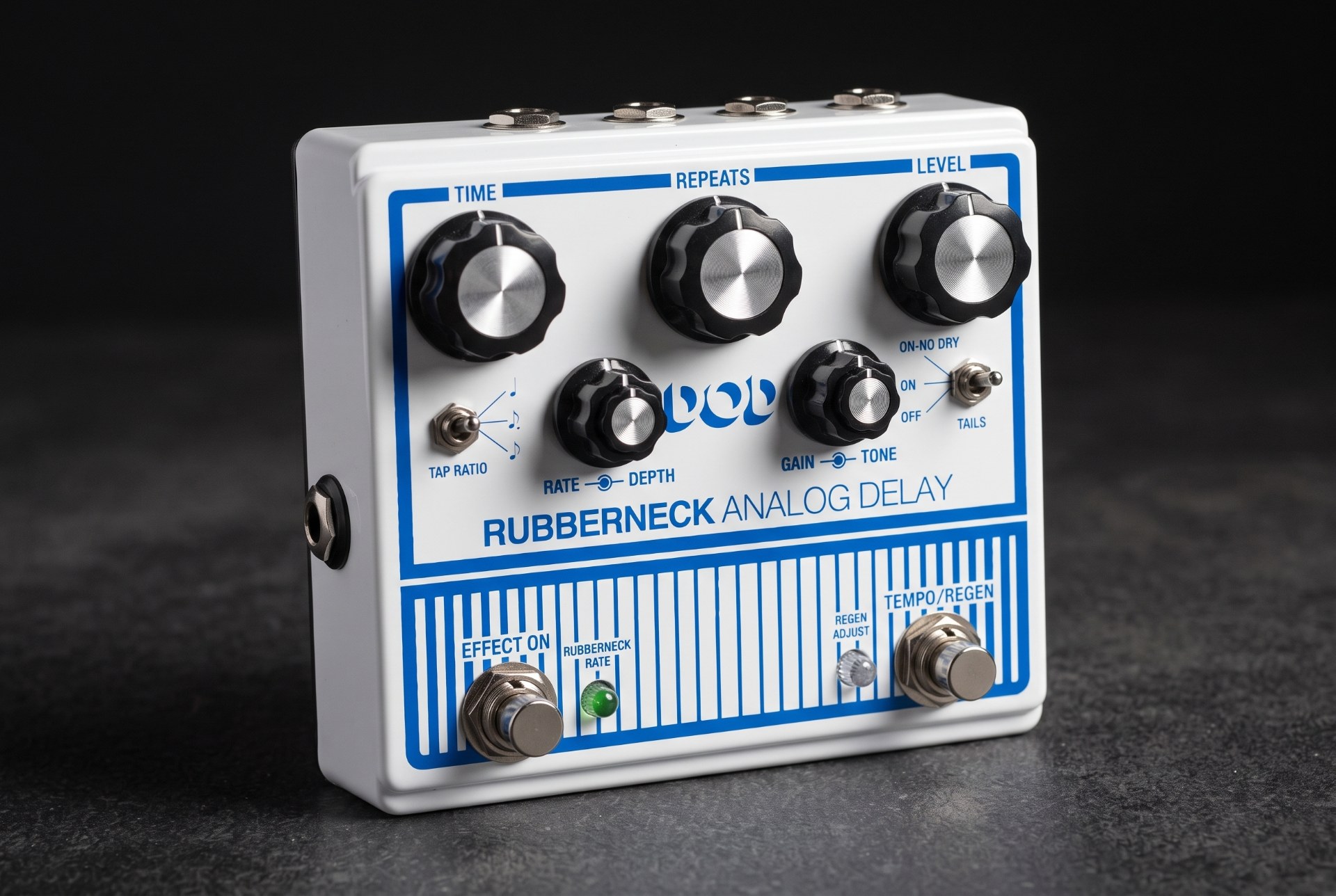
An AI-generated illustration of the DOD Rubberneck Analog Delay.
DOD Rubberneck Analog Delay explained: 1.5s BBD repeats, tap tempo, Rubbernecking pitch drag, effects loop, verified players, tone recipes and buying advice.
Most analog delays ask you to accept a bargain. You get the warm, dark, slowly-decaying repeats that only a bucket-brigade chip can make, and in exchange you give up tap tempo, you give up subdivisions, you give up tails, and you give up any hope of a delay time long enough to build something atmospheric on top of. That bargain has been the price of admission since the late 1970s, and an entire generation of guitarists simply paid it.
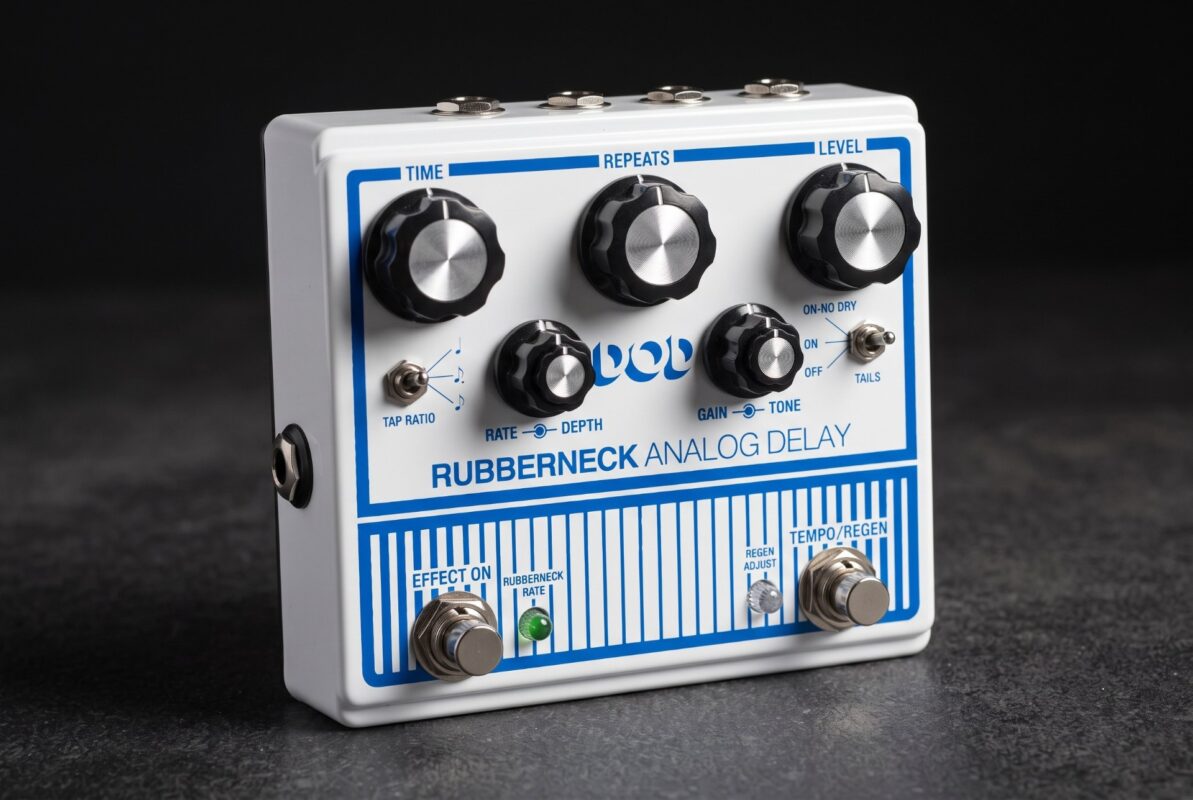
The DOD Rubberneck refuses the bargain. It is a genuine bucket-brigade delay — the manual says so in its first paragraph, “uses BBDs for up to 1.5 seconds of classic analog delay” — and it also has tap tempo with three subdivisions, a three-position tails switch, an effects loop wired into the feedback path, a footswitch jack for remote control, independent modulation rate and depth, a gain control that drives the delay line into distortion, and a pair of clear backlit potentiometers that glow at you in green, yellow, red and white to tell you what the pedal is doing. And then there is the feature it is named after, which nobody else has: hold down the left footswitch and the delay time physically stretches or compresses, dragging every repeat in the buffer with it like a tape machine being throttled by hand.
That is the Rubberneck’s argument in one paragraph. This article is about whether the argument holds up, what the pedal actually does at each control, who has genuinely been photographed using one, and who has not.
Housekeeping: two things you will read elsewhere that are not true
Before the history, two corrections, because both of them are repeated widely enough that they will shape your expectations if we leave them alone.
First: the Rubberneck is not unconditionally true bypass. DOD’s own marketing copy lists “True Bypass” in the feature bullets, and it appears in the press release verbatim. The owner’s manual is more honest. With the TAILS switch in the Off position, the pedal is genuinely hardwire bypassed — the specification sheet literally reads “Effect off: True hardwire bypass with Tails switch off.” With TAILS set to On or On+No Dry, the manual states plainly that “the signal will travel through a buffered signal path when the effect is bypassed, rather than being true bypass.” That is not a flaw; it is physically necessary, because you cannot hear repeats trail off after bypass if the circuit has been disconnected from your signal. But it does mean the marketing bullet and the manual disagree, and the manual wins. If you bought this pedal specifically for true bypass, you bought a pedal that is true bypass in one of its three tails settings.
Second: the famous-player list attached to this pedal in most secondary sources is wrong. That list names The Edge, David Gilmour, John Frusciante, Andy Summers and Steve Vai against the Rubberneck. Not one of those attributions survives contact with evidence. Every one of those five players built their delay identity on units that predate the Rubberneck by decades, and there is no photograph, no rig rundown, no interview and no retailer listing connecting any of them to this pedal. We will name the players who are documented later, and there are more of them than you would expect — but they are not the five names the internet keeps recycling. This is a recurring failure mode in gear writing: a delay pedal appears, and the roster of Famous Delay Guitarists gets copy-pasted onto it regardless of what anyone has actually seen.

Where the Rubberneck came from
DOD is one of the oldest names in American stompbox manufacturing, founded in Salt Lake City in the mid-1970s and responsible for a run of boxes — the 250 Overdrive Preamp, the 280 Compressor, the Grunge, the FX25 Envelope Filter — that were cheap, plentiful, and consequently ended up under the feet of far more working musicians than the boutique brands ever reached. The company spent the 1990s and 2000s absorbed into DigiTech, then into Harman, and by the mid-2010s DOD had been deliberately revived as, in MusicRadar’s phrase at the time, “the original boutique pedal brand so ably resuscitated by Digitech/Harman in recent years.”
The Rubberneck was announced at NAMM in January 2017, on 20 January, alongside a pair of far less interesting Mini Expression and Mini Volume utility pedals. MusicRadar called it “undoubtedly the main event.” The launch price is worth pausing on: DOD announced a US MSRP of $429.95. That is an eye-watering number for a DOD pedal and it never had much to do with reality — by the time Total Guitar reviewed the pedal in November 2017 the street price was £209 / €251 / $249, and over the following years the Rubberneck has traded anywhere from clearance-bin figures around $99 during inventory purges to a post-pandemic $350 when parts procurement got difficult. As of September 2026 the aggregated retail range sits at roughly $275 to $350, with an average around $288.
The other thing worth noting from the paperwork: the owner’s manual, issue date 05/2017, carries a DOD support address in Gangseo-gu, Seoul, Republic of Korea. The Rubberneck is a product of DOD’s corporate era, not its Salt Lake City garage era, and it is engineered accordingly — this is a pedal designed by people who had access to a proper development budget and used it on features rather than on mojo. In 2022 DigiTech and DOD were acquired by Cort, and the line has continued since, which is why the Rubberneck is still in production nearly a decade after launch while most of its 2017 contemporaries are long gone.
What “Rubbernecking” actually is
Every analog delay with a manual delay-time knob can do the pitch-warp trick: turn the TIME control while repeats are in the buffer and the audio already stored in the bucket brigade gets read out faster or slower, which shifts its pitch. It is the single most fun thing about a BBD delay, and it is also useless live, because your hands are on the guitar.
The Rubberneck’s headline feature is that trick moved to a footswitch and given a rate control. Press and hold the EFFECT ON footswitch and the delay time begins to travel — the manual describes it as creating “‘dive bomb’ or ‘chipmunk’-like delay stabs during a performance.” Release the switch and it travels back. The RUBBERNECK RATE pot governs how fast that journey happens, and it does so asymmetrically in a way most people miss: the left half of the control sets the time it takes to stretch (dive-bomb) the delay, and the right half sets the rate at which the delay time compresses. It is one knob doing two jobs on either side of centre, not a single speed control.
The practical consequence is that the Rubberneck is the only mainstream analog delay where a whammy-style pitch collapse of the repeats — while the dry signal stays exactly where it is — is a foot-operated performance move rather than a studio accident. If you have ever tried to fake that with a pitch-shifting pedal placed after a delay, you will know it is not the same thing at all: the Whammy shifts everything including the note you are currently playing, whereas Rubbernecking bends only the tail.
The second footswitch: Repeats Oscillation
The right-hand footswitch is labelled TEMPO/REGEN and it also does two jobs. Tapped, it sets the delay time, working with the TAP RATIO toggle. Pressed and held, it swaps the REPEATS knob out of the audio path and swaps the tiny REGEN ADJUST pot in.
Read that again, because it is more clever than the usual “momentary feedback boost” implementation. The Rubberneck does not add feedback on top of your setting; it substitutes a completely separate feedback setting for as long as your foot is down, then hands control back when you lift. That means you can run the REPEATS knob at a single slapback and park REGEN ADJUST at total runaway, and the pedal becomes a two-state instrument: tight and rhythmic with your foot off, screaming self-oscillation with your foot on, with no intermediate mess. The manual’s phrasing is unusually vivid for a spec document: “you can go from single repeats into oscillation oblivion and back.”
Both of these small pots are clear, backlit potentiometers with LEDs underneath, and DOD gave the LEDs a real job rather than decoration. The RUBBERNECK RATE pot’s bi-colour LED is off when the pedal is bypassed, solid green when the effect is on, pulsing between green and yellow at the modulation rate when the DEPTH knob is above minimum, and solid red while Rubbernecking is active. The REGEN ADJUST pot’s white LED blinks at the current delay time — including when the pedal is bypassed, so you can tap in a tempo before you switch on — and goes solid while the regen footswitch is held. It is, in effect, a status display built out of two knobs.
Specifications
The 150 mA problem, stated plainly
That current-draw figure deserves to be lifted out of the table, because it is the single most common cause of a Rubberneck misbehaving. 150 mA is enormous for an analog delay. For scale, the DOD Carcosa fuzz covered immediately before this article in the guide draws 4 mA. A Carbon Copy is in the region of 26 mA. The Rubberneck needs roughly as much current as a small digital reverb, because it is running multiple BBD chips, a clock, an LED-lit control surface and a buffer network simultaneously.
Owner reports collected on forums and Reddit converge on the same story: generic daisy-chained supplies produce noise, clipping or outright failure to start, and the problem disappears when the pedal is given its own isolated 9 V output with real headroom. There is also a small documentation inconsistency worth flagging honestly — the product page recommends a “PS0913DC,” the manual’s specification block names the PS0913DC-04, and owners on forums report being told to use the PS0913DC-02. All are 9 VDC centre-negative supplies from the same family and all deliver far more than 150 mA; the practical instruction is simply to give the Rubberneck an isolated output rated 250 mA or better and stop worrying about the suffix.
Famous players: who really has one
Here is where the Rubberneck’s story gets genuinely interesting, and where it diverges hard from the recycled roster.
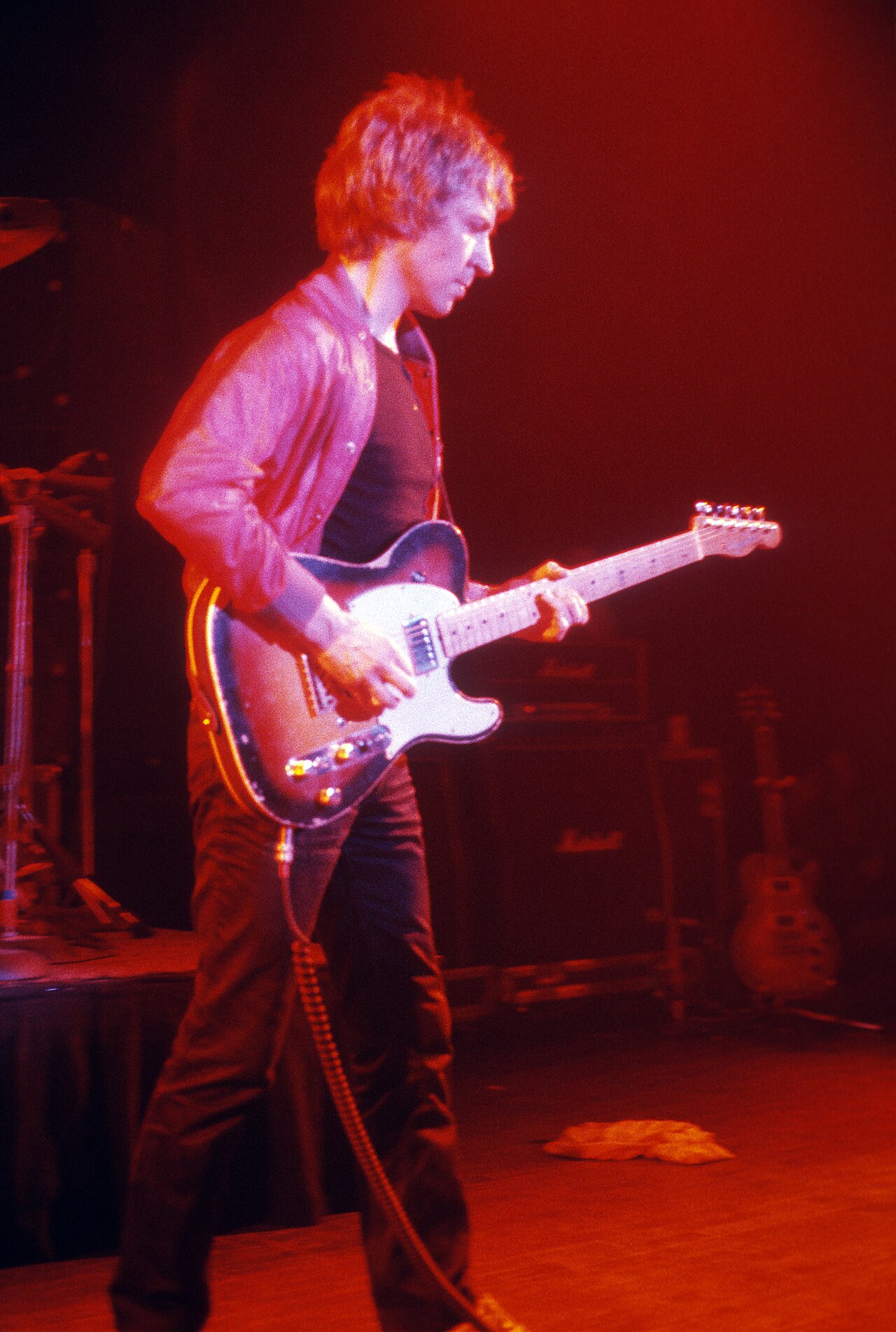
There is no evidence whatsoever that The Edge has ever used one — his delay architecture has been built around rack units and, more recently, meticulously programmed digital systems, for forty years. There is no evidence for David Gilmour, whose repeats come from Binson and rack-based sources. John Frusciante‘s delays are famously a Boss DD-series and a Deluxe Memory Man story. Andy Summers defined his sound on early Electro-Harmonix and rack delay years before this pedal existed, and Steve Vai‘s delay rig has been rack-and-switcher based since the 1980s. None of these five players has any documented connection to the DOD Rubberneck, and we are stating that explicitly because the opposite claim circulates widely. They belong in this article only as the lineage the Rubberneck is arguing with.
The players who are documented make a far more coherent picture — and there are sixteen credited users logged on Equipboard, which is a lot for a pedal of this profile. The strongest evidence tier first:
- Ryan Primack (Poison the Well) — a Rubberneck is visible on his board in a Premier Guitar Rig Rundown hosted by Perry Bean. Video documentation in a professional rig feature is about as good as this evidence gets.
- Nate Newton (Converge) — demonstrated in a Premier Guitar gear rundown, where he uses the Rubberneck specifically to generate stage noise during performances. A bassist using a guitar delay as a noise generator is exactly the use case the Regen footswitch was designed for.
- Yvette Young (Covet) — photographed with the pedal on the board she used for a recent album. Math-rock’s most recognisable tapping-based guitarist reaching for a warm analog delay rather than a pristine digital one is a data point in itself.
- Nick Reinhart (Tera Melos, Death Grips) — showcased the Rubberneck in an Instagram post titled “the golden age of cool sounds pt II.” Reinhart is one of the most inventive effects users working, and his endorsement-by-photograph carries weight with the people who buy this kind of pedal.
- Mark Lettieri (Snarky Puppy, The Fearless Flyers) — posted the pedal on his working board for a Radio City Music Hall date with Dave Chappelle.
- Harry McVeigh (White Lies) — clearly visible in a photograph of the band’s 2018–2019 rehearsal board, apparently replacing a Providence DLY-4 Chrono Delay. This is the earliest available photograph of the pedal in his rig.
- Tommy Guerrero — a photograph from an interview shows the Rubberneck as the last pedal in his chain.
- Gary “Dr. Know” Miller (Bad Brains) — listed a Rubberneck for sale in his official Reverb shop, which confirms ownership but, honestly, confirms that he parted with it too.
- Walter Schreifels (Gorilla Biscuits, Quicksand, Dead Heavens) — mentioned the pedal on Instagram ahead of a Dead Heavens show.
- Jack Conte (Pomplamoose, Scary Pockets) — visible in video using the Rubberneck on keyboard, not guitar.
- Tamino and Thom Wasluck (Planning for Burial) — both documented via photographs of their boards, Wasluck’s in the context of a drone/noise/ambient set.
They are the real list, and the shape of it tells you something the marketing does not. This is a pedal adopted by post-hardcore, math rock, noise and experimental players, plus one session monster and one keyboard player. Equipboard’s genre data agrees: rock first, then electronic, pop and metal, with post-rock, noise rock and math rock all showing up disproportionately for a pedal in this price bracket. Nobody is buying a Rubberneck for polite rockabilly slapback, even though it does that perfectly well.
Tone recipes and settings
1. Clean rhythmic eighths (the “just be a delay” setting)
TIME to taste or tapped in, REPEATS at 9 o’clock, LEVEL at 11 o’clock, DEPTH at minimum (this fully disables modulation), GAIN at minimum, TONE at noon, TAP RATIO on eighth note, TAILS off. This is the Rubberneck pretending to be a simple delay, and it is a very good simple delay — dark, unobtrusive, sitting behind the dry signal instead of competing with it.
2. Dotted-eighth rhythm engine
Same as above but TAP RATIO on dotted eighth, REPEATS at 10 o’clock, LEVEL at noon. Tap in quarter notes with the band and the pedal produces the triplet-feel pattern that has powered arena rock for four decades. The advantage over an analog delay without tap tempo is not subtle: you can re-tap between songs instead of hunting for the right knob position in the dark.
3. Warm slapback
TIME at minimum-ish (around 80–120 ms), REPEATS almost off, LEVEL at noon, TONE just past noon, GAIN at minimum. Because the delay line is analog, the single repeat is already darker than the dry note, which is exactly what makes slapback sit correctly. Add a touch of GAIN if you want the repeat to have a slight grit that helps it read on a clean amp.
4. Dirty repeats
GAIN at 2 o’clock, TONE at 10 o’clock, REPEATS at noon, LEVEL at 1 o’clock. The GAIN control feeds more signal into the bucket brigades, so the repeats distort while the dry note stays clean. This is the trick that makes the Rubberneck sound expensive: dirty echo behind a clean chord is something you normally have to build with a separate drive in a parallel loop.
5. Vibrato echo / seasick chorus
DEPTH at 1 o’clock, RATE at 9 o’clock, REPEATS at 11 o’clock, TONE at 11 o’clock. Slow and deep modulation on the repeats only. Compare with a dedicated analog chorus: the Rubberneck’s modulation never touches your dry signal, so chords stay in tune while the tail swims.
6. Full seasick warble
DEPTH at maximum, RATE at 1 o’clock, REPEATS at 2 o’clock. Total Guitar‘s review described the Rubberneck’s modulation range as running from “a subtle vibrato” to “a deep, seasick warble,” and this is the far end. Owners consistently report that the modulation becomes intense and somewhat unpredictable at the top of its range. Treat that as a feature to be deployed, not a setting to live at.
7. Ambient wash (the 1.5-second setting)
Tap in the longest tempo you can, REPEATS at 1 o’clock, LEVEL at 1 o’clock, TONE at 10 o’clock, DEPTH at 10 o’clock, TAILS on. The Rubberneck’s competitive advantage over almost every other analog delay is that it stays coherent well past the one-second mark where most BBD units collapse into mud. It is still an analog delay, so the far repeats do degrade — but they degrade musically rather than falling apart.
8. Delay bender (the signature move)
Set anything you like, put RUBBERNECK RATE around 9–10 o’clock for a slow stretch, then hold the EFFECT ON footswitch at the end of a phrase. The tail dive-bombs while your dry note holds. Push RUBBERNECK RATE past noon to get the compression side moving faster and you get the chipmunk lift instead. The trick with this control is to remember it is asymmetric: set the stretch and the compression independently by choosing which half of the sweep you live in.
9. Runaway oscillation stab
REPEATS at 9 o’clock, REGEN ADJUST at maximum, TONE and GAIN both high. Play a phrase, hold the TEMPO/REGEN footswitch, and the pedal detonates into feedback for exactly as long as your foot is down. Release and it snaps back to a tidy single repeat. This is Nate Newton’s stage-noise application, and it is genuinely the most performable self-oscillation implementation on any analog delay.
10. Loop-path madness
Put a fuzz, ring modulator, phaser or reverb into the Send/Return jack and every successive repeat is processed again. The manual explicitly recommends distortion, ring mod, phaser and flanger. Note the jack format: a single TRS jack, Tip = Send, Ring = Return, running at instrument level — you need a TRS-to-dual-TS Y-cable, not two separate cables, and this catches people out constantly. An Big Muff in the feedback path turns repeat five into a completely different animal from repeat one.
DOD’s own manual ships six starting points — Rockabilly, Mod Delay, Dirty Repeats, Vibrato Echo, Delay Bender and Runaway. Those are good, but they are printed as knob diagrams without explanation, so here are ten settings described in words, with the reasoning attached.
How it compares
Versus the MXR Carbon Copy: the Carbon Copy is the default recommendation in this category and it is a third of the price, a third of the size and a fifth of the current draw. It gives you 600 ms, three knobs and an internal modulation trim. Owners who have compared them directly tend to cite the Rubberneck’s tap tempo with dotted-eighth subdivision and its gain knob as the deciding factors. If you want an analog delay to set once and forget, buy the Carbon Copy. If you want to perform with it, the Rubberneck is doing things the Carbon Copy structurally cannot.
Versus the EHX Deluxe Memory Man: the closest philosophical rival — an analog delay with real modulation and, in the 1100-TT version, tap tempo. Rubberneck owners on forums specifically argue that its modulation and its oscillation ramping are better implemented than the Memory Man’s. The Memory Man, in exchange, has decades of recorded history behind its particular chorus-and-echo blend that the Rubberneck will never own.
Versus the Boss DM-2W Waza Craft: the DM-2W is the purist’s choice — smaller, cheaper, quieter, and utterly committed to being one great-sounding 300/800 ms analog delay with no performance features at all. It is the better pedal if what you want is the classic analog delay sound with nothing in the way. The Rubberneck is the better pedal if you want that sound plus a control surface.
Versus the Maxon AD999: the AD999’s claim to fame is 900 ms of clean analog delay from a stack of BBD chips, and it does that with more headroom and less noise than most. The Rubberneck goes further in time and vastly further in features, but the AD999 remains the reference for how quiet a long analog delay can be.
Versus the Way Huge Aqua Puss MkIII: opposite ends of the same idea. The Aqua Puss is 300 ms, three knobs, and a deliberately narrow, gnarly voice. The Rubberneck is the maximalist reading of analog delay. Both are correct; they are answering different questions.
Versus the digital flagships — Strymon TimeLine, Source Audio Nemesis, Boss DD-500: these do everything the Rubberneck does, plus presets, plus stereo, plus twenty other delay algorithms including convincing BBD emulations. What they cannot give you is an actual bucket brigade responding in real time to a footswitch dragging the clock around. Whether that distinction matters is the oldest argument in delay pedals and this article is not going to settle it. What is true is that the Rubberneck’s Rubbernecking and Regen behaviours are analog-native: they work the way they do because there is real charge moving through real capacitors.
Versus the lo-fi specialists — Caroline Kilobyte and Death By Audio Echo Dream 2: both of those are built to break. The Rubberneck can be pushed into similar territory via GAIN, REGEN and the effects loop, but its default state is clean and controlled. If destruction is the point rather than an available option, buy one of those instead.
Buying guide
Buy a Rubberneck if: you want genuine BBD repeats but refuse to give up tap tempo and subdivisions; you play music where a delay is an instrument rather than a garnish; you want an effects loop in the feedback path without building a rack; or the Rubbernecking pitch-drag is a sound you can hear yourself using — in which case nothing else will do, because nothing else has it.
Do not buy a Rubberneck if: your pedalboard power supply is a daisy chain (the 150 mA draw will punish you); you need battery operation (impossible, the pedal has no battery compartment); you need stereo (it is mono in, mono out); you want presets (there are none — every setting is where you left the knobs); or your board is genuinely tight on space, because the double-wide chassis at 5.0″ × 4.68″ occupies the footprint of two normal pedals.
On price: the Rubberneck’s used market has been unusually volatile. It has sold for as little as $99 during clearance events and as much as $350 new when supply chains tightened. As of September 2026 the realistic new range is $275–$350 with a market average near $288, and it holds an aggregate 4.7 out of 5 across 38 ratings. If you find a clean used example under $200, that is a good trade. Check that the seller has the correct power supply or budget for one.
Accessories worth having: a DigiTech FS3X three-button footswitch, connected with a genuine TRS cable, unlocks remote Rubbernecking, modulation on/off and tap tempo/regen. The manual is specific that a TS cable with a third-party momentary switch gets you tap tempo and regen only, and that the switch must be plugged in before power is applied for the pedal to detect it. Latching footswitches will not work at all. You will also want a TRS-to-dual-TS Y-cable if you intend to use the effects loop.
Living with one: the honest notes
Reviews of the Rubberneck have been broadly excellent — Total Guitar‘s verdict was “a highly usable analogue delay that can get as weird as you like,” with the only stated con being that it is “not the cheapest analogue delay.” When the professional press is that uniformly positive, the useful criticism has to come from owners, and it does:

- The usable delay time is shorter than the headline figure. 1.5 seconds is achievable, but noise and artefacts become audible before you get there. Owners describe the practical ceiling as somewhat below the spec. This is normal BBD behaviour and not a defect, but the marketing number and the musical number are not the same number.
- It can sound messy in front of a dirty amp. Several owners report that the pedal is much happier in an amp’s effects loop than in front of a driven preamp — which is true of any delay, but more true of this one because its own GAIN stage is already adding harmonic content to the repeats. The manual includes a dedicated effects-loop connection diagram and notes that if your amp’s loop has a mix control, it should be set to 100% wet.
- Self-oscillation arrives early on the REPEATS knob, and effects placed in the feedback loop make it arrive earlier still. Plan your REPEATS setting with that in mind rather than expecting a linear sweep.
- The delay voice is dark. Some players love this and some find it too dark — the TONE control brightens the repeats considerably but it is brightening a fundamentally warm circuit, not turning it into a digital delay.
- Quality control has not been flawless. A minority of owners report units that clip or misbehave, and out-of-warranty repair options for a pedal this complex are limited. Buy from a dealer with a return policy.
- Everything is momentary. Both of the Rubberneck’s signature features require you to hold a footswitch down. There is no latching mode. If your playing does not leave a foot free at the moment you want the effect, you cannot have the effect.
Frequently asked questions
Is the DOD Rubberneck a true analog delay?
Yes. The owner’s manual states that it “uses BBDs” — bucket-brigade devices — for its delay line, and DOD’s marketing describes “100% analog repeats.” The tap tempo, LED indication and footswitch logic are digitally controlled, but the audio path itself never gets converted; the clock speed feeding the bucket brigade is what changes when you tap in a tempo or engage Rubbernecking.
How long is the maximum delay time, really?
The TIME knob alone covers 30 ms to 1.0 second. Using the tap tempo function, the delay time can be extended to 1.5 seconds. That is the manufacturer’s figure and it is technically accurate, but expect audible degradation as you approach the ceiling — that is inherent to bucket-brigade delay lines, and owners note the practical usable limit sits somewhat below the spec.
Is the Rubberneck true bypass?
Only with the TAILS switch set to Off. In that position the specification sheet confirms “true hardwire bypass.” In the On and On+No Dry positions the pedal uses a buffered bypass path, which is what allows the repeats to keep sounding after you switch off. The marketing bullet listing “True Bypass” without qualification is a simplification.
Can it run on a battery?
No. The manual is explicit: “Rubberneck does not run on a battery and requires a power adapter for operation.” It needs a 9 VDC supply — DOD names the PS0913DC-04 — and it draws 150 mA, so give it an isolated output with real headroom rather than a slot on a daisy chain.
What does the “On+No Dry” tails setting do, and why would I want it?
It mutes your dry signal while the effect is engaged, so you hear only the delayed repeats. It is designed for parallel rigs and for amp effects loops, and it is also how you use the Rubberneck as a pure ambient generator — send it a phrase, kill the dry, and it becomes a texture source rather than an echo.
How does the effects loop work?
It is a single 1/4″ TRS jack where the Tip carries the Send and the Ring carries the Return, operating at instrument level. You need a TRS-to-dual-TS Y-cable to break it out. Anything you patch in there processes the delay’s feedback path, so each successive repeat is processed again — the manual suggests distortion, ring modulator, phaser or flanger.
What is the difference between the REPEATS knob and the REGEN ADJUST pot?
They control the same parameter — delay feedback — but only one is in the circuit at a time. REPEATS is active normally. Hold the TEMPO/REGEN footswitch and the pedal swaps REPEATS out and REGEN ADJUST in for as long as you hold it, then swaps back. It is a momentary alternate feedback setting rather than an additive boost.
Do I need the DigiTech FS3X footswitch?
No, but it adds remote control of Rubbernecking, modulation on/off, and tap tempo/regen, which is genuinely useful given that both of the pedal’s headline features are momentary and foot-operated. Use a real TRS cable for full functionality. Third-party momentary switches on a TS cable will get you tap tempo and regen only, and must be connected before you power up the pedal. Latching switches will not work.
Did The Edge, David Gilmour or Steve Vai use a Rubberneck?
No. There is no photographic, video or interview evidence connecting any of them to this pedal, despite the claim appearing in secondary sources. The documented users are a different and more contemporary group — Ryan Primack of Poison the Well, Nate Newton of Converge, Yvette Young of Covet, Nick Reinhart, Mark Lettieri, Harry McVeigh of White Lies and others, most of them evidenced by rig rundowns or board photographs.
Image credits
- Steve Vai: Wojciech Pędzich, Wikimedia Commons, CC BY 4.0.
- Andy Summers: Acroterion, Wikimedia Commons, CC BY-SA 4.0.
- John Frusciante: Hel Davies, Wikimedia Commons, CC BY-SA 2.0.
- Top image: GuitarGangsters AI-generated reference illustration, not a photograph.
- DOD Rubberneck Analog Delay: AI-generated illustration by GuitarGangsters, based on the manufacturer’s product design (not a photograph).
Latest News
Related
On This Day
Monday 9 November
From this week: