The Blue Box That Never Left: Inside the Boss DD-3 Digital Delay
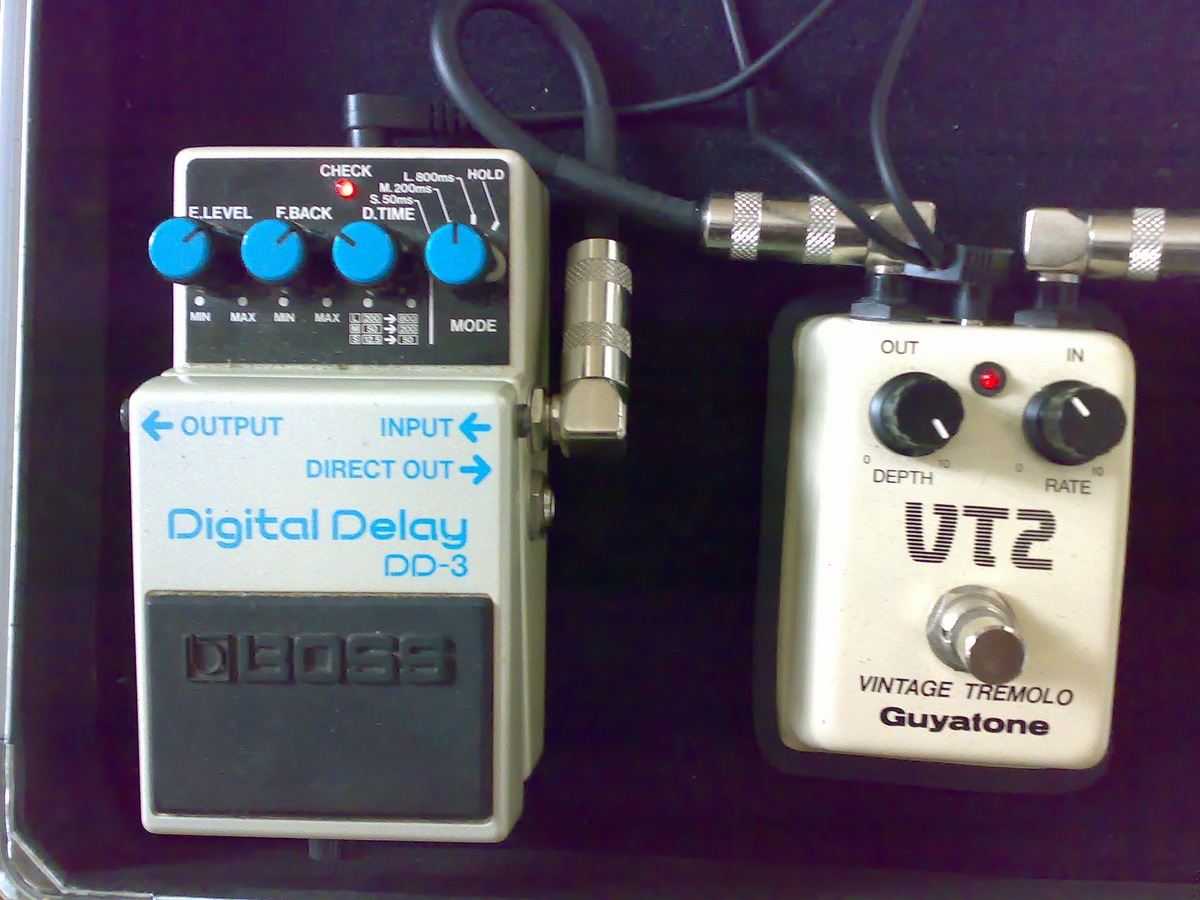
Boss DD-3 Digital Delay beside a Guyatone VT2 Vintage Tremolo. Photo: Boss and Guyatone by Adrian F (adrianfurby), CC BY 2.0 (https://creativecommons.org/licenses/by/2.0/). Full frame resized and JPEG re-encoded. Source: https://www.flickr.com/photos/adrianfurby/1806632129/
Boss DD-3 Digital Delay: launched 1986, still on pro boards today. Gilmour, Morello, Bonamassa — here's the full history, specs, and tone guide.
Some pedals get discontinued and quietly disappear into the secondhand market. Others hang around for a decade or two on legacy reputation before something better takes their place. And then there is the Boss DD-3 Digital Delay, which launched in 1986, outlasted every competitor of its era, survived four complete circuit redesigns, and in 2019 got a tap-tempo upgrade and a new model designation rather than a retirement party. Guitar World’s Chris Gill — whose June 2026 history of the DD-2/DD-3 remains the definitive account — put it simply: everyone who is anyone has used one at some point in their careers.
That’s not marketing. Joe Bonamassa still keeps one on his board. Tom Morello never left. David Gilmour has used the DD-2 (the DD-3’s direct predecessor and circuit-identical twin) in two-pedal stereo configurations across multiple world tours. Brad Paisley, Nels Cline, Eric Johnson, Billy Duffy — the list reads like a wristband guest list at a festival spanning five decades of guitar music. None of them kept it because there was nothing better available. They kept it because it does something specific that better-on-paper alternatives often fail to deliver: it makes delay sound like it belongs in the music, not on top of it.
This is the full account. Where the DD-3 came from, why the circuit sounds the way it does, which players use it and how, which version to buy used, and the truth about a certain Irish guitarist whose name comes up in every DD-3 tutorial — even though he actually used completely different gear.
From Rack to Stompbox: The DD-2 Origin Story
To understand the DD-3, you have to understand what Boss pulled off in 1983 with the DD-2. Digital delay existed before that point, but it existed in rack units — expensive, heavy, professional studio equipment that working guitarists couldn’t afford and couldn’t fit on a pedalboard. The Boss SDE-3000 rack unit was the pinnacle: a full-featured professional digital delay using a custom 63H101 CMOS gate array integrated circuit. It sounded superb and cost accordingly.
The DD-2 put the same 63H101 chip into a compact stompbox format. Not a simplified version, not a scaled-down approximation — the same primary delay chip, in the same orange enclosure Boss had been using since 1977. Launched at around $200, it was expensive for a compact pedal in 1983, but it was transformative. Guitarists who had been running tape units, bucket-brigade analog delays with their characteristic degradation, or cheap digital rack units that sounded brittle and cold suddenly had access to something that sounded genuinely musical at a price that was at least theoretically attainable.
The DD-2 had four controls — Effect Level, Feedback, Delay Time, and a four-position Mode selector — and a pair of output jacks. The main jack delivered a mixed wet/dry signal in standard operation; with a cable plugged into both outputs, the main jack switched to delay-only and the second jack became dry-only, enabling true stereo rig configurations. David Gilmour would exploit exactly this architecture, running two DD-2s simultaneously.
Three years later, in 1986, the cost of the 63H101 chip dropped dramatically. Rather than simply cut the price of the DD-2 (which would have implied it had been overpriced all along), Boss rebranded the pedal as the DD-3, lowered the list price, and made a minor cosmetic update to the enclosure. The circuit inside was, for the first production batch, completely identical to the DD-2. This is why long-chip DD-3 units — identifiable by the external power supply jack cutout in the bottom housing and the large IC spanning the full width of the circuit board — are collected as aggressively as DD-2s, and why Guitar World’s Chris Gill groups the two pedals together when listing famous users. For all practical purposes, early DD-3 = DD-2.
Version History: Four Circuits, One Name
The DD-3 is not, and has never been, a single consistent product. Over its production life from 1986 to the present day (continuing as the DD-3T), the internal circuit went through four substantially different designs. Understanding the versions matters when you’re buying used.
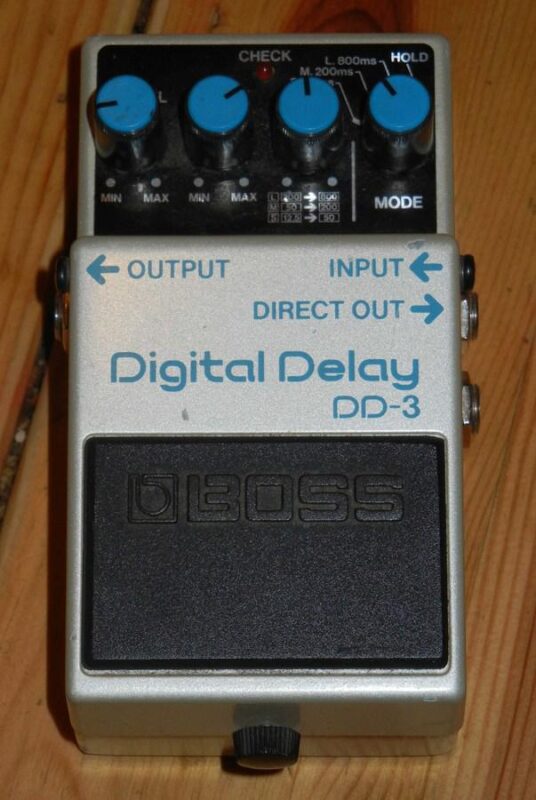
Version 1 (1986 to approximately the early 1990s) is the long-chip unit: the same 63H101 CMOS gate array as the DD-2, manufactured in Japan, with the distinctive external power supply jack and a circuit board covered in hand-wired connections. The Mode selector sits independently from the other three pots, which are ganged on a small sub-board. This is the version that serious collectors and discriminating players want. It commands $200–400 on the used market, sometimes considerably more.
Version 2 — which Boss officially designates the DD-3(A) — arrived as the long chip became too expensive to manufacture. Boss completely redesigned the circuit board around a new square IC chip, eliminated the hand-wiring, and extended the pot sub-board to accommodate the Mode selector. Early V2 units retained the external power jack; later production switched to the modern internal (PCB-mounted) jack. These began as Made in Japan and later transitioned to Taiwan. The circuit sounds slightly different — a touch brighter and cleaner — but is still considered excellent by most players.
Version 3 appeared in 2002 with a fully double-sided PCB and mostly surface-mount components, enabling faster, cheaper construction. These are the Made in Taiwan units that most players encounter in the $60–80 used range. The sound is more precise and less warm than earlier versions — the characteristic “lo-fi grit” of the 12-bit conversion process is still present, but the overall character is a bit colder.
Version 4 arrived around 2014 with a new DSP-based Roland delay chip replacing the DRAM architecture of previous versions. These produce slightly darker repeats and represent a further refinement of the circuit. Production remained in Taiwan.
The DD-3T — the current version, launched 2019 and Made in Malaysia — adds a tap-tempo input (allowing an external footswitch to set delay time) and moves the Direct Out jack to the left side of the enclosure to make room. Boss describes the rest of the circuit as unchanged from Version 4. This is the pedal currently available new.
Why the Circuit Sounds the Way It Does
The DD-3 is frequently described as a “digital delay with an analog character,” and that description is technically precise, not marketing language. Understanding why requires a brief look at what “12-bit with analog feedback” actually means in practice.
The pedal’s signal path splits incoming audio: one path goes directly to the output stage (the dry signal), while a portion is routed into the digital delay circuit. Inside that circuit, the signal is converted from analog to digital at 12-bit resolution — not CD quality, which runs at 16 bits, but considerably less. The conversion is, by modern standards, slightly crude. Quantization noise, minor aliasing artifacts, and subtle compression are baked into the conversion process itself.
Here is where the “analog feedback” part becomes crucial. The delayed output from the chip is not simply summed with the dry signal and sent to the output. A portion of that delayed signal — controlled by the Feedback knob — is routed back into the input of the delay circuit for another pass. And with each pass, the signal goes through the same 12-bit conversion process again. Each repeat picks up a fresh layer of quantization artifacts, a slight softening, a progressive darkening. The repeats decay not just in volume but in character, getting progressively warmer and rougher. This is the opposite of what a purely digital delay system with internal feedback would produce, and it is the single largest reason the DD-3 sounds more musical than many technically superior designs.
The frequency response ceiling of approximately 7kHz also contributes. High-frequency content above that point is simply not reproduced in the delayed signal. Guitar sits primarily below 6kHz anyway, and the gentle rolloff means delay repeats never harshly compete with the dry signal’s attack transients. Long chip versions (V1/DD-2) have a slightly different rolloff characteristic — the 63H101 chip was rated for 10Hz to 8kHz input, and the output path was tuned differently — which is a significant part of why those units sound warmer than later V3/V4 production.
Specifications
Famous Players
David Gilmour
David Gilmour’s relationship with the Boss DD series is extensively documented across his pedalboard configurations. From the 1984 About Face sessions, through The Division Bell, Royal Albert Hall, On an Island, and Rattle That Lock — Gilmour ran Boss DD-2s as primary delay sources. On multiple rigs he ran two simultaneously: one set to a 3/4 rhythm delay and one at 4/4, creating the layered ambiance that defines his post-Waters solo work. Gilmourish documents the About Face 1984 live rig as using two DD-2s on a Boss SCC-700 pedalboard.
Gilmour’s preference is specifically for the DD-2 rather than later DD-3 variants — he has described its sound as “warm, almost analog-sounding digital delay” and preferred it to subsequent DD iterations he found brighter. Guitar World’s Chris Gill, in his June 2026 authoritative history of the pedal, names Gilmour among the discriminating players who “still keep their original DD-2 or long chip DD-3 delays on their pedalboards.” Since the long chip DD-3 V1 is circuit-identical to the DD-2, the distinction is primarily semantic — they are the same pedal.
Tom Morello
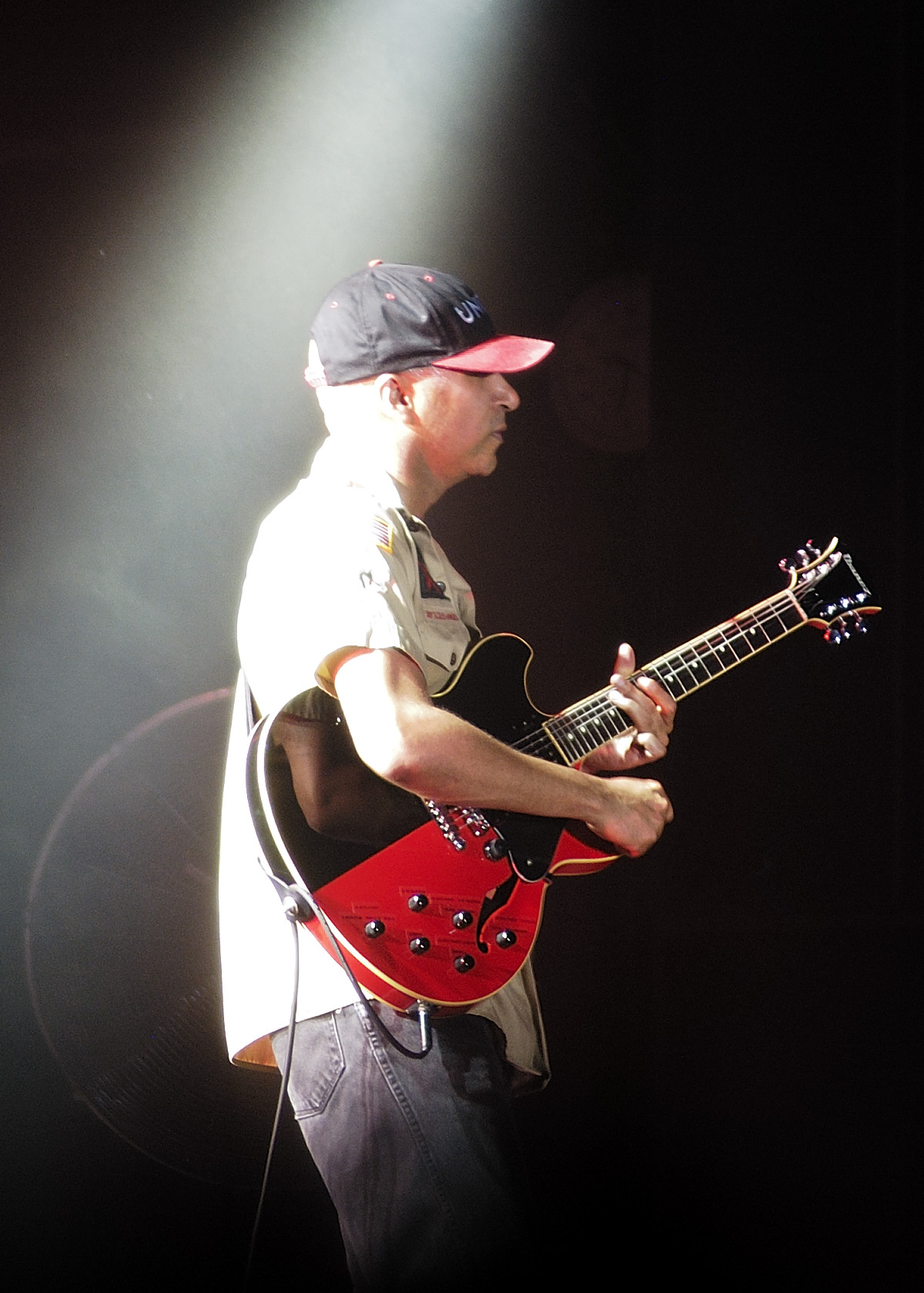
Few guitarists have weaponized the DD-3 as systematically as Tom Morello. Where most players use delay as a background texture or a note-extension tool, Morello has turned the DD-3 into a rhythmic instrument in its own right — setting feedback high, using the Hold function for loops, or exploiting the pedal’s specific timing characteristics to create the synthesizer-like stuttering textures that defined Rage Against the Machine’s sound. Guitar World (Chris Gill, June 2026) confirms his continued DD-3 use across studio and touring work.
Joe Bonamassa
Joe Bonamassa is a collector and connoisseur of vintage gear across the board, and his delay preferences reflect the same vintage bias: he keeps an original DD-2 or long chip DD-3 on his board, confirmed by Guitar World June 2026. For a player whose rig is otherwise dominated by boutique and vintage pieces, the continued presence of a Boss compact pedal says something specific about what those long-chip units do that modern alternatives don’t replicate.
Brad Paisley
Brad Paisley’s use of Boss digital delay is characteristic of how country players approach the pedal — as a precision tool for slap-echo textures that snap behind the beat without blurring the note definition that defines clean Telecaster playing. Guitar World June 2026 lists him among players maintaining DD-2 or long chip DD-3 units on current rigs.
Nels Cline
Nels Cline‘s pedalboard is one of the most extensively documented and analyzed in guitar journalism, and the DD-3 (confirmed Guitar World June 2026) sits within a larger ecosystem of delays and modulation sources that he uses with Wilco and in his solo work. The DD-3’s reliability and predictability — the fact that it responds identically every time — makes it a functional anchor in rigs that include more unpredictable effects.
Billy Duffy
Billy Duffy‘s clean-channel work with The Cult has long relied on delay for the sustained, atmospheric quality of songs like “She Sells Sanctuary.” Guitar World’s June 2026 DD-2/DD-3 history names him among confirmed users. The same article had earlier confirmed his CE-2 Chorus use in the same era, establishing Duffy as a particularly thorough Boss compact user during the period when those pedals defined a certain strain of British post-punk guitar tone.
Eric Johnson
Eric Johnson‘s obsession with tone is well-documented — he is the guitarist who can hear the sonic difference between battery brands. His confirmed use of the DD-2/DD-3 (Guitar World June 2026) is therefore a statement: for delay, the Boss compact does something he can’t improve on with alternatives. Given his known preference for vintage gear and his sensitivity to subtle sonic qualities, the long-chip warmth is almost certainly the version he runs.
The Edge: The Most Misunderstood Connection in DD-3 History
This section requires a correction that every DD-3 article should make plainly. The Edge is the guitarist most frequently invoked when people discuss the DD-3’s capabilities. YouTube tutorials for “Edge-style dotted eighth notes on DD-3” number in the hundreds. The pedal’s own users and advocates regularly cite his playing as the sound they’re after.
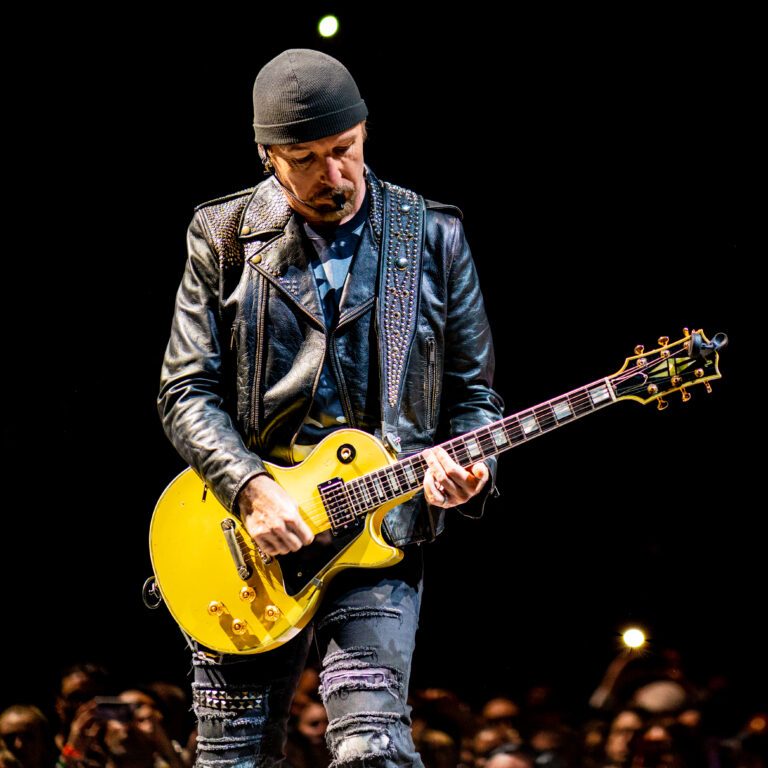
The Edge has never, to any documented or confirmed extent, used the Boss DD-3 as a primary rig component.
His actual delay history runs as follows: in the early 1980s, he used a pair of Electro-Harmonix Deluxe Memory Man analog delays, which produced the signature swell and oscillation of U2’s early albums. By the time of The Joshua Tree in 1987, he had moved to TC Electronic TC 2290 Digital Time Processors — rack units with considerably more precision and flexibility than any compact pedal. His touring rig from that period included multiple 2290s plus Korg SDD-3000 digital delays. His current rig continues with TC 2290s, SDD-3000s, and Fractal Audio processing. The DD-3 does not appear at any confirmed point in this chain.
What is true is that the DD-3 is, on a practical level, an excellent approximation tool for players who want to dial in dotted-eighth delay textures in the style of The Edge’s playing. At the tempo-appropriate settings — delay time calculated at dotted-eighth values, moderate feedback, effect level at or just below unity — the DD-3 produces a convincing version of those rhythmic cascade patterns. But it produces them because the technique works on virtually any reliable digital delay, not because The Edge validated the specific hardware.
Signal Chain Placement
Standard placement for the DD-3 is after drive and modulation pedals, before reverb, either at the end of the pedalboard or in the amp’s series effects loop. Both positions work; the choice depends on what you’re optimizing for.
Placed in front of the amp, the DD-3’s output — 35 mA draw, buffered bypass, 1MΩ input impedance — is compatible with the rest of a standard pedalboard chain without impedance issues. Its buffer is clean and beneficial: unlike the Klon Centaur’s always-on buffer, which some players dial in deliberately for its tonal contribution, the DD-3 buffer is intentionally neutral. The delay repeats hit the front of the amp and go through the full gain and EQ structure — if you’re running an overdriven amp, those repeats will distort alongside your dry signal, which can sound either musical or chaotic depending on the gain level.
In the effects loop, the DD-3 sits after the amp’s preamp section. Delay repeats stay clean and separated from the amp’s distortion character. This is the technically correct position for ambient and rhythmic delay applications, and it’s where working musicians with effects loops usually run it.
The Cry Baby wah typically precedes the DD-3 in front-of-amp rigs; the wah’s sweep is then “recorded” by the delay and repeated, which at moderate feedback settings creates interesting harmonic artifacts. With the wah fixed in position rather than sweeping, this combination can produce cocked-wah delay textures similar to what Morello achieves with fixed filter positions on his chain.
The Direct Out jack deserves attention as a practical tool. With a cable in the Direct Out, the main output switches to delay-only signal. This enables a genuine wet/dry rig — dry guitar signal to one amp, delay-only to another — without a mixer or additional routing hardware. Gilmour’s two-DD-2 stereo configuration used exactly this function, with each pedal contributing a different rhythmic delay value to its respective amp.
Tone Recipes and Settings
Rockabilly Slapback
Mode: Short. Delay Time: approximately 7–8 o’clock (around 60–80 ms). Feedback: minimum (single repeat only). E. Level: matched to dry signal volume. This is the tape-slap simulation the DD-3 does effortlessly — one distinct, clean repeat that adds punch and dimension to single-note lines without cluttering the sound. Works best with Telecaster into a clean amp.
Gilmour Floating Lead
Mode: Long. Delay Time: approximately 380–400 ms (around 1–2 o’clock). Feedback: 9 o’clock (two to three repeats, decaying naturally). E. Level: below dry (around 9 o’clock). Run before a clean boost or light overdrive. The longer delay time creates the sustained, atmospheric quality of Gilmour’s solo lead tones. A second DD-3 or similar delay at a shorter time (120–150 ms) in parallel produces his full stereo ambiance. Feed this setup into a loud, relatively clean amp — the volume does work the delay circuit cannot.
Dotted-Eighth Rhythmic Texture
Mode: Short or Medium depending on tempo. Delay Time: set to dotted-eighth of your song’s tempo — calculate as (60,000 / BPM) × 0.75 in milliseconds. At 120 BPM that’s 375 ms (Medium mode). Feedback: 10–11 o’clock (three to four repeats). E. Level: at or slightly above unity. This is the “Edge-style” texture that has made the DD-3 tutorial-famous. Repeated with a clean Stratocaster into an AC30-style amp, it produces exactly the rhythmic cascade that defines that playing style. This setting works with any reliable digital delay — the DD-3’s particular contribution is that the 12-bit repeats decay gracefully rather than repeating with clinical precision.
Morello Rhythmic Stomp
Mode: Medium. Delay Time: set by ear to 1/8th or 1/4 of tempo. Feedback: 2–3 o’clock (borderline self-oscillation). E. Level: near maximum. Use the Hold function (footswitch held down) to capture a phrase and loop it indefinitely, then play over the top. This is how Morello turns the DD-3 from an echo pedal into a rudimentary looper and generates the synthesizer-like sustained textures of tracks like “Killing in the Name.” The analog feedback path means the held loop gradually degrades — a feature, not a bug.
Ambient Wash
Mode: Long. Delay Time: maximum or near maximum (700–800 ms). Feedback: 2–3 o’clock. E. Level: below unity (8–9 o’clock). The 12-bit degradation is most audible at this setting — repeats become progressively more textured and warm as feedback increases. Stack with a plate reverb in the loop after the DD-3 for full ambient territory. The DD-3 will not self-oscillate as dramatically as some analog delays, but at high feedback settings it approaches a usable borderline without runaway.
DD-3 vs. The Competition
DD-3 vs. Boss CE-2 Chorus
The Boss CE-2 is the DD-3’s direct era-contemporary, sharing the same compact format and Japanese manufacturing heritage from the same period. Where the CE-2 adds modulation — a slight pitch variation that creates the “shimmer” of chorus — the DD-3 produces straight time-based repetition. They are designed to be run in the same chain: CE-2 before the DD-3 is the classic sequence, with modulation “printed” into the dry signal before the delay picks it up and repeats it. This is the signal path that defined a significant strand of 1980s clean-tone guitar playing.
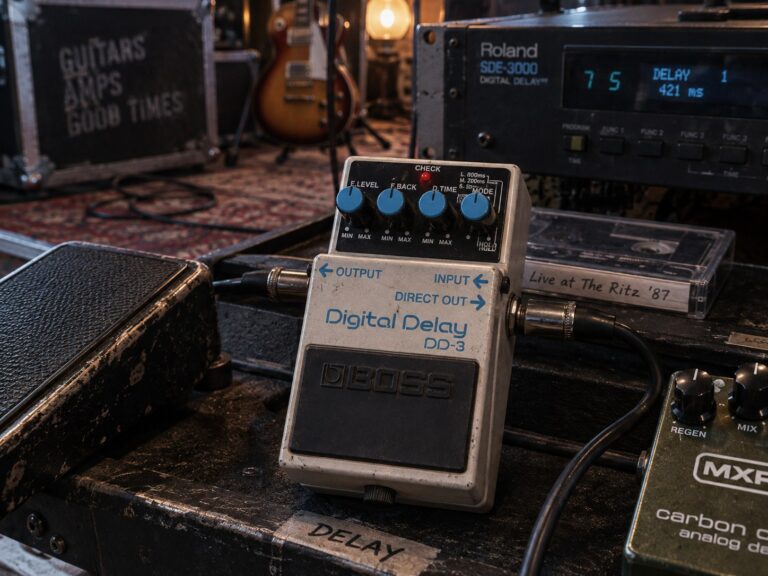
DD-3 vs. MXR Carbon Copy Analog Delay
The debate between digital and analog delay is older than the DD-3 itself. Analog delays — the Carbon Copy being the modern standard-bearer — use bucket-brigade device chips that produce inherently warm, self-degrading repeats with a gentle high-frequency rolloff that makes them blend naturally into a mix. The DD-3’s repeats are cleaner and more defined in comparison, with its own characteristic degradation from the 12-bit architecture. In direct comparison, analog delays feel warmer and less precise; digital delays like the DD-3 produce repeats that sit more distinctly behind the dry signal. Neither is objectively better — they serve different purposes. Slapback and slap-enhanced lead playing tend to favor the digital definition of the DD-3; warm, ambient, touch-sensitive playing tends to favor analog.
DD-3 vs. Electro-Harmonix Deluxe Memory Man
The Deluxe Memory Man is the analog delay that The Edge actually used during U2’s formative period — and it is a fundamentally different instrument from the DD-3. The Memory Man has a modulation section (chorus/vibrato) that is baked into the repeats, a maximum delay time considerably shorter than the DD-3’s 800 ms ceiling, and a tonality that degrades musically with long feedback tails in ways the DD-3 doesn’t fully replicate. Comparing them directly is somewhat category confusion: they are both delay pedals the way a Telecaster and a Les Paul are both electric guitars. The DD-3 is the precision, high-ceiling, clean-defined option; the Deluxe Memory Man is the warm, modulated, character-heavy option. Players choosing between them are generally choosing between different aesthetics rather than competing implementations of the same function.
DD-3 vs. DD-3T (Current Production)
The DD-3T is the current Boss compact digital delay. Its circuit is described by Boss as the same as V4 of the DD-3, with the addition of tap-tempo functionality via a TRS jack accepting an external footswitch. The Direct Out jack moved to the left side to make room. For practical purposes, the DD-3T is strictly better than the V3/V4 DD-3 — same sound, better tempo accuracy. The only argument for the older versions over the DD-3T is cost (used V3 DD-3 can be found for $60 vs. $130+ for the DD-3T) or the specific preference for the long-chip V1 sound, which is a genuinely different-sounding instrument.
Buying Guide
The choice between DD-3 variants comes down to what you’re optimizing for.
If you want the current production pedal with tap tempo and reliable warranty coverage, the DD-3T is the answer at approximately $130–145 new. It does everything the V3/V4 DD-3 does, plus tap tempo, and Boss’s build quality means it will outlast virtually any competing product at the same price point.
If you want a budget DD-3 for a working pedalboard, Version 3 or V4 units are available used in excellent condition for $60–80. Inspect the pots for scratchy behavior and test the Mode selector. These are well-built pedals and the circuit is solid; players who claim V3 sounds bad are usually comparing to long-chip units in A/B conditions, not using V3 in isolation in an actual mix.
If you want the long-chip experience — the “warm, almost analog” quality that Gilmour, Bonamassa, and Johnson have chosen over everything else — expect to spend $200–400 for a clean V1 DD-3. The external power jack cutout in the bottom plate is the easiest identification: if the power jack sits in a rectangular cutout on the side of the bottom housing (rather than poking through a round hole), it’s an early unit. Opening the pedal reveals the massive 63H101 chip spanning the full PCB width. Test before buying; pots and the Mode selector mechanism are the common wear points at this age.
For the DD-2 specifically — the original 1983 predecessor — budget $250–500 for a functioning example in good condition. In a blind test, the DD-2 and V1 DD-3 are indistinguishable. The DD-2 carries a price premium that reflects rarity and historical cachet rather than sonic superiority. The V1 DD-3 is the pragmatic choice for players who want the circuit without the collector tax.
Ownership Notes
The DD-3’s 35 mA current draw is moderate by compact pedal standards — lower than a digital multi-effect but higher than simple analog pedals. It runs on standard 9V DC center-negative; the PSA adapter Boss has used since the 1980s remains the correct choice. High-quality regulated supply recommended — the buffered bypass circuit is sensitive to power supply noise in ways that all-analog circuits are less affected by.
The Mode selector is the most mechanically vulnerable component in long-term use. In V1 units where it sits independently from the other pots, the wiring connections can loosen over decades. Clean operation of all four mode positions before purchasing is essential.
The Hold function warrants attention. Holding the footswitch down (rather than tapping) captures a loop of audio equal to the current Delay Time setting and plays it back continuously. Delay Time set to maximum (800 ms) gives approximately 0.8 seconds of looped audio. This is a primitive looper, not a performance tool — but Morello has demonstrated it’s enough for specific textural purposes.
Tap tempo is absent on all DD-3 versions (present only on the DD-3T). Players who use delay rhythmically and need precise tempo-matching either calculate delay time manually using the formula above, use the DD-3T, or add a tap-tempo interface pedal (the Boss FS-5U will not work; you need a unit that sends a mono TS plug with momentary switching to the DD-3T’s external tap jack).
Running the DD-3 in front of a Boss DS-1 or similar hard-clipping distortion means the distortion pedal sees clean, buffered input — the DD-3 buffer is compatible and beneficial here. The reverse (DS-1 into DD-3) is the standard and correct sequence for distorted-with-delay rigs: drive first, then time-based effects. Putting delay before distortion means the repeats get distorted too, producing a smeared, compressed effect that is occasionally useful but usually not what players want.
Frequently Asked Questions
What is the difference between the Boss DD-2 and DD-3?
The DD-2 (1983) and the first version of the DD-3 (1986) are the same pedal internally, using the same 63H101 CMOS gate array chip. Boss renamed and repriced the pedal when the chip’s manufacturing cost dropped in 1986. Later DD-3 versions (from approximately the early 1990s onward) use different, more modern chips and sound somewhat brighter. The DD-2 commands a price premium that reflects its rarity and historical status rather than a genuine sonic difference over a V1 DD-3.
Did The Edge from U2 actually use the Boss DD-3?
No confirmed documentation exists of The Edge using the DD-3 as a primary rig component. His delay history runs from EHX Deluxe Memory Man (early 1980s) to TC Electronic TC 2290 and Korg SDD-3000 (from the late 1980s onward). The DD-3 is an excellent tool for approximating the dotted-eighth rhythmic delay style he pioneered — but the technique works on any reliable digital delay, and The Edge’s specific hardware was different gear entirely.
What are the four modes on the DD-3?
The Mode selector cycles through Short (12.5–50 ms), Medium (50–200 ms), Long (200–800 ms), and Hold. Short covers slap-echo and tight doubling. Medium handles rhythmic delay at most tempos. Long enables ambient and multi-second cascade effects. Hold captures a loop for continuous playback — it’s a basic looper function, not a full performance tool.
How do I calculate the right delay time for dotted-eighth notes?
The formula is: delay time in milliseconds = (60,000 ÷ BPM) × 0.75. At 100 BPM the dotted eighth is 450 ms (Long mode, around 11–12 o’clock). At 120 BPM it’s 375 ms (Medium mode near maximum). At 140 BPM it’s approximately 321 ms (Medium mode, around 3 o’clock). The DD-3’s continuous Delay Time knob allows precise dialing once you know the target value.
What version of the DD-3 should I buy?
For a working pedalboard on a budget: a V3 or V4 DD-3 used for $60–80. For the current production model with tap tempo: the DD-3T new at $130–145. For the “vintage warm” character players like Gilmour and Bonamassa prefer: a V1 long-chip DD-3 or original DD-2 at $200–400+. The V1 and DD-2 are circuit-identical; the V1 is the pragmatic vintage choice.
Can I use the DD-3 in a stereo rig?
Yes, and Boss designed it for this purpose. With cables in both output jacks, the main output delivers delay-only signal and the Direct Out delivers dry-only signal. Feed these to two separate amps for a genuine wet/dry stereo setup — no mixer required. David Gilmour used two DD-2s this way, with each pedal set to a different delay time, routing to separate amp stacks. The DD-3T maintains this architecture.
Why does the Boss DD-3 sound warmer than other digital delays?
Two reasons. First: the 12-bit analog-to-digital conversion is lower resolution than modern digital audio, introducing subtle quantization artifacts that sound like warmth and slight compression when heard in musical context. Second: the analog feedback path means each delay repeat is re-converted through the same 12-bit process, accumulating degradation naturally with each pass rather than simply reducing in volume. Later versions of the DD-3 (V3/V4) use more modern chips and sound noticeably cleaner; the “warm” quality is most pronounced in long-chip V1 units and the DD-2.
What is the Hold function on the Boss DD-3?
Holding the footswitch down (rather than tapping it) engages Hold mode, which captures a segment of audio equal to the current Delay Time setting and plays it back continuously as long as the switch is held. Release the switch and the loop stops. With Delay Time at 800 ms, you can capture approximately 0.8 seconds of audio. The looped signal is subject to the same 12-bit conversion degradation as regular repeats and will gradually change character over time — it is not a clean looper but a textural tool. Tom Morello has used this function as a compositional element in live performance.
Image credits
- Tom Morello: deep ghosh, Wikimedia Commons, CC BY 2.0.
- Top image: Boss DD-3 Digital Delay beside a Guyatone VT2 Vintage Tremolo. Photo: Boss and Guyatone by Adrian F (adrianfurby), CC BY 2.0. Full frame resized and JPEG re-encoded.
- Boss DD-3 Digital Delay: photo by JuandiLOL, via Wikimedia Commons, CC BY-SA 3.0.
- The Edge: by Joe Ahorro, Wikimedia Commons, CC BY-SA 4.0.
- Boss DD-3 Digital Delay: GuitarGangsters AI-generated reference illustration, not a photograph.
Latest News
Related
On This Day
Tuesday 10 November
From this week: