Vemuram Myriad Fuzz: The Brass Box That Started Life As Half Of Something Bigger
Vemuram Myriad Fuzz guide: the germanium-silicon hybrid explained, the bias trimmer decoded, verified players, tone settings and 2026 buying advice.
Almost every fuzz pedal ever built is an argument about one transistor family. Germanium is warm, woolly, temperature-flaky and cleans up like a dream. Silicon is loud, spitty, aggressive and reliable. You pick a side, you buy the pedal, and you spend the next decade quietly wishing it did the other thing on Tuesdays.
The Vemuram Myriad Fuzz refuses to pick. It puts a silicon transistor and a vintage germanium transistor in the same signal path, gives you a knob called Feel to move between their characters, and hides a trimmer inside the enclosure that biases the germanium side to taste. It is hand-built in Tokyo, wrapped in solid brass, and it costs more than most people’s first amplifier.
It is also, unusually for a signature pedal, the leftover half of a much stranger machine — and the guitarist whose name is on it has been photographed using it on his own board for years, which is more than can be said for a lot of endorsements. This is the full story: where the circuit came from, what every control actually does, who genuinely plays one, how to dial it in, and whether the brass justifies the invoice.
The short version
The Myriad Fuzz is a hybrid germanium/silicon fuzz, hand-built by Vemuram in Tokyo in a solid brass enclosure, developed with American blues guitarist and producer Josh Smith. It has four external knobs — Level, Fuzz, Feel and Tone — plus an internal Germanium Bias trimmer. It runs on a 9-volt battery or a standard centre-negative 9 V supply, is true bypass, and draws a startlingly small amount of current.
Its selling point is range. At low Fuzz settings with the Feel knob backed off it behaves like a thick, saturated overdrive with enormous output on tap. Wound up, it goes into Big Muff territory without the mid-scoop, and it retains a low end that vintage Fuzz Face circuits simply do not have. It cleans up off the guitar volume knob the way good germanium fuzzes do, but it does it without the volume drop and tonal collapse that usually comes with that trick.
As of September 2026 it is a $435-and-up pedal in the United States, with Equipboard tracking an average across merchants of $462 and a spread up to roughly $558. It sits in the top price tier of the fuzz category, and it knows it.
Who Josh Smith is, and why the pedal exists
The résumé
Josh Smith was born in Middletown, Connecticut on 7 October 1979 and raised in Fort Lauderdale, Florida. He picked up a guitar at seven, was playing blues festivals at ten, and was making albums at fourteen. By eighteen he had three records out. At sixteen he toured the United States with his band the Rhino Cats, who released Born Under a Blue Sign and Woodsheddin’; at eighteen he formed the trio Josh Smith and the Frost, whose Too Damn Cold was produced by Jim Gaines — the man behind Stevie Ray Vaughan‘s In Step.
At twenty-two he married and moved to Los Angeles, where he became one of the busiest sidemen and session guitarists in the city, cutting tracks for Taylor Hicks, Ricky Fanté and Raphael Saadiq among many others. He now runs Flat V Studios and has produced records for Eric Gales, Joanne Shaw Taylor, Joanna Connor, Reese Wynans, Larry McCray, Marc Broussard, Artur Menezes, Andy Timmons and Joe Bonamassa. Guitar World placed him sixteenth on its 2019 list of the thirty best blues guitarists in the world today; Rock and Blues Muse put him in its top fifteen contemporary blues rock guitarists for 2020.
Why a session producer wanted this particular fuzz
Smith’s own account of the pedal’s origin is unusually specific, and it is worth quoting because it explains the design brief better than any dealer copy: “The Myriad fuzz started life as one half of my larger Myriad pedal. When it started to become clear how great the fuzz sounded we knew it would need to be released on its own. This is the fuzz I’ve had in my mind for over 10 years.”
Ten years of wanting a fuzz, from a man who spends his working life deciding whether a guitar part fits in a mix, produces a very particular set of priorities. He wanted something that would clean up like vintage germanium, because a session player needs one pedal to cover three parts. He wanted a genuine tone control, because fuzz that only works in one room is useless on a deadline. And he wanted volume — “a large amount of volume on tap,” in his words — because the classic Fuzz Face problem is that it barely reaches unity gain and cannot push an amp.
What he did not want, and this is the interesting part, was simplicity for its own sake. His own description ends: “It is incredibly tweak-able but never complicated. There is no bad sounds in this pedal. No matter where you set the knobs you get great tone.”
Where the Myriad Fuzz came from
The big box came first
The pedal most people mean when they say “Myriad Fuzz” is the compact four-knob unit. But the name belongs first to a much larger device — the Myriad, sometimes catalogued as the Myriad “Big Box” Wet/Dry Fuzz — which Josh Smith demonstrated at the Vemuram booth at Winter NAMM on 17 January 2020, and which Equipboard dates to 2020 in a brass finish.
The Big Box is not really a fuzz pedal. It is a fuzz pedal wearing a routing system. It carries a dedicated effects loop, two outputs, an expression pedal input and a wet/dry mixer, and its control set runs to WET-LV (Fuzz + Loop), MIX, FUZZ-LV, GAIN, TONE and FEEL, plus toggles for OUT2-GND and for sending the fuzz to output 1 or output 2, push switches for loop phase and output 2 phase, and two footswitches — one for the fuzz, one for the loop. Guitar Part’s French review measured it at 140 x 97 x 50 mm and 750 grams and put its draw at 18.1 mA.
Smith’s stated goal for it was two-amp creativity: “I wanted a way to be creative in a two amp situation, this pedal cracks the code on creativity by giving you literally ‘myriad’ of routing options and possibilities. Plus, in my opinion the best fuzz pedal in the world.” Vemuram says the Myriad took over two years of development.
In practice you can run the fuzz into amp A and a dry signal into amp B; send the looped effect to one side and the untreated signal to the other; or combine fuzz and loop on A while B stays clean — with the balance set by the Mix knob or an expression pedal. Guitar Part’s reviewer, Samy Docteur, was enthusiastic about the sound and blunt about the practicality: brilliant if you tour two amps, an expensive irrelevance if you don’t. It was €629 in France in April 2021. Equipboard currently tracks the Big Box from $1,115.30, which tells you how few of them exist.
Then they split it in half
The compact Myriad Fuzz is the fuzz circuit from that machine, sold on its own. Peach Guitars’ own headline for it is simply “Taken Straight From The Vemuram Myriad” — which is the clearest possible statement of the lineage from a dealer that carries both.
A dating conflict worth flagging. Equipboard’s spec block lists the compact Myriad Fuzz as “available since March 2019” — a figure that traces back to European retail cataloguing. That date sits awkwardly against a big box demonstrated at NAMM in January 2020, since Smith’s own quote says the compact came after the big one. Two readings are possible: either the Big Box existed and was being sold quietly well before its NAMM appearance and the compact followed within a year, or the March 2019 date is a catalogue artefact rather than a release date. Note also that the same “March 2019” appears on the Vemuram Shanks ODS-1’s listing at the same retailer, which makes a shared cataloguing event look more likely than a genuine coincidence. This article does not settle it. Treat 2019–2020 as the window and treat any source that states a precise launch date with confidence as overreaching.
Specifications
Two published spec conflicts, stated openly
Current draw. Mass Street Music’s spec block, which reproduces Vemuram’s own figures, states 1.9 mA. Equipboard’s description block states 19 mA. One of these is a decimal point away from the other, and the balance of evidence favours 1.9 mA — a two-transistor fuzz with no LED-heavy circuitry has no business drawing nineteen milliamps, and the Big Box, with its loop, mixer and two outputs, only draws 18.1 mA. Assume 1.9 mA. In practical terms it barely matters: at either figure the pedal will run for a very long time on a battery and will not trouble any power supply.
Dimensions. Mass Street lists 65 x 112 x 30 mm. Other listings circulate a 70 x 113 x 50 mm figure — which is very close to the Shanks ODS-1’s published 70 x 112 x 50 mm, and looks like it has been copied across from a sibling product. The 30 mm height is almost certainly the enclosure body without knobs and jacks. Either way the footprint is standard-pedal-sized and it will fit on any board.
One dealer error that has propagated
Mass Street Music’s Myriad Fuzz page closes with the sentence “Made in Tokyo, Japan, the Jan Ray features a heavy brass body for noise reduction.” That is a copy-paste from their Vemuram Jan Ray page. The claim about brass and Tokyo is true of the Myriad Fuzz; the model name is not. If you find that sentence quoted elsewhere as evidence of something, it is evidence of a content management system.
What every control does
Level
Output volume, and there is a lot of it. This is the control that separates the Myriad from vintage-correct Fuzz Face designs, which struggle to reach unity. Owners consistently describe the available output as excessive in the best sense — you can use the Myriad as a fuzz-flavoured boost into an already-cooking amp, which is not something you can do with most germanium boxes.
Fuzz
Gain. The range is genuinely wide: low settings give a thick, slightly compressed overdrive; high settings give a saturated, sustaining wall. Owners report a spitty, gated quality appearing at the very top of the sweep, which is a feature rather than a fault if you want that vintage decay stutter.
Feel
The important one, and the least self-explanatory. Feel moves the pedal’s character across the germanium/silicon divide and interacts directly with the internal bias trimmer — Vemuram’s own wording is that the trimmer “allows you to control the Germanium Bias with the FEEL knob.” Practically: one end of the sweep is tighter, brighter and more silicon-like, more distortion than fuzz; the other is looser, warmer, spongier and more germanium-like. Owners describe it as the standout feature and note that its usable range shifts substantially depending on where the bias is set. It is small, which is the single most common complaint about the pedal’s ergonomics.
Tone
A conventional but effective treble control. Its presence is one of the design’s departures from tradition — the classic two-transistor fuzz has no tone control at all, and adding one is what makes the Myriad usable in a room you did not choose. Like Feel, it is a small knob, which owners find impractical on a dark stage.
The Germanium Bias trimmer
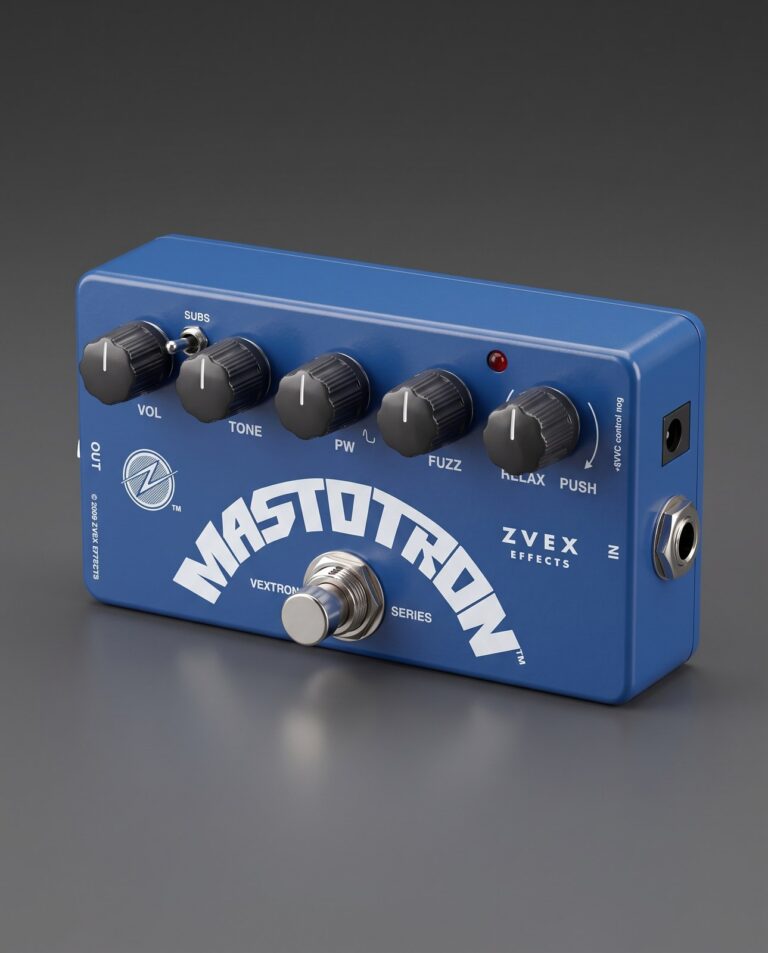
Inside the enclosure, adjusted with a small screwdriver. It sets the operating point of the germanium transistor, which is what germanium bias trimmers do on every fuzz that has one — the same job the internal blue trimpot does on an Analog Man Sun Face, and the same job the external knob does on a ZVEX Fuzz Factory.
Two honest caveats from owners. First, it requires opening the pedal, which means it is a set-once control, not a performance control. Second, the supplied documentation is thin on how to adjust it, and at least some owners report that with certain rigs the usable range is narrower than they expected. The generally reported result of biasing hotter is more attack and more clarity without losing body — and a meaningful number of owners simply never touch it and are perfectly happy.
Practical protocol: set it once, at your normal room temperature, with the guitar and amp you actually gig, with Feel at noon and Fuzz around three o’clock. Turn it in small increments, play the same phrase after each, and stop when the attack sharpens without the low end thinning. Then close the box and leave it alone. Germanium bias drifts with temperature — down in heat, up in cold — so a setting chosen in a cold rehearsal room will behave differently under stage lights.
What it actually sounds like
The consistent thread through owner reports is that the Myriad keeps clarity and low end where other fuzzes lose one or the other. Players coming from vintage Fuzz Face circuits report a much larger bottom end and far more volume and sustain. Players coming from Muff-style pedals report the saturation without the scooped mids.
The cleanup behaviour is the other repeated theme. Rolling back the guitar volume gives a glassy, articulate clean the way a good germanium fuzz does — but with, in owners’ words, superior usability, meaning you do not lose all your output in the process. That single property is why a session player wanted it: one pedal, three parts, no board changes.
It works with everything. Documented owner rigs include Suhr Classic S guitars with V60LP and SSV pickups, Les Paul Customs with 57 Classics, and Fender Custom Shop Strats with 60/63 sets, all reported as working well. Several owners note it particularly rewards high-headroom amps — a blackface-era Bandmaster comes up specifically — because the pedal’s own output is high enough to shove a clean amp somewhere interesting.
One reported party trick: stacked with an octave-flavoured pedal it will produce credible Octavia-style sounds, which is a reasonable way to get into Jimi Hendrix territory without buying another dedicated box.
Famous players: what actually holds up
Signature pedals attract inflated rosters. The Myriad Fuzz’s is small but unusually well-evidenced, with almost every entry tied to a photograph, a video timestamp or a magazine feature rather than a rumour. It also contains one clear error that needs correcting.
Tier 1 — the artist himself, on the record
Josh Smith. Not merely the namesake but a documented user. Guitar World’s 10 December 2021 pedalboard feature, built on Smith’s own Sweetwater breakdown video, places the Vemuram Myriad fourth in his signal chain: a TC Electronic Polytune 2 Noir, then the Myriad fuzz, then a Mythos Argonaut octave on the second layer, then the Lovepedal Tchula — his other signature pedal, which he calls his “main pedal” responsible for “95 percent” of what audiences hear live. After that comes a King Tone Soloist, a Chase Bliss Preamp MKII, a Poly Digit and a long-serving Eventide H9.
A correction to that article: Guitar World describes the Myriad as “a boutique silicon-and-germanium diode unit.” It is a transistor design, not a diode-clipping one — the distinction is the whole point of the pedal. The rest of the piece is excellent and remains the single best published source on Smith’s rig.
Tier 1 — photographed or filmed on the board
Gary Clark Jr. The strongest non-namesake entry. A 2024 social post showing his setup includes a Vemuram Myriad Fuzz. For a player whose fuzz sound is a defining part of his identity, that is a meaningful endorsement.

Joey Landreth of The Bros. Landreth, visible in an Instagram post dated 3 February 2020 — which, incidentally, is one of the earliest hard datestamps anyone has on the pedal in the wild, and lands three weeks after the NAMM demonstration.
Quinn Sullivan, from a board photo posted 19 April 2025. Sullivan — the former child prodigy who came up under Buddy Guy’s wing — is exactly the demographic this pedal is aimed at.
Artur Menezes, the Brazilian blues guitarist named Gibson Blues Guitarist of the Year, filmed using one. Worth noting that Menezes’ albums have been produced by Josh Smith, which makes the connection direct rather than coincidental.
Rajan Silva of Glass Beams, identified from board photographs shared on Reddit and corroborated by the same board appearing in performance video. Glass Beams’ psychedelic Indian-influenced instrumental rock is about as far from Los Angeles blues as this pedal has travelled, which is a good sign.
Tier 1 — the Japanese contingent
Vemuram is a Tokyo company, and the Myriad Fuzz has a domestic following that English-language coverage almost entirely misses. MORRIE of DEAD END has shown one in an Instagram story. Asahi Ren of Necry Talkie had one on the pedalboard photographed by Guitar Magazine on 19 May 2021 — the same board used in the “CHAKAPOCO” video. AssH, the guitarist behind much of YOASOBI’s live and studio guitar work, presents it as a staple of their setup on their own YouTube channel. Yoshimasa Terui of Haisuinonasa appears with a labelled board photograph featuring the Myriad Fuzz in a Guitar Hakase interview.
The correction: two Josh Smiths
Equipboard’s artist list for this pedal contains two separate Josh Smith entries. One is the blues guitarist and producer whose signature pedal this is. The other is Josh Smith the bassist from Halestorm — a completely different musician — credited with the line “The Myriad Fuzz by Vemuram is Josh’s signature fuzz pedal.”
That is a database name collision, not a second endorsement. Halestorm’s bass player has no known connection to this pedal, and any article that lists both “Josh Smith” and “Halestorm” among Myriad Fuzz users has copied a database error without reading it. Mentioned here not to embarrass anyone but because it is the sort of thing that propagates for years once it gets into a listicle.
Genre spread
Equipboard’s tally across artists who own one runs Rock 15, Blues 8, Pop 6, Modern Blues 6, Funk/Soul 5, Blues Rock 5, Jazz 4, Metal 3, Folk/World/Country 3, Soul Blues 3. That is a blues-weighted distribution with a healthy pop and rock tail — which matches a pedal designed by a session player rather than by a stoner-rock band.
Six settings that work
1. The always-on thickener
Fuzz at 9 o’clock, Feel toward the silicon side, Tone at noon, Level high enough that switching it on gets slightly louder. This is not really a fuzz sound — it is a saturated, dimensional overdrive with more weight than a Tube Screamer and none of its mid-hump. Good for rhythm parts that need to sit forward without getting fizzy.
2. Volume-knob blues
Fuzz at 2 o’clock, Feel toward germanium, Tone just above noon, Level for a healthy push. Then play the whole gig on the guitar volume: 4 for clean, 7 for edge-of-breakup, 10 for the full thing. This is the setting the pedal was designed around and it is the one to test before you buy — if the cleanup does not convince you here, nothing else about the pedal will.
3. Fuzz Face impersonation
Fuzz at 3 o’clock, Feel fully germanium, Tone at 11 o’clock, Level at unity. Neck pickup, single coil, amp on the edge. Bigger and louder than an actual Fuzz Face, which is either the point or the problem depending on your religion. Roll Tone back further if the amp is bright.
4. Muff without the scoop
Fuzz at maximum, Feel toward silicon, Tone at noon, Level moderate. Humbuckers. You get the sustaining wall of a Rams Head Big Muff but with the midrange still present, which means the part survives in a mix instead of disappearing under the vocal. This is the single most useful thing the Myriad does that a real Muff cannot.
5. Spitty and gated
Fuzz maximum, Feel at the extreme germanium end, bias biased cold, Tone up, Level to taste. Notes decay into a stutter. Fragile, unpredictable, wonderful on a solo entrance, unusable for chords. Every good germanium fuzz has this setting hiding in it.
6. Octave stack
Set the Myriad for setting 3, then put an octave-up or ring-modulated pedal after it. Owners report credible Octavia-adjacent territory from this combination. A POG2 is overkill for this; a simple analogue octave-up does it better.
How it compares
Myriad Fuzz vs Analog Man Sun Face
The Sun Face is the reference point for boutique germanium done properly, and it approaches the problem from the opposite direction: pick one transistor family, source the best examples of it, build the most faithful two-transistor circuit possible, and let the player choose the flavour at order time. It has no tone control and modest output.
The Myriad is the modernist answer. Both families in one box, a tone stack, a huge output, and a bias trimmer instead of a transistor choice. If you want the most convincing 1966 experience, the Sun Face. If you want one fuzz that covers the ground of three, the Myriad. They are not really competitors so much as opposite philosophies at similar money.
Myriad Fuzz vs ZVEX Fuzz Factory
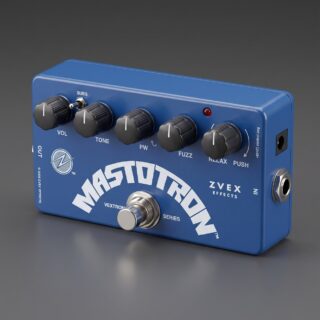
Both offer bias control; only the Fuzz Factory puts it on the front panel alongside a Stab and a Comp control, and only the Fuzz Factory is genuinely happy to self-oscillate. The Fuzz Factory is an instrument for making noise. The Myriad is an instrument for making records. Choose accordingly.
Myriad Fuzz vs Keeley Fuzz Bender
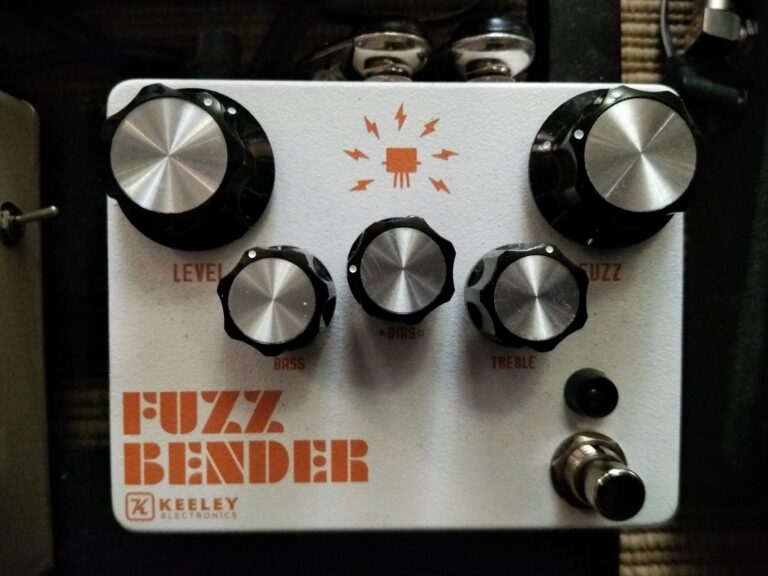
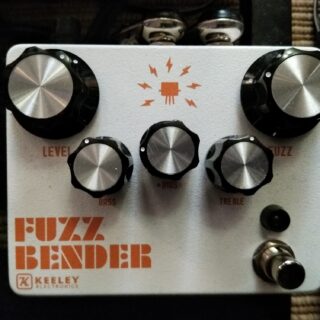
The Fuzz Bender is the sane person’s version of this same idea — a hybrid germanium/silicon Tone Bender variant with a Bias knob on the outside and a two-band EQ, at roughly a fifth of the price. It is genuinely excellent and it is the first pedal anyone should try before spending Myriad money. What the Myriad has over it is refinement, output and build; what the Fuzz Bender has over the Myriad is external bias, an actual bass control, and four hundred dollars in your pocket.
Myriad Fuzz vs Boss FZ-1W
The FZ-1W gives you Vintage and Modern voicings in a rugged, cheap, reliable box with a buffered bypass. It is arguably the better working musician’s fuzz on pure logistics. The Myriad wins on dynamic response and cleanup; the Boss wins on everything to do with the actual business of touring.
Myriad Fuzz vs JHS 3 Series Fuzz
The JHS 3 Series Fuzz also has a bias control and a fat switch, for under a hundred dollars. If your question is “do I like bias controls?”, buy that first and find out. If your answer turns out to be yes and you want the boutique version of the experience, that is when the Myriad conversation starts.
Myriad Fuzz vs the rest of the Vemuram line
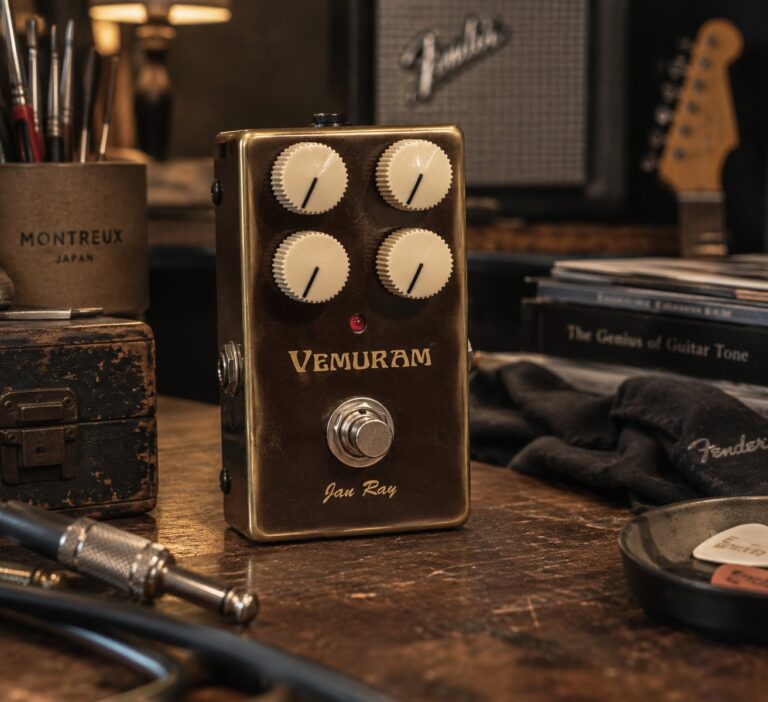
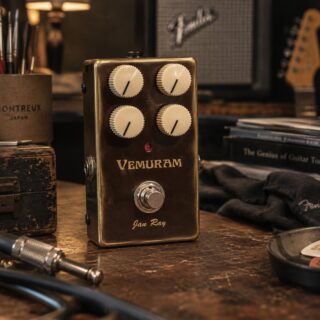
Vemuram builds gain pedals only, all in brass, all with at least one internal trimmer. The Jan Ray is the transparent blackface-flavoured overdrive that made the brand’s name; the Shanks ODS-1 is the John Shanks signature drive with more gain and more low-end weight. The Myriad Fuzz is by some distance the highest-gain pedal in the catalogue — Mass Street Music calls it “by far the heaviest gain of all the Vemuram pedals” — and it is the only fuzz. If you already own a Jan Ray, the Myriad is a complement, not a replacement.
Buying guide
Prices, September 2026
United States dealers start at $435, with Equipboard’s tracked spread running from $435 to about $558 and an average across merchants of $462. Mass Street Music’s listing was $395 before it sold, which is a useful floor for what a good deal looks like. In France, Guitar Part quoted €629 for the full Big Box Myriad in 2021 — the compact fuzz is well below that. The Big Box itself is now a collector item, tracked from around $1,115.
There have been publicly noted price drops on this pedal at Canadian retail, which is worth knowing before you pay full sticker: dealer stock on a low-volume Japanese import moves in fits and starts, and patience is rewarded.
Three things to check on a used one
First, open it and look at the bias trimmer. Previous owners fiddle. A used Myriad may have been left at an extreme setting by someone who did not know what they were doing, and a badly biased germanium fuzz sounds broken rather than characterful. Recentre it and re-evaluate before concluding anything about the pedal.
Second, check the brass. Vemuram enclosures develop a patina, which is normal and arguably desirable, but check the jack sockets and the footswitch for the kind of wear that suggests a hard touring life. Note that Guitar Part’s review described the enclosure as copper — brass is a copper alloy, so it is an understandable slip, but the correct answer is brass.
Third, confirm which Myriad you are buying. “Vemuram Myriad” and “Vemuram Myriad Fuzz” are different products at wildly different prices, and used listings are not always careful about it. If the photograph shows two footswitches and more than four knobs, it is the Big Box.
Who should not buy this
If you want one sound and you want it immediately, this is the wrong pedal — the whole design assumes you enjoy tweaking, and owner reviews say so explicitly. If you play in the dark and need to make adjustments mid-set, the Feel and Tone knobs are genuinely too small. If you object on principle to opening a pedal with a screwdriver to access an important control, that objection is legitimate and the Keeley Fuzz Bender exists. And if you are buying it because it will make you sound like Josh Smith, be aware that the Myriad is the fourth pedal in his chain and he attributes ninety-five percent of his live sound to a different one.
Living with one
The Myriad is easy to power — 1.9 mA means any supply will do and any isolated output is more than enough. Being a hybrid with a silicon input stage, it does not carry the positive-ground daisy-chain problem that pure germanium fuzzes inflict on pedalboards, but an isolated output remains the sensible default with any fuzz.
Placement follows normal fuzz rules with one caveat. Fuzz circuits interact with what is in front of them, so first in the chain after the guitar is the traditional answer — and Josh Smith’s own board does exactly that, putting the Myriad immediately after his tuner. Buffered pedals and wah pedals placed before a fuzz can change its input impedance behaviour; if you run a Cry Baby ahead of it and the fuzz sounds thin, that is why.
The top-mounted jacks and power socket come in for owner criticism on layout grounds, so measure before you commit board space next to something tall.
On temperature: the germanium half will drift. If you gig outdoors in summer and rehearse in a cold room, expect the pedal to feel different, and resist the urge to re-bias it every time. Pick the environment you play in most, set it for that, and use the Feel knob for the rest.
FAQ
Is the Vemuram Myriad Fuzz germanium or silicon?
Both. It uses one silicon transistor and one vintage germanium transistor in the same circuit, with the Feel knob and the internal bias trimmer determining how much of each character you hear. That hybrid arrangement is the pedal’s entire reason for existing.
What does the Feel knob actually do?
It moves the pedal’s response across the germanium/silicon divide, and it interacts directly with the internal Germanium Bias trimmer. Toward one end it is tighter, brighter and more distortion-like; toward the other it is looser, warmer and spongier. Its usable range changes noticeably depending on where the bias is set.
Do I have to adjust the internal bias trimmer?
No. Plenty of owners never touch it and are happy with the factory setting. If you do adjust it, biasing hotter is generally reported to add attack and clarity without thinning the low end. Set it once with a screwdriver at your normal playing temperature, then leave it — it is not a performance control.
What is the difference between the Myriad and the Myriad Fuzz?
The Myriad, sometimes called the Big Box, is a large pedal combining the fuzz with an effects loop, a wet/dry mixer, two outputs, phase switches and an expression pedal input for two-amp rigs. The Myriad Fuzz is the fuzz circuit from that pedal sold on its own in a compact enclosure. The Big Box came first; the compact was released after it became clear how good the fuzz section was.
Which famous guitarists actually use a Myriad Fuzz?
Josh Smith, documented in his own Guitar World-covered pedalboard breakdown. Gary Clark Jr., from a 2024 setup photograph. Joey Landreth, Quinn Sullivan, Artur Menezes and Rajan Silva of Glass Beams, all from dated photographs or video. In Japan, MORRIE of DEAD END, AssH of YOASOBI, Asahi Ren of Necry Talkie and Yoshimasa Terui. Ignore any list that includes Halestorm’s bassist — that is a database name collision with the blues guitarist of the same name.
How much current does it draw?
1.9 mA according to Vemuram’s own spec block as reproduced by Mass Street Music. A 19 mA figure circulates on some listings and is almost certainly a misplaced decimal point. Either way any 9 V supply will run it comfortably, and battery life is excellent.
Can I run it at 18 volts?
Vemuram specifies 9 V only — a 006P battery or a regulated centre-negative 9 V DC supply. There is no published 18 V option, and germanium circuits are less forgiving of overvoltage than op-amp overdrives. If you want more headroom, the Level control gives you plenty of output to push a cleaner amp instead.
Is it worth $435 when the Keeley Fuzz Bender does something similar for a fifth of the price?
Objectively, on price-to-performance, no — and the Fuzz Bender puts its bias control on the outside, which is arguably the better design decision. What you are buying with the Myriad is a hand-built brass object with hand-selected transistors, a wider and more refined range, considerably more output, and the specific voicing a working session guitarist spent ten years imagining. That is a diminishing-returns purchase, which is a perfectly legitimate thing to buy as long as you know that is what you are buying. Try the Fuzz Bender first.
Image credits
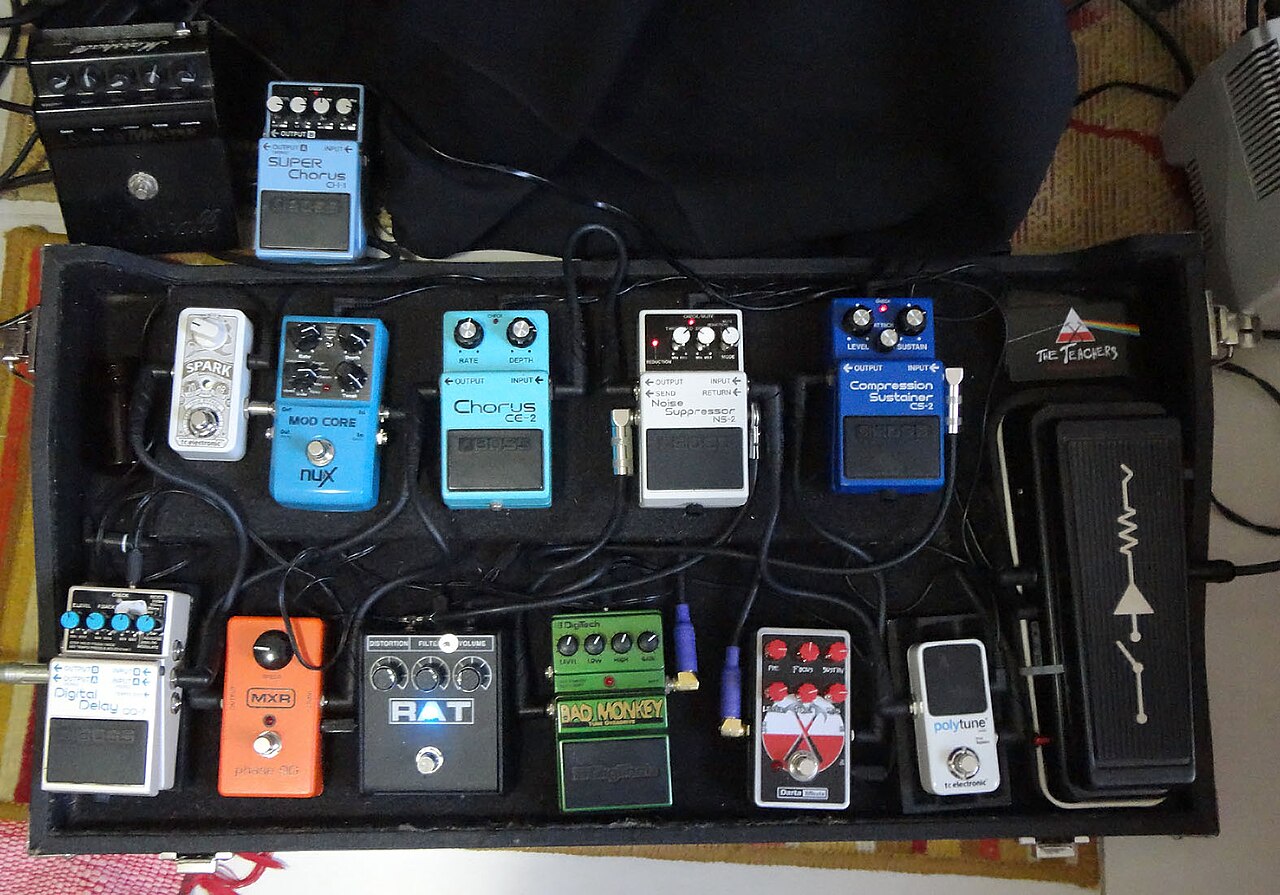
- A pedalboard with a mix of pedals: marcelodonati, Wikimedia Commons, CC BY 2.0.
- A pedalboard with overdrive, wah and fuzz pedals: Michael Morel from Barcelona, Spain, Wikimedia Commons, CC BY 2.0.
- Gary Clark Jr.: Eddy BERTHIER, Wikimedia Commons, CC0.
Latest News
Related
On This Day
Monday 9 November
From this week: