Red Panda Tensor: The Pedal That Turns Your Guitar Into a Reel of Tape You Can Grab With Both Hands
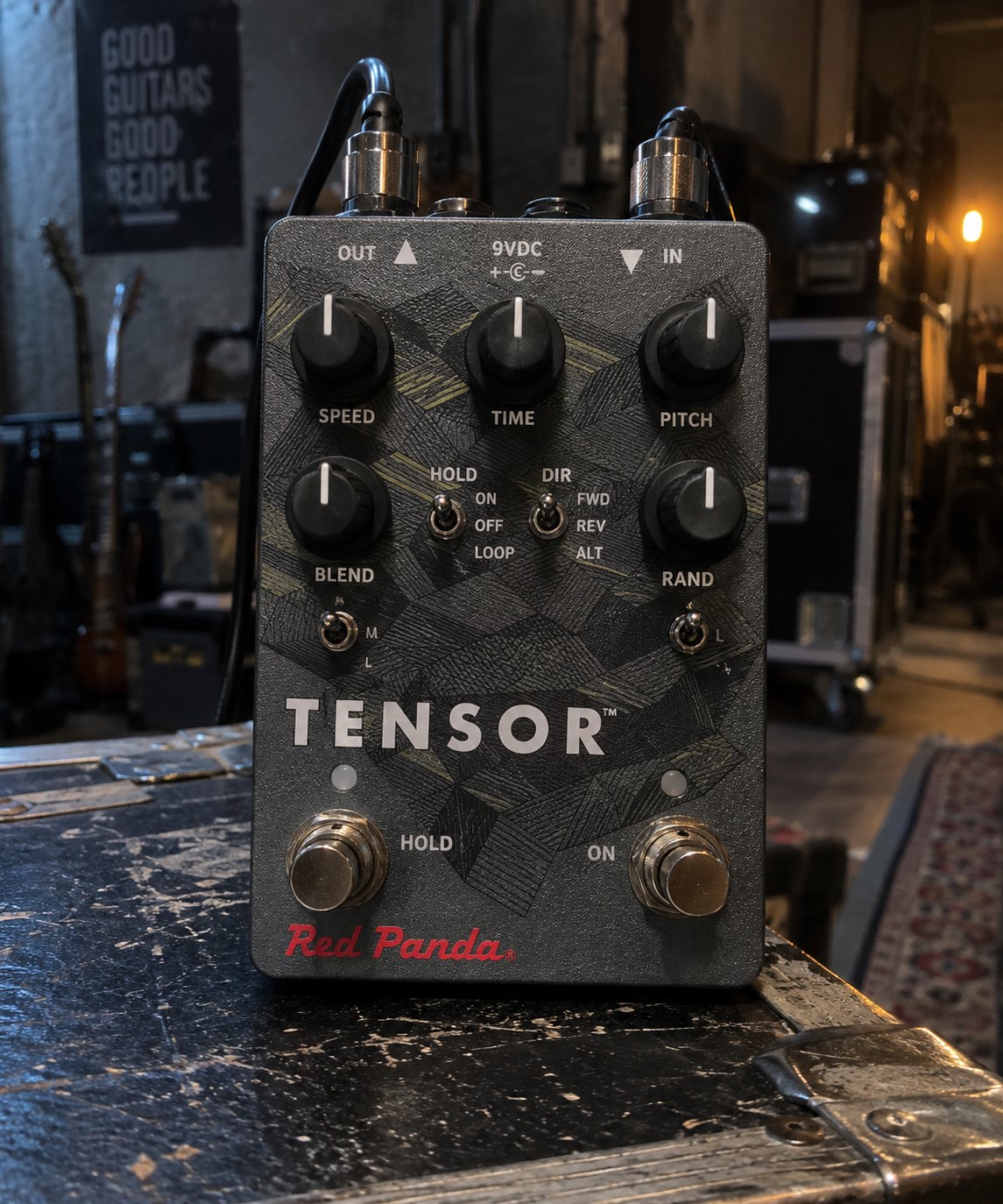
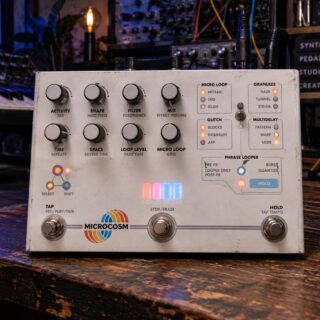
Red Panda Tensor. AI-generated reference illustration, not a photograph.
The Red Panda Tensor turns your guitar into tape you can drag, stop and rewind. Full guide to its modes, controls, verified users and best settings.
Every guitarist who has ever stood next to a reel-to-reel machine has had the same illicit thought: what if I just put my thumb on that spinning reel and dragged it backwards? Not as an edit. Not as a studio trick printed to another track. Live, mid-phrase, in front of a room full of people, with the note still ringing.
That is the entire pitch of the Red Panda Tensor, and it is worth stating plainly because almost every description of this pedal gets tangled trying to explain it. It is filed under “delay” in most shops. It is sold as a looper by some. Sound On Sound reviewed it in the Delays / Echo section and then spent four paragraphs explaining that the category was wrong. None of those labels are lies, exactly, but they all miss the point. The Tensor is a digital emulation of the physical act of touching tape. Speed, direction, splice, stretch. It just happens to live in a 3.05-inch box with two footswitches and a jack layout that will annoy you.
Red Panda showed a prototype at NAMM in February 2017 and shipped the finished pedal in 2018. Eight years on, it remains one of the very few pedals on the market that does what it does, which is why it keeps turning up on boards belonging to people who have no obvious business owning the same pedal as each other: a Radiohead guitarist, a Queens of the Stone Age guitarist, a Japanese noise legend, a Nine Inch Nails bassist, and a medical videographer at the University of North Carolina who uses it to score footage of the human nervous system. We will get to all of them.
What the Tensor Actually Does
The Tensor is always listening. That single design decision is the one that makes it feel unlike anything else on a board. Even in bypass, it is holding a rolling buffer of what you just played, which means the moment you hit the footswitch you can be instantly playing the last two seconds of your own performance backwards. There is no “arm record, wait, now capture” ritual. You play something, you decide after the fact that it should have been reversed, and it is.
On top of that buffer sit four independent manipulations that you can combine freely:
- Tape speed — continuously variable from full reverse, through a dead stop, to forward and beyond. This bends pitch exactly the way dragging a reel would.
- Time stretch — up to 4:1 in real time, and 1:4 through 4:1 on recorded loops. This changes duration without touching pitch, which is the one thing real tape absolutely cannot do.
- Pitch shift — plus or minus two octaves, in fixed intervals rather than a continuous sweep.
- Randomisation — a single knob that intelligently scrambles the above, scaled to wherever the other knobs are sitting.
Underneath, the pedal is continuously analysing your input at three levels — phrase, note, and waveform — to choose splice points that do not click. That analysis is the quiet, unglamorous engineering that separates the Tensor from a cheap stutter effect. When you jam the speed knob to reverse mid-solo, something has to decide where to cut, and the Tensor decides musically.
Where Red Panda Came From
Red Panda is a four-person company in metro Detroit, and its founder Curt Malouin has a prehistory that explains a great deal about how the Tensor thinks. In 1997 he wrote ObjektSynth, a real-time, multi-timbral, polyphonic modular software synthesiser — and it was one of the first commercial applications for BeOS, running on a PowerPC 603e. He spent the following decade building software synths that never shipped. Red Panda is what happened when that DSP obsession finally found a box with footswitches on it.
The company’s own timeline is refreshingly specific:
- 2009 — a bitcrusher module for the Line 6 ToneCore platform.
- 2011 — the Particle, widely recognised as the first granular delay pedal, and only the second pedal ever to use the Spin FV-1 chip.
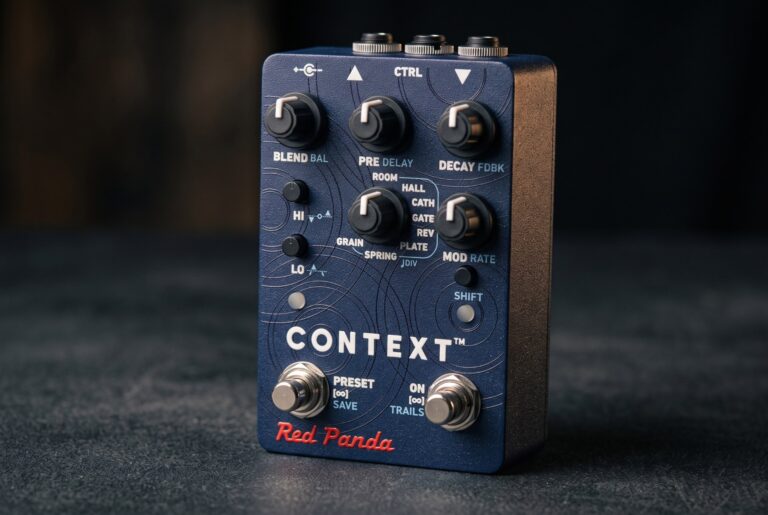
- 2012 — the Context reverb, with laser-etched graphics.
- 2014 — the Bitmap bitcrusher.
- 2015 — the Raster, a delay with pitch and frequency/phase shifting.
- 2018 — the Tensor, and this is the pivot point: the first Red Panda built on an ARM Cortex-M7 instead of the FV-1, with MIDI and user-updatable firmware.
- 2019 onwards — Particle 2, Context 2, Bitmap 2 and Raster 2, all Cortex-M7, all stereo, all with the web editor.
This matters for how you read the Tensor. It is not a “version 2” pedal, but it is the machine on which the entire version-2 platform was prototyped. Everything the modern Red Panda line does — stereo I/O, stored presets, MIDI, a browser-based editor for the hidden parameters — appeared here first. The Tensor is the bridge between old Red Panda and new Red Panda, which is part of why it has never been superseded. There is no Tensor 2, because the Tensor already was the 2.
Red Panda Tensor Specifications
The Controls, One at a Time
Speed
The heart of the pedal. At 12 o’clock the tape is stopped. Clockwise plays forward, anticlockwise plays in reverse, and the further you go the faster it runs. Critically, moving Speed bends pitch — it does not stretch time. This is correct tape behaviour and it is the control that makes the Tensor immediately intuitive to anyone who has ever slowed down a record with a finger.
Time
The control that breaks tape physics on purpose. Time handles stretching and compression with no pitch change at all: 1:4 to 4:1 on loops, up to 4:1 in real time. Where Speed gives you the seasick, dive-bombing, gloriously wrong sound of a machine being abused, Time gives you the clean, uncanny, slightly digital sound of a phrase getting longer while staying in key. Using both at once is where the pedal stops sounding like anything else.
Pitch
Plus or minus two octaves in fixed intervals. Fixed steps rather than a sweep is the right call here — it means Pitch stays musical while Speed handles all the smeary, in-between business. Stack them and the two ranges multiply rather than fight.
Rand
The knob that turns a tool into an instrument. Low settings introduce occasional stutters and CD-skip artefacts. Around 12 o’clock the pedal starts randomly repeating short segments. Fully clockwise, it slices your playing apart and shuffles the pieces. The clever part is that Rand does not just randomise playback — it randomises the values of the other knobs, scaled to where you have already set them. A little goes a very long way, and this is the control most likely to make you laugh out loud the first time you push it too far.
Blend
Wet/dry. Straightforward, but more important on this pedal than most, because the Tensor’s best trick is often sitting a reversed or stretched version of your playing behind the dry signal rather than replacing it. There is also a kill-dry mode for anyone running it on an effects send.
The Hold footswitch and the Dir switch
Hold records. The toggle above it sets momentary or latching behaviour — held down for momentary, one press on and one press off for latching. In momentary mode a short stab produces glitch and stutter effects rather than a loop, which is how most people actually use it live. The Dir switch sets loop playback direction: Forward, Reverse, or Alternating. Note that Dir and the Speed knob combine to determine what you hear, so setting both to reverse gives you forward playback. That catches everyone once.
The Three Hold Modes, and Why They Are Not Interchangeable
You can switch between all three while playing, and your loop carries over. That alone puts the Tensor ahead of most loopers on flexibility. But they behave very differently.
Rec
Records in real time and plays back according to the pedal’s current settings. There is no overdubbing — arming record again writes a new loop and erases the old one. This is the mode for short, destructive, throw-it-away captures, and it is the one that suits live glitch work best.
Ovr
Sound-on-sound overdubbing, exactly as an analogue tape machine would do it. The first loop sets the loop length. Whatever your controls are doing at the moment of recording gets printed to the layer. Set Pitch an octave up and overdub, and that layer is committed an octave up — then return Pitch to unison and your original loop comes back to pitch while the overdub sits an octave down.
Sound On Sound’s Simon Small put the required mindset perfectly: you have to think in tape. His worked example is the one everybody hits. You set Speed to reverse, you enjoy your backwards loop, you decide to overdub a part alongside it — and on playback your overdub is running forwards, because of course it is. That is not a bug. That is a tape machine. There is also no undo, because there was never an undo on a tape machine either.
Nxt
The cleverest and least understood mode. Nxt splits the record buffer in half, so you only get half the recording time. One half listens while you play; the other plays back what was captured previously, with current settings applied. Because record and playback times can be completely independent, this turns the Tensor into something no other mode can produce: put Hold in latching mode, use it as a tap, and every time the Hold LED blinks red the pedal swaps the live buffer for the playback buffer. You have built a tap-tempo delay out of a looper.
Famous Players: What Holds Up, and What Doesn’t
The Tensor has a genuinely strange user list, and it is worth separating what is documented from what merely circulates.
Aaron Marshall (Intervals) — the strongest case
Premier Guitar’s Rig Rundown with Intervals’ Aaron Marshall, filmed before a December 2021 headline show at Nashville’s Mercy Lounge and published 2 February 2022, lists his board item by item. Alongside a Neural DSP Quad Cortex, a Hologram Electronics Microcosm for stutter and glitch work, a DigiTech FreqOut for instant feedback, a Boss EV-30 dual expression pedal and a TC Electronic PolyTune 3 Mini, PG records a Red Panda Tensor — used, in their words, for laser sounds. Everything sits on a custom Temple Audio DUO Series board, feeding a Seymour Duncan PowerStage 700 into custom vertical Revv 2x12s loaded with a Celestion Vintage 30 and a G12M-65 Creamback.
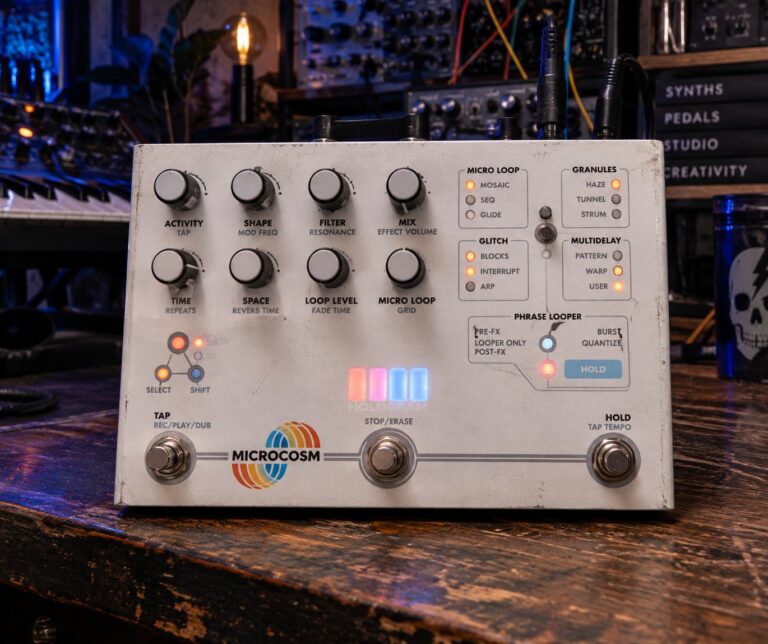
Two things make this the single most useful data point on the pedal. First, it is first-party editorial with the gear named on camera. Second, the Microcosm sitting next to it tells you exactly where Marshall draws the line: the Microcosm handles granular texture, the Tensor handles violent, deliberate, pitch-jumping interruption. They are not redundant, and anyone considering both should study that board.
Ed O’Brien (Radiohead)
Ed O’Brien is documented with a Tensor on his 2025 Radiohead tour board, via TheGigRig’s own video walking through the design and build of that board. Given that O’Brien has spent thirty years being the member of Radiohead whose job is to make a guitar not sound like a guitar, this is about as on-brand as a pedal placement gets — and it is builder-documented rather than inferred, which is the standard we care about.
Vernon Reid (Living Colour)
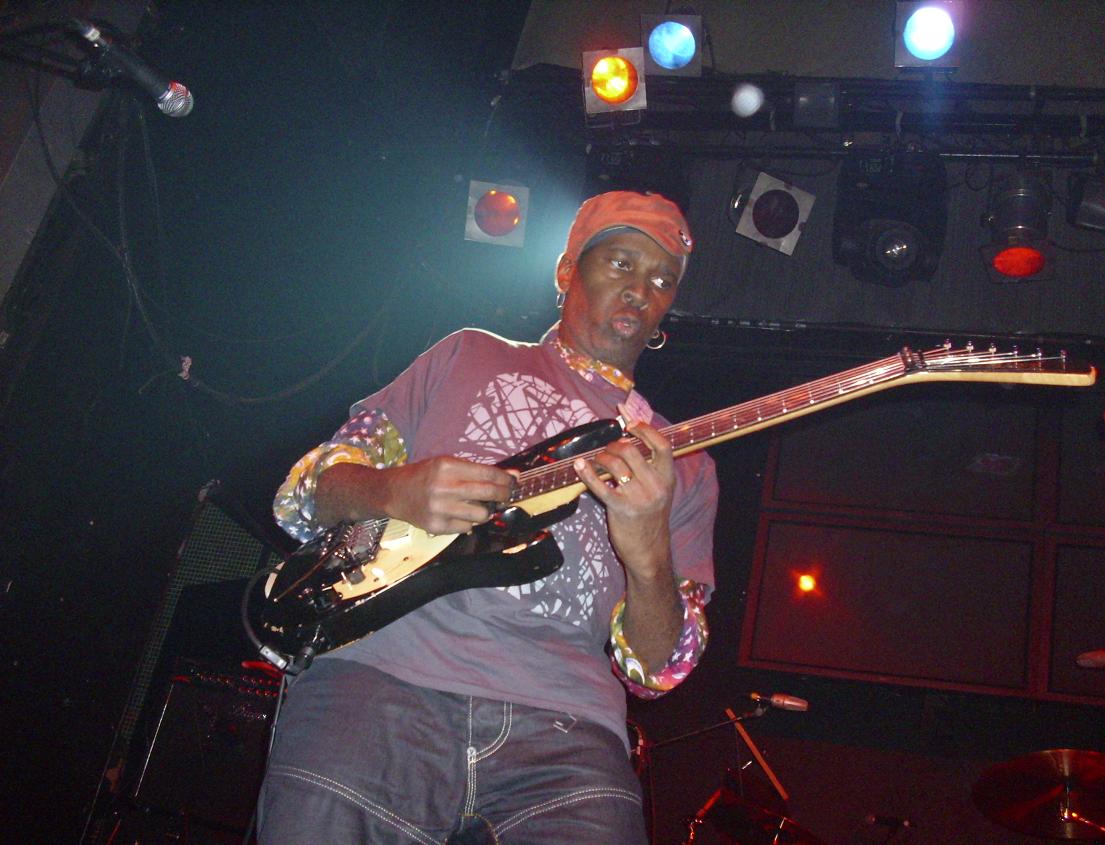
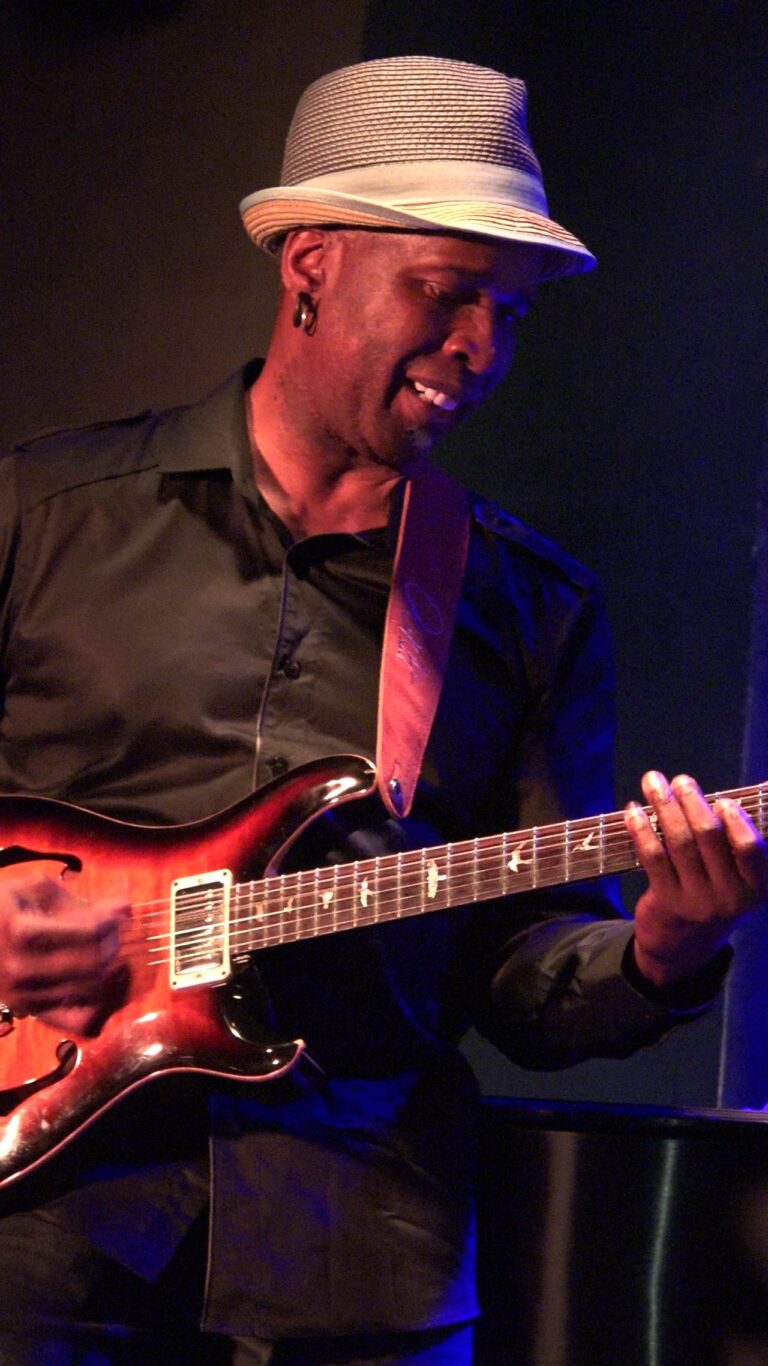
Vernon Reid is photographed with a Tensor on his board following a rebuild by TSA. Reid is a recurring name across this entire corner of the pedal world — he is one of the best-documented users of the Eventide H9 as well — and his presence here is consistent rather than surprising.
Troy Van Leeuwen (Queens of the Stone Age) and Alain Johannes
Van Leeuwen’s Tensor is visible on his board at 30:00 in a filmed rig walkthrough. Alain Johannes, another QOTSA alumnus, has posted his own board with the Tensor visible. Both are photo-confirmed rather than rumoured.

Nick Reinhart
Reinhart is on camera in a Premier Guitar Rig Rundown naming the pedal outright at 28:12 and explaining that he uses it for momentary looping and pitch shifting — which is, for our money, the most accurate one-sentence summary of the Tensor any player has given. One correction worth making: Equipboard files Reinhart under Death Grips, whose live band he has played in. He is far better known as the guitarist in Tera Melos, and Tera Melos’ 2018 record Treasures and Trolls is separately logged as a Tensor album. Attributing him to the wrong band obscures the actual connection.
The rest of the confirmed list
Justin Meldal-Johnsen (Nine Inch Nails, and one of the most in-demand producers alive) posted about using the Tensor in his studio in 2018, hashtag and all. Merzbow — yes, that Merzbow — has a Tensor in a gear photo posted to his own account. Jessy Caron of Men I Trust had one on his board at an October 2021 show, sitting between a Strymon BigSky and a POG. Sarah Lipstate, who records as Noveller, has photographed it in her film-scoring kit. Alan Sparhawk of Low had one on his board on the Hey What tour in April 2022, and Hey What itself is logged as a Tensor album — a record whose entire sound is built from beautiful things being destroyed, which is about as fitting a credit as this pedal could ask for.
What does not survive checking
Search for the Tensor on Premier Guitar and one of the top results is the Peter Frampton Rig Rundown, apparently placing the pedal in a board Frampton calls his “Starboard,” assembled from pedals previously owned by famous guitarists. It is a great story. It is also not Frampton’s, and there is no Tensor in it.
Two independent checks kill it. First, the arithmetic: Frampton’s Rundown was published 17 February 2016, a full year before the Tensor was even shown as a prototype and two years before it shipped. Second, the actual text: the “Starboard” belongs to reader Paul Martin and appears in Reader Pedalboards 2026, and its contents are a Boss PH-3 owned by Andy Taylor, an Ibanez AD9 owned by session player Mitch Holder, a Boss DD-2 owned by Kiko Loureiro, and so on. No Red Panda anywhere.
The mechanism is worth naming, because it will catch you again. Modern magazine pages render teaser blocks for other articles inside the same HTML document. A search engine indexing the Frampton page therefore sees text belonging to a completely different article and returns the wrong URL. The fix is the same as always: fetch the page and read the gear paragraphs, rather than trusting the result.
While we are here: the Tensor is also credited on an album called Ventre dated 2015. That is three years before the pedal existed. Treat crowd-sourced album credits as leads, not facts.
The genuinely charming entry, meanwhile, belongs to nobody famous at all. In Reader Pedalboards 2026, Kurt Nolen — the medical photographer and videographer for the University of North Carolina School of Medicine’s Department of Neurosurgery — runs a Tensor on his second board, in the amp loop, between a Chase Bliss MOOD and a Pigtronix Infinity 2, with a Red Panda Bitmap earlier in the same chain — one of the few boards anywhere running two Red Pandas at once. He uses it to answer questions like what high-intensity focused ultrasound treatment would sound like if you could hear it. That is the Tensor’s real constituency.
Eight Settings Worth Stealing
1. The reverse shadow
Speed fully anticlockwise, Blend around 9 o’clock, Time and Pitch at unity. This is the Sound On Sound reviewer’s favourite and it is the single best starting point on the pedal: your dry playing sits in front, a reversed ghost of it trails just behind, and nothing sounds broken. Press the On switch to trigger Drift mode and the whole thing resolves into a tape-stop.
2. The Eventide-style widener
Speed one notch back from Forward, Pitch up one interval, Time down one, running in stereo. A chorus/warble that spreads enormously wide. This works on far more than guitar — it is a legitimate vocal bus effect, and with kill-dry engaged it makes sense on an aux send.
3. Laser sounds
Pitch to +2 octaves, Rand around 10 o’clock, Hold in momentary. Stab the switch on an accent. This is the Aaron Marshall setting and it is the reason people buy the pedal for modern prog.
4. Broken cassette
Speed just below forward, Rand at 2 o’clock, Blend fully wet. Constant micro-fluctuations in pitch and timing, with occasional dropouts. Sits somewhere between a warped tape and a failing CD transport.
5. Half-speed doom
Speed roughly halfway anticlockwise from centre — but on the forward side of the dial — with Time at unity. Everything plays back an octave down and twice as slow, exactly as it would at 15 ips played at 7.5. Excellent under a clean arpeggio, devastating under a fuzz.
6. The stretched drone
Hold in latch, Ovr mode, Time pushed toward 4:1, Dir set to Alternating. Capture one chord, then let the pedal stretch it in both directions indefinitely. Add layers and it becomes a slowly rotating pad.
7. Nxt as a tap delay
Nxt mode, Hold in latch, tap the tempo you want, Blend around 11 o’clock. The pedal swaps buffers on each blink of the red Hold LED. Now put Pitch up an octave and you have a delay whose repeats are in a different register — territory otherwise reserved for an LVX or an HX One.
8. Total collapse
Rand fully clockwise, Blend fully wet, Speed anywhere, Hold latched. The pedal shreds your input into fragments and reassembles them at random. Genuinely unusable most of the time, and occasionally the best thing you have ever recorded. Have a recorder running.
How It Compares
Versus the Hologram Microcosm
The most common cross-shop, and Aaron Marshall’s board proves they coexist. The Microcosm is granular and generative — it takes what you play and grows something ambient out of it, largely on its own schedule. The Tensor is manual and violent — you are the one grabbing the reel. If you want the pedal to be a collaborator, buy the Microcosm. If you want the pedal to be an instrument you operate, buy the Tensor.
Versus the Hologram Infinite Jets
The Infinite Jets captures and sustains individual notes, stripping attack and decay to leave synth-like pads. It is note-oriented. The Tensor is phrase-oriented. Also worth noting for anyone building a board: the Tensor is Boss-standard centre negative, while several of its obvious rivals are not — always check before you daisy-chain.
Versus the Chase Bliss Blooper
The Blooper is a looper with modifiers bolted on and a much deeper structural approach to layers. The Tensor is a tape machine that happens to loop. If your music is built out of loops, buy the Blooper. If loops are one of several ways you want to abuse time, buy the Tensor.
Versus the Chase Bliss Habit
Habit is about memory — it keeps the last three minutes and lets you retrieve and mangle it. Philosophically it is the closest thing to the Tensor’s always-listening buffer, but Habit’s outputs are echo-shaped where the Tensor’s are transport-shaped.
Versus the EHX Freeze and the pitch family
The Freeze does one thing brilliantly and costs a fraction as much. If all you want is a sustained pad under a lead line, buy the Freeze and save the difference. Similarly, if the appeal is purely the ±2 octaves, a Pitch Fork, a Nano POG or a Whammy will track better and cost less. The Tensor earns its price only if you want the interaction between pitch, speed and time.
Versus a delay you already own
Worth saying bluntly: the Tensor is a poor first ambient pedal. If your board has no TimeLine or equivalent, buy that first. The Tensor is a specialist that assumes the fundamentals are already covered.
Buying Guide
The Tensor lists at $329 on Red Panda’s own site as of 2026, up modestly from the $299 Sound On Sound quoted in 2022 — that is a real-terms price cut over four years of considerable inflation, and worth knowing before you talk yourself into a used one at a marginal saving. It has never been formally discontinued: Red Panda still lists it under current products, still shipped new firmware in 2025, and the pedal periodically goes out of stock rather than away.
Firmware is the thing to check on a used unit. Version 1.1 added a great deal that the original shipped without: loop sampler functions (retrigger, stop, one-shot) via MIDI or remote switch, all 31 presets, an expression pedal assignable to any knob, improved MIDI scaling for speed, time and pitch, and kill-dry mode. Any Tensor can be updated over micro-USB, so an un-updated unit is a small inconvenience rather than a problem — but it changes what you are actually buying at first plug-in.
Budget for the accessories honestly. Stereo operation requires TRS Y-cables, because there is one input jack and one output jack. Red Panda’s Remote 4, at $99, is the single biggest upgrade to how the pedal plays live — its mode three turns the remote into a classic looper interface that will feel instantly familiar to anyone who has used a Line 6 DL4. If you intend to gig the Tensor as a looper rather than as a texture box, treat the Remote 4 as part of the purchase price rather than an optional extra.
Living With It
Power is non-negotiable. 9V DC, centre negative, 250 mA minimum. This is a genuinely hungry pedal and it will misbehave in ways that look like faults if it is underfed. Use an isolated, transformer-based supply — Sound On Sound reported clean results with both Cioks and Strymon units. There is no battery option.
The jack layout is the pedal’s real design flaw, and every long-term owner mentions it. All jacks are on top, which is good for board density. But the expression/MIDI/CV input sits between the audio in and out, which makes plugging in an expression pedal with a right-angle cable genuinely awkward on a crowded board. Plan the neighbouring pedals before you plan the cable.
Read the manual. It is 34 pages, it is excellent, and it is the only entry in Sound On Sound’s cons list — the entire criticism of the pedal was that reading the manual is mandatory. That is unusual and it is honest. The Tensor is not difficult, but it is deep, and every owner who calls it gimmicky turns out to have skipped the section on Ovr and Nxt.
Expect artefacts, and expect to like them. Time compression introduces noise. Splices occasionally click. This is a digital tape machine and it has the personality traits of one. If you want a surgically clean pitch and time processor, this is the wrong purchase and no amount of firmware will change that.
The web editor works, and you should use it. It is browser-based over micro-USB, Red Panda recommend Chrome, and it is where the hidden parameters and preset management live. It also lets you set the maximum input level — the difference between +5.5 dBu and +8 dBu is what makes the Tensor usable on line-level sources like an interface or a console send rather than only on a guitar.
Frequently Asked Questions
Is the Red Panda Tensor a looper or a delay?
Neither, quite. It is a tape-transport emulator that can loop and can be configured to behave like a delay. It will do basic looper duties — record, playback, overdub — but it has no undo and is not designed as a workhorse looper. Buying it purely to loop is buying the wrong pedal.
How long can the Tensor record?
9.4 seconds in mono, 4.7 seconds in stereo. In Nxt mode you get half of that again, because the buffer is split between listening and playback.
Does the Tensor work in stereo?
Yes, but through single TRS jacks rather than separate left and right sockets, so you will need Y-cables to interface with the rest of a stereo board. The upside is a much smaller enclosure; the downside is buffer time halved and an extra cable to lose.
Can it change pitch without changing speed, and vice versa?
Yes to both, and independently, which is the pedal’s central trick. The Speed knob bends pitch as tape would. The Time knob stretches or compresses duration with no pitch change at all. The Pitch knob shifts in fixed intervals up to two octaves either way. Running all three at once is where sounds appear that you will not get from any other single box.
What power supply does the Tensor need?
9V DC, centre negative, at least 250 mA, from an isolated supply. It is not included, there is no battery compartment, and the pedal will not work correctly on an undersized supply. The current draw is high enough that it should be factored into board planning rather than assumed.
Is the Tensor discontinued?
No. It remains listed among Red Panda’s current products, received firmware updates as recently as 2025, and is not on the company’s legacy page. It does go out of stock at both the manufacturer and major retailers, which is a supply pattern rather than a discontinuation.
What is the difference between Rec, Ovr and Nxt?
Rec records a loop with no overdubbing — recording again erases what was there. Ovr adds sound-on-sound layers, printing your current control settings into each layer permanently. Nxt splits the buffer in two, so one half listens while the other plays back, which allows record and playback times to differ and enables the tap-tempo delay trick. You can switch between all three while playing without losing your loop.
Do I need the Remote 4?
Not to enjoy the pedal, but yes if you plan to use it as a looper on stage. The Tensor’s two footswitches cannot reach the loop sampler functions or the 31 presets on their own; those need MIDI or a remote switch. The Remote 4’s third mode turns it into a familiar DL4-style looper interface, and it costs $99.
Image credits
- Vernon Reid: Mario, Wikimedia Commons, CC BY 2.0.
- Top image: GuitarGangsters AI-generated reference illustration, not a photograph.
- Vernon Reid: Alex Lozupone, Wikimedia Commons, CC BY-SA 4.0.
- Troy Van Leeuwen: Rama, Wikimedia Commons, CC BY-SA 2.0.
Latest News
Related
On This Day
Monday 9 November
From this week: