Floor Level, Zero Apologies: The Marshall 1960B 4×12 Is the Straight-Shooter the Stack Was Built Around
Marshall 1960B 4x12: straight, 300W, four G12T-75s, thicker low end than the 1960A. Stage base for Cobain, Frusciante, Cantrell, Morello and Armstrong.
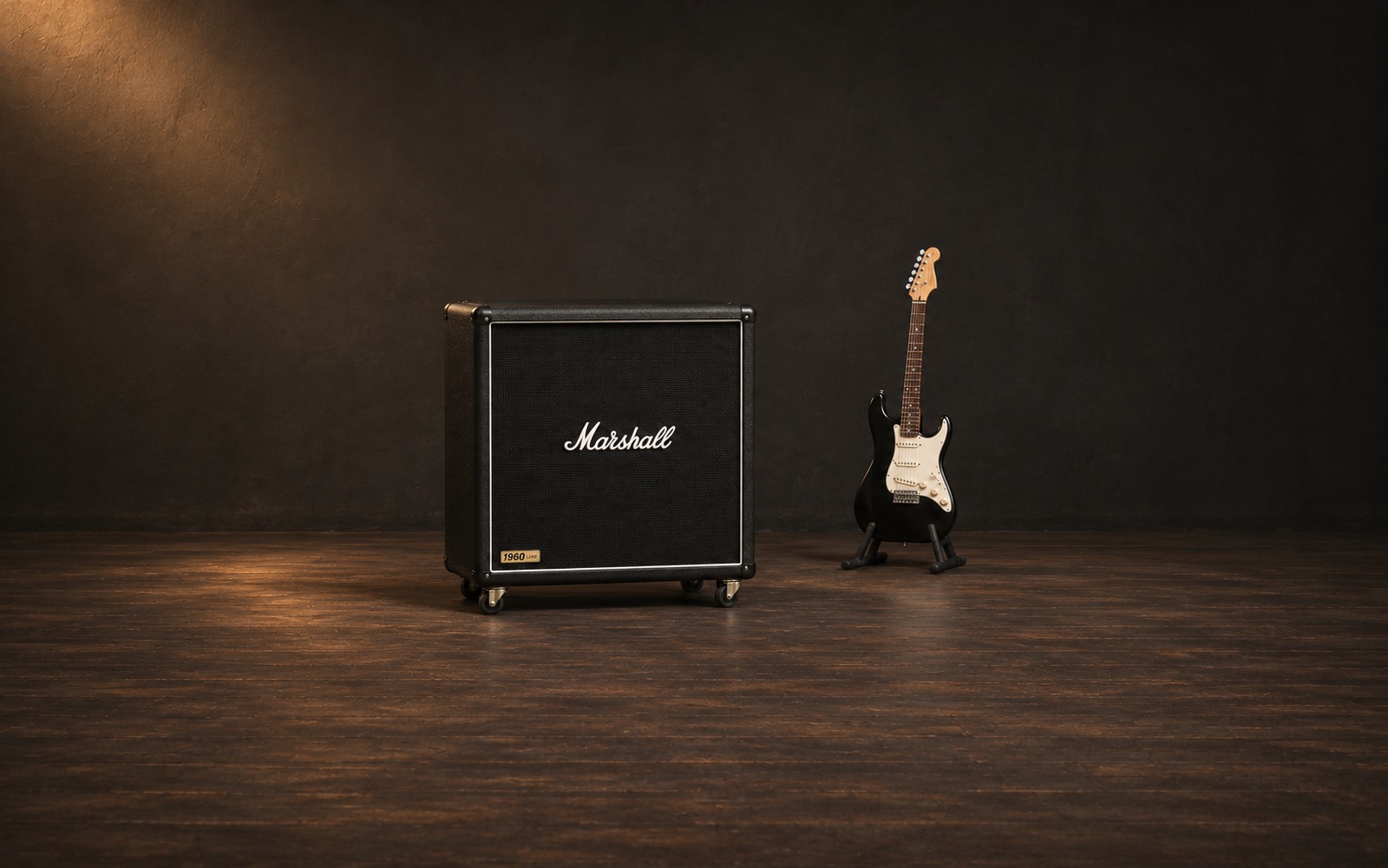
There is a specific image so burned into the visual grammar of rock that it barely registers as design anymore — a tower of black-covered plywood, four speaker cones arranged in a 2×2 grid behind a black grille cloth, a white script logo high on the front baffle, and above it an identical box with the top tilted back at a shallow angle. You have seen this configuration on more album covers, in more live photographs, on more arena stages and dive-bar backlines than any other single piece of guitar hardware. What you are looking at is always a pair: the angled 1960A on top, and directly underneath it, the straight Marshall 1960B 4×12 Base Cabinet.
The 1960B is the part of that image most people have stopped seeing. The 1960A gets the write-ups because it angles toward your face on stage and creates the slightly more complex dispersion pattern that engineers and recording magazines love to analyse. But the 1960B is older in concept, simpler in geometry, and in one measurable sense more powerful in the room: all four speakers pointing in exactly the same direction, at exactly the same angle, projecting the same coherent wave front at the audience. Marshall’s own product page says it plainly — “the straight version will give you a thicker low-end sound.” That is not marketing copy. It is a statement of basic physics, and it is the reason Kurt Cobain rebuilt his stage rig around them, why Jerry Cantrell had two of them stacked behind him through every significant Alice in Chains show of the 1990s, and why Tom Morello reached for one the moment his irreplaceable 1987 Peavey 4×12 needed a night off from the road.
This is the story of the box on the bottom. It deserves one.
Where the 4×12 Came From: The Foundation of the Marshall Cabinet Family
Jim Marshall’s first amplifiers were heads — chassis with valves and transformers designed to sit on top of speaker enclosures that someone else would supply. His early customers in his Hanwell, London drum shop played those heads through whatever they could find: Vox AC30s with the speakers still in them, Fender Bassman cabs, mismatched 1×12 and 2×12 configurations that sounded different every night. The heads kept destroying the speakers, not because the amplifiers were grossly overpowered — the first Marshall design was a Fender Bassman clone producing somewhere between 30 and 45 watts — but because the speakers available in the early 1960s in Britain were built to handle far less.
The solution Marshall settled on by 1962 was a dedicated cabinet housing four 12-inch speakers in a single closed-back enclosure. The math was straightforward: four speakers sharing the load meant each one handled a fraction of the total power. It also meant the cabinet radiated from a larger surface area, producing more acoustic output and a fuller low-end response than any single driver could achieve. The very first Marshall 4×12 was loaded with Celestion speakers — the beginning of a relationship that has never ended — and it was a straight-sided box. The idea of angling the top half of the speaker array came later, almost accidentally, when Jim Marshall noticed at a gig that a head placed on top of a straight cabinet looked proportionally wrong. He had the top portion angled to make the combination look more finished. The sonic benefit of that angle — wider coverage pattern, better on-stage monitoring for the guitarist — turned out to be real, but it was discovered at a live performance rather than designed from measurements.
By the mid-1960s, Marshall had formalised the two variants. The angled cab became the 1960A (A for Angled). The straight cab became the 1960B (B for Base — the bottom position in the full stack). The 1960A was intended to sit on top of the 1960B, a head on top of both, producing the configuration that Pete Townshend had essentially commissioned from Jim Marshall in conversations around 1964 and 1965. Townshend wanted height. He wanted a wall of amplification behind him, physically present on stage in a way that a single combo or a head-and-cab combo could never be. He got it. The full Marshall stack — a 100-watt Plexi head, a 1960A angled above a 1960B straight — became within five years the defining visual and sonic statement of rock amplification.
The 1960B has been in continuous production since that period. It predates almost every iconic rock recording you can name. It has outlasted every trend in amplifier design that has tried to replace it. At £1 or $1 of cost per watt of handling capacity, it remains one of the most efficient value propositions in all of guitar gear.
Straight vs. Angled: The Physics of What the 1960B Does Differently
The 1960A and 1960B share identical external dimensions — 770mm wide, 755mm tall, 365mm deep — and identical internal specifications: four Celestion G12T-75 speakers, 300 watts of mono power handling, 36.4 kilograms of Baltic birch plywood and steel hardware. The only structural difference is the baffle board. In the 1960A, the top section of the baffle is hinged back at approximately 15 degrees. In the 1960B, the baffle is flat. Everything else is the same cabinet.
That flat baffle changes the acoustic behaviour in two distinct ways. First, all four speakers in a straight cabinet are radiating their energy in precisely the same direction. There is no partial dispersion upward from the top pair, no angular separation in the coverage pattern. The sound waves from all four cones reinforce each other at a single axis — straight ahead, at whatever height the cabinet is positioned on stage. This coherent radiation adds up to a tighter, more focused sound with a more powerful low-frequency response in the direct axis. Marshall describes this as “thicker low-end,” and players consistently describe the 1960B as having more bass weight and a more assertive bottom-end punch than the 1960A.
Second, because the speakers all face the same direction, the 1960B fires directly at whatever is in front of it. At floor level — which is where the 1960B lives in a full stack — this means it fires at the audience from below their ear height. Combined with its position on the floor rather than raised on a head-height stand, the 1960B provides the fundamental low-end underpinning of the stack sound. The angled 1960A above it handles the wider dispersion and better on-stage monitoring. Together the pair covers both axes: close-up intelligibility for the guitarist on stage, and floor-level low-end projection for the audience in the room.
Run on its own — as a single cab rather than as part of a full stack — the 1960B sounds different from the 1960A in ways that matter for specific musical contexts. The 1960B is what you reach for when you need maximum low-end impact at moderate stage volumes, when you want all the cabinet’s power pointing at the room rather than dispersed across angles, or when you are running a stereo amp rig and need each side of the stereo field to project coherently. It also sits differently in a band mix: the more focused low-end adds body to heavy rhythm playing in a way that the slightly dispersed 1960A does not always achieve at the same volume.
Specifications
A few specification notes worth expanding. The mono impedance selector is one of the most important and most frequently misunderstood features on any Marshall cab. Setting the switch to 16Ω connects the two inputs in series — you use a single cable from the head’s speaker output, and the cabinet runs as a 16Ω load. Setting the switch to 4Ω puts the inputs in parallel — you can run two cables from two speaker outputs of the same head, or use it with a head that has a 4Ω minimum output tap. The stereo setting splits the cab into left and right halves, each presenting 8Ω, and you run one cable per side from a stereo power amplifier or a head with separate stereo speaker outputs. Standard use — one head, one cab, 16Ω — requires only the included speaker cable and the mono 16Ω setting.
The birch plywood construction deserves a note because it has been a consistent target of forum scepticism since the late 2000s when Marshall introduced lower-cost MDF-cab variants into their mid-range lines. The 1960B is not one of those variants. The 15mm Baltic birch in the 1960B is the same specification that Marshall has used in the 1960 family since the 1960s. Birch is stiffer and stronger than MDF at the same thickness, denser and more acoustically inert than pine, and more resonant than particleboard. It does not mechanically couple with the drivers the way a pine cab does — Marshall birch runs dry and neutral, letting the speakers do the tonal work without cabinet colouration. The closed back is the other essential design element: sealed air behind the cone provides controlled back-pressure, tightening the bass response and extending low-frequency output compared to an open-back design.
The Celestion G12T-75: The Speaker That Defined an Era
The Celestion G12T-75 is so closely associated with the 1960 cabinet family that many players forget it was not original equipment. The first 1960 cabs in the early-to-mid 1960s were loaded with Celestion G12M Greenbacks — 25-watt speakers with ceramic magnets, a warm, compressed, harmonically complex character that defined the sound of late-1960s and early 1970s British rock. Jimi Hendrix, Jimmy Page and Eric Clapton all used Greenback-loaded Marshall cabs. The sound everyone thinks of as “classic Marshall” — the warm, slightly squashed, chewy lead tone of those recordings — is partly a Greenback sound.
The Greenbacks were replaced in the late 1970s and early 1980s as amplifiers grew more powerful. Fifty-watt and 100-watt heads were asking 25-watt speakers to handle sustained high-volume playing, and they were failing. Celestion introduced the G12-65 (65W rating) as a transitional solution, and then in 1983 released the G12T-75 — a 75-watt speaker with a significantly different character. The T-75 has a larger magnet assembly, a different voice coil, and a pronounced mid-scoop in its response curve. Where the Greenback has a full, warm 500Hz–2kHz midrange hump, the G12T-75 has a dip in that same region and an extended high-frequency response that adds a scooped, bright clarity to high-gain tones. This character — the so-called “scooped mid” shape — turned out to be exactly right for the emerging heavy metal sounds of the 1980s and 1990s. Tight, punishing, articulate, and extremely loud, the G12T-75 did not replace the Greenback so much as it defined an entirely different aesthetic.
The consequence for the 1960B buyer today is significant: the stock G12T-75 is a purpose-built high-gain speaker, not a neutral all-rounder. At low-to-moderate volumes it sounds somewhat stiff and lacking in dynamic response. At high volume it opens up, tightens the low end, and delivers the aggressive scooped-mid presence that put it on every rock and metal stage of the last four decades. Players who find the G12T-75 unsatisfying at bedroom volumes — as many do — and who swap it for Celestion Vintage 30s or G12M Greenback reissues are not doing anything unusual. Kurt Cobain did exactly that during the In Utero tour, filling his 1960B cabs with Celestion Vintage 30s to work with his Mesa/Boogie Studio .22 Preamp and Crown Power Base 2 power amplifier. The 1960B is the host cabinet; the G12T-75 is the stock occupant, and the relationship is not necessarily permanent.
Famous Players: The Verified Record
Of Slash, Zakk Wylde, Kerry King, Gary Moore, and Tom Morello, one is actually documented on this specific cabinet. The others require corrections.
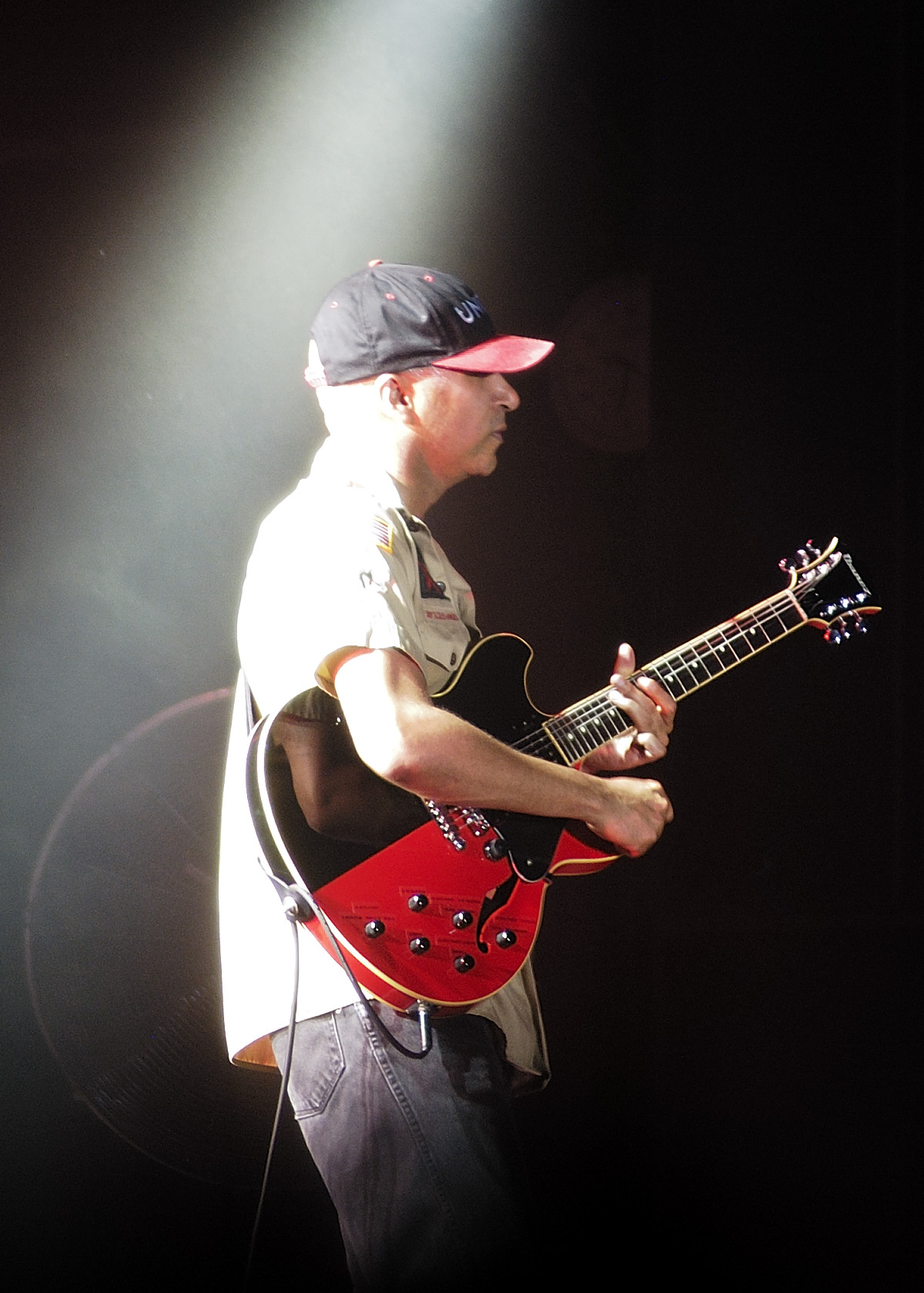
Tom Morello
Tom Morello‘s primary stage rig for Rage Against the Machine — documented in multiple primary sources including a Premier Guitar Rig Rundown video — runs a Marshall JCM800 2205 50-watt head through a 1987 Peavey 4×12 cabinet loaded with Celestion G12K-85 speakers. That Peavey cab is the instrument Morello has used to define his signature sound; it has been his primary cab since his original rig was stolen in the late 1980s and he discovered, in the process of replacing it, that the G12K-85-loaded Peavey produced a tighter, more percussive low-end than any standard Marshall equivalent. The Peavey cab is not a backup. It is the sound.
However, at approximately the 19-minute mark of the Premier Guitar Rig Rundown with Morello, he specifically discusses his use of a Marshall 1960B 4×12 as a tour backup for his vintage Peavey cabinet. During winter tours where he preferred to leave the original cab in California to reduce wear and road exposure, Morello ran the Marshall 1960B in its place. This is documented, confirmed usage — not a snippet claim, not a brand association, not inference from a stage photo. It is worth noting precisely what it means: Morello used the 1960B as a road-safe stand-in for a specific vintage cab, not as a preferred equal. The 1960B was capable enough to replace his primary instrument for entire touring legs, which is its own endorsement.
Kurt Cobain
The Kurt Cobain documentation on the 1960B is specific and verifiable. During Nirvana’s In Utero touring period — including the live performance captured at Pier 48, Seattle on December 13, 1993, released as the Live and Loud video — Cobain ran his stage rig through multiple Marshall 1960B cabinets loaded with Celestion Vintage 30 speakers rather than the stock G12T-75s. His amplification at this time was not a conventional head: Cobain was using a Mesa/Boogie Studio .22 Preamp paired with a Crown Power Base 2 800-watt power amplifier, sending the output into eight Marshall cabs on stage — a configuration designed less for conventional guitar tone than for sheer physical presence in large venues.
The speaker swap is the detail most commonly missed. Cobain specifically did not like the sound of Marshalls as amplifiers and had documented opinions about the G12T-75 in particular; the Vintage 30 in a Marshall straight cab was a different thing entirely — warmer in the midrange, more forgiving at the top end, and better matched to the sonic character he wanted from his Mesa preamp. The 1960B without its stock speakers is still a 1960B: the cab’s acoustic environment, its closed-back birch construction and its physical dimensions all contribute to the sound regardless of what driver you bolt in. Cobain used the 1960B as a construction platform and rebuilt the speaker load around it. That is a more sophisticated approach to cab selection than simply purchasing the amp the artist’s image suggests, and it is worth understanding.
John Frusciante
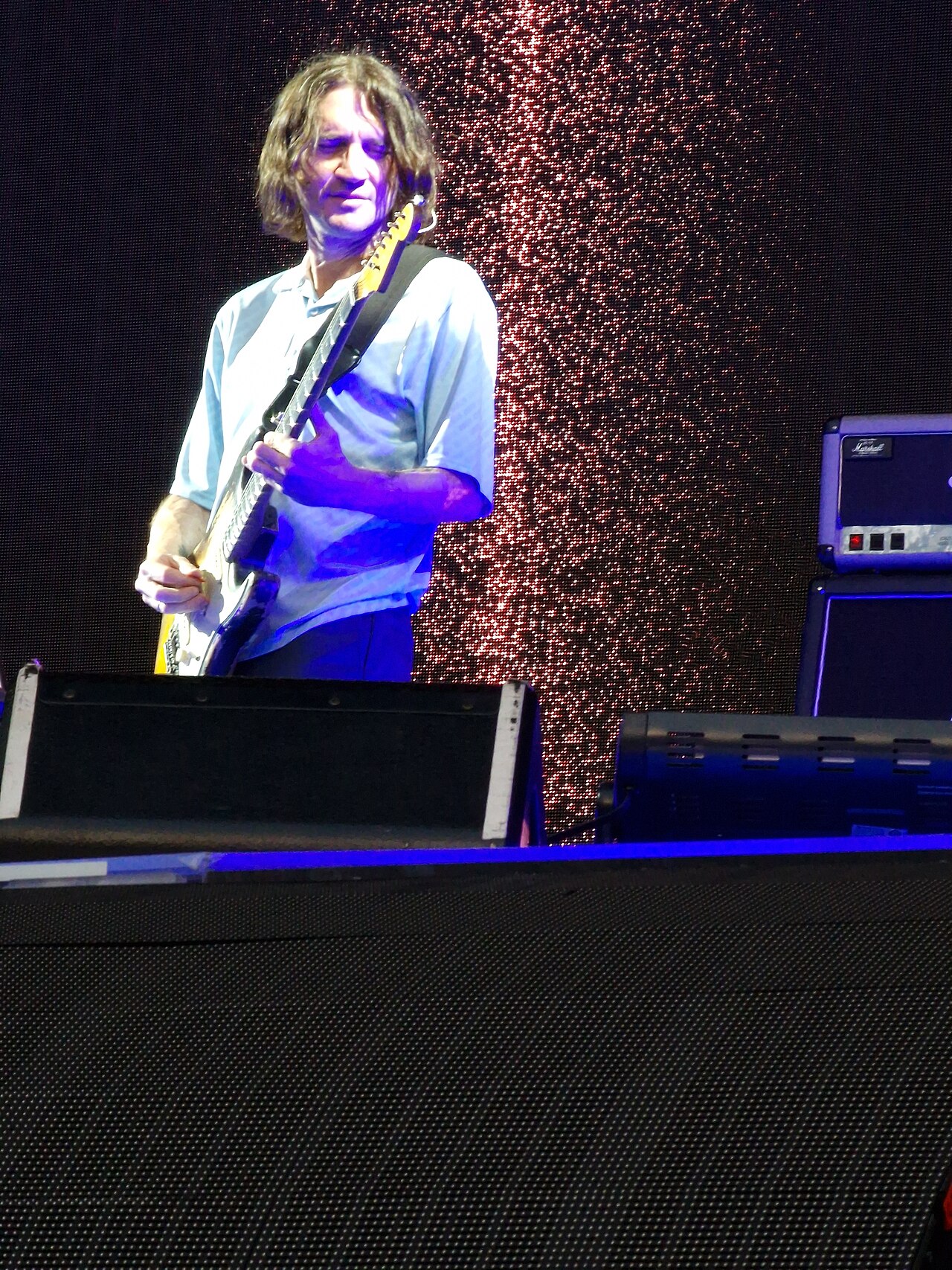
John Frusciante of the Red Hot Chili Peppers has documented use of the Marshall 1960B in the context of his large-venue live rig. A widely reproduced rig diagram from his RHCP touring configuration shows three 1960B straight cabinets as part of his stage setup, typically paired with Marshall Silver Jubilee heads. Frusciante’s studio work and smaller-venue playing often involves a very different signal chain — Marshalls, Fenders, and various vintage combinatiions at moderate volume — but for stadium and arena shows where the raw acoustics demand full-scale speaker arrays, the 1960B is his straight cab of choice. The Silver Jubilee and 1960B combination produces a specific character: the Jubilee’s Class A/B power stage pushing G12T-75s generates the punchy, clear, slightly scooped tone that sits behind Frusciante’s lead playing without obscuring his guitar’s midrange presence.
Jerry Cantrell
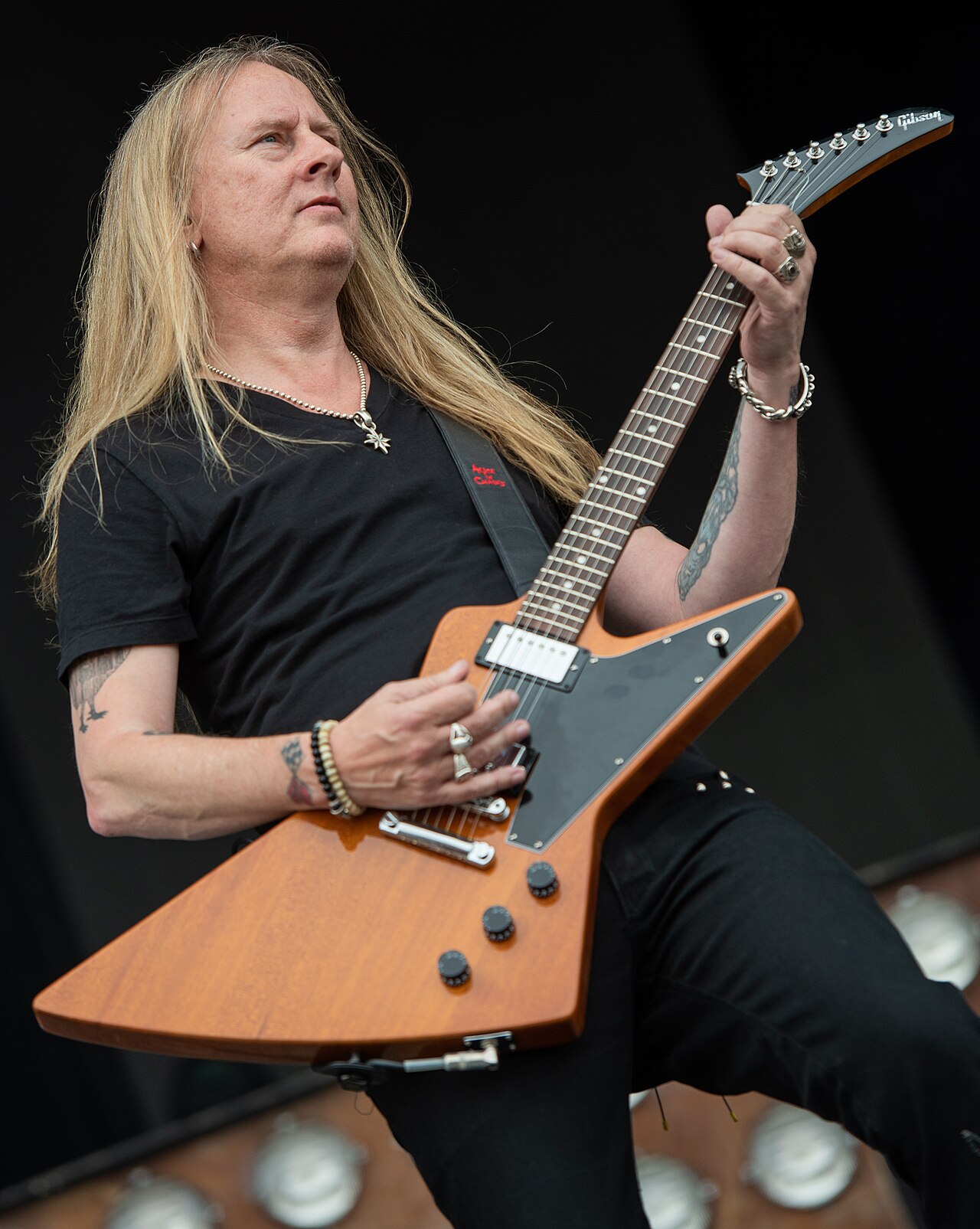
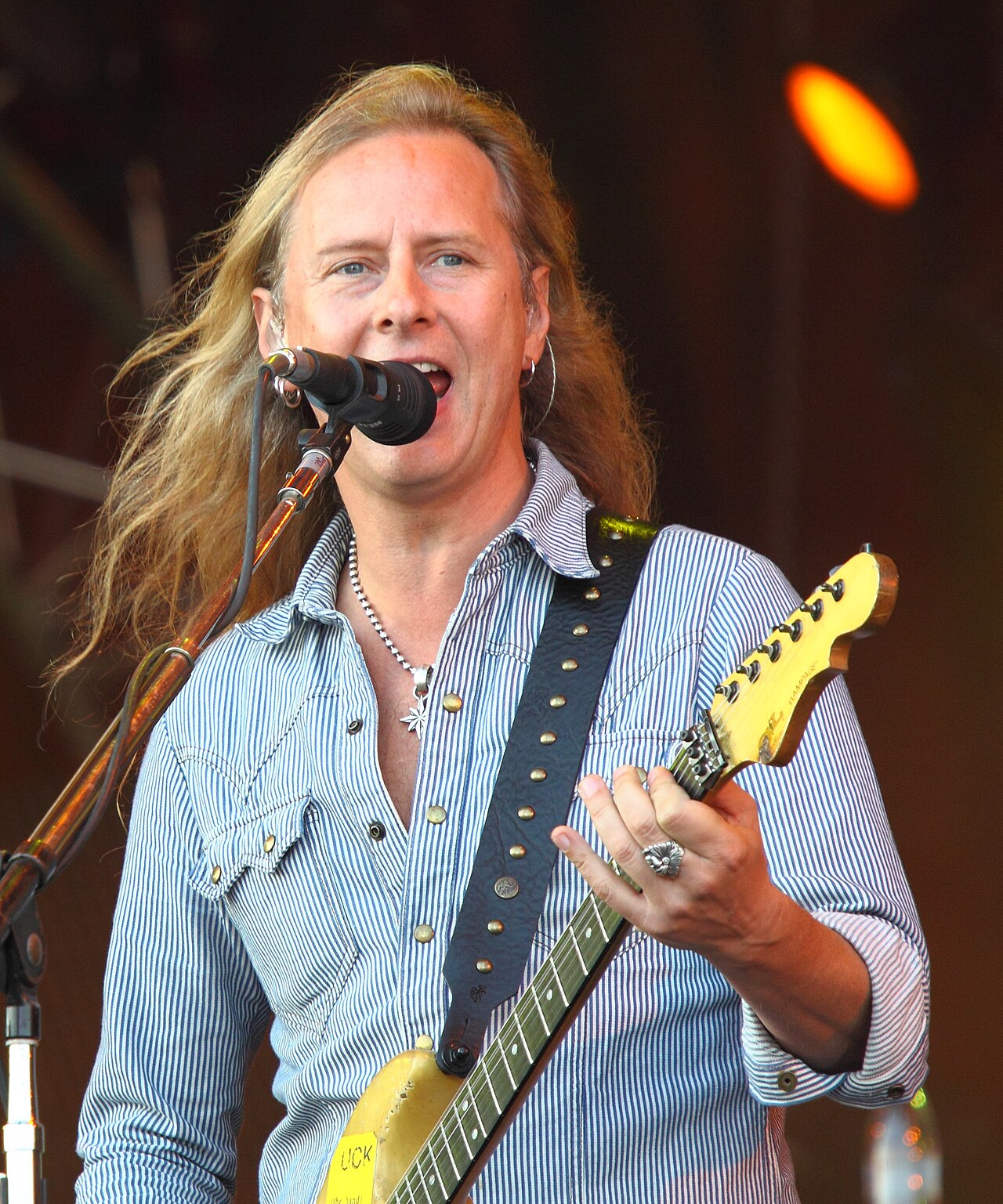
Jerry Cantrell‘s relationship with Marshall 4×12 cabs is extensively documented in live footage from the early 1990s. At the concert performed on Layne Staley’s birthday in 1991 — a live medley covering Black Sabbath, Judas Priest and Soundgarden — two 1960B straight cabinets are visible below slanted 1960A cabinets in Cantrell’s stage rig at approximately the 0:43 mark, confirming the configuration that appears behind him in photographs from the vast majority of Alice in Chains’ most significant touring years. Cantrell typically ran this setup in the standard full-stack format: 1960A angled on top of 1960B straight, driven by a Marshall head, producing the heavy, downtuned tone of albums like Dirt and Jar of Flies. The downtuned nature of Alice in Chains’ music — Cantrell frequently played in drop D and various lowered tunings — makes the 1960B’s tighter low-end projection particularly relevant. You need the floor-level straight cab to project the extended fundamental frequencies that come with B-standard and drop-C tunings.
Billie Joe Armstrong
Billie Joe Armstrong of Green Day is documented on Equipboard as running multiple Marshall 1960A and 1960B 300W cabinets in his live rig, consistent with the large-scale stage production that Green Day has employed since the mid-1990s. This is consistent with what appears in photographs and video footage from Green Day’s touring across multiple decades. Armstrong runs a high-gain signal chain — his signature driving tones through Marshall and Fender heads — into large speaker arrays at arena volumes, and the 1960B straight cab is part of that array.
Corrections
Slash is frequently cited in connection with Marshall 4×12 cabs, and his connection to the B-format straight cab is real — but the cab he uses is the 1960BV, which is the 1960B loaded with Celestion G12M Vintage (reissue Greenback) speakers instead of the stock G12T-75s. The 1960BV is a distinct product with a significantly different sonic character: the G12M Vintage has the warm, compressed, harmonically rich character of the original 1960s Greenbacks that Slash’s Silver Jubilee tone was built around. Using a 1960BV or using a standard 1960B are meaningfully different choices. Slash is not documented on the standard G12T-75-loaded 1960B, and using his name as a straight association with this product overstates the connection.
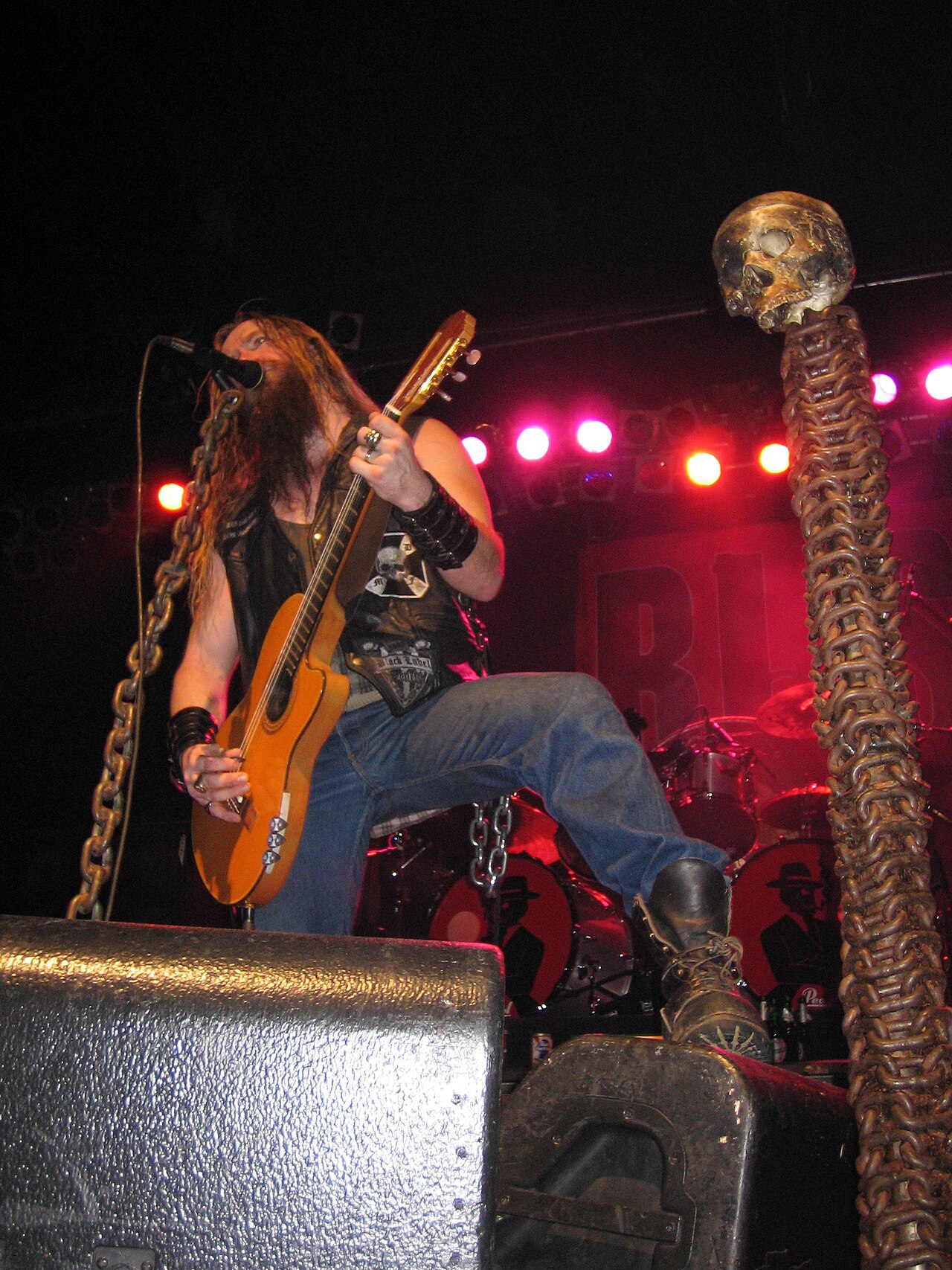
Zakk Wylde has reportedly stated a preference for straight B-format cabs over angled A-format because of the tighter low-end and because the straight cab does not fire directly at his head on stage (angled cabs at floor level can produce the feedback and ear-level volume issues that monitor engineers hate). But Wylde’s documented primary cab through his JCM800 2203 head-based rig is not specifically confirmed as the standard G12T-75-loaded 1960B versus other variants. The general preference for straight-cab geometry over angled is documented; the specific product is less clear.
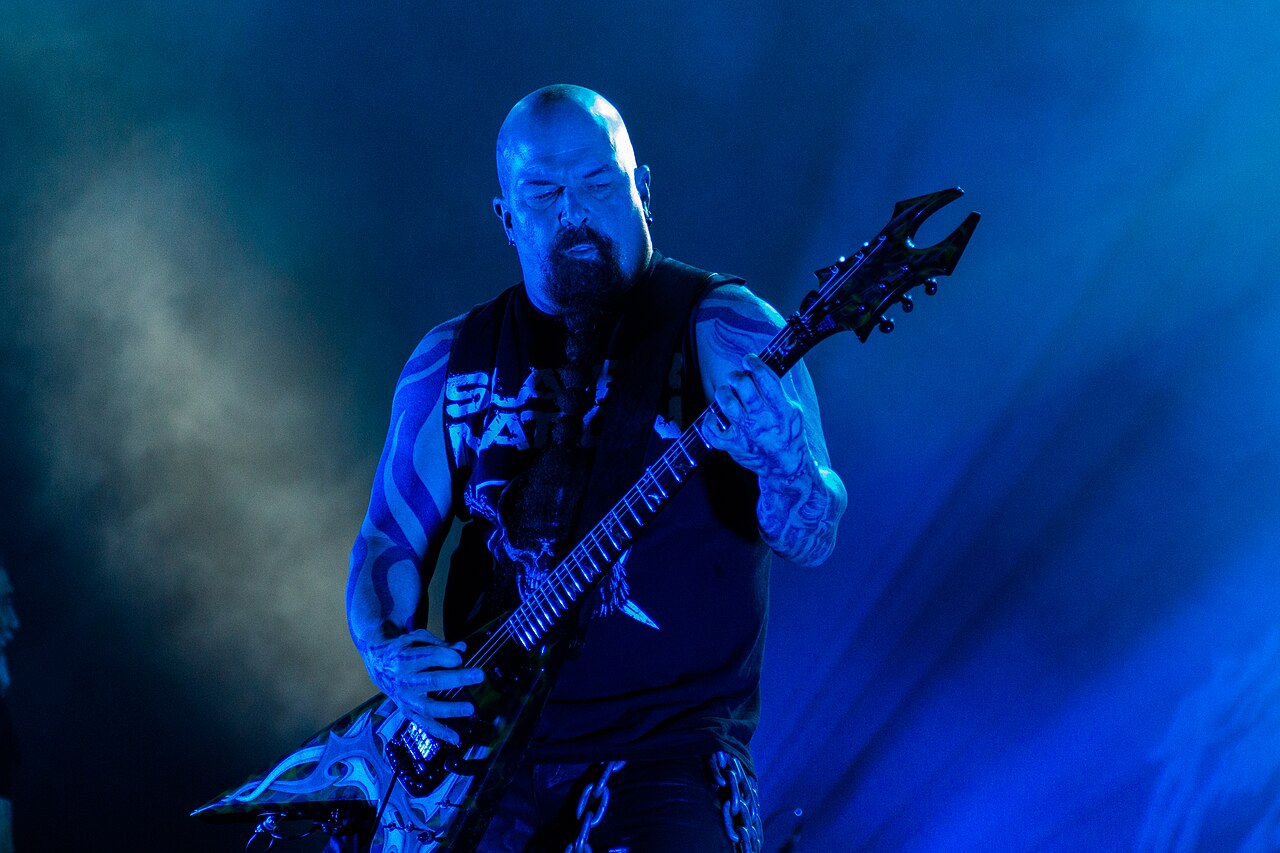
Kerry King of Slayer ran Marshall JCM800 2203 heads into large 4×12 arrays for much of Slayer’s career, and straight Marshall cabs are present in multiple live photographs. No primary source — manufacturer page, Rig Rundown interview, or documented product use — specifically confirms the 1960B as the exact cab in those setups versus other Marshall straight-cab options.
Gary Moore died in February 2011. His legacy is real and his guitar playing is genuinely worth reading about in his dedicated article. His connection to the 1960B in any specific documented form does not exist in primary sources. The debunk stands.
Tone Recipes
Recipe 1: Full Stack Classic Rock — Head into A+B Pair
Run a Marshall 1987X Plexi (or any 100-watt Plexi-style head) into a 1960A and 1960B in standard full-stack configuration. Both cabs at 16Ω. Mono cable from the head’s 8Ω tap into the 1960A’s input, then daisy-chain a second cable from the 1960A’s second input to the 1960B’s input, both cabs at 16Ω = 8Ω load total at the amp. Head: master volume (if present) at 7–8, presence at 6, bass at 5, middle at 5, treble at 6, high-input channel. The pair produces the full-stack sound: the 1960A gives you the sweet, wide dispersion of an angled array on stage, the 1960B delivers the floor-level weight that fills the room. This is the configuration that created classic rock.
Recipe 2: Kurt Cobain In Utero — Mesa Preamp into V30-Loaded 1960B
Replace the stock G12T-75s with four Celestion Vintage 30s (8Ω each, series-parallel = 8Ω total). Run a Mesa/Boogie Studio .22 Preamp into a solid-state power amp (Crown, QSC, or modern equivalent) — 100 to 200 watts is sufficient; Cobain used 800W but that was for eight cabs. At the preamp: clean channel, gain low (3–4), master volume moderate (5–6), treble at 6, mid at 5, bass at 6. The Vintage 30’s honking upper midrange and its warmth at moderate volume produces the open, slightly saturated clean tone that Cobain used on the quieter In Utero passages. Push the preamp gain to 7–8 for the “Territorial Pissings” wall-of-distortion sound. Add a Boss SD-1 in front of the preamp for additional saturation without altering the midrange character.
Recipe 3: Jerry Cantrell Downtuned Crunch — JCM800 into Straight Cab
Drop-D or drop-C tuning, Gibson or PRS into a Marshall JCM2000 DSL100 or original JCM800 2203, running into a single 1960B in mono at 16Ω. High-gain channel, gain at 6–7 (not full — Cantrell’s tone has definition in the pick attack), bass at 6, mid at 5, treble at 6, presence at 5. Add a Pro Co RAT 2 before the amp input — distortion at 9 o’clock, filter at 11 o’clock, volume up to match bypassed level. The 1960B’s focused straight projection handles the extended low frequencies from the downtuned strings without the flabbiness that an angled cab can introduce at floor level when the bottom pair is pointing at the ceiling. Cut 300Hz by 3dB in the PA if the bottom end is congesting the mix.
Recipe 4: John Frusciante Stadium Clean-to-Dirty — Jubilee into Three 1960Bs
For this recipe you obviously need more than one 1960B, which makes it academic for most players — but the principle scales down. A Marshall Silver Jubilee 100-watt head (or the 2555X reissue) into a single 1960B at 16Ω. Channel A (clean): presence at 7, treble at 6, middle at 5, bass at 5, volume at 7–8 (the Jubilee’s Class A clean is best accessed near the top of the volume range where the output stage starts to engage). Channel B (lead): gain at 6, treble at 7, middle at 4, bass at 5, volume at 6. The G12T-75’s extended top end complements the Jubilee’s warm, slightly scooped character — together they produce a clean tone with real body and a lead tone with singing but not shrill top end. Use an Ibanez TS9 on the lead channel (gain at 0, tone at 10, level at maximum) to tighten the front of the gain stage.
Recipe 5: Modern Metal Wall of Sound — High-Gain Head, Single 1960B, Maximum Projection
One 1960B in mono 4Ω (parallel), one high-gain head with a 4Ω minimum output tap — Marshall DSL100HR is the straightforward option. DSL100HR ultra-gain channel: gain 1 at 7, gain 2 at 7, bass at 6, middle at 3 (the mid-scoop is the point), treble at 7, presence at 6, resonance at 5, master volume at 5. A noise gate is essential in this configuration — the high gain and the G12T-75’s extended top end will pick up every electromagnetic interference source in the building. A Boss NS-2 or ISP Decimator between guitar and amp kills the noise floor without affecting the attack of the pick. The 4Ω mono setting maximises the current draw through the output transformer and produces a tighter, harder-hitting low end than the same amp at 16Ω — ideal for palm-muted metal riffing where the fundamental frequencies need to arrive with physical impact.
How the 1960B Compares
vs. Marshall 1960A 4×12 Angled Cabinet
The 1960A is the natural comparison and the natural companion. Identical external dimensions, identical speakers, identical construction, identical price. The difference is purely geometric: the 1960A angles the top pair of speakers back approximately 15 degrees. The result is wider horizontal dispersion, slightly more complex midrange response due to the interference pattern between angled and forward-facing speakers, and better on-stage monitoring for the guitarist’s ear height. The 1960A sounds slightly more “open” and three-dimensional in close-proximity listening and is the preferred cab for players who need to hear themselves clearly on stage without a floor monitor. The 1960B projects more coherently into the room and delivers more focused low-end impact at audience positions. In a full stack both are present; as a standalone cab, the choice is between on-stage monitoring and front-of-house projection. Floor monitoring is the 1960A’s territory; maximum room presence is the 1960B’s.
vs. Marshall 1960BV (Vintage Greenback)
The 1960BV is the same straight birch-ply cabinet loaded with Celestion G12M Vintage speakers instead of G12T-75s. The G12M Vintage is a 25-watt Greenback reissue: warmer, more compressed, with a full midrange hump centred around 800Hz–1.5kHz that the G12T-75’s scoop removes. The 1960BV can only handle 100W total (four 25W speakers) versus the 1960B’s 300W, which limits its pairing options — you cannot run a 100W Plexi flat-out into a 1960BV without risking speaker failure. But at moderate volume the 1960BV produces the warm, vintage character that Slash’s and Jimmy Page’s tones are built around. The 1960B stock is the heavy metal/high-gain cabinet; the 1960BV is the classic rock cabinet. They look identical from the front.
vs. Marshall 1960BHW (Handwired Series)
The 1960BHW is the premium straight-cab option in the Marshall range, loaded with Celestion G12H-30 reissue speakers (30W each, 120W total). The G12H-30 has a larger ceramic magnet than the Greenback and a richer, more harmonically textured response than the G12T-75 — it was the original speaker in the 1960 family’s British Rock era, used by early Hendrix and Clapton before the 25W Greenback became standard. The 1960BHW pairs naturally with the 1974X and handwired heads. At roughly two to three times the price of the standard 1960B, the HW version delivers a more refined, complex character but also a significant drop in power handling and headroom. The standard 1960B is the working tool; the 1960BHW is the studio luxury.
vs. Marshall 1960AX (Greenback Angled)
The 1960AX is the angled G12M Greenback straight-cab equivalent — angled geometry, Greenback speakers, the vintage dispersion-meets-warmth combination. Compared to the 1960B it has both axis differences (angled vs straight) and speaker differences (G12M 25W vs G12T-75 75W). For players who want the full-stack visual and want vintage Greenback character rather than T-75 aggression, the AX on top of a BV on the bottom is the configuration. For players who want maximum output, maximum power handling, and maximum low-end projection, the standard 1960B wins on every count.
vs. Mesa/Boogie Rectifier Standard 4×12 Straight Cabinet
The Mesa 4×12 Standard is loaded with four Celestion Vintage 30s and is one of the definitive high-gain cabs of the 1990s and 2000s — the default companion for Mesa Dual and Triple Rectifiers. It is a thicker, more dense-sounding cabinet than the Marshall 1960B: the V30’s upper-midrange bark at around 2–3kHz gives it a more aggressive, forward character in that frequency range, while its warmer low-mid response (less scooped than the T-75) creates a fuller, chewier low-end texture. At comparable price points the Mesa feels “heavier” and the Marshall 1960B feels “tighter.” Players running downtuned metal often prefer the V30/Mesa combination; players running classic and 1980s hard rock often prefer the T-75/Marshall combination. They are both right, because the frequency targets are different. Swapping the Marshall 1960B’s G12T-75s for V30s — as Cobain did — moves it toward Mesa 4×12 territory tonally while keeping the Marshall’s birch-ply acoustic behaviour. The best of both worlds, at speaker replacement cost.
Buying Guide
The 1960B is available new from Marshall’s UK factory at $1,099.99 (Marshall.com US price), though Sweetwater has been showing it at $923.99 — a genuine markdown from the standard MAP that reflects either a promotional pricing period or inventory adjustment. At either price point it is the most affordable route to a genuine British 4×12 with real birch plywood and UK manufacturing. The Sweetwater price in particular represents extraordinary value: at $923.99 for a 300W 4×12 built in Bletchley, you are paying significantly less per watt of handling capacity than you would for almost any premium boutique cab alternative.
Used, the 1960B trades on Reverb with a current average around $571 and a range from roughly $400 (heavily worn, driver issues possible) to $750 for a clean, fully functional example. The 1960B is a large, heavy cabinet — 80 pounds — and it has historically been used hard on stages. Buying used requires inspection of several specific elements: the integrity of all four speaker cones (push gently on the dustcap of each speaker; any scraping suggests a damaged voice coil), the condition of the comb joints at the corners (these should be tight; any gap indicates moisture damage to the birch plywood), the function of the mono/stereo impedance selector switch (toggle it and check both settings with an ohmmeter), and the condition of the input jacks and internal speaker wiring (loose connections are common in a cab that has lived on tour).
The stock G12T-75 speakers are a known quantity. They work. They have a specific character — scooped, bright, better at high volume than at bedroom levels — and players who do not enjoy that character on first listen should not conclude the cabinet is wrong. Swapping to Celestion Vintage 30s, G12M Vintage reissues, or Creamback H or M variants will transform the tonal character of the 1960B significantly while retaining everything that the cabinet’s physical construction contributes. Speaker replacement in a 1960B is a straightforward task requiring only a screwdriver to remove the baffle panel, standard speaker cable to disconnect the old drivers, and basic soldering or push-connector wiring to install the new ones. Budget $120–200 per speaker for premium Celestion replacement options; $80–120 for mid-range alternatives.
Note on transport: the 1960B includes casters, which are essential — 80 pounds is not a carry in any comfortable sense. The casters fit into pre-drilled holes in the bottom panel and attach with screws. Invest in a flight case or padded cover for any application that involves loading into vehicles or checking on airlines. A case for a 4×12 is a significant additional cost and a significant additional weight; factor this into the total if touring is the application.
Ownership Notes
The 1960B is a deceptively simple piece of equipment that nonetheless has several operating quirks worth knowing. The impedance selector is the most important: running the cab at the wrong impedance setting relative to the head’s output tap is the fastest way to damage either the amp’s output transformer or the speakers. The general rule is that the amp and cab impedances should match — or the cab can be higher impedance than the head, but never lower. Running a 16Ω cab setting on a head with an 8Ω tap is safe; running a 4Ω cab setting on the same 8Ω-tapped head is not. The included speaker cable is wired for the standard 16Ω mono configuration; label the impedance switch position with a piece of tape once you have confirmed the correct setting for your head to prevent accidental changes between gigs.
Break-in is real with the G12T-75 but modest. The speakers will sound somewhat harsh and stiff for the first three to five hours of use at moderate volume. Sustained playing through the full frequency range accelerates this process. A fully broken-in G12T-75 is noticeably looser, more responsive to dynamic playing, and better in the low-mid frequencies than a new one. Do not judge the cabinet’s character on the first session.
The closed-back design means the 1960B pressurises a room in a way that open-back designs cannot. At high volume in a low-ceiling rehearsal space, this can become physically uncomfortable and seriously dangerous to hearing health. The cab is designed to operate in large stage environments or with significant acoustic separation. Practice spaces with the 1960B should use hearing protection at anything above 40% of the head’s volume range. The 80.2-pound cabinet is significantly more than your back wants to handle alone; use a sack truck or recruit assistance for any application that involves moving the cab up stairs.
The birch plywood is durable but not impervious. The PVC covering will scuff and peel at the corners after sustained road use — this is normal and does not affect tone. Bare-wood corners can be re-covered with replacement PVC adhesive covering available from multiple suppliers for under $30. More serious structural issues — loose comb joints, delamination in the birch plies — indicate moisture exposure. Keep the cab off concrete floors (use the casters or a rubber mat) and store it in a climate-controlled environment when not in use.
FAQ
What is the difference between the Marshall 1960A and the 1960B?
The 1960A is the angled cabinet — the top section of the speaker baffle is hinged back at approximately 15 degrees. The 1960B is the straight cabinet — all four speakers face the same direction. External dimensions are identical (770×755×365mm). Both use the same four Celestion G12T-75 speakers, the same 300W mono power handling, and the same Baltic birch plywood construction. The angled 1960A disperses sound more widely and provides better on-stage monitoring for the guitarist. The straight 1960B projects more coherently into the room and delivers tighter, thicker low-end. In a full stack the 1960A sits on top and the 1960B sits on the floor.
What speakers are in the Marshall 1960B?
The stock speakers are four Celestion G12T-75s, each rated at 16Ω and 75 watts, wired in series-parallel to produce the cabinet’s switchable 16Ω/4Ω mono or 8Ω stereo impedance options. The G12T-75 was introduced in 1983 and features a scooped midrange response and extended high-frequency output, making it well suited for high-gain rock and metal applications. Replacement with Celestion Vintage 30s, G12M Vintage Greenbacks, or Creamback variants is straightforward and significantly alters the tonal character while retaining the cabinet’s physical properties.
Can I use the Marshall 1960B with any amp head?
In principle, yes — the 1960B accepts any head with a ¼” speaker output. In practice, impedance matching is essential. The 1960B offers 16Ω mono (one cable from a 16Ω head output), 4Ω mono (one cable from a 4Ω head output tap), or 8Ω stereo (two cables from a stereo power amp or a head with dual 8Ω outputs). The head’s rated speaker impedance and the cab’s selected impedance must match or the cab must be higher than the head’s tap. Mismatched impedance — particularly running a lower-impedance cab on a higher-impedance tap — can damage output transformers in tube amplifiers. When in doubt, run the cab at 16Ω and use the head’s 16Ω speaker output.
Is the Marshall 1960B made in the UK?
Yes. Marshall’s official product page confirms: “Designed and engineered in UK. Made in UK.” The manufacturing location is Bletchley, Buckinghamshire, England — the same factory that has produced Marshall cabinets since the company moved production there from Hanwell in the 1960s. This is not the case for all Marshall products; some of the lower-cost combo and cab lines are manufactured overseas. The 1960 family — including the 1960A and 1960B — remains UK-manufactured.
Why do some players prefer the straight 1960B to the angled 1960A when using just one cab?
Several documented reasons exist. The straight cab’s coherent radiation pattern means all four speakers reinforce each other at the same axis, producing more focused output and a thicker low-end in the direct field. For players with floor monitoring who do not need the angled cab’s on-stage coverage improvement, the 1960B’s focused projection is preferable. For downtuned playing — drop D, drop C, B standard — the additional low-end coherence of the straight cab handles extended fundamental frequencies more effectively. Zakk Wylde has reportedly noted that a straight cab at floor level does not fire directly at his ear height the way an angled top cab sometimes does, reducing the immediate fatigue of stage-level volume.
Kurt Cobain used Marshall cabs but reportedly did not like Marshalls — how does that work?
Cobain’s documented opinions on Marshall amplifiers were negative — he found their preamp and tone-shaping character unsympathetic to his needs and strongly preferred Mesa/Boogie and Fender amplification for the actual tone shaping in his signal chain. The Marshall 1960B cabinets were a different matter. A cabinet does not generate tone the way an amplifier does; it converts the electrical signal from the power amplifier into acoustic energy. The Marshall 1960B — especially with its stock G12T-75 speakers replaced by Celestion Vintage 30s — was a reliable, roadworthy, widely available enclosure that handled his stage power requirements. Cobain was using a Mesa/Boogie Studio .22 Preamp and a Crown power amp into the cabs, so the Marshall name on the cabinet grille was architecturally irrelevant to his signal chain. He used the Marshall boxes. He did not use the Marshall tone.
What is the difference between the 1960B and the 1960BV?
The 1960BV is the same straight closed-back birch cabinet loaded with Celestion G12M Vintage speakers (25W Greenback reissues) instead of the stock G12T-75s. This reduces total power handling from 300W to 100W and changes the tonal character fundamentally: the G12M Vintage has a warm, compressed, harmonically rich midrange character versus the G12T-75’s scooped, bright, high-headroom character. The 1960BV is the vintage-rock cabinet; the standard 1960B is the high-gain/high-volume cabinet. Slash uses the 1960BV, not the standard 1960B.
Can you use a single 1960B on its own, or does it need to be paired with a 1960A?
A single 1960B works perfectly well as a standalone cabinet — it does not require a partner 1960A to function. Many players use a single straight 4×12 without the full-stack configuration, particularly in club environments where a two-cab stack would be acoustically overwhelming and visually out of scale. The 1960B alone provides 300W of power handling and the full G12T-75 complement. The full-stack format is a choice, not a requirement. If anything, using a single 1960B without the 1960A on top produces a more focused, directional sound that some players prefer over the wider dispersion of the paired format.
Image credits
- Top image: GuitarGangsters AI-generated reference illustration, not a photograph.
- Jerry Cantrell: Morten Jensen, Wikimedia Commons, CC BY 2.0.
- Kerry King: Alfred Nitsch, Wikimedia Commons, CC BY-SA 3.0 AT.
- John Frusciante: Hel Davies, Wikimedia Commons, CC BY-SA 2.0.
- Zakk Wylde: Joanna Corwin, Wikimedia Commons, CC BY-SA 3.0.
- Jerry Cantrell: Stefan Brending (2eight), Wikimedia Commons, CC BY-SA 4.0.
- Tom Morello: deep ghosh, Wikimedia Commons, CC BY 2.0.
Latest News
Related
On This Day
Monday 9 November
From this week: