Walrus Audio Fathom Reverb: The Little Submarine That Went Looking For Julia
An AI-generated illustration of the Walrus Audio Fathom Multi-Function Reverb.
Walrus Audio Fathom Reverb guide: Hall, Plate, Lo-fi and Sonar algorithms, verified famous players, tone settings, discontinued-market buying advice and FAQ.
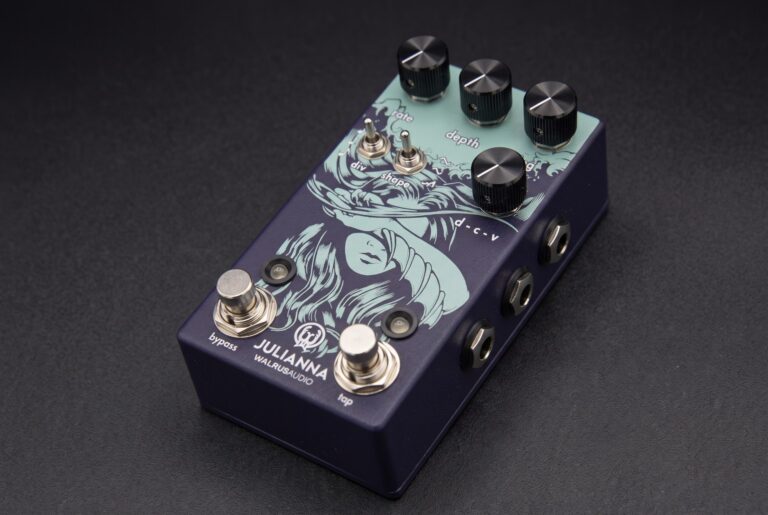
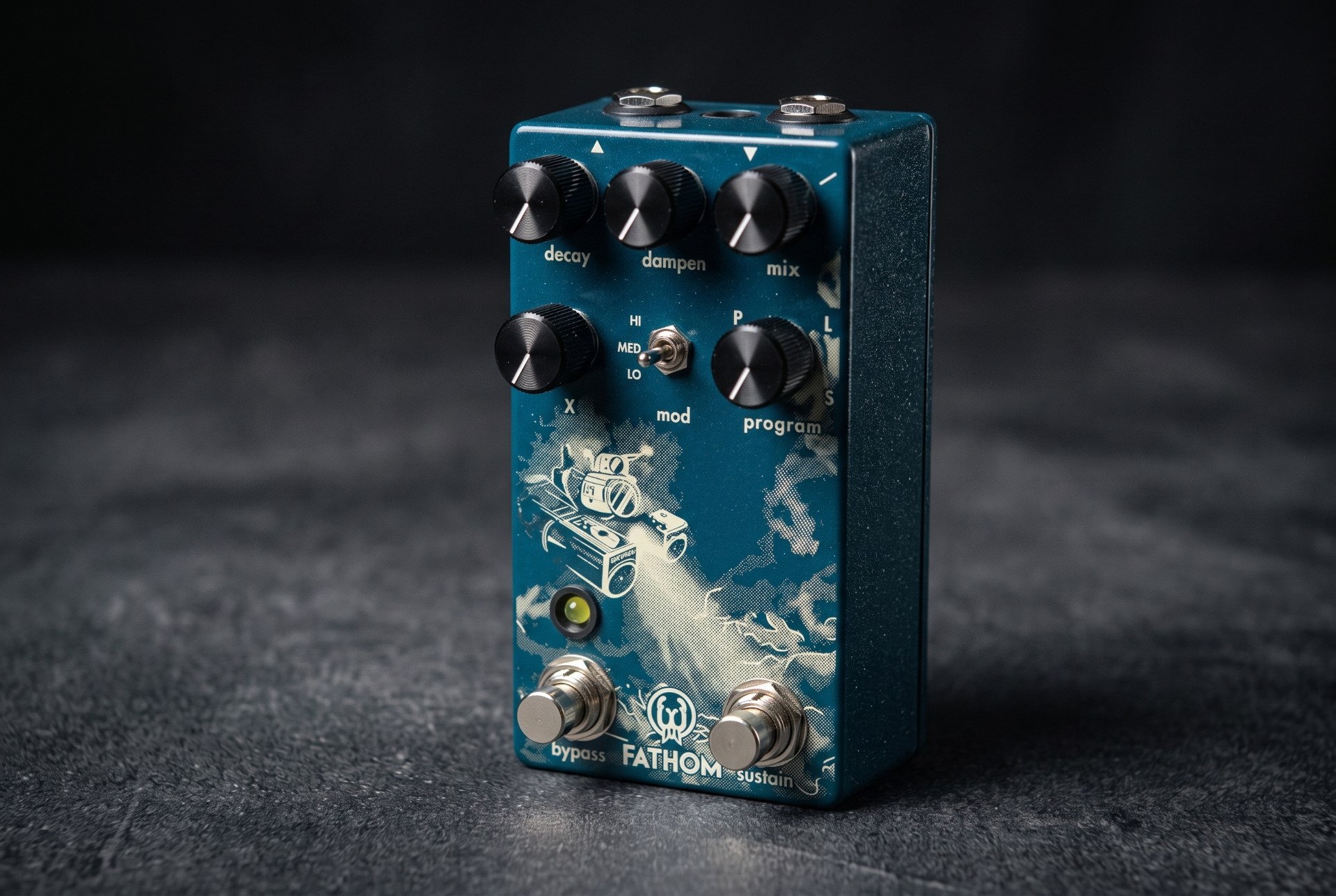
There is a lone one-manned submarine painted on the face of this pedal. It is sinking through what the artist, Stuart Dooley, described as the chasmic depths, and according to Walrus Audio’s own launch copy it is down there searching for the origins of the mysterious Julia. That is not marketing filler bolted on after the fact. It is the whole thesis of the Fathom stated in one image: this is a reverb built by a company that had already made a chorus pedal named after a woman nobody can find, and the reverb was designed to go looking for her.
The Walrus Audio Fathom Reverb arrived in January 2018 at $199 and spent eight years turning up on more serious pedalboards than its price tag or its press coverage would suggest. It was never the flashiest reverb Walrus made — the Slö took the ambient-YouTube crown, the Mako R1 took the spec-sheet arms race. The Fathom just kept showing up: on a Covet board in Nashville, on a Big Thief board, on a City and Colour board, on a boygenius board, on a black midi board where it had unceremoniously replaced a Holy Grail Max.
And then, sometime before this was written, Walrus Audio moved it to the discontinued page. As of September 2026 the Fathom Multi-Function Reverb sits on walrusaudio.com/collections/discontinued-pedals alongside the Descent, the Slötvå, the Lillian and the Monument V2, with a link out to Reverb and a polite suggestion that you go find one yourself. The B-stock listing — Arizona Teal, cosmetic blemishes only, $119.99 — is sold out. The little submarine has gone down for good.
So this is a guide to a pedal you now have to hunt for. Which, given the artwork, feels about right.
Origins: The Prototype That Leaked A Year Early
Walrus Audio’s own press release for the Fathom opens with something most pedal companies would have edited out. “Pedal enthusiasts and message board devotees may remember seeing a prototype image from early 2017 of a new reverb from Walrus,” it reads, “leading to lots of messages and speculation of what we were up to. After a complete art redesign and many more hours of breadboarding, the Fathom Multi-Function Reverb is ready to surface.”
That is an unusually honest paragraph. It tells you the Fathom leaked roughly twelve months before it shipped, that the version people saw looked different enough for the company to say the art had been completely redesigned, and that the circuit kept moving on the breadboard for another year afterwards. Boutique pedal development is normally presented as a clean arc from idea to enclosure. This was a public false start followed by a long, quiet rebuild.
The press release went out from Oklahoma City on 15 January 2018, timed for NAMM. Retail was $199, pre-orders opened immediately, and the stated ship date was 29 January. Amusingly, the original release has a typo that has never been corrected in the archived version — it promises “an expected release date of January 29, 2017,” a year that had already been over for a fortnight. Given that the prototype really did leak in early 2017, it is a very forgivable slip by whoever was writing at NAMM speed.
The Descent Connection
Walrus explicitly framed the Fathom as a descendant rather than a debut. The Sonar algorithm, the press release says, “gives a tip of the hat to its older brother, the Descent, with a blendable shimmer/octave.” The Descent Reverb/Octave Machine was the big, eight-knob, preset-capable ambient machine Walrus had launched in 2016 — a pedal Premier Guitar praised specifically for a hall setting they called one of the best they had heard in a pedal, clear and three-dimensional.
The Descent was expensive, large and complicated. The Fathom took its most distinctive idea — blendable pitch-shifted octaves feeding the reverb — shrank it into a standard enclosure, added three more algorithms and undercut the price badly. Both pedals are now discontinued, the Descent first and the Fathom years later; in between, Walrus built an entire ambient ecosystem on the ground the Fathom broke — the Slö Multi Texture Reverb, the Slötvå, the Slöer, the Lore, the Fable, the Mako R1 and eventually the Qi Etherealizer.
What The Fathom Actually Does
Five knobs, one three-way toggle, two footswitches. That is the entire control surface, and it is worth stressing how restrained that is for a pedal with four distinct algorithms and a secondary function on nearly every control.
The knobs are Decay, Dampen, Mix, X and Program. Decay sets tail length. Dampen is a treble roll-off applied to the reverb, not the dry signal — this is the control that decides whether your reverb sits behind the guitar or on top of it. Mix is a straight wet/dry blend with a printed 50/50 indicator line on the faceplate, a small courtesy that matters more than it sounds when you are setting up in the dark. Program sweeps between the four algorithms, and crucially it sweeps rather than clicks, so the in-between positions are usable rather than undefined.
X is the Walrus house control, and on the Fathom it changes job entirely depending on where Program is pointed. That single knob is doing four different things across the pedal’s range, which is the main reason the Fathom manages to feel deep on a five-knob layout.
Hall
Walrus describes Hall as wide, open and vast, with a decay that ends in a high-frequency rolloff. That rolloff is the important part. A lot of budget digital hall algorithms decay linearly across the spectrum and end up sounding like a fizzing cymbal wash; the Fathom’s hall gets progressively darker as it dies, which is what real large rooms do. On this setting the X knob controls pre-delay, letting you push the onset of the reverb back so the dry attack stays clear before the room opens up behind it.
Reviewers repeatedly singled out the Hall for acoustic guitar as much as electric, which tells you something about how naturalistic it is. It is the setting you would leave on if you only ever used one.
Plate
Full-bodied with a smooth decay, X again on pre-delay. Plate is the studio setting — denser and more immediate than Hall, with less of a sense of physical space and more of a sense of sheen. It flatters single notes, arpeggios and vocals-style sustained chords. Where Hall says “this room is enormous,” Plate says “this was recorded properly.”
Lo-fi
This is where the Fathom stops behaving like a utility. Lo-fi is a filtered reverb whose decay ranges, in Walrus’s own words, from warm to thin AM-sounding radio, and the X knob controls filter width. Narrow the filter and the tail turns into a band-limited ghost of itself — something that sounds like your reverb is being broadcast from another room through a wall. Widen it and it warms back into something close to a dark plate.
Lo-fi is the algorithm that gets the Fathom onto boards belonging to players who already own three other reverbs. It does a thing that the Strymon BigSky and the Boss RV-500 can approximate with menu diving but cannot reach with one knob.
Sonar
The Descent’s inheritance. Sonar feeds the reverb with both a high and a low octave, and X blends between them. Push it one way and you get a conventional shimmer — the upper-octave sparkle that has been the default “ambient guitar” sound since the mid-2000s. Push it the other and you get sub-octave rumble underneath the tail, which is a far rarer and far more interesting sound, and the one that actually justifies the pedal’s nautical theme. Somewhere in the middle you get both at once, and the reverb starts to sound like a chord that is not on your fretboard.
This is the setting people mean when they say the Fathom sounds like it is underwater. It is not a shimmer pedal with extra steps; the downward octave is the differentiator, and it is why a Fathom stacked into a fuzz produces something genuinely strange rather than just large.
The Modulation Toggle
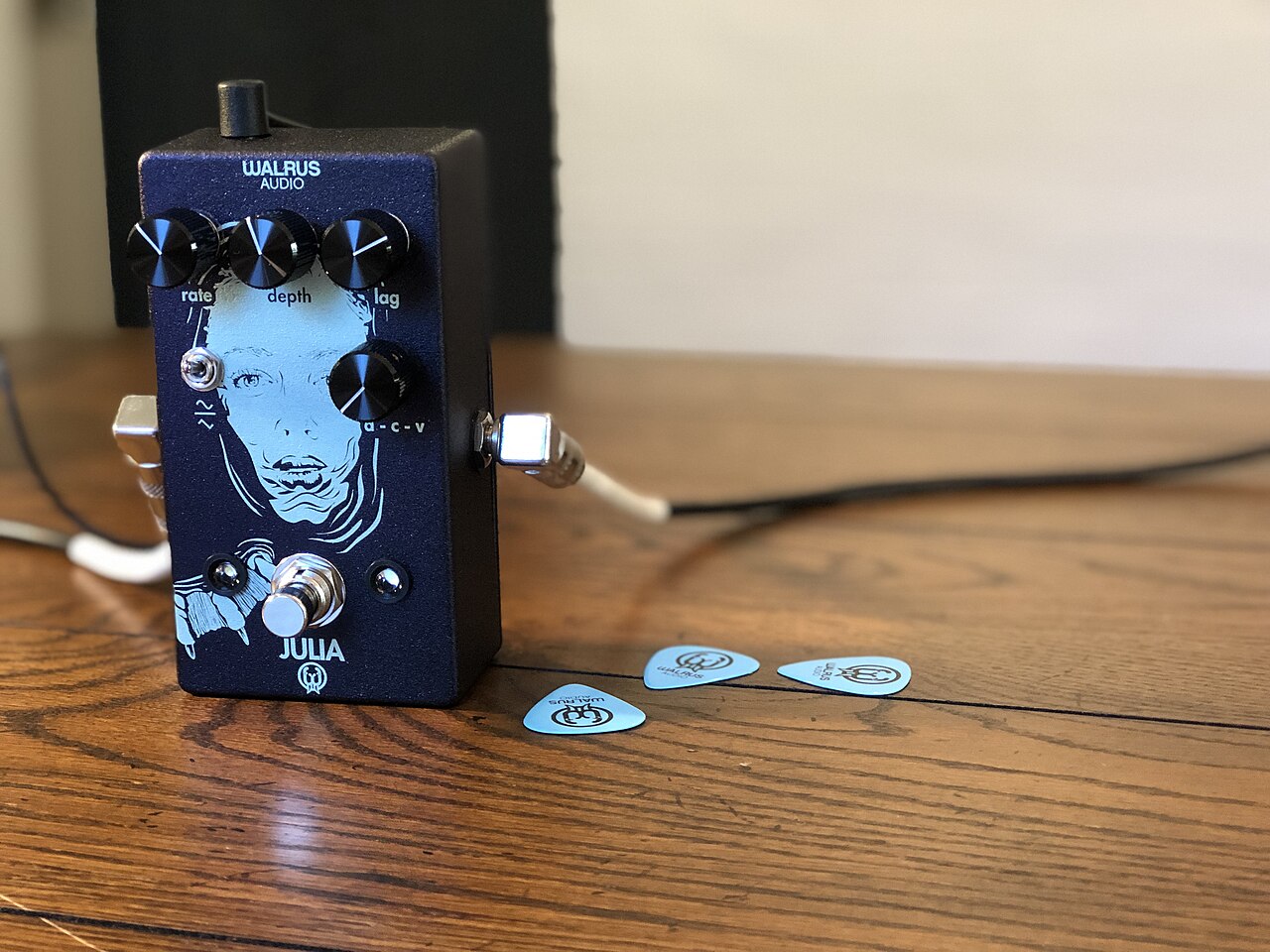
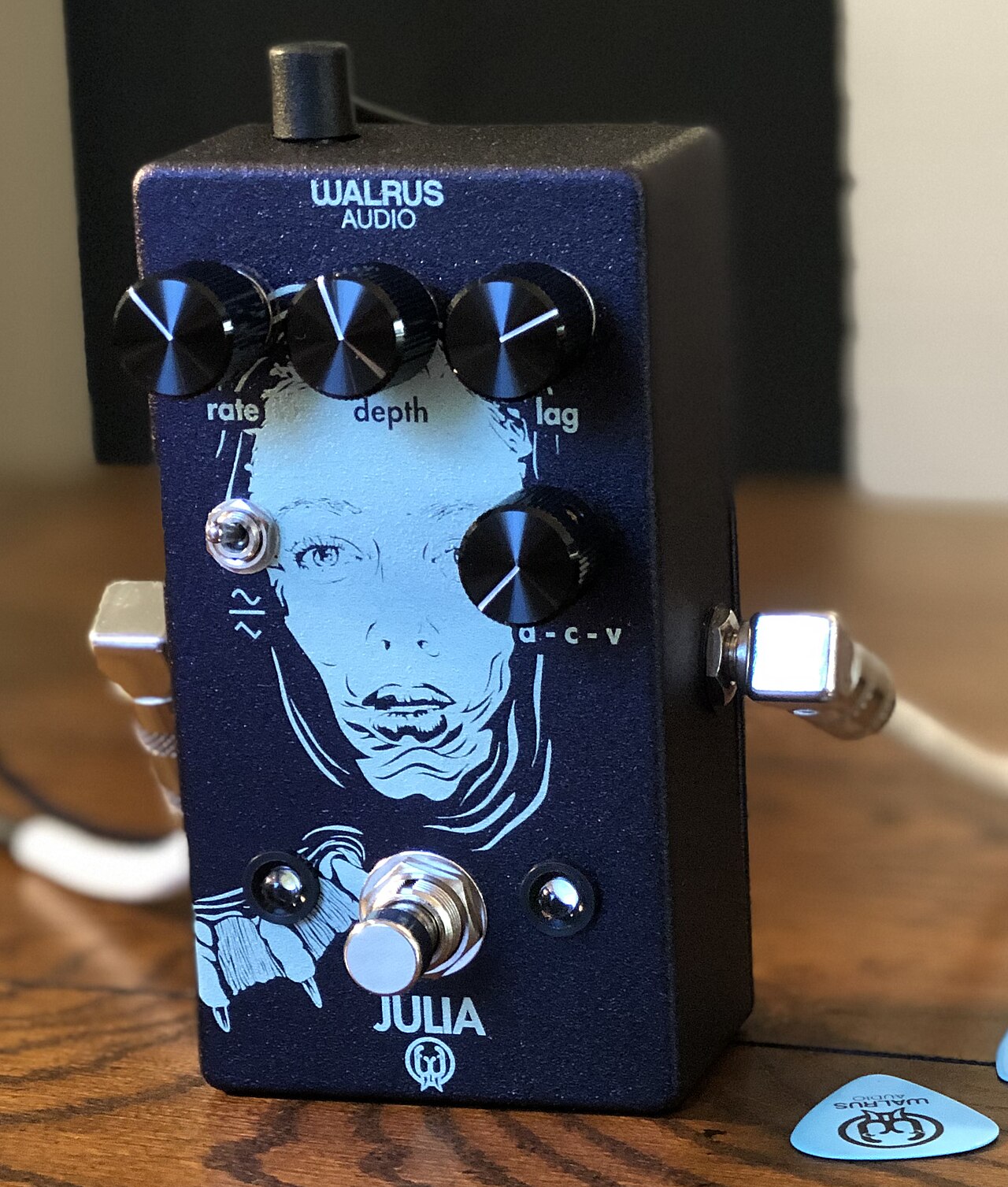
A three-position mini-toggle offers low, medium and high modulation applied to the reverb tail. Walrus called it “very tasteful amounts of modulation,” and they were being accurate rather than modest — even the high setting is a gentle drift rather than a seasick warble. This is the control that connects the Fathom back to the Julia Analog Chorus/Vibrato conceptually as well as narratively. It is chorus applied only to the wet signal, which is a very different and much more usable thing than putting a chorus pedal after your reverb.
Specifications
The Two Footswitches Are The Point
Plenty of reverbs give you four algorithms. Very few give you two footswitches on a compact enclosure, and the Fathom’s second switch is what separates it from being a set-and-forget box.
The Sustain switch, held down while the pedal is engaged, stretches the decay towards infinity. Release it and the held tail decays away naturally underneath whatever you play next. This is a performance control, not a parameter — it is the pedal equivalent of a sustain pedal on a piano, and it is the reason the Fathom turns up on boards belonging to players who build songs live rather than just colour them.
The Bypass switch has a hidden second life. With the pedal off, press and hold it and the effect activates for exactly as long as your foot is down. Let go and it drops out. That gives you a momentary splash of reverb — one enormous chord in an otherwise dry verse, a single arpeggio that blooms and vanishes — without ever committing the reverb to the whole passage. It is a small feature that changes how you write.
Trails mode is off by default and enabled by an unusual gesture: unplug the pedal, hold the bypass switch, and plug the power back in while holding for two seconds. Tails then decay naturally when you disengage. It is a hardware-boot procedure rather than a menu item, so it is easy to forget you set it — which matters used, where you may buy a Fathom configured to somebody else’s preference.
Famous Players: What Actually Checks Out
Here is where this guide diverges sharply from most of what is written about the Fathom, and where it is worth being blunt about method. The gear database this series is built from claims The Edge, John Mayer, Mark Lettieri and Mateus Asato for this pedal. That same five-name string appears verbatim on the entry for the previous pedal in the list, character for character, which is a reliable sign that it is a template rather than a finding.
Independent checking bears that out. There is no documented instance of The Edge using a Fathom — his ambient architecture has always been built from rackmount delays and, latterly, the Eventide and Korg ecosystem, and the U2 tech blogs that document his rig in obsessive detail have never listed one. There is no documented Fathom on any of John Mayer‘s three touring pedalboards, which have been photographed and published repeatedly. Mark Lettieri is a genuine Walrus user, but the pedal associated with him is the Julia, not the Fathom. And Mateus Asato — who really does run a stack of Walrus boxes, and who filmed his own walkthrough of them — runs a Slö and an ARP-87, not a Fathom.
So all four of the headline claims fail. But the Fathom’s real roster is better than the fabricated one, and that is the genuinely interesting part.
Yvette Young — The One That Became A Signature Pedal
The strongest documented Fathom user is Yvette Young of Covet, and the source is about as good as it gets: a Premier Guitar Rig Rundown, filmed post-soundcheck before a Nashville show at the High Watt, in which she walks through the entire board. The Fathom is on it. So is a Walrus Julia, a pair of EarthQuaker boxes including an Avalanche Run, three MXR pedals including a Carbon Copy Deluxe and a Ten Band EQ, a Caroline Somersault, an Electronic Audio Experiments Longsword, a Meris Mercury7 and a TC Electronic Ditto.

Note what that board is: a player who already owns a Mercury7 — one of the most respected ambient reverbs ever made — choosing to also carry a $199 Fathom. That is not a budget decision. It is two reverbs doing two different jobs.
The story has a coda. At NAMM in January 2025 Walrus launched the Qi Etherealizer — a $449.99 stereo multi-effect combining chorus, delay, granular processing and reverb on the company’s new MDSP platform, designed with Yvette Young over more than a year. A player who put a Fathom on her board in the late 2010s ended up co-designing the pedal that now occupies the Fathom’s old slot in Walrus’s Delay and Reverb menu.
The Indie Rock Contingent
Lucy Dacus and Julien Baker — two-thirds of boygenius — both appear in Fathom documentation independently. Dacus’s is a pedalboard photograph from her own Instagram during the Forever Is A Feeling touring cycle, Fathom at the top left. Baker’s is a video in which she shows the pedal directly. Both are the artist showing you their own gear.
Buck Meek of Big Thief has a board shot on the band’s own Instagram account showing a Fathom alongside a Julia and a Jupiter V2 fuzz — a three-pedal Walrus core, which is a meaningful vote of confidence from a guitarist whose entire sound is built on textural restraint.
Dallas Green, who records as City and Colour and plays in Alexisonfire, was photographed with a Fathom on the official City and Colour Instagram. Green’s solo work lives on exactly the kind of wide, dark, slow-decay reverb the Fathom’s Hall algorithm produces.
The Heavy Side
This is the part people underestimate. The Fathom is not a delicate pedal, and its user list skews heavier than its ambient reputation suggests.
Jordan Buckley of Every Time I Die confirmed a Fathom on his live board in a Premier Guitar Rig Rundown — a mathcore guitarist running a boutique ambient reverb in a band built on chaos. Will Swan of Dance Gavin Dance posted a photo of new pedals picked up in Toronto that included one. And Matt Kelvin of black midi turned up in a Reddit board photo from a Toronto set with a Fathom that had, per the caption, replaced his Electro-Harmonix Holy Grail Max.
That last detail is the most useful single data point in this entire section. A working touring guitarist swapped out a Holy Grail — the default, universally respected, do-no-harm reverb — for a Fathom. That is a direct competitive comparison made with somebody’s own money and their own stage volume.
The Session And Demo World
Cory Wong of Vulfpeck has an Instagram clip in which the board visible at the start includes a Fathom on the left, a Julia V2 second from the right, and a Walrus Aetos power supply — an all-Walrus signal path in a genre where nobody would expect one. Ariel Posen discussed it on camera, with the timestamped line “and last but not least, I have the new Walrus Audio Fathom, which is a really nice reverb.” Daniel Steinhardt of TheGigRig and That Pedal Show has featured it, which for a certain audience carries more weight than any of the above. And Tyler Larson built a video around it under the entirely unavoidable title “Unfathomably Good Guitar Tone.”
One note on linking: none of the twelve verified Fathom users above has a guitarist guide in this archive yet, so none of them is linked here. The names that are linked — The Edge, Mateus Asato and the reference points below — are linked because their guides exist, not because they used this pedal. In several cases the link exists to explain that they did not.
Reference Points, Not Users
If you are trying to place the Fathom’s sound in your head, the useful comparisons are players whose reverb-forward guitar sound predates the pedal entirely. Robin Guthrie of the Cocteau Twins and Kevin Shields of My Bloody Valentine define the wall-of-blur end of the Fathom’s Lo-fi and modulated Hall territory. Bill Frisell and Nels Cline are the reference for reverb used as a compositional element rather than a coating. Jonny Greenwood is the reference for the Sonar algorithm’s sub-octave rumble used as a threat rather than a decoration. David Gilmour is the reference for what Hall with a long pre-delay does to a sustained bend. None of these players is documented using a Fathom. All of them are useful targets.
Tone Recipes
The Always-On Room
Program to Plate. Decay 9 o’clock, Dampen 1 o’clock, Mix 9 o’clock, X (pre-delay) at minimum, modulation toggle to Lo. This is the setting that makes a dry amp sound like it is in a decent room and nothing more. Turn trails mode on and you can forget the pedal exists. If your amp already has spring reverb, run this instead of it rather than alongside it.
Big Sad Chords
Program to Hall. Decay 2 o’clock, Dampen 2 o’clock, Mix 12 o’clock (on the printed 50/50 line), X around 11 o’clock for a touch of pre-delay, modulation toggle to Med. Play open chords slowly. The pre-delay keeps the strum articulate while the tail swells behind it, and the Dampen setting stops the whole thing turning into hiss. This is the City and Colour setting.
Underwater Broadcast
Program to Lo-fi. Decay 1 o’clock, Dampen 11 o’clock, Mix 1 o’clock, X rolled well back to narrow the filter, modulation to Hi. Now play single notes with the neck pickup and your tone control at 6. The tail should sound like it is arriving through a wall. Add a slow delay in front and the two effects stop being distinguishable, which is the goal.
Sonar Descent
Program to Sonar. Decay 3 o’clock, Dampen 12 o’clock, Mix 1 o’clock, X set fully towards the low octave, modulation to Lo. Hold a single low note and let it bloom. The sub-octave content builds underneath the fundamental and produces something closer to a synth pad than a reverb. This is the Fathom’s signature move and the one no other reverb at this price does properly.
Shimmer Without The Cliché
Program to Sonar. Decay 2 o’clock, Dampen 3 o’clock, Mix 11 o’clock, X pushed towards the high octave but not all the way, modulation to Med. Keeping Mix below noon and X short of the extreme is what stops this becoming the same shimmer everyone else has. Compare it against an EarthQuaker Afterneath and you will hear the difference in philosophy immediately: the Afterneath scatters, the Fathom stacks.
Fuzz Cathedral
Program between Hall and Sonar — park the sweep in the gap. Decay maxed, Dampen 1 o’clock, Mix 2 o’clock, modulation to Hi. Put a big-box fuzz in front. The Fathom’s headroom holds up under a fuzz far better than most compact digital reverbs, and the in-between Program positions are where its best sounds hide. One user review on Walrus’s own site describes exactly this: looking to expand a distortion tone without adding squeal, and getting growl plus near-infinite sustain instead.
Momentary Punctuation
Any algorithm, Mix at 3 o’clock, Decay maxed, pedal switched off. Play the verse completely dry. On the last chord before the chorus, hold the bypass switch down. You get one enormous bloom and then silence. Nobody who has not used a two-switch reverb will work out how you did it.
Knob positions here are given as clock positions. Mix is the control to move first on every one of these; everything else is fine-tuning.
How It Compares
Against The Slö
The obvious in-house comparison. The Slö Multi Texture Reverb is dreamier, slower and more explicitly designed for texture — its Dark, Rise and Dream algorithms are moods rather than spaces. The Fathom is the more practical pedal: Hall and Plate are legitimately good conventional reverbs that you can leave on all night, which is not really what the Slö is for. If you need one reverb, the Fathom. If you need atmosphere, the Slö. Chicago Music Exchange eventually sold both ideas glued together in a double-wide enclosure — first as a Fathom + ARP-87 combo, later as the Slärp, which paired the Slö with the ARP-87 instead.
Against The BigSky
The Strymon BigSky is three times the money, has twelve algorithms, presets, MIDI and stereo. It is a better machine by every measurable criterion. What it does not have is the Fathom’s single-gesture immediacy — one Program knob, one X knob, no menus, no saving. Players who own both tend to keep the Fathom for the Lo-fi and Sonar sounds specifically.
Against The Hall Of Fame 2 And The RV-6
The TC Electronic Hall of Fame 2 and the Boss RV-6 are the two default answers when somebody asks for a reverb pedal, and both are cheaper. Both give you a good reverb and variations on it; the Fathom gives you two good reverbs, two strange ones and a second footswitch. That footswitch is most of the price difference, and worth it if you will use it.
Against The Oceans 11
The Electro-Harmonix Oceans 11 is the value champion here — eleven modes for well under the Fathom’s launch price. The Fathom wins on feel: the Oceans 11’s modes are distinct presets, the Fathom’s Program knob is a continuous sweep with usable territory between the marked positions. The Oceans 11 wins on breadth and, frankly, availability, since it is still in production.
Against The Afterneath And The Microcosm
If your interest is the weird end, the EarthQuaker Devices Afterneath V3 and the Hologram Microcosm both go considerably further out than the Fathom’s Lo-fi and Sonar. But neither will do a convincing plate reverb, and both are conspicuously not the pedal you leave on for a whole set. The Fathom’s trick is that it covers the normal jobs competently and the strange jobs adequately. That combination is rarer than it sounds.
Against Its Own Successor
Walrus’s current answer in this slot is the Qi Etherealizer at $449.99, plus the simple-reverb tier occupied by the Fundamental Reverb at the budget end. There is now no direct replacement at the Fathom’s price point and size — which is the strongest possible argument for buying a used one.
Buying Guide
The Fathom is discontinued at the manufacturer and no longer stocked new at Sweetwater. Everything below assumes the used market.
Prices To Expect
Launch retail was $199, late-life street sat around $199–219, and Walrus’s own B-stock — cosmetically blemished, functionally perfect — was $119.99 before it sold out. Expect roughly $110–170 used for a standard Arizona Teal unit in good condition, with clean boxed examples pushing higher now new stock has gone. Discontinued Walrus boxes have historically firmed up in the twelve to eighteen months after leaving the line, so this is not a decision to sit on.
Variants Worth Knowing
- Standard Arizona Teal. The production run, cream and white ink, Stuart Dooley submarine artwork. This is what almost every listing is.
- Nautical Edition. A Chicago Music Exchange exclusive limited finish, sold as part of a three-pedal set with the ARP-87 Multi-Function Delay and the Deep Six Compressor V3. Individually split units turn up; they command a premium over standard.
- Fathom + ARP-87 combo. A CME-exclusive double-wide enclosure containing a complete Fathom and a complete ARP-87 side by side. The direct ancestor of the later Slärp concept, and considerably rarer.
- Fathom / Slö. A rarer combination still, sold under Walrus’s own exclusive series branding. If you find one at a sensible price, it is the most interesting object in this list.
What To Check Before Buying
Check that both footswitches work independently — the Sustain switch is used far less than Bypass on most people’s boards and can therefore be the one that has quietly failed without the seller noticing. Ask the seller to confirm whether trails mode is currently on or off, because the enabling procedure requires a power cycle and you want to know what you are getting. Verify the pedal powers up from a standard 9V isolated supply and not just from the seller’s daisy chain. And look closely at the Program knob sweep in any video the seller provides: the in-between positions are a feature, so a knob with a dead zone or a crackle is a real problem, not a cosmetic one.
Ownership Notes
Power. 9V DC, centre-negative, 100mA minimum. There is no battery compartment and no battery operation — this is a digital pedal and it needs a supply. Walrus explicitly recommends an isolated supply across their entire line and explicitly advises against daisy chains. On a digital reverb this is not boilerplate: a shared, undersized supply is the single most common cause of the whining and digital hash people blame on the pedal itself.
Buffered bypass. The Fathom is buffered, not true bypass — a benefit at the end of a long chain, but it does mean the pedal is always in your signal path. If you run a vintage-style fuzz at the front of the board and the Fathom is your only buffer, you are fine: the buffer is at the end where it belongs.
Trails. Off by default. Enable it. The procedure — unplug, hold bypass, plug back in, keep holding two seconds — is easy to get wrong the first time. If it does not seem to take, you probably released too early.
Placement. End of chain, after modulation and delay, is the default and the right answer for the Hall and Plate settings. But Sonar rewards experimentation: putting the Fathom before a delay means the delay repeats the octave content, which stacks into something enormous. Try both.
Size and support. At 4.77″ x 2.6″ the Fathom is a standard Walrus enclosure — not small, but efficient for two footswitches. Walrus still hosts the manual as a PDF and keeps the pedal fully documented on the discontinued page, which matters when buying from a seller who has lost the paperwork.
Frequently Asked Questions
Is the Walrus Audio Fathom discontinued?
Yes. As of September 2026 it is listed on Walrus Audio’s official discontinued-pedals page, it has been removed from the Delay and Reverb section of their current Core Series lineup, and it is no longer stocked new at major retailers. Walrus’s own B-stock listing is sold out. It is a used-market pedal now.
What is the difference between the Fathom and the Slö?
The Fathom’s four algorithms are Hall, Plate, Lo-fi and Sonar — two conventional reverbs and two experimental ones. The Slö’s three are Dark, Rise and Dream, all atmospheric rather than naturalistic. The Fathom is the more versatile everyday pedal, the Slö the more distinctive ambient one, and only the Fathom offers blendable high and low octaves.
Does the Fathom do shimmer?
Yes, via the Sonar algorithm with the X knob blended towards the upper octave. It also does the far less common inverse — a sub-octave fed into the reverb — and blends of both. Shimmer is not the whole of what Sonar does, and arguably not the most interesting part.
Is the Fathom true bypass?
No, it is buffered bypass. Trails mode is available as a separate, user-toggled setting, enabled by holding the bypass switch for two seconds while reconnecting power.
Can the Fathom run on a battery?
No. It requires a 9V DC centre-negative supply drawing at least 100mA, and Walrus recommends an isolated supply rather than a daisy chain. There is no battery compartment.
Which famous guitarists actually used a Fathom?
Documented users with photographic or video sourcing include Yvette Young of Covet — via a Premier Guitar Rig Rundown — plus Lucy Dacus, Julien Baker, Buck Meek of Big Thief, Dallas Green of City and Colour, Jordan Buckley of Every Time I Die, Will Swan of Dance Gavin Dance, Matt Kelvin of black midi, Cory Wong, Ariel Posen and Daniel Steinhardt. Claims that The Edge, John Mayer or Mateus Asato used one do not hold up to checking.
What replaced the Fathom in Walrus Audio’s lineup?
Nothing directly. The current Walrus reverb offering runs from the Fundamental Reverb at the entry level up through the Slö and Slöer to the Mako R1 MKII and the Qi Etherealizer, the $449.99 Yvette Young collaboration launched at NAMM 2025. There is no current Walrus pedal that occupies the Fathom’s specific combination of size, price and four-algorithm simplicity.
Is a used Fathom still worth buying in 2026?
For the Lo-fi and Sonar algorithms and the two-footswitch layout, yes — nothing at the same size and secondary-market price does the same things. If all you need is a competent hall reverb, current-production alternatives like the Oceans 11 or the RV-6 are easier to buy and easier to service. The Fathom is worth hunting down because of what makes it strange, not because of what makes it normal.
Image credits
- A pedalboard with wah and effects pedals: John Athayde, Wikimedia Commons, CC BY 2.0.
- A Walrus Audio Julia chorus and vibrato pedal: Guitar Chalk, Wikimedia Commons, CC BY 2.0.
- A Walrus Audio Julia chorus and vibrato pedal, close up: Guitar Chalk, Wikimedia Commons, CC BY 2.0.
- Top image: GuitarGangsters AI-generated reference illustration, not a photograph.
- Yvette Young: Zrubinphoto, Wikimedia Commons, CC BY-SA 4.0.
Latest News
Related

On This Day
Tuesday 10 November
From this week: