Meris Mercury7 Reverb: The Pedal That Put Blade Runner on a Pedalboard
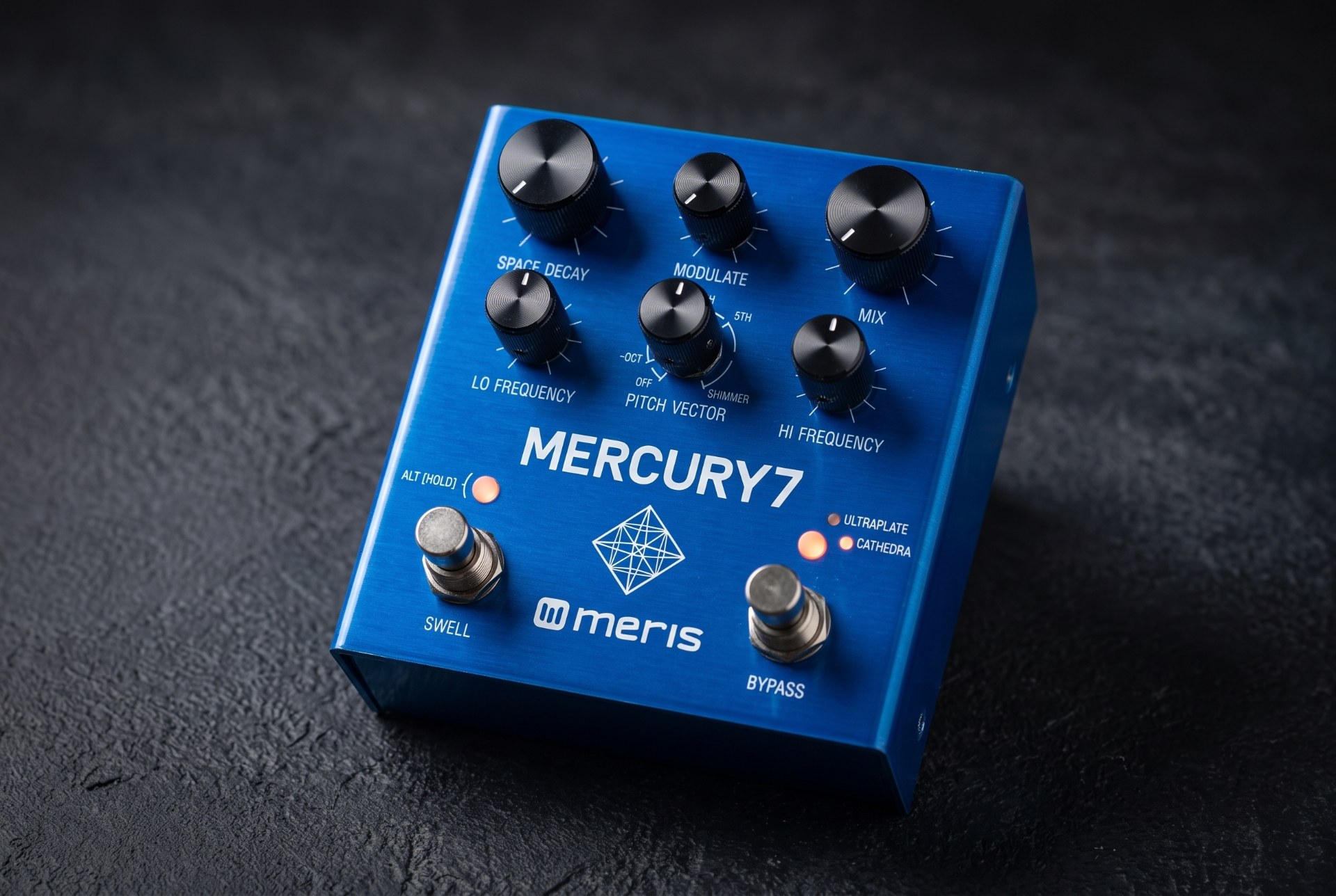
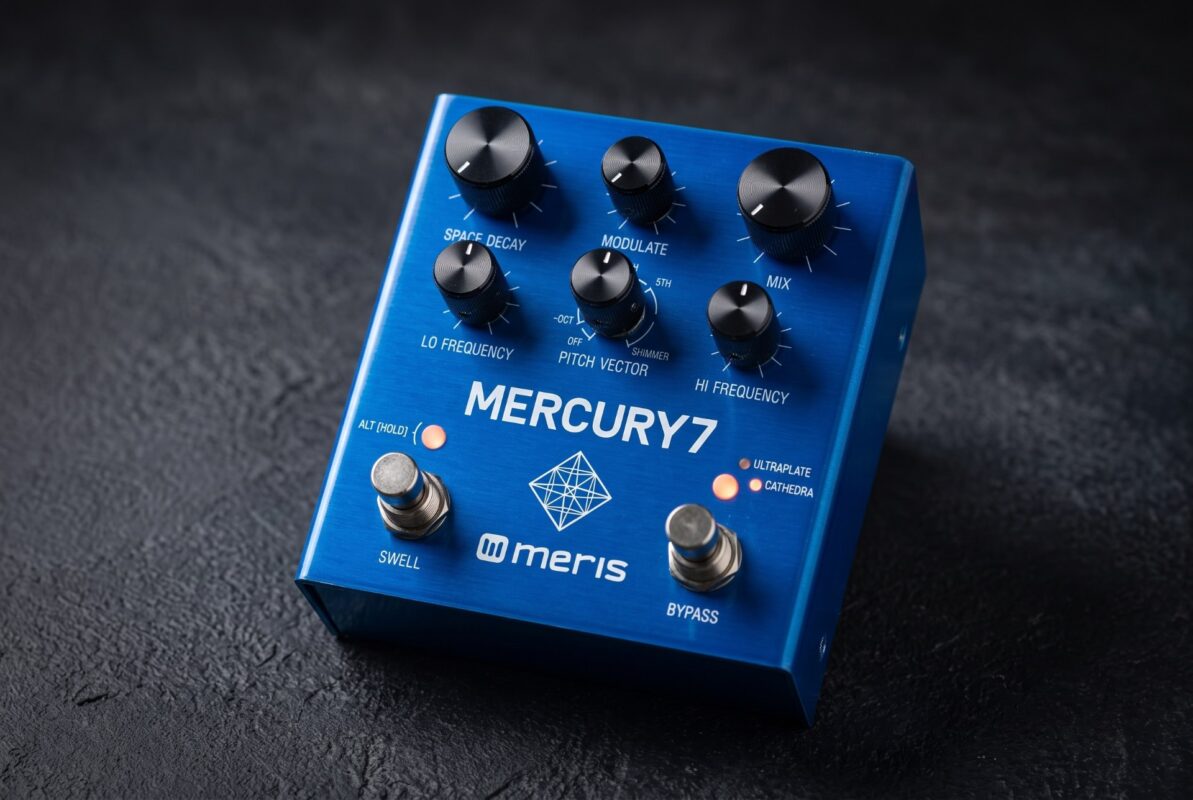
An AI-generated illustration of the Meris Mercury7 Reverb.
The Meris Mercury7 turns Blade Runner into a pedal. Full specs, Ultraplate vs Cathedra, pitch vector settings, verified players and tone recipes.
Most reverb pedals are trying to sound like a room. The Meris Mercury7 is trying to sound like a city that never existed — rain on neon, a saxophone somewhere below, and a synthesizer decay so long it stops being an effect and becomes weather. Meris never hid the reference. The product page still says “Inspired by the 1982 Bladerunner film soundtrack,” the tagline is “OFF-WORLD AMBIENCE,” and the newsletter signup box on that same page is headed, with a straight face, “REPLICANTS STANDBY.”
That is not marketing decoration bolted on after the fact. It is the design brief, stated by the man who wrote the code. Meris DSP engineer Angelo Mazzocco, quoted on the company’s own product page: “I get inspired every time I hear Vangelis’s use of reverb on the original Blade Runner soundtrack. It never gets old. I designed the Mercury7’s algorithms to bring those same extra long decays and lush modulated reflections to the pedal world.”
Nearly a decade after it shipped, the Mercury7 is still $299, still in the current Meris catalogue, and still on pedalboards belonging to people who could afford anything. It has also been outgrown by its own successor and quietly criticised by a meaningful slice of its owners. All of that is true at once, and this article is going to hold all of it.
Where the Mercury7 Came From
Meris: a Strymon engineer, a 500-series rack, and a very specific idea
Meris was founded in 2013 in Los Angeles. The founder credited on the public record is Terry Burton, and the detail that matters to guitarists is where he came from. Vintage King’s launch coverage put it plainly in its opening line: “Building off the groundwork he laid at Strymon, engineer Terry Burton is now creating next-level 500 Series and effects pedals at Meris.” If the Mercury7 feels like it was built by people who have already solved the hard problems of pedal-format DSP — low noise floor, analog dry path, sensible converters — that is because it was.
But Meris did not start as a pedal company. It started as a 500-series module company, building for the API-format racks that live in professional studios: a mic preamp, a bitcrusher called Ottobit, and a mono algorithmic reverb called Mercury7. That module was reviewed by Hugh Robjohns in Sound On Sound in June 2016 — a full year before most guitarists had heard the name.
From rack module to stompbox
The pedal came next, and the timeline is unusually easy to pin down. Meris’s own product-page assets were uploaded in March 2017. Vintage King published its announcement piece — “Meris Condenses Incredible 500 Series Modules Into Pedal-Form,” covering the Mercury7 and the Ottobit Jr. together — on 4 May 2017. Premier Guitar’s review by Joe Charupakorn landed 3 September 2017, in the October 2017 pedal issue, and took a Premier Gear Award with it. Sound On Sound came back for the pedal version in August 2018, with Bob Thomas writing the second review.
Bob Thomas also summarised exactly what the conversion gained, and it is worth quoting because it explains why the pedal, not the module, is the famous one: the repackaging “brought with it stereo operation at both instrument and line levels and a very welcome drop in price. Other upgrades include a hard or buffered bypass, the ability to store 16 presets, support for continuous controller and program change messages via MIDI, and the facility to interface with external hardware controls.”
So the pedal is not a compromised version of the rack unit. It is the better one. That is a rarer story than it sounds.
Meris Mercury7 Reverb — Full Specifications
Read that last row again. The Mercury7 has not changed price in nine years. Not a promotional discount, not an all-time-low flag, not a clearance. Sweetwater, Guitar Center, Musician’s Friend, Reverb and Vintage King all sit at $299; Thomann is $333 and Gear4Music £320.50, which is normal currency-and-VAT drift. In a pedal market where almost every boutique digital box has been marked down at some point, that is a statement about how Meris runs its business.
The Two Algorithms — and Why Two Is the Whole Argument
Almost every competitor at this price offers eight, ten, twelve reverb modes. The Mercury7 offers two. Whether that is the pedal’s greatest strength or its fatal flaw is genuinely the central debate about it, and both camps have a case.
Ultraplate
Meris describes it in five words: “Inspiring & lush plate with a fast build.” Ultraplate is the everyday setting — a rich, immediate plate that arrives quickly behind the note rather than blooming in after it. Owners repeatedly describe it as “subtle and lush, serving as a great always-on reverb alternative to traditional spring reverb, especially for clean tones.”
What makes it more than a plate emulation is that the Lo and Hi Frequency controls are not simple filters. Meris is explicit that these “change how low frequencies react in the reverb algorithm” and “alter the high frequency absorption of the reverb space.” You are not EQing the output; you are changing how long each part of the spectrum lives inside the virtual tank. Push Lo Frequency toward maximum and, in Meris’s words, “low frequency decay times are extended giving the impression of a larger room.” Pull Hi Frequency down and the space gets more natural, more absorbent, more like a room with soft surfaces.
Cathedra
Meris: “Massive & ethereal algo with a slow build.” This is where the Blade Runner brief actually lives. The slow build means the reverb does not appear behind your note — it swells up under it, which is why the pedal has a dedicated Swell footswitch rather than treating auto-swell as an afterthought.
Charupakorn’s Premier Guitar review documented what Cathedra does at extremes better than any marketing copy has: “In the cathedra algorithm—with additions of shimmer pitch vector, low space decay settings, fast and deep modulation settings, and the mix all the way up—my guitar was transformed. The high mix reduced the intensity of my pick attack and the effect bloomed like clouds of sound—making the guitar feel more like some slow-motion organ than a 6-string.”
He went further: with Pitch Vector at fifth-up he “conjured ethereal sounds that evoked images of an underwater harp,” and with Space Decay maxed he got “a creepy, wind-tunnel-like effect with a super-long trail that lifted chords into the ether.”
The honest counterargument
Two algorithms genuinely is a limitation, and Meris’s own customers say so. Aggregated owner discussion flags that “the Mercury7 can feel overwhelming due to the limited number of algorithms compared to other reverb pedals, despite the unique sounds it can achieve,” and some players find it “too extreme for ambient music,” reaching instead for a Source Audio Ventris or a Neunaber Immerse for everyday work.
The counter-counterargument is the better one, and it also comes from owners: “While the Mercury7 has only two algorithms, its extensive control options allow it to compete with more multi-mode offerings from brands like Strymon and Universal Audio.” Two algorithms × six pitch vector settings × six alt parameters is not two sounds. It is a modulation matrix with two starting points.
Pitch Vector: the Control That Defines the Pedal
Charupakorn called it “the centerpiece of the control set,” and he was right. Pitch Vector sets an intra-tank pitch interval — a phrase worth unpacking, because it is the technical heart of the design.
On most shimmer pedals, a pitch shifter sits before or after the reverb: you hear a reverb, and you hear an octave-up ghost of it. On the Mercury7 the shift happens inside the reverb tank, applied to the reflections as they regenerate. The result compounds rather than layers. Meris says the controls “all interact to sculpt the intra-tank pitch regeneration” — Space Decay, Pitch Vector Mix and both frequency controls are all part of the shimmer engine, not separate from it.
The six settings, per Meris and confirmed by both magazine reviews:
- Off — a straight, uncoloured reverb tank
- Octave down — a sub-octave shadow under the tail; the darkest, heaviest setting on the pedal
- Slight pitch down — micro-detune, sagging; tape-like without being tape
- Slight pitch up — micro-detune, lifting; the most usable “always on” colour
- 5th up — the harmonically strangest setting, and the one that produces the “underwater harp”
- Octave up (shimmer) — the classic, and the most divisive
The alt function is where it gets genuinely powerful. Hold ALT and turn Mix and you get Pitch Vector Mix — the balance between pitch-shifted reflections and normal reflections inside the tank. Charupakorn: “Factory balance settings for the basic pitch vector colors are excellent. But pressing the alt control as you move the mix knob lets you control how much of the pitch vector shift is present, and you can make very profound changes in the balance that make pitch effects stronger, less organic, and more reminiscent of movie sound design.”
That last phrase — “more reminiscent of movie sound design” — is the sentence that sold a lot of Mercury7s.
The honest caveat: a recurring owner complaint is that “the shimmer function is often criticized, with many finding it unusable except at extreme settings.” If you want the tasteful, mix-in-a-little shimmer that a Strymon Cloudburst or a Walrus Audio Fathom gives you at the turn of one knob, the Mercury7 will make you work for it.
Every Control, and Its Hidden Second Life
Sound On Sound identified the real design achievement in one sentence: “it’s the implementation of its control and modulation capability that makes this unit rise above its peers — by assigning an Alt function to every control knob, Meris have delivered the level of control necessary to exploit the Mercury7’s full potential.”
Space Decay / Predelay
Primary: “Sets decay energy of the reverberation space.” Alt: predelay — “the amount of time that elapses before the onset of reverberation.” Predelay is the single most underused control on any reverb pedal. Adding 60–100 ms of it is how you get a huge Cathedra tail that still lets the dry note speak.
Modulate / Mod Speed
Primary: overall modulation depth. Alt: “dominant modulation speed of the reverb algorithm.” Note the word dominant — there is more than one modulator running, and you are steering the loudest of them.
Mix / Pitch Vector Mix
Primary: the wet/dry blend, and critically, Meris states it “adjusts Mix of Dry and Wet signals in the analog domain.” Your dry guitar never gets converted. Alt: Pitch Vector Mix, covered above.
Lo Frequency / Density
Primary: low-frequency behaviour inside the tank. Alt: Density — “amount of initial build up of echoes before the reverb tank.” This is the early-reflections control, and it is the difference between a smooth wash and a grainy, gated-sounding attack.
Hi Frequency / Vibrato Depth
Primary: high-frequency absorption. Alt: Vibrato Depth, which “adds vibrato to the reverb input for lush, haunting trails.” Note where it sits: vibrato on the input to the reverb, not the output. Everything downstream inherits the wobble.
Pitch Vector / Attack Time
Alt: attack time for the swell envelope. Combined with the Swell footswitch, this is a volume-swell rig with no volume pedal — an owner-noted advantage that saves a board slot and a cable run.
The Swell footswitch, and the freeze that nobody advertises
Press to engage auto-swell. Hold to maximise Space Decay sustain — effectively an infinite-hold pad, on a pedal whose spec sheet does not use the word “freeze” anywhere. If you have been shopping for a dedicated sustain pedal, the Mercury7 already does a version of it.
Famous Players — What Actually Checks Out
Reverb pedals attract vague artist claims, so here is a graded list rather than a name-dump.
Tier 1: documented in a professional publication
Yvette Young (Covet) is the strongest verified Mercury7 user, and by a distance. The pedal appears in Premier Guitar’s Covet Rig Rundown, and it survived a full board rebuild between the 2019 and 2023 rundowns — PG’s 2023 write-up lists it among the “staples still being stomped on from the 2019 Rundown,” alongside EarthQuaker’s Warden and Avalanche Run, an MXR Carbon Copy Deluxe and a Caroline Somersault. Four years and a complete pedalboard redesign, and the Mercury7 stayed. That is a far better endorsement than any launch-week demo video. Her 2023 board added a Hologram Microcosm, a Walrus Julianna and a DigiTech Whammy Ricochet — and still kept the Meris.
Sarah Lipstate (Noveller) discussed using the Mercury7 to build her soundscapes in an interview with Guitar.com. Lipstate is the ideal reference case for this pedal: an artist whose entire practice is guitar-as-texture, who once told Premier Guitar that pedals feel more like the instrument than the guitar does.
Tier 2: photographed or filmed
- Tycho (Scott Hansen) — visible and being adjusted mid-sequence in a video clip posted to his own ISO50 Twitter account. A creator filming his own rig is good evidence.
- Wata (Boris) — seen in an Instagram story dated 24 March 2020. Boris is a band built on volume and decay; the fit is obvious.
- Ryuichi Sakamoto — visible in an Instagram post. The evidence trail is thinner than the others (no direct link is published), so treat it as a sighting, not a confirmation.
- Mark Hoppus (Blink-182) — credited to his “Rack of Doom” posted on Twitter. Plausible, but the image published alongside the claim is a profile photo rather than the rack itself, so it is unverified as presented.
- Isaiah Sharkey (John Mayer Trio) — presents the pedal in his own YouTube pedalboard walkthrough.
- Michael Guy Chislett (Hillsong United) — pedalboard photograph. Worth noting because worship guitar is one of the Mercury7’s largest real-world user bases and it rarely gets acknowledged in gear writing.
- Eric Cannata (Young the Giant) — posted his current board on Instagram for the band’s ten-year show.
- BT, KARRA and Anthony Marinelli — all producers and composers rather than guitarists, which tells you something real about who buys this pedal. Marinelli’s is the most concrete: a Mercury7 visible at 13:14 in his 2025 studio tour, patched to an Oberheim OB-X.
What the roster actually means
Look at the shape of that list. Two guitar-magazine-verified guitarists, a handful of instrumental and post-rock players, and then a cluster of synth people. The genre tags on aggregated user data tell the same story: Rock leads, but Electronic sits second and Ambient is comfortably represented — unusual for a guitar pedal. Sound On Sound reached the same conclusion from the other direction: “Although the Mercury7 appears to be positioned primarily as a guitar effect, electronic musicians, keyboardists and modular synthesists will undoubtedly also find themselves attracted by its superb audio performance.”
The switchable headroom setting for guitar, synth or line level is not a bonus feature. It is Meris telling you who the pedal is for.
A note on the shoegaze crowd
The Mercury7 gets namechecked constantly in discussions of shoegaze and dream pop, and one owner comparison is specific enough to be useful: Cathedra mode “provides massive, spacious reverb with choir-like pitch shifting, ideal for emulating Cocteau Twins’ ‘Head Over Heels’ sound.” That is a listener describing a target, not a claim that Robin Guthrie ever owned one — he was building those sounds on rack gear in 1983. The same distinction applies to Kevin Shields, Neil Halstead, Jason Pierce and Vini Reilly: they are the vocabulary the Mercury7 speaks, not its customers. If you want the ambient-jazz end of that vocabulary instead, Bill Frisell is the reference; for the noise end, Thurston Moore and Lee Ranaldo.
Ten Tone Recipes
1. Always-On Plate
Ultraplate. Space Decay 9 o’clock, Modulate off, Mix 9 o’clock, Lo 11, Hi 1, Pitch Vector off. The setting you leave engaged all night. Replaces a spring reverb without sounding like one.
2. Blade Runner Pad
Cathedra. Space Decay maxed, Modulate 2 o’clock, Mix 3 o’clock, Lo maxed, Hi 11 o’clock, Pitch Vector octave up. ALT+Mix to roughly 1 o’clock for a heavy shimmer balance. Hold the Swell switch and let a single sustained chord become a synth patch.
3. Slow-Motion Organ
Charupakorn’s discovery, reproduced: Cathedra, shimmer, low Space Decay, fast and deep modulation, Mix all the way up. The high mix kills your pick attack and the notes bloom instead of striking. Play open triads.
4. Underwater Harp
Cathedra. Pitch Vector 5th up, Space Decay 2 o’clock, Mix noon, Hi Frequency 2 o’clock, Modulate 10 o’clock. Single-note melodies only — the fifth turns chords to mush and single notes to something otherworldly.
5. Sub-Octave Doom
Cathedra. Pitch Vector octave down, Lo Frequency maxed, Hi Frequency 9 o’clock, Space Decay 3 o’clock. Put it before your dirt. The sub-octave reflections get saturated along with the note, and you get a wall that no octave pedal alone will give you.
6. Wind Tunnel
Cathedra. Space Decay maxed, Pitch Vector 5th up, Modulate 3 o’clock, ALT+Modulate (speed) slow. Strike a chord and stop playing. This is a texture cue, not a guitar sound.
7. Predelay Clarity Trick
Any algorithm, big settings. Hold ALT and turn Space Decay to roughly 10 o’clock of predelay. Your dry note lands first, then the room opens behind it. This one fix rescues more “my reverb is too washy” complaints than any other adjustment on the pedal.
8. Haunted Vibrato Trails
Ultraplate. ALT+Hi Frequency for Vibrato Depth at around 1 o’clock, Modulate 10 o’clock, Mix 11. Because the vibrato is on the reverb input, your dry signal stays pitch-stable while the tail wobbles — the effect is unsettling in a way output-side modulation cannot reproduce.
9. Grainy Gated Attack
Ultraplate. ALT+Lo Frequency (Density) low, Space Decay 10 o’clock, Hi Frequency maxed, Mix 1 o’clock. Sparse early reflections give a rattly, almost gated front end — the closest the Mercury7 gets to eighties drum-room reverb.
10. Auto-Swell Ambient Bed
Cathedra. ALT+Pitch Vector to set a slow attack time, Mix 2 o’clock, Pitch Vector slight up, Space Decay 3 o’clock. Tap the Swell switch and play. No volume pedal, no fader, no violining with your pinky.
How It Compares
Mercury7 vs. Strymon BigSky
Twelve algorithms against two, at roughly $200 more. The BigSky is the correct choice if you want one box to cover every reverb your set requires. The Mercury7 is the correct choice if you want a specific and unusual sound that no BigSky mode quite produces. Sharing a board with a BigSky is also entirely reasonable, and plenty of people do it — the Meris is not a general-purpose reverb.
Mercury7 vs. Eventide Space
The comparison owners raise most often, and not always in the Meris’s favour: “Eventide Space is frequently preferred over the Mercury7 for its extensive algorithm options and user-friendly interface.” The Space is bigger, deeper and has a real preset system with real buttons. It is also physically enormous and, arguably, harder to enjoy casually. The Mercury7 does one aesthetic better than anything on the Space does.
Mercury7 vs. Empress Reverb
Similar price bracket, opposite philosophies. The Empress Reverb gives you twelve mode families and dozens of sub-algorithms, plus onboard presets. The Mercury7 gives you two algorithms and demands you learn them. The Empress is a Swiss Army knife; the Mercury7 is a chisel. If you want breadth for the money, the Empress wins outright. If you want the Vangelis sound specifically, the Empress will not get you there.
Mercury7 vs. Strymon Cloudburst and BlueSky
The Cloudburst is the modern answer to “I want beautiful ambient reverb without a learning curve,” and it is genuinely excellent at that. The BlueSky v2 is the studio-plate benchmark. Both are easier to use than the Mercury7 and neither will surprise you the way it does. That is the trade.
Mercury7 vs. Walrus Audio Slö
The Slö is roughly $110 cheaper, mono-only, and built on the Spin FV-1 chip. The Mercury7 is stereo, has a far quieter noise floor thanks to its 24-bit conversion and analog dry path, and offers a controllable pitch engine the Slö does not have. If the Slö’s noise issues put you off — a well-documented complaint — the Meris is the fix, at nearly triple the price.
Mercury7 vs. EarthQuaker Devices Afterneath
Both are “weird reverb” pedals, but weird in different directions. The Afterneath is a granular, stuttering, drainpipe kind of strange. The Mercury7 is a cinematic, orchestral kind of strange. Owning both is not redundant.
Mercury7 vs. MercuryX
The elephant. Meris’s MercuryX is a full modular reverb system in the LVX form factor — a screen, a proper preset system, many more structures, and roughly double the price. It is the Mercury7’s successor in every technical sense. What it is not is a replacement: the Mercury7 is a six-knob pedal you can operate without reading a screen, and a lot of players who have tried both keep the smaller one. If you want the sound and hate menus, the older pedal is arguably still the right buy.
Budget alternatives worth naming
If $299 is out of reach, honest options exist. The EHX Oceans 11 gives you eleven modes including shimmer for well under half the money. The Boss RV-6 is the bulletproof workhorse. The TC Hall of Fame 2 and JHS 3 Series Reverb cover the basics well. None of them sound like a Mercury7, and none of them claim to.
Buying Guide
Who should buy one
Buy a Mercury7 if you are a texture player — post-rock, ambient, math rock, worship, film scoring, modular synth — and you want a specific cinematic quality that general-purpose reverbs do not have. Buy it if you play in stereo, because stereo is where the algorithms genuinely open up. Buy it if you have a synth or a modular rig, because the switchable line-level headroom makes it a legitimate studio processor and not a guitar pedal you are abusing.
Who should not
Do not buy it as your only reverb if you also need a plausible spring or a small room. Do not buy it if you want to plug in and get a great sound in thirty seconds — multiple owners have said, in effect, that the pedal is “overwhelming due to its complexity and hidden parameters,” and they are not wrong. Do not buy it if you need instant preset recall on stage without additional hardware.
The preset problem, stated plainly
The Mercury7 has no onboard preset buttons. Four presets require the Meris four-button preset switch; all sixteen require MIDI via the separately sold MIDI I/O box. Guitar.com’s reviewer flagged that “preset access is limited without external hardware,” and it remains the pedal’s most legitimate structural criticism. Budget for the accessory if presets matter to you; the pedal’s real cost for a preset-dependent player is not $299.
New versus used
New is $299 essentially everywhere. Used examples run around $200 — roughly 67% retention after nine years, which is strong for a digital pedal and reflects the fact that the price has never been cut. The unit has no moving parts to wear beyond the footswitches and the relay, and the enclosure is thick brushed aluminium. There is little risk in buying used, and a $99 saving is real money.
Is it discontinued?
No. It sits in the current Pedals section of the Meris catalogue alongside Enzo X, Ottobit X, MercuryX, LVX, Hedra, Enzo, Ottobit Jr. and Polymoon. Meris’s own store did show it out of stock in September 2026 with a wait-list signup attached, which is worth knowing before you plan on buying direct — but every major retailer had stock at full price.
Living With a Mercury7
Power
9V DC, under 150 mA. That is a real load — give it an isolated 250 mA or 500 mA output. Do not daisy-chain it. Note also that on some retail listings the power supply is sold separately; confirm what is in the box before you buy.
Bypass
Selectable between relay-based true bypass and analog buffered bypass. Take the buffered mode seriously: a buffer at the end of a long ambient chain is usually the right engineering answer, and Meris’s buffer is a proper analog one, not an afterthought.
The labelling complaint
The most consistent practical criticism is not about sound at all. Waveform Magazine noted that “the lack of labeled alternate functions might require additional overlays for clarity,” and owners describe the alt system as a set of “secret key combinations.” Meris evidently agrees, because it now sells Alt Function Overlays v2 as an accessory. If you buy a Mercury7, buy the overlays with it. It is a small purchase that removes the pedal’s single biggest usability problem.
Placement in the chain
Traditionally last, after your dirt and modulation. But owners specifically praise the Mercury7’s “ability to handle pre or post distortion well, providing a washy cathedra tone with added modulation,” and the octave-down setting into a fuzz is one of the best sounds the pedal makes. Try both orders before you settle.
What it is most often paired with
Aggregated pedalboard data has the Mercury7 sitting most often alongside other Meris boxes — the Polymoon delay and the Enzo synth — then a Strymon El Capistan, a EHX Pitch Fork, a Walrus Julianna and, notably, a Walrus Slö. Two ambient reverbs on one board is not a mistake; it is people using the Slö as the always-on and the Meris as the event.
What owners actually say
The published member reviews are few but consistent. One long-term owner: “It’s just the best reverb, I haven’t found anything it doesn’t work on. It seems to just work however you have it set. It’s a pretty inspiring pedal from a subtle mood change to a trip through space.” Another, and this is the most technically useful observation anyone has made about it: “The Mercury 7 never muddies up your sound, no matter the settings. And unlike other reverb pedals, no matter how high you have the mix and the decay, your notes, your melodies, will ring through all of the reverb you’ve created.”
That is the analog dry path and the 24-bit converters doing exactly what the spec sheet promises, described by someone who did not read the spec sheet.
A note on the aggregator data
Some caution is warranted about the numbers that circulate online. One major gear database claims 17 artists use the Mercury7 while displaying only 12; publishes genre-usage totals of 165 tags attributed to at most 17 artists; states an “average price” of $291 that is lower than every new price in its own table; and lists a “true bypass” spec row whose value says the bypass can be switched to something other than true bypass. Its fifteen “owner insights” all trace back to exactly three Reddit threads, one of which is titled “Meris Mercury 7 overrated.” Treat aggregated pedal data as a lead to verify, never as a source.
Frequently Asked Questions
Is the Meris Mercury7 worth $299?
Sound On Sound’s verdict is the fairest one: “the market isn’t exactly short of reverb pedals and this one doesn’t come cheap, but the involving musical experience borne of the complex interactions in the reverb and modulation algorithms differentiates the Mercury7 pedal from the competition — and justifies its price.” If you will use the depth, yes. If you want a good reverb, cheaper pedals are good reverbs.
Does the Mercury7 have presets?
It stores up to 16, but you cannot access them from the pedal itself. Four require the optional Meris preset switch; all sixteen require MIDI through the optional MIDI I/O box. An expression pedal can also morph between the Slot 1 preset and a modified version, which is the one preset-like trick available with no extra hardware beyond the expression pedal.
Is it true bypass or buffered?
Both, selectable. Relay-based true bypass or analog buffered bypass. Note that the dry signal path is analog either way — the wet/dry mix happens in the analog domain, so your dry tone is never digitised.
Can I use it with synthesizers or in a studio?
Yes, and this is one of its genuine advantages. The input and output headroom is switchable between guitar, synthesizer and line levels. Vintage King specifically highlighted that “the higher headroom path, in particular, makes it perfect for utilizing with synthesizers, as it allows players to avoid clipping.” Roughly a quarter of documented Mercury7 users are producers and keyboardists rather than guitarists.
How is it different from the MercuryX?
The MercuryX is a modular reverb system with a screen, many more structures and a full preset interface, at roughly double the price. The Mercury7 is a six-knob pedal with two algorithms. The MercuryX does more; the Mercury7 is faster to operate and, for a lot of players, does the one thing they bought it for perfectly well.
What is “intra-tank pitch regeneration”?
Pitch shifting applied to reflections inside the reverb algorithm rather than before or after it. Instead of a reverb plus a separate shimmer layer, the shifted reflections regenerate into further shifted reflections, which is why the Mercury7’s pitch effects compound and interact with the decay and damping settings rather than sitting on top of them.
Does the Mercury7 do freeze or infinite sustain?
Effectively, yes, though Meris does not call it that. Holding the Swell footswitch maximises Space Decay sustain, giving you a held pad you can play over. It is not a true sample-and-hold freeze like a dedicated sustainer, but for pad duties it does the job.
Is the Mercury7 discontinued?
No. It remains in Meris’s current pedal lineup as of September 2026 and is stocked at full price by every major retailer, though Meris’s own direct store has shown it out of stock with a wait list. The manual is at revision v4 and factory preset diagrams and MIDI SysEx files are still published.
Is two algorithms really enough?
For some players, no — and those players should buy an Empress Reverb, an Eventide Space or a Strymon BigSky instead. For the Mercury7’s intended user, the six pitch vector settings and six alt parameters multiply out to far more than two sounds. The honest answer is that this is the one specification you should decide about before you buy, not after.
Image credits
- An orange overdrive pedal: Andrés Galeotti, Wikimedia Commons, CC BY 2.0.
- A mint green distortion pedal: Danelectro French Toast octave distortion rehouse on metal case (2011-10-03 by Andrés Galeotti).jpg: Andrés Galeotti fro, Wikimedia Commons, CC BY 3.0.
- Top image: GuitarGangsters AI-generated reference illustration, not a photograph.
- Meris Mercury7 Reverb: AI-generated illustration by GuitarGangsters, based on the manufacturer’s product design (not a photograph).
Latest News
Related
On This Day
Monday 9 November
From this week: