King Tone Blues Power: The Transparent Overdrive That Hid a Fake Transistor to Keep Its Secret
King Tone Blues Power guide: the decoy transistor, the Timmy circuit inside, Glass-Stock-Edge explained, verified players, settings and 2026 buying advice.
Open up most boutique overdrives and the story is written on the board. A pair of clipping diodes here, a familiar op-amp there, a tone stack you have seen a hundred times, and within about ninety seconds anyone who has spent time on a DIY forum can tell you which 1979 pedal you have just paid four hundred dollars for. Builders know this. Some of them pot the board in epoxy. Some scratch the numbers off the chips. Some just shrug and let you look.
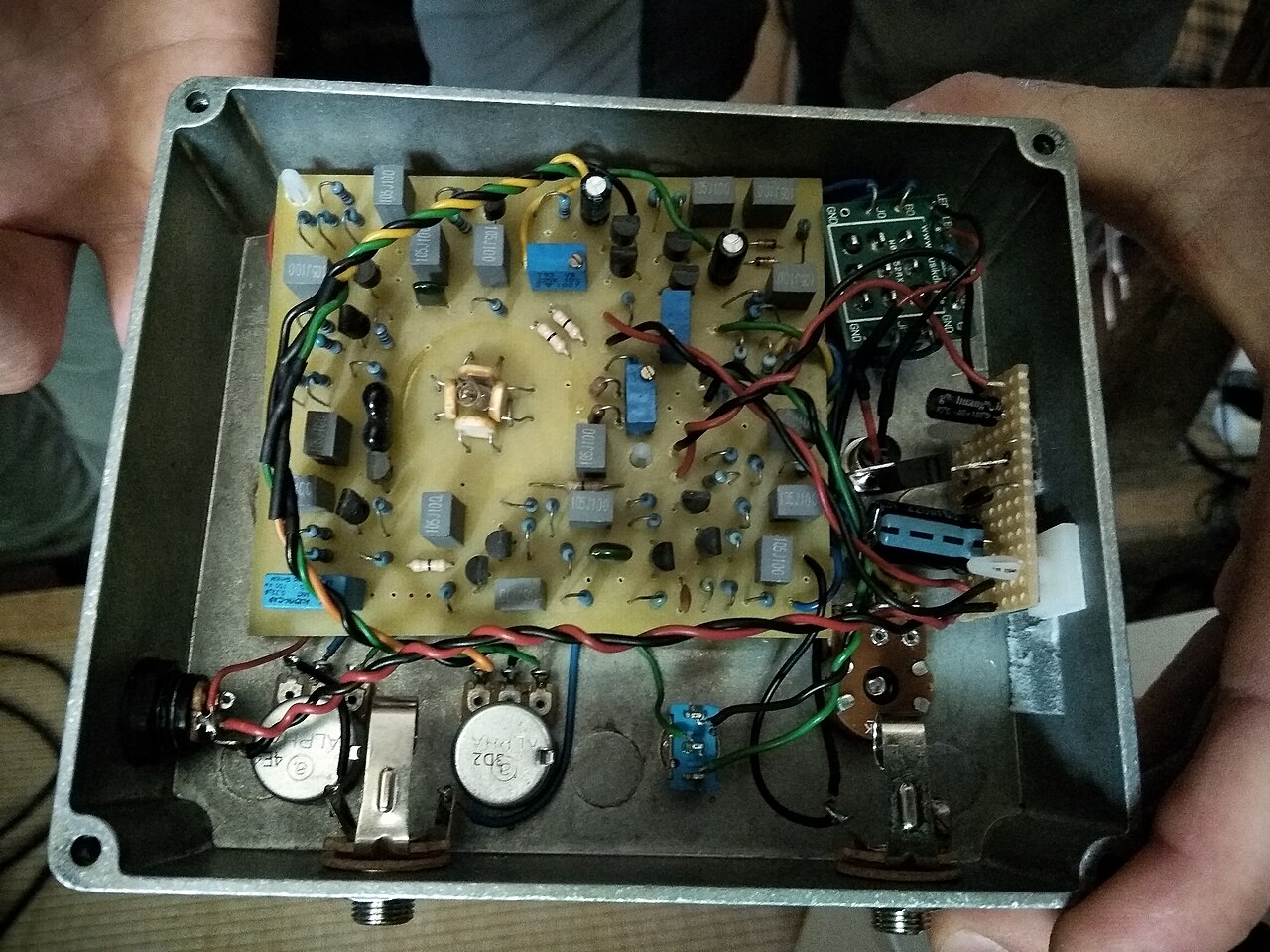
KingTone did something more interesting with the Blues Power. They soldered a transistor onto the board that does absolutely nothing — all three of its legs run straight to the ground plane — purely so that anyone photographing the guts and trying to reverse-engineer the circuit would waste an afternoon wondering what it was for.
It worked, for a while. Then in May 2022 the DIY outfit Aion FX bought a brand-new unit, traced it properly, published the schematic, and answered the question everyone had been asking since 2017. What is inside the Blues Power? It is a Timmy. A very good, carefully tweaked, cleverly extended Timmy, in a beautiful hand-wired box with switching options the original never had — but a Timmy.
That single sentence is either a scandal or a shrug, depending on how you think about pedals. This article argues it is mostly a shrug, and then spends the rest of its length explaining why the Blues Power is nevertheless one of the most quietly loved transparent overdrives of the last decade, who actually uses one, how to set it up, and whether the current $299.99 asking price makes any sense in 2026.
The short version
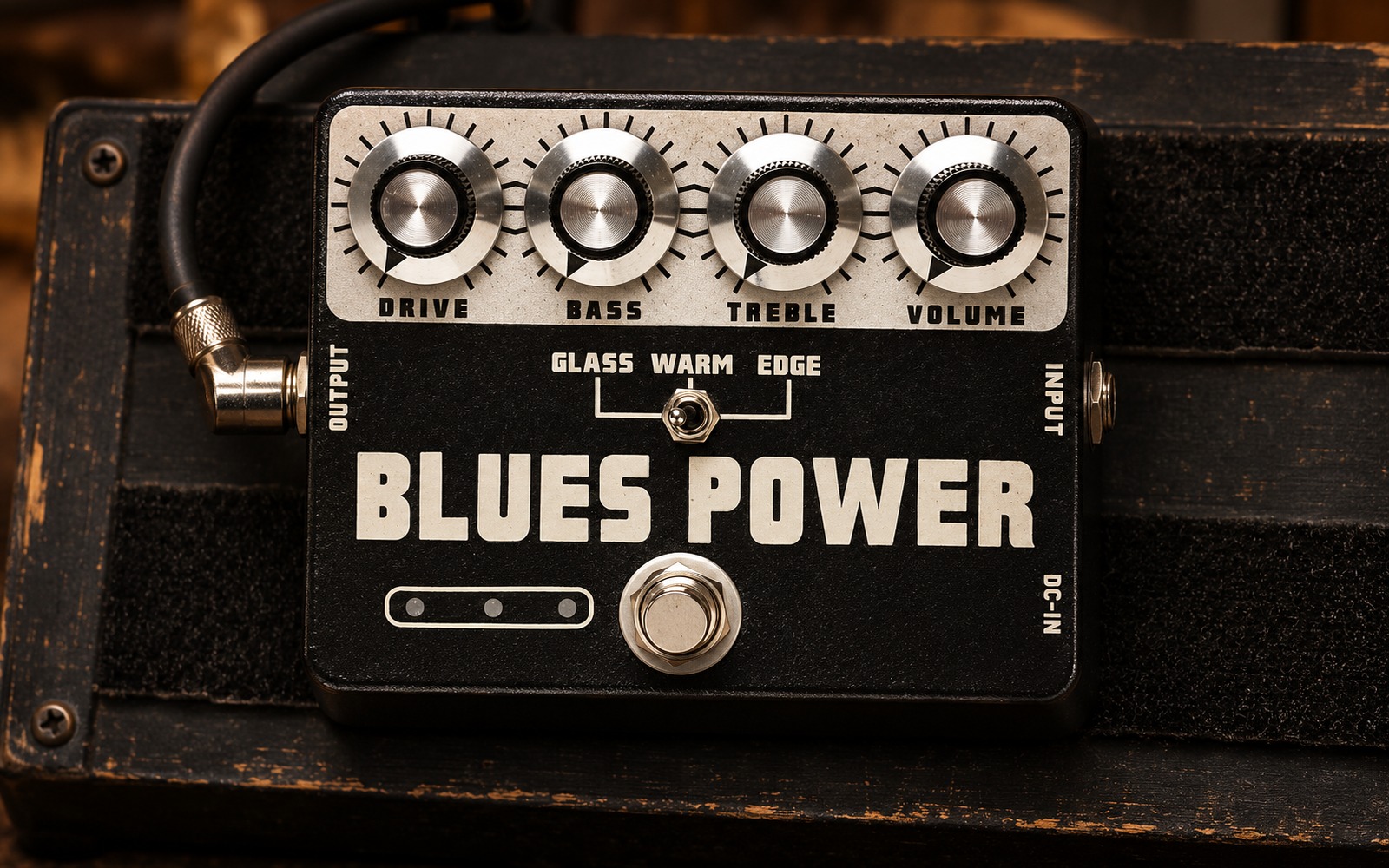
The Blues Power is a hand-wired, full-range transparent boost and overdrive built in California by KingTone — the company Jesse Davey founded in 1999 after his British blues band The Hoax broke up. It was released in 2017, originally badged Jesse Davey Blues Power, and originally sold to retailers as a limited edition before demand promoted it to the permanent lineup within months.
The control set is four knobs — Volume, Drive, Bass, Treble — plus a three-position Glass / Stock / Edge toggle that sets the treble character feeding the drive stage, and a bank of DIP switches for midrange voicing, a Cranked mode and the house KingTone setting. The circuit is a Timmy derivative with a passive Baxandall-style bass-and-treble stack, a second op-amp stage carrying four fixed clipping diodes, and one transistor that is there to lie to you.
Current pricing: $299.99 direct from KingTone (frequently out of stock), £339 at Peach Guitars in the UK, and roughly $210 used on Reverb. The bigger Blues Power Deluxe sits at $425 / £459 and adds a footswitchable boost, a warmer Blues voicing and silent soft switching.
The one-line verdict: if you want an overdrive that disappears and leaves your amp sounding like a better version of itself, this is one of the two or three best executions of that idea on the market. If you want a pedal with a sound, buy almost anything else.
Where it came from
KingTone’s origin story has been told at length in our guide to the King Tone Duellist, so the compressed version will do here. Jesse Davey was building circuits in his father’s workshop at eight. At sixteen he attached himself to the British amp builder Brian Jefferys and learned the trade properly. Through the nineties he fronted the guitar chair in The Hoax, a hard-touring British blues band, and modified his own amplifiers between soundcheck and downbeat — often so close to the downbeat that the chassis never made it back into the cabinet. The Hoax folded in 1999; KingTone was founded the same year. The company is still run by Jesse and his wife Krystal, and everything is still hand-built in California.
The Blues Power arrived in 2017, later than the Duellist’s spiritual ancestors and with a very different pitch. Where the Duellist announced itself openly as a Tube Screamer and a Bluesbreaker in one box, the Blues Power came with no lineage claim whatsoever. It was described simply as a full-range transparent boost/overdrive, and the spec sheet that went out to retailers called it a limited edition. That did not last. The pedal sold, the “limited” language quietly disappeared, and it has been a core KingTone product ever since.
Changes over the following years have been almost entirely cosmetic, which is itself unusual in the boutique world:
- 2017: original release, with “Jesse Davey” printed on the face and three LEDs on the right-hand side.
- 2018: cosmetic redesign — Davey’s name removed from the front, the dot pattern in the logo solidified, and the three LEDs relocated to the left.
- 2020: jacks moved to the top edge for pedalboard space efficiency.
- Current production: the DIP switches, once internal, are now external on the side; the LED is a user-configurable RGB unit; the knobs sit in a protective recess in a custom CNC case; the footswitch is a soft, relay-style switch rather than a mechanical 3PDT.
Crucially, KingTone has never claimed a circuit revision. As far as anyone outside the workshop can establish, the audio path in a 2026 Blues Power is substantially the same as the audio path in a 2017 one. That is either admirable consistency or a missed opportunity, and owners have argued about which for nine years.
What is actually inside: the trace
In May 2022, Aion FX — a DIY PCB house that has built a reputation on publishing careful, honest traces of boutique circuits — bought a new Blues Power, revision 1.2 from 2021, and opened it up. Their findings are the single most useful piece of primary documentation that exists on this pedal, and they are worth going through properly.
The decoy transistor
At first glance the board looks like a stripped-down Tube Screamer variant — the sort of layout you would expect from a Timmy or a Zendrive. Two things argued against that: an unexplained transistor, and four more diodes than the layout needed.
The transistor turned out to be connected to nothing. All three pins run to the ground plane on the underside of the board. It is not part of a hidden signal path, it is not a clever biasing trick, and — as Aion pointed out, pre-emptively, to the crowd on Facebook who insisted they must have missed an internal layer — the board is a two-layer design and a connection to ground supersedes everything else. It is a prop. It exists to be photographed.
The detail that makes it unambiguous is chronological: the earliest Blues Power boards did not have the transistor at all. It appeared in a later revision, alone, with none of the biasing resistors or coupling capacitors a working transistor stage would require. Someone at KingTone looked at the gut shots circulating online and decided to add a red herring.
The four extra diodes
The second oddity is four diodes wired as fixed clippers in the second op-amp stage. On paper, multi-stage clipping is a legitimate and excellent way to get amp-like drive behaviour. In practice, in this circuit, that second stage has a gain of only 2, it is fixed in place, and there is already signal loss ahead of it through the passive treble control. Aion’s assessment is that they contribute very little — possibly another attempt to muddy the water, though unlike the transistor they are not literally inert.
The verdict
Strip the decoys away and the Blues Power is a Timmy: Paul Cochrane’s famously transparent, famously interactive drive, with its active bass and treble controls that cut rather than boost and its refusal to hump the midrange. KingTone’s additions are the Glass / Stock / Edge toggle and a four-position DIP array, both of which manipulate the filter frequencies feeding the op-amp gain stage — the same architectural trick used in the Heavyhand and Soloist circuits from the same workshop.
Aion released a direct clone of the Blues Power called the Durandal Transparent Drive in 2022, including the fake transistor, which they described as being in on the joke.
The claim that turned out to be wrong
One widely repeated forum theory holds that the Blues Power is a modified run-off-groove Peppermill — a MOSFET boost stage into a JFET “tube” stage. It is not, and the origin of that error is instructive. GuitarPCB, an unrelated DIY board house, sells a project of its own called Blues Power, which genuinely is a modded Peppermill with added clipping options. Two products named after the same corner of the blues songbook — Albert King and Eric Clapton each have a “Blues Power” to their name — one commercial and one DIY, with no relationship to each other. Search results collapsed them, forum posts repeated the collapse, and an aggregator page eventually printed it as a spec.
This is a good general lesson for anyone researching pedals: a circuit-origin claim with no schematic attached is a rumour, however many places you find it. The Timmy claim is different — there is a published trace and a downloadable schematic behind it.
Specifications
The controls, in the order you should learn them
Drive and Volume
The Drive control has a very wide sweep, and the useful part of it is the first third. Fully counter-clockwise the pedal is a clean boost with a slight thickening; by nine o’clock it is at the edge of breakup; by noon it is a proper crunch. Past three o’clock it becomes something rawer and more compressed that some owners describe as fuzz-adjacent, particularly at 18V where the extra headroom changes the character of the collapse.
Volume has far more output than the circuit needs, which is deliberate. The Blues Power is designed to be able to slam the front end of a stubborn tube amp, and a large part of its reputation comes from using it that way — modest Drive, generous Volume, let the power section do the distorting.
Bass and Treble
These are the Timmy-style controls, and they behave differently from what most players expect. They are subtractive: at full clockwise you are hearing the flat response, and turning them down removes content. That means the correct starting position is both maxed, and the correct method is to take away what you do not want rather than add what you do. Players who dial them like a Fender tone stack — starting at noon and boosting — will conclude the pedal sounds thin, and will be wrong.
Glass / Stock / Edge
This is the pedal’s most important control and the least obvious one. It adjusts the treble content going into the clipping stage, not coming out of it — the same pre-clipping logic KingTone uses on the Duellist’s Fat / Stock / Glass switch. Because you are changing what gets distorted rather than filtering the distortion afterwards, the difference is one of texture rather than tone.
- Glass: more high content into the drive, producing a brighter, more open, more chime-forward breakup. Excellent with humbuckers and dark amps.
- Stock: the neutral Timmy-ish voice. Start here.
- Edge: less pre-drive treble, a thicker and slightly more aggressive push. Owners report this is where the pedal gets its bite with single coils.
The DIP switches
Four external DIPs handle midrange voicing — flat, punch, transparent and lift — plus the two special modes. Cranked pushes the second overdrive stage harder for a more saturated, more amp-like response. KingTone is the house voicing: thicker, with a vocal top end and a valve-like chug in the low end.
One critical caveat that KingTone’s own dealers spell out and most owners discover the hard way: the KingTone setting only works properly if the Blues Power is first in the signal chain, directly after the guitar. It is designed to behave as though Jesse Davey’s King Tone Switch were installed inside your instrument. Put a buffer, a tuner or a wah in front of it and the mode will not do what it is supposed to do.
Who actually uses one
The Blues Power has a small but unusually well-documented user base. Four professional users are confirmed by photograph or video, which for a low-volume boutique pedal is a respectable count — and, importantly, all four are documented rather than merely claimed.
Joey Landreth
The Bros. Landreth guitarist and slide obsessive is the highest-profile confirmed user, with the pedal visible in an Instagram post from 3 February 2020. Landreth’s tone — open-tuned, slide-heavy, built on dynamics rather than gain — is close to a design brief for what the Blues Power does. He also uses the Duellist, which tells you something about how well the two coexist.
Ariel Posen
Posen’s board is one of the most photographed in modern roots guitar, and a Blues Power sits underneath the top deck of his Schmidt Array — documented in a clip from his own Instagram. Posen is another player whose entire approach depends on an overdrive that reacts to the volume knob rather than flattening it.
Chris Tapp (The Cold Stares)
The most specific documentation of the four, and the most useful, because it comes with a full signal chain. In a Facebook video, Tapp plays sections of “Got No Right” from The Cold Stares’ 2023 album Voices on a genuine 1952 Gibson Les Paul goldtop, running through a KingTone Blues Power into a 1965 Fender Super Reverb. That is a heavy, riff-driven blues-rock band, not a jazz-adjacent tone chaser — and it is a useful corrective to the idea that this pedal only works at whisper volume.
Ángel Parra (Los Tres)
The Chilean guitarist and composer, a founding figure in that country’s rock scene, has one on a pedalboard shown in an Instagram reel from a rehearsal. Worth naming because it is the only non-Anglophone confirmation and it drags the pedal’s genre spread sideways.
The honest caveats
Four confirmed users is four, not forty. KingTone’s broader roster — the names that circulate around the brand generally — includes Kirk Fletcher, Josh Smith, Philip Sayce and Artur Menezes, but those associations attach to the Duellist and the Soloist rather than to this pedal specifically, and we have not repeated them here as Blues Power users. On the genre side, the sample is small enough that the numbers barely mean anything: Blues 5, Rock 4, Modern Blues 3, then a scatter of alternative country, folk, jazz, funk and Latin entries.
One further note on sourcing. The most widely syndicated description of this pedal online lists its controls as “Gain, Volume and Tone” and credits it with a high-quality buffer. The Blues Power has four knobs, none of them labelled Gain or Tone, and it is not a buffered-bypass pedal. That description is machine-generated boilerplate, and it has been copied onto retail listings. Check the faceplate, not the blurb.
Settings that work
All positions given clock-face. Remember that Bass and Treble are cut controls — maxed is flat.
1. Always-on amp thickener
Volume 1 o’clock, Drive 8 o’clock, Bass max, Treble 2 o’clock, Stock. The classic use. Barely audible as an effect; switch it off mid-song and the amp sounds like someone put a blanket over it.
2. Cranked blackface at apartment volume
Volume 11 o’clock, Drive 12 o’clock, Bass 2 o’clock, Treble max, Glass, Cranked DIP engaged. This is the setting the pedal’s reputation is built on — a Super Reverb at seven when the amp is actually at two.
3. Texas Strat lead
Volume 2 o’clock, Drive 1 o’clock, Bass 1 o’clock, Treble 1 o’clock, Edge. Thick, vocal, plenty of output to shove the amp. Stack a TS808 in front for the full Stevie Ray Vaughan-adjacent midrange bump.
4. Humbucker cleanup
Volume 12 o’clock, Drive 10 o’clock, Bass 12 o’clock, Treble max, Glass. Glass mode and a Bass cut stop a Les Paul turning to mud. Roll the guitar volume back and it cleans up almost completely.
5. Fuzz booster
Volume 3 o’clock, Drive 7 o’clock, Bass max, Treble max, Stock, placed after the fuzz. The Blues Power’s headline party trick: it lifts a fuzz’s volume without stripping its low end, which most overdrives cannot do. Try it behind a Sun Face or a Fuzz Face.
6. Clean boost for solos
Volume 3 o’clock, Drive fully counter-clockwise, Bass max, Treble max, Stock. Roughly what an EP Booster does, with more level available and tone controls if you need them.
7. The KingTone voice
Volume 1 o’clock, Drive 11 o’clock, Bass max, Treble 1 o’clock, Edge, KingTone DIP engaged, pedal first in chain. Fatter, edgier, with the chug in the bottom end. Do not judge this mode from anywhere else in the signal path.
8. 18V headroom mode
Same as any of the above but on an 18V supply. Everything gets firmer, the compression at high Drive settings backs off, and the pedal becomes noticeably louder before it distorts. Several owners run it this way permanently.
How it compares
Blues Power vs the Timmy
The unavoidable comparison, now that the trace exists. An MXR Timmy costs about a fifth of the Blues Power and contains the same fundamental circuit. What the extra money buys is the Glass / Stock / Edge switch, the DIP-selectable midrange voicings, the Cranked and KingTone modes, a much larger and better-built enclosure, recessed knobs, a soft footswitch, an RGB indicator, and hand-wired construction in California. Whether that is worth $220 is a decision only you can make, but be honest with yourself about which of those features you will actually use.
Blues Power vs the Duellist
Different jobs. The Duellist is two coloured drives — a Tube Screamer and a Bluesbreaker — that can be stacked. The Blues Power is one transparent drive that gets out of the way. At least one owner reports preferring the Blues Power to the Duellist’s Bluesbreaker channel outright for responsiveness. Many players run both, with the Blues Power always on underneath.
Blues Power vs King of Tone
The Analog Man King of Tone is the transparent-drive benchmark and has a waiting list measured in years. The Blues Power is available (intermittently) at half the price with far more voicing options, and does not require you to join a queue. The King of Tone has more inherent midrange character; the Blues Power is flatter and more amp-like. If you cannot face the wait, the Blues Power or the Prince of Tone are the two sensible answers.
Blues Power vs Jan Ray
Owners compare these constantly, and the comparison is fair: both chase a blackface Fender at the edge of breakup. The Vemuram Jan Ray is prettier, costs more, and has a stronger baked-in character. The Blues Power is more configurable and more genuinely neutral. Players wanting one perfect sound tend to prefer the Jan Ray; players who need one pedal to work across three guitars tend to prefer the Blues Power.
Blues Power vs the affordable field
A Boss BD-2 will get you a substantial part of the way for under a tenth of the price with a grainier, more obviously effected texture. A Nobels ODR-1 gives you a different flavour of transparency with its own mid character. A JHS Morning Glory is the Bluesbreaker answer to the same question. And a Wampler Pantheon Deluxe or a Keeley D&M Drive will give you more switchable circuits for less money, at the cost of KingTone’s build.
Standard vs Deluxe
The Blues Power Deluxe ($425 / £459) adds a footswitchable boost with its own level knob, a new voicing toggle offering a darker warm Blues setting alongside the classic transparent and KingTone options, through-hole construction with hand-selected low-noise resistors and polyester film capacitors, and silent pop-free soft switching. Colour and knob-style options are available, and KingTone will laser-engrave it for $15. If you were going to put a separate boost after the Blues Power anyway, the Deluxe is arguably the cheaper route.
Living with one
The good news first. The build is genuinely excellent, the recessed knobs mean nothing gets kicked out of position on a dark stage, and the current draw is low enough that battery operation is realistic. The 30-day money-back guarantee direct from KingTone is unusually generous for a boutique brand, and it exists for a reason — this is a pedal that some players fall for instantly and others cannot get on with at all.
Now the honest negatives, aggregated from owner discussions rather than from marketing copy:
- Noise floor. Multiple owners report a higher-than-expected noise floor, particularly with single coils. It is not unusable, but it is there.
- Compression at high gain. Push the Drive hard and some players find it loses openness and starts to sound compressed rather than amp-like. This is the single most common complaint.
- Guitar-volume cleanup can go muddy. Rolling back the guitar volume to control gain — the classic transparent-drive technique — does not always work cleanly here. Some owners describe it as getting woolly rather than getting quieter.
- Too transparent for good amps. A recurring and genuinely interesting criticism: through a really excellent tube amp, some players find the pedal does not add enough to justify itself, and conclude it is more useful for improving a mediocre amp than for flattering a great one.
- Amp dependency. Owners running bass-heavy rigs — a Blues Junior with a Cannabis Rex speaker was one cited example — report real difficulty dialling it in. This pedal wants a reasonably neutral or bright amp underneath it.
- Pickup dependency. The consensus is that it shines with Strats and Teles and can feel characterless with hot humbuckers. Glass mode helps; it does not entirely solve it.
The counter-evidence is equally strong. Owners repeatedly describe the pedal as imparting character to the amp’s tone rather than having a sound of its own; several report owning multiple units so that every board has one; one described it as the best edge-of-breakup pedal they have ever owned, “like having a cranked amp in the sweet spot” permanently available. Combined with a univibe it gets compared to “Machine Gun”-era Jimi Hendrix; combined with a Kingsley Minstrel, slapback and spring reverb it becomes somebody’s entire core tone.
Availability is the real practical obstacle. KingTone is a two-person operation and the standard Blues Power is frequently out of stock everywhere, direct and at dealers. The used market on Reverb hovers around $210, which is where the value case is strongest.
Frequently asked questions
Is the King Tone Blues Power a Timmy clone?
Functionally, yes. Aion FX traced a 2021 unit in 2022 and published the schematic: it is a Timmy with minor tweaks, plus the Glass / Stock / Edge toggle and DIP-selectable midrange filters that manipulate the frequencies feeding the gain stage. KingTone has never claimed the lineage, but it has never denied it either, and there is no schematic-level ambiguity about it.
Why is there a transistor that does nothing?
It is a decoy, added in a board revision after the original release, with all three legs tied to the ground plane and no supporting components. Its purpose was to confuse people studying gut shots. Aion FX’s clone of the pedal, the Durandal, includes the fake transistor as a joke — and notes it can be omitted with no effect whatsoever.
Is it based on the ROG Peppermill?
No. That claim comes from a name collision with an unrelated DIY project sold by GuitarPCB, which is also called Blues Power and genuinely is a modded Peppermill. The two have nothing to do with each other.
What is the difference between the Blues Power and the Blues Power Deluxe?
The Deluxe adds a footswitchable boost with its own level control, an extra dark-and-warm Blues voicing on the toggle, hand-selected through-hole components, and silent soft switching, in exchange for $125 more. The core drive circuit is the same. Read the faceplate before you buy secondhand — the two look similar at a glance.
Do I have to put it first in the chain?
Only if you want the KingTone DIP setting to work as designed. Everything else on the pedal works anywhere in the chain. If you never use the KingTone mode, place it wherever it sounds best — including after a fuzz, which is one of its strongest applications.
Can it run at 18V?
Yes, and many owners prefer it that way. You get more headroom, firmer low end, and less compression at high Drive settings. Standard 9V centre-negative operation is the default, and there is an internal battery option.
What year did it come out, and how do I identify an early one?
2017. Original units carry “Jesse Davey” on the face and have three LEDs on the right-hand side. From 2018 the name was removed, the logo dot pattern solidified, and the LEDs moved to the left. From 2020 the jacks sit on the top edge. The audio circuit is understood to be unchanged across all of them, so buy on condition and price rather than vintage.
Is it worth $299.99?
If you want a genuinely transparent always-on drive with more voicing flexibility than any Timmy variant on the market, in a beautifully built box, and you can find one in stock — yes, particularly at the used price. If you want a pedal with its own strong voice, or you play through a bass-heavy amp, or you mainly use hot humbuckers, look at the EQD Plumes, the Wampler Belle or the Jan Ray instead. And if the circuit lineage bothers you on principle, buy the MXR Timmy and put the difference towards a better amp — which, in fairness, is exactly what this pedal is trying to make yours sound like.
Image credits
- Top image: GuitarGangsters AI-generated reference illustration, not a photograph.
- Guitar pedals on a rug: Oldangelmidnight from Northampton, MA, Wikimedia Commons, CC BY-SA 2.0.
- Inside a DIY pedal showing the circuit board: Skimel, Wikimedia Commons, CC BY-SA 4.0.
Latest News
Related
On This Day
Monday 9 November
From this week: