The Wampler Tumnus: The Klone That Fooled Everyone
Wampler Tumnus guide: real specs, the V2 myth debunked, the Andertons blind test, confirmed players like Ed O'Brien, tone recipes and buying advice.
In 2021 the Andertons Music Co. team sat Peter “Danish Pete” Honoré down in front of ten overdrive pedals he could not see. One of them was a real Klon Centaur — the gold box with the silver horse, the most mythologised drive circuit in the history of the electric guitar, a pedal that at the time was fetching several thousand dollars on the used market. The other nine were klones. Honoré, a working professional with decades of ears behind him, picked the Wampler Tumnus. Not the Klon. A hundred-and-fifty-dollar mini pedal the size of a matchbox, built in Indiana by a man who had spent his career telling people that there is no such thing as magic parts.
That is the whole story of the Tumnus in one anecdote, and it is why this pedal matters more than the dozens of other Centaur tributes that have come and gone since Bill Finnegan stopped building the original in 2009. The Tumnus did not win on mystique, on unobtainium components, on limited runs or hushed forum whispers. It won on being right, being small, being available, and costing roughly two percent of what the thing it was imitating had come to cost. Brian Wampler walked into the most superstitious corner of the pedal world carrying a screwdriver and a price list, and he came out with one of the best-selling boutique overdrives ever made.
What follows is what the Tumnus actually is, what is genuinely inside it, which players are documented using it — and which widely repeated claims about it fall apart the moment you check them, including the persistent belief that there is such a thing as a “Tumnus V2.”
Before the Golden Box: The Klon Centaur Problem
To understand why the Tumnus exists you have to understand the hole it was built to fill. Bill Finnegan began producing the Klon Centaur in 1994 and hand-assembled somewhere in the region of 8,000 units across roughly thirteen years before ending production. The circuit did something that guitarists had been chasing for decades and had never quite been able to name: it made an amplifier sound like a better version of itself. It did not stamp a mid-hump on your signal the way a Tube Screamer does. It did not fizz. It did not compress the life out of a hard-picked note. It added bloom, sustain, low-end authority and harmonic complexity while leaving the fundamental character of your guitar and amp intact. Players reached for the word “transparent,” which is not quite right but is the closest single word available.
Then Finnegan stopped making them, and the market lost its mind. By the mid-2010s original Centaurs had crossed the thousand-dollar line and kept going. By late 2023, MusicRadar was reporting gold Klons listed on Reverb at $7,500 — for a stompbox with three knobs and no moving parts beyond a footswitch. The Klon had stopped being a piece of equipment and become an asset class, and for the overwhelming majority of working guitarists it was permanently out of reach.
Klones filled the vacuum, and the quality spread was enormous. The good ones — Ceriatone’s Centura, the various boutique traces, Finnegan’s own KTR continuation — were competent but were either expensive, large, or hard to get hold of. The cheap ones were frequently disappointing in the same specific way: too bright, too compressed, thin in the bottom octave, missing the sense of physical weight that made the original feel three-dimensional under the fingers. What the market needed was somebody willing to do the engineering properly and then price it like a tool rather than a collectible.
Brian Wampler and the Anti-Mythology Pitch
Brian Wampler was an unusually good candidate for that job, largely because his entire career had been an argument against the kind of thinking that inflated Klon prices in the first place. The story starts around 2000, when a technically-minded friend modified Wampler’s Boss DS-1 and the result was better than the pedal he had bought. That single experience sent him down the rabbit hole. He taught himself electronics in his late twenties through the DIY communities of the early internet — DIYstompboxes.com chief among them — trading under the handle Indyguitarist, and eventually wrote and self-published books on pedal design that became reference material for a whole generation of small builders. Wampler Pedals was formally founded in Martinsville, Indiana in 2007.
By the time he turned his attention to the Centaur circuit, Wampler had a reputation for saying out loud what other builders preferred to leave mysterious. The Tumnus product copy is worth quoting because it is effectively the pedal’s mission statement: “We don’t believe in telling you about magic parts, we don’t believe in telling you that this pedal is an EXACT replica using the same fabled components… the originals were different, every single one… we took as many as we could find, found the common ground and made each one as consistent as the last. Each one is the perfect version of this circuit without all the magical unicorn tears and fairy poopdust.”
That approach — study a statistically meaningful sample of originals, identify the consensus behaviour, build to that consensus rather than cloning one arbitrary unit — is genuinely different from what most klone builders do, and it is the reason the Tumnus tends to sound “correct” to people who have played several real Centaurs. Hand-built analogue pedals drift. Component tolerances, aging electrolytics, and the specific batch of diodes that happened to be on the bench that week all move the target. Any single original Centaur is a data point, not a definition. Wampler built to the average, and the average turned out to be what everybody had been describing all along.
The name is the other half of the joke. The Klon’s logo is a centaur — half man, half horse. Mr. Tumnus, in C.S. Lewis’s The Lion, the Witch and the Wardrobe, is a faun — half man, half goat. The Tumnus is a slightly smaller, slightly more approachable, considerably less intimidating mythological hybrid, sold in a slightly smaller, considerably less intimidating gold box. Wampler has never had to explain the gag.
What’s Actually Inside the Golden Box
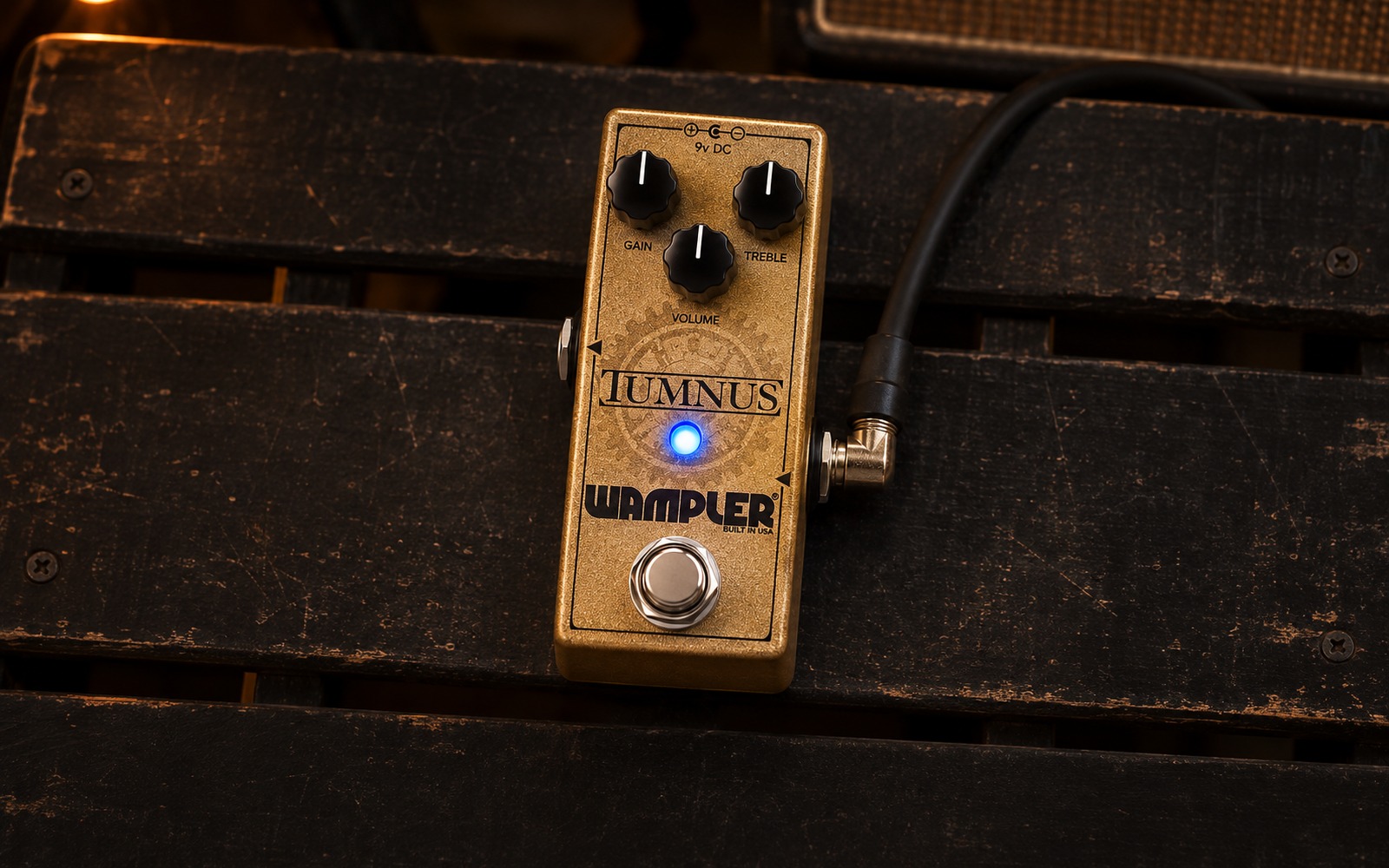
The Tumnus is a faithful reproduction of the Centaur’s topology in a mini enclosure measuring 1.5″ × 3.5″ × 1.5″, small enough to drop into the awkward gap on a crowded board without renegotiating the whole layout. Three architectural features do the heavy lifting, and all three are inherited directly from the original.
The charge pump. The circuit does not run at 9 volts. An internal charge pump doubles the incoming supply so the audio path operates at 18V regardless of what your power brick is putting out. This is where the headroom comes from — the ability to take a hard-picked transient from a hot humbucker without folding over into compression before the clipping stage has had its say. It is also the single most misunderstood thing about the pedal in practical terms, because it means running the Tumnus at 18V externally is pointless: the doubling already happened inside.
The clean blend hidden in the Gain knob. This is the part that makes the circuit behave differently from a Tube Screamer and is why “transparent” gets used so often. In the Centaur architecture the Gain control is a dual-ganged potentiometer that does not simply increase distortion — it shifts the balance between two parallel paths, a clipped path and a clean path, which are then summed. At low Gain settings the great majority of what reaches your amp is your unaltered signal with a small proportion of harmonically enriched signal folded in underneath it. That is a fundamentally different proposition from pushing your entire signal through a pair of diodes and then EQ-ing the wreckage. It is also why low-Gain Tumnus settings feel less like switching on a pedal and more like the amp having a very good night.
The clipping diodes. Finnegan’s originals used germanium diodes — 1N34A types — in the clipping stage, and he has said publicly that these were the single most important factor in how the circuit distorts. He also called his supply “unobtanium,” because he bought a finite stash of the right parts decades ago and they ran out. The standard Tumnus does not use those. It uses modern parts chosen to land on the same tonal target, which is exactly what Wampler says in the product copy rather than pretending otherwise. This matters later, when we get to the Germanium Tumnus.
The buffer is not optional, and that is deliberate. Like the original, the Tumnus is buffered bypass, not true bypass — a 3PDT switch handles the mechanical duties, but the buffer stays in circuit when the drive is disengaged. Finnegan considered the buffer part of the design rather than a compromise, and Wampler kept it. In practice it converts your high-impedance guitar signal to low impedance early in the chain, which defends your top end against cable capacitance and against the cumulative loading of a long true-bypass chain. For the overwhelming majority of rigs this is a feature. The one meaningful exception is germanium fuzz: Fuzz Face-style circuits want to see a guitar pickup’s impedance directly, so put those before the Tumnus, not after it.
Controls and Operation
Volume, Gain, Treble. That is the entire interface, and Wampler’s own technical sheet labels the first one Level, which tells you how the company thinks about it — this is a boost with a drive stage attached at least as much as it is a drive pedal with a level control.
The Volume control reaches unity somewhere around 9 o’clock into a typical amp, which leaves the top three-quarters of the sweep available as boost. That is a lot of headroom to play with, and it is why the Tumnus doubles convincingly as an end-of-chain solo lift as well as a front-of-chain drive.
The Gain control is the clean/clipped blend described above. Wampler’s own guidance for the Germanium variant — which shares the layout — is that around 9 o’clock gives a smooth overdriven boost, noon gives a fuller-voiced, meatier drive, and fully clockwise gives something considerably more brutal. In practice, most players who love this pedal live in the bottom third of the knob. One long-standing owner review puts it bluntly: above roughly 30% of the sweep, “there is no profit there.” That is a matter of taste rather than fact — plenty of people run it higher and enjoy it — but it is a useful default assumption for anyone dialling one in for the first time.
The Treble control is a passive-feeling tilt on the output, flat around noon, brightening clockwise and warming counter-clockwise. It is subtle, and it rewards small adjustments. Quarter-turns do real work; extremes fight the pedal’s natural voice.
The most common productive starting point across almost every rig: Gain between 8 and 11 o’clock, Volume a little above unity, Treble at noon and then nudged to match your amp. Sit there for a while before you go looking for anything else.
The “Tumnus V2” That Doesn’t Exist
This deserves its own section, because it is the single most repeated piece of misinformation about this pedal and it is repeated by retailers, marketplaces and gear databases alike. Search for a Tumnus and you will be offered a “V1” and a “V2” as though they were distinct products. Equipboard lists them as separate items. Thomann sells one under the name “Tumnus Overdrive V2.” Reverb listings differentiate them. Used prices diverge accordingly.
Wampler Pedals published an official statement on 3 January 2017 saying, in effect: no.
What actually happened is that in late 2016 the entire Wampler range got a cosmetic and hardware refresh at once — new paint, new logo, refreshed enclosure graphics, clearer labelling, better manual, new box, new bag, top-mounted jacks and relay-based soft switching across the line. The minis, including the Tumnus, did not get relay switching because there is physically no room for it, though Wampler notes the footswitch on the newer ones is slightly better than the old. Dealers with old stock and new stock sitting side by side started calling them V1 and V2 to differentiate the listings and justify discounting the older boxes. The nickname stuck and then hardened into folklore.

Wampler’s own words: “The ONLY pedals that are v2 are the Faux Tape Echo and Pinnacle Deluxe, everything else has just been brought into line with the pedals that have been released over the last couple of year. So, unless it has v2 on it – the circuit is the same, it is not a v2 in any way and tonally; it’s effectively the same as the previous models.”
The practical takeaway for a buyer is simple and financially useful: there is no tonal difference between a pre-2016 Tumnus and a post-2016 Tumnus. Buy whichever is cheaper. Anyone charging a premium for a “V1” on the basis of originality, or for a “V2” on the basis of being the newer circuit, is selling you a marketplace artefact. The only genuine differences are the graphics, the jack orientation on full-size models, and a marginally nicer stomp.

The Tumnus Family: Deluxe, Germanium, and the Germanium Deluxe
Wampler has extended the line in two directions since 2015 — one practical, one collectible.
The Tumnus Deluxe is the practical one, and it is a genuinely different proposition rather than a cosmetic upsell. It keeps the core circuit and adds three things. First, a full three-band EQ: active Bass and Mid controls alongside the familiar Treble, which lets you compensate for a dark amp, a bright room, or a guitar change without touching your amp settings. Second, a Hot/Normal switch — Normal is the standard Tumnus voicing, Hot adds a higher-gain stage for players who want the circuit to go further than the mini will. Third, a side-mounted switch that lets you choose between the classic buffered bypass and true bypass, which resolves the one legitimate complaint about the original design for players with signal-chain constraints. It also has a battery cavity, which the mini does not. Street price is $199.97, and it draws a considerably heavier 70.3mA at 9V — worth checking against your power supply’s per-output rating before you buy.
The Germanium Tumnus is the collectible one, and its story is the best possible illustration of the mythology the standard Tumnus was built to puncture. Announced on 7 December 2023, it was a strictly limited run built around a stash of the original-specification vintage germanium diodes — the actual “unobtanium” Finnegan spoke about — that Wampler had managed to hunt down. It shipped in a textured “Alien Silver” finish with knurled red anodised knobs, measured 1.3″ × 3.6″ × 2″, drew 19mA at 9V, and had a street price of $179.
Note what Wampler actually claims for the germanium diodes, because the common assumption gets it backwards. The received wisdom is that germanium is softer and rounder than silicon. Wampler’s own description says the Germanium Tumnus “retains all the usability of its golden sibling but introduces an extra level of aggression,” with the diodes specified for “extra bite and sizzle.” It is a hotter, more characterful variation, not a mellower one. Whether that is better is entirely a matter of taste; whether it is a large difference is a matter that a great many people have argued about at length on the internet.
What happened next was inevitable. The run sold out fast. By 5 January 2024 — less than a month after launch — MusicRadar was reporting Germanium Tumnus units listed on Reverb and eBay above $500, roughly triple the launch price, joining the Boss Waza Craft TB-2W and the briefly deranged DigiTech Bad Monkey in the pantheon of pedals whose used prices detached from reality. A pedal explicitly designed to democratise a hype-inflated circuit had become a hype-inflated circuit. Wampler followed it in 2024 with a Germanium Tumnus Deluxe, a limited batch combining the rare diodes with the Deluxe’s three-band EQ, bypass switch and Hot mode, listed at $279.
Specs at a Glance
| Feature | Tumnus (mini) | Tumnus Deluxe | Germanium Tumnus | Klon Centaur (original) |
|---|---|---|---|---|
| Controls | Volume, Gain, Treble | Volume, Gain, Treble, Bass, Mid + Hot/Normal | Volume, Gain, Treble | Output, Gain, Treble |
| Bypass | Buffered (3PDT) | Buffered or true bypass, side switch | Buffered | Buffered |
| Clipping diodes | Modern, voiced to target | Modern, voiced to target | Vintage-spec germanium | Germanium (1N34A type) |
| Size | 1.5″ × 3.5″ × 1.5″ | Standard enclosure | 1.3″ × 3.6″ × 2″ | Large (roughly 5″ × 5.5″) |
| Power | 9V DC, 20mA, no battery | 9V DC, 70.3mA, battery cavity | 9V DC, 19mA, no battery | 9V DC or battery |
| Internal voltage | 18V via charge pump | 18V via charge pump | 18V via charge pump | 18V via charge pump |
| Price (new) | $149.97 | $199.97 | $179 at launch, discontinued | Discontinued |
| Warranty | 5 years | 5 years | 5 years | None |
The Blind Test That Made Its Name
The Tumnus had been selling steadily since 2015 on word of mouth and demo videos, but the thing that turned it from “well-regarded klone” into “the default answer” was a video. In 2021 Andertons ran a blind shootout: ten Klon-style overdrives including a genuine Klon Centaur, judged by ear with the pedals hidden. Danish Pete Honoré — a guitarist with a professional career, a long-running gear-show presence, and no particular reason to flatter a $149 mini pedal — picked the Wampler Tumnus over the real thing and over eight other contenders.
It is worth being precise about what that does and does not prove. It does not prove the Tumnus is a Klon. It does not prove the original is overrated in absolute terms. Blind tests are single-take snapshots taken through one guitar, one amp, one room and one set of ears on one day, and swap any of those variables and the ranking might move. What it does prove is that under controlled conditions, with the branding removed and the price tag removed, an experienced professional could not identify the expensive one — and preferred the cheap one. In a corner of the market that runs almost entirely on reputation, that is the most useful data point anybody has produced.
MusicRadar’s Rob Laing, who owns one, summarised the value proposition afterwards in a line that has been widely quoted since: “I genuinely believe Brian Wampler could charge double for these US-made pedals and they would still be great value.”
There is a nice postscript. Honoré, the man the pedal fooled, subsequently turned up with a Tumnus on his own board, documented in his own Instagram post. Whatever else the blind test was, it was not a stunt he walked away from.
Famous Players: What Actually Holds Up
This is the section where klone articles usually go wrong, so a note on method first. Being a famous Klon user is not the same as being a Tumnus user, and appearing on a manufacturer’s artist page is not the same as having the pedal on your board. Below, everything is sorted by how strong the evidence actually is, and the names that circulate without support are named as such rather than quietly omitted.
Rig-documented and first-person
Ed O’Brien (Radiohead) is the strongest and by some distance the most interesting confirmation, because of a detail that is easy to miss. TheGigRig — the UK company that built his board — posted a photograph of it showing the Tumnus sitting beneath a Boss DD-5 delay, and when a commenter asked the obvious question, TheGigRig answered directly: “Klon is on his studio board, he has the Wampler Tumnus in his live rig.” That is the entire argument for this pedal delivered by somebody with no incentive to make it. O’Brien owns the original. He has access to anything. For the rig that has to survive a world tour, get repaired in a hurry, and fit on a board with thirty other things on it, his tech put the Tumnus in. O’Brien is also one of modern rock’s most deliberate rig architects — his boards are the product of long thought about texture rather than about gain — and a transparent, always-available foundation layer is exactly the role a Tumnus is built for.
Chris Shiflett (Foo Fighters) confirmed his own use directly to MusicRadar’s Rob Laing, who reported in November 2023 that Shiflett “recently told me he’d added one to his live ‘board.” First-person, to a named journalist, on the record. Shiflett is a useful data point for a different reason than O’Brien: he is a documented believer in small, high-value utility drives — his long-running enthusiasm for the Xotic EP Booster is on record in the same publication — and the Tumnus fits that philosophy of buying the thing that works rather than the thing that impresses.
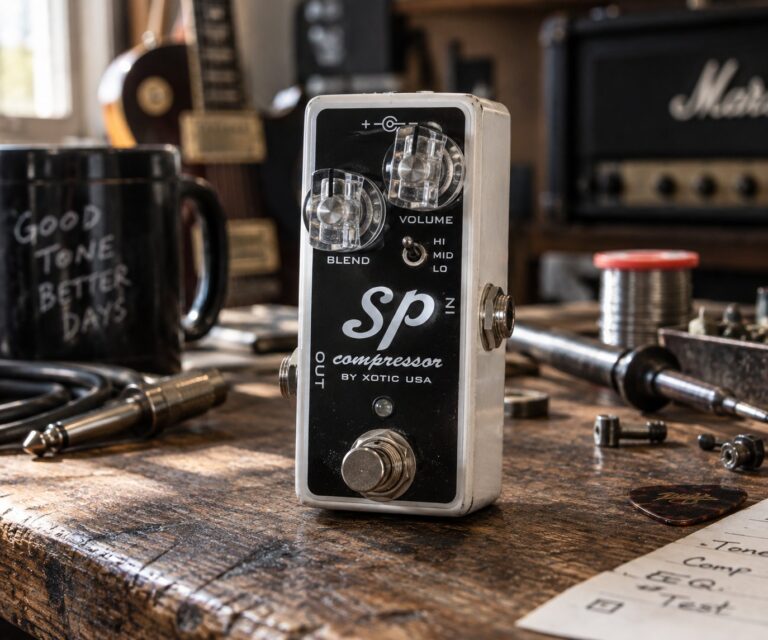
Gina Gleason (Baroness) gave the clearest description of how the pedal sits in a real chain, in a Guitar.com interview around the Gold & Grey record: an Xotic SP Compressor into a Wampler Tumnus — “which is like a Klon mock” — and then an MXR Super Badass Distortion, with Philly-built fuzzes alongside. That is a heavy band running a transparent Klon-style drive as the tonal foundation underneath a genuine distortion, which is one of the most underrated ways to use this circuit and the basis of a tone recipe below. Honest caveat: that documented chain is from the Gold & Grey era, and Baroness rigs have moved on since — her more recent boards document an Xotic SP Compressor and a UAFX 1176 for compression duties.
Dan Auerbach (The Black Keys) has a Tumnus visible on his pedalboard in a MusicRadar interview feature. Auerbach is worth noting because of what he could have chosen instead: he is a serious vintage collector with a studio full of rare gear and a documented allergy to anything that sounds processed. A raw, amp-forward, garage-blues player putting a mini klone in front of a cranked tube amp is the Tumnus operating in its natural habitat.
Mateus Asato documented a Tumnus on his second pedalboard in an Instagram post dated 29 September 2016 — early adoption, back when the pedal was still building its reputation rather than trading on it. Asato’s playing is all touch and dynamics and long melodic lines, which is precisely the use case the low end of the Gain knob was designed to serve.
Pete Thorn — session guitarist, longtime Chris Cornell sideman, and one of the most-watched demo voices in the business — ran a Tumnus on his compact VBoard Pro pedalboard, documented in a post by VBoutiqueUSA. Thorn’s board selections carry unusual weight because other players study them as curated shortlists rather than as endorsements.
Aaron Marshall (Intervals) has a Tumnus on a pedalboard setup he describes as the one used “when logistically convenient” — a fly-rig or reduced-footprint board, which again is the mini format earning its keep.
Theo Katzman (Vulfpeck) has one on a board built by Mason Marangella of Vertex Effects, documented photographically. Josh Klinghoffer is documented on video, though the timestamps cited for the sighting are inconsistent between sources, so treat this one as solid-but-softer than the names above. Peter “Danish Pete” Honoré — the blind-test story above — has one documented in his own Instagram post.
Demonstrators, not necessarily users
A distinction worth drawing, because gear databases regularly collapse it. Tom Quayle has demoed the Tumnus on video and has a genuine relationship with the brand — the Dual Fusion is his signature Wampler pedal — but demoing a pedal for the company that makes your signature model is not the same as choosing it for your own rig. Tyler Larson features one in a mini-pedalboard video, and Phillip McKnight shows one in his 2017 year-in-review at the 4:20 mark. All three are legitimate sightings; none of them is rig documentation of the kind that O’Brien or Shiflett provide.
Names that do not hold up
The Tumnus attracts a specific kind of false attribution: famous Klon players getting quietly reassigned to the klone. John Mayer, Jeff Beck, Nels Cline, Matt Schofield and Warren Haynes are all genuinely associated with the Centaur circuit, and none of them is a documented Wampler Tumnus user. Schofield’s board in particular has been photographed and documented repeatedly with an original Klon in the drive position. These players are why the Tumnus exists — they established what the circuit could do at a level of visibility that made everybody else want in — but the Tumnus is the democratised descendant, not the pedal on their boards. Any article that lists them as Tumnus users has conflated the sound with the box.

There is a second trap specific to Wampler. The company has a large artist page, and several notable names — Guthrie Govan and Nick Johnston among them — are associated with the brand through other pedals, principally the Euphoria overdrive. Even Equipboard’s own thumbnails put O’Brien, Govan and Johnston together under the Euphoria rather than the Tumnus. A brand relationship is not a SKU credit, and the two get merged constantly.
Tone Recipes and Settings
1. The Always-On Foundation Layer (Strat into a clean American amp)
This is the setting the pedal was built around. Set a Fender Deluxe Reverb — or any warm, clean, American-voiced tube amp — just below its natural breakup point. Tumnus: Gain at 8 o’clock, barely moved. Volume slightly above unity around 11–12 o’clock. Treble at noon. Engage and leave it. The bottom end tightens, the midrange gains a dimension, sustain extends, the top keeps its shimmer. Nothing announces itself as an effect. One Sweetwater owner describes running exactly this — gain at 9 o’clock, volume just above unity — after hearing a Klon comparison on That Pedal Show. It is the most common Tumnus setting in the world for a reason.
2. Edge-of-Breakup Blues (Les Paul into a pushed amp)
With a Gibson Les Paul or any hot humbucker guitar, the internal 18V is doing its most useful work — a 9V circuit would already be squashing. Gain to 10–11 o’clock, Volume matched to the amp’s clean level, Treble back to 10 o’clock to answer the humbuckers’ natural darkness. Push the amp itself into crunch. What you get is two forms of saturation stacking into something that reads as a single, larger amplifier rather than as an amp plus a pedal.
3. The Foundation-Under-Distortion Trick (the Gina Gleason approach)
Compressor first, Tumnus second at low Gain and unity Volume, heavy distortion third. This is documented as Gleason’s Gold & Grey-era chain, and it solves a real problem: modern high-gain distortions tend to scoop and thin the signal they are handed, and a Klon-voiced pedal in front of one restores the low-mid weight before the distortion ever sees it. The distortion keeps its aggression and stops sounding brittle. Try it before you EQ anything.
4. Volume-Knob Dynamics in a High-Gain Rig
Tumnus first in the chain, Gain at minimum, Volume boosted, Treble at noon, feeding a heavier drive or a cranked channel. Now roll your guitar volume back to 7. Instead of just getting quieter, the whole front-end saturation structure unwinds and you land on a usable crunch rhythm sound; back to 10 and the full lead voice returns. The Tumnus’s buffer and headroom are what make this behave predictably rather than turning to mud.
5. Transparent Solo Boost
Gain at minimum, Volume pushed to 3–4 o’clock, Treble to taste. Used purely as a level lift into an amp that is already working, this is arguably the pedal’s single most effective mode. You do not get a drive character laid over your lead line; you get the amp itself pushed harder. On a small board where one footswitch has to do the whole job of “louder and more urgent,” this is it.
6. Stacked into a Tube Screamer
The Tumnus and the Ibanez TS9 pull in opposite directions — the Tumnus is wide-bandwidth with real low-end authority, the TS9 rolls off bass and humps the mids — which makes them complementary rather than redundant. Tumnus first at low Gain and unity Volume, TS9 second at medium Gain. The Tumnus keeps the TS9 from sounding nasal and thin; the TS9 gives the stack a focused midrange that cuts through a dense mix. One long-time owner reports the reverse order also working: Tumnus after everything, adding midrange back into a bright drive that needed filling in.
7. The Deluxe-Only Recipe: Hot Mode as a Second Channel
If you have the Deluxe, the Hot switch is best treated as a second amp channel rather than as “more gain.” Set Normal mode as your rhythm voice — Gain low, Bass and Mid flat, Treble to taste. Then set the Hot mode’s extra stage as your lead voice and use the three-band EQ to add a couple of decibels of Mid, which is the difference between a lead tone that sits on top of the band and one that disappears into it. You are effectively getting two footswitchable drive voices from one enclosure.
How the Tumnus Compares
Versus the original Klon Centaur. The honest answer is that the gap is far smaller than the price gap, and the 2021 Andertons blind test is the best available evidence. Both have the doubled internal voltage, both have the clean-blend Gain architecture, both have the buffer. Where they genuinely differ is consistency and the top octave: originals vary unit to unit and have decades of component aging in them, and several owners who have compared the two directly report the Tumnus as having a slightly fuller frequency range at the extremes. The $7,000-plus premium buys you an original artefact, provenance, and a resale market. It does not, on the available evidence, buy you a better-sounding pedal.
Versus the Timmy. Paul Cochrane’s Timmy — now also produced by MXR — is the other great transparent overdrive of the modern era, and it approaches the problem from the opposite end. The Timmy gives you independent Bass and Treble cut controls, which is enormous tonal flexibility at the cost of requiring you to know what you want. The Tumnus gives you one Treble knob and a strong opinion. If you enjoy dialling, take the Timmy. If you want to plug in and be right in ten seconds, take the Tumnus. Both have excellent headroom and low compression.
Versus the Analog Man King of Tone. The comparison people reach for most often, and mostly for availability reasons — the King of Tone has a legendary waiting list, the Tumnus is in stock. Sonically they are different animals: the KOT is a dual Bluesbreaker-derived circuit with two independent channels and a softer, more amp-like clipping character, while the Tumnus has more low-end weight and more boost on tap from a single channel. The KOT is a two-drive solution in one box. The Tumnus is one drive done extremely well in a box a quarter of the size.
Versus the Boss BD-2 Blues Driver. These get compared constantly and they are not really competitors. The BD-2 is a FET-based drive with a distinctive, slightly ragged high-mid character and a pronounced breakup voice. It sounds like a pedal, in a good way. The Tumnus at low Gain sounds like your rig. If you want a defined overdrive voice, take the BD-2; if you want your existing voice with more of everything, take the Tumnus.
Versus the Nobels ODR-1. The Nashville session world’s other great “just makes it better” pedal. The ODR-1’s Spectrum control does something the Tumnus cannot — it lifts low-mids and treble simultaneously while leaving the mids alone, which is a very specific and very useful curve. The Tumnus has more headroom and more available boost. Both are legitimate always-on candidates; the ODR-1 is the more coloured of the two, and colour is the point.
Versus the JHS Morning Glory and EarthQuaker Plumes. Both are excellent transparent drives at similar money and both are lighter-weight propositions than the Tumnus in the literal sense — less bottom-end authority, less boost on tap. The Morning Glory is the most polite of the three. The Plumes gives you three switchable clipping modes for the money. The Tumnus gives you the most headroom and the most physical low end, and it is the only one of the three that also functions as a serious buffer.
Versus the Fulltone OCD. Different jobs. The OCD is an amp-in-a-box that will happily go to genuine distortion and has a distinctive aggressive midrange. The Tumnus tops out at moderate overdrive and stays warm. If your amp is clean and you need it to sound cranked, the OCD. If your amp is already good and you need more of it, the Tumnus.
Versus the Tumnus Deluxe. Buy the mini if you play at essentially one gain setting, value the pedalboard real estate, and are happy with the buffer. Buy the Deluxe if you switch between guitars with very different pickup outputs, need a second higher-gain voice on a footswitch, or have a specific reason to want true bypass. The Deluxe is not a better-sounding Tumnus. It is a more configurable one, for $50 more and a lot more board space and current draw.
Buying Guide
New, the standard Tumnus is $149.97 direct from Wampler and from authorised dealers including Sweetwater. It has been in continuous production since 2015 and shows no sign of stopping, which means there is no scarcity pressure on the purchase whatsoever — a rare and pleasant thing in this corner of the market. Retailers discount it regularly; $127 has been a common sale price, and the Deluxe has been seen at $169.97 against its $199.97 list.
Used, expect roughly $90–130 in good condition, with market averages tracking around $127 across major platforms. Given how narrow that gap is against a discounted new unit with a five-year warranty attached, the used market is only compelling at the bottom of that range. And to repeat the point from earlier because it is where money actually gets wasted: ignore V1/V2 labelling entirely. Wampler has stated officially that no such distinction exists for this pedal. Buy on condition and price.
The Germanium Tumnus is a different calculation. It was $179 new, it is discontinued, and it crossed $500 on the used market within a month of selling out. The diodes are genuinely the vintage specification and the voicing is genuinely hotter and more aggressive than the standard. Whether that is worth three to four times the price of a new standard Tumnus is a question about your relationship with money rather than about tone. If one surfaces at $200–250, it is a reasonable buy. At $500 it has become exactly the kind of speculative object the standard Tumnus was designed to make unnecessary — which is an irony worth sitting with before you click.
On counterfeits: the worn-gold enclosure with three knobs is visually simple and has been faked. Buy from authorised dealers or from used platforms with real seller protection and reputation systems. Wampler pedals carry a “Wampler – Built in USA” logo and a five-year warranty tied to the original purchaser; if a listing’s photos are vague about the back of the enclosure, ask for better ones.
Ownership Notes
Power. 9V DC centre-negative only, 20mA, no battery compartment on the mini. Any pedalboard supply will run it. Do not feed it 18V looking for more headroom — the internal charge pump has already done that, and you are not going to improve on it from outside.
The power-up pop. A known quirk, discussed at length by owners: because of the charge pump, some Tumnus units produce an audible pop when the board is first powered on. It is characteristic of Klon-style circuits with mechanical switching rather than a fault, and it is one of the reasons the Deluxe’s bypass switch is a welcome addition. Powering the board up before the amp comes out of standby solves it entirely.
The buffer. Always on, whether or not the drive is engaged. Put germanium fuzz pedals in front of it. Everything else can go either side.
Where the Gain knob lives. Most players find the bottom third — roughly 7 to 11 o’clock — is where the pedal does what it is uniquely good at. Above noon it starts to compress and the transparency advantage narrows. There is nothing wrong with living up there, but you are asking a Klon-style circuit to do a job that a Wampler Pantheon, a Pinnacle or a Pro Co RAT does better and cheaper.
Treble is subtle. Quarter-turns. Start at noon.
Stacking direction. Both ways work. In front of another drive it builds foundation and enables volume-knob dynamics. After another drive it acts as a clean gain stage, a midrange filler and a low-impedance output driver. Several long-term owners report preferring it last on the board, which is worth trying if the obvious position has not clicked.
Build and support. Built in the USA, five-year limited warranty to the original purchaser with a dated receipt, and a company that actually answers the phone. Register the pedal after purchase — it makes any future warranty claim considerably less painful.
FAQ
Is there really no difference between a Tumnus V1 and a V2?
Correct, and this comes from Wampler directly. In a January 2017 statement the company explained that the entire range got a cosmetic and hardware refresh in late 2016, that dealers began labelling old and new stock as V1 and V2 to differentiate listings, and that “unless it has v2 on it – the circuit is the same, it is not a v2 in any way.” The only genuine V2 products in the Wampler line at that point were the Faux Tape Echo and the Pinnacle Deluxe. Buy whichever Tumnus is cheaper.
Is the Tumnus an exact clone of the Klon Centaur?
No, and Wampler has never claimed it is. The topology is faithful — same charge-pump architecture, same clean-blend gain structure, same buffered bypass philosophy — but the original’s germanium clipping diodes are long out of production, and Wampler explicitly refuses to pretend otherwise. What Wampler did instead was study as many original Centaurs as could be sourced, identify what they had in common, and build every unit to that consensus. Since originals vary considerably unit to unit, “the average of many Klons” is arguably a more meaningful target than any single one of them.
Can I run the Tumnus at 18 volts for more headroom?
No, and you do not need to. The pedal contains a charge pump that doubles the incoming 9V and runs the audio path at 18V internally. That is where its headroom comes from. Feed it a standard 9V DC centre-negative supply and let the circuit do its job.
Why does it pop when I turn my pedalboard on?
The charge pump takes a moment to come up to voltage, and on some units that produces an audible click or pop through the amp at power-on. It is a known characteristic of Klon-style circuits with mechanical footswitches rather than a defect. Power the board first and bring the amp up afterwards and you will never hear it.
Why is there no true bypass?
Because the original did not have it, and because Bill Finnegan considered the buffer part of the design rather than a compromise. The buffer converts your guitar’s high-impedance output to low impedance, which protects your top end across long cable runs and true-bypass chains. If you have a specific reason to need true bypass — a germanium fuzz you refuse to put first, or an amp switching system with its own buffering — the Tumnus Deluxe has a side-mounted switch that lets you choose.
Does it work with high-output humbuckers?
Yes, and this is where the 18V internal rail earns its keep. Hot humbuckers push a 9V circuit into compression before the clipping stage has done anything musical; the Tumnus has enough headroom to handle the transient cleanly first. Pull the Treble back to around 10 o’clock to compensate for the darker voicing of most humbuckers and it sits very naturally.
Tumnus or Tumnus Deluxe?
The mini if you play at roughly one setting and want the board space — which is most people. The Deluxe if you need the three-band active EQ to compensate across different guitars or venues, want the Hot mode as a footswitchable second gain voice, or need selectable true bypass. Bear in mind the Deluxe draws 70.3mA against the mini’s 20mA, which matters on a crowded power supply.
Is the Germanium Tumnus actually different, or is it just a colour?
It is genuinely different, though not in the direction most people assume. Wampler built it around a located stash of the original-specification vintage germanium diodes — the “unobtanium” Bill Finnegan referred to — and describes the result as adding “an extra level of aggression” with “extra bite and sizzle.” It is hotter and more characterful than the standard, not softer. It is also discontinued, was a strictly limited run, and crossed $500 used within a month of selling out at $179.
Which famous players actually use one?
The best-documented are Ed O’Brien of Radiohead, whose tech at TheGigRig stated plainly that O’Brien keeps his real Klon on the studio board and the Tumnus in the live rig; Chris Shiflett of the Foo Fighters, who told MusicRadar directly in 2023 that he had added one to his live board; Gina Gleason of Baroness, who described her chain including the Tumnus in a Guitar.com interview; and Dan Auerbach of The Black Keys, photographed with one. Mateus Asato, Pete Thorn, Aaron Marshall, Theo Katzman and Danish Pete Honoré are all documented as well. Note that John Mayer, Jeff Beck, Nels Cline, Matt Schofield and Warren Haynes are Klon Centaur players, not Tumnus players — that conflation is extremely common online and does not survive checking.
Is it a good always-on pedal?
It is one of the best there is, and that is the majority use case rather than an exotic one. At low Gain with Volume near unity it enriches the signal without imposing an obvious effect character, and the always-active buffer means it is doing useful signal-conditioning work even when the drive stage is contributing very little. The most common owner testimony about this pedal, repeated almost word for word across a decade of reviews, is that it goes on and never comes off.
Image credits
- Top image: GuitarGangsters AI-generated reference illustration, not a photograph.
- Jeff Beck: Shannon Kringen, Wikimedia Commons, CC BY-SA 2.0.
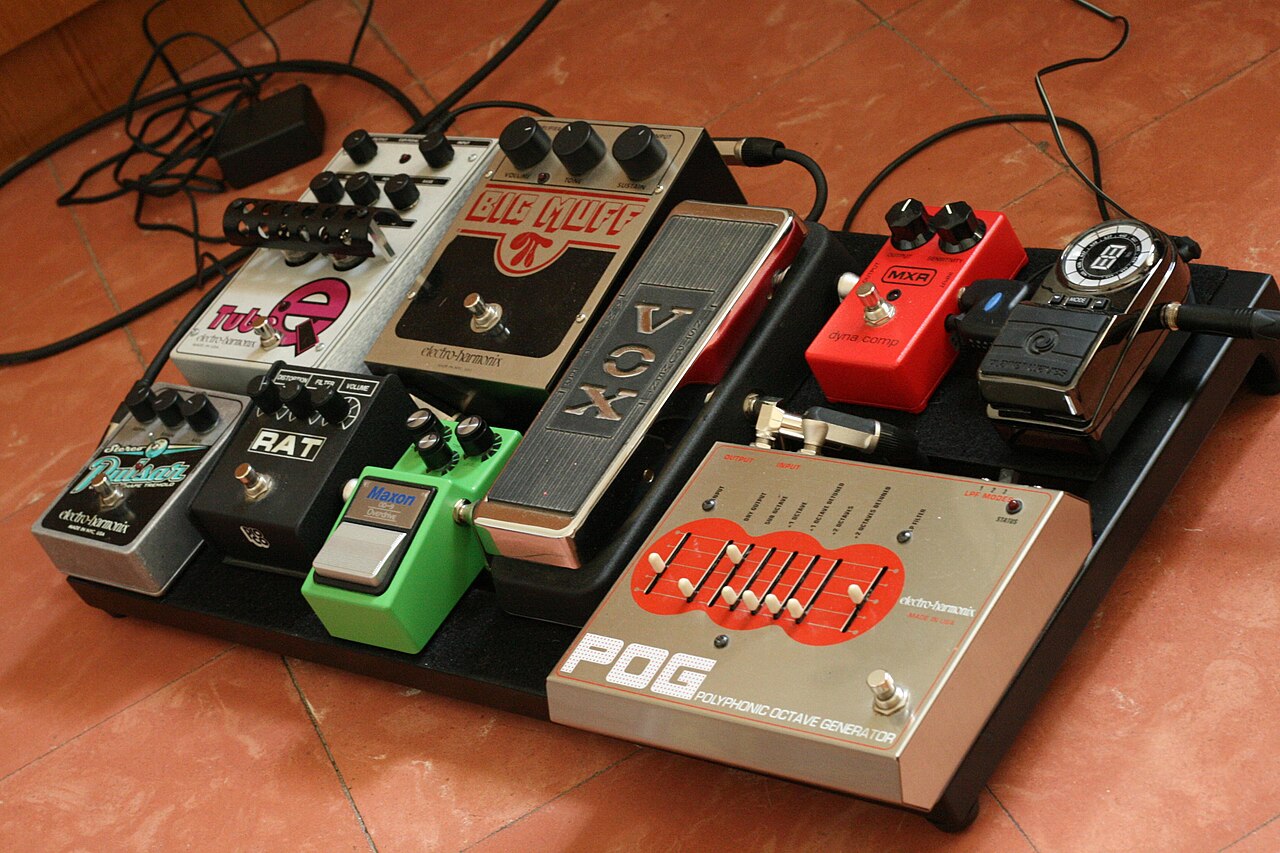
- A pedalboard with overdrive, wah and fuzz pedals: Michael Morel from Barcelona, Spain, Wikimedia Commons, CC BY 2.0.
- A pedalboard full of colourful pedals: Skimel, Wikimedia Commons, CC BY-SA 4.0.
- Jeff Beck: Shannon Kringen, Wikimedia Commons, CC BY-SA 2.0.
- Warren Haynes: Frank Schwichtenberg, Wikimedia Commons, CC BY-SA 3.0.
Latest News
Related

On This Day
Tuesday 10 November
From this week: