A Tube Screamer With Two Extra Rooms: The Xotic BB Preamp and the Quiet Art of the Bolt-On Upgrade
Xotic BB Preamp guide: what's inside the circuit, the serial 3643 change, verified famous players, settings, comparisons and used-buying advice.
There is a particular kind of pedal that never wins an argument on a forum and never loses a place on a pedalboard. The Xotic BB Preamp is the definitive example.
It is not exotic despite the brand name. It does not have a mythology like the Klon, a cult like the King of Tone, or a colour scheme anyone can pick out of a stage photo at fifty paces. It has four knobs, a small orange box, and a reputation built almost entirely on the fact that it works — plugged into a clean amp it gives you an overdrive, plugged into a dirty amp it gives you a lead channel, and turned down with the gain off it gives you thirty decibels of clean boost with a two-band EQ attached. Twenty-odd years after it appeared, it is still in production, still made in Van Nuys, California, and still on more professional boards than its public profile would suggest.
What makes it genuinely interesting — and this is the part almost nobody talks about — is that the BB Preamp is not an original circuit. It is a Tube Screamer with two extra op-amp stages surgically inserted into the middle of it. That is not a slur, and it is not speculation. It is what the schematic says, and we will walk through exactly where the cut was made.
Van Nuys, Not Tokyo: Where Xotic Came From
Xotic Effects operates out of 14920 Calvert Street in Van Nuys, California — the address is printed on the back of the manual, which is a charmingly analogue detail for a company that has been shipping pedals worldwide since the early 2000s. The parent company is Prosound Communications, Inc., which also handles Xotic guitars, Xotic basses and the Raw Vintage line of pickups and hardware. The company’s own copy describes “nearly 20 years” as an innovator in sound and design, which puts the origin firmly in the early-to-mid 2000s.
Sources disagree on exactly when the BB Preamp itself arrived. Dealer and encyclopedia listings variously give 2002 and 2005. What is documented with more precision is the moment the circuit changed, and that gives us a hard anchor: Xotic’s own statement about the BB-AT reissue confirms that a revised BB Preamp shipped from serial number 3643 onward in April 2007. A company does not quote a serial-number cutoff for a pedal it launched last year. By April 2007 the BB had already sold enough units to have a meaningful pre- and post- population, which supports the earlier of the two origin dates rather than the later one.
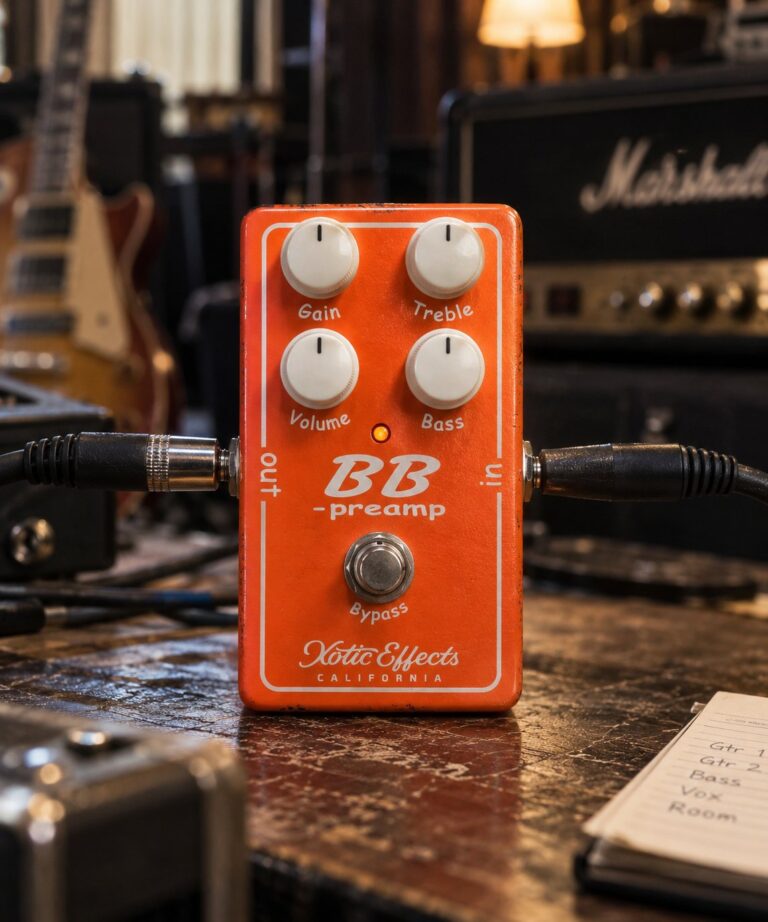
The pedal that Xotic sells today is called the BB Preamp v1.5. The “v1.5” designation is recent branding rather than a circuit revision — it was applied when Xotic updated the cosmetics, moving the pedal into what the company’s own shop page calls a “sleek new Vermillion Orange case” with white knobs. The shop listing is explicit that this is the “Same great sound as the original BB Preamp,” and independent tracing has confirmed that. The v1.5 is the post-2007 circuit in a new coat of paint.
What Is Actually Inside the Box
In October 2021, Aion FX — a DIY PCB company that publishes meticulous reverse-engineering write-ups — bought or borrowed three different BB Preamps and traced them component by component. The resulting schematics are the most reliable public documentation of the circuit that exists, and they are worth understanding, because they explain the pedal’s behaviour better than any amount of adjective-heavy marketing copy.
Here is the finding, stated plainly by Aion in its own write-up: from the input all the way through to a specific resistor mid-circuit, the BB Preamp is identical to a Tube Screamer — with the tone control hard-wired at roughly the 9 o’clock position and the drive pot value doubled to 1M. In a real Tube Screamer, that point in the circuit feeds straight into the output volume control and the output buffer. In the BB Preamp, Xotic cut that connection and inserted two additional op-amp stages: a variable gain stage and a two-band Baxandall EQ. After the EQ, the signal rejoins the standard Tube Screamer volume control and output buffer.
That is the entire design. And once you know it, the pedal’s character stops being mysterious:
- The midrange hump people describe as “singing” or “vocal” is the Tube Screamer’s fixed 720 Hz-ish emphasis, locked in place because the TS tone control has been soldered at one setting instead of given a knob.
- The compression is diode clipping in the TS-style feedback loop — nothing to do with an actual compressor circuit.
- The enormous clean boost and the ability to sound nothing like a Tube Screamer come from the added variable-gain stage, which sits after the clipping section and can push the output hard without adding dirt.
- The two-band EQ is a genuinely active Baxandall stage with ±15 dB of range per band — which is why it can cure a dark amp or tame an ice-picky bridge pickup in a way that a passive tone knob cannot.
Aion is also candid that the execution is untidy: the added gain stage has a capacitor, resistor, variable resistor, resistor and capacitor all in series between two op-amps, where a single resistor and a single capacitor would have done the same job. Their conclusion is worth quoting in spirit rather than word-for-word — they note that you can critique the design process all day, but Aion has never invented a pedal as legendary as the BB Preamp, and there was probably a reluctance to change what works over a few pennies of parts. That is the correct posture. Redundant components in the signal path are an aesthetic complaint, not an audible one.
The Serial 3643 Divide
This is the single most important thing a used buyer needs to know, and Xotic has said it publicly in its own product copy for the Andy Timmons model:
The original BB Preamp had a warm, heavily compressed overdrive voice. For some players that compression was too much — the pedal did not “breathe.” In April 2007, from serial number 3643 upward, Xotic released a revised version with some of the compression removed, producing a more aggressive pedal.
Aion’s tracing pinned down what changed, and it is almost comically small: one additional set of clipping diodes. Adding diodes in series raises the clipping threshold, so the circuit stays clean for longer before it squashes — less compression, more attack, more perceived aggression. Everything else on the board is identical. Same PCB layout, same components, with the extra diodes “tented” so that two occupy the footprint of one.

So if you are buying used and the seller can read you a serial number, you now know exactly which voice you are getting. Below 3643: softer, rounder, more compressed. 3643 and above: tighter, louder, more forward. Neither is better. They are two different pedals wearing the same badge.
Specifications
Two honest notes on that table. First, the current-draw discrepancy between 6 mA and 15 mA is real and unresolved — Xotic publishes both numbers in different places. Either way it is a trivially low-draw analogue pedal that any isolated supply will run without complaint, so the disagreement is academic rather than practical. Second, the 9V–18V adapter range on the current product page is a meaningful claim: running the pedal at higher voltage raises internal headroom, which makes the clean boost cleaner and the overdrive stiffer. The older printed manual only sanctions 9V. If you have a v1.5, the manufacturer’s current documentation permits 18V. If you have an early unit, be conservative and stay at 9V.
The Family Tree: Six Pedals, One Name
Searching for “BB Preamp” on the used market is genuinely confusing, because Xotic released at least six distinct variants over the years. Aion’s tracing project catalogued them:
- BB Preamp (now “v1.5”) — the standard, post-2007 circuit. Still in production.
- BB Preamp AT (BBP-AT) — the Andy Timmons signature model, which is functionally a reissue of the pre-2007 circuit Timmons preferred. Housed in orange metallic paint, sold as a limited edition. Discontinued, though Xotic’s shop has listed a 2017 Andy Timmons edition since the original run.
- Bass BB Preamp — released 2006, on a different PCB layout, with an unusual capacitor soldered across an entire op-amp stage acting as a treble bypass. Aion described never having seen that trick before.
- Custom Shop BB Preamp Comp — 2009. Adds a three-position switch selecting standard clipping, more clipping (AT voicing), or no clipping at all.
- Custom Shop BB Preamp MB (Mid Boost) — 2009. Restores the Tube Screamer tone control that the standard BB has hard-wired at 9 o’clock, giving it a knob. Xotic’s own copy confirms it: set the mid control to 9 o’clock and you have the standard BB.
- BB Plus — a two-channel dual pedal, substantially different from the rest of the family. Premier Guitar reviewed it.
Worth flagging for anyone shopping: when Xotic uses the word “compression” in the Custom Shop Comp description, it is not talking about a compressor circuit. It is talking about diode clipping thresholds. Aion called this out as a somewhat obnoxious use of the term, and they are right — clipping and compression both reduce dynamic range, but one is two diodes and the other is an entire circuit. If you want an actual compressor from Xotic, that is the SP Compressor, a different pedal entirely.
Famous Players: What Holds Up and What Doesn’t
The BB Preamp has a genuine professional user base, but the quality of the evidence varies enormously between names. Here is the honest sort.
Andy Timmons — Documented, With an Important Caveat
This is the strongest connection by a distance, and it is the only one Xotic itself promotes. The BB Preamp’s official product page carries a direct endorsement from Timmons stating that the BB Preamp has been a permanent part of his studio and live rig for many years. Xotic and Timmons partnered to recreate the original pre-2007 BB as the signature BB-AT, which Vintage Guitar covered in July 2011 (Aion dates the model to 2009, so there were likely multiple runs or a gap between production and trade-press coverage — the two dates are not necessarily in conflict). The BBP-AT was a limited edition of 3,000, in orange metallic paint, with the same Gain, Volume and two-band ±15 dB EQ layout as the standard pedal but the warmer, more compressed pre-2007 voice.
Here is the caveat, and it matters. Timmons’ documented current pedalboard — the one described in recent rig walkthroughs — does not feature the Xotic BB. His drive section now runs a beat-up Ibanez TS-808, a Keeley-modified Boss Blues Driver, a modified JHS Angry Charlie, and his JHS AT signature channel drive, all routed through a GigRig G2. His delay is a Strymon TimeLine, with a Cry Baby wah at the front and an MXR Phase 90 in the loops. He also has a signature Keeley delay, the Halo Dual Echo.
None of that retroactively invalidates the endorsement. Timmons used the BB heavily enough to get a signature version of it, and he has demonstrated it on camera. But a player who has moved to a different signature drive with a different company is not the same as a player who still has yours on the board tonight, and we are not going to pretend otherwise.
Keith Urban — Verified on Video, Twice Over
Keith Urban’s Premier Guitar Rig Rundown shows not one but two BB Preamps: a Custom Shop version at 23:38 and a standard BB Preamp at 23:49. That is about as solid as pedalboard documentation gets — moving footage, a named magazine, timestamps. Urban’s whole approach is a country-rock hybrid built on cutting midrange and controlled compression, which is exactly what the BB is engineered to deliver.

Ben Gibbard — Verified, With the Best Quote of the Lot
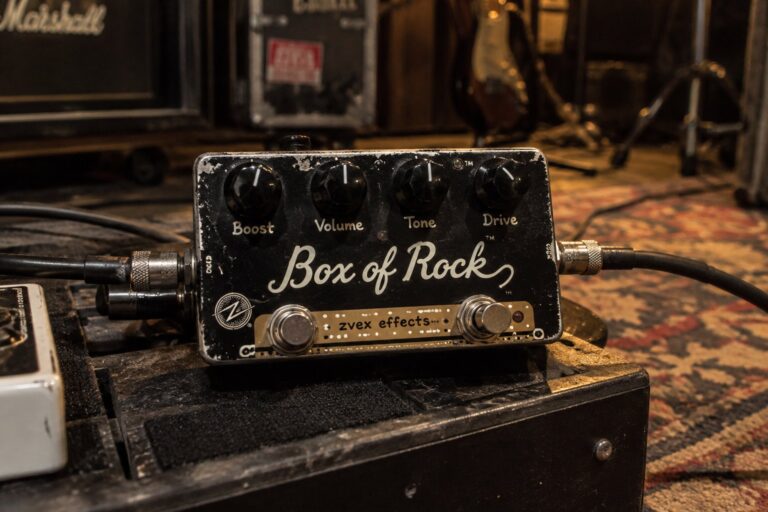
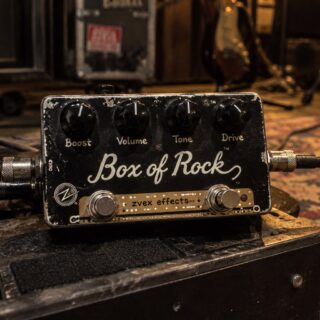
Death Cab for Cutie filmed a Rig Rundown with Premier Guitar at Nashville’s Ryman Auditorium on 29 April 2015, published that May. In a companion rig tour with MusicRadar, Gibbard explained the BB’s exact role on his board: he found the ZVEX Box of Rock a little dark and its big distortion a little murky, so the BB pedal took over the heavy distortion duties — and, crucially, the two layer well together, with the Box of Rock’s overdrive side stacking into the BB.
That is the most useful artist testimony about this pedal in existence, because it describes a specific problem (a dark, murky big-distortion sound) and the BB solving it. The BB’s active treble control is doing the work. If your main dirt pedal is dark, the BB is a remarkably direct fix.
Mike Sullivan, Greg Howe, Danielle Haim and Vinnie Moore
Mike Sullivan of Russian Circles had a BB Preamp on the board photographed for a 2013 Premier Guitar Rig Rundown — which is a genuinely surprising credit, because Russian Circles is instrumental post-metal and the BB is usually filed under blues-rock. It says something about the pedal’s range that it turns up under that much gain.
Greg Howe’s effects have been photographed with a BB Preamp among them. Danielle Haim’s board is documented in multiple photographs and live footage of HAIM performing “The Wire,” with the layout confirmed against additional images. Vinnie Moore has shown Xotic pedals from his touring rig on camera. The album-credit trail is broader than the fame of the pedal suggests, taking in HAIM’s Days Are Gone (2013), Lindsay Ell’s The Project (2017) and Baroness’s STONE deluxe edition (2023).
Claims That Are Weaker Than They Look
Three names deserve an asterisk rather than a citation.
Joe Satriani is widely listed as a BB Preamp user, but the sourcing traces back to a third-party gear-guide article rather than to Satriani, his tech, or a filmed rundown. Satriani’s signature relationships are extensively documented elsewhere and the BB does not appear in them. Treat this one as unconfirmed.
Kiko Loureiro is listed on the strength of a Reverb listing describing a BB Preamp as having been owned by him. A used-gear listing establishes ownership at some point, not use on a record or a stage — and a pedal reaching the second-hand market is arguably evidence it left the board.
Nergal of Behemoth appears on the strength of a Reddit thread discussing his pedalboard. That is a forum, not a source.
We are flagging these because the BB Preamp does not need padded credits. Two Premier Guitar rundowns, an artist signature model, and a specific, articulate explanation of its role from Ben Gibbard is a stronger case than a list of names nobody can verify.
Tone Recipes: Four Settings That Cover Most of It
1. The Always-On Amp Sweetener
Gain 7:30 (fully down) · Volume 1:00 · Treble 12:00 · Bass 11:00
This is the setting that gets the pedal onto boards and never lets it off. Gain all the way down, volume above unity, EQ almost flat with a touch of bass trimmed to stop the amp getting flubby. What you get is a mild level lift with a slightly firmer front end and better note definition. Because the gain stage sits after the clipping section, you can push the amp harder without the pedal itself adding grit. Compare this to what an Xotic EP Booster does — same job, but the BB gives you EQ control over it.
2. The Tube Screamer Replacement
Gain 10:00 · Volume 12:00 · Treble 1:00 · Bass 2:00
Since the front end is a Tube Screamer, this setting simply undoes the TS’s two most-complained-about traits. The bass boost restores the low end the TS’s input cap rolls off; the treble boost opens the top end the TS closes down. You keep the mid-forward push and the compression, but the pedal stops sounding like it is playing through a cardboard tube. Anyone who has spent years toggling between a TS808 and something more open should try this before buying a third overdrive.
3. The Gibbard Layer
Gain 1:00 · Volume 11:00 · Treble 2:00 · Bass 12:00
Built from Gibbard’s description of what the BB does on his board: it takes over big-distortion duties from a darker pedal and layers with it. Set the BB fairly hot with the treble pushed, then run a dark, thick drive into it — a Box of Rock, a Big Muff, an Angry Charlie. The BB adds cut and definition on top rather than more mud. If the stacked result is harsh, pull the BB’s treble back to 12 and add volume instead.
4. The Singing Lead
Gain 2:00 · Volume 1:00 · Treble 11:00 · Bass 1:00
This is the Andy Timmons-adjacent territory: high gain on the pedal, a moderate amount of treble cut, a bass lift, and enough volume to shove the amp’s front end into its own breakup. The compression is the point here — it is what gives the sustain its even, vocal quality. A pre-2007 unit or a BB-AT will do this better than a v1.5, because it clips earlier and squashes harder. On a v1.5 you can approximate it by driving the amp a little more and letting the amp supply the last of the compression.
All positions are given in clock terms with the knob at 12 o’clock as neutral. Note that on this pedal, 12 o’clock on Treble and Bass is genuinely flat — it is an active EQ, so it cuts as well as boosts, and there is no “off.”
Where It Goes in the Chain
The BB Preamp is not fussy, but a few placements make a measurable difference.
After wah and fuzz, before everything else. The 1M input impedance is high enough to be well behaved with most pickups, but a germanium fuzz still wants to see your guitar directly. Wah first, fuzz second, BB third is the conventional ordering.
Before modulation and delay. Standard practice: shape the distortion, then process it. The 2k output impedance drives long cable runs and subsequent buffered pedals without loss.
As the second drive in a stack, not the first. This is the placement most people underuse. Because the BB has active EQ after its clipping stage, it can correct the tone of whatever comes into it. Put your character pedal first — a fuzz, a Muff, a dark distortion — and let the BB be the stage that fixes the frequency balance and sets the final level. That is exactly the arrangement Gibbard described.
Into the effects loop as a lead lift. With gain at zero, the BB works as an EQ-equipped level boost in an amp’s loop. Note that this bypasses the interaction with the amp’s preamp entirely, so it is a volume-and-EQ tool at that point rather than an overdrive. Some players prefer it there precisely because the boost stays clean.
How It Compares
Versus the Ibanez Tube Screamer
The most important comparison, because the answer is genuinely “it is one, plus more.” The TS9 and its siblings give you Drive, Tone, Level and a fixed voice. The BB gives you the same front end with the tone control frozen at one setting, then adds an independent gain stage and a real two-band EQ. That means the BB can do everything a TS can, plus a great deal a TS cannot — but it is also roughly three times the price of a standard TS9, and if you love the TS voice exactly as it comes, you are paying for flexibility you may never touch. Players who want the TS front end with maximum variation instead might look at the JHS Bonsai, which takes the opposite approach: nine different Screamer circuits, no added EQ.
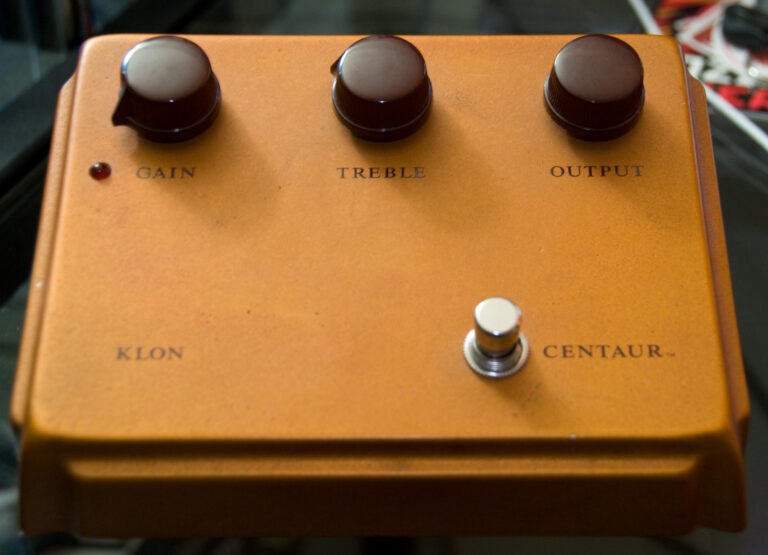
Versus the Klon Centaur and its descendants
Different philosophies entirely. The Klon Centaur and clones like the Wampler Tumnus use a clean-blend architecture and a charge pump for internal headroom — they add gain while leaving your dry signal largely intact, which is why they are described as transparent. The BB is not transparent and does not try to be. It is a voiced pedal with a fixed midrange character and a corrective EQ layered on top. If you want your amp plus more of it, the Klon family is the answer. If you want your amp plus a specific, singing, compressed midrange, that is the BB.
Versus the Analog Man King of Tone and JHS Morning Glory
The King of Tone and Morning Glory descend from the Marshall Bluesbreaker pedal — low gain, open, uncompressed, amp-like. They flatter a good amp and add very little of their own personality. The BB is the opposite kind of tool: more compression, more midrange, more gain on tap, more ability to reshape the signal. Players often end up owning one from each camp rather than choosing.
Versus the JHS AT+ Andy Timmons
A pointed comparison, since both are Timmons signature pedals from different eras and different companies. The JHS AT+ is his current documented drive; the Xotic BB-AT was his earlier one. If you are chasing Timmons’ recorded tone specifically, the honest answer is that his catalogue spans both, and the era of the record you are chasing determines which pedal is closer.
Versus the Nobels ODR-1
The ODR-1 is the Nashville session player’s counter-argument to the mid-humped overdrive: a broad, flat-ish voice with a Spectrum control that tilts the whole curve. Where the BB adds mids and then lets you EQ around them, the ODR-1 never adds the hump in the first place. If the BB’s core voice sounds honky to you, the ODR-1 is the pedal to try next.
Buying Guide
New. The current BB Preamp v1.5 lists at $219.00 on Xotic’s own end-user price sheet dated October 2025; dealer street pricing has historically run below that. You get the post-2007 circuit, the Vermillion Orange enclosure with white knobs, and current-production manufacturer support. If you want the pedal and do not have a strong opinion about the older voice, buy this one and stop thinking about it.
Used, standard BB. Ask for the serial number. Below 3643 is the pre-April-2007 circuit — warmer, more compressed. At 3643 or above it is the current voice. Sellers are frequently unaware this distinction exists, which cuts both ways: you may find a pre-2007 unit priced as a standard one, or vice versa. Cosmetics are the fast check on the newest units, since the Vermillion Orange finish with white knobs is v1.5-era.
Used, BB-AT. A limited edition of 3,000 in orange metallic. It is the pre-2007 voice by design, and it carries a signature premium. Buy it because you want that specific warmer, more compressed sound — not because a limited run implies an upgrade. It is not more capable than the standard pedal; it is a different flavour.
Used, Custom Shop MB or Comp. Both from 2009, both long discontinued, both genuinely more flexible than the standard pedal. The MB gives you the Tube Screamer tone control back as a knob. The Comp lets you select between the standard clipping, the AT clipping and no clipping at all. If you find one at a sane price and you like tinkering, these are the interesting ones.
Used, Bass BB. Released 2006 and apparently discontinued, though stock lingered into 2020. Different PCB, different voicing, and a treble-bypass capacitor across an op-amp stage. Guitarists occasionally buy it for the extended low end; it is a legitimate choice if you play baritone or downtuned.
What to check on any used unit. Open the four bottom screws and look for battery corrosion — this is a 9V-battery-capable pedal from an era when people left batteries in. Check that all four pots sweep smoothly, particularly the volume, which is a dual-gang pot in this circuit and can develop imbalance. Confirm the footswitch clicks positively; true-bypass switches are the most common failure point on any pedal of this age.
Living With It
Power. Centre-negative 9V DC on a 2.1 mm x 5.5 mm barrel, and it disconnects the battery automatically when a supply is plugged in. Xotic’s current documentation permits 9V to 18V on the v1.5, which raises headroom noticeably — the clean boost gets cleaner and the overdrive firms up. The older manual only sanctions 9V, so do not run an early unit hot. Current draw is trivially low by either published figure.
Noise. This is a high-gain-capable op-amp circuit with an active treble boost, which is a combination that will find any noise already in your chain and amplify it. If the pedal seems noisy, the pedal is usually not the problem — check your power supply isolation first, then your single-coil orientation relative to lighting rigs, then the drive pedal in front of it.
The EQ is stronger than you expect. Fifteen decibels in either direction on two bands is an enormous amount of tonal authority for a drive pedal. Most players who dislike the BB on first listen have it set with both EQ knobs boosted well past noon on an amp that did not need it. Start with both at 12 o’clock, get the gain and volume right, and only then touch the tone.
It genuinely is a preamp, sort of. The name is not entirely marketing. With gain down and the EQ active, it functions as a level-and-tone stage that can drive a power amp input or a recording interface into something usable. It is not a full amp-in-a-box — there is no cab simulation and no power-amp modelling — but it holds up better in that role than most overdrives, and players do use it that way.
Build. Made in the USA, in an enclosure that is smaller than a standard Boss box, at 280 grams. It is a hybrid surface-mount and through-hole design with a sandwich-style construction: a component PCB and a separate potentiometer sub-PCB stacked together. That is not a repair-friendly layout for the home tinkerer, but it is compact and it has survived two decades of touring boards.
Frequently Asked Questions
Is the Xotic BB Preamp just a modified Tube Screamer?
Substantially, yes — and this is documented rather than rumoured. Aion FX’s trace found that from the input through to a specific point mid-circuit, the BB is identical to a Tube Screamer with the tone control hard-wired at approximately 9 o’clock and the drive pot doubled to 1M. Xotic then cut the connection to the output section and inserted a variable gain stage and a two-band Baxandall EQ before rejoining the standard TS volume and output buffer. That addition is what makes it a genuinely different pedal in use, but the DNA is not in dispute.
What does “BB” stand for?
Xotic has never published an explanation in any manual, product page or press release we could find, and we are not going to invent one. Various theories circulate online; none of them trace to the manufacturer. If you see a confident answer, ask where it came from.
What is the difference between the BB Preamp and the BB Preamp v1.5?
Cosmetics. The v1.5 designation was applied when Xotic moved the pedal into a Vermillion Orange enclosure with white knobs. Xotic’s own shop copy states it is the same sound as the original, and Aion’s tracing confirmed the circuit is the post-2007 design in both cases. It is not a third revision of the circuit.
What changed at serial number 3643?
In April 2007, from serial 3643 upward, Xotic reduced the compression by adding one more set of clipping diodes. Higher clipping threshold means the circuit stays clean longer before squashing, so post-3643 units are tighter and more aggressive while earlier ones are warmer and more compressed. Everything else about the board is identical.
What is the difference between the standard BB Preamp and the Andy Timmons BB-AT?
The BB-AT is, by Xotic’s own account, a recreation of the pre-2007 circuit — the warmer, more compressed version Timmons preferred over the revised one. It has the same Gain, Volume and two-band ±15 dB EQ controls, comes in orange metallic paint, and was a limited edition of 3,000. Circuit-wise the only difference from the standard pedal is the clipping diode arrangement.
Does Andy Timmons still use the Xotic BB Preamp?
Xotic’s product page carries a Timmons quote saying the BB has been a permanent part of his studio and live rig for many years. However, his documented current touring board runs a different drive section — a TS-808, a Keeley-modified Blues Driver, a modified JHS Angry Charlie and his JHS AT signature drive, through a GigRig G2. The historical association is real and produced a signature model; the present-day board is a different rig, and we would rather say so than let the endorsement quote imply otherwise.
Can I run it at 18 volts?
On a current v1.5, yes — Xotic’s own product page lists a 9V–18V DC adapter range. Higher voltage increases internal headroom, making the clean boost cleaner and the drive stiffer and less compressed. The older printed manual specifies 9V only, so do not assume an early unit will tolerate 18V. If in doubt, contact Xotic with your serial number.
Is it true bypass?
Yes. Xotic states true bypass switching on both the product page and in the manual, describing it as eliminating signal interference when the pedal is off. Note that a board full of true-bypass pedals and long cable runs may still want a buffer somewhere — the BB will not supply one when it is disengaged.
Will it work for metal or high-gain music?
On its own it is not a metal distortion — it is a boost and overdrive with substantial but not extreme gain. In front of an already-saturated amp it works extremely well, tightening the low end and adding cut, which is the traditional Screamer-into-high-gain-amp move with the added benefit of a real EQ. Mike Sullivan of Russian Circles had one on his board for a Premier Guitar Rig Rundown, which is a reasonable proof of concept for heavy music.
How does it compare to the Xotic AC Booster and RC Booster?
All three share Xotic’s design language — compact enclosure, two-band active EQ, USA build — but they sit at different points on the gain scale. The RC Booster is the cleanest and most transparent of the three, the AC Booster adds more drive and colour, and the BB Preamp has the most gain and the most compression of the family, along with the pronounced Tube Screamer-derived midrange the other two lack. If the BB sounds too coloured for you, the AC or RC is the pedal to try next.
Image credits
- Vinnie Moore: Frank Schwichtenberg, Wikimedia Commons, CC BY-SA 3.0.
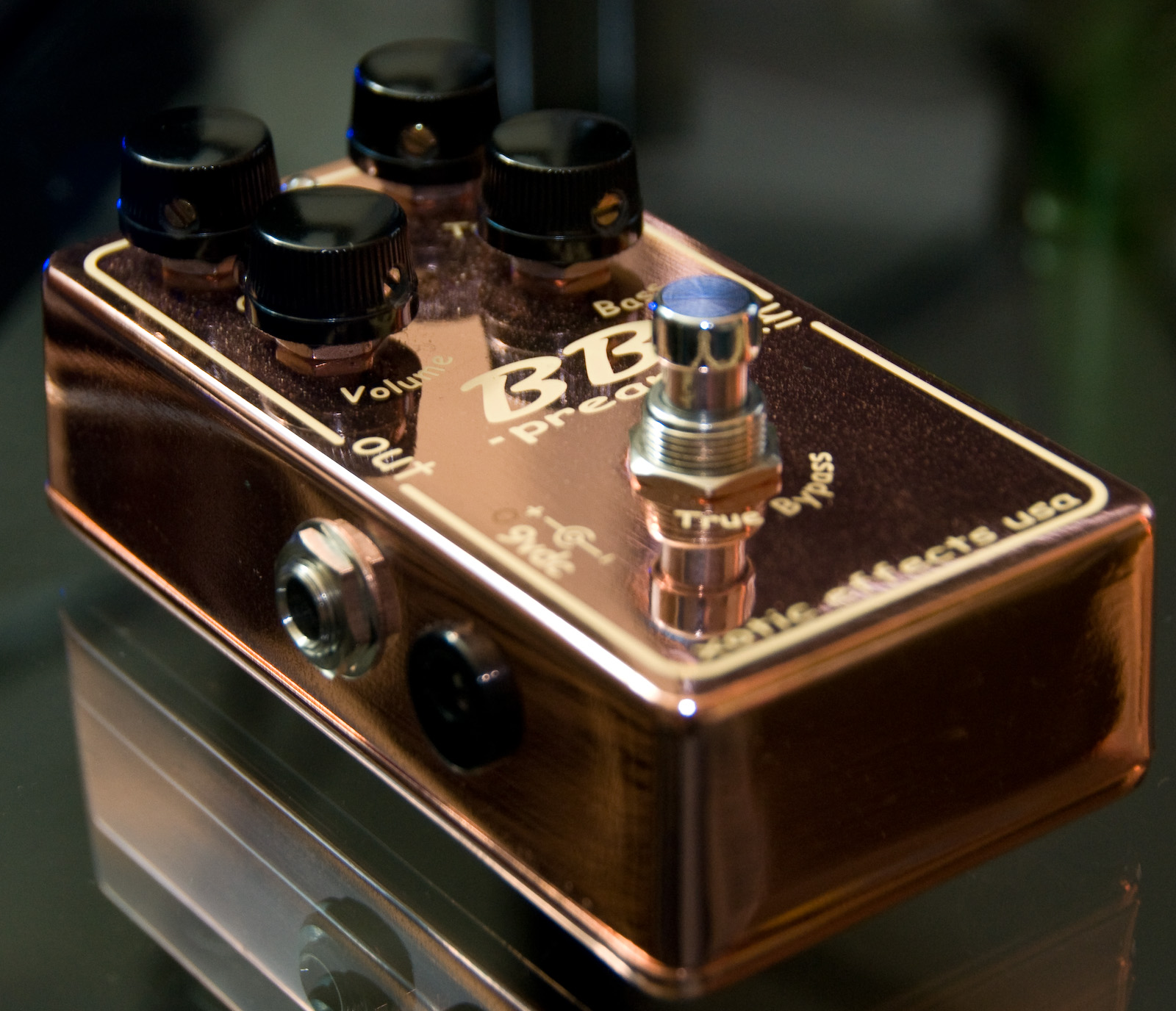
- Top image: Xotic BB Preamp (Copper), an earlier copper-finish example photographed on 17 September 2008. Photo: Art Bromage (ArtBrom). (C)Art Bromage. Source photograph, CC BY-SA 2.0. Full photographer-published frame retained; existing source crop and Lightroom processing preserved. Proportionally resized for display. Adaptations remain under the same license.
- Keith Urban: 20200304SM0323, Wikimedia Commons, CC0.
- Klon Centaur: ArtBrom, Flickr, CC BY-SA 2.0.
- Xotic BB Preamp: GuitarGangsters AI-generated reference illustration, not a photograph.
Latest News
Related
On This Day
Monday 9 November
From this week: