Walrus Audio Julia V2: The Chorus Pedal Built for People Who Swore They Hated Chorus
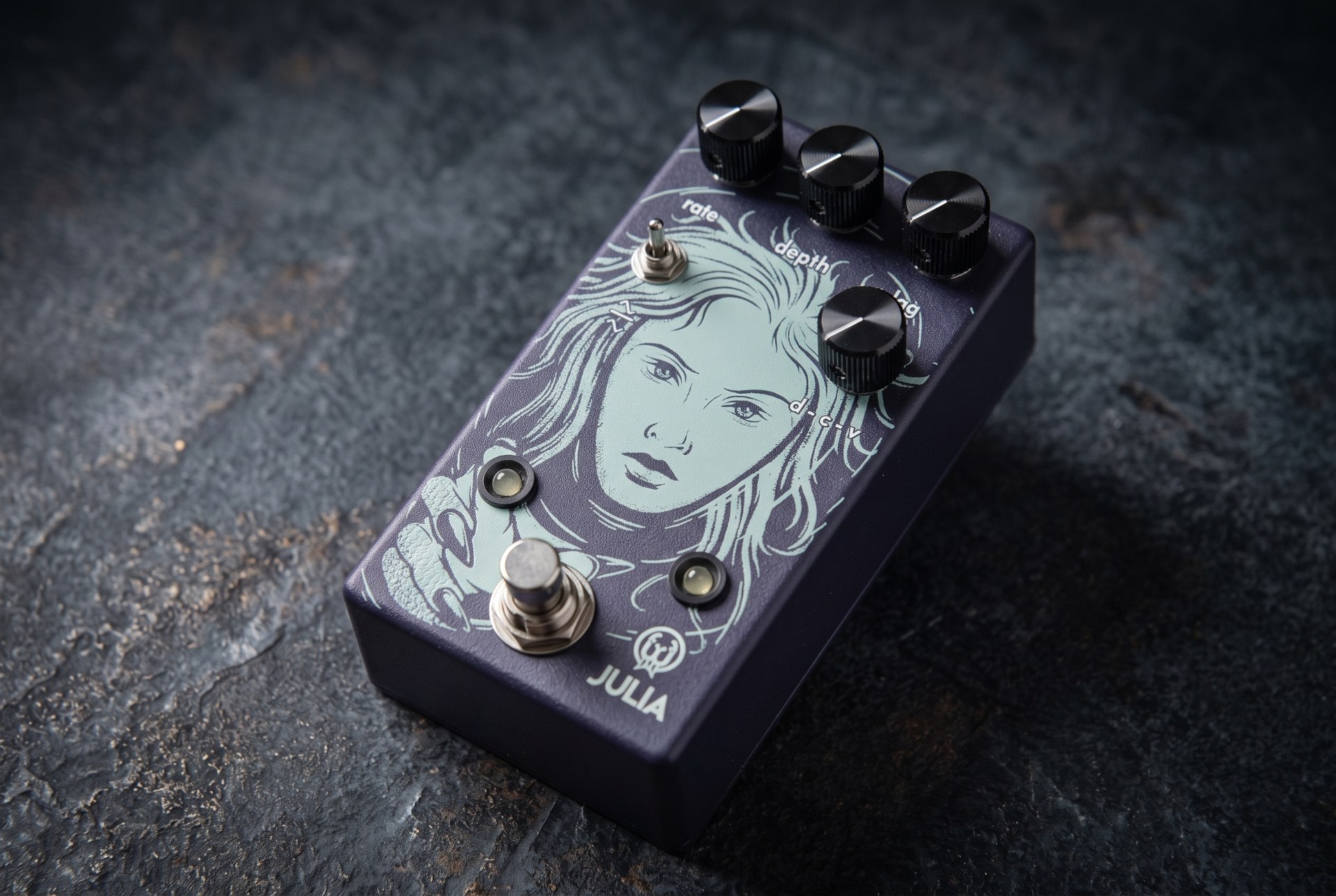
An AI-generated illustration of the Walrus Audio Julia Analog Chorus/Vibrato V2.
Walrus Audio Julia V2 chorus and vibrato: full specs, the Lag and D-C-V controls explained, ten tone recipes, verified famous players and buying advice.
In the spring of 1999, hydrophones belonging to the American National Oceanic and Atmospheric Administration picked up something from the deep South Pacific that nobody could explain. It lasted around two minutes and 43 seconds. It had no obvious source. The recording was catalogued, given a name, and quietly filed away with the other unexplained ocean sounds of that strange, fertile year — the Bloop, Slow Down, Train, Whistle. The sound they logged in March was called Julia. Scientists eventually settled on the least romantic answer available: a large iceberg, probably grounded off Antarctica, groaning against the sea floor.
Walrus Audio of Oklahoma City preferred a different explanation. In their telling, Julia is a water demigoddess crying from the deep in a chorus of melancholy hymns, still uncaught, still pursued. It is exactly the kind of overwrought mythology that would be insufferable if the pedal underneath it were mediocre. It is not. Since 2016, the Julia has been quietly making converts of guitarists who spent their entire playing lives insisting that chorus was the sound of a bad decade — and the reason has almost nothing to do with icebergs and everything to do with one knob nobody else thought to build.
The Sound From the Bottom of the Ocean: Where the Name Comes From
Walrus Audio has always leaned on narrative harder than most pedal builders. Their enclosures carry illustrations rather than logos, their names come from myth and geography rather than model numbers, and their product copy reads like the back cover of a paperback. Julia is the purest expression of that approach. The pedal is named for a real acoustic event with an unromantic explanation, and the company chose to write the romantic version anyway.
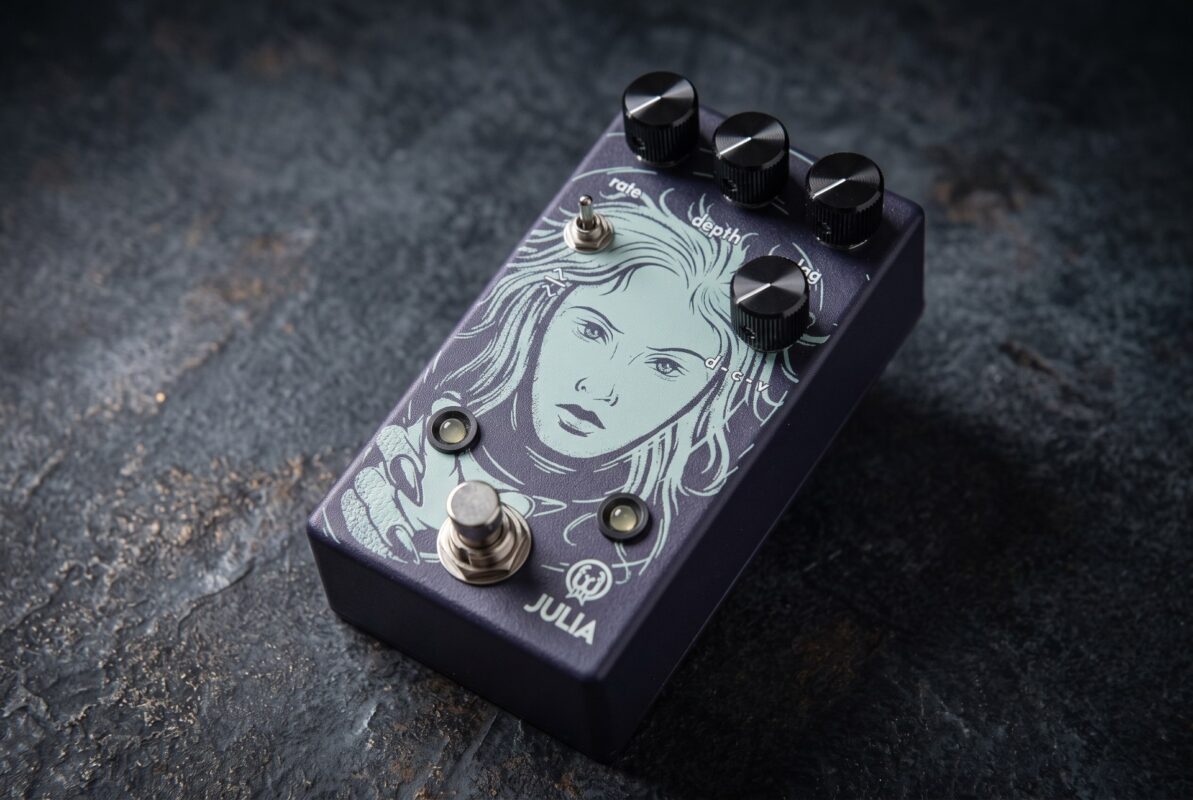
It matters more than it sounds like it should, because the mythology sets an expectation the circuit then has to meet. A pedal called “Analog Chorus” promises a known quantity. A pedal called Julia, wrapped in deep lavender with surf green ink and an illustration of a figure surfacing from black water, promises something stranger and less predictable. The Julia delivers on that in a specific, engineering-led way — and the way it does so is the whole story of this pedal.
2016: A Chorus Pedal Arrives With an Extra Knob
The original Julia landed in 2016 into a market that did not need another chorus pedal. The category had been settled for decades. Boss owned the mainstream with the CE-2 and its descendants, Electro-Harmonix owned the ragged alternative with the Small Clone, and the boutique world mostly built refinements of one or the other. The received wisdom held that chorus was a solved problem and, worse, an unfashionable one.
Walrus did two things differently. The first was the Lag control, a knob that sets the centre delay time the low-frequency oscillator modulates around. On a conventional chorus, that centre point is fixed by the designer; you get Rate and Depth and nothing else. Making it variable turns one pedal into a family of them — tight, hi-fi, almost flange-adjacent at one end of the sweep, and wide, detuned, seasick warble at the other.
The second was the D-C-V knob, and it is the reason the Julia has outlived its competitors’ launch cycles. Nearly every chorus/vibrato pedal ever built treats the two effects as a binary: a toggle switch, chorus on one side, vibrato on the other. Walrus made it a continuous control. Turn it all the way down and you hear nothing but your dry signal. Set it at noon and you have equal dry and wet, which is the textbook definition of chorus. Turn it fully clockwise and the dry signal disappears entirely, leaving only the pitch-modulated path, which is the textbook definition of vibrato. Everything in between is territory that most pedals simply do not have a way of reaching.
The Premier Guitar Review That Set the Terms
Joe Gore reviewed the original Julia for Premier Guitar on 26 August 2016, and his opening line framed the pedal better than any marketing copy has managed since: “Here’s a 6-string litmus test: ‘Do you like chorus?'” His argument was that the Julia’s genuine achievement is not that it does classic chorus well — plenty of pedals do — but that it offers subtle settings that don’t announce themselves. His verdict was that he knew within seconds of plugging in that the Julia would become one of his favourite chorus pedals, and that players who dislike conventional chorusing might well be converted by the in-between settings. Street price was $199. The review carried a Premier Guitar Gear Award for 2016.
Gore also did something reviewers rarely bother with and opened the pedal up. Inside, he found a circuit board populated with modern small-format components, with two significant exceptions: the new-production Coolaudio bucket-brigade delay chip and its clocking chip, both through-hole. That is the analog heart of the pedal, and it is worth being precise about what it means. A bucket-brigade device passes the audio signal through a long chain of capacitors, handing it from one to the next in step with a clock. Speed the clock up or slow it down and the delay time changes — and because the audio is being physically shuffled rather than mathematically resampled, changing the clock speed bends the pitch. That pitch-bending is chorus. It is also why analog chorus has the particular slightly hazy, slightly compressed top end that digital emulations chase and rarely catch.
2020: The V2 Revision, and Exactly What Changed
Walrus announced the Julia V2 at NAMM in January 2020. It is a small revision list, and — importantly for anyone shopping used — it does not touch the audio path. Three changes, all of them ergonomic or cosmetic:
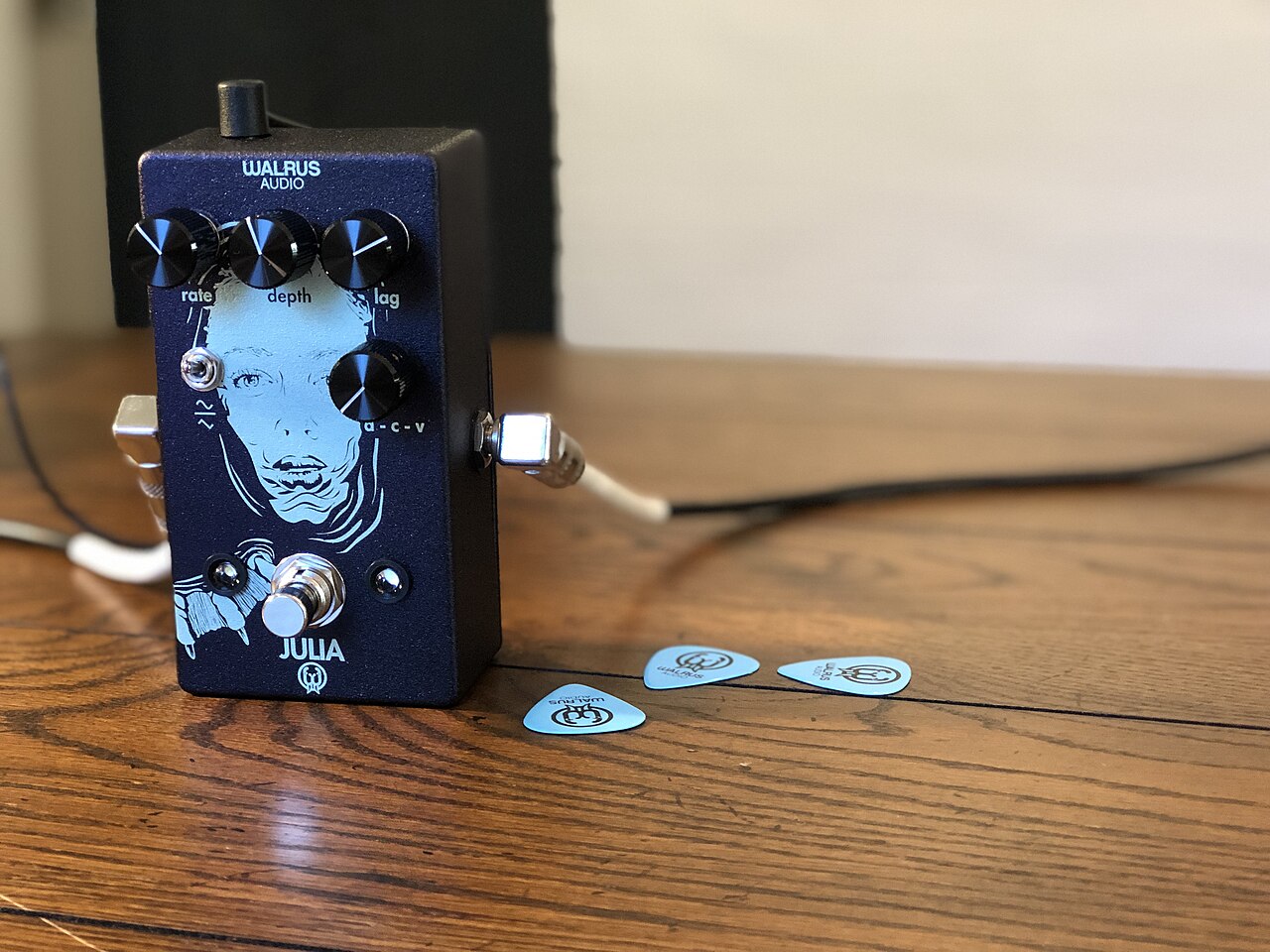
- Top-mounted input and output jacks. The V1’s jacks were on the sides, which on a crowded board costs you an inch of width per pedal. Moving them to the top face was the single most requested change.
- Soft-touch, clickless bypass switching. The V1 used a mechanical footswitch that produced an audible pop on engagement for some players. The V2 switches silently.
- New artwork by illustrator Adam Forster, in deep lavender with surf green ink, plus the Walrus Audio logo recessed into the backplate — one of the first Walrus pedals to carry that detail.
That is the complete list. The Coolaudio BBD circuit, the Lag control, the D-C-V blend and the sine/triangle wave switch all carried over untouched. If you find a V1 cheap and don’t care about top jacks, you are not buying an inferior-sounding pedal.
Michael Watts reviewed the V2 for Guitar.com on 5 February 2020 and scored it 9 out of 10 at £179, calling it a great take on a classic effect and noting that even players who think they dislike chorus may be pleasantly surprised. His most useful observation concerned the two waveforms: the sine setting is smooth and organic with none of the wateriness that afflicts lesser units, while the triangle setting is “reminiscent of a vintage EHX Small Clone” and “ragged around the edges in a good way.” He also flagged the V2’s second LED, which flashes in time with the modulation rate — a small thing that matters live, because it lets you confirm your speed setting without playing a note.
Walrus Audio Julia V2 Specifications
A Note on the Dimension Figures
Walrus lists the enclosure at 4.77″ x 2.9″ x 2.3″, which converts to roughly 121 x 74 x 58 mm. Guitar.com’s V2 review spec box printed 64 x 52 x 120 mm. The two do not agree, and the likeliest explanation is that Guitar.com measured the bare enclosure without knobs and jacks while Walrus quotes the figure including them. For pedalboard planning purposes, treat it as a standard 125B footprint and allow the usual clearance for top-mounted cables.
The Four Controls, and What Each One Actually Does
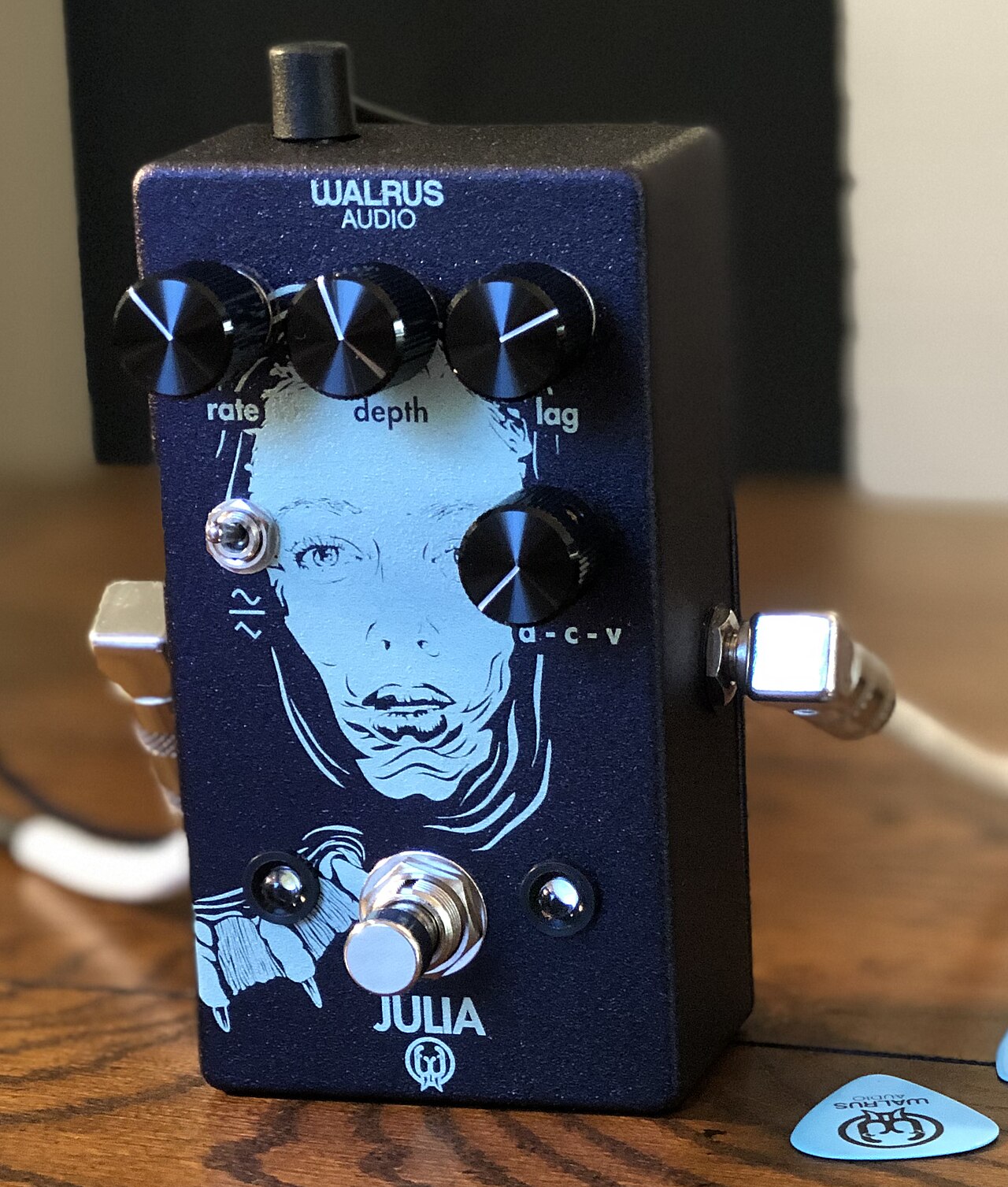
Rate
Straightforward modulation speed. What separates the Julia from a good deal of the competition is how slow it will go. Owners on r/guitarpedals have specifically praised the V1’s ability to reach genuinely slow vibrato speeds, where many pedals bottom out too fast to be useful for long, drifting swells. At the other end it gets fast enough for Leslie-adjacent flutter, though it will never be a rotary simulator.
Depth
How far the pitch swings either side of centre. Below about 9 o’clock the effect is thickening rather than modulation. Past 2 o’clock in vibrato territory it becomes genuinely aggressive — Guitar.com’s reviewer noted that the triangle waveform “veers towards less usable waters” as depth increases in the vibrato range. Whether that is a criticism or a feature depends on whether you are playing an Americana ballad or scoring a nightmare.
Lag
The signature control, and the one that is hardest to explain and easiest to hear. It sets the centre delay time the LFO modulates around. Low settings mean short delay times, which means a tight, focused, almost flanging-adjacent modulation with a hi-fi character. High settings mean long delay times, which means wide, blurry, detuned warble that starts to sound like tape wow or a warped VHS cassette. Turning it while playing a sustained chord is the fastest way to understand what the pedal is for.
D-C-V Blend
The wet/dry ratio, laid out as a continuous journey rather than a switch. Minimum: no effect audible. Noon: equal dry and wet, classic chorus. Maximum: 100 percent wet, classic vibrato. The two most interesting regions are the ones the labelling barely acknowledges. Between minimum and noon you get animation without obvious chorus — the setting that makes the Julia work on bass guitar and the setting that converts chorus sceptics. Between noon and maximum you get chorus/vibrato hybrids that most pedals cannot produce at all, because they only offer one or the other.
The Wave Switch
Sine or triangle. Walrus’s own guidance is that the sharper corners of the triangle wave generally suit chorus and the rounder sine wave generally suits vibrato, though in practice most players end up reversing that advice at least half the time. Triangle is the more vintage, more obviously “pedal-like” setting; sine is smoother and more transparent.
One correction worth making here, because it circulates: some crowd-sourced gear databases describe the Julia as having a “random waveform setting.” It does not. The Julia offers two waveforms, sine and triangle, and nothing else. Random LFO shapes belong to the larger Julianna, the Julia’s deluxe stereo sibling with tap tempo, and to digital modulation platforms — not to this pedal.
Famous Players: What Actually Holds Up
This is the section where a gear feature usually recites a list of names and hopes nobody checks. The Julia deserves better treatment than that, partly because the verified list is genuinely good and partly because the unverified list contains at least one claim that the artist herself contradicts in print.
Tier One: Photographed, Filmed or Quoted in Independent Press
Teppei Teranishi (Thrice) is the strongest documented user. Premier Guitar‘s Rig Rundown from 27 October 2021, filmed at Nashville’s Mercy Lounge on the Horizons/East tour, describes the Julia explicitly as “the lone carryover” from his previous board — everything else had been replaced or consolidated into a Line 6 HX Effects. It sat alongside a Walrus Audio Warhorn and a Fuzzrocious Afterlife, powered by a Walrus Phoenix, tuned by a TC Electronic PolyTune 3 Mini, into a Supro Dual Tone and a hand-wired Vox AC30HW2. In a separate interview with MusicRadar, Teranishi explained how he ended up with it at all: “I actually never liked choruses ever, but we ended up using quite a bit on this last record and it just worked, so I was like, ‘I guess I need a chorus pedal now!’ So Dustin was like, ‘Try this one!’ and I really like it; it’s beautiful-sounding. It’s got the chorus and the vibrato, and then you can actually blend in between, so I think it’s the vibrato that’s winning me over.”
That quote is the Julia’s entire commercial case delivered by an accidental customer, and the “Dustin” in it is Dustin Kensrue, Thrice’s singer and other guitarist, who has been filmed using a Julia in Walrus Audio’s own Songs at the Shop series. Two members of the same band, one of whom recruited the other.
Lucy Dacus named the pedal directly to Guitar.com‘s Gary Walker on 29 June 2021, in an interview built around the making of Home Video. Listing the board she had assembled by that point: “I’ve got a KTR Klon, which is on almost all the time, an Xotic SP compressor, the Keeley Caverns, the Iron Horse for big distortion, the Longsword, and the Walrus Julia chorus… I have the most pedals I’ve ever had. On No Burden, I just had a tuner.” Home Video was recorded at Trace Horse Studio in Nashville in August 2019, mostly on a Fender American Professional Telecaster Deluxe through her collaborator Jacob Blizard’s 1969 Fender Vibro Champ and 1971 Princeton Reverb. Nearly every drive pedal on that list has its own entry here — the Klon Centaur lineage, the Xotic SP Compressor, and the Keeley Caverns.
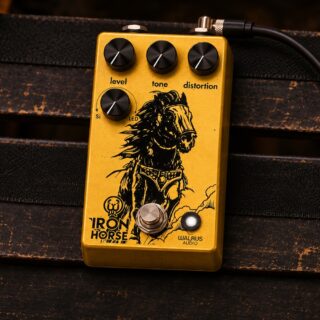
Cory Galusha (Drug Church) gives the Julia its most recent independent sighting. Premier Guitar‘s Rig Rundown, published 15 July 2026 and filmed at Nashville’s Basement East, lists his board as an Ernie Ball VP JR, a Shure GLXD16+, a PolyTune 3, a Boss NS-2, an Ibanez Tube Screamer, a Walrus Iron Horse, the Walrus Julia, an MXR Phase 90 and an Electro-Harmonix Freeze Nano, all fed by a Voodoo Lab Pedal Power 2 Plus. His guitar is a 1977 Gibson Les Paul Standard in tobacco burst, into a 1981 Marshall JCM800 and an Orange 4×12 loaded with Celestion Vintage 30s. That is a heavy post-hardcore rig with a lavender chorus pedal in the middle of it, ten years after launch, which tells you something about the range of contexts the pedal survives in.
Yvette Young (Covet) appears with a Julia on the board documented in Premier Guitar‘s Covet Rig Rundown — a natural fit for a player whose entire vocabulary is built on ringing, tapped, open-voiced clean tones where a chorus has room to breathe.
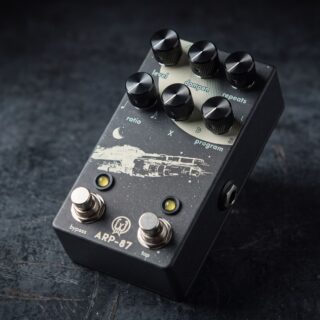
Mateus Asato shows a Julia on his board in his own filmed pedalboard walkthrough, at the 12:04 mark, sitting alongside a Walrus Slö reverb and a Walrus ARP-87 delay — a three-pedal Walrus front line. (One note of caution: at least one crowd-sourced database files Asato under “Silk Sonic,” which is not a band he has been a member of. He is a solo instrumentalist and session player. Treat band labels on aggregator sites as unreliable metadata even when the gear sighting itself is sound.)
Tier Two: Photo-Sourced, Credible, Less Formally Documented
A second group is documented through the artists’ own social posts rather than magazine features, which makes the sighting real but the context thin. Cory Wong has a Julia visible in a session pedalboard photo from his own Instagram. Russell Lissack of Bloc Party shows one on his board in an Instagram post from October 2019 — a sensible fit for a guitarist whose signature is high, chiming, heavily-effected clean lines. Anthony Gonzalez of M83 posted a photo of his Walrus pedals with the comment that they are “probably the best sounding pedals I’ve had in a long time.” Mark Lettieri (Snarky Puppy, The Fearless Flyers) has one visible in a board photo from November 2019. Ben McLeod of All Them Witches has discussed on camera using the Julia’s vibrato side for recording. Drew Shirley of Switchfoot has been photographed with one on his rig.
The Claim That Doesn’t Hold: No Burden
Equipboard’s album-usage section credits the Walrus Julia on two records: Four Year Strong’s Brain Pain (2020) and Lucy Dacus’s No Burden (2016). The first is chronologically fine. The second is not — and the person who debunks it is Dacus herself, in the very same interview that Equipboard cites as its evidence for her using the pedal. “On No Burden, I just had a tuner.” No Burden was released in February 2016, before the Julia was even in circulation, and Dacus’s own account of that record is that she was running effectively no pedals at all. This is a textbook example of a recurring failure mode on crowd-sourced gear databases: once an artist is associated with a piece of gear, the association gets back-propagated across their entire discography with no date check and no reading of the source. Always run the album’s release date against the pedal’s release date before repeating a credit like this.
And the Names That Are Not On This List
Chorus history belongs to a specific set of players — Andy Summers with the Police, Kurt Cobain and his Small Clone, Robert Smith, Johnny Marr, The Edge, Kevin Shields, Prince, John Frusciante. None of them are Julia users, and the pedal did not exist for most of the recordings that made them synonymous with the effect. They belong in this article as the reference points the Julia is measured against, not as endorsements. Anyone telling you otherwise is guessing.
Ten Settings Worth Stealing
Knob positions are given as clock face. Start with everything at noon and the wave switch on sine unless stated.
1. The Invisible Thickener
Rate 10 o’clock, Depth 9 o’clock, Lag 9 o’clock, D-C-V 9 o’clock, sine. Almost nothing is happening. Turn it off and you notice immediately. This is the setting that wins arguments with chorus sceptics and the one that works on bass.
2. Classic 1980s Clean Chorus
Rate 11 o’clock, Depth 1 o’clock, Lag 11 o’clock, D-C-V noon, triangle. The postcard-from-1983 sound, sitting closest to CE-2 territory. The triangle wave supplies the period-correct edge.
3. The Small Clone Impersonation
Rate noon, Depth 3 o’clock, Lag 10 o’clock, D-C-V noon, triangle. Fast, wide, unsubtle. Not a clone of a Small Clone, but it lands in the same postcode — which is precisely what Guitar.com heard.
4. Slow Ocean Drift
Rate 8 o’clock, Depth 2 o’clock, Lag 3 o’clock, D-C-V 1 o’clock, sine. Very slow, very wide, mostly wet. Hold a chord and let it move. This is the setting that earns the pedal its name.
5. Warped VHS Tape
Rate 9 o’clock, Depth 3 o’clock, Lag maximum, D-C-V 3 o’clock, triangle. Long lag plus deep modulation equals tape wow. Owners on Reddit describe exactly this as the pedal’s party trick, and it is the reason the Julia keeps turning up in bedroom-pop and shoegaze rigs.
6. Tight Flange-Adjacent Shimmer
Rate 1 o’clock, Depth 11 o’clock, Lag minimum, D-C-V 11 o’clock, sine. Minimum lag pulls the delay time so short the effect starts to bite like a mild Electric Mistress. Not a flanger, but a distinctly different animal from the pedal’s default voice.
7. True Vibrato for Chord Stabs
Rate 11 o’clock, Depth 11 o’clock, Lag 10 o’clock, D-C-V maximum, sine. Fully wet, no dry signal, moderate everything else. This is the setting Teranishi says won him over, and it is the setting most chorus pedals cannot produce at all.
8. Seasick Vibrato
Rate 10 o’clock, Depth maximum, Lag 2 o’clock, D-C-V maximum, triangle. Uncomfortable on purpose. Use it for eight bars, not eight minutes.
9. Chorus/Vibrato Hybrid — the Uncatalogued Zone
Rate noon, Depth 1 o’clock, Lag noon, D-C-V 2 o’clock, sine. More wet than dry but not fully wet. Pitch instability with just enough dry signal to keep the attack defined. This is the region the D-C-V knob exists for and the reason to own this pedal over a cheaper one.
10. Bass Guitar Animation
Rate 10 o’clock, Depth 10 o’clock, Lag 10 o’clock, D-C-V 10 o’clock, sine. Walrus explicitly recommends the sub-noon region of the D-C-V knob for bass, because keeping the dry signal dominant preserves the fundamental while the wet path adds movement above it.
How the Julia Compares
Against the Boss CE-2 and CE-2W
The CE-2 is the reference standard and the Julia does not replace it. Community consensus, gathered across several r/guitarpedals threads, is that the Julia gets close to CE-2 territory but comes out slightly less “fat,” and that the CE-2 wins on pure classic chorus tone. What the CE-2 cannot do is vibrato, blend, or lag. The CE-2W adds a CE-1 mode and a genuine chorus/vibrato option, which makes it the closest mainstream competitor — but it still gives you a mode switch where the Julia gives you a continuous sweep.
Against the Boss DC-2W Dimension C
Different job entirely. The DC-2W is a four-button preset machine designed to widen a stereo image without sounding like a chorus at all. If you want invisible, the DC-2W is more invisible. If you want a knob to turn, the Julia is the pedal.
Against the EHX Small Clone and Neo Clone
The Small Clone has one knob and one job, and it does that job with an aggression the Julia’s sine setting deliberately avoids. Owners are blunt about this: some prefer the Small Clone’s “direct, in-your-face” character, which the Julia genuinely cannot replicate. The Neo Clone and Nano Clone are the compact descendants. If you want one sound and want it loud, buy the EHX. If you want ten sounds, buy the Julia.
Against the Boss VB-2W Vibrato
The VB-2W is a dedicated vibrato with a rise-time control and an Unlatch mode, and its vibrato is deeper and more specialised than the Julia’s. But it is a vibrato pedal that does a little chorus, whereas the Julia is a chorus pedal that does real vibrato. Which one you want depends on which side of the blend you spend your time.
Against Budget and Mid-Price Analog Chorus
The MXR M234 Analog Chorus gives you bass and treble controls the Julia doesn’t have, at roughly half the price. The JHS 3 Series Chorus is cheaper still and unapologetically simple. The Analog Man Mini Chorus is the boutique CE-2-alike for people who want that specific voice and nothing else. The Boss CH-1 is the bright, hi-fi option. None of them have the Lag knob.
Against the Julianna
Walrus’s own Julianna Deluxe Chorus/Vibrato is the Julia scaled up: stereo in and out, tap tempo, additional LFO waveforms, and a preset. It is the right pedal if you run stereo or need tempo sync. It is the wrong pedal if you want the Julia’s specific four-knob immediacy on a board that is already too full.
The Uni-Vibe Question
Joe Gore’s Premier Guitar review made the point that chorus/vibrato switching is not a new idea — the Shin-Ei Vibra Chorus and the Uni-Vibe carried it in the 1960s, and guitarists largely ignored the vibrato side because it sounded, in his phrase, seasick and clubfooted. If it is genuine Uni-Vibe throb you want rather than BBD chorus, a Fulltone Déjà Vibe is a different circuit doing a different thing, and the Julia is not a substitute.
Where It Goes in the Chain
Conventional placement is after drive and before delay and reverb. In Cory Galusha’s Drug Church board the Julia sits after a Tube Screamer and a Walrus Iron Horse and before a Phase 90 and a Freeze — modulation in the middle, ambience last. Equipboard’s aggregated “used with” data across community setups puts the Julia most often alongside reverbs and delays, particularly the Walrus Fathom, the Strymon TimeLine, the EarthQuaker Devices Plumes, the Boss GE-7 and the Boss RC-1.
One practical caveat from the owner community: the Julia can behave awkwardly next to particularly input-sensitive pedals, and if you hear something odd, moving it a slot either way in the chain is the first thing to try. Running it into a loop pedal is a good stress test — a chorus that sounds lovely on a single pass can turn to soup on the fourth overdub.
Buying Guide: What to Pay and What to Look For
New
Walrus lists the V2 at $219.99 and, as of September 2026, was discounting it to $186.99 direct. UK launch pricing was £179. It is widely stocked, and there is no shortage of supply — this is a current-production pedal that has been in the catalogue continuously for a decade, which in boutique-pedal terms is close to permanent.
Used
Used V1 examples turn up from roughly $120, and this is where the value is. The V1 and V2 are sonically identical. You are paying the difference for top jacks, silent switching and the newer artwork. If your board has room and you don’t mind a click, the V1 is the smarter buy. Confirm the seller has the correct power supply situation understood — there is no battery compartment on either version, so a dead pedal at a gig means a dead cable or a dead supply, not a dead 9-volt.
Limited Editions
Walrus runs limited-edition Julias more aggressively than almost any other pedal in their line. Documented variants include Platinum, Coral, National Park Series, Craftsman Series (leather-wrapped), Black Friday, Floral, Retro, Neon and Reverb-exclusive runs, among many more. They are all the same circuit. Some carry a modest premium on the used market. None of them sound different, and anyone telling you a particular finish is tonally superior is selling something.
As of 2026 the standard catalogue offers the original lavender-and-surf-green artwork plus a blacked-out minimal colourway — worth knowing if you have been told the pedal only comes in purple.
Living With It: Ownership Notes
Two complaints come up repeatedly from owners, and both are worth knowing before you buy.
The LEDs are extremely bright. This is the single most consistent criticism in owner reviews. One reviewer’s advice is straightforwardly practical: “The lights are blinding bright though so tape over them if needed.” In a dark room the rate LED in particular will strobe in your peripheral vision. A strip of gaffer tape or a dab of nail varnish fixes it permanently. Onstage under lights it is a non-issue and arguably a benefit.
There is a volume bump on engagement. Several owners report a noticeable level increase when the pedal is switched on, particularly with high-output pickups. Because the Julia has no output or level control, you cannot compensate at the pedal. Options are to run it with the D-C-V lower, to place a level-trimming pedal or EQ after it, or simply to account for it in your playing. If you switch the Julia on for a clean interlude it is not a problem; if you switch it on mid-riff expecting unity gain, it will surprise you.
Power. Standard 9V DC centre-negative. Walrus recommends a supply capable of at least 100 mA, which any decent isolated brick delivers comfortably. No battery option on either version. No stereo, no expression jack, no MIDI — this is a deliberately single-purpose analog pedal, and everything the platform adds is in the Julianna instead.
Build and warranty. Made in Oklahoma City and covered by the Walrus limited lifetime warranty. Both Premier Guitar and Guitar.com singled out the build quality as excellent. The Premier Guitar teardown noted plastic jacks rather than metal, which is worth knowing but has not translated into any documented reliability pattern in ten years of circulation.
Frequently Asked Questions
Is the Walrus Audio Julia V2 fully analog?
Yes. The modulation is produced by a bucket-brigade delay chip — a new-production Coolaudio device with its own clocking chip, confirmed by Premier Guitar’s teardown of the original. There is no digital signal processing in the audio path. What is worth understanding is that the bypass switching on the V2 is soft-touch and relay-controlled rather than a mechanical switch, which is a separate matter from the audio circuit being analog.
What is the difference between the Julia V1 and V2?
Three things, none of them sonic: the V2 has top-mounted jacks instead of side jacks, clickless soft-touch bypass switching instead of a mechanical footswitch, and new artwork by Adam Forster with the Walrus logo recessed into the backplate. The Coolaudio BBD circuit, all four knobs and the wave switch are unchanged. A V1 and a V2 sound the same.
What does the Lag knob actually do?
It sets the centre delay time that the modulation oscillates around. Short lag gives tight, hi-fi, almost flanger-adjacent modulation. Long lag gives wide, blurry, detuned warble reminiscent of a warped tape. On a conventional chorus this value is fixed by the designer and you never get to touch it. It is the Julia’s defining feature.
Can the Julia do vibrato properly, or is it just chorus with the dry turned down?
Turning the dry signal down is vibrato — that is what vibrato is, the wet pitch-modulated path on its own. What matters is whether it sounds musical, and both Premier Guitar and multiple users say it does. Joe Gore specifically contrasted the Julia’s vibrato favourably against the “seasick bends and clubfooted modulation” of classic Uni-Vibe vibrato. Teppei Teranishi of Thrice says the vibrato side is the reason he kept the pedal.
Does it work on bass guitar?
Yes, and Walrus recommends it explicitly. The technique is to keep the D-C-V knob below noon so the dry signal stays dominant and the low fundamental is preserved, letting the wet path add movement above it. Owner reports of the pedal on bass are consistently positive on this point.
Is the Julia better than a Boss CE-2?
Different, and honest owners say the CE-2 wins on pure classic chorus tone — the general community verdict is that the Julia gets close but is slightly less fat. The Julia wins on everything else: real vibrato, a continuous blend, the Lag control, and a far wider tonal range. If you want one classic sound, get the CE-2 or a CE-2W. If you want a modulation instrument, get the Julia.
Why are the lights so bright?
Nobody outside Walrus knows, and it is the most consistent owner complaint about the pedal. The rate LED flashes in time with the modulation, which is genuinely useful onstage but distracting in a dark room. Tape over them. This is a known, universally-recommended workaround and it costs nothing.
Should I buy the Julia or the Julianna?
Buy the Julianna if you run stereo, need tap tempo, or want additional LFO waveforms and a preset. Buy the Julia if you want the same fundamental voice in a standard enclosure with four knobs and no menu. The Julianna is roughly $80 to $100 more and takes noticeably more board space.
Is the Julia still in production in 2026?
Yes. The V2 remains a current catalogue item on the Walrus Audio site as of September 2026, at $219.99 list, and is now offered in a blacked-out minimal colourway alongside the original lavender artwork. The original V1 is the version that Equipboard and other aggregators mark as vintage or discontinued — it was superseded by the V2 in 2020, not withdrawn.
The Verdict That Isn’t a Verdict
The Julia’s real achievement is not that it is the best-sounding chorus pedal ever made. It probably isn’t; the CE-2 has a fatness the Julia doesn’t quite reach, and the Small Clone has an aggression it deliberately declines. What the Julia did was notice that the chorus/vibrato toggle switch had been an unquestioned design convention for forty years, replace it with a knob, and discover a whole continent of sounds sitting in between that nobody had bothered to map.
Ten years later, that one decision is why the pedal is still in production, why it turns up on boards belonging to a Nashville indie songwriter, an Albany post-hardcore band, a Japanese-American math-rock virtuoso and a post-hardcore veteran who “actually never liked choruses ever.” The iceberg explanation for the 1999 recording is almost certainly correct. The pedal named after it is stranger and better than the science.
Image credits
- An orange overdrive pedal: Andrés Galeotti, Wikimedia Commons, CC BY 2.0.
- A Walrus Audio Julia chorus and vibrato pedal, close up: Guitar Chalk, Wikimedia Commons, CC BY 2.0.
- A Walrus Audio Julia chorus and vibrato pedal: Guitar Chalk, Wikimedia Commons, CC BY 2.0.
- Top image: GuitarGangsters AI-generated reference illustration, not a photograph.
- Walrus Audio Julia Analog Chorus/Vibrato V2: AI-generated illustration by GuitarGangsters, based on the manufacturer’s product design (not a photograph).
Latest News
Related
On This Day
Monday 9 November
From this week: