Strymon El Capistan dTape Echo V2: The Pedal That Made Digital Tape Believable
Strymon El Capistan dTape Echo V2 guide: the three tape machines explained, verified famous players, tone recipes, V1 vs V2, buying advice and FAQ.
There is a specific moment that happens the first time a guitarist plugs into a real tape echo. Not the first repeat — the third one. The one where the pitch sags a fraction, the top end has quietly walked out of the room, and the note that comes back is not quite the note that went in. Analogue delay smears. Digital delay copies. Tape degrades, and it degrades musically, and for roughly sixty years that degradation has been doing more compositional work in rock and roll than most people who use it realise.
The Strymon El Capistan dTape Echo arrived in November 2010 with an unfashionable proposition: that the way to get that degradation onto a pedalboard was not to build a smaller tape machine, and not to build an analogue bucket-brigade approximation of one, but to model the entire mechanical system in software — the motor, the capstan, the tape stock, the heads, the bias, the age of the oxide — and then hand the player knobs for the parts of it that matter. The name is a pun on San Juan Capistrano and the Spanish word for capstan. That tells you the company’s sense of humour. The pedal itself was entirely serious.
Sixteen years later, a second-generation version sits on boards from Ecuadorian-Swiss desert-noir duos to Smashing Pumpkins arenas, and the El Capistan has become one of the small number of pedals that other pedals are described in relation to. This is a gear guide, not a review. What follows is what the V2 actually is, what its three tape machines actually model, which famous players are actually documented using one.
The El Capistan has a first-party editorial paper trail. It has a band whose entire sonic identity changed the day one member bought one, on the record, in a Premier Guitar Rig Rundown, with a direct quote. It has a Smashing Pumpkins quote. It has a Khruangbin quote. The Famous Players section below tiers every name by evidence strength and says clearly where a documented user has since moved on to a different pedal — because a guide that claims a current endorsement for a rig that changed three years ago is worse than one that claims nothing.
Origins: Damage Control, Westlake Village, And A Capstan Joke
Strymon did not begin as Strymon. The company started in 2004 as Damage Control Engineering in Westlake Village, California, building tube-driven pedals, and rebranded under the Strymon name in 2009. The founding engineering team — Pete Celi, Gregg Stock and Dave Fruehling — came out of Line 6 and Alesis, which is to say they arrived at the pedal market from the DSP-research and studio-hardware side rather than the stompbox side. That lineage matters for the El Capistan more than for any other product in the catalogue, because the El Capistan is not a delay algorithm with some wobble bolted on. It is a physical model.
Strymon calls the underlying technology dTape, and the design brief behind it was to reproduce the two dominant architectures of vintage tape echo rather than one specific box. On one side sit the fixed-head, variable-speed machines: the Roland RE-201 Space Echo, the Watkins Copicat, the Meazzi and Binson-adjacent Italian designs. On those, delay time changes because the tape moves faster or slower, which means every time you turn the Time knob the pitch of the existing repeats slides with it. On the other side sit the moving-head machines, principally the Maestro Echoplex, where the tape runs at a constant speed and the record head slides along a rail. On those, changing delay time moves the head, and the repeats already in the loop keep their pitch.
Almost every delay pedal ever built ignores this distinction. The El Capistan is organised around it.
The Three Machines
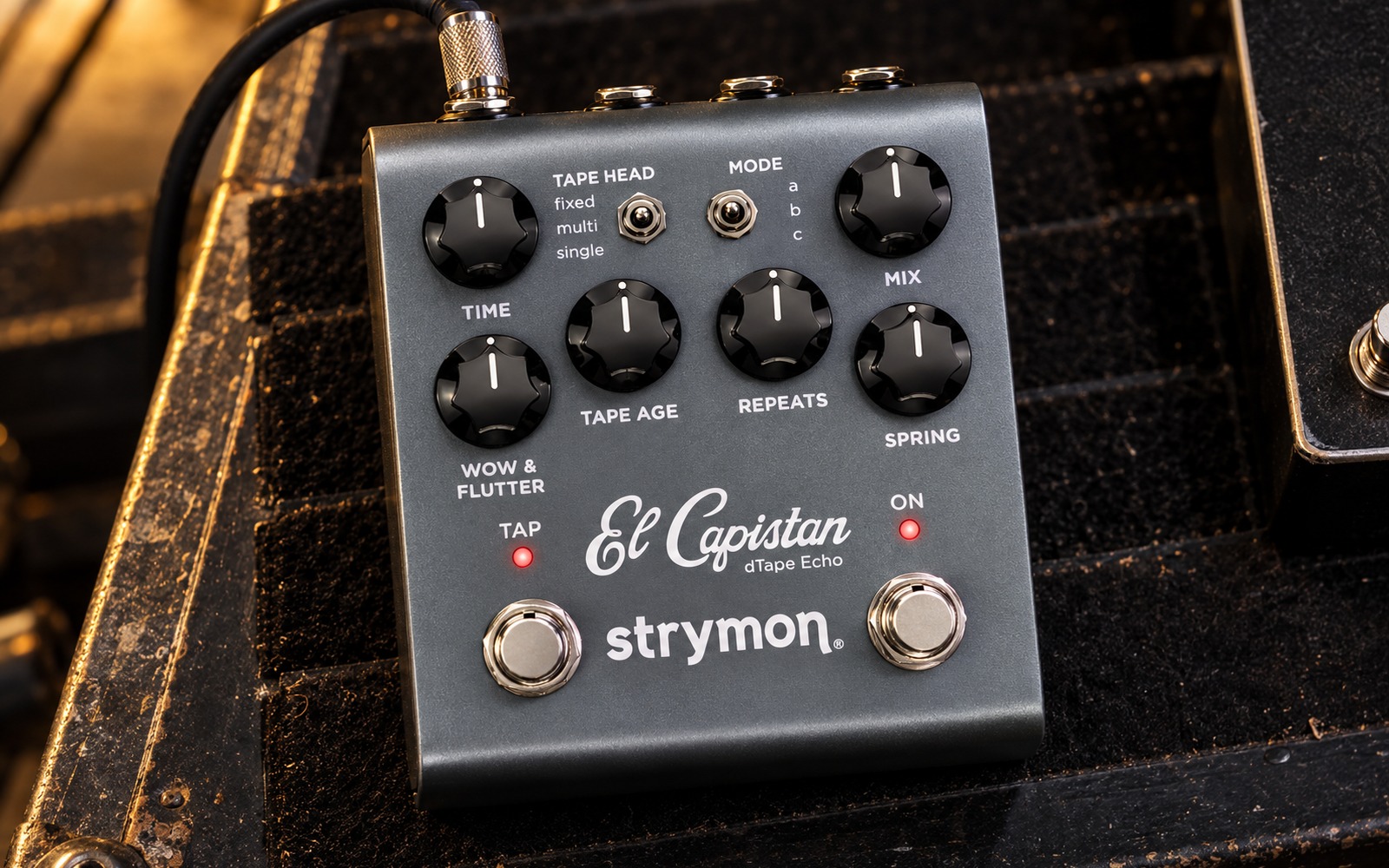
A single three-position Tape Head switch selects which kind of machine you are standing in front of. Each machine has three modes, accessed by the Mode switch, so the pedal contains nine core behaviours before you touch a single tone control.
Fixed — One Head, Variable Speed
The single-playback-head, variable-speed architecture. This is the Space Echo’s most common configuration and the sound most players mean when they say “tape slapback.” The Time knob physically changes the modelled tape speed, so sweeping it while repeats are ringing produces the tape-warp pitch dive that no bucket-brigade pedal quite gets right and no digital delay gets right at all. The three modes vary the tape speed range and character.
Multi — Two Heads, Variable Speed
The multi-head configuration, where two playback heads produce rhythmically interlocked repeats from a single input. This is the Space Echo’s more exotic territory — the mode selections give you different head combinations, which is how you get dotted-eighth-plus-quarter patterns without a tap-division menu. It is also, in practice, the mode most likely to make a simple chord progression sound like a film score.
Single — Sliding Record Head, Fixed Speed
The Echoplex model. The tape runs at a fixed speed; the Time knob moves the record head’s position. The pitch of existing repeats stays put when you adjust time, which makes this the mode to use if you want to change delay length mid-song without the tape-warp effect. Single mode also carries the pedal’s Sound On Sound looper — up to roughly twenty seconds of tape-style layering, with the older layers degrading as new ones are stacked, exactly as they would on a real machine running its own output back to its own input.
The Controls That Do The Real Work
Six knobs sit on the face: Time, Mix, Repeats, Wow & Flutter, Tape Age and Spring. Three of those are the ones that separate the El Capistan from every generic “tape delay” mode on a multi-effects unit.
Wow & Flutter is the machine-health control. It governs the amount of mechanically-related tape speed fluctuation — wow being the slow drift of a worn motor or an eccentric capstan, flutter being the fast irregularity of a tape path that needs servicing. At minimum you have a machine fresh from the technician. Past two o’clock you have a machine that should have been retired, and past three you have something closer to a broken chorus pedal than a delay.
Tape Age controls the bandwidth of the modelled tape, exactly as oxide shedding and print-through would narrow it over a machine’s service life. Counterclockwise is fresh, full-range, almost hi-fi. Clockwise is dark, gnarled and vibey — the repeats lose their top end faster with each pass, which is the single most important reason tape echo sits behind a guitar part instead of competing with it.
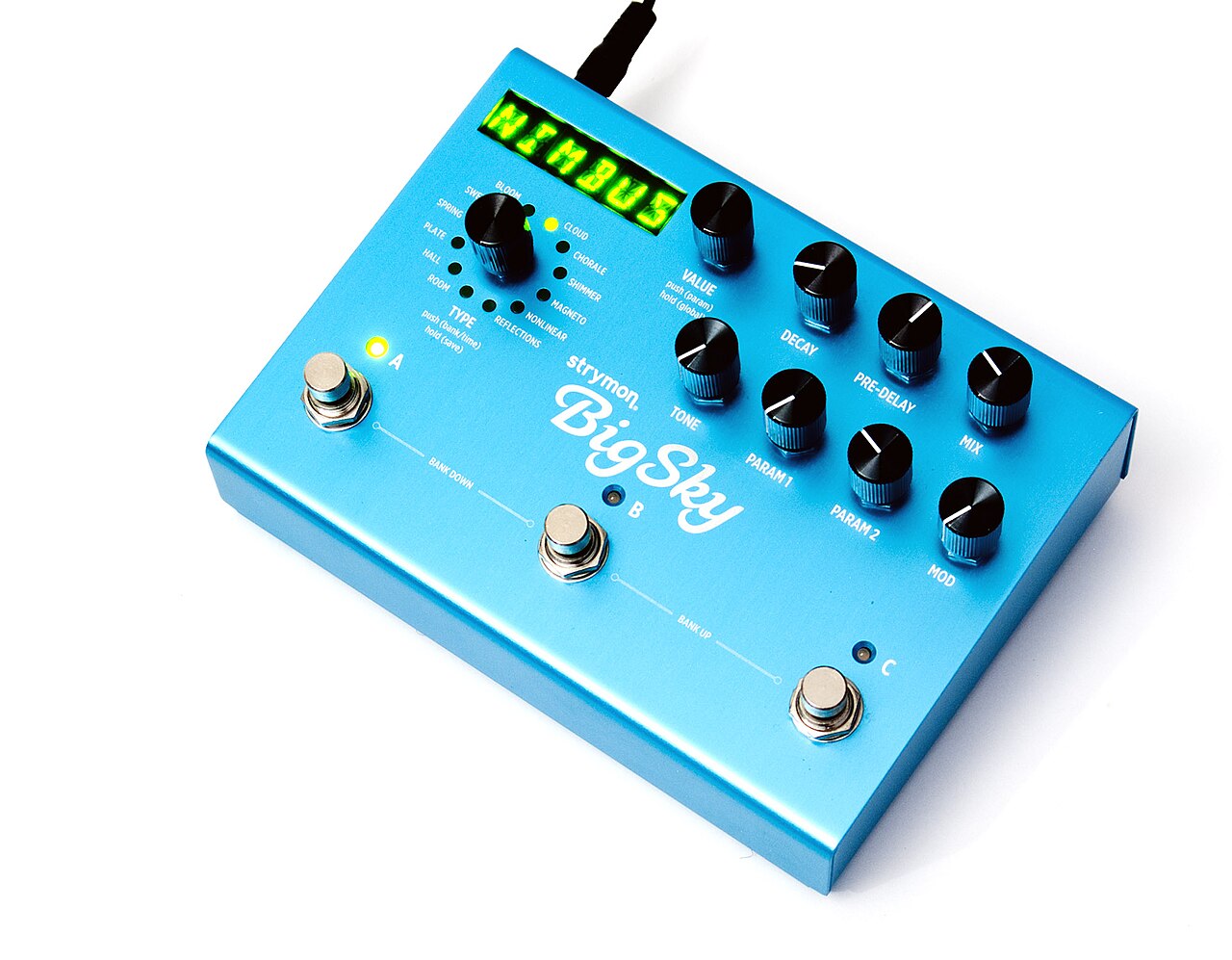
Spring is new to the second generation, and it is the addition that most changed how the pedal behaves in a real rig. Many classic tape echo units — the RE-201 among them — had a small spring reverb tank built into the same chassis, deliberately limited in bandwidth. Strymon modelled that character rather than porting a full-range reverb across from the BigSky. It adds space without touching the level of either the dry or the echo signal, which means you can use it as a permanent background wash and still bypass the delay.
The Live Edit Layer
Holding a footswitch and turning a knob reaches a second tier of parameters. Tape Crinkle introduces dropouts and physical damage to the modelled tape. Tape Bias adjusts the record-head bias, which on a real machine is the difference between clean saturation and compressed, distorted repeats. Low End Contour shapes the bass content of the repeats, which is the practical fix for a delay that clutters a band mix. And a +/-3 dB Boost/Cut lets you level-match the engaged pedal against bypass — a small feature that solves a real problem on stage.
Specifications
What The Second Generation Actually Changed
Strymon’s own framing is instructive: the V2 “keeps the same rich magnetic tape echo tones from our original.” The core dTape algorithms were not rewritten. What changed sits around them.
The input stage is now a premium analogue JFET circuit, and reviewers consistently report that this is audible rather than a spec-sheet flourish — Guitar.com attributed a new “clarity and sensitivity” to some combination of the JFET front end and the more powerful processor. Guitar World’s verdict on the V2 pair was that El Capistan “still delivers some of the best and most realistic tape echo effects available.”
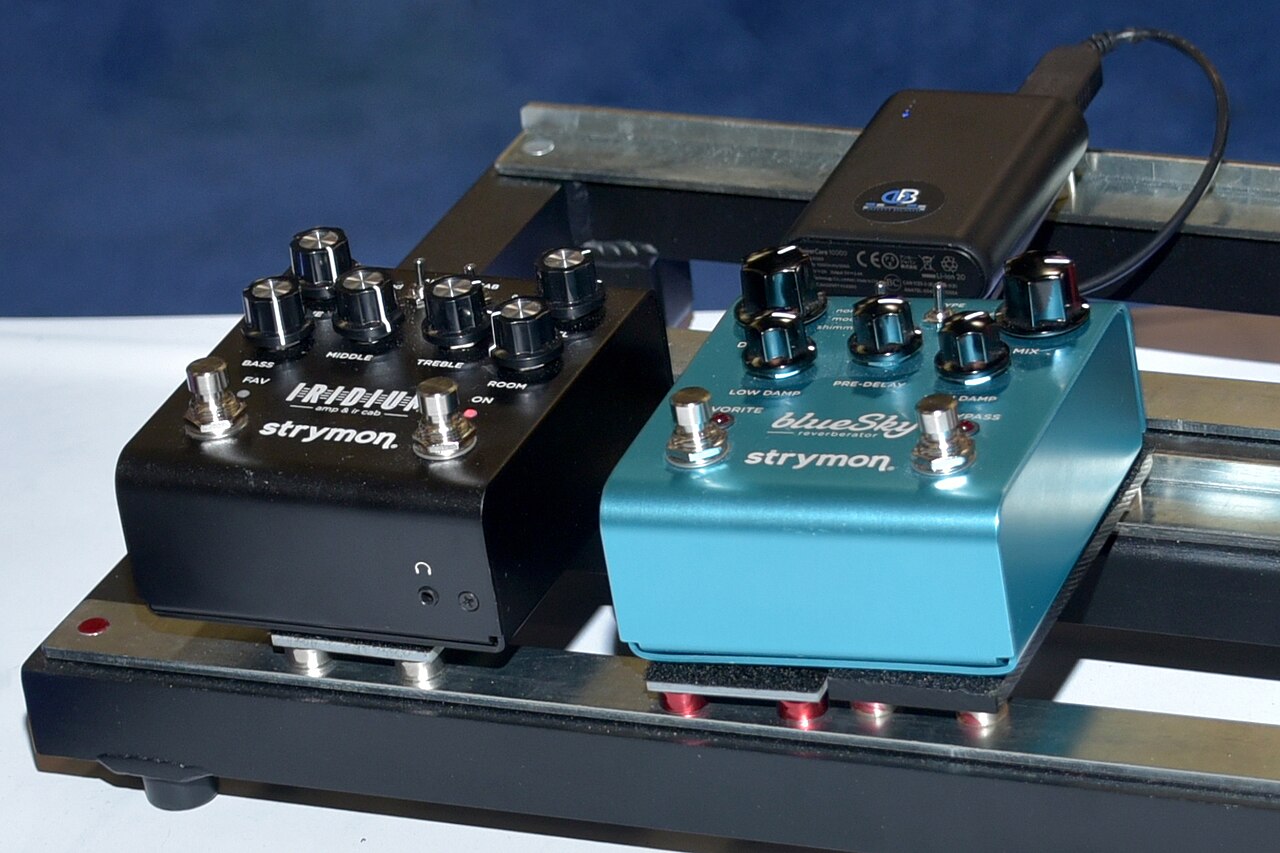
The functional additions are the ones that change how the pedal fits a modern board: 300 preset slots where the V1 had none, full MIDI over a jack or USB-C, MIDI Clock Sync stored per preset, selectable mono or stereo input, selectable true or buffered bypass, instrument/line level switching, and the spring reverb. The ARM processor also draws less current than the V1’s DSP, which matters if you are running a crowded board off a Strymon Iridium and a fistful of other digital boxes on one supply.
What did not change is as telling. There is no fourth machine type. There is no reverse mode, no shimmer, no granular anything. Given a full redesign and a decade of headroom, Strymon added connectivity and left the sound alone.
Famous Players: What The Evidence Actually Supports
Tiered by source strength. Tier 1 means editorial or first-party documentation with attribution. Tier 2 means crowd-sourced logging on Equipboard or comparable, which is useful for breadth and unreliable for currency.
Tier 1: Hermanos Gutiérrez — The Band The Pedal Built
If the El Capistan has a defining artist association, this is it, and it is documented in unusual detail. In their August 2023 Premier Guitar Rig Rundown, the Ecuadorian-Swiss brothers Estevan and Alejandro Gutiérrez both run El Capistans, and Estevan describes buying his as the moment their sound was fixed. He told PG he remembered the day he first played one — that he fell in love, and knew immediately it was going to change something in their sound. He then phoned his brother and told him he had to buy one too, because it was going to be “next level.”
The detail that makes this more than an endorsement anecdote is how differently the two of them use the same pedal. Alejandro described his approach to PG as a layer — “really subtle” — while Estevan uses it more overtly as a delay, generating what Alejandro calls a galloping horse sound out of his own right-hand attack interacting with the repeats. Two identical boxes, two entirely different jobs, on the same stage. Both brothers also run a Strymon Flint and an MXR Dyna Comp Mini, and Estevan adds a Malekko Omicron Vibrato and a Boss RC-500 Loop Station; Alejandro’s board carries a Boss GE-7 Equalizer. The band played without pedals at all before the El Capistan entered the picture.
Worth noting for anyone chasing that record: El Bueno Y El Malo was cut at Easy Eye Sound with Dan Auerbach producing, with Estevan running into a vintage Magnatone for the entire tracking process and Alejandro into a mid-sixties Fender Deluxe Reverb borrowed from the studio. The El Capistan is doing the spatial work on top of amps that already had character.
Tier 1: Billy Corgan
Billy Corgan confirmed an El Capistan on his Smashing Pumpkins board in his Premier Guitar Rig Rundown, describing it as a really great delay, almost like a sixties tape delay, used for a few specific things. That framing is worth taking at face value: a utility voice on a large board rather than a signature sound, sitting alongside a Skreddy Echo, two MXR Phase 90s, a Fulltone Catalyst used as a preamp, a Chicago Iron Octavian and a Boss PS-2.
Tier 1, With A Correction: Mark Speer (Khruangbin)
Mark Speer described his live delay rig in a Premier Guitar Rig Rundown as an El Capistan with an expression pedal patched into the back — expression control over Time being one of the most expressive things you can do with this pedal, and a very Khruangbin choice. However, this is no longer current. Board photography from 2024 shows the El Capistan replaced by a Strymon TimeLine. Any guide telling you Speer is a current El Capistan user is working from stale information; the historical usage is real, the present-tense claim is not.
Tier 2: Crowd-Sourced Logging
Equipboard’s entries for the El Capistan carry a long list of professional users, including Nels Cline — whose Wilco board was photographed with one by Jay Blakesberg in 2017 — plus Noel Gallagher, Joe Satriani, Jeff Beck, Chris Shiflett, Wes Borland, Justin Vernon of Bon Iver, Joe Perry, Devin Townsend and the electronic producer Four Tet. Treat these as indicative of the pedal’s reach rather than as verified rig facts; none carries the first-party confirmation that the Hermanos Gutiérrez, Corgan and Speer entries do.
Two more editorial data points deserve a mention because they come from Premier Guitar rather than crowd submissions. Phil Jamieson of the post-rock band Caspian told PG that the sonic signature of the 2015 album Dust and Disquiet could be traced to one pedal for his parts — the El Capistan, on what he described as a no-delay, slight-warble setting. That is the El Capistan used as a saturation-and-instability box rather than as a delay at all, and it is one of the most instructive things anyone has said about the pedal. Zach Person’s board in his PG Rundown carries a V2.
Tone Recipes
Desert Noir Layer — the Alejandro Gutiérrez approach
Tape Head: Fixed. Mode: 2. Time: 10 o’clock. Repeats: 9 o’clock. Mix: 9 o’clock. Tape Age: 2 o’clock. Wow & Flutter: 11 o’clock. Spring: 11 o’clock. The point here is that you should not be able to identify a delay. You should only notice its absence when you switch it off. Fingerstyle on a hollowbody, and the repeats function as room rather than rhythm.
Galloping Slapback — the Estevan approach
Tape Head: Fixed. Mode: 1. Time: 8 o’clock (roughly 100 ms). Repeats: 10 o’clock. Mix: 11 o’clock. Tape Age: 1 o’clock. Wow & Flutter: 9 o’clock. Spring: 9 o’clock. Then play with a hard palm-muted attack. The rhythm comes from your right hand hitting against the single short repeat; the pedal is a metronome you are fighting with.
Broken Machine
Tape Head: Fixed. Mode: 3. Time: 12 o’clock. Repeats: 1 o’clock. Mix: 12 o’clock. Tape Age: fully clockwise. Wow & Flutter: 3 o’clock. Tape Crinkle (Live Edit): 2 o’clock. This is a machine that should be in a skip. Sustained chords disintegrate into detuned sludge over four or five repeats. Excellent under a clean arpeggio, unusable under distortion.
Echoplex Lead
Tape Head: Single. Mode: 2. Time: to taste — remember the pitch will not slide. Repeats: 11 o’clock. Mix: 10 o’clock. Tape Age: 12 o’clock. Wow & Flutter: 10 o’clock. Boost/Cut (Live Edit): +2 dB. The classic sixties lead-guitar echo, with a small level lift so the pedal doubles as a solo boost.
Multi-Head Film Score
Tape Head: Multi. Mode: 3. Time: 1 o’clock. Repeats: 12 o’clock. Mix: 12 o’clock. Tape Age: 1 o’clock. Wow & Flutter: 12 o’clock. Spring: 2 o’clock. Play one note every two bars and let the two heads build the rest. Stereo outputs strongly recommended here — this is the setting that most rewards the V2’s stereo path.
Warble, No Delay — the Caspian setting
Tape Head: Fixed. Mode: 1. Time: fully counterclockwise. Repeats: fully counterclockwise. Mix: 1 o’clock. Tape Age: 2 o’clock. Wow & Flutter: 1 o’clock. Tape Bias (Live Edit): 2 o’clock. There is no audible echo. What you get is a saturated, pitch-unstable version of your dry signal — a tape-machine tone colour rather than a delay. Enormous under a wall of tremolo-picked chords.
Ambient Sound-On-Sound Bed
Tape Head: Single. Mode: 3 (SOS). Mix: 12 o’clock. Repeats governs how quickly earlier layers decay — start at 2 o’clock. Tape Age: 1 o’clock. Spring: 1 o’clock. Lay down a chord, add a second, add a third, and let the oldest one dissolve. This is not a looper for songs; it is a looper for weather.
All settings are clock positions and starting points, not gospel. Amp assumed clean to edge-of-breakup unless stated.
Where It Goes In The Chain
Standard placement is late — after drive and modulation, before or in place of a dedicated reverb. Because the V2’s spring reverb sits after the delay in the internal path, an El Capistan can be the entire back end of a small board.
Two placements are worth experimenting with. First, in front of a dirt pedal rather than after it: tape echo into overdrive gives you repeats that are themselves distorted and compressed, which is closer to how a Space Echo behaves when it is driving the front of a cranked amp. Second, in an amp’s effects loop with the bypass set to buffered and the level switch set to line, which is the cleanest way to run it alongside a high-gain preamp.
If you are running true bypass across the whole board, note that switching the El Capistan out kills its repeat tails. Buffered bypass allows trails to decay naturally. On this pedal, that setting is worth more thought than it is on most.
How It Compares
Against the Strymon TimeLine: the TimeLine is a twelve-machine delay workstation with a looper, presets and a display. The El Capistan is one machine type explored in depth. If you need dBucket, digital, reverse, filter and pattern delays, the TimeLine is the correct pedal and its tape mode is good. If tape is what you actually want, El Capistan is deeper on the thing you want and half the board space.
Against the Boss RE-202 Space Echo and RE-2: the Boss units model one specific machine, the RE-201, with a virtual head-selector and its own spring tank, and they do it faithfully and enjoyably. The El Capistan covers both fixed-head and moving-head architectures and gives you deeper control over tape condition. The RE-202 is arguably more fun to operate; the El Capistan is more controllable.
Against the EHX Deluxe Memory Man and MXR Carbon Copy: these are genuinely analogue bucket-brigade delays and they degrade in their own characteristic way — darker with each repeat, but smoothly, without the mechanical instability of a tape transport. Analogue delay does not wow and flutter. If the wobble is the point, no BBD pedal will substitute. The Boss DM-2W and Maxon AD999 sit in the same category.
Against the Strymon EC-1: the EC-1 is the El Capistan’s Single mode extracted into a compact enclosure at $279, with Time, Repeats, Mix, Tape Age, Rec Level and a Mechanics control. If you only ever use Single mode and want the board space, it is the smarter purchase. You lose Fixed, Multi, the spring reverb and the sound-on-sound looper.
Against the Walrus Audio ARP-87, JHS 3 Series Delay and EHX Canyon: all three cost a fraction of the El Capistan and all three include a usable tape voice. The honest comparison is that they give you a good tape flavour; the El Capistan gives you a tape machine whose condition you can adjust. Whether that difference is worth $250 depends entirely on whether tape echo is a colour in your playing or the foundation of it.
Against the Line 6 DL4 and Boss DD-500: different category. Those are multi-algorithm platforms bought for breadth and looping. The El Capistan is bought for one sound done better than anyone else does it. Plenty of boards carry both.
Buying Guide
Buy the V2 new ($379) if you need presets, MIDI, stereo, or the spring reverb, or if you are building a board that will be MIDI-controlled. The preset count alone changes the pedal from a set-and-forget box into something that can hold a different machine type per song.
Buy a V1 used (roughly $230–260) if you play with your hands on the knobs, run mono, and do not need recall. The core tape algorithms are the same. What you give up is the JFET front end, stereo, presets, MIDI, bypass selection and the spring reverb. That is a substantial feature gap, and the used price has not fallen far enough to make it an obvious bargain — check current listings carefully rather than assuming.
Buy the EC-1 ($279) if you have tried both and found you only ever use Single mode, and board real estate is your binding constraint.
Buy something cheaper if you want tape colour rather than tape behaviour. Nobody should feel obliged to spend $379 to get warm repeats. The TC Electronic Flashback 2 and the Boss DD-3 route are perfectly respectable, and the money is better spent on an amp.
Ownership Notes
Power is not optional and batteries are not supported. The El Capistan needs 9V DC centre-negative at a minimum of 300 mA, and it will not run on anything less. A daisy chain shared with three analogue pedals will introduce noise; give it an isolated output. No supply is included in the box.
Set the bypass before you set anything else. True bypass cuts repeat tails dead when you disengage. Buffered bypass lets them ring out. On a delay this is a musical decision, not a technical one, and it is worth making deliberately.
The stereo input requires a TRS adapter cable. The rear switch selects mono or stereo input; the output is stereo either way. Running Out L alone gives you mono. If you are only ever going to one amp, ignore the stereo path entirely — but be aware that Multi mode loses a great deal in mono.
USB-C is for MIDI and firmware. Strymon has shipped firmware updates for the second-generation line, and the USB port makes updating trivial compared to the V1 era. Check for updates when the pedal arrives.
Expression control is the underused feature. A standard TRS expression pedal gives continuous control over any knob. Assigned to Time in Fixed mode, it turns the tape-warp pitch dive into a performable gesture. Assigned to Mix, it becomes a delay swell pedal. Strymon’s MultiSwitch Plus, MiniSwitch and Conduit all interoperate through the same jack.
Preset organisation matters more than it looks. Three hundred slots sounds generous until you realise that machine type, mode, all six knobs, every Live Edit parameter and the MIDI Clock Sync setting are stored per preset. Build a small library of eight to twelve and label them by function, not by machine type.
Frequently Asked Questions
Is the El Capistan V2 worth upgrading to from a V1?
The core tape sound is the same by Strymon’s own account, so the upgrade case rests entirely on features: presets, full MIDI, stereo I/O, selectable bypass, the JFET input stage and the spring reverb. If you play in mono with your hands on the knobs, the V1 remains a completely current-sounding pedal. If your board is MIDI-controlled or you play in stereo, the V2 is a different proposition.
Which machine type should I start with?
Fixed, mode 1, with Tape Age around one o’clock. That is the sound most people are picturing when they say tape echo, and it is the setting that will tell you fastest whether this pedal is for you. Move to Single when you want to change delay time without pitch artefacts, and to Multi when you want rhythm rather than repeats.
Does it do a proper Space Echo?
Fixed and Multi modes are built around the fixed-head, variable-speed architecture that the Roland RE-201 uses, and with Tape Age and Wow & Flutter set high the family resemblance is unmistakable. It is not a one-to-one model of a specific RE-201 the way the Boss RE-202 is — it models the machine class rather than the machine.
Can the El Capistan replace a reverb pedal?
For a limited, vintage-flavoured spring sound, yes — the V2’s Spring control is a genuinely good bandwidth-limited tank emulation and it is independent of the dry and echo levels. It will not replace a BigSky or a hall reverb. Think of it as the tank that would have been bolted inside the tape machine, because that is exactly what it is modelled on.
How good is the sound-on-sound looper?
It is roughly twenty seconds, it lives in Single mode, and it degrades older layers as new ones are added — which is the point. It is an ambient texture tool, not a song-structure looper. If you need verse-chorus looping, run a dedicated unit such as the Boss RC-500.
Does it run on a battery?
No. It requires a 9V DC centre-negative supply of at least 300 mA. No pedal in this DSP class runs sensibly on a nine-volt battery, and Strymon does not provide the option.
Is there noticeable latency or tone loss when bypassed?
With buffered bypass the JFET input stage is in circuit and the dry path is analogue-buffered; with true bypass the signal passes the electronics entirely. Neither introduces the kind of delay-line latency associated with older digital units. The practical difference is tail behaviour, not tone.
Why is it called El Capistan?
It is a pun. The capstan is the rotating spindle that pulls tape past the heads at a controlled speed — the component whose imperfection produces most of what we hear as tape wow. San Juan Capistrano is a Californian mission town not far from Strymon’s original Westlake Village base. The pedal is named after the part that goes wrong.
The Verdict That Isn’t A Review
The El Capistan’s achievement is that it took a category defined by nostalgia and treated it as an engineering problem. Everybody in 2010 knew what tape echo was supposed to sound like. Very few products had asked why — why the pitch sags, why the top end vanishes, why turning the time knob on one machine warps the repeats and on another does not. Strymon answered those questions in software and then, crucially, exposed the answers as knobs a guitarist can turn mid-song.
Sixteen years on it is still in production, still $379, still the reference point in its category, and it is still doing the thing that the Gutiérrez brothers described: taking a band that played without pedals and giving them a sound. That is a rare thing for a delay pedal, and it has almost nothing to do with the spec sheet.
Image credits
- Top image: GuitarGangsters AI-generated reference illustration, not a photograph.
- An orange overdrive pedal: Andrés Galeotti, Wikimedia Commons, CC BY 2.0.
- A Strymon BigSky pedal: Ashley Pomeroy, Wikimedia Commons, CC BY-SA 4.0.
- Strymon effects pedals on a pedalboard: Toglenn, Wikimedia Commons, CC BY-SA 4.0.
Latest News
Related
On This Day
Monday 9 November
From this week: