Death By Audio Rooms: The Reverb Oliver Ackermann Built For Himself
The Death By Audio Rooms is a stereo six-algorithm reverb built around one man's obsession. History, specs, verified players, settings and FAQ.
Most reverb pedals are designed to solve a problem. Somebody at a company notices there is a gap in the market between a spring emulation and a shimmer, someone else costs out a DSP chip, and eighteen months later there is a box on a shelf with eight presets and a Bluetooth app. The Death By Audio Rooms did not come from that process. It came from a man who had bought every reverb he could find, been disappointed by all of them, and decided the only remaining option was to build the one he actually wanted to stand behind on a stage.
“I use reverb on everything and have tried every pedal and processor under the sun,” Oliver Ackermann told Guitar Player‘s Dave Hunter in February 2021, “always searching for the perfect reverb sound and the way to control it. We designed Rooms to satisfy every wish and desire I wanted in a touring reverb pedal.” That is not marketing language dressed up as a quote. It is a fairly literal description of the design brief, and it explains almost everything odd about the finished product — why the time knob is enormous, why there are no presets at all, why the dry and wet levels get their own dedicated controls with twenty times gain on tap, and why one of the six algorithms is called GONG and sounds like a sitar falling down a lift shaft.
Rooms is the pedal Death By Audio made when they decided to compete with the grown-ups. It is stereo, it is digitally programmed in-house, it costs $395, and it is the closest thing the Brooklyn-then-Ridgewood noise factory has ever made to a studio device. It is also, unmistakably, a Death By Audio pedal — because at least two of its six modes are not really reverbs at all.
Where Rooms Came From
Death By Audio was founded in 2002 by Oliver Ackermann, guitarist and singer of the New York noise band A Place To Bury Strangers, initially as a web-based service that modified other people’s effects. The company grew out of a Williamsburg factory that doubled as one of New York’s most important DIY venues until the venue closed in 2014; the workshop now operates out of 18-71 Greene Ave in Ridgewood, Queens. The house style is well established by now — oversized enclosures, sliders and dip switches instead of menus, “medical-grade IC chips, obsolete transistors, and military surplus electronics,” and a lifetime warranty summarised as “if you can possibly break it, we will fix it.”
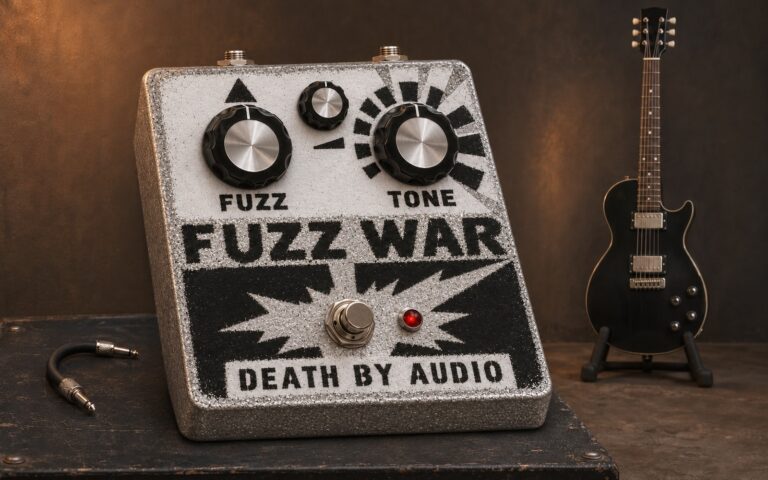
The catalogue that style produced is mostly analog and mostly deranged: the Fuzz War, the Echo Dream 2, the Reverberation Machine, the Interstellar Overdriver. Rooms is the outlier. It was revealed at Winter NAMM in January 2020, with pre-orders opening on 30 January 2020 and units shipping in the spring. The press material described it as “the finely tuned and infinitely tweakable result of Death By Audio founder Oliver Ackermann’s lifelong obsession with reverb effects units,” which for once is a claim the product backs up.
One detail from that launch has been quietly under-reported ever since. The output mixer — the section that gives Rooms its independent DRY and FX controls — was designed in collaboration with Electronic Audio Experiments, the boutique builder run by John Snyder. DBA’s own press copy said it “provides pristine, studio-quality control of the wet and dry signals from -inf to 20x gain.” That is worth sitting with for a moment: a company famous for chaos outsourced the one part of the circuit that needed to be clean. It is the single clearest signal that Rooms was built with different intentions from everything around it in the catalogue.
The press reaction confirmed it. Premier Guitar‘s Charles Saufley reviewed it on 11 October 2020 and gave it a 2020 Gear Award, opening with the observation that most modern digital reverbs sound alike “even in their spaciest incarnations,” and closing with the line that has followed the pedal ever since: “If you can’t have fun with Rooms, you might just be a zombie.” Tape Op’s Larry Crane reviewed it in issue #140 (Nov/Dec 2020) and got so distracted mid-review that he recorded a thirteen-minute Neu!-inspired track instead of finishing the copy. His verdict was blunt: “I won’t let the Rooms pedal return to Death By Audio.”
Specifications
| Model | Death By Audio Rooms Stereo Reverberator |
|---|---|
| Type | Stereo, multi-function digital reverb, six algorithms |
| Announced | Winter NAMM, January 2020; pre-orders 30 January 2020; shipped Spring 2020 |
| Price | $395 direct (unchanged from launch to 2026) |
| Algorithms | ROOM, DIGIT, PEAK, GATE, WAVE, GONG |
| Main controls | FREQ, DEPTH, TIME, mode rotary selector |
| ALT controls | F, D, T mini-knobs (second full set, engaged by the ALT footswitch) |
| Mixer | DRY and FX, each -inf to +20 dB (20x gain), designed with Electronic Audio Experiments |
| Footswitches | Bypass, ALT |
| I/O | Stereo in, stereo out, TRS expression/CV in, 9 V DC |
| Expression | TRS expression pedal or 0–3.3 V CV; controls TIME or FREQ via side-mounted “F ↔ T” slider; active in ALT mode only |
| Power | 9 V DC, 2.1 mm centre negative, 80 mA |
| Dimensions | 5.95″ x 3.86″ x 2.96″ including hardware (5.5″ x 3.65″ x 1.9″ excluding feet and knobs) |
| Weight | 13 oz per current DBA spec; 18 oz per the 2020 launch documentation |
| Presets | None, other than the ALT setting |
| Bypass | Buffered, with trails |
| Built | Assembled in USA |
Two of those rows deserve a note, because they are the kind of discrepancy that trips up people shopping second-hand. The weight figure has changed: DBA’s 2020 launch spec sheet said 18 oz and the current product page says 13 oz. Nobody has explained the difference and it is not worth losing sleep over, but if a listing quotes one figure and the pedal arrives matching the other, that is not a fake. The dimensions differ between sources for a much more boring reason — Death By Audio measure including hardware, Guitar Player measured excluding feet and knobs. Both are correct. Plan your pedalboard around the larger number.
The Six Algorithms, One At A Time
The mode selector is a big, obvious rotary knob, and it does the single most important job on the pedal, because the FREQ and DEPTH knobs mean something completely different in every mode. This is the thing to internalise before anything else. There is no master parameter map; there are six of them.
1 — ROOM
The straight one. A classic reverb that, in DBA’s own words, “simulates many different rooms.” FREQ sets the tone of the decay; DEPTH sets the pre-delay of the right side only, which is the mechanism by which ROOM generates its stereo width. Saufley found it “capable of subtle and cosmic-scale sounds that are well suited to volume swells.” Crane went further and called it the biggest surf guitar sound he had ever heard, then used it on vocals in a mix and had the client assume he had some exotic plug-in chain. If you are only going to use one mode, this is the one that justifies the price on its own.
2 — DIGIT
Officially “a delay and verb capable of creating otherworldly resonances and fractured repeats,” though the 2020 press release called it a “filter matrix verb” and the phrase has stuck in retailer copy ever since. FREQ becomes delay time; DEPTH becomes delay feedback. Crane’s description is the most useful one anybody has written: “a later ’80s vibe; think of David Gilmour‘s tone from that era — colder and sleek, with some spiralling modulation sounds that seem to pop out when hit harder.” Hunter at Guitar Player reckoned DIGIT was the most straightforward mode when used judiciously, and capable of extremes when pushed. Both are true, and that duality is the mode’s whole appeal.
3 — PEAK
“A super intense bandpass filter combined with an ambient reverb.” FREQ is filter frequency, DEPTH is filter resonance. This was Crane’s favourite setting to work from, and Saufley’s rave is worth quoting because it identifies the specific trend PEAK is a reaction against: it “is awesome — particularly if you’ve wearied of high-octave-emphasized ‘choral’ verbs.” Roll the filter down instead of up, and PEAK emphasises heavy low-frequency reverberation. Feed it a detuned guitar and, per PG, you get “massive, ominous, deep-Earth tones.” Nothing else in the pedal reverb market does this specific thing, and it is the mode that most justifies the “not just another verb” pitch.
4 — GATE
A gated reverb, and a considerably more useful one than the word suggests. Short reverb times give you the classic eighties gate; long reverb times give you a controllable freeze effect, which is the part people miss. FREQ is decay tone, DEPTH is gate response time. Crane, who lived through the era the first time, admitted he “wept for a little bit at first,” then put it on drum tracks and got a range of sounds that “did not remind me of Phil Collins.” Saufley’s framing is the practical one: GATE gives you the attack and drama of splashy ambience without burying the rest of the band under trails.
5 — WAVE
A pitch vibrato effect with reverb attached. FREQ is modulation speed, DEPTH is modulation depth — and crucially, lowering TIME blends the reverb signal out, so the mode sweeps continuously from a dry chorus/vibrato at one end to a long modulated reverb at the other. That single design decision turns WAVE into two effects in one position on the selector. Saufley found dry, in-your-face eighties Brit-chorus in it — he named the Cure and New Order specifically — as well as high-speed vibrato at the other extreme. Crane, characteristically, got a single vocal to build chordal layers and described the warped oscillation settings as “pure Hawkwind.”
6 — GONG
The Death By Audio mode. DBA’s own copy promises “ethereal, crushed reverb sounds guaranteed to make you star in the upcoming remake of DUNE and live out your sci-fi fantasies of space travel and galactic domination” — the 2020 press release added “control the spice, control the universe,” which has since been dropped from the product page. Mechanically it is bit-crushing and ring modulation: FREQ sets modulator frequency, and DEPTH blends from aliasing at the left to ring modulation at the right. DBA’s own note is that it sounds most mellow with DEPTH near the centre, which is a rare instance of a manufacturer telling you where the usable part of a knob is.
Both reviewers landed in the same place on GONG: it is spectacular and you will not use it often. Saufley heard “unorthodox near-fuzz tones” with quick decays and low-mid emphasis, and at other settings “ring modulated colors that sound like a gamelan-and-sitar duo lost in the bowels of an endless cavern.” Crane got a harmonised fuzz guitar out of it, wrote “WTF?”, and concluded he would keep it in his back pocket “and use infrequently, but with distinct purpose.” That is exactly the right relationship to have with it.
The ALT Switch Is The Actual Idea
Strip away the six algorithms and Rooms still has one feature that separates it from almost every reverb at any price: a second complete set of FREQ, DEPTH and TIME controls, laid out as three mini-knobs and engaged by the right-hand footswitch. Stomp ALT and the pedal instantly reads F, D and T instead of the big knobs. You stay in the same algorithm; you jump to a different sound within it.
This is not a preset system and it is important not to confuse the two. There is no recall, no memory, no scrolling. It is two live settings, both of which you can see at a glance and adjust with your hands mid-song. Saufley noted that the two footswitches are “far enough apart to avoid accidental activation,” which sounds trivial until you have done it on a smaller pedal.
Crane identified the trick that makes ALT worth the enclosure space: mirror your main settings but with a very short TIME, so that pressing ALT causes an expansive reverb to squash back down in a single dramatic gesture. Saufley found the same thing from the other direction — switching between primary and ALT can generate transitional artefacts, “pitch swoops and slides that could become killer song hooks.” Neither of those is a documented feature. Both fall out of the architecture.
The expression jack is chained to the same idea. Any TRS expression pedal, or 0–3.3 V of control voltage, can drive either TIME or FREQ, selected by the small “F ↔ T” slider on the right side of the enclosure. The ALT knob for whichever parameter you have chosen then sets the minimum value of the sweep — turn it all the way down to get the full range of the pedal under your foot. Two things trip people up here: the expression input only works in ALT mode, and it is silently deactivated the moment you switch ALT off. If your expression pedal seems dead, that is almost always why.
Routing: The Bit Most Owners Never Use
DBA’s launch copy mentioned “clever I/O switching” for “parallel processing and stereo amplifier setups” without ever explaining what that meant. Dave Hunter’s review is the clearest published account:
- Mono guitar into the RIGHT input: the dry signal is split to both outputs while the reverb cascades in stereo — or comes out mono from the right output alone.
- Stereo signal into both inputs: the individual left and right dry signals are preserved at the outputs, with stereo reverb added on top.
The dual-mono dry lines are what make Rooms genuinely useful in a studio and not just on a board. Crane ran it line-level, direct, via quarter-inch TRS cables into an in-the-box mix — he had to drop his sends a little and the return was on the quiet side, but it worked, and his verdict on the noise floor is the fair one: “being that it’s a stompbox there’s a bit of hum in the background, but it never bothered me much. Better than many other pedals in this vein.”
With DRY and FX each capable of 20x gain, you can also run Rooms as a wet-only unit in a parallel loop, or crank DRY and use the pedal as a boost that happens to have reverb attached. Saufley pointed out that both controls “function effectively as boosts.” That is an unusual amount of level authority for a reverb and it is the main reason Rooms behaves like outboard gear rather than a stompbox.
Famous Players — And An Honest Accounting
House rule here, as on every gear feature we run: a player only gets named as a user if there is a dated photograph of their board in a published rig rundown, a manufacturer artist page that attributes the specific pedal, or a direct interview quote. Rooms is a 2020 pedal at a boutique price point, and the verified list is short. We would rather print a short list than a padded one.
Will Swan (Dance Gavin Dance) — verified
The one properly documented Rooms sighting comes from Premier Guitar‘s Rig Rundown with Dance Gavin Dance’s Will Swan, filmed by Chris Kies at Nashville’s Marathon Music Works and published on 3 November 2021, during the band’s headline tour with Polyphia. Swan does not use a pedalboard in the conventional sense — his effects live in a rack of drawers, sequenced by a Voodoo Lab Ground Control Pro MIDI controller. PG captioned the final drawer “Weird, Wild Stuff,” and it contained exactly two things: a DigiTech Whammy and the Death By Audio Rooms reverberator.

The rest of the rack tells you why Rooms fits there. Swan’s other drawers hold a Boss SY-300 guitar synth (“I love synth pedals. When I found the SY-300, it blew my mind”), a Strymon El Capistan, an MXR Carbon Copy, an Eventide PitchFactor he has used since 2015’s Instant Gratification, an EarthQuaker Devices Grand Orbiter phaser, and three Electro-Harmonix nine-series machines — a C9, a Mono Synth and a Synth9. Signal path is a pair of signature Kiesel WS6 models and a custom Kiesel Delos into a Friedman Small Box 50W and a Friedman 2×12 with Vintage 30s.
Swan’s stated philosophy is worth reproducing because it is a near-perfect description of what Rooms is for: “I really like those tones that take the guitar far away from its normal sounds. I like to layer those with typical guitar tones, and to mix cool sounds with interesting-playing parts.” And on how he approaches gear: “I’m self-taught, so I don’t know music theory, so when I’m writing I don’t know what things are going to sound like. I’m just messing around and seeing what catches my ear. It’s similar to the way I explore pedals. I don’t quite know what’s going to happen, but if I come across something that I enjoy, I’ll use it and don’t question it.” A pedal with six wildly different algorithms and no presets was built for exactly that person.
What we could not verify
Rooms turns up in a handful of aggregator entries and social-media board photographs — most persistently attached to Damon Tutunjian of Swirlies, via a March 2024 band Instagram post, and to Daniel Fox of Gilla Band via a practice-space photo. Composer Anthony Marinelli has been shown with one in a 2025 studio tour video. We are naming these because they are plausible and because it is more useful to tell you what exists than to pretend it does not; we are not counting them as verified, because a photo circulated by a third party is not a dated, captioned rig rundown, and we have been caught out by that distinction before.
The same caution applies to Death By Audio’s own artist page, which lists roughly forty famous names — The Edge, Trent Reznor, Jeff Tweedy, Kevin Shields among them — with zero per-pedal attributions. That page tells you those artists have used DBA products. It does not tell you any of them has touched a Rooms, and no honest writeup should imply otherwise.

The lineage, which is a different claim
What Rooms unmistakably belongs to is a tradition, and that is worth naming separately from usership. The long, regenerating, barely-controlled ambience Crane cited as his reference points — Robert Fripp‘s Frippertronics, Brian Eno’s tape loops, Sigur Rós, and Robin Guthrie’s cascading Cocteau Twins guitars — is the exact aesthetic Rooms was engineered to make survivable on a stage. Saufley’s Brit-chorus reference points for WAVE mode were Robert Smith‘s Cure and New Order. Ackermann’s own band operates downstream of Kevin Shields. None of these people used a Rooms. All of them are why it exists.
Tone Recipes
Big, expensive-sounding studio room
Mode ROOM. TIME 11 o’clock, FREQ 1 o’clock (bright decay), DEPTH 10 o’clock for a modest right-side pre-delay. DRY 3 o’clock, FX 9 o’clock. This is the “sounds like a plug-in chain” setting Crane used on vocals. Keep FX low; the pedal has enormous level available and ROOM is at its best when it is felt rather than heard.
Surf, but enormous
Mode ROOM. TIME 2 o’clock, FREQ 2 o’clock, DEPTH noon. FX up to 11 o’clock. Bridge pickup, a bit of amp compression. This is the setting Crane singled out as the biggest surf sound he had encountered, and it does not need a spring emulation to get there.
Gilmour-adjacent eighties gloss
Mode DIGIT. TIME noon, FREQ 10 o’clock (shorter internal delay), DEPTH 11 o’clock (moderate feedback). DRY 2 o’clock, FX 10 o’clock. Play softly and it stays sleek; dig in and the spiralling modulation artefacts surface. That dynamic response is the mode’s signature.
Deep-Earth drone for detuned guitar
Mode PEAK. TIME 3 o’clock, FREQ 8 o’clock (filter well down), DEPTH 1 o’clock (high resonance). FX noon, DRY 1 o’clock. Drop to C standard or lower. This is the Premier Guitar “massive, ominous, deep-Earth” setting and the single most distinctive noise the pedal makes.
Freeze pad under a solo
Mode GATE. TIME maxed, FREQ noon, DEPTH 2 o’clock (slow gate response). Set ALT’s T knob near minimum, leave F and D roughly matched to the main knobs. Hold a chord, stomp ALT, and the frozen pad collapses on cue. This is the ALT trick in its most gig-ready form.
Brit-chorus, no reverb
Mode WAVE. TIME fully counter-clockwise (reverb blended out), FREQ 1 o’clock, DEPTH 10 o’clock. FX 2 o’clock, DRY 2 o’clock. You now have a dry chorus/vibrato with no ambience at all. Run TIME up to 2 o’clock for the same modulation smeared across a long tail and you have the other half of the mode.
Gamelan cavern
Mode GONG. TIME 2 o’clock, FREQ 11 o’clock, DEPTH at noon (DBA’s own recommendation for the mellowest results). FX 10 o’clock, DRY 2 o’clock. Nudge DEPTH clockwise for ring modulation, counter-clockwise for aliasing. For the near-fuzz version, drop TIME to 9 o’clock and pull FREQ into the low mids.
Rooms has no presets, so these are starting points rather than patches. Knob positions are described as clock face.
How It Compares
The obvious rival on paper is the Eventide Space, which has more algorithms, full preset recall and MIDI, and is the correct choice if your reverbs need to change with the setlist. The Strymon BigSky is the studio-grade benchmark and does hall, plate and spring with an accuracy Rooms simply does not attempt — Saufley listed “doesn’t do super-accurate spring or plate sounds” as an explicit con. If you want beautiful ambience with a small footprint and no drama, the Strymon blueSky V2 or the Strymon Cloudburst will make you happier and cost you less.
The more honest comparison set is the experimental one. The EarthQuaker Devices Afterneath V3 chases similar cave-and-collapse territory with a completely different personality and half the price. The Old Blood Noise Endeavors Dark Star is the pad-machine alternative. The Meris Mercury7 is the one to compare against PEAK mode specifically, since both are filter-forward. The Caroline Météore and the Hologram Infinite Jets occupy the same “reverb as a sound-design tool” shelf.
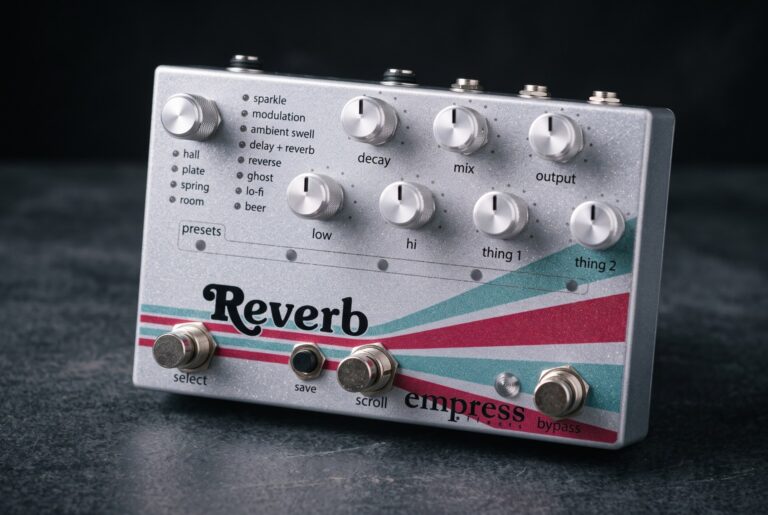
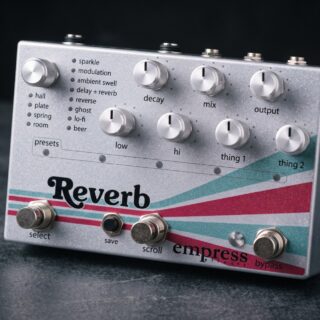
Against big multi-reverbs with deep preset systems — the Source Audio Ventris, the Source Audio Collider, the Empress Reverb, the Boss RV-500 — Rooms loses on every spec sheet metric and wins on the one thing spec sheets do not measure. Hunter’s summary of the trade-off was precise: users familiar with programmable presets “might miss them here, since the Rooms pedal requires good old-fashioned analog-style knob twiddling.”
And if you want a competent reverb that costs a fifth as much and does not have opinions, that market is extremely well served: the EHX Oceans 11, the TC Hall of Fame 2, the Boss RV-6, the MXR M300, the Walrus Fathom, the EHX Holy Grail Neo. None of them will make you record a thirteen-minute Neu! track by accident.
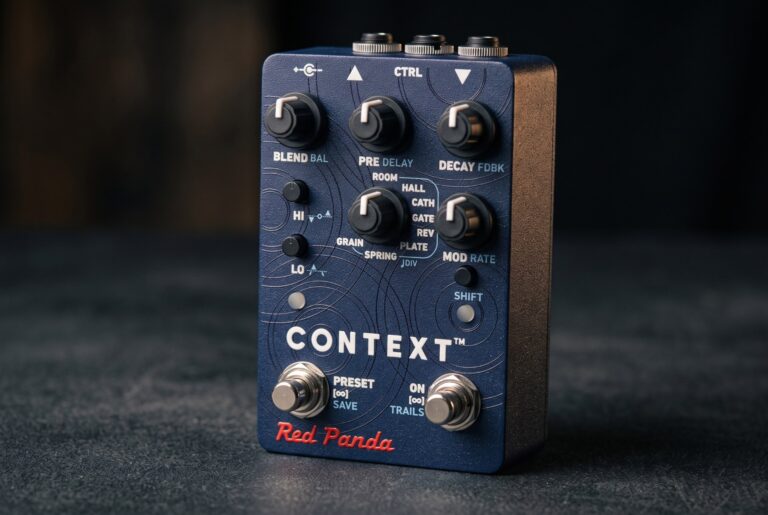
Within Death By Audio’s own line, Rooms sits alongside the Echo Dream 2 and the Fuzz War as the third pillar, and it is the only one of the three you could plausibly hand to a recording engineer. It also stacks well with the modulation-as-degradation school — a Chase Bliss Generation Loss MkII after it, or a Red Panda Context 2 before it, both of which reward the stereo outputs.
Buying Guide
Price has not moved. Rooms launched at $395 direct in 2020 and is still $395 direct in 2026. That is unusual and it matters for the used market — a second-hand unit needs to be meaningfully under $300 to be worth the risk of buying sight-unseen, because there is no supply pressure pushing new prices up.
There is only one version. No mkII, no revision, no cosmetic colourway that changes the circuit. A 2020 unit is functionally identical to a 2026 one. This is genuinely useful: unlike most digital reverbs of the era, there is nothing to check for and no firmware generation to worry about.
Measure your board first. At 5.95″ x 3.86″ x 2.96″ including hardware, Rooms is a large pedal on a tall enclosure, and the height is what catches people — nearly three inches means it will not slide under a tiered board’s upper shelf. This is a house DBA trait, not a Rooms quirk; the Echo Dream 2 and Fuzz War have the same problem.
Power it properly. 9 V DC only, 2.1 mm centre negative, 80 mA. That is a substantial draw for a single reverb — budget an isolated 100 mA output rather than daisy-chaining it. Unlike the Echo Dream 2, Rooms is not rated for 12 V or 18 V; do not experiment.
Buy it for one specific mode. Both Hunter and Saufley made the same point independently: even if you only ever use two or three of the six algorithms, the pedal is worth it. The corollary is that if you cannot name which mode you want before you buy, you are probably shopping for a different pedal.
Do not buy it if you switch sounds by preset. This is the single clearest disqualifier. If your live rig depends on recall, Rooms is the wrong tool and no amount of enthusiasm about GONG mode changes that.
Living With One
The good news first: Guitar Player found the controls “immediately clear and concise once you start twisting knobs,” with “no menu screens to negotiate or laborious toggling.” Crane sorted them out without opening the manual at all. For a six-algorithm digital reverb, that is a real achievement, and it comes down to the mode selector being large and obvious and the FREQ/DEPTH/TIME triangle being consistent in position even when it is inconsistent in meaning.
The less good news: because the parameters change function per mode, your optimal settings change substantially every time you turn the selector. Hunter flagged this as the practical cost of no presets — “more of that knob twiddling every time you change modes.” Saufley, who liked the pedal more, admitted the same range and sensitivity “may give control freaks fits,” but reported he could return to near-identical settings by eye without much trouble. Both are describing the same pedal accurately; which one you turn into depends on how you work.
Expect a small amount of background hum. It is a stompbox with a digital engine and a mixer capable of 20x gain, and Crane — a professional studio engineer with every reason to complain — described it as noticeable but not bothersome, and better than most pedals in the category. If yours is noisier than that, check your supply is isolated before you check anything else.
The two long-term rewards owners report are consistent. The first is that the pedal keeps giving up new sounds; Hunter, after a thorough review period, wrote that he “came away feeling I’d barely scratched the pedal’s surface.” The second is compositional. Both published reviews describe Rooms actively causing music to happen — Crane’s accidental thirteen-minute track, Saufley’s “the fresh ideas it inspires are likely to flow hard and fast.” That is a rare and slightly unquantifiable property for a reverb pedal, and it is the honest answer to the “why does it cost $395” question.
Frequently Asked Questions
Does the Death By Audio Rooms have presets?
No. The only stored second sound is the ALT setting, engaged by the right-hand footswitch, and it is not a memory — it is a second live set of FREQ, DEPTH and TIME knobs. There is no recall, no MIDI and no way to save a patch. This is the pedal’s single biggest limitation and the most common reason people sell one.
Why isn’t my expression pedal doing anything?
Because expression control only works while ALT mode is engaged, and it is deactivated the moment you switch ALT off. Check that first. Then check the side-mounted “F ↔ T” slider, which selects whether the expression pedal drives frequency or time — it is easy to have it set to the parameter you are not listening to. Finally, remember that the corresponding ALT mini-knob sets the minimum of the sweep; turn it fully down to get the full range under your foot.
Can I run Rooms in stereo, or into two amps?
Yes, and this is one of its strengths. Plug a mono guitar into the right input and the dry signal is split to both outputs while the reverb cascades in stereo. Plug a stereo source into both inputs and the left and right dry signals are kept separate at the outputs with stereo reverb added on top. The dual-mono dry lines also make parallel-loop and wet-only routings straightforward.
Is Rooms usable in a studio, or is it strictly a guitar pedal?
Both published long-form reviews used it as studio gear. Larry Crane ran it line-level via quarter-inch TRS into an in-the-box mix, had to pull his sends down a little, and got usable returns on vocals and drums. Charles Saufley specifically imagined it “in composition, or, more intriguingly, in mixing.” The 20x-gain DRY and FX controls — built with Electronic Audio Experiments — are the reason it survives outside a pedalboard.
What is the difference between GATE and WAVE?
They are frequently confused, partly because the 2020 press release swapped the two descriptions and that error has propagated through retailer listings for years. To be clear, per Death By Audio’s current product page: GATE is the gated reverb, with short times giving a classic gate and long times giving a controllable freeze. WAVE is the pitch vibrato mode, where lowering TIME blends the reverb out to leave chorus and vibrato. If a listing tells you otherwise, it is copying the old press release.
How much power does it need, and can I run it at 18 V?
9 V DC, 2.1 mm centre negative, 80 mA — and no, do not run it at 18 V. Death By Audio’s Echo Dream 2 explicitly sanctions 9, 12 or 18 V, which leads some owners to assume the whole catalogue is flexible. Rooms is not. Give it a dedicated isolated 9 V output rated at 100 mA or more.
Is the Rooms discontinued?
No. It remains in the current Death By Audio catalogue at $395 as of 2026, six years after launch, with no version revisions. It has outlasted a great many of the deluxe reverbs it launched alongside.
Which mode should I learn first?
ROOM, then PEAK. ROOM is the one that justifies the pedal as a working reverb and will get you through a gig; PEAK is the one that justifies it as a Death By Audio pedal and is the mode nothing else on the market really replicates. GONG is the most fun to demonstrate and the least likely to survive contact with an actual song — learn it last, and take DBA’s own advice to keep DEPTH near the centre while you do.
The Verdict In One Paragraph
Rooms is not the most capable reverb pedal you can buy, and Death By Audio have never claimed it was. It has no presets, no MIDI, no accurate spring or plate, and a price that makes people wince. What it has instead is six genuinely distinct algorithms, a level section built to studio standards by a company that specialises in that sort of thing, a second-settings footswitch that turns reverb into a performance gesture, and the fingerprints of someone who was building the thing he personally could not find. Charles Saufley gave it a Gear Award and told readers it was not for everyone. Larry Crane refused to send his review unit back. Will Swan keeps his in the drawer marked “weird, wild stuff.” All three verdicts describe the same pedal, and all three are correct.
Image credits
- Kevin Shields: Julio Enriquez, Wikimedia Commons, CC BY 2.0.
- Will Swan: Derrick Austinson Photog, Wikimedia Commons, CC BY-SA 2.0.
Latest News
Related

On This Day
Monday 9 November
From this week: