Marshall JCM800 2203: The Amp That Turned One Knob Into an Entire Decade
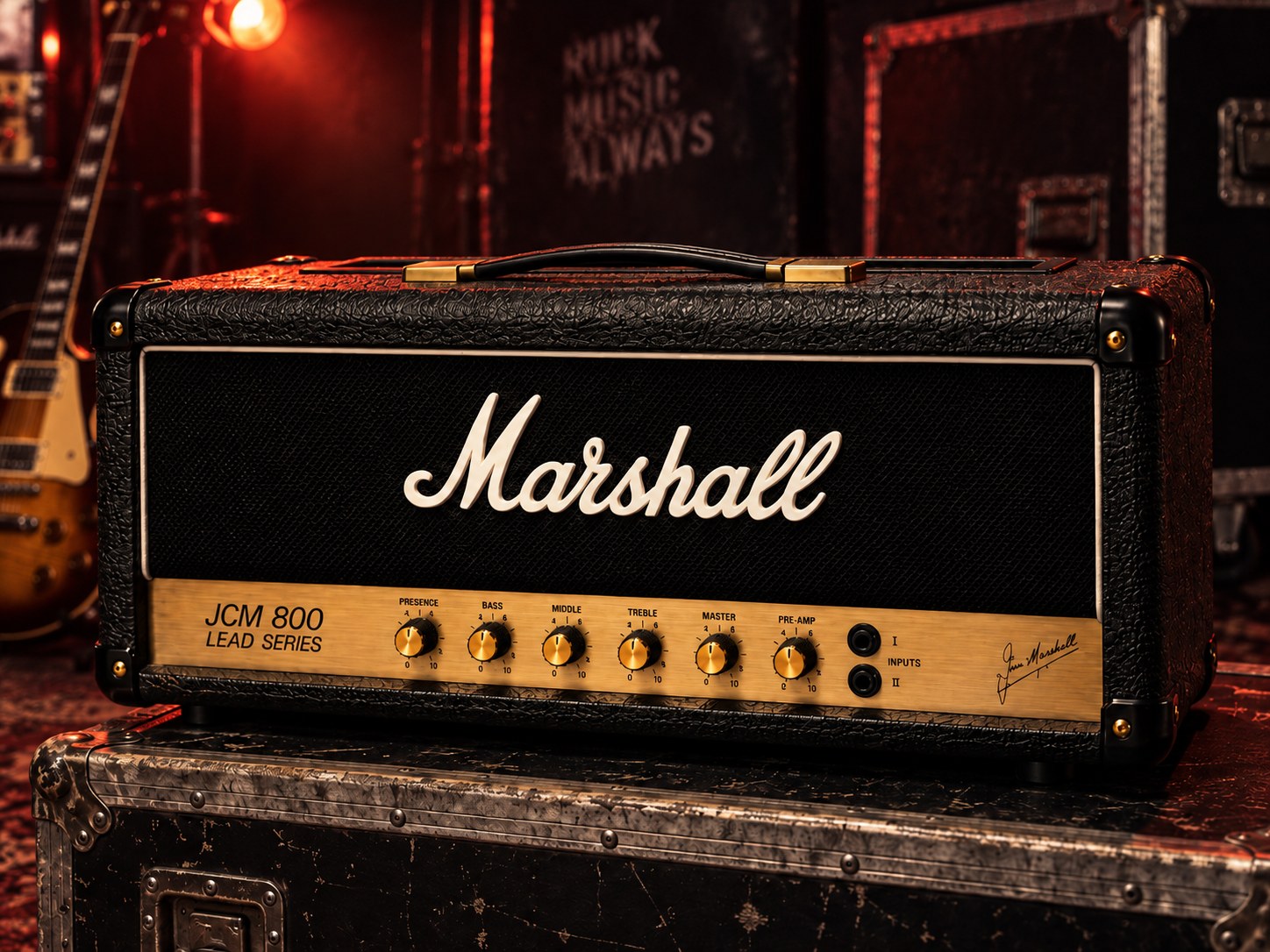
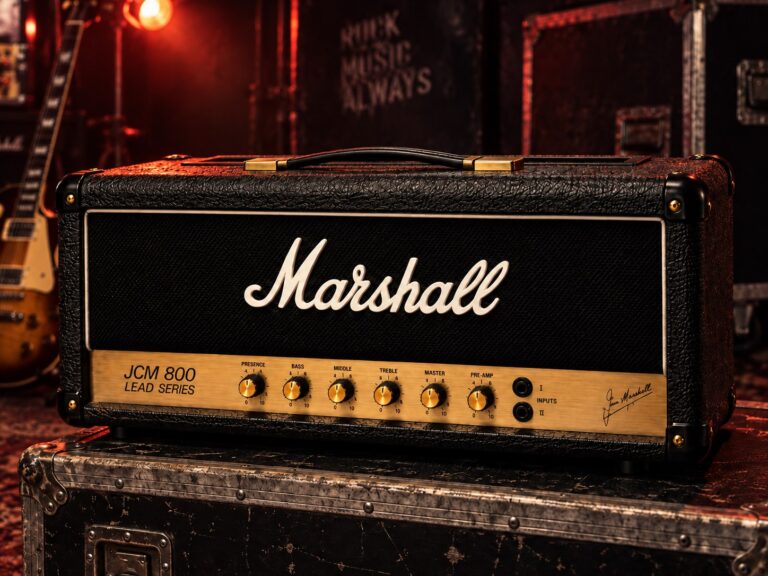
Marshall JCM800 2203 head. AI-generated reference illustration, not a photograph.
The full story of the Marshall JCM800 2203 — its 1975 JMP origins, EL34 vs 6550 voicing, verified players, tone recipes, comparisons and a used buying guide.
There is a version of rock history where the loudest amplifier ever built also happens to be the most useless. The Marshall 1959 Super Lead Plexi made every sound anyone wanted from a guitar amplifier in 1967, and it made every one of them at a volume that would strip paint. All of its overdrive came from the power section. You could not have the sound without the sound pressure. That was fine when Hendrix was playing festivals into a wall of cabinets, and it was catastrophic when the same guitarist needed to overdub a rhythm track in a room with a control-room window and a producer behind it.
The JCM800 2203 is the answer to that problem, and it is worth being precise about what the answer actually was, because the popular story gets it wrong twice. The JCM800 did not invent the master volume — Marshall had shipped that circuit as the JMP 2203 in 1975, six years earlier. And the JCM800 was not, at launch, a new amplifier at all. It was a 1975 circuit in a new box with a new name, released in 1981 because Jim Marshall’s distribution contract had expired and he needed a product line that his old distributor could not undercut with warehouse stock.
That is a marketing story, not an engineering one. And yet the JCM800 2203 went on to become, by a wide margin, the most-recorded high-gain amplifier of the 1980s — the head behind Slayer’s rhythm tone, the head Ozzy’s guitarists stood in front of, the head that made Siamese Dream sound like a hurricane in a cathedral. Guitar World’s Chris Gill estimated it was the amp of choice for “probably 95 percent” of the hard rock and metal bands who recorded and toured with Marshalls in that decade. A cosmetic rebrand became the defining voice of an era. This is how that happened, what is actually inside the thing, which famous players genuinely used one, and which famous players the internet has quietly attached to it by mistake.
Where the 2203 Came From: The 1975 Problem
The volume problem, stated plainly
Every classic Marshall before 1975 shares one design fact: the distortion happens in the power amp. Four EL34s in fixed-bias class AB, driven hard by a preamp with no gain structure to speak of, feeding a Drake output transformer that is being asked to pass more than it comfortably can. That is a beautiful, dynamic, touch-sensitive sound. It is also a sound that only exists above roughly 110 dB at three feet.
Players lived with this for a decade because there was no alternative and because stages were getting bigger anyway. But by the mid-’70s three things had changed. Recording had moved from “capture the band in a room” to multitrack overdubbing, where an amp screaming at full tilt bleeds into everything. Venues had started installing proper PA systems, so the backline no longer needed to fill the room by itself. And a generation of players had arrived who wanted more distortion than a Super Lead could physically produce, not less.
The 1975 JMP 2203
Marshall’s fix was structurally simple and conceptually enormous. Instead of one volume control feeding a power amp, the circuit gained two: a preamp volume that sets how hard the preamp valves are driven, and a master volume that sets how much of that already-distorted signal reaches the power section. Crank the preamp, back off the master, and you get saturation at conversational volume for the first time in Marshall’s history.
The 1975 amp was the JMP 2203 (100 watts) with a 50-watt sibling, the 2204. JMP stood for Jim Marshall Products, the branding Marshall had used since late 1967. These are excellent amps and they are the same circuit that would become famous under a different name six years later. It is one of the quiet injustices of gear history that the JMP 2203 is worth meaningfully less on the used market than a JCM800 2203 that is electronically identical to it.
1981: Rose-Morris, a licence plate, and a rebrand
Marshall’s export business had been throttled for years by its distributor, Rose-Morris, which was adding a reported 55 percent to the price of exported amps. When that deal expired in 1981, Jim Marshall wanted a new line — partly to sell direct, and partly, bluntly, to render obsolete the stock of JMP amps still sitting in Rose-Morris warehouses.
What he did not want was to redesign anything. So the 2203 got a cosmetic overhaul instead: black vinyl replacing the grille cloth, white piping, a gold control panel stretched the full width of the chassis, and an enlarged Marshall logo. The circuitry was untouched.
Marshall reportedly rejected every name suggestion put to him as “dreadful” before settling on the registration plate of his own car: JCM800. JCM was James Charles Marshall. The 800 meant nothing at all, beyond coinciding neatly with the decade about to begin. The most iconic model designation in amplifier history is a number plate and a coincidence.
The speaker that nearly sank it
The early reception was not universally warm. Some players complained that the new JCM800s sounded “flat” compared to the JMPs they replaced. The amps were innocent: the problem was Marshall’s contemporary cabinets, loaded with Celestion G12-M70 speakers. Marshall accepted the criticism and moved to G12-M75s, and the complaints stopped.
This is a useful thing to remember every time someone tells you an amp “sounds thin.” A 100-watt head is a voltage source with an opinion; the speaker is what converts that opinion into air. If you are chasing a JCM800 tone through the wrong drivers, no amount of knob-turning will find it. More on speaker pairing below, because with this particular amp it is not a footnote — it is half the tone.
Inside the 2203: What the Circuit Actually Does
Signal path
Three ECC83 (12AX7) preamp valves — two doing preamp duty, one acting as phase splitter — feed four EL34 power valves in fixed-bias class AB, with a solid-state rectifier and no sag. Two inputs, high and low sensitivity, with the low input attenuated roughly 6 dB. That is the whole front end.
The crucial architectural change from a Super Lead is not just the master volume knob. It is that the 2203’s preamp has an extra gain stage, cascaded, so that by the time the signal reaches the tone stack it has already been clipped. On a 1959 Super Lead, the preamp is close to a clean buffer and the EL34s do all the dirty work. On a 2203, the preamp is the primary distortion generator and the power amp adds compression, punch and the final layer of grind on top.
That single difference explains almost everything about how a 2203 behaves. It is tighter than a Plexi. It is more aggressive in the upper midrange. It cleans up less obligingly from the guitar’s volume knob, because you are backing off the input to a stage that is designed to clip. And it retains its character at low volume in a way no four-input Marshall ever could.
The tone stack and Presence
The 2203 uses the standard Marshall passive stack — Bass, Middle, Treble — sitting after the gain stages, which is why the controls interact heavily and why turning Bass up on a JCM800 tightens the low end rather than loosening it. Bass on 10 with Treble low is a legitimate, widely used setting, not a mistake, and Marshall’s own factory demo settings for the current reissue put Bass at 8 to 10 in every single preset.
Presence is not an EQ band. It works in the power amp’s negative-feedback loop, reducing feedback at high frequencies and therefore increasing power-amp gain up top. On a 2203 it is the difference between a rhythm tone that sits under the vocal and one that peels the top off the mix. Slayer-adjacent settings run it high; classic hard rock settings run it low and let the mids do the work.
The 6550 question
This is the single most consequential spec variation on the model, and it is invisible from the front panel. Standard JCM800s shipped with EL34 power valves. Amps exported to the United States were fitted with 6550 valves instead, because Marshall’s American distributor had concerns about EL34 reliability and about meeting UL safety standards.
The 6550 is not a subtle substitution. It gives bigger and tighter bass, more clean headroom, negligible sag and compression, and a faster, more percussive attack. Compared with an EL34 amp, a 6550-equipped 2203 is less singing and more slamming. Guitar World’s summary is exactly right: it is the difference between roasted prime rib and a grilled ribeye — same cut, different flavour.
The historical consequence is enormous and rarely acknowledged. American thrash was, to a significant extent, played through 6550 Marshalls, and the tight, dry, percussive rhythm tone associated with that music is partly a UL compliance decision. Marshall reverted US exports to EL34 in 1986.
Year-by-year changes, 1981–1990
The 2203 is not one amplifier. It drifted steadily across its production run, and the changes are audible.
- 1981–1983: internally near-identical to the 1975 JMP 2203. Six filter capacitors. Vertical input jacks.
- 1984: a quarter-inch DI output added to the rear panel, so players could link multiple heads — something four-input Marshalls had always allowed via jumping, and which the two-input 2203 could not do.
- Late 1984: input jack configuration changes from vertical to horizontal. This is the single fastest visual way to date a 2203 chassis.
- 1985: one filter capacitor removed, six down to five.
- 1986: two more filter caps removed as a cost-cutting measure, and EL34s return to US exports.
- 1990: the JCM800 series is discontinued in favour of the JCM900.
The filter-cap reduction matters more than it sounds. Filter capacitance determines how stiffly the power supply holds up under load. Fewer caps means more sag and more low-end compression when the amp is pushed hard — which some players hear as tighter and more aggressive, and others hear as thin and muddy. There is no consensus, which is itself informative: the difference is real but its desirability depends entirely on what you are playing. For chugging low-string rhythm, many players prefer the earlier six-cap amps. For cranked single-note lead work, the later amps can feel more forgiving.
The practical buying implication: “vertical input, six caps” is the configuration most associated with the classic early-’80s recordings, and it commands a premium. Note that Guitar World and Wikipedia disagree slightly on the 1986 figure — Guitar World says the count fell to three caps, Wikipedia’s summary of the same source describes removing two more from five. Either way the direction is the same and the late amps have visibly less filtering than the early ones. Count them yourself when you look at the chassis.
The end of “simple circuit” Marshall
The 2203 and the 50-watt 2204 were the last of Marshall’s simple-circuit designs. Everything after them — the split-channel 2205 and 2210 with reverb and effects loops, then the JCM900 4100, then the JCM2000 DSL line — added switching, loops and gain stages. The 2210 in particular became Marshall’s best-selling amplifier of the JCM800 era, which is worth sitting with: the model that sold the most is not the model anyone remembers.
Simplicity is the whole argument for the 2203. One channel, six knobs, no reverb, no footswitching, nothing to go wrong and nothing to hide behind.
Specifications
| Specification | Original JCM800 2203 (1981–1990) | 2203 Vintage Reissue (2002–present) |
|---|---|---|
| Output | 100 W | 100 W |
| Channels | 1 | 1 |
| Preamp valves | 3 x ECC83 (incl. phase splitter) | 2 x ECC83 + 1 x ECC83 phase splitter |
| Power valves | 4 x EL34 (4 x 6550 on US exports 1981–1986) | 4 x EL34 |
| Rectifier | Solid state | Solid state |
| Inputs | 2 x 1/4″ jack, high / low sensitivity | 2 x 1/4″ jack, high / low sensitivity |
| Controls | Preamp Volume, Master Volume, Treble, Middle, Bass, Presence | Preamp Volume, Master Volume, Treble, Middle, Bass, Presence |
| Effects loop | None | 1 x series, switchable |
| Speaker outputs | 2 x 1/4″ jack, selectable 16 / 8 / 4 ohm | 2 x 1/4″ jack, selectable 16 / 8 / 4 ohm |
| Reverb | None | None |
| Weight | Approx. 20 kg | 20.5 kg / 45 lb |
| Dimensions (W x H x D) | Approx. 740 x 310 x 210 mm | 740 x 315 x 210 mm / 29.1 x 12.4 x 8.3″ |
| Country of origin | Bletchley, England | Designed, engineered and made in the UK |
| Street price (July 2026) | Used market, see buying guide | $2,899.99 |
The reissue is faithful in every way that matters and adds exactly one thing: a switchable series effects loop, placed between preamp and power amp. Marshall’s own copy is honest about why — with the preamp cranked, time-based effects in front of the amp turn to mush, and the loop is the only way to keep delay and modulation legible. If you are building a rig around cranked-preamp tones, this single addition is worth more than the price difference between a reissue and a beaten original.
Famous Players: What Holds Up and What Doesn’t
The JCM800 2203 attracts more casual attribution than almost any amp in existence, partly because “Marshall stack” is a visual shorthand that photographs well and partly because a black-and-gold head looks the same from row twenty regardless of what is inside it. Here is what survives scrutiny.
Verified: Kerry King and Jeff Hanneman (Slayer)
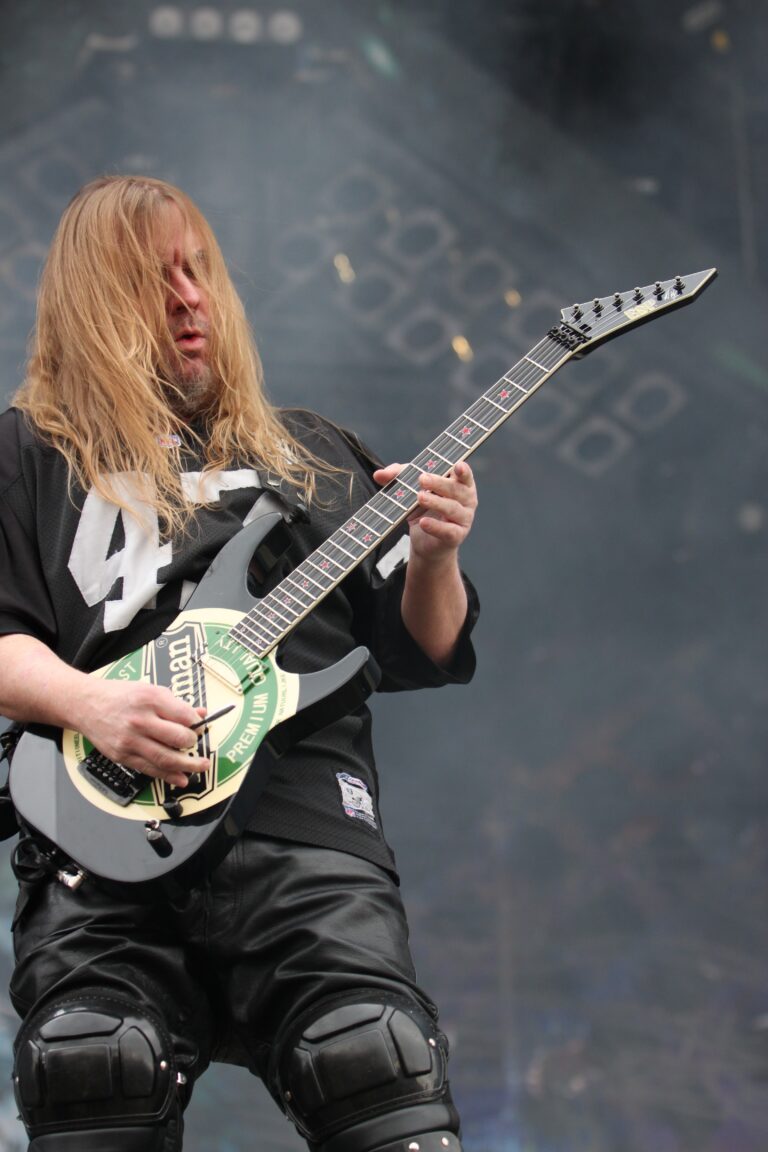
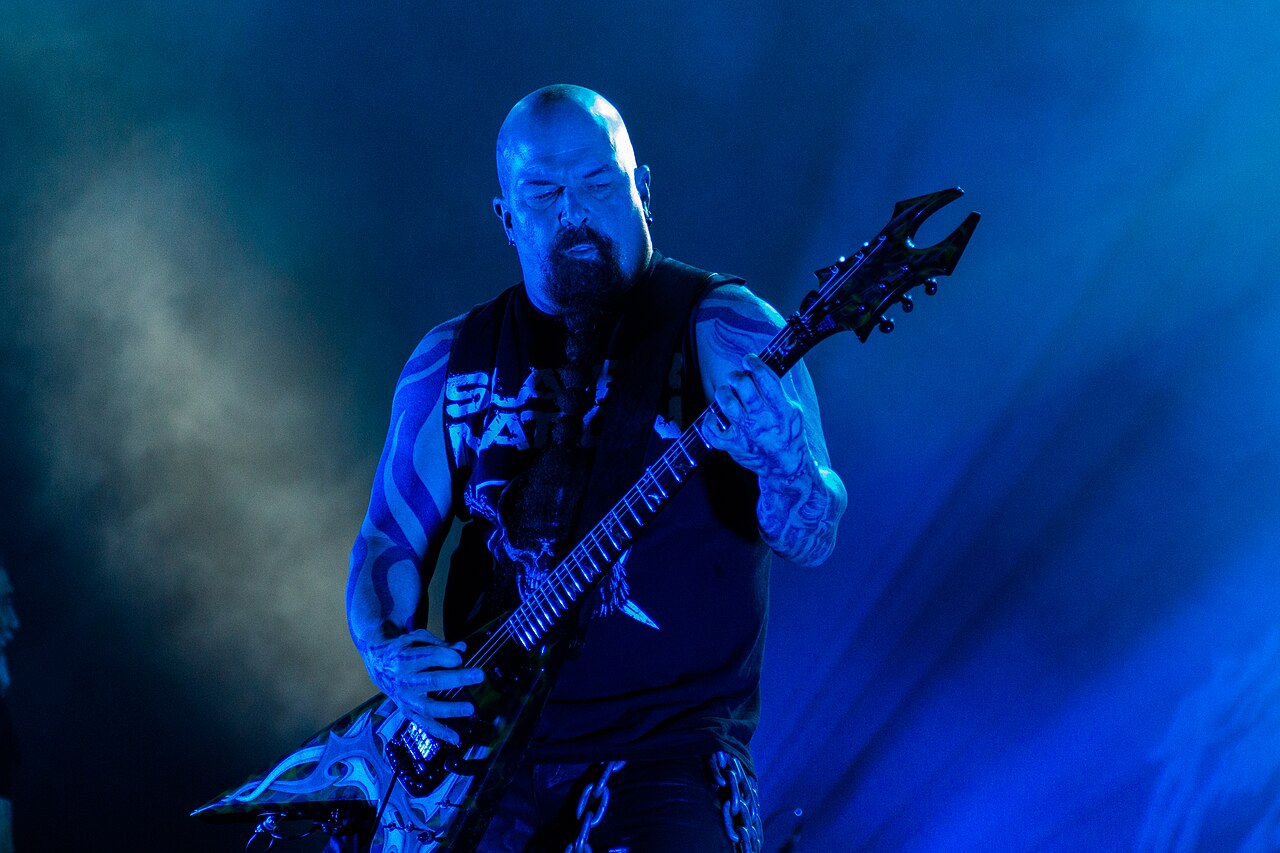
This is the strongest documentation on the model. Kerry King and Jeff Hanneman built Slayer’s rhythm tone on JCM800 2203s across Hell Awaits, Reign in Blood and Seasons in the Abyss — 6550-equipped US-market amps, which is exactly why that guitar sound is so dry, so fast in the attack and so completely devoid of the woolly compression you hear on British hard rock records of the same period.
Crucially, both ran Boss 10-band graphic EQs in front of the amps, boosting mids and hitting the input with additional level. This matters because it disproves the lazy version of the story. The Slayer tone is not “a JCM800 turned up.” It is a JCM800 being force-fed by an EQ pedal, into 6550s, into big cabinets, with Presence set aggressively high. Any of those elements removed and it stops sounding like Slayer.
The relationship was formalised in a way that provides its own evidence trail. During Slayer’s 2005 European tour, Marshall’s US product manager asked to borrow King’s own amp — nicknamed “the Beast” — so the factory could analyse it and build a signature model. The result was the JCM800 2203KK: 100 watts, three ECC83s, and, notably, four KT88 power valves rather than 6550s or EL34s, plus a “Beast” boost, a noise gate with threshold control, and an “Assault” intensity control. When a manufacturer reverse-engineers a specific player’s specific amp and puts it into production, the attribution is about as verified as gear archaeology gets.
Verified: Zakk Wylde
Zakk Wylde is the other player whose association with the 2203 is documented rather than assumed, and again the evidence is a production signature model. The JCM800 2203ZW was a limited run of 600 worldwide: 100 watts, three ECC83s, and four 6550s — Wylde on the American-spec valve, not the EL34, which is entirely consistent with the percussive, headroom-heavy attack of his rhythm playing with Ozzy Osbourne and Black Label Society. The cosmetic treatment carried his bullseye motif onto the panel and grille.
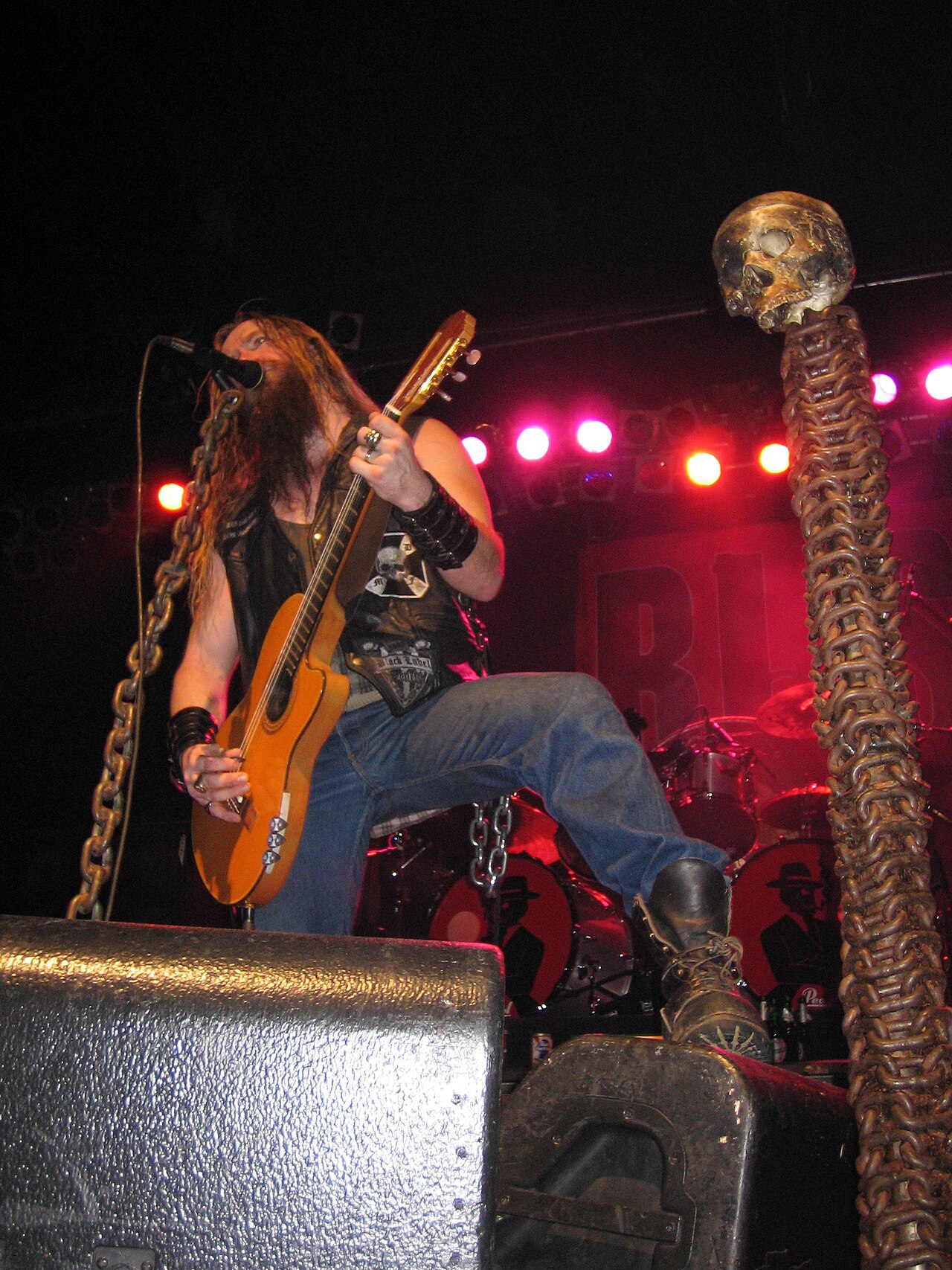
Wylde’s tone is often described as “a Marshall and a chorus pedal,” and reduced to essentials that is close to true — the 2203 does the heavy lifting and the modulation sits on top. The 6550 spec is the part most people miss when they try to copy it through an EL34 amp and wonder why the palm mutes bloom instead of snapping.
Verified: Billy Corgan, with a modification
Billy Corgan‘s Siamese Dream rhythm sound is one of the most distinctive guitar textures ever committed to tape, and its foundation is a 1984 JCM800 2203 — with two details that are usually left out.
First, the amp was re-valved with KT88s, which Corgan has said transformed it and gave him the gain character he wanted. Second, the signal chain into it was deliberately backwards: an Electro-Harmonix Big Muff Pi — a late-’70s op-amp version — plugged into the low-sensitivity input, with the amp’s master volume all the way up and the preamp gain used for fine adjustment. Running a maximum-gain fuzz into the quieter input, then setting master high and preamp low, is the opposite of how most players approach a 2203, and it is precisely why the record sounds enormous but never fizzy. The fuzz supplies the saturation; the amp supplies the power-section push and the air.
The wall-of-guitars density on that album also owes a great deal to the ADA MP-1 rack preamp used alongside the Marshall on layered parts. If you copy only the Big Muff and the amp, you will get most of the way there — but the record is a stack of takes, not a single tone.
Correction: Tom Morello used a 2205, not a 2203
This one is genuinely worth flagging because it appears in vendor copy, in artist round-ups. Tom Morello‘s amp is a JCM800 2205 — the 50-watt, two-channel, reverb-equipped model — not the 100-watt single-channel 2203.

The story behind it is worth telling. Morello’s entire rig was stolen after a Valentine’s Day gig in the ’80s and he had to replace everything before a session. He walked into his neighbourhood shop and bought what was there: a 50-watt JCM800 2205 head and a 1987 Peavey 4×12 loaded with Celestion G12K-85s. He has used that pairing ever since. He runs only the boost channel, gets his clean sounds by rolling back the guitar volume, and famously etched his settings into the panel and never moved them again.
So the tone that defines Rage Against the Machine is a JCM800 — but a different JCM800, at half the power, through a Peavey cabinet, bought by accident. “JCM800” is a series of fifteen models, and treating the name as a synonym for the 2203 is how these errors propagate.
Correction: Slash is a Super Lead and Jubilee player
Slash appears on almost every JCM800 player list, and the Appetite for Destruction tone is not a JCM800. It is a Marshall 1959T Super Lead Tremolo rented from S.I.R. in Los Angeles and modified by Tim Caswell, who repurposed the amp’s unused tremolo circuit and its spare preamp valve as an additional gain stage, and added a master volume. Slash wanted stock #39; it was out on rental to George Lynch for Dokken’s 1986 tour, so he ended up with #36 — the amp Marshall later modelled for the AFD100 signature head.
There is a second widely repeated error worth killing at the same time: Slash did not use a Silver Jubilee on Appetite. The album was recorded between August and December 1986; the Jubilees were not built or shipped until 1987. The Jubilee became his live amp afterwards and remains central to his sound, but it cannot appear on a record that was finished before it existed. This is the same category of check that catches a dozen false attributions across gear writing: compare the recording date to the manufacturing date first, and everything else second.
The Angus Young footnote
Angus Young is frequently listed as a JCM800 player, and the truthful version is more interesting: he generally used a late-’70s JMP 2203 — the same circuit under the earlier name. Since JMP and JCM 2203s are functionally identical, the tone is the same, and any “JCM800 Angus setting” you find is really a JMP setting. Guitar World’s own suggested settings page makes exactly this caveat. It also notes the speaker dependency: a 4×12 with 25-watt Celestion Greenbacks gets that sweeter, more vocal AC/DC character, where the 65- and 75-watt Celestions most ’80s players used push things harder and colder.
Players in the broader orbit
Beyond the four verified names, the 2203 and its 50-watt sibling were backline furniture for a generation. James Hetfield, Dave Mustaine, Jerry Cantrell, John Sykes, Vivian Campbell, Warren DeMartini, Doug Aldrich, Scott Ian, Gary Holt and Noel Gallagher all appear in JCM800-adjacent contexts across the ’80s and ’90s — but for most of them the amp was one element in a rig that changed constantly, often modified, often blended with something else. We are naming them here as part of the landscape rather than claiming a documented single-amp signature tone, because that is the honest distinction. Randy Rhoads is a special case worth being careful about: he died in March 1982, months after the JCM800 launched, and his documented amps are earlier Marshalls, so treat any “Randy Rhoads JCM800” claim with suspicion.
Tone Recipes
1. Marshall factory clean
Low sensitivity input. Presence 4, Bass 10, Middle 5, Treble 4, Master 7, Preamp 5.
Straight from Marshall’s own demo settings for the reissue. Note the bass on 10 — on this tone stack that is a tightening control, not a boom control. High master and low preamp is the key relationship: you are letting the power amp do the work and keeping the preamp out of clip. Cleaner still: Master 8, Preamp 6, Middle 6, Treble 2.
2. Classic ’80s crunch
High sensitivity input. Presence 3, Bass 8, Middle 7, Treble 7, Master 7, Preamp 7.
The all-purpose JCM800 sound: enough grind for power chords, enough definition for open-string ringing, and it cleans up reasonably from the guitar volume. A Les Paul Standard lives here. This is also the setting that reveals whether your speakers are right — through Greenbacks it sings, through V30s it gets noticeably more aggressive in the upper mids.
3. Maximum single-amp saturation
High sensitivity input. Presence 3, Bass 10, Middle 6, Treble 3, Master 7, Preamp 10.
Marshall’s own “Crunch 3” preset, and it is more useful than it looks. Preamp at 10 with Treble at 3 is counterintuitive but correct: the gain stages add so much upper-mid energy of their own that a low treble setting is what keeps it from becoming ice pick. If it sounds dull, raise Presence before you touch Treble.
4. Jeff Hanneman rhythm (6550, horizontal input)
High sensitivity input. Presence 9, Bass 8, Middle 6.5, Treble 6, Master 3, Preamp 10.
Guitar World’s documented Slayer rhythm setting. Presence at 9 is the whole trick — that is where the razor edge lives. Add a Boss 10-band graphic EQ in front with the mids boosted, exactly as Hanneman and King ran it, and you are hitting an already-maxed preamp with more level. On an EL34 amp this becomes flubby; the 6550 headroom is what makes it work.
5. Angus lead (EL34, Greenbacks)
High sensitivity input. Presence 3, Bass 10, Middle 5, Treble 9, Master 4, Preamp 10.
Treble at 9 with Presence at 3 is the inverse of the Slayer approach and gives you cut without harshness — brightness generated before the power amp rather than after it. An SG Standard and 25-watt Greenbacks are effectively part of the recipe.
6. Siamese Dream wall
Low sensitivity input, Big Muff in front. Master 10, Preamp 3–5, Presence 4, Bass 8, Middle 6, Treble 5.
Corgan’s inverted approach. The fuzz is the distortion; the amp is a very loud, very clean-ish power stage with a bit of preamp colour. Sustain on the Muff around 3 o’clock, its tone control low, and the amp’s master genuinely wide open. This needs volume or an attenuator — there is no low-wattage shortcut to it, because the power amp is the effect.
7. Boosted modern rhythm
High sensitivity input, Tube Screamer in front. TS9: Drive 0, Level 8, Tone 6. Amp: Presence 5, Bass 7, Middle 6, Treble 6, Master 5, Preamp 8.
The standard contemporary approach to a 2203. A Tube Screamer with drive at zero adds almost no distortion of its own — what it does is roll off bass before the preamp and add level, which tightens palm mutes dramatically. A Boss SD-1 does the same job with a slightly brighter, more asymmetrical character.
All settings assume the current reissue or an original in good health, into a 4×12. Numbers are 0–10. The 2203’s controls interact heavily, so treat these as starting coordinates rather than destinations — and always set the master first, then bring the preamp up to meet it.
Cabinets and Speakers: Half the Amp
The G12-M70 episode at launch established the principle permanently: a 2203 is only as good as what it is driving. Four practical pairings.
- Celestion G12M Greenback (25 W): the vintage voice. Early breakup, pronounced upper-mid honk, compresses beautifully. Four of them in a 1960A handle 100 watts on paper, and plenty of people have run 2203s into them for decades — but there is no headroom margin at all, and cranked, they will fail eventually. Sweeter than anything else for classic rock.
- Celestion Vintage 30 (60 W): the default modern pairing, and the reason so many 2203 recordings from the ’90s onward sound alike. Aggressive upper-mid spike, tight bass, enormous durability. Excellent for high-gain, sometimes fatiguing for cleans.
- Celestion G12M-65 Creamback (65 W): arguably the best all-round match. Greenback voicing with enough power handling to survive a 100-watt head, and a fuller low end than the 25-watt version.
- Celestion G12-65 Heritage: the reissue of the driver that appeared in period Marshall cabinets. Tighter than a Greenback, less spiky than a V30 — the closest thing to a period-correct ’80s JCM800 sound.
Angled 1960A versus straight 1960B is a real difference at close range and largely irrelevant at distance: the angled cab throws upper mids toward your ears on stage, which is why so many players put the angled one on top. Recording a 2203, the straight cab is usually easier to mic consistently.
How the 2203 Compares
Versus the 1959 Super Lead Plexi
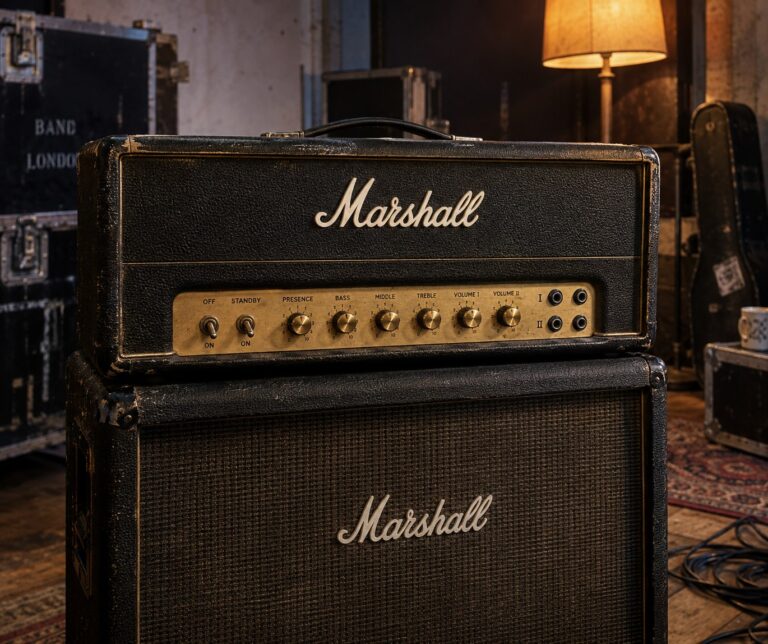
The Super Lead is more dynamic, more open, more responsive to picking attack and guitar volume, and completely impractical below stadium volume. The 2203 is tighter, more aggressive, more mid-forward, and usable in a room. If you play blues-rock and can control your volume, the Plexi wins. If you play anything with palm mutes in it, the 2203 wins before the argument starts. As of July 2026 Marshall’s own Vintage Reissue range does not include a 100-watt 1959 in any form — the 2203 is the only 100-watt vintage-spec Marshall head you can currently buy new, at $2,899.99.
Versus the 1987X / 50-watt Marshalls
The 1987X is the 50-watt Plexi and shares the Super Lead’s virtues and problems at slightly lower volume. Against a 2203 it is looser, sweeter, and still lacks a master volume. The relevant comparison inside the JCM800 family is the 50-watt 2204, which is the same circuit with two EL34s: earlier power-amp breakup, more compression, slightly less low-end authority. Many players consider the 2204 the better recording amp and the 2203 the better stage amp, and Guitar World’s own suggestion — a 6550 2203 for rhythm and a cranked EL34 2204 for leads — is a rig plenty of professionals actually built.
Versus the Silver Jubilee 2555
The Silver Jubilee takes the 2203 concept further with a diode clipping stage, a pull-out rhythm clip and a half-power switch. It is smoother, more compressed and more forgiving than a 2203 — which is exactly what some players want and exactly what others cannot stand. The Jubilee flatters sloppy right-hand technique; the 2203 does not.
Versus the JCM900 4100
The JCM900 exists because so many JCM800 owners were having their amps modified for more gain that Marshall decided to build the modification in. It succeeds at that and loses something in the process: JCM900s are brighter, with less low end and less of the midrange growl that makes a 2203 sit in a mix. The 900 is a better amp on paper and a less-loved amp in practice, which is one of the more instructive stories in Marshall’s catalogue.
Versus American high gain
A Mesa Mark IIC+ has a graphic EQ and a scooped, cutting, extremely tight voice built around preamp cascade — more gain than a 2203, less power-amp character, and a fundamentally different midrange. A Dual Rectifier is looser and lower-voiced with far more low-end saturation, the ’90s answer where the 2203 was the ’80s question. A Soldano SLO-100 is arguably the JCM800’s most direct descendant — a hot-rodded Marshall topology taken to its logical extreme, smoother and more liquid on leads. And a Peavey 5150 delivers a substantial fraction of a boosted 2203’s usefulness for a fraction of the money, at the cost of dynamics and cleans.
Versus low-wattage modern Marshalls
Marshall’s own answer to “I want this at home” is the Studio series — including the SV20H Studio Vintage, a 20-watt Plexi-derived head switchable to 5 watts, and its JCM800-derived sibling in the same range. These are legitimately good and they solve a real problem. What they do not fully replicate is the way four EL34s and a large output transformer move air below 200 Hz. That is a physics problem, not a voicing problem, and no amount of clever design gets around it.
Buying Guide
New: the Vintage Reissue
The JCM800 2203 Vintage Reissue is $2,899.99 at Marshall, Sweetwater, Guitar Center and Musician’s Friend as of July 2026 — the same figure across all four, so there is no discount hunting to be done. It is built in the UK, carries EL34s, and adds the switchable series effects loop. Sweetwater lists it under the model code 2203X, which is the same amplifier; the X suffix is Marshall’s reissue-range designation.
For most buyers this is the right amp. It is under warranty, it has the loop, its filter capacitors are new rather than forty years old, and it does not carry the anxiety of owning a piece of history.
Used originals: what to check
- Input orientation. Vertical jacks mean pre-late-1984. Horizontal means later. This is the fastest external dating check on the model.
- Filter capacitor count. Look inside. Six is early, five is 1985, three is 1986 onward. This is a genuine tonal fork, not trivia — and if the caps have never been replaced on a forty-year-old amp, they need to be regardless of how many there are.
- Power valve type. Check the sockets and the bias. A US-market amp originally built for 6550s that has been casually re-valved with EL34s and never rebiased will sound wrong and wear out valves fast. This is the single most common problem on used 2203s.
- Modifications. Enormous numbers of 2203s were modified for more gain in the late ’80s — that is literally why the JCM900 exists. A modified amp is not necessarily worse, but it is worth substantially less and it is not a JCM800 tone any more. Look for added switches, non-original jacks, and neat-but-not-factory wiring around the preamp.
- Transformers. Original transformers are the value driver, exactly as with the Plexis. Replacement transformers are a legitimate repair and a legitimate reason to pay less.
- The lack of a loop. Original 2203s have no effects loop. If your rig depends on delay and modulation with a cranked preamp, you either add a loop (reducing the amp’s value) or you accept mushy effects. Decide before you buy, not after.
Signature variants
The 2203KK (Kerry King) and 2203ZW (Zakk Wylde, 600 units) both turn up used. Neither is a plain 2203: the KK runs KT88s and adds a boost, gate and “Assault” control; the ZW runs 6550s. If you want the standard amp, buy the standard amp — but if the specific voicing appeals, these are interesting and the ZW in particular is genuinely rare.
Living With a 2203
The volume, revisited
The master volume solved the Plexi’s problem; it did not abolish physics. A 2203 at bedroom volume gives you preamp distortion without power-amp compression, and the difference is not subtle — the amp sounds thinner and stiffer than the records that made it famous, because on those records the power section was working. If you want the full sound at manageable volume you need a reactive load attenuator, and a good one. Cheap resistive attenuators load the output transformer badly and dull the top end.
Valves and bias
Four power valves in fixed bias means the amp must be biased whenever they are replaced, by someone competent, with the chassis live. This is not a home job unless you already know it is not a home job — there are lethal voltages inside a 100-watt amp and the filter capacitors hold charge after it is unplugged. Budget for a tech visit every time you re-valve.
Impedance
The 2203 has a selectable 16/8/4 ohm output and two speaker jacks. Two 16-ohm cabinets together present 8 ohms; set the selector accordingly. Never run a valve amp without a speaker load — an unloaded output transformer under signal is how output transformers die.
Noise
A cranked 2203 hisses and hums. It is a single-channel, high-gain, no-gate design from 1975 and it was never quiet. Good mains, good cables, humbuckers rather than single coils, and a noise gate in the loop if you play modern metal. The 2203KK includes a gate for exactly this reason.
Guitars that suit it
Humbuckers, mostly. A Les Paul, an SG, an Explorer, a Flying V or a superstrat with a hot bridge pickup all push the front end the way it wants to be pushed. A Stratocaster works beautifully but sits in a different place — brighter, thinner, more dependent on the amp’s midrange, and considerably noisier at high gain. Neither is wrong; they are different instruments meeting the same circuit.
Frequently Asked Questions
Is the JCM800 2203 the same as the JMP 2203?
Electronically, at launch, yes. The JCM800 2203 introduced in 1981 was internally identical to the JMP 2203 that Marshall had been building since 1975; the differences were cosmetic — black vinyl, white piping, a full-width gold panel and a bigger logo. The amps diverged gradually from 1984 onward as Marshall made running changes. A late-’70s JMP 2203 and an early-’80s JCM800 2203 sound the same, and the JMP usually costs less.
What does JCM800 stand for?
JCM is James Charles Marshall, Jim Marshall’s initials. The 800 has no technical meaning whatsoever — the whole designation came off the registration plate of Marshall’s own car, after he rejected every other suggested name. The number happened to suit the decade the amp launched into.
Should I get EL34s or 6550s?
EL34s give the classic British voice: meaty midrange, singing compressed leads, more sag and bloom. 6550s give bigger and tighter bass, more headroom, faster attack, almost no compression, and a harder, chunkier character. American thrash and Zakk Wylde’s rhythm tone are 6550 sounds; classic hard rock leads are EL34 sounds. Whichever you fit, the amp must be rebiased — the two valve types are not drop-in interchangeable.
How loud is a 2203 really, with the master volume down?
Manageable, but the tone changes. You get preamp saturation at any volume, which is the whole point of the design, but the power-amp compression and the low-end movement that define the recorded sound only appear when the output stage is working. Realistically you need a loud rehearsal room, a gig, or a good reactive attenuator to hear what the amp actually does.
Does the reissue sound like an original?
Close enough that the differences are smaller than the differences between two originals from different years. Filter cap counts, valve type, forty years of component drift and speaker choice all move an original 2203 further from another original than the reissue sits from either. The reissue also has a series effects loop the originals lack, which for most rigs is a net gain.
Why do so many JCM800s have modifications?
Because in the late ’80s the demand for gain outran the circuit. So many owners had their amps hot-rodded — often while the amp was in the shop for something else entirely — that Marshall responded by designing the JCM900 with the extra gain built in. If you are shopping used, assume a modification until you have looked inside and confirmed otherwise.
Did Slash use a JCM800 on Appetite for Destruction?
No. The Appetite amp was a Marshall 1959T Super Lead Tremolo rented from S.I.R. and modified by Tim Caswell, who converted the unused tremolo circuit into an extra gain stage and added a master volume. He also did not use a Silver Jubilee on that record — the album was recorded in late 1986 and Jubilees did not ship until 1987. The Jubilee came afterwards and became his live amp.
What pedal should I put in front of a 2203?
A Tube Screamer or SD-1 with the drive at or near zero and the level high. It adds almost no distortion of its own; what it does is trim low end before the preamp and add signal level, which tightens the attack considerably. Slayer used Boss 10-band graphic EQs to do the same job with more control. For time-based effects, use the loop if your amp has one — a delay in front of a cranked 2203 preamp turns to porridge.
Is a 100-watt 2203 overkill for most players?
For volume, yes, for almost everyone. For tone, the honest answer is that the 100-watt version’s low-end authority and headroom are part of its character, and the 50-watt 2204 is a genuinely different amp rather than a quieter one — earlier breakup, more compression, less bottom. Many players find the 2204 more useful; nobody who wants the specific 2203 sound is satisfied by the 2204 for long. Buy the one whose voice you want and solve the volume separately.
Image credits
- Tom Morello: deep ghosh, Wikimedia Commons, CC BY 2.0.
- Kerry King: Alfred Nitsch, Wikimedia Commons, CC BY-SA 3.0 AT.
- Zakk Wylde: Joanna Corwin, Wikimedia Commons, CC BY-SA 3.0.
- Top image: GuitarGangsters AI-generated reference illustration, not a photograph.
- Marshall 1959 Super Lead Plexi: GuitarGangsters AI-generated reference illustration, not a photograph.
- Marshall JCM800 2203: GuitarGangsters AI-generated reference illustration, not a photograph.
Latest News
Related

On This Day
Tuesday 10 November
From this week: