Eleven Ways to Make the Air Move: The Wampler Terraform and the Multi-FX Pedal That Refused to Have a Screen
Wampler Terraform explained: all 11 effects, the hidden 2023 firmware update, real power draw, pre/post routing, verified players and settings.
For fifteen years Brian Wampler built analog dirt boxes. Overdrives, distortions, fuzzes, a compressor, a Klone. Circuits you could point at and explain. Then in November 2019 he shipped a pedal with a French digital signal processing chip inside it, eleven algorithms, MIDI, an expression input and a stereo output pair — and somehow made it feel like the least computery multi-effects unit on the market.
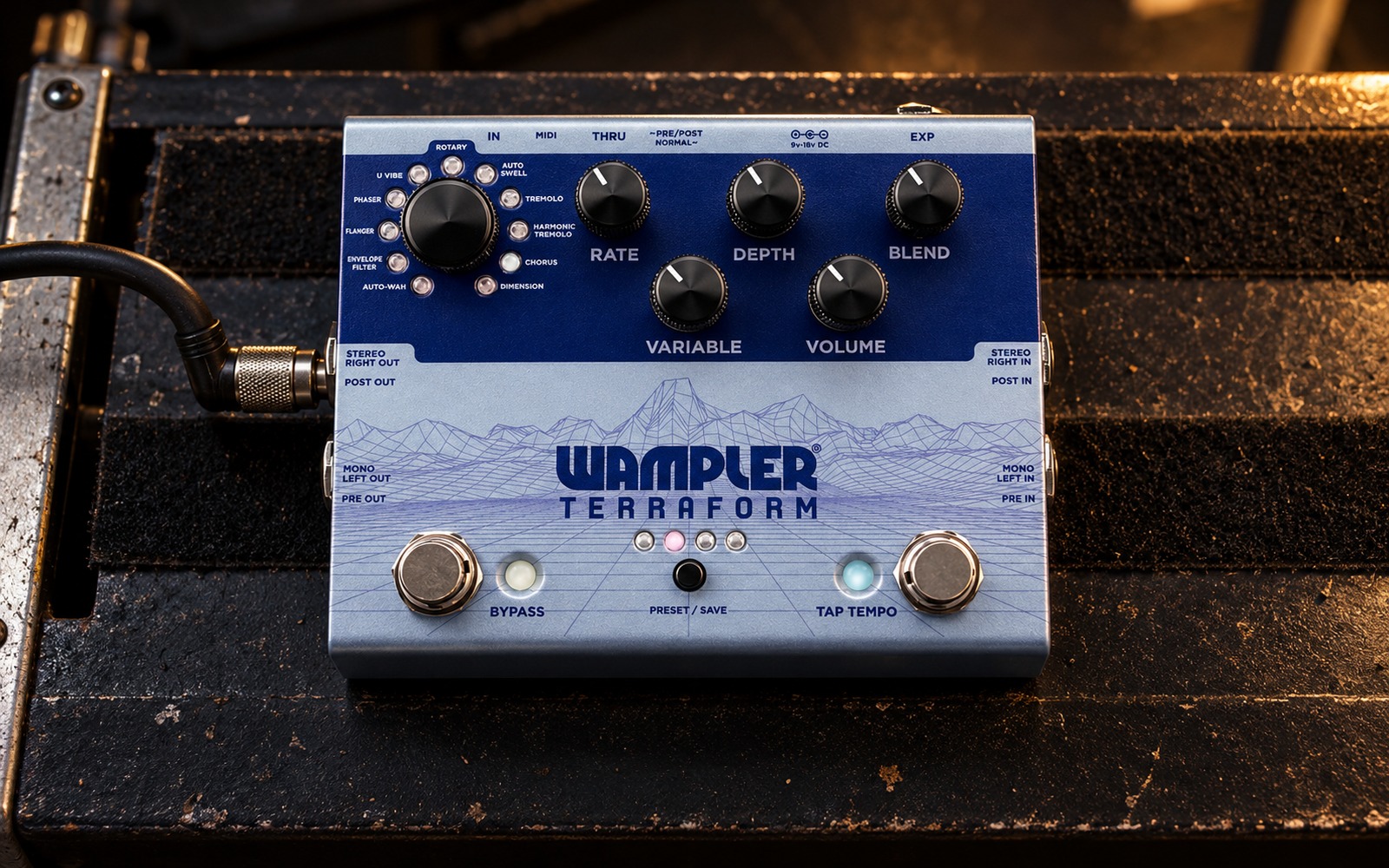
The Wampler Terraform is what happens when a builder who genuinely does not like menus is forced to admit that digital sounds good now. There is no screen. There is no bank system. There are five knobs, a rotary selector ringed with LEDs, two footswitches and a small black button, and that is the entire interface. You turn the selector to the effect you want and you turn knobs until it sounds right. That is the whole design philosophy, and it is the reason the pedal still sells at full price seven years after launch while a dozen more powerful boxes have come and gone.
It is also a pedal with a genuinely confusing documentation trail. There are three different published figures for its current draw, from three sources that all belong to the manufacturer or the manufacturer’s press kit. There is a 2023 firmware revision that changes how the pedal behaves at power-up and reassigns one of the knobs, which means a large chunk of the settings advice on the internet describes a machine that is not the one in front of you. And there is an artist story that is the exact inverse of what you would expect: the pedal has four photographically documented professional users, and the two you have probably never heard of are the better evidence.
Let us take all of it apart.
The Origin Story: Wampler Goes Digital, Reluctantly
Wampler Pedals came out of Indiana in 2004 as a modding and education operation. Brian Wampler wrote publicly about how gain circuits actually work at a time when most boutique builders preferred to imply their tone came from unobtainium capacitors. The catalogue that grew out of that — the Plexi-Drive, the Euphoria, the Tumnus, the Sovereign, the Ego Compressor — was analog to a fault, and the brand’s identity was welded to that fact.
So the Terraform was a statement of intent as much as a product. Wampler’s own manual opens by admitting the discontinuity in plain language: the company had “completely thrown ourselves into the realms of digital.” The first customer reviews landed on the Wampler product page on 16 November 2019, which pins the retail launch to that month. Premier Guitar’s Joe Gore reviewed it on 19 March 2020 at a $299 street price and it took a 2020 Premier Gear Award. MusicRadar’s Guitarist review followed on 2 April 2020 at £299 / €331 / $299.
One long-form owner review on Wampler’s own site, posted by Dan Hall on 24 February 2021, captures the reception better than any press quote. Hall listed the seven Wampler pedals he already owned, admitted he “was still slightly hesitant to give the Terraform a try, just because I viewed Wampler as a specialist in simple analogue pedals,” and then spent about a thousand words explaining why the gamble paid off. Wampler published it in full, complaint about the preset button included. We will come back to that complaint, because it turns out to be the single most consistent criticism the pedal has ever received.
Living the Dream Chip
The engine is a SAM 5504B from Dream, a French DSP house. Gore’s review is the source for that identification, and his assessment of what it buys you is the most useful technical paragraph anyone has written about the pedal: “The pitch shifting is better than on some cheaper DSP chips, which means smoother, more immersive modulation effects, devoid of tinny resonance.”
That matters more than it sounds. Nearly every modulation effect is a pitch-shifting effect underneath — chorus, flanger, vibe and rotary all work by delaying and detuning a copy of your signal. Cheap converters make that audible as a brittle, glassy artefact sitting on top of the note. The Terraform does not do that. Gore is careful to say these are not analog-sounding effects — “you don’t encounter the quirky noise and spectral distortion you’d get from a chorus pedal with a bucket-brigade chip” — but he is equally clear that “there’s nothing harsh or cold about these inviting textures.”
Owner reports run warmer than that. Michael Hecker, writing on the Wampler product page on 23 November 2019: “When I play a chorus, it sounds analog. The phaser sounds analog. The flanger, analog.” That is a subjective claim from an early adopter and should be read as one. Gore’s framing — clean, detailed, well-programmed, not pretending to be analog — is the more defensible description, and it is what you should expect when you plug in.
What You Actually Get: Eleven Effects, One at a Time
The single biggest limitation, stated up front because Premier Guitar listed it as the pedal’s only con: you can only run one effect at a time. This is not a multi-effects processor in the Helix sense. It is eleven modulation pedals sharing one enclosure and one set of knobs, and you get one of them.
Here is what the rotary selector gives you, with the effect that each knob has in that mode, taken from the official manual rather than from retailer copy.
| Effect | What it is | What the Variable knob does |
|---|---|---|
| Dimension | Multi-voice chorus, Boss Dimension C territory | Amount of low end in the effect |
| Chorus | Single-voice chorus, Japanese to American voicings | Low end (original firmware) / tone (2023 firmware) |
| Harmonic Tremolo | Brownface-style dual-band tremolo | Width of the effect |
| Tremolo | Amp tremolo, sine through square wave | Width of the tremolo waveform |
| Auto Swell | Volume-swell / attack removal | Pick-attack sensitivity |
| Rotary | Leslie cabinet with independent horn and woofer | Ramp speed (acceleration) |
| U-Vibe | Uni-Vibe style photocell phaser | Waveshape — throb emphasis, high or low |
| Phaser | Four-stage-style phaser | Stereo width of the swoop (original) / phaser tone (2023) |
| Flanger | Flanger up to through-zero at full depth | Feedback level, up to high negative feedback |
| Envelope Filter | Pick-attack-triggered filter | Filter Q — resonance |
| Auto Wah | Rate-driven filter sweep, tap-tempo synced | Filter Q — thin to fat |
Rate, Depth and Volume behave predictably across all eleven. Volume is a genuine level control with a defined range — fully counter-clockwise is −6 dB, centre is unity, fully clockwise is +6 dB — which means you can use it to compensate for the perceived volume drop that deep modulation causes, or to give a rotary patch a small lift for a solo.
Blend is where it gets interesting, because Blend does not always mean blend. On most effects it is a straightforward dry/wet mix. On Tremolo it sets the stereo phase spread between the two outputs: fully counter-clockwise is mono, centre is 90 degrees, fully clockwise is 180 degrees. On Harmonic Tremolo it is the crossover frequency between the low and high filter bands — Wampler’s MIDI documentation puts that range at 100 Hz to 2500 Hz with 700 Hz at centre. On Rotary it is the balance between the woofer and the horn, from 100 per cent woofer to 100 per cent horn.
Gore’s advice on the Variable knob remains the most practical thing anyone has said about operating this pedal. You can consult the manual for what it does in each mode, “or you might, like me, just think of it as the ‘do something cool’ control and add to taste.” He is right. The knob spacing is close enough that you can move two pots at once with one hand, which sounds like a small thing and is actually the reason the pedal is fast to program.
There Is No Vibrato Mode — And Then There Is
MusicRadar flagged the omission: “It is a surprise that there is no vibrato mode. It’s a mainstream effect, if criminally underrated by some.” Wampler flagged the workaround in the manual with visible glee. Select Chorus, turn Blend fully clockwise so you hear only the pitch-modulated wet signal with no dry underneath it, and you have a vibrato — “secret effect block right there, free of charge, you’re welcome!”
That is not a fudge. A chorus is a vibrato mixed with dry signal; remove the dry and vibrato is what is left. Dan Hall’s comparison put a finer point on it: with Blend at 100 per cent you get a true-pitch vibrato that he rated above the CE-1 vibrato mode on his Boss CE-2W. So the Terraform has twelve effects. One of them is undocumented on the front panel.
Specifications
The Power-Draw Problem: Three Numbers, One Pedal
This is worth its own section because it will bite someone. The Terraform’s current draw has been published three different ways by three sources that all trace back to Wampler:
- 108 mA — MusicRadar’s spec panel in the April 2020 Guitarist review, which is normally transcribed from the manufacturer’s press material.
- 130 mA — the official user manual, stated twice, on the overview page and again in the power requirements section.
- 155 mA — the Wampler product page’s technical details list, as published in 2026.
That is a 47 mA spread, which is the difference between fitting comfortably on a standard 250 mA isolated outlet alongside nothing else and not fitting on a 100 mA outlet at all. Plan for 155 mA and give it its own isolated output. The higher figure is the most recently published and the most conservative, and on a digital pedal an underfed supply produces intermittent misbehaviour rather than silence — which is exactly the sort of fault people spend weeks blaming on cables.
Two other power rules are non-negotiable and both are stated in the manual and repeated on the product page. Centre-negative pin only. And do not exceed 9V — unlike most Wampler analog pedals, which happily take 18V for extra headroom, the Terraform is a digital circuit with a defined supply rail and Wampler explicitly says exceeding 9V can damage it and will void the warranty. There is no battery compartment, so there is no fallback.
The Firmware Split: Why Half the Advice Online Describes a Different Pedal
In October 2023 Wampler published a one-page addendum to the Terraform manual documenting a software update rolled out on “a number of the recent production run.” It is not a version-two pedal. There is no cosmetic difference, no new model name, no price change. It is the same box with different code, and it behaves differently in ways that matter.
Here is how you find out which one you have: hold down the bypass footswitch while powering the pedal on. If the LED turns red, you have the updated firmware. That test is buried in a PDF linked from the product page’s Downloads tab under the unhelpful label “More Info,” which is why almost nobody knows about it.
What changed:
- Power-up behaviour. Original firmware boots into preset 1. Updated firmware loads whatever the knobs are physically set to.
- Program changes. Original firmware loads that effect’s factory default when you turn the selector. Updated firmware keeps your current knob positions, so you can sweep through effects at a fixed rate and depth and compare them directly.
- Chorus Variable knob. Was a low cut. Is now a tone control. Every review written before October 2023 — including both of the major magazine reviews — describes the old behaviour.
- Phaser gains an alt parameter. Variable now controls phaser tone, and holding Alt while turning Blend sets feedback, documented in the MIDI table as running from “script” through “block” to “beyond.”
- Tap tempo subdivisions. Hold Alt and press Preset to step through them. Eight are reachable from the front panel; MIDI exposes fifteen, up to triplet whole notes.
- MIDI grows up. Full continuous-controller access to all five knobs, full MIDI clock sync, and presets 1 through 128 addressable by program change.
- Bug fix. Switching the right footswitch from preset-increment back to tap tempo no longer increments the preset on the way past.
That MIDI expansion is not a random feature bump. It is Wampler answering its own customers by name. Andrea Posarelli, 3 April 2020: “I just wondering why just 8 preset to recall via midi…? Can you please, please, please add more.” Andrew Hall, 14 September 2020, suggesting Wampler adopt the Kismet’s preset system to unlock 127 slots. Martin, 30 September 2023, docking the pedal a star specifically for the eight-preset ceiling and adding: “It would be OK if there was a way to use CC messages to tweak the 5 controls. So maybe we can hope for an update!”
The addendum landed the following month with CC numbers 3 through 7 mapped to Rate, Depth, Variable, Output Mix and Output Level, and 128 MIDI-addressable presets. Whatever else is true about this pedal, the company read its own product page.
Famous Players: Four Documented Users, and the Two You Haven’t Heard Of Are the Better Evidence
Equipboard carries four artist entries for the Terraform, all four supported by photographs rather than assertions. But they are not equally strong, and the strength runs opposite to the fame.
Brent Mason — documented, but on the brand’s own channel
Brent Mason is one of the most-recorded guitarists in Nashville history and a long-standing Wampler signature artist; his Hot Wired v2 is still in the current catalogue at $259.97. The Terraform sighting comes from a Wampler Pedals YouTube short titled “Brent Mason pedalboard this weekend,” in which the pedal is visible on his board.
Take that for exactly what it is. It is a real photograph of a real working board belonging to a player whose session credits are beyond argument, and Mason has no obvious reason to put a pedal on a board he is actually going to work on unless it earns its place. But it was published by the manufacturer, about a player the manufacturer pays, and no independent source corroborates it. Strong enough to name. Not strong enough to lean on.
Andy Wood — dated, self-published, and also a signature artist
Andy Wood posted a photo of his pedalboard to Instagram on 22 March 2021 with the Terraform on it, captioned “Current version. 👽 👾 it’s actually really intuitive. Nothing to see in the top left corner. (SOON!)” — the teased corner being, in hindsight, his own forthcoming Wampler Gearbox signature dual overdrive.
Better evidence than Mason’s, because Wood published it himself, dated it, and volunteered an opinion of the pedal in the caption. Still discounted by the same signature-artist relationship. Wood is a mandolin-champion-turned-guitarist with a genuine reputation for technical rigour, and “it’s actually really intuitive” is the specific thing a player like that would notice about a menu-free digital box.
Matt Beck — no endorsement, no incentive, just a board
Matt Beck plays guitar and keyboards for Matchbox Twenty. On 27 October 2022 he uploaded a photograph of his pedalboard to Instagram with the Terraform sitting near the middle of it. There is no Wampler signature pedal with his name on it and no evident commercial relationship.
This is the strongest single piece of evidence the Terraform has. A working touring guitarist in an arena-level band chose the pedal, gave it centre-board real estate on a board that has to survive a tour, and posted it himself with nothing to sell.
Diego Castillio — a full board list, from an unaffiliated player
Diego Castillio plays guitar in the Filipino rock band Sandwich. His Instagram pedalboard post — a board built by GearDropPH — lists the full signal chain: Boss TU-2, EarthQuaker Devices Plumes, a Klon Centaur clone, JHS Sweet Tea v1, JHS Crayon, Boss DD-20, Wampler Terraform, Mr. Black Supermoon.
Also unaffiliated, also self-published, and more useful than the others because it shows the company the Terraform keeps. Three drives, a delay, a reverb, and one box handling all the modulation. That is exactly the job the pedal was designed for, documented in the wild.
What it all adds up to
Four users, zero Premier Guitar Rig Rundowns, zero magazine artist features, no headline name. The lesson worth taking from this is not about the Terraform specifically — it is that fame and evidential strength are not the same axis. The two famous names here come with a paycheque attached and one of them was published by the payer. The two you had to look up posted their own boards with nothing at stake, which makes them the better proof.
It is also a completely predictable roster for a pedal of this type. A utility modulation box is not a signature-tone item; nobody’s sound is “the Terraform sound” the way somebody’s sound is a Uni-Vibe or a Phase 90. It replaces four pedals in the middle of a board and then disappears from the conversation. Any article that hangs Jimi Hendrix or David Gilmour on this pedal is selling you the ancestry of the effects, not the pedal — and the Terraform’s own manual is refreshingly upfront about that ancestry, naming the 1960s Uni-Vibe, the brownface Fender harmonic tremolo circuits and the Boss Dimension C as its reference points without ever claiming a famous owner.
Tone Recipes: Eight Places to Start
1. That Dimension Sound (the reason people buy this pedal)
Select Dimension, run in stereo, Depth generous, Blend around three-quarters wet, Variable set to taste for how much low end joins the effect. This is the mode owners single out most often — Jamie M. Harrison, 10 December 2019: “The dimension alone is worth the price of admission!” Dan Hall’s side-by-side verdict was that it “sounded identical to the Boss DC-2W Waza Craft Dimension C,” with the advantage that you get continuous parameters instead of four push buttons. In mono it is still good; in stereo it is the argument for the whole pedal.
2. Vintage American Chorus
Chorus mode, Rate slow, Depth moderate, Blend around 50 to 60 per cent, Variable rolled clockwise to leave the low end in. Manual’s own framing: Japanese-style chorus rolls the bass off, American-style leaves it in. On 2023 firmware Variable is a tone control instead, so aim by ear rather than by knob position. For thinner, glassier eighties chorus, go the other way and compare it against a Boss CE-2 or an EHX Small Clone if you have one to hand.
3. The Secret Vibrato
Chorus mode, Blend fully clockwise. No dry signal, pure pitch modulation. Rate around ten o’clock and Depth low gives you the seasick warble that the Terraform’s front panel does not admit to having. Push Depth up for full Leslie-adjacent wobble.
4. Uni-Vibe Into Dirt
U-Vibe, Variable turned clockwise to emphasise the low part of the throb, Blend high, Rate slow. The manual is explicit that the clockwise Variable position gives “that classic Vibe thump… perfect for running into a dirty signal.” Put it in front of your gain stage, not after it — that is what the Pre/Post routing exists for. This is the mode MusicRadar singled out as “a lovely gelatinous Uni-Vibe effect that’s ideal for getting your Robin Trower/Hendrix thing going.” Counter-clockwise Variable emphasises the top of the wave for a cleaner, more subtle result that sits better under clean chords.
5. Leslie in a Box
Rotary. Rate sets the horn’s fast speed, Depth sets the woofer’s fast speed, Blend balances the two, Variable sets the ramp. Then use the tap tempo switch as the speed lever — in Rotary mode it toggles the ramp between slow and fast rather than tapping a tempo. The manual is correct that “the power of the ROTARY is in the ramp”; the sound people actually want is the acceleration, not either end state. Add a little drive in front for the speaker grit. Dan Hall rated it above the Strymon Lex, which is a bigger claim than it sounds.
6. Brownface Harmonic Tremolo
Harmonic Tremolo, Rate slow, Depth about two o’clock, then spend your time on Blend — which here is the crossover frequency between the two bands — and Variable, which sets the width. The manual calls the interaction of those two “the key to achieving the perfect Harmonic Tremolo effect,” and it is right; the difference between a swirl and a lurch is entirely in that pair. Depth fully clockwise on either tremolo mode gives you a hard square wave chop, which is a different pedal entirely and worth saving to its own preset alongside your TR-2-style straight trem.
7. Phaser, Not on Top of Everything
Phaser, and the one control that matters is Blend. Wampler’s advice here is unusually good: most classic phaser tones are not a 50/50 wet/dry split, and finding the right Blend lets the effect “sit right on top, in the background or just peeking out from behind the tone curtain.” The manual’s own suggested settings are named “eFREAKINGruption” and “an extreme Summers day,” which tells you the two poles it was voiced against — Eddie Van Halen‘s aggressive fast sweep and Andy Summers‘ wide, chorused shimmer. On 2023 firmware, Variable is a tone control and Alt+Blend sets feedback from script through block to beyond, which is where the Phase 95 comparison gets genuinely close.
8. Flanger That Doesn’t Take Over
Flanger, and Wampler’s warning is the useful part: do not park Blend at noon. “This MAY make it overbearing, so drop it down so it’s not dominating the sound. Don’t be surprised if you have it MUCH lower than you think, it’s perfectly natural.” Variable is feedback, which sets the character of the whoosh; Depth at maximum gives through-zero flanging, which is the dramatic jet sound rather than the shimmering one. For the classic rock flange that lives under a riff rather than on top of it, Blend low, feedback moderate, Rate slow — comparable ground to an MXR M117R or a Boss BF-2, with more control over how much of it you hear.
Wampler ships suggested settings inside the manual with wonderfully unserious names, and each of the eleven effects also has a factory default preset that sits alongside your eight user slots. Those defaults are the fastest way into the pedal — the Danish owner “Bjørn,” writing on 18 December 2020, called the idea “brilliant… allowing you to instantly finding a classic sound and then tweak it from their to your own preference.” Start there, then try these.
The Pre/Post Trick Is the Real Feature
Everything above is available on plenty of pedals. This is not.
Flip the small switch from Normal to Pre/Post and the Terraform’s two inputs and two outputs stop being a stereo pair and become a mono in, a send, a return and a mono out. You can now put a drive pedal — or your entire amp preamp, via the four-cable method through an effects loop — inside the Terraform. And then you assign each of the eleven effects to sit either before or after that gain stage.
This solves a problem that otherwise costs money. Uni-Vibe and wah want to be in front of your dirt. Chorus, tremolo and rotary generally want to be after it. With one modulation box you normally have to pick a side, or buy a second modulation box. The Terraform lets you assign per effect, globally, and then override the global setting on a per-preset basis if one particular song needs the chorus out front.
The factory assignment, straight from the manual, is sensible: Pre — U-Vibe, Phaser, Flanger, Envelope Filter, Auto Wah. Post — Dimension, Chorus, Tremolo, Harmonic Tremolo, Auto Swell, Rotary. Changing it is a power-up procedure: unplug, hold both footswitches, power up, use the program knob to select an effect, press Bypass for Pre (LED green) or Tap Tempo for Post (LED blue), repeat, then press the preset button to save and power-cycle.
Gore called this out as the thing that elevates the pedal: “Without these assignable loop positions, you’d need a second distortion pedal after the Terraform to get the same results.” Two cautions. First, none of it applies in stereo — Pre/Post is a mono-only feature, and if you set the switch to Pre/Post while running a single cable in and out you will get silence or an apparently dead effect, which is the first item in Wampler’s own troubleshooting list. Second, the Blend knob on Tremolo does nothing in mono, because in that mode Blend is the stereo spread.
How It Compares
Against the dedicated pedals it replaces
Dan Hall’s February 2021 owner review is the most thorough public head-to-head anyone has published, and because it is a single player through a single rig it is internally consistent in a way that scattered reviews are not. His findings, presented as one owner’s ears rather than as measurement: Dimension identical to the Boss DC-2W. Chorus preferable to a TC Corona and a Strymon Ola, comparable to a Boss CE-2W. Tremolo matching a Boss TR-2 and a 1979 Fender Deluxe Reverb for speed range, going deeper than either, with the added benefit of a volume control. Rotary better and more realistic than a Strymon Lex. Phaser doing everything he liked about an MXR CSP101SL script reissue. Flanger combining the warmth of an MXR Micro Flanger with the weirdness of a Strymon Orbit.
Scott Johnson, 8 March 2022, put the practical version more bluntly: “Once I placed this pedal on my board it helped me remove 7 others.”
The honest counterweight: one effect at a time. If your sound needs phaser and tremolo together, or chorus under a rotary, the Terraform cannot do it and no firmware update will change that. Two dedicated pedals will always beat one Terraform for stacking.
Against the other multi-modulation boxes
MusicRadar placed it against the Strymon Mobius, the Boss MD-200 and the Eventide H9, and that is still the right shortlist. The Terraform’s pitch against all of them is the same: no screen, no menu diving, one knob per parameter. Andrew Hall’s owner review made the trade explicit and it remains the best single-sentence buying guide anyone has written for this category — the Terraform is the best modulation pedal you can get “if you don’t want to spend your valuable playing time ‘tweaking’, programming and searching internet forums. If you prefer to spend your time tweaking and programming, get an Eventide H9.”
Against a general-purpose multi-effects unit — an HX One, an M9, an HX Stomp — the calculus changes again. Those do more things for similar or less money. They also involve screens, scribble strips and firmware ecosystems. The Terraform is deliberately not competing on feature count; it is competing on the amount of time between plugging in and playing.
Against the pedals in front of it
The Pre/Post loop makes the Terraform unusually cooperative with drive pedals. An Ibanez TS9 or a Tumnus in the loop, with U-Vibe assigned Pre and Rotary assigned Post, is a two-pedal rig that covers a startling amount of ground. And if you already run a Cry Baby or an Ibanez WH10, note that the Terraform’s Auto Wah and Envelope Filter are complements rather than replacements — one is rate-driven and tap-syncable, the other reacts to your picking hand, and neither does what a foot-controlled wah does.
Buying Guide
Price. $299.97 direct from Wampler as of 2026, unchanged since launch. The pedal is current production, listed as in stock and backorderable, and is not on Wampler’s discontinued page. Used examples start around $214. Given that the pedal has been in continuous production for seven years without a price rise, the used discount is modest and a new unit carries a fresh five-year warranty.
The plugin is free with the pedal, and that is worth $50.99. Wampler sells a Terraform VST/AU plugin separately at $50.99, and gives it away with every hardware purchase once you register the warranty. It runs in Logic, Pro Tools, Reaper, GarageBand and the rest, on Intel and Apple Silicon Macs and on Windows, with both a rack and a pedal-style interface, and there is a seven-day free trial if you want to audition the algorithms before spending three hundred dollars on the hardware. That trial is the single smartest thing a prospective buyer can do.
Which firmware to buy. If you are buying new, you will get the current code. If you are buying used, ask the seller to run the test — hold bypass, power on, red LED means updated. The updated firmware is meaningfully better if you use MIDI, and marginally better if you do not. It is not worth paying a premium for, but it is worth knowing.
Who should not buy this. Players who need two modulations at once. Players who want deep parameter editing and do not mind a screen — buy the H9 and enjoy it. Players on a crowded 9V supply who cannot find 155 mA. And players who only ever use one modulation effect: a single dedicated chorus or phaser costs a third as much and will not make you happier or sadder.
Who should. Anyone currently running three or more modulation pedals who wants their board back. Anyone with a stereo rig, because the Terraform’s stereo implementation is where the money went. And anyone who has bounced off multi-effects units before because of the interface — this is the one built specifically for that person.
Living With One
The preset button is the pedal’s weak point, and everyone says so. It is a small black plastic button between the two footswitches, and it is the only way to save a preset and one of three ways to recall one. Dan Hall, who otherwise wrote a rave: “the preset button (as mentioned by others) is a weak point. If it was replaced with a third awesome metal foot switch, that would make this an utterly perfect pedal.” The Danish owner “Bjørn,” 18 December 2020, went further and headlined his review with it — “It is small and flimsy and it teases me too often by not working on both push and hold function and then suddenly working making me mess up what I am trying to program” — and reported that Wampler’s own customer service described the button as “fragile.” He called it “the pedal’s only major design flaw.”
Treat it accordingly. Program at home, save your eight presets, and drive the pedal from the footswitches or MIDI on stage. Holding the tap tempo switch until its LED turns green converts it into a preset scroller; holding it again until the LED returns to blue puts it back to tap tempo. MusicRadar found that workflow good but noted the obvious limitation: “This works well until you have a preset with which you’d like to use the tap tempo.”
The effect-selector legend is small. Both MusicRadar and multiple owners flagged that the printing around the rotary switch is hard to read, particularly on a dark stage at floor level. The LED ring tells you where you are; the text tells you what that means, and the text is tiny.
If tap tempo or rotary ramp stops working, factory reset before you panic. Cody McCombs, 7 February 2024, spent hours with the pedal before noticing that tap tempo and rotary ramping were not functioning, called Wampler support, and was talked through a reset that fixed it. The procedure is in the manual: hold Bypass, Tap Tempo and the preset button together at power-up until the LEDs go red, then restart. It wipes your presets, so save your settings on paper first.
Expression pedal. Standard TRS wiring — tip is the output, ring is the 5V live, sleeve is ground. Assign it to any of the five knobs, set the heel and toe positions yourself, and the assignment saves inside the preset. Wampler’s own warning is worth repeating: save the preset immediately after configuring, because loading a different preset first will discard the setup.
MIDI. TRS Type A, in and thru, with the quarter-inch-to-MIDI converter supplied in the box. The pedal ships in omni mode so it responds to any channel out of the box; changing the channel is a power-up procedure using the preset button, with the channel shown in binary on the four preset LEDs. On updated firmware you also get full clock sync, meaning the modulation rate can follow your DAW or your drummer’s click.
Frequently Asked Questions
Can the Wampler Terraform run two effects at once?
No. One effect at a time, and this is the pedal’s only significant functional limitation — Premier Guitar listed it as the review’s sole con. If you need chorus and tremolo simultaneously, you need two pedals or a different unit.
How much current does the Terraform actually draw?
Wampler has published three different figures: 108 mA in the press specifications MusicRadar reproduced, 130 mA in the user manual, and 155 mA on the current product page. Budget for 155 mA on an isolated output. It must be 9V DC centre-negative, it must not exceed 9V, and there is no battery option.
How do I tell which firmware version my Terraform has?
Hold the bypass footswitch down while you power the pedal on. If the LED turns red, you have the October 2023 or later software. If it does not, you have the original. The updated version keeps your knob positions when you change programs, boots to the current knob settings rather than preset 1, turns the Chorus Variable knob into a tone control, and unlocks full MIDI CC control and 128 presets.
Does the Terraform have a vibrato mode?
Not on the front panel, but yes in practice. Select Chorus and turn Blend fully clockwise to remove the dry signal entirely, and what remains is a true-pitch vibrato. Wampler documents the trick in the manual and at least one owner rated it above the CE-1 vibrato mode on a Boss CE-2W.
Is the Terraform good in mono?
Good, but you are leaving the best of it on the table. Set the routing switch to Normal, plug into the Pre/L jack and take either output. Everything works except the Tremolo’s Blend control, which is the stereo spread and therefore does nothing in mono. The Dimension and Rotary modes in particular are built around stereo and are the strongest argument for running two amps.
What does the Variable knob do?
Something different in every mode. Low-end content on Dimension, tone or low cut on Chorus depending on firmware, tremolo width on both tremolos, pick sensitivity on Auto Swell, ramp speed on Rotary, waveshape on U-Vibe, stereo width or tone on Phaser, feedback on Flanger, and filter Q on both filters. Joe Gore’s advice stands: treat it as the “do something cool” control and turn it.
Which guitarists actually use a Wampler Terraform?
Four are documented photographically. Brent Mason, on a Wampler-published YouTube short. Andy Wood, on his own Instagram, 22 March 2021. Matt Beck of Matchbox Twenty, on his own Instagram, 27 October 2022. Diego Castillio of the Filipino band Sandwich, on his own Instagram with a full board list. Mason and Wood are both Wampler signature artists, so the Beck and Castillio sightings — unaffiliated players posting their own boards — are actually the stronger evidence. There is no Premier Guitar Rig Rundown featuring the pedal.
Is the Terraform discontinued?
No. As of 2026 it is current production at $299.97 direct from Wampler, listed in stock and available on backorder, and it does not appear on the company’s discontinued page. The product page was last updated in August 2026.
Does the pedal come with the software plugin?
Yes. The Terraform plugin sells separately for $50.99 and is free with every hardware purchase once you register the warranty. It covers all eleven effects, runs in every major DAW on Mac and Windows, and offers both rack and pedal-style interfaces. There is also a seven-day free trial available to anyone, which is the cheapest possible way to audition the algorithms before buying the hardware.
Terraform or Eventide H9?
It depends entirely on how you like to spend your time. The H9 does far more and demands screen time, an app and a learning curve. The Terraform gives you eleven well-chosen modulations with one knob per parameter and no menus. An owner on Wampler’s own site framed the choice best: buy the Terraform if you would rather play than program, buy the H9 if programming is part of the fun.
Image credits
- Top image: GuitarGangsters AI-generated reference illustration, not a photograph.
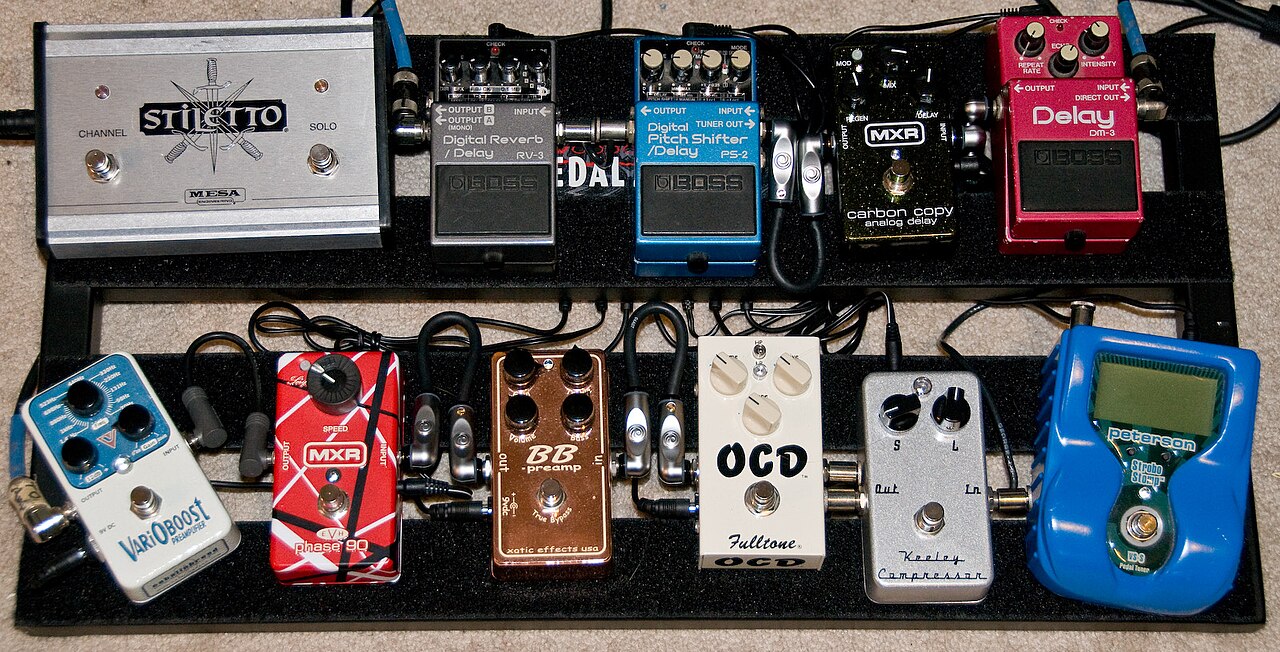
- A pedalboard with a mix of effects pedals: ArtBrom, Wikimedia Commons, CC BY-SA 2.0.
- Effects pedals piled together with a guitar behind them: Alessio Bragadini from Milan, Italy, Wikimedia Commons, CC BY-SA 2.0.
Latest News
Related
On This Day
Tuesday 10 November
From this week: