TC Electronic Sub ‘N’ Up Octaver: The Ninety-Dollar Box That Made Three Extra Guitarists Appear
TC Electronic Sub 'N' Up Octaver: polyphonic and classic octave modes, TonePrint, verified famous players, tone recipes, specs and buying advice.
There is a particular kind of pedal that changes how you play rather than how you sound, and the octaver is the purest example of the breed. Turn on a reverb and you are still the same guitarist in a bigger room. Turn on an overdrive and you are still the same guitarist with more hair. Turn on an octaver — a real one, with a second sub-octave and enough blend control to bury the dry signal — and the instrument in your hands stops being a guitar. It becomes an organ, a bass, a twelve-string, a synthesiser with a whammy bar, or a subsonic weather event that makes the PA engineer look up from his phone.
The TC Electronic Sub ‘N’ Up arrived in May 2016 into a category that had spent the previous decade being quietly conquered by Electro-Harmonix. It cost $129 street at launch. It is roughly $90 now. And it does something that the pedals it was competing with — many of them excellent, most of them more expensive — could not do: it gives you three separate octave voices, two completely different pitch-tracking engines, and a fully rewritable digital brain, in an enclosure small enough that you can wedge it between a tuner and a fuzz without redesigning your board.
Premier Guitar reviewed it in September 2016 and filled in the “Cons” field with a single word: None. That is not a common sight. This is the story of how a mid-priced digital box earned it, what it actually does, who has been photographed using one, and — because this guide has a house habit of reading the fine print — what happens when you compare the manufacturer’s own manual against the manufacturer’s own spec table and find that they disagree with each other twice on the same page.
The Problem the Sub ‘N’ Up Was Built to Solve
To understand why polyphonic tracking mattered so much in 2016, you have to understand what octave pedals were before it.
Classic analogue octave circuits — the ones descended from the Octavia, the Boss OC-2, the Mutron Octave Divider — work by frequency division. The circuit looks at the incoming waveform, finds the zero crossings, and builds a new square-ish wave at half the frequency. It is elegant, cheap, and completely dependent on the input being one note. Feed a divider a chord and it does not hear a chord. It hears a chaotic composite waveform with dozens of crossings per cycle, and it produces an output that sounds like a wasp trapped in a biscuit tin.
Guitarists learned to live with this. You played single notes on the low strings, you kept your tone knob rolled back to help the tracking, you accepted that the octave went strange above the twelfth fret, and you built the glitching into your musical vocabulary. Jimi Hendrix did not use an Octavia despite its instability; he used it because the instability sounded like the future. That tradition runs straight through the noisier end of rock history.
Then digital pitch shifting got good enough — and cheap enough — to put in a stompbox. A polyphonic pitch engine does not divide frequencies. It analyses the whole incoming spectrum, identifies the multiple simultaneous pitches inside it, and resynthesises them at the target intervals. Suddenly you could play a full six-string chord and hear the same chord, an octave down, in tune, without artefacts. Electro-Harmonix got there first for guitarists with the POG family, and their POG2 and the more affordable Nano POG effectively defined the market. DigiTech’s Whammy attacked the same territory from the expression-pedal direction.
What was missing was a pedal that did both. That gave you the pristine polyphonic thing and the crooked old-school thing, in one box, at a price that did not require a board-wide budget conversation. That gap is exactly the shape of the Sub ‘N’ Up.
What TC Actually Built
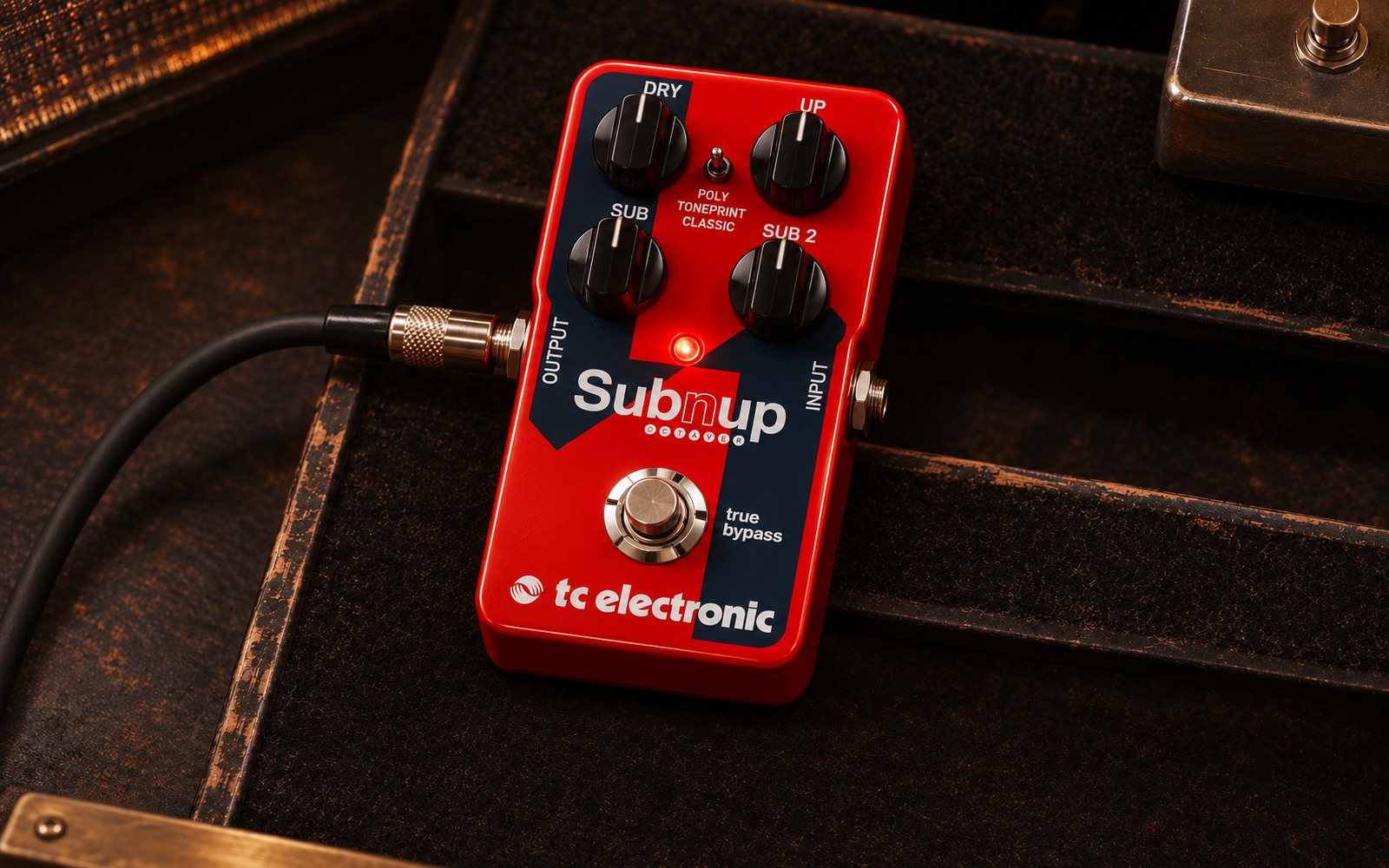
The pedal is a standard-format TC TonePrint enclosure with four knobs and one three-position toggle. TC’s own manual describes it, with characteristic Danish restraint, as “the new leader of the pitch-pack.”
The Four Knobs
Each of the four voices gets its own independent level control, which is the single most important design decision in the pedal. There is no “blend” knob balancing wet against dry; there are four faders, and you build the sound you want out of them.
- DRY — the level of your unprocessed signal. The manual’s instruction is blunt and useful: “Crank this knob if you want the same amount of dry signal as when Sub ‘N’ Up Octaver is bypassed.” In other words, full clockwise is unity. Anything less is a deliberate duck.
- UP — one octave above. TC’s own suggested application: “Try cranking this knob in classic mode to get some cool ol’ school Hendrix-type tones.”
- SUB — one octave below. The manual’s framing: “This can be used to fatten up riffs or getting fake bass sounds when backing down the dry signal completely.”
- SUB 2 — two octaves below, described in the manual as “earth-shattering,” with a warning attached that experimental bass players who crank it low enough may “potentially bring down the P.A.”
The Mode Toggle
The three-way toggle is where the pedal stops being a good octaver and starts being an unusually complete one.
POLY is the polyphonic engine — TC’s “latest in polyphonic pitch technology,” in the company’s phrasing, capable of handling “even the most complex jazz chords.” This is the mode that produces the fake twelve-string, the organ swells, and the enormous unison guitar-plus-bass sound.
CLASSIC is a monophonic octaver deliberately voiced to behave like a vintage analogue divider. TC does not hide from what this means. From the manual, verbatim: “you get all the warm, organic imperfections associated with classic analog stompbox octaving. Playing chords in this mode will lead to weird and beautiful glitches.” A manufacturer describing its own product’s failure state as beautiful is a manufacturer that understands its customer.
TONEPRINT is the third slot, and it is not a preset in any ordinary sense. It is a socket into which an entire alternative pedal can be loaded.
TonePrint, Explained Without the Marketing
TonePrint is TC’s system for rewriting what is under the hood of a pedal while leaving the physical controls where they are. A TonePrint file redefines the internal parameter set and remaps the four knobs onto whichever of those parameters the author chose. You load one via USB from a computer, or — and this remains one of the genuinely delightful pieces of engineering in modern pedal design — by holding a smartphone speaker against your guitar’s pickup and letting the app transmit the data as an electromagnetic signal that the pickup receives as audio.
One Thomann owner-reviewer described the mechanism accurately and with obvious glee: it “uses electromagnetic vibration in a coil of a smartphone speaker (and not the sound made by speaker cone) to communicate digitally with the pedal.” The same reviewer counted what the free TonePrint Editor exposes on this particular pedal: “In this mode all physical knobs and the curves of their response(!) can be remapped to around 50 different parameters. There are 8 different octaver settings, input EQ, EQs for each of the 2 subs and an EQ for up, modulation tab, etc.”
That is the crucial number. Fifty parameters, including a modulation section that the front panel does not otherwise give you access to at all. The TonePrint slot is where the Sub ‘N’ Up becomes a chorused octave-up shimmer machine, an organ with vibrato, an octave-fuzz, or a twelve-string with detune — none of which the four knobs can produce on their own.

Premier Guitar’s David Von Bader got a review unit preloaded with an organ TonePrint and it clearly derailed his afternoon. Through a Fender Pro Junior with a Strat, he found comped chords “became a great alternative rhythm guitar texture.” Through a 100-watt Marshall JCM800 and a 4×12, he wrote, “it sounded like Jon Lord and Ritchie Blackmore melded into a single musician!”
Specifications
What We Could Not Verify — And Where TC Contradicts Itself
This guide has a standing habit of checking first-party documents against each other rather than assuming a manual is internally consistent. On the Sub ‘N’ Up, that habit turned up three separate contradictions inside a single nine-page PDF.
One: current draw. Section 3.1 of the manual states that the pedal “requires a 9 V power supply providing 100 mA or more (not supplied).” The technical specifications table on page 8 of the same document states “>300 mA.” Thomann’s product listing says 100 mA. We cannot reconcile these from published sources. The house fix, used on every TC SKU in this guide where this has come up — and it has come up repeatedly — is to state both and budget for the higher one. If you are planning an isolated supply, reserve a 300 mA outlet and you will never think about it again.
Two: the battery. Section 2.3 says “If no power supply is available, you can run this product using a battery.” Section 6.2 gives step-by-step instructions for changing that battery, including the thumb-screw on the backplate. The spec table on page 8 lists “Battery option: —”, meaning none. Thomann, which physically stocks the thing, lists battery operation as supported and even suggests a compatible 9 V cell as an accessory. The retailer and the operating sections agree; the spec table is the outlier.
Three: the enclosure size. The spec table lists dimensions of 93 × 48 × 48 mm. That is not the full-size Sub ‘N’ Up. That is the exact dimensional triplet of TC’s mini enclosure — the same numbers this guide has already documented on other TC mini-format pedals. The full-size Sub ‘N’ Up is a standard four-knob compact and is visibly, obviously larger than a mini. The most plausible explanation is a spec table carried across from a sibling product during documentation assembly, which would also explain the “power supply included” line in the same table directly contradicting section 2.3’s “This product does not come with a power supply.”
None of this affects how the pedal sounds. All of it affects whether you can trust a spec sheet, and the honest answer is: trust the operating sections, trust the retailer who has the box in a warehouse, and treat the summary table as the least-checked page in the document.
Famous Players
Here is where the usual caution applies with more force than normal. TC Electronic runs an enormous artist programme, and a name appearing on a brand’s artist page tells you the brand and the player have a relationship — not that the player has ever put that specific pedal on a board. Every entry below is graded by what the underlying evidence actually is.
Photographic and Video Evidence — The Strong Tier
Steve Stevens is the cleanest sighting in the set. In a video walkthrough of his current pedalboard, the Sub ‘N’ Up is visible and in use at the 4:20 mark. Stevens has spent forty years building some of the most identifiable lead textures in rock — the Billy Idol records, the flamenco-inflected solo work, the Top Gun theme — and his boards have always leaned towards pitch and modulation extremes rather than a wall of dirt. An octaver with a rewritable modulation engine is precisely the kind of thing his rig has room for.
Gary Holt — Exodus, and for a decade Slayer’s touring guitarist — has the pedal appear at 2:06 in a rig video. This one is worth pausing on, because a thrash guitarist is not the obvious customer for a polyphonic octaver. But the Classic mode’s mono sub-octave, stacked under a high-gain riff, is one of the oldest tricks for making a downtuned part sound an entire cabinet size larger, and it costs nothing in tuning stability compared with actually dropping the guitar another step.
Theresa Wayman of Warpaint has the pedal documented in a photograph of her pedalboard taken during the band’s 2022 European tour. Warpaint’s guitar language is built almost entirely out of texture, interlock and space rather than riffs, and a blendable octave-up is a very Warpaint device — it thickens a repeating figure without adding a second guitarist.
Mark Lettieri — Snarky Puppy, The Fearless Flyers, and a solo catalogue that treats the baritone guitar as a lead instrument — has the pedal visible on his board in a November 2019 photograph. Lettieri’s whole musical identity sits in the register where a sub-octave becomes structurally load-bearing rather than decorative, which makes this one of the more musically legible sightings in the list.
Sergio Vega, longtime Deftones bassist, has it documented via his own Instagram. The Deftones connection is worth flagging because another Deftones-adjacent TC pedal, Stephen “Stef” Carpenter’s Ditto X2, got its own heading in a MusicRadar rig tour. Two members of the same band on TC boxes is a stronger signal than two unconnected sightings.
Guy Pratt — the bassist who has held down Pink Floyd’s low end since 1987, alongside a session career that runs from Madonna to Michael Jackson — appears via a 2016 pedalboard photograph. Bass is arguably where this pedal is most dangerous; Premier Guitar noted that the second sub-octave is “a huge part of the fun, especially when utilized on bass guitar through a proper bass amplifier,” and that “truly filthy textures lurk in the upper range of this control.”
Buck Meek of Big Thief has it in an Instagram story showing studio pedals, and Rob Scallon — the YouTube multi-instrumentalist whose entire creative method is “what if this instrument were wrong in an interesting way” — has it on his board in an Instagram post and visible in his videos.
The Interview Tier
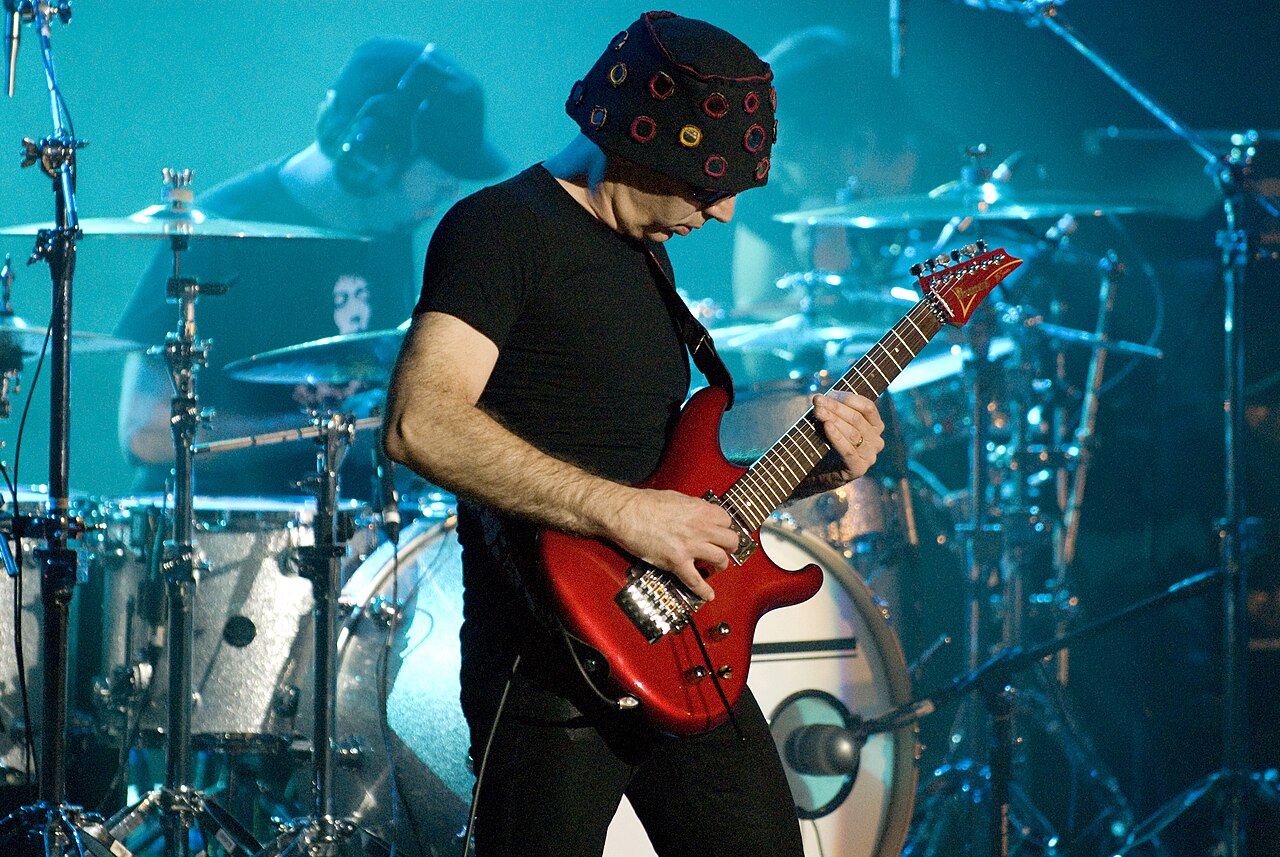
Joe Satriani is the highest-profile name on the list, and the evidence is an interview in which he says he used the Sub ‘N’ Up on a studio album, for one song. That precision is worth respecting in both directions. It is a genuine, volunteered, first-person statement of use — which puts it above any roster listing. It is also explicitly limited: one song, on one record. Anyone writing “Joe Satriani’s octave sound” around this pedal is inflating a modest, honest claim into something the source does not support.
Tyler Larson (Music is Win) not only has the pedal visible on his pedal shelf but built and released his own TonePrint preset for it, named “Phantom,” in a sit-down with TC. A player caring enough to author a preset is a meaningfully different level of engagement from a player owning the box.
The Brand-Demo Tier — Read With Care
Paul Gilbert appears in the roster via a video in which he “tests the octave-up feature of the Sub ‘N’ Up Octaver pedal.” That is a manufacturer demonstration, not an interview. The distinction matters and this guide applies it consistently: a demo video is excellent evidence that the artist has held the pedal and can explain it, and weak evidence of long-term rig use. Gilbert’s genuinely documented TC relationship sits elsewhere in the line — he named the MojoMojo as a rig mainstay in a 2016 magazine interview, unprompted, and TC eventually built him a signature version of it. That is the real endorsement. The Sub ‘N’ Up video is a video.
The Roster Tier — And a Broken Image That Tells You Something
Stephen “Stef” Carpenter of Deftones appears with the sourcing note “on the tc electronic website, it states stephan uses this pedal.” That is a brand roster entry, full stop. It is not corroborated by any photograph or interview we could locate. Amusingly, the attached source thumbnail on the aggregator is a logo for Lake — a completely unrelated pro-audio brand under the same corporate parent — which is a neat, accidental demonstration of how roster-scraped data degrades as it travels. Carpenter may well use one. This particular citation does not show it.
A final note for anyone cross-referencing aggregator data themselves: the band-affiliation fields on these pages are unreliable in a specific, repeatable way. On this page, Joe Satriani is filed under “Mark Knopfler’s Guitar Heroes” and Paul Gilbert under “The G3 Jam” — both one-off guest appearances inherited into the artist record rather than the bands anyone associates them with. It is the third TC product page in a row where this guide has found the same artefact.
Tone Recipes: Six Settings Worth Stealing
1. The Invisible Thickener
Mode: Poly · Dry: max · Up: 8 o’clock · Sub: 9 o’clock · Sub 2: off
The setting most owners end up leaving on. Neither octave is audible as a separate voice; they widen the harmonic envelope of what you are already playing. Clean arpeggios gain a bell-like top and a little chest. Nobody in the audience will identify an effect. Leave it on all night. This is the octave-pedal equivalent of a subtle always-on boost, and it pairs with the same philosophy as running a Spark Mini permanently engaged.
2. Fake Twelve-String
Mode: Poly · Dry: max · Up: 2 to 3 o’clock · Sub: off · Sub 2: off
Trevor Curwen’s recipe from the Guitarist review, near enough verbatim: set the high octave “somewhere in the higher regions of its travel for delivering a passable impersonation of a 12-string that can be thrown into a song for extra flavour.” Works best on open-position chords with a clean or lightly broken amp. Add a slow chorus after it and the illusion improves considerably. If you want to push it further, this is what the TonePrint slot exists for — a modulated octave-up is a much more convincing twelve-string than a static one, and Premier Guitar found the editor capable of “very convincing 12-string guitar tones.”
3. Guitar and Bass, One Player
Mode: Poly · Dry: max · Up: off · Sub: 1 o’clock · Sub 2: 9 o’clock
The duo setting. Curwen described exactly this territory as “the illusion of guitar and bass playing in unison.” Play root-position power chords low on the neck and the band gets an octave wider without anyone joining it. Keep Sub 2 restrained — the second sub-octave on a low E is down around 41 Hz, which is below what most guitar cabinets can reproduce and squarely in the region where it eats headroom from everything else on stage.
4. Seven Nation Army Territory
Mode: Classic · Dry: max · Up: off · Sub: max · Sub 2: off
Curwen again, naming the reference directly: Classic mode is “great for huge, tightly-tracked Seven Nation Army-style riffs or if you’re just wanting to play basslines on a standard guitar.” Monophonic tracking is tighter than polyphonic here, not worse — the divider locks onto a single note with a hard, immediate attack that the poly engine smooths out. Play one note at a time, stay in the lower half of the neck, and let the glitches happen when you slip. Jack White made a career out of that particular sound existing.
5. Hendrix-Adjacent Octave Fuzz
Mode: Classic · Dry: 1 o’clock · Up: max · Sub: off · Sub 2: off · Into a fuzz
TC’s own manual points at this: crank Up in Classic mode “to get some cool ol’ school Hendrix-type tones.” The critical detail is signal order — the octave must come before the fuzz, not after, because the ring-modulator-ish upper-octave character of the original Octavia sound comes from a dirty signal being multiplied, not from a clean octave being dirtied afterwards. A Big Muff after it will smear the octave into a scream; a RAT after it keeps more of the note intact. Play above the twelfth fret on the D and G strings, where octave-up circuits historically sing rather than choke.
6. Doom, Actual Doom
Mode: Poly · Dry: 11 o’clock · Up: off · Sub: 2 o’clock · Sub 2: 1 o’clock · Into high gain
Curwen called the pedal “the perfect tool for stoner rock and metal players looking for the sound of doom.” Pulling the dry signal back below unity is the trick most players miss: it stops the sound being “a guitar with weight underneath it” and starts making it “a thing playing in a register guitars do not occupy.” Slow the tempo, use whole notes, and check with the front-of-house engineer before you deploy it, because Premier Guitar’s warning about the second sub-octave — “truly filthy textures lurk in the upper range of this control” — is not hyperbole and neither is TC’s PA warning.
The Rule That Governs All Six
Octave pedals go early. The pitch engines need a clean, full-bandwidth signal to analyse, and every stage of compression or distortion in front of them reduces the amount of pitch information available. Tuner first, then wah, then octave, then dirt. If you run a PolyTune 3 or a Boss TU-3 at the front of the chain, the Sub ‘N’ Up wants to be roughly the next thing it sees.
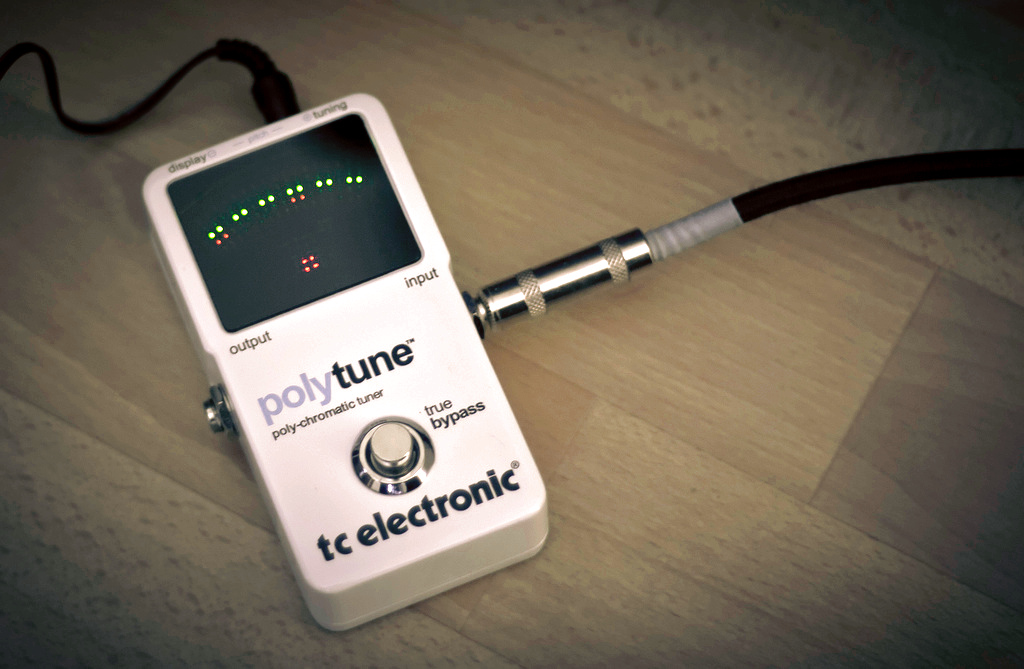
All knob positions are given as clock face. Assume DRY at maximum unless stated otherwise, because that is unity with bypass and it makes every other setting an addition rather than a trade.
How It Compares
Versus the Electro-Harmonix POG Family
The POG2 is the deeper instrument: more voices, attack and filter shaping, presets, and a specific glassy organ character that has become its own genre. It also costs substantially more and takes up considerably more board. The Nano POG is the direct price competitor and the comparison most owners actually make.
A Thomann owner who has run both put it clearly: the Micro POG “is a beast of its own and a wonderful octave generator,” but “to my ears it has slower tracking specially on lower tones. On high notes it produces the classic glitching tone which makes it suitable for dirty sounds and that’s where it shines best.” His conclusion was that he needed “a very natural sounding octaver with less to no glitches and the Sub ‘N’ Up Octaver exactly does that.” That is a fair summary of the split: EHX for character, TC for accuracy — plus a second sub-octave and a mono mode that EHX’s nano-format boxes do not offer at all.
Versus the EHX Pitch Fork
The Pitch Fork is a different tool wearing similar clothes. It shifts to arbitrary intervals across a three-octave range and does detune and latching bends; the Sub ‘N’ Up does octaves only. If you want fifths, minor thirds or a slow pitch dive, the Pitch Fork is the answer. If you want octaves that sit in a mix without you thinking about them, the Sub ‘N’ Up is.
Versus the DigiTech Whammy
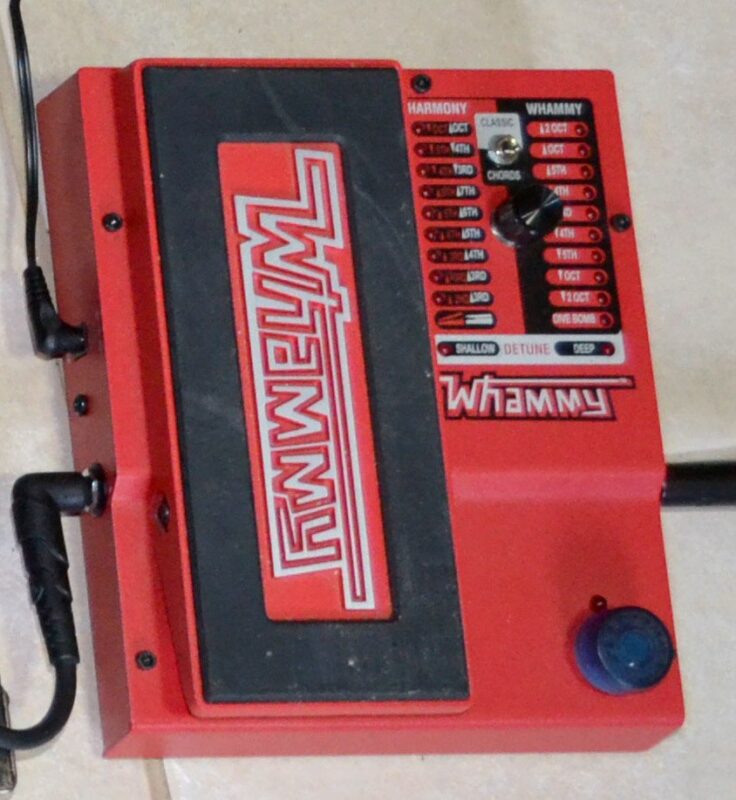
Not really a competitor, and Premier Guitar said so directly. The Whammy is a performance instrument built around a treadle; its whole point is pitch that moves under your foot in real time. Von Bader’s only qualification of the Sub ‘N’ Up in an otherwise glowing review was that “the lack of treadle means some extremely radical octave-shift maneuvers remain impossible.” True, and irrelevant if what you wanted was three fixed octaves. Many boards carry both.
Versus the Organ and Synth Boxes
The TonePrint organ presets are the entry point to territory that EHX’s B9 and Synth9 occupy full-time, and that Boss’s SY-1, the SY-200, Source Audio’s C4 and Meris’s Enzo take considerably further. The honest framing: the Sub ‘N’ Up gets you a convincing combo-organ impression for free, as a bonus on top of an octaver you were buying anyway. It does not replace a dedicated synth pedal. It does mean you may discover you never needed one.
Versus the Rack and Multi-FX Approach
Eventide’s PitchFactor and H9 will out-pitch-shift this pedal in every technical respect and cost several times as much while doing it. The Sub ‘N’ Up’s argument has never been that it is the best pitch shifter available. It is that it is the best octave-per-dollar-per-square-inch on the market.
Versus the Sub ‘N’ Up Mini
TC’s own mini version costs roughly $67 against the full-size pedal’s $90 and fits in a footprint the size of a matchbox. What you give up is the front panel: the Mini has no independent knob for each voice and no physical mode toggle, so the multi-voice blends and the Poly/Classic switch have to be set through TonePrint rather than by hand. If you know exactly one sound you want and will never change it, the Mini is the smarter purchase. If the appeal of this pedal is the four-fader mixing desk on top of it — and for most players it is — the extra twenty-odd dollars buys the entire point.
Buying Guide
Who Should Buy One
The guitarist in a two-piece who needs the low end filled. The bassist who wants a synth register without a synth. The texture player building parts out of layers rather than riffs. The metal guitarist who wants downtuned weight without downtuning. The studio player who wants a twelve-string, an organ and a bass guitar available on one footswitch. And — a category worth naming explicitly — anyone who has been curious about polyphonic octaves but not curious enough to spend two hundred dollars finding out.
Who Should Not
Players who want intervals other than octaves. Players who want pitch that moves. Players who need dry and wet signals separated for parallel amp rigs — this is the one substantive criticism in the Guitarist review, whose Cons field read: “Separate outputs for the dry sound and the octaves might have enhanced the versatility.” The Sub ‘N’ Up has one output. If your rig depends on sending the sub-octave to a bass amp and the dry signal to a guitar amp, this is not the pedal.
What It Costs
Launch was $129 street in the US, £122 in the UK. Thomann now lists it at $90 against 416 customer ratings averaging 4.5 out of 5 — 264 of those five stars, 123 four, and only six ratings below three across the whole sample — with 277 written reviews and a sales rank of 149 in the Miscellaneous Guitar Effects category. It has been “available since May 2016” and remains a top-150 seller in its category a decade later.
That is a roughly 30% real-terms price decline on a product that never stopped selling, which is the same pattern this guide has now documented across the Ditto, the Spark Mini and the MojoMojo. It is not a signal of failure. It is what happens when a manufacturer with serious manufacturing scale keeps a successful design in production through a decade of a brutally competitive market.
Buying Used
Digital pedals with no analogue signal path and no moving parts other than one footswitch age extremely well. The things worth checking on a used Sub ‘N’ Up: that the footswitch does not need a firm stamp, that the USB port is intact — a damaged Mini-B socket cuts off TonePrint loading and firmware updates permanently — and, if the seller will humour you, that the pedal has been updated to current firmware. That last one is done over USB from a computer, free, and takes about two minutes.
Living With It
The Bypass Switch Nobody Notices
The Sub ‘N’ Up ships true bypass, but there are two DIP switches under the backplate and the upper one — the one nearer the power jack — swaps it to buffered. TC’s own guidance in the manual is more sensible than most marketing on this subject: true bypass suits “setups with a few pedals and relatively short cables,” while long cable runs or a crowded board mean “the best solution will most likely be to set the first and the last pedal in the signal chain to Buffered Bypass mode.” Since the Sub ‘N’ Up wants to sit near the front of the chain anyway, it is a strong candidate for the buffered position. And TC’s closing line on the topic deserves quoting for its refusal to oversell: “Maybe, maybe not — many factors apply… Use your ears and find the best solution for your setup!”
The Frequency-Range Limit
The most substantive owner complaint in the Thomann review body concerns bandwidth in the two fixed modes. One reviewer, using the pedal on harmonica rather than guitar, found that “the EQ limits the range within which the octaver adds the SUB 2, SUB, and UP to your signal” — and that in Poly and Classic modes it “doesn’t respond to the higher tones in the higher octaves.” His workaround is instructive: in the TonePrint mode he could turn that limiting off and open up the full range. His stated wish was “to be able to turn the limiters off for the poly and classic mode as well.”
For a guitarist this rarely bites, because the guitar’s fundamental range sits comfortably inside the window. If you are feeding the pedal something unusual — harmonica, keys, a high-tuned instrument, anything above standard guitar range — expect to build a TonePrint rather than use the fixed modes.
Tracking on Bass, Honestly
A bass-playing Thomann reviewer reported that “the octave down tracking seems to not work around the middle of the fretboard on the A string,” and that in Poly mode “octave up has too much sub bass and octave down is just rumble.” His favourite setting was Classic, in front of a Big Muff, where it “makes you sound Huge.”
That is worth taking seriously as a counterweight to the review-press consensus. Polyphonic pitch tracking on bass is a harder engineering problem than on guitar — the fundamentals are lower, the harmonic content is different, and the analysis window has to be longer. The pedal works on bass; several documented users are bassists. But the Classic mode is genuinely the stronger bass mode, which inverts the usual assumption that the polyphonic engine is the good one and the mono engine is the novelty.
The One Reported Software Frustration
The same bassist noted a problem storing a custom TonePrint he had created in the editor. This appears to be an individual case rather than a pattern — the overwhelming majority of the 277 Thomann reviews raise no software issue at all — but it is a reminder that the TonePrint chain involves an app, a computer, a USB link and a firmware version, and that any of those can be out of date. If a preset will not store, updating the pedal’s firmware and the editor before doing anything else solves most of these.
Board Placement and the TC Ecosystem
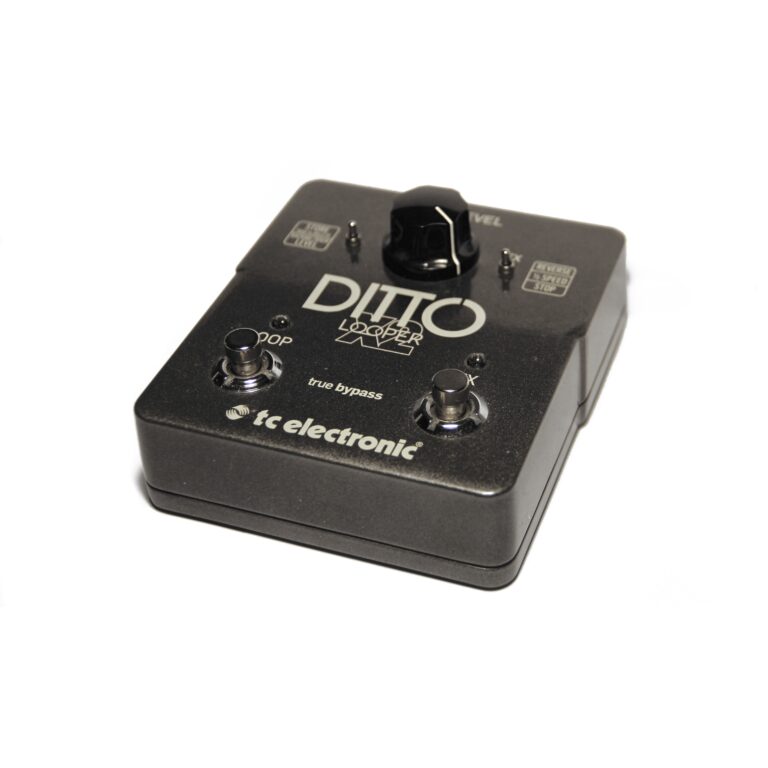
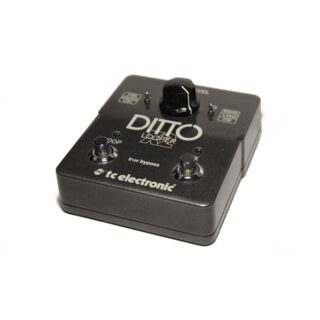
If you already run TC pedals, note that they share the TonePrint app and the same beam-through-the-pickup mechanism, so adding a second or third one costs no new workflow. A common TC-heavy board runs PolyTune into Sub ‘N’ Up into dirt into Flashback 2 into Hall of Fame 2, with a looper such as the Ditto X2 at the very end. The octaver at the front, the time-based effects at the back, everything beamable from one phone.
Frequently Asked Questions
Is the Sub ‘N’ Up good for bass?
Yes, with a caveat. Premier Guitar singled out the second sub-octave as being at its most fun “on bass guitar through a proper bass amplifier,” and several documented users are bassists, including Pink Floyd’s Guy Pratt and Deftones’ Sergio Vega. But owner reports suggest the polyphonic mode’s tracking is less reliable in the middle of the bass fretboard than on guitar, and that the monophonic Classic mode is often the better choice for bass. Try both before deciding which one lives on your board.
What is the difference between Poly and Classic mode?
Poly uses digital polyphonic pitch analysis and can track full chords cleanly, with no glitching and — per Premier Guitar’s testing — “without pronounced latency or glitchy artifacts.” Classic emulates a vintage monophonic frequency divider: it tracks single notes with a harder, tighter attack, and it deliberately falls apart on chords. TC’s own description of that failure is that it produces “weird and beautiful glitches.” Neither mode is better; they are different instruments sharing a chassis.
Do I have to use TonePrint?
No. Poly and Classic are fully usable without ever installing the app or connecting a computer, and most owners use the pedal that way. But the TonePrint slot is where the modulation engine, the eight alternative octaver algorithms and the per-voice EQ live, and none of that is reachable from the four knobs. Ignoring it means using roughly half the pedal.
How do I load a TonePrint?
Two ways. Over USB from a Mac or PC using the free TonePrint Editor, or wirelessly from the free phone app: plug in, turn the pedal on, turn your guitar’s volume up, select a single pickup, hold the phone’s speaker against that pickup and hit “Beam to pedal.” The pickup receives the data as an electromagnetic signal. It looks like a magic trick and works reliably.
Where should the Sub ‘N’ Up go in my signal chain?
Early — after your tuner and wah, before your overdrives and fuzzes. Pitch-tracking engines need the cleanest, most complete signal available, and compression or distortion in front of the pedal makes the analysis harder. The one deliberate exception is a very compressed clean signal, which some players use to help the Classic mode lock on to single notes more consistently.
Does it need a lot of power?
The manual’s operating section and Thomann both say 100 mA. The manual’s own specification table says more than 300 mA. Since the two first-party figures contradict each other, budget for the higher one: give it a 300 mA outlet on an isolated supply and the question never comes up again. It also runs on a 9 V battery, despite the spec table listing no battery option — the manual includes battery-changing instructions and a thumb-screw backplate to reach it.
Is it true bypass or buffered?
True bypass out of the box, with buffered bypass available via the upper of two DIP switches underneath the backplate. TC recommends buffered mode for the first and last pedals on larger boards or with long cable runs — and since this pedal belongs near the front of the chain, that recommendation frequently applies to it.
Sub ‘N’ Up or Sub ‘N’ Up Mini?
The Mini is cheaper and dramatically smaller, but it loses the four independent voice knobs and the physical mode toggle, which means every blend and mode change has to be programmed via TonePrint instead of dialled by hand. If you have one fixed sound in mind, take the Mini and the board space. If you want to actually mix the four voices — which is the main reason to own this pedal at all — take the full-size version.
The Verdict
The Sub ‘N’ Up is not the deepest octave pedal ever made, and it never claimed to be. What it is, is the pedal that made three-voice polyphonic octaves an ordinary thing for an ordinary guitarist to own — a mid-priced box that tracks chords cleanly, glitches beautifully on request, hides an organ and a modulation engine behind a toggle position, and takes up no more room than an overdrive.
A decade after launch it is still in production, still selling in the top 150 of its Thomann category, still averaging 4.5 stars across more than 400 ratings, and now costs about seventy percent of what it did in 2016. Premier Guitar handed it a Premier Gear Award and could not think of a single thing to put in the Cons box. That verdict has aged well.
And the deeper reason is the one this article opened with. The Sub ‘N’ Up does not make your guitar sound better. It makes your guitar sound like something else — a bass, an organ, a twelve-string, a subsonic rumble that arrives before the note does — and then hands you four knobs to decide how much of “something else” you want. That is not a tone-shaping tool. That is a songwriting tool wearing a tone-shaping tool’s clothes, and at ninety dollars it is one of the cheapest ways to be surprised by your own instrument that the pedal market currently offers.
Image credits
- Top image: GuitarGangsters AI-generated reference illustration, not a photograph.
- A TC Electronic PolyTune pedal: Antti Simonen, Wikimedia Commons, CC BY 2.0.
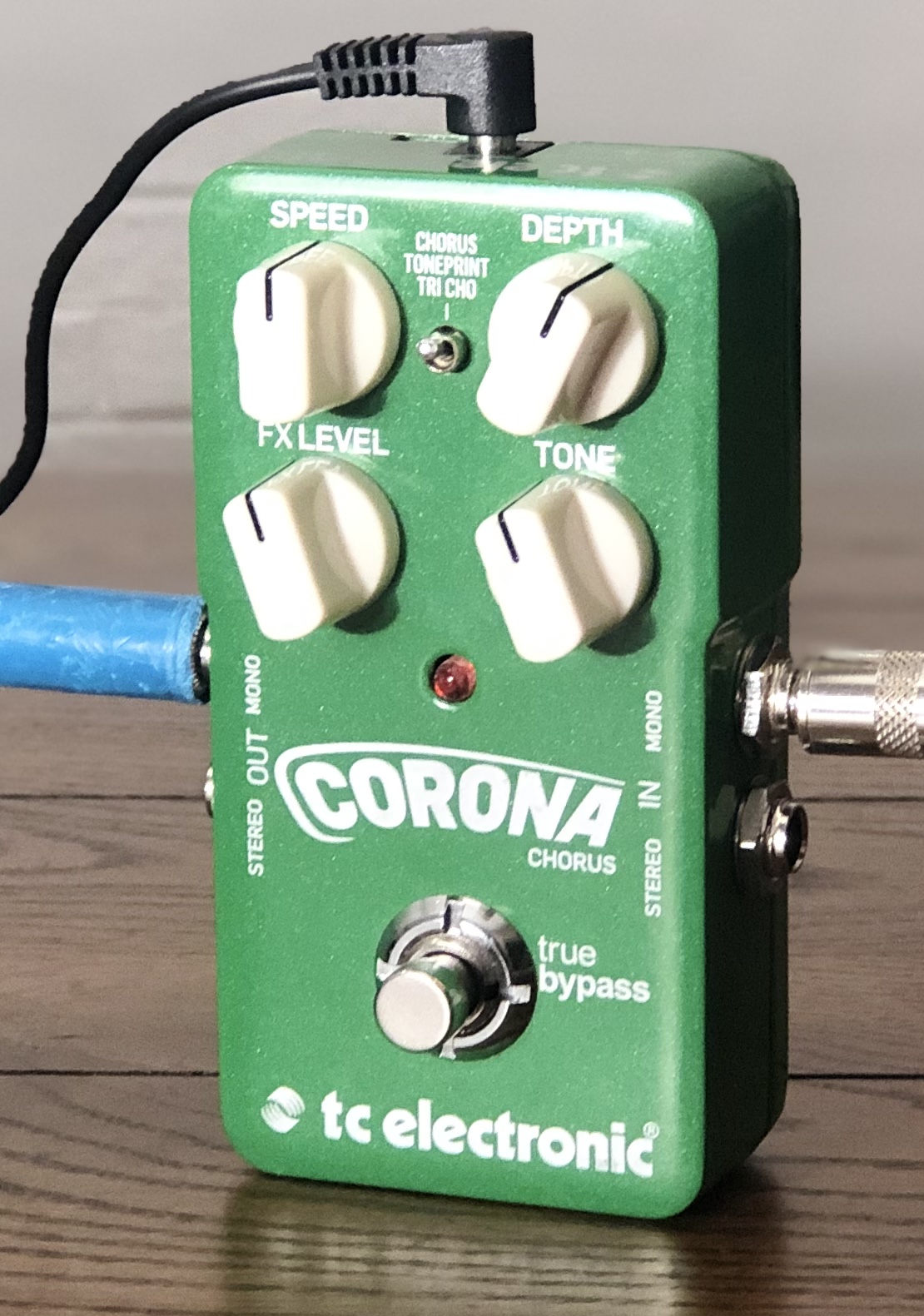
- A TC Electronic Corona Chorus pedal, cropped: Guitar Chalk, Wikimedia Commons, CC BY 2.0.
- Paul Gilbert: matt barsden, Wikimedia Commons, CC BY-SA 2.0.
- Joe Satriani: livepict.com, Wikimedia Commons, CC BY-SA 3.0.
- DigiTech Whammy V: marcelodonati, Wikimedia Commons, CC BY 2.0.
Latest News
Related
On This Day
Monday 9 November
From this week: