Analog Man Sun Face: The Fuzz Face Finally Done Right
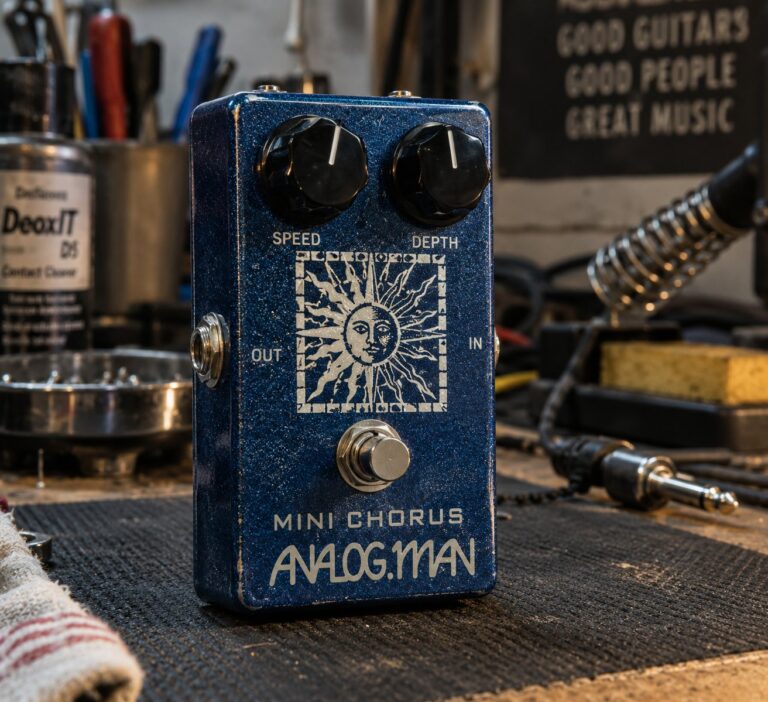
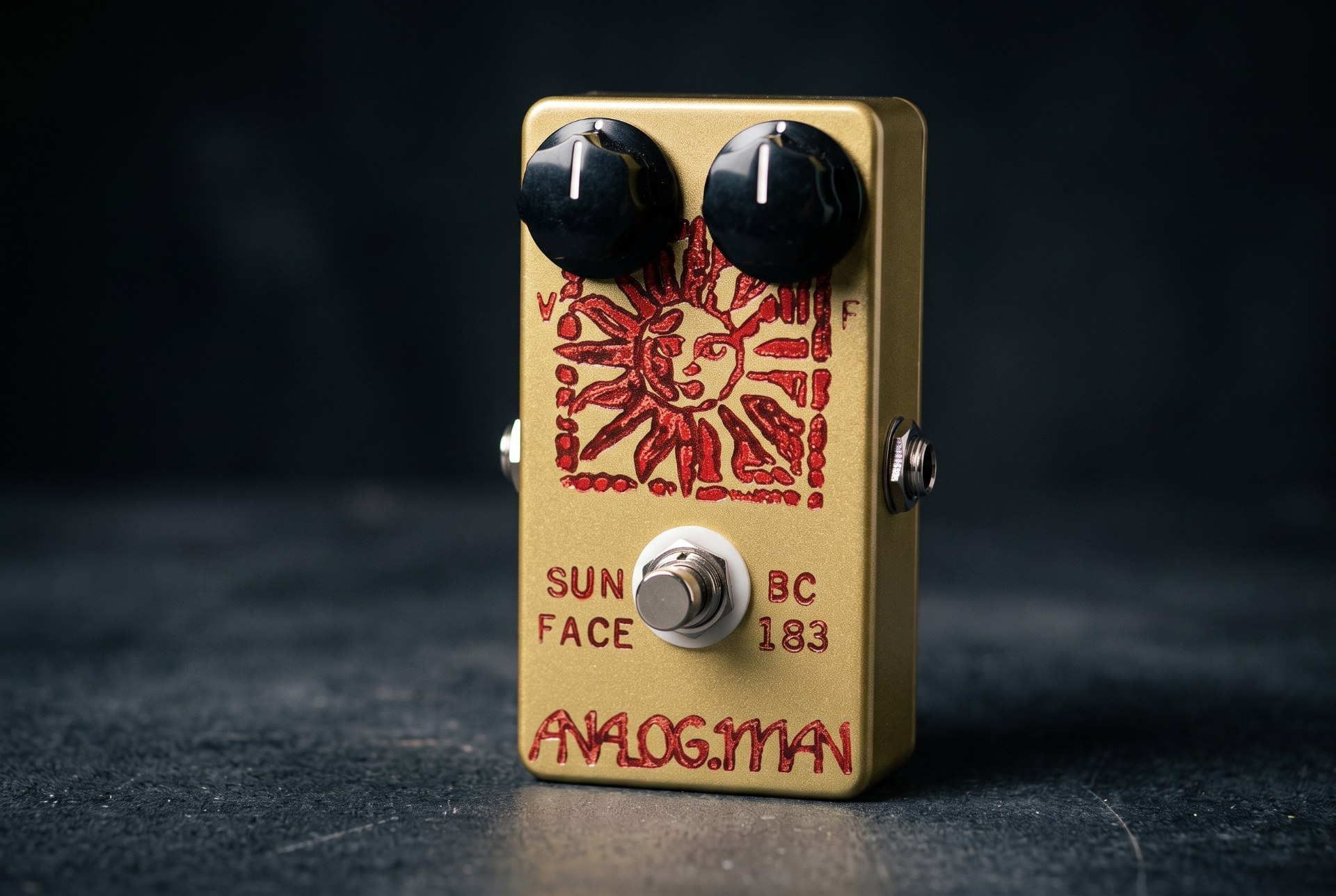
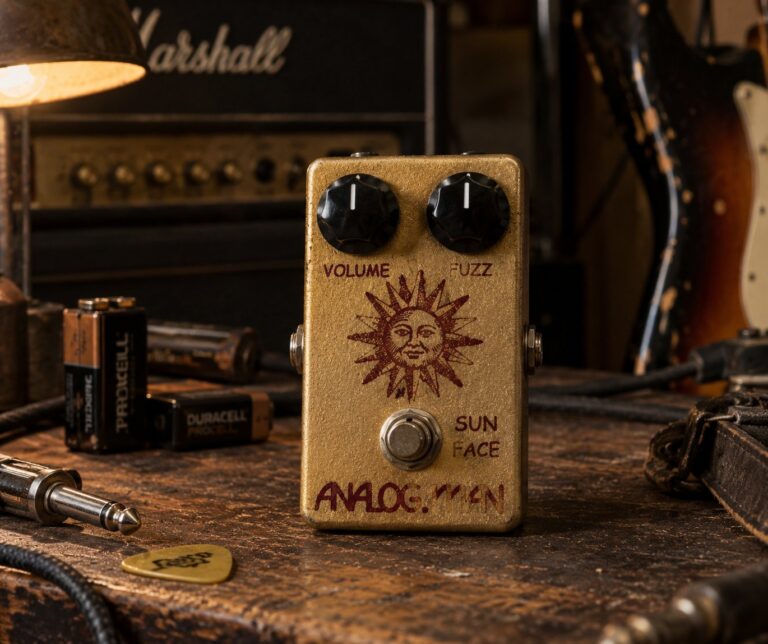
An AI-generated illustration of the Analog Man Sun Face.
Complete Analog Man Sun Face guide: every transistor option decoded, the Sun Dial and Clean trimpot explained, verified players and 2026 buying advice.
Two transistors. Two resistors of consequence. A handful of capacitors. The Dallas Arbiter Fuzz Face is very nearly the simplest circuit anyone ever sold to a guitarist, and it is also the one that most reliably breaks people’s hearts. You buy one because of “Purple Haze” and the Beano album. You plug it in. It farts. It hisses. It sounds fine in your bedroom in February and completely dead on stage in July. You sell it.
The reason is not the circuit. It is the two transistors, and the fact that nobody in the mass-production business can afford to test them properly.
In a cramped two-room shop on the second floor of an old house behind a disused strip mall in Bethel, Connecticut, a former software engineer named Mike Piera has been doing exactly that testing, by hand, one pair at a time, for over two decades. The pedal that comes out of it is called the Sun Face, and it is not really one pedal at all. It is a menu — germanium or silicon, high gain or low, 1960s British military stock or 1960s Japanese organ pulls or Russian parts routed out through Ukraine — assembled to order in a small gold box.
This is not a review. It is the map: what Piera actually does that Dunlop cannot, what every transistor in the catalogue sounds like, why the two most important controls on the pedal are not on the outside of it, which famous players are genuinely documented on a Sun Face and which are just names on a customer list, why plugging it into your pedalboard power supply can destroy the power supply, and what any of it costs in 2026.
Why a Fuzz Face Is So Hard to Get Right
Piera’s own explanation of the problem is the most useful thing written about this circuit anywhere, and it starts with a comparison. A Tube Screamer, he points out, will always sound good if you install the right chip and the right parts correctly. The op-amp does the work and the op-amp is a mass-produced, consistent, specified component.
A Fuzz Face is the opposite. There is no chip. The two transistors are the circuit, and germanium transistors — the first type available in any quantity, from the early 1960s — were never stable or consistent to manufacture. Silicon took over around 1970 and essentially nobody has made a decent germanium transistor since. Each one that goes into a good fuzz has to be tested for gain, leakage, noise and, crucially, tone. Piera built dedicated bench equipment to test four parameters per part, originally in a set of ugly boxes, since rehoused into a steel cabinet for durability.
The economics of that are brutal for a large company. You cannot pay someone to sit and hand-match transistor pairs by ear on a product with a retail price under two hundred dollars. So, as Piera puts it, most do not even try. He is generous about it — his shop carries the Dunlop line and he rates the blue BC108 Jimi Hendrix model as genuinely great — but the gap in approach is the whole reason the Sun Face exists.
He is also honest about who the pedal is for, in a disclaimer that sits near the top of his own page and which no marketing department on earth would have approved. A Fuzz Face, he writes, is not an easy pedal to get a great sound out of. If you have a budget guitar and a budget amp, do not expect to sound like Jimi. You will need an excellent guitar and amp, several years of playing, and some prior experience of other fuzzes to appreciate what this circuit is doing. It may take time to make it work with the rest of your rig. The pedals are made for pros — though he adds, decently, that a beginner willing to work at it should still get great tones.
From The Band’s Telecaster Player to a Gold Box
Piera was a software engineer posted to Japan in the mid-1980s, where he found a thriving market in vintage American guitars and effects. He started buying and selling on the side, moved from guitars to pedals, and discovered that a lot of the pedals were simply badly built — but that he had a knack for reverse-engineering them, as he puts it, “so we could really figure out what made them tick,” then rebuilding them with better parts and extra features.
He began trading under the Analog Man name in 1993, at the first Classic American Guitar show on Long Island. His early modification work — Ross compressors, Ibanez Tube Screamers, the Electro-Harmonix Small Clone — built a following, and there was a waiting list for the modified Ross compressor years before there was a King of Tone. In 2000 he quit software entirely and set up Analog.Man Guitar Effects in Bethel, in the same rented space he still occupies a quarter of a century later.
The Sun Face has an origin story with a name attached. Piera built a custom-painted Fuzz Face for Jim Weider, the Telecaster player who replaced Robbie Robertson in The Band. It looked, in Piera’s own words, too cool — and he was never able to reproduce the paint job. Weider later had him re-house the circuit in one of the grey CompROSSor boxes so it would not look like any other Fuzz Face on a stage. That rehoused unit, Piera says, “was in effect the first SUN FACE pedal.” He subsequently fitted it with NKT-275 transistors and a Sun Dial knob and moved it into the small gold box that became the production format. The original painted one now belongs to Kenny Wayne Shepherd.
Weider is a recurring character in this shop’s history — the King of Tone itself was born from an attempt to build him a better overdrive around 2003. If you want the other half of the Analog Man story, our Analog Man King of Tone guide covers the pedal with the six-year waiting list.
Specs at a Glance
| Specification | Analog Man Sun Face |
|---|---|
| Type | Two-transistor fuzz, Dallas Arbiter Fuzz Face topology |
| Standard controls | Volume, Fuzz, footswitch |
| Internal controls | CLEAN trimpot (white); BIAS trimpot (blue, germanium models) |
| Optional third knob | SUN DIAL — external bias, $25 option |
| Bypass | True bypass (standard on all Fuzz Face circuits) |
| Power | 9V battery standard; power jack is an option, not fitted by default |
| Polarity | Germanium is positive-ground internally, but wired for normal centre-negative Boss-type supplies |
| Current draw | Under 1 mA while playing; less at idle |
| Battery life | Several hundred hours without an LED; roughly 4× faster drain with one |
| Enclosure (to mid-2007) | 125B “small” box, 2.5″ × 4.75″ × approx. 1.5″ |
| Enclosure (late Aug 2007 on) | MXR “B” box, 2.25″ × 4.25″ × approx. 1.25″ |
| Enclosure (BART transistors) | Larger box — the Russian parts do not fit the smaller one |
| Other options | Top or side jacks, LED, on/off Fuzz pot ($15), external Clean knob, custom graphics |
| Build | Hand-built in Bethel, Connecticut, USA; boards to military-spec standards with shielding and plated through-holes |
| Build time | Approx. one week to order; some “quick deal” configurations ship immediately |
The Transistor Menu, Decoded
This is the part that paralyses buyers, and it deserves a warning before it deserves a description: most of the famous options on Analog Man’s page are historical. Piera documents his stock levels honestly and in public, which is admirable and also means the page reads like a menu when it is partly a museum. Before you fall in love with a transistor type, check whether he still has any.

The germaniums
NKT-275, white dot. The holy grail, and gone. These are early-1970s British Newmarket parts made to a NATO military specification, with almost no leakage, a little brighter than the red dots and with better high-end definition. Piera first got original 1960s NKT-275s in July 2002 after a nine-year search; the white dots arrived that November. He ran out in 2011 and has kept the remainder back for repairs, because everything offered to him since has been either relabelled fakes or batches with the good ones already picked out. The NKT sound is less fuzzy and less fizzy than other germaniums, deeper, and it cleans up better than almost anything: roll your guitar volume back and it goes totally clean, with no fuzz remnants at all.
NKT-275, red dot. Also gone, sold out again in late 2015. Softer, darker, smokier, with genuine mojo but less clarity. They do not get sparkly clean on the volume rollback, but they have a longer, smoother taper on the way down, which makes it easier to find exactly the right amount of dirt. More finicky at varying temperatures — which is why Piera says the Sun Dial has an unusually wide range on these.
Mullard CV7005. The honest workaround, and a great piece of detective work. Piera found that almost all NKT-275s sold in the last decade or so are relabelled parts, and could faintly read a CV7005 marking under the fresh printing on some of them. So he bought a batch of genuine CV7005 in the UK. They carry the code KBDA 7301: K for manufactured to specification, B for UK military approval, D for Mullard Ltd, A for the Blackburn factory, 7301 for the first week of 1973. They sound like an NKT-275 because they very probably are the same thing — closer to the white dot than the red, a little brighter and clearer.
TI/UK CV7003. A large 2008 batch from Texas Instruments’ Bedford, England plant, with NQ date codes (NQ6843 = week 43 of 1968). Medium-high gain, brighter and less woolly than the 2SB parts, similar in voicing to the high-gain NKTs. Sold out in 2017, restocked, sold out again in early 2023.
2SB171 / 2SB175. 1960s Japanese parts by Hitachi, Toshiba or Matsushita, which Piera used to harvest from dead Acetone organs in the early 1990s. Brighter and fuzzier than the NKTs; darker and woollier than the TI/UK. The 171 is the lower-gain of the pair, the 175 higher. Low-gain 2SB units make the closest surviving approximation of the white-dot NKT’s clean-up behaviour. These same transistors turned up in the Japanese Crazy Face fuzzes Sears sold in the early 1970s, which sounded bad only because they were biased wrong — correct a few resistor values and they are excellent.
General Electric 2N types. American 1960s germaniums pulled from forty-year-old new-old-stock Baldwin organ tone generator boards. These are the parts you see repeatedly in Gear Page “pedal guts” threads under other boutique brands’ logos.
High-gain germanium. The same family as the Baldwin pulls but tested high; some are Texas Instruments parts dated 1974. Shorter, fatter metal cans than the NKT and 2SB.
RCA. Introduced 2018 and, for most working players, the single most sensible germanium on the list. Like the red-dot NKT they are house-numbered rather than carrying a standard 2N part number. Bright for germanium, normal gain, excellent clean-up — and, decisively, very stable at temperature, so they keep working under stage lights when other germaniums go flat. A second RCA batch dated 1967 arrived in mid-2022; those sound similar but are not good at temperature extremes, so the year matters.
BART — Big Ass Russian Transistors. In from 2020. Huge-sounding, easy to use, fuzzy with full clean-up on the guitar pot, and heavy in the low end, which the Clean trimpot or knob can tighten. Inherently medium-high gain. They are physically too big for the small box, so BART units ship in the larger enclosure — which conveniently allows every option. Occasionally a little noisy; Piera discards the worst.
RCA/BART hybrid. RCA in the first position for temperature stability and brightness, BART in the second for size. Owners on the forums describe it as rawer and more aggressive than a white-dot NKT while still cleaning up on the volume knob, with more low end than the other options and a particular affinity for humbuckers. Piera also offers hybrids pairing RCA with a red-dot NKT or a high-gain BART.
NPN germanium, British CV. Military CV equivalents of a 2N type, made in 1976. Voiced like the RCA — bright, decent clean-up, going bright and British at the top. Medium-high gain, which Piera calls his favourite range. The practical benefit is the normal polarity: an NPN germanium Sun Face can go on a daisy chain, though he still recommends isolated power.
The silicons
Silicon Fuzz Faces arrived around 1969 and Dallas Arbiter used BC108 and BC109 types. Silicon is fuzzier, brighter and much higher gain than germanium; it does not go completely clean on the guitar volume the way an NKT does, but it cleans up substantially and stays dynamic. Silicon is a no-cost option on a new Sun Face. It is also negative-ground, so power sharing is far less dangerous.
BC183. Plastic-cased, medium-high gain, warmer than the BC108 and the smoothest of the silicons — almost germanium-like, per Piera, and closer to Eric Johnson than to Hendrix in character. Vintage Guitar reviewed this version in September 2013 at $185 and described it turning a clean amp into “a warm, woolly mammoth,” reminiscent of Clapton’s Beano and early Cream years, with the guitar’s volume control still taming a maxed Fuzz knob into punchy blues lines. Piera believes Eric Johnson’s long-serving red Fuzz Face has BC183s in it, and that the 2012 Dunlop Eric Johnson signature model uses them too. It is also his recommendation for bass players, with a note on the order for extra low end.
BC108C. The classic 1970 Fuzz Face part, usually Telefunken-branded. Piera got a batch of Telefunken BC108C in May 2013; they do not look identical to the 1970 or late-1970s parts, so although they appear to be TFK he will not guarantee it — and therefore does not charge extra. “C” is the highest gain grade; B is lower. He keeps a small number of genuine NOS BC108C aside for restoring original Fuzz Faces, where the price is justified.
BC109. Added in late 2012 by request, after word spread that David Gilmour may have had these fitted to a Fuzz Face — offered as a no-cost option alongside clock graphics, in tribute to the solo on “Time.” Grittier and edgier than the BC108, less smooth than the BC183, but they cut through a band exceptionally well. Telefunken BC109B and BC109C followed in spring 2014, edgier still, with a nice attack and a fuzzy roundness that helps them poke through.
The AC128 myth, dismantled
You will read on plenty of websites that original Fuzz Faces used AC128 transistors. Piera, who has seen hundreds of originals and whose friends in this corner of the hobby have seen hundreds more, says flatly that none of them has ever seen an AC128 in a genuine 1960s Fuzz Face. The AC128 was in the grey 1990s reissues — and the ones he pulled out of those sounded horrible. He has tried most AC128 variants available on eBay and from suppliers worldwide and has piles of them sitting unused. Some square heat-sink versions are passable, with a muffy, compressed, saturated tone that a few players enjoy, but they lack the clarity he is after. If a seller is charging a premium for an AC128 fuzz on the grounds of vintage authenticity, that premium is being charged for a story.
The Two Most Important Controls Are Inside the Pedal
A stock Sun Face has two knobs. It has four controls.
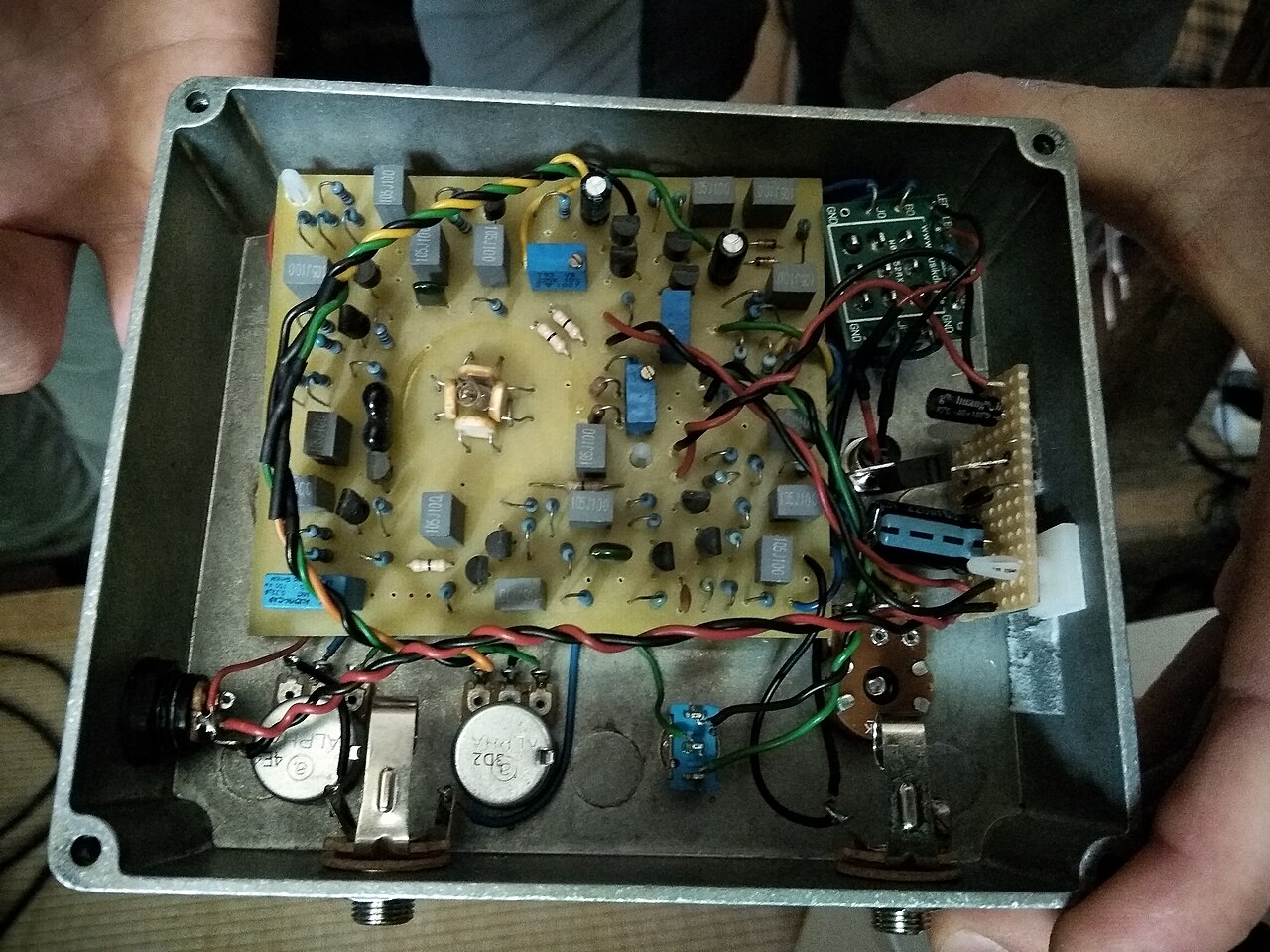
The CLEAN trimpot (white)
This sets the input level, and it behaves exactly like turning down the volume knob on your guitar — which means you can preset the pedal to sit permanently in the rolled-back sweet spot, then use your guitar’s actual volume control for finer movements from there. It also has three uses that nobody mentions when they sell you a fuzz. It kills radio frequency interference, which high-gain fuzzes pick up in some areas, if you back it off a hair. It lets a Sun Face behave itself after a vintage-style wah without needing a Foxrox Wah Retrofit. And with humbuckers it can, counter-intuitively, seem to produce more fuzz when turned a little, rather than less. An external CLEAN knob is available if you want it live.
The BIAS trimpot (blue) and the Sun Dial
Germanium transistors drift with temperature. The bias control keeps them at their sweet spot, which Piera puts at approximately 5 volts: turn it down a little when it is hot, up a little when it is cold. On the two-knob model this lives inside as a blue trimpot. Pay the $25 and it comes outside as the SUN DIAL, a third knob painted to match the box and mounted in the centre of the sun graphic.
Analog Man factory-sets the Sun Dial so the sun’s face is vertical at their shop temperature, around 70°F. From there you set it by ear: turn it up until the buzziness disappears as much as you want it to. Jim Weider runs his almost all the way up for less fuzz and a purer tone. Turn it all the way down and the fuzz starves and fizzes out, which is the “Spirit in the Sky” sound. Michael Katon’s ratty, ragged Sun Face recordings — a Strat into a 100-watt Plexi with a Greenback 4×12 — are Fuzz and Volume full up with the Sun Dial hard counter-clockwise.
On a silicon Sun Face the Sun Dial is not really necessary, because silicon is not temperature-sensitive, and Piera notes the extra wiring can add noise on a high-gain silicon build. He still fits the internal bias trimpot on two-knob silicon models so you can tweak it. If you order silicon and want it quiet, skip the Sun Dial.
The one on your guitar
This is not a joke. With germanium, a Strat rolled to about 7 produces very little distortion; at 9 it is a smooth bluesy Clapton-in-Cream tone; at 10 it is properly fuzzy, more so with hot pickups or humbuckers. Sid McGinnis, longtime guitarist in the David Letterman band, used his on the show nearly every night with the effect on all the time — Level at 11:00, Drive full or just under, Sun Dial at 3:00 or lower for more fuzz — and did all the actual sound-changing from the guitar. His verdict: “It’s Jimi, Cream, and American Woman in a box.” Michael Katon reported playing entire 30-plus-song nights with the Sun Face engaged from the first song and never touched again, controlling everything from the Strat and the Marshalls.
The Power Supply Problem, Explained Properly
This section exists because getting it wrong destroys equipment, and because almost every summary of the pedal online garbles it.
The Sun Face does not have a power jack as standard. Germanium versions are positive ground. If you share a non-isolated supply between a positive-ground fuzz and a normal negative-ground pedal, the negative ground of the normal pedal flows through the patch cable shield into the positive ground of the fuzz, shorting the supply and blowing it. That is the actual failure mechanism, and it is why the jack is optional rather than fitted.
Now the part that surprises people. Piera states in capitals that Analog Man pedals do not require a reverse-polarity plug — you use normal centre-negative Boss-type wiring even on a germanium Sun Face. That does not mean you can share power with another pedal. One isolated output from a Voodoo Lab-style supply is safe; a daisy chain is not. TheGigRig Virtual Battery solves both the isolation problem and the oscillation that some high-gain Sun Faces develop on a power supply, and Analog Man sells it as an option. Silicon Sun Faces are negative-ground and can share power without drama, though isolated supplies are still recommended.
If you think you might ever use a supply, order the power jack. Do not file a notch in the bottom plate to sneak a cable to the battery clip — a Sun Face with a jack fitted still ships with a battery and works identically on one.
Why the battery actually sounds different
This is not audiophile folklore, and Piera explains the mechanism. In a Fuzz Face the battery is part of the circuit, and what matters is not only its voltage but its resistance, inductance and capacitance. An alkaline battery sounds a bit dull in a germanium Fuzz Face and loses some character; Piera prefers cheap old-style non-alkaline carbon-zinc cells — Eveready 1222 “black cat”, Maxell, Panasonic — bought two for a dollar at dollar stores. He has published an A/B recording of the same NKT-275 pedal alternating between Duracell alkaline and cheap general-purpose cells so you can hear the high end shift.
He has also published a battery drain chart measured with a cheap heavy-duty cell left plugged in: fine for about eight days, still working at sixteen, then downhill fast. Without an LED a battery lasts at least a few hundred hours of playing — at under 1 mA, two or three hours a night on a cheap cell should give you at least a hundred nights. Adding an LED costs you roughly four times that. Green LEDs are the efficient choice if you want one anyway.
The $15 on/off Fuzz pot solves the practical problem: turn the Fuzz knob all the way down and it clicks, disconnecting the battery, so you can leave the pedal patched into your board permanently. It fits the side-jacks model; top-jacks units get a mini toggle instead.
Famous Players
Fuzz articles attract two kinds of dishonesty. The first is claiming dead men as users. The second is repeating a builder’s customer list as if every name on it plays the specific pedal under discussion. Both apply here, so we have sorted the evidence into tiers and said out loud which is which.
Tier 1: documented on a Sun Face, with a source
David Gilmour is the strongest name and the documentation runs across a decade. Analog Man’s own account has him taking delivery of a pair of Sun Faces for the 2006 On an Island tour, with bassist Guy Pratt using a BC108 silicon on bass; an Italian customer reported two Sun Faces on the side of Gilmour’s board at the Venice show that year, one used on “Comfortably Numb.” In late 2015 Piera personally brought a BC109 Sun Face to London for the Rattle That Lock tour and delivered it to Gilmour’s houseboat studio Astoria — Gilmour already had the BC108 version and wanted something with more edge. That is a manufacturer-sourced account, which is a weaker tier than a filmed Rig Rundown, but it is dated, specific, internally consistent and independently catalogued by Equipboard. Gilmour is also the reason the BC109 option exists at all.
Dan Auerbach has the best combination of length of service and independent corroboration. Analog Man documents him using NKT Sun Faces — both red and white dot — live and in the studio since roughly 2007, preferring the RCA/BART hybrid for live work. Equipboard has photographic evidence from the 2008–09 Attack & Release touring cycle, and Auerbach discussed the pedal in a Guitar World interview published in the November 2022 issue, saying he had used it for over twenty years and naming it on the recording of “Didn’t I Love You.” A player who keeps a hand-built fuzz for two decades across that many records is not endorsing anything; he is just using it.
Doyle Bramhall II took an NKT Sun Face with the Sun Dial onto Eric Clapton‘s tours from 2004, with an Analog Man Bicomp a few pedals to its left and Analog Man’s TS9/808 modification already in his history. Analog Man published a screen capture from rehearsal.com showing the Sun Face in the middle of the board, plus a photo of the whole enormous rig. Independent corroboration exists: PedalNuts’ 2008 inventory of his Clapton-tour board lists the Analog Man Sun Face NKT alongside the BicompROSSor, a Xotic RC Booster, a Pete Cornish P-2, a Fulltone Deja Vibe and a Fulltone ’70 Fuzz. That is the closest anyone gets to a legitimate Clapton connection for this pedal, and it runs through his sideman rather than through him.
Marc Ford (The Black Crowes) is confirmed on film. An Analog Man Sun Face RCA is clearly visible on his pedalboard at 20:57 in Premier Guitar‘s Rig Rundown for the Lucinda Williams Band’s Doug Pettibone, Marc Ford and David Sutton. Analog Man separately hosts video of Ford playing a germanium Sun Face and Beano Boost together into tweed Fender clones, and of him trying the BC108 silicon at the shop for the first time.
Charlie Starr of Blackberry Smoke has an Analog Man Sun Face BART/RCA on the board catalogued in Premier Guitar‘s 2023 Rig Rundown with him and Paul Jackson. Chris Turpin (Ida Mae, Mirador) is documented on a Sun Face BART at 18:38 of PG’s Mirador Rig Rundown with Jake Kiszka. Anders Osborne and RJ Ronquillo are both catalogued on Sun Faces via their own PG Rig Rundowns.
Scott Henderson took delivery of an NKT-275 Sun Face with Sun Dial in late 2003. Jorma Kaukonen got a red-dot NKT-275 in summer 2014 and has used it with Hot Tuna and other electric projects — Analog Man also restored some of his old wahs, and notes he prefers an old Cry Baby with the brown stack-of-dimes inductor, which our Cry Baby guide puts in context. Vinnie Moore used his Sun Face on UFO’s 2012 album Seven Deadly. David Torn recorded a first-take improvisation on a high-gain germanium Sun Face with the bias set low and the pedal always on — a useful counterweight to the idea that this is only a classic-rock box.
Tier 2: named by the builder, or documented in the player’s own words
Matthew Healy of The 1975 listed his rig to MusicRadar and named “an Analogman Sun Face fuzz pedal” between an Electro-Harmonix Clone Theory and two Holy Grails, into a Blackstar Artisan 30 with a fleet of vintage Mustangs. Wayne Sermon of Imagine Dragons told MusicTech he used the Sun Face for the guitar solo on “Dull Knives.” Al Cisneros of Sleep has one photographed on his bass board. Buck Meek of Big Thief runs a 2SB-equipped Sun Face, per a Reverb feature. Christian Bland of The Black Angels keeps both a silicon BC108 and a germanium NKT275 Sun Face on his board — which is the single best argument in this article that the two families are not interchangeable. Paul Waaktaar-Savoy of a-ha has one on his pedal rack; Torsten Kinsella of God Is an Astronaut has one in the studio; Daniel Steinhardt of TheGigRig and That Pedal Show is on video with one, which is unsurprising given TPS filmed a full episode comparing four Sun Faces with Piera himself.
Jon Carin — Pink Floyd, The Who, Roger Waters — contacted Piera in 2012 looking for a fuzz that would reproduce the giant lap steel on “One of These Days.” Piera recommended the BC183 Sun Face, later sent him a BC109B for extra cutting edge, and heard it live with Roger Waters in 2017. Carin’s response: “This Sunface is tear-your-face-off unreal but warm. You are the Distortionist.” He also bought one for James Guthrie, Pink Floyd’s engineer and producer since The Wall.
Others named on Analog Man’s own pages, with the caveat that these are the builder’s accounts rather than independent documentation: Jim Weider (The Band), whose “Metal Jam” from the 2002 album Remedy is the reference recording for what Piera is actually chasing — a fuzz you can still hear the guitar through; Michael Katon, the Detroit blues-boogie player who has bought at least four; Corky James, who recorded every guitar on Avril Lavigne’s “Complicated” with a modified Dunlop Fuzz Face on, including the clean intro tones; Jasin Todd of Shinedown; Rogers Stevens of Blind Melon; Jackie Greene; Steve Mac of The Australian Pink Floyd Show; Doug Rappoport of the Edgar Winter Band; Andrew Carillo with Joan Osborne; Nashville’s Kenny Greenberg; Rontrose Heathman of the Supersuckers; Emerson Swinford of the Rod Stewart band; Jon Butcher; and Greg V, formerly of Double Trouble and the Buddy Miles band. Guns N’ Roses commissioned a one-off four-knob Sun Face through tech Curtis Laur, who wanted documented settings so the guitarists could leave their guitar controls alone; Analog Man is credited on Chinese Democracy.
Tier 3: names on a customer list, not evidence of Sun Face use
Vintage Guitar‘s 2013 review opens by noting that Piera “boasts a customer list that includes guitar aficionados like Kenny Wayne Shepherd, Doyle Bramhall II, Carl Verheyen, Scott Henderson, and Gary Clark, Jr.” That sentence is about Analog Man as a company, not about the Sun Face. Bramhall and Henderson are separately documented on Sun Faces above, so they graduate. Kenny Wayne Shepherd owns Jim Weider’s original custom-painted Analog Man Fuzz Face — the Sun Face’s direct ancestor — which is a genuine and interesting connection but is not the same as owning a production Sun Face; his documented current drives are a King of Tone, a Klon KTR and a TS808HW. Verheyen and Clark should be read as Analog Man customers, full stop. We could find no Sun Face documentation for either, and we are not going to invent it.
Chronologically impossible, stated plainly
Jimi Hendrix died in September 1970. Eric Clapton recorded Blues Breakers with Eric Clapton in 1966. Neither man ever saw a Sun Face, and every reference to them in this article — and on Analog Man’s own page — is about the circuit they made famous, not an endorsement. If you want the pedal Hendrix actually used and the reissue that carries his name, that is our Dunlop JH-F1 Jimi Hendrix Fuzz Face guide.
Eric Johnson deserves a specific correction because his name attaches to the BC183 constantly. Piera’s claim is that Johnson’s long-serving red Fuzz Face contains BC183s and that the 2012 Dunlop Eric Johnson signature model probably does too — that is a statement about transistors, and it is the reason the BC183 Sun Face is described as “more Eric Johnson than Jimi Hendrix.” It is not a claim that Johnson plays a Sun Face, and we found no evidence that he does. The closest thing is Austin player Lance Keltner’s email to Piera about his modified NKT-275: “This is the real deal, the new fuzz you sent sounds JUST LIKE THE FACE that Eric Johnson talked me out of years ago.”

Eight Tone Recipes
1. The Sid McGinnis always-on
Volume 11:00, Fuzz full or just under, Sun Dial 3:00. Effect never switched off; all dynamics come from the guitar. This is the single most useful Sun Face setting for anyone who wants the pedal as a permanent tone-shaper rather than a stomp. Works on a Tweed Twin or any clean amp with headroom.
2. Clapton-in-Cream on a Strat
Germanium, Fuzz full up, Volume to unity, Sun Dial at the factory vertical mark, guitar volume at 9. The volume knob is doing all the work: 7 for near-clean, 9 for the smooth bluesy tone, 10 for full fuzz. Try it into a Marshall-style amp with treble and presence pulled well back.
3. Bold as Love clean-fuzz
Mark Jacobs’ documented red-dot NKT-275 setting: guitar volume around 7, guitar tone at 10, Fuzz all the way up, pedal Volume at 11:30, into a Fender Blues Junior. Strat with a vintage-noiseless bridge pickup. This is what “cleans up” actually means on a good germanium — the fuzz disappears rather than thinning out.
4. The ragged Katon
TI/UK or any medium-high-gain germanium, Volume and Fuzz both full, Sun Dial all the way counter-clockwise, into a cranked 100-watt Plexi with a Greenback-loaded 4×12. Starves the bias deliberately for a torn, gated, spitting fuzz. The same trick at a milder setting gives you the “Spirit in the Sky” fizz-out.
5. Humbucker tightening with the Clean control
BART or RCA/BART hybrid, Fuzz around 2:00, Clean trimpot (or knob) backed off a hair, guitar volume full. The Clean control removes the excess low end the Russian transistors deliver into a humbucker without touching the fuzz character. Counter-intuitively, a small movement can make the pedal seem fuzzier with humbuckers, so move it in tiny increments.
6. Pink Floyd “Time” lead
BC108 or BC109 silicon, Sun Dial and Fuzz both all the way up, Strat, into a Fender Twin Reverb with amp reverb, then a delay after the fuzz. Kit Rae’s documented recreation used an MXR Carbon Copy in that slot. The BC109 is the edgier of the two and cuts better in a dense mix.
7. Bass fuzz
BC183 silicon ordered with the extra-low-end note on the build sheet, Fuzz around 11:00, Volume to unity. Guy Pratt ran a BC108 silicon Sun Face on bass on Gilmour’s 2006 tour, so both silicons work; the BC183 is the warmer starting point. Silicon is negative-ground, which makes it far easier to power on a bass board.
8. Fuzz as the only dirt, all night
Germanium, Fuzz full, Volume set so engaging the pedal is a slight lift, Sun Dial by ear until the buzziness is where you want it, nothing between guitar and fuzz. Michael Katon’s report is the template: he stopped kicking in his Tube Screamer and his Klon entirely and did whole 30-song sets on the Sun Face alone, working the Strat’s volume and tone and the Marshall’s controls. If you want a second stage anyway, put a clean boost after the fuzz — our Xotic EP Booster guide and Xotic RC Booster V2 guide both cover boxes that work well in that slot.
Fuzz Face controls interact, so treat these as starting points rather than settings. Positions are clock references with the pedal facing you.
How It Compares
| Pedal | Circuit | Transistor choice | Bias control | Notes |
|---|---|---|---|---|
| Analog Man Sun Face | Fuzz Face, two transistor | A dozen-plus options, hand-matched | Internal trimpot or external Sun Dial | Built to order in Connecticut; Clean trimpot as well |
| Dunlop JDF2 Fuzz Face | Fuzz Face, two transistor | Fixed, germanium | None | The mass-market baseline; roughly $169–$180 |
| Dunlop Fuzz Face Mini FFM1 / FFM2 / FFM3 | Fuzz Face, two transistor | Fixed per model, silicon or germanium | None | Pedalboard-friendly, power jack fitted, no matching |
| ZVEX Fuzz Factory | Five-knob germanium oscillator fuzz | Fixed germanium | Comp and Stab knobs, external | Different animal entirely — instability is the feature |
| Electro-Harmonix Big Muff Pi | Four-transistor cascaded clipping | Fixed silicon | None | Sustain and scoop, not touch response |
| Fulltone ’70 / ’69 | Fuzz Face derived | Fixed per model | External bias on some | The other long-running American Fuzz Face rebuild |
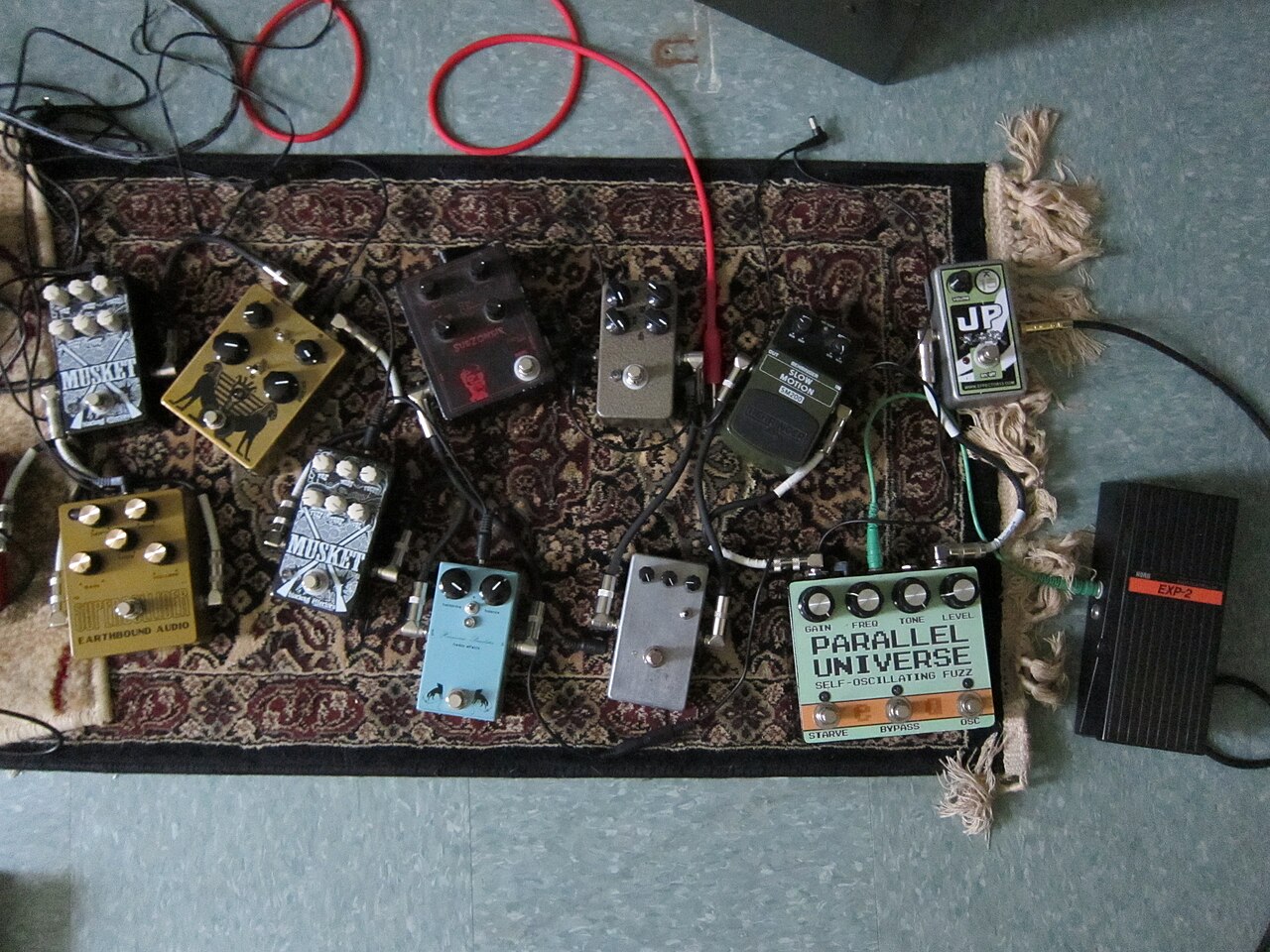
The honest comparison is not really against other fuzzes; it is against the idea of buying a fixed-spec pedal at all. Against a ZVEX Fuzz Factory the Sun Face is the conservative choice: the Factory wants to squeal and gate and self-oscillate, and its Comp and Stab knobs exist to push the circuit deliberately into misbehaviour. Against a Big Muff Pi it is not even the same job — the Muff is a wall of sustain with a scooped middle, the Sun Face is a dynamic device that follows your picking hand and your volume knob. Against the Dunlop Fuzz Face line, the difference is entirely in the transistors and the trimpots, and Piera’s own comparison is the most useful data point available: when a collector sent him four 1960s Fuzz Faces for repair in early 2008, he A/B’d the two BC108 silicon originals against a BC108 Sun Face he had just finished and found the sounds almost identical, with the Sun Face slightly clearer. Of the two NKT-275 originals, one was decent and the other was dull and woofy; his NKT Sun Face beat both. The owner kept them original anyway.
Two placement notes worth more than any comparison table. First, a Fuzz Face wants to see your guitar directly — put a buffered pedal in front of it and the input impedance interaction that makes the circuit clean up disappears. That is why so many players run the Sun Face first and everything else after, and why our Klon Centaur guide and Ibanez TS9 guide both matter here: those go after, not before. Second, vintage-style wahs and vintage-style fuzzes fight each other. Jimi did not appear to mind. If you do, the Clean trimpot goes a long way, a Foxrox Wah Retrofit fixes it properly, and a ZVEX Wah Probe sidesteps the problem entirely.
Buying Guide
There is no single price for a Sun Face, because there is no single Sun Face. Vintage Guitar tested a BC183 model at $185 in September 2013. Options are individually priced: the Sun Dial is $25, the on/off Fuzz pot is $15, and on the one-off Guns N’ Roses build every extra knob and switch was a $25 item. Transistor pricing varies by rarity and is listed only on the ordering site, because it changes with what Piera has managed to find. Expect roughly a week’s build time for a custom order; some pre-built “quick deal” configurations ship immediately, and dealers stock ready-made units with the common option set of LED, power jack and Sun Dial.
Choose the transistor before you choose anything else. Our reading of the evidence, for a player buying today:
- RCA germanium if you gig. Bright for germanium, normal gain, excellent clean-up and — the reason it wins — genuinely stable under stage heat. Confirm which batch: the 2018 stock is the temperature-stable one, the 1967-dated 2022 stock is not.
- RCA/BART hybrid if you play humbuckers or want more size and low end, with the RCA holding the temperature stability.
- Mullard CV7005 if you specifically want the NKT-275 voice, since it is very probably the same part with different printing.
- Low-gain 2SB if you want the white-dot NKT’s clean-up character and cannot have a white-dot NKT.
- BC183 silicon if you want warmth, more gain, no temperature anxiety, negative-ground power, and a bass-capable option.
- BC109 if you need the fuzz to cut through a loud band, and the BC108’s smoothness is getting lost.
Order the power jack even if you plan to use batteries. It costs less than the mistake it prevents, and it does not compromise battery operation.
Think hard about the LED. Four times the battery drain in exchange for a light. If you must, ask for green.
Order the on/off Fuzz pot or the toggle if the pedal will live in the middle of a board where you cannot easily unplug the input.
Skip the Sun Dial on a high-gain silicon build — it is not needed and can add noise. Buy it on any germanium build; that is the whole point.

The used market
Older units carry a premium driven entirely by the transistors inside. A concrete, verified data point: Russo Music in New Jersey listed a 2003 white-dot NKT275 Sun Face with the Sun Dial at $550 — in fair condition, with excessive cosmetic wear, paint removed by adhesive residue and three of the four base screws missing. It sold. That is the market for a discontinued transistor in a beaten box.
Three things to check before buying used. Which transistors — the answer changes the value by hundreds of dollars, and if the seller does not know, assume the cheaper answer. Whether it has a power jack, because a battery-only unit limits your board options. Whether the Sun Dial is fitted, since retrofitting means sending it in. Piera does a great deal of repair work on old Fuzz Faces and will keep them as original as possible; the expensive scenario is one that needs a NOS transistor, because he is holding very few of those and saving them for exactly this.
One counterfeit warning that comes from Piera directly: many transistors sold on eBay and elsewhere as NKT-275 are fakes or relabelled parts, and most NKT-275s sold in the last decade or so are relabelled. If you are buying a “vintage NKT” fuzz from a builder you do not know, you are buying a claim.
Living With a Sun Face
It goes first. Guitar, cable, Sun Face. For the purest tone there should be nothing between the two. Effects with true bypass that are switched off are fine in front of it.
Temperature is real, not superstition. Germanium drifts. Set the Sun Dial at the gig, not at home. Down a little when it is hot, up a little when it is cold, target roughly 5 volts of bias — or just turn it until the buzz sits where you want it.
Learn the CLEAN trimpot before you complain about the pedal. Most people who find a Sun Face too fuzzy, too loose or too noisy have never opened it. That white trimpot is the answer to at least three of the four common complaints, including radio interference.
Alkaline batteries dull the germanium. Cheap carbon-zinc cells are not a joke or a cost saving; they are a tone choice with a stated technical reason.
Isolated power or nothing. One output from a Voodoo Lab-style supply, or TheGigRig Virtual Battery. Never a daisy chain on a germanium unit.
It will not fix your rig. Piera’s own disclaimer is the fairest thing anyone has said about Fuzz Faces: this circuit rewards a good guitar, a good amp and a player who already knows what they are chasing. Into a mediocre solid-state amp it will sound like a mediocre solid-state amp with fuzz on it.
Frequently Asked Questions
Is the Analog Man Sun Face just an expensive Fuzz Face clone?
It is a Fuzz Face circuit, yes — but the circuit was never the variable. The transistors are, and Piera tests every pair for gain, leakage, noise and tone on purpose-built bench equipment before it goes in a box. When he compared a freshly built BC108 Sun Face against two genuine 1960s BC108 Fuzz Faces sent in for repair, he found the sounds almost identical with the Sun Face slightly clearer; against two original NKT-275 units, his NKT Sun Face beat both. You are paying for selection, hand assembly, a military-spec board with shielding and plated through-holes, two internal adjustments no factory pedal has, and the ability to specify the voicing before it is built.
Germanium or silicon — which should I buy?
Germanium if the volume-knob clean-up is the point. A good germanium Sun Face, especially an NKT-type, goes totally clean when you roll the guitar back, with no fuzz remnants at all. Silicon if you want more gain, more brightness, more fuzz and no temperature anxiety — it still cleans up substantially and remains dynamic, but never all the way to sparkling clean. Christian Bland of The Black Angels carries one of each, which tells you they are not substitutes. Silicon is also negative-ground, which makes powering it dramatically simpler, and it costs no extra.
What does the Sun Dial actually do?
It is the bias control for the output transistor, moved from an internal trimpot to an external knob painted to match the pedal. Germanium transistors drift with heat, and the bias sets where they sit — around 5 volts is the sweet spot. Turn it down in heat, up in cold. Musically, higher settings give less fuzz and a purer tone (Jim Weider runs his almost maxed), and turning it fully down starves the circuit into a torn, gated fizz. It is a $25 option and worth it on any germanium build. On a silicon it is optional at best and can add noise.
Can I power it from my pedalboard supply?
Only from an isolated output, and only if you ordered the power jack — it is not fitted as standard. Germanium Sun Faces are positive-ground, and daisy-chaining one with a normal negative-ground pedal shorts the supply through the patch cable shields and blows it. Note the counter-intuitive detail: Analog Man wires its pedals for normal centre-negative Boss-type supplies even on germanium, so you do not need a reverse-polarity cable — you need isolation. TheGigRig Virtual Battery solves both isolation and the oscillation some high-gain units develop on a supply. Silicon versions are negative-ground and much less fussy.
Does the battery really change the sound?
Yes, and the mechanism is specific rather than mystical: in a Fuzz Face the battery is part of the circuit, and its resistance, inductance and capacitance affect the tone, not just its voltage. Piera reports that alkalines sound a little dull in germanium and lose character, and prefers cheap old-style carbon-zinc cells. He has published an A/B recording of the same NKT-275 pedal switching between Duracell alkaline and general-purpose cells. Current draw is under 1 mA, so a cheap battery lasts a very long time — several hundred hours of playing without an LED.
Which transistor should I pick if I gig regularly?
RCA germanium, or the RCA/BART hybrid. The RCA’s defining property is temperature stability — Piera specifically notes they keep working in the heat of a gig when other germaniums go flat — combined with germanium warmth, useful brightness and excellent clean-up. Check the batch: the 2018 RCAs are the temperature-stable ones, while similar-looking 1967-dated parts from mid-2022 sound comparable but are not good at extremes. If you want no temperature question at all, buy silicon.
Did Jimi Hendrix or Eric Clapton use one?
No, and no one should claim otherwise. Hendrix died in September 1970 and the Beano album was recorded in 1966; the Sun Face descends from a Fuzz Face that Piera rehoused for Jim Weider decades later. What is true is that the pedal chases those sounds, and that the closest legitimate Clapton link runs through his sideman: Doyle Bramhall II carried an NKT Sun Face with Sun Dial on Clapton’s tours from 2004, corroborated by an independent 2008 board inventory. Similarly, Eric Johnson’s name attaches to the BC183 because Piera believes Johnson’s red Fuzz Face contains those transistors — that is a claim about parts, not about Johnson owning a Sun Face.
Why can’t I just buy the NKT-275 version everyone raves about?
Because it does not exist any more. Piera ran out of white-dot NKT-275s in 2011 and keeps the remainder for repairs; red dots sold out in late 2015; the house-numbered red-dot NKTs he found in the Netherlands in 2017 ran out in 2020. Every batch offered to him since has been relabelled fakes or picked-over rejects, so he has not used them. The honest substitutes are the Mullard CV7005 — almost certainly the same part that was being relabelled as NKT-275 in the first place — and low-gain 2SB for the clean-up behaviour. On the used market a beaten 2003 white-dot unit with the Sun Dial sold for $550 in fair condition, which is what scarcity looks like.
Image credits
- Guitar pedals on a rug: Oldangelmidnight from Northampton, MA, Wikimedia Commons, CC BY-SA 2.0.
- Inside a DIY pedal showing the circuit board: Skimel, Wikimedia Commons, CC BY-SA 4.0.
- Doyle Bramhall II: Alex G, Wikimedia Commons, CC BY 2.0.
- Kenny Wayne Shepherd: Andreas Lawen (Fotandi), Wikimedia Commons, CC BY-SA 4.0.
- Eric Johnson: Jud McCranie, Wikimedia Commons, CC BY-SA 4.0.
- Top image: GuitarGangsters AI-generated reference illustration, not a photograph.
- Analog Man Sun Face: GuitarGangsters AI-generated reference illustration, not a photograph.
Latest News
Related
On This Day
Monday 9 November
From this week: