EarthQuaker Devices Dispatch Master: The Two-Effect Pedal That Became Everybody’s Default Ambience
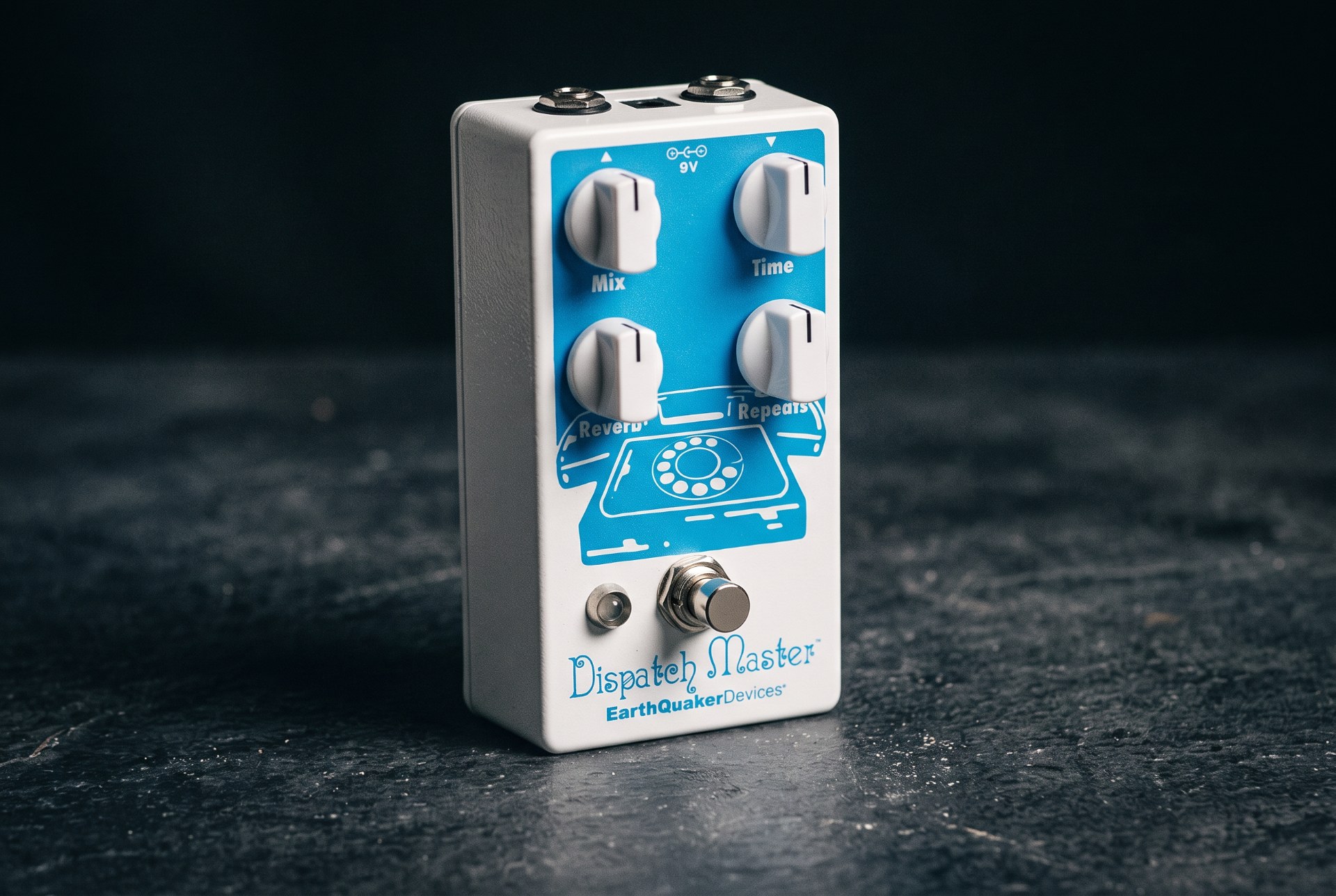
An AI-generated illustration of the EarthQuaker Devices Dispatch Master Digital Delay & Reverb.
EarthQuaker Devices Dispatch Master delay and reverb: full history, V1 vs V2 vs V3, verified famous players, eight tone recipes and buying advice.
There is a particular kind of pedal that stops being a pedal and starts being a utility. Nobody argues about it. Nobody posts a 3,000-word forum thread about whether the mid-2010s revision ruined it. It just sits on the board, on, forever, doing the job it was bought to do. The Dispatch Master is that pedal, and it has been that pedal for fifteen years.
EarthQuaker Devices say so themselves, twice over. The product page calls it “the best-selling EarthQuaker Devices pedal.” A company blog post from February 2020 put it more bluntly, in an aside inside a round-up of new records: “Yes, the Dispatch Master is one of the most widely used pedals across all genres!” That is a manufacturer bragging, obviously. But the roster underneath the brag is real, and it is stranger and broader than almost any other single pedal we have covered: Queens of the Stone Age, Sonic Youth, Death Cab for Cutie, Pavement, King Crimson’s Adrian Belew, Alter Bridge, Panic! at the Disco, boygenius, Warpaint, Tame Impala’s touring circle, Earthless, Broken Social Scene, Full of Hell, and a bass player from The Mars Volta.

That is not a niche. That is a cross-section of guitar music with almost nothing in common except a need for delay and reverb that does not require reading a manual.
This is a feature, not a review. We are not scoring it. We are here to explain what the Dispatch Master actually does, where it came from, which famous-player claims survive a source check and which ones do not, how the three hardware versions differ, and whether a fifteen-year-old four-knob box is still the right purchase in a world of thousand-preset multi-effects.
Akron, And The Pedal That Came From Two Other Pedals
The EarthQuaker Devices story — Jamie Stillman, a basement in Akron, Ohio, a touring musician who stopped touring and started soldering, and a company that grew into one of the largest pedal builders in America without ever leaving town — is told in full in our feature on the EarthQuaker Devices Hoof Fuzz. The shape of EQD’s dirt catalogue is covered in the Acapulco Gold feature, the company’s long argument with the Tube Screamer in the Palisades piece, and its most beloved overdrive in the Westwood one. We will not repeat any of it.
What matters here is a limited-run pedal from 2010 called the Ghost Disaster.
By 2010 EarthQuaker had two ambience pedals that people liked: the Ghost Echo, a short, dark, splashy reverb, and the Disaster Transport, a modulated delay machine. The Ghost Disaster was a limited run that put both circuits into one enclosure. It sold out, and it left behind a demand the company had not planned for.
The Dispatch Master, launched in July 2011, was the answer. EarthQuaker’s own original press copy, archived verbatim by Effects Database, is unusually candid about the lineage: it is “the smaller and more modern answer to the well loved limited run Ghost Disaster from 2010.” The launch description promised “a digital delay and reverb unit with an all analog direct signal path and true bypass switching,” capable of “nearly 2 seconds of delay time with near-infinite repeats and a cavernous reverb,” and it went out of its way to reassure people about the D-word: “Even though it is a DSP based effect, the sound is warm and full. No sterile lifeless tones here!”
That last sentence is a period document. In 2011, “digital” was still an insult in boutique-pedal circles. Analog bucket-brigade delay was the prestige format, and a small builder shipping a DSP box had to defend the choice in the first paragraph of the press release. The Dispatch Master’s commercial history is, in part, the story of that argument being won.
It debuted publicly at Summer NAMM 2011 — Premier Guitar filmed a demo reel on 27 July 2011 covering the Speaker Cranker, Bit Commander and Dispatch Master together — and EarthQuaker posted their own demo video on 15 August 2011. The pedal has been in continuous production ever since.
The “Black Hole Ambience Generator”
The original press release ended with a phrase EarthQuaker never used again but which describes the pedal better than any of their later copy: the perfect “Black Hole Ambience Generator.”
What that meant in practice was a reverb voiced not as a spring, not as a plate, but as room-to-hall-to-cathedral space, and a delay voiced to blur into it rather than sit on top of it. Premier Guitar’s review picked up on exactly this, describing a digital reverb that was “exceptionally organic,” geared toward ambient room, hall or cathedral rather than spring, with a striking absence of digital artificiality — and noting that even at maximum settings it kept a natural decay and an immensity the reviewer compared to standing alone in the empty hold of an enormous freighter.
That is the design thesis. The Dispatch Master is not a precision delay tool. It is an atmosphere machine that happens to have a delay in it.
How The Four Knobs Actually Work
The Dispatch Master has four controls, and the reason it has never been intimidating is that three of them do exactly what their labels say. The fourth is where the pedal hides its depth.
- Mix — a wet/dry blend that sets the overall level of the affected signal. It is not a “reverb amount” control and it is not a “delay amount” control; it is how much of the whole processed signal you hear against your dry tone.
- Time — delay time, from 0 ms to 1500 ms on the current version (1.5 seconds).
- Reverb — how much reverb. Counterclockwise less, clockwise more.
- Repeats — delay regeneration. At maximum you get, in EarthQuaker’s words, “infinite repeats without runaway self-oscillation,” which the company explicitly recommends for drones and “dialing in the ultimate post-rock guitar sound without feedback.”
The trick — the thing that separates people who own a Dispatch Master from people who have used one — is what Repeats does when the delay is switched off. EarthQuaker capitalise this in their own manual, and they are right to: in reverb-only mode, the Repeats knob becomes a reverb character control. With Time and the delay out of the picture, Repeats adjusts the decay, depth, thickness and overall tonal quality of the reverb. Turn it up for more dynamics and a thicker tone. With the Reverb control maxed, high Repeats settings will gradually overload the effect, which is either a bug or the best sound in the pedal depending on your genre.
So the operating modes are:
- Both effects: set everything to taste. Signal hits the delay and the reverb together.
- Delay only: Reverb all the way down; adjust Time, Repeats and Mix.
- Reverb only: Time and Repeats all the way down to start, then use Reverb and Mix — and bring Repeats back up as a tone/decay shaper, not as a repeat control.
Three pedals in one enclosure, controlled by four knobs, with no menus. That is the entire commercial proposition, and fifteen years of sales suggest it was the right one.
Specifications
One honest note on the delay time. The 2011 launch copy said “nearly 2000ms” and Equipboard’s product description still repeats “up to 2000ms.” EarthQuaker’s current product page and the V3 manual both say 1500 ms, and every V3-era press release since 2019 says 1.5 seconds. We have not found a documented statement from the company explaining whether the maximum time was reduced or whether the original figure was simply generous marketing rounding. Treat 1.5 seconds as the number you can rely on.
V1, V2, V3: What Actually Changed
Three hardware revisions in fifteen years, and — unusually for a pedal this popular — the circuit has never been the argument. Every revision has been about switching and jacks.
V1 (2011–2016)
Side-mounted jacks. Mechanical true-bypass footswitch. Smaller enclosure (4.37 x 2.37 x 1.75 in). This is the version with the one genuinely notorious flaw: a loud footswitch pop. It comes up in owner reports constantly, and it is the single most-cited reason to prefer a later version. One long-term owner reviewing the pedal on Equipboard summarised the V1 experience precisely: “my only real problem with the v1 I had was the unbearably loud footswitch pop. Other than that there’s not a single bad sound.”
V2 (November 2016)
Announced by press release on 7 November 2016, in stores from 1 November 2016, as part of a four-pedal batch update that also covered the Speaker Cranker, Acapulco Gold and Afterneath. Two changes to the Dispatch Master:
- Top-mounted input and output jacks — the practical one. Saves real estate on a crowded board and makes cable routing sane.
- Silent soft-touch relay-based switching — the fix. This is what kills the pop.
MAP was $195. Note that the V2 got the top jacks and the Speaker Cranker got them too, but the Acapulco Gold and Afterneath in that same batch only got the switching change — a detail worth knowing if you are trying to date a used EQD pedal by its jack placement.
V3 (January 2019)
Announced at NAMM 2019 and covered by Guitar.com on 14 January 2019, with a Sweetwater demo video posted 9 January. The single change is Flexi-Switch: the relay switching from V2 now supports momentary operation as well as latching. Tap once to engage and again to bypass, as normal — or hold the switch down and the effect stays on only for as long as your foot is on it.
Guitar.com’s summary was blunt and accurate: “Otherwise, the updated pedal is identical to its predecessor.” Retail price at launch was $199, where it has essentially stayed.
Flexi-Switch matters more on an ambience pedal than it does on a dirt box. Being able to hold the switch for one note of cathedral wash at the end of a phrase, and have it snap back to dry the instant you lift your foot, is a technique you cannot execute with a latching switch and a four-second reverb tail. It is the closest thing the Dispatch Master has to a hidden feature.
A practical warning that applies to V2 and V3: relay switching requires power to pass signal. If your board dies, a Dispatch Master does not fall back to true bypass. It falls silent. Plan your power accordingly.
Famous Players: What Holds Up And What Doesn’t
This is the strongest verified roster we have assembled for any EarthQuaker pedal, largely because EQD themselves have filmed a decade of artist content and tagged it by product. Everything below has been checked against a specific source. Where the source is weak, we say so.
The strongest evidence
Troy Van Leeuwen (Queens of the Stone Age, A Perfect Circle) — the best single piece of evidence for any player on this list, because he says it out loud on camera. In a filmed rig walkthrough, at 3:21, Van Leeuwen says: “I really like this company called EarthQuaker Devices. They’re in Akron, Ohio. I’m using a couple of their pedals. I use the Dispatch Master. It’s a nice reverb echo.” Named brand, named pedal, named function, from the player’s own mouth. It does not get cleaner than that.
Isaiah Mitchell (Earthless) — EarthQuaker published a session film with Mitchell in February 2017 in which he points at the pedal and says, “This is probably my favorite EarthQuaker pedal.” He then explains the reference point: “I think Daniel Lanois would like it. And I like Daniel Lanois.” That is a remarkably precise piece of tonal criticism. Lanois’s guitar sound — on his own records and across the U2 and Emmylou Harris work he produced — is built on delay and reverb blurred together into a single wash rather than kept as separate, countable effects. That is exactly what the Dispatch Master does by design. Mitchell also appears in a second EQD film, “On the Fly,” shot outdoors in June 2017 and interrupted mid-take by park rangers.
Lee Ranaldo (Sonic Youth) — manufacturer-documented. The Dispatch Master appears at 11:54 in EarthQuaker’s own “Show Us Your Junk! Ep. 18,” filmed in Ranaldo’s setup. Ranaldo is one of the most consistently EQD-associated players in the company’s history; he also turns up in our Acapulco Gold and Westwood features. The chain of custody here is as good as it gets: the manufacturer filmed the pedal on the artist’s own floor.
Stephen Malkmus (Pavement) — photo posted by Malkmus’s own account showing the pedal. Self-published evidence from the artist.
Adrian Belew — appears in a video Belew posted to his own Facebook page showing pedals in his home studio, Dispatch Master included. Worth a correction here: Equipboard files Belew’s band affiliation as Nine Inch Nails, presumably because of his brief and famously short-lived involvement with the band’s 2009 touring lineup. Belew is, by any reasonable measure, a King Crimson, David Bowie, Talking Heads and Frank Zappa guitarist first. We are flagging it because this is the second time in three articles that Equipboard’s band field has been wrong, and it is a good reminder to read the caption rather than the metadata.

Ben Gibbard (Death Cab for Cutie) — the evidence here is third-party but unusually solid: L.A. Sound Design, the company that built Death Cab’s touring boards, posted a photo of the finished board with the Dispatch Master on it. A pedalboard builder photographing their own work is a better source than a fan photo from row 30.
Julien Baker (boygenius) — visible on her board in filmed footage, sitting just behind a Strymon BigSky. The Dispatch Master is also credited on her 2015 debut Sprained Ankle, which is entirely consistent with that record’s sound: a small number of guitar parts, drenched, with the ambience doing most of the arranging.
Myles Kennedy (Alter Bridge, Slash’s Conspirators) — documented in Premier Guitar’s 2023 Alter Bridge Rig Rundown with Mark Tremonti. Worth pausing on, because it is the one entry on this list that breaks the pedal’s indie/psych stereotype. Kennedy is a hard-rock player in an arena band, and he still reached for a four-knob boutique ambience box. (Our Mark Tremonti feature covers the other half of that rig.)
Chelsea Wolfe — Instagram post from her own account showing the pedal. Wolfe is also the anchor artist on our Acapulco Gold feature, where she gave a first-person interview quote about that pedal.
Josh Klinghoffer — photographed via Dot Hacker’s official account. Klinghoffer’s résumé now spans Dot Hacker, Red Hot Chili Peppers, Pearl Jam’s touring band and Jane’s Addiction; the source here is the Dot Hacker material, so that is the context we will credit.
Brendon Urie (Panic! at the Disco) and James Bay — both documented by board footage and photos respectively. Neither is the first name you would expect on an Akron boutique pedal, which is rather the point of this article.
Manufacturer-tagged users
EarthQuaker’s blog tags every artist interview by product, which effectively gives you a curated list the company is willing to stand behind. The Dispatch Master tag returns:
- Theresa Wayman (Warpaint) — Board to Death Ep. 6, filmed at Cleveland’s Beachland Ballroom, August 2017. The only two effect tags on that entire episode are “delay” and “reverb.”
- Jim Jarmusch and Carter Logan (SQÜRL) — Board to Death Ep. 13, February 2018. Yes, that Jim Jarmusch. His drone-and-Western film-score band runs a Dispatch Master alongside an Avalanche Run and a Transmisser.
- Brendan Canning and Andrew Whiteman (Broken Social Scene) — Board to Death Ep. 24, July 2019, filmed on stage.
- Lauren Larson (Ume) — Board to Death Ep. 19, November 2018. Larson also appears in our Westwood feature; she runs an unusually deep EQD board.
- Spencer Hazard (Full of Hell, Eye Flys) — EQD interview, January 2020. Proof that the pedal is not confined to gentle music.
- Ilan Rubin (Nine Inch Nails, The New Regime) — EQD interview, April 2020.
- Cameron Avery (Tame Impala, The Last Shadow Puppets, The Growl) — EQD interview, March 2018.
- Taka Tozawa (Deltron 3030) — Show Us Your Junk! Ep. 3, June 2017.
- Molly Miller (Jason Mraz, Molly Miller Trio) — fronted an official EQD “Dispatch Master Tips and Tricks” film in August 2020. A jazz player demonstrating the pedal for the manufacturer is a useful counterweight to the post-rock reputation.
- Juan Alderete (The Mars Volta, Racer X) — EQD published two films in August 2014 specifically demonstrating the Dispatch Master on bass. This is the manufacturer’s own answer to the “does it work on bass” question.
- H.C. McEntire (Mount Moriah) — performed “Wild Dogs” through the pedal in an EQD film, August 2018.
- Frank Maraldo (Niights), Joe Golden, Chris Tran and Justin Seeker (Stems) — all in EQD-published performance films between 2017 and 2018.
Album credits
Logged album appearances include Baroness’s STONE (Deluxe) (2023), Spanish Love Songs’ Brave Faces Etc. (2022), Bonnie ‘Prince’ Billy & Matt Sweeney’s Superwolves (2021), Better Oblivion Community Center’s self-titled record with Conor Oberst and Phoebe Bridgers (2019), Esmé Patterson’s We Were Wild (2016), Eagles of Death Metal’s Zipper Down (2015), Julien Baker’s Sprained Ankle (2015), Elder’s Lore (2015), and two My Brightest Diamond releases from 2014.
Look at that list for a second. Doom-adjacent heavy rock, pop-punk, avant-folk, indie supergroup, desert rock, bedroom confessional, stoner metal and art-pop — inside nine years, on one four-knob pedal.
What does not hold up
Blaster Silonga (IV of Spades) is listed as a user, but the stated evidence is “images available through a Google search,” which is not evidence. We mention him because he is on the aggregator list; we are not counting him.
Daniel Lanois has no documented connection to this pedal at all. His name appears in this article only because Isaiah Mitchell invoked him as a tonal reference point. Lanois’s own delay history runs through Roland and Korg rack gear and a great deal of studio processing, not an Akron stompbox. Do not let the association travel.
Similarly, The Edge, David Gilmour, Robert Fripp and Kevin Shields appear later in this piece purely as reference points for delay and reverb technique. None of them is a documented Dispatch Master user, and any listing that claims otherwise is guessing.
Eight Tone Recipes
1. The Always-On (the way most owners actually use it)
Mix 9:00 · Time 8:30 · Reverb 10:00 · Repeats 9:00. Barely there. A short slap you cannot consciously hear and a room that makes your amp sound like it is in a slightly bigger room. Owners report this being the setting that changes how you play — the guitar simply feels better under the fingers, and you stop turning the pedal off. If you take one setting from this article, take this one.
2. Rockabilly Slap (an official EQD setting)
Mix 11:00 · Time 8:00 · Reverb 8:00 (off) · Repeats 7:00. Reverb down, one repeat, very short time. This is the Sun Studio bounce, and it is one of the four settings EarthQuaker publish on the product page themselves. Add a touch of Reverb — no more than 9:00 — if you want the room back.
3. 120 BPM With Reflection (an official EQD setting)
Mix 12:00 · Time 11:00 · Reverb 11:00 · Repeats 11:00. The other named factory setting: a quarter-note-ish delay at a mid-tempo, with enough reverb to keep the repeats from sounding like separate events. The Dispatch Master has no tap tempo, so “120 bpm” here means “EarthQuaker measured it, and this is roughly where the knob lands.” You will be setting time by ear.
4. Reverb Only, Thick (the mode people forget exists)
Mix 12:00 · Time 7:00 (fully down) · Reverb 2:00 · Repeats 1:00. With Time at zero, Repeats stops being a delay control and starts thickening the reverb’s decay and body. High Reverb plus high Repeats is where the effect starts to gently overload, which is the pedal’s best texture and its least-documented one. This is the setting that makes people stop wanting a separate reverb pedal.
5. Reverb Only, Amp Emulation
Mix 10:00 · Time 7:00 · Reverb 10:30 · Repeats 9:00. EarthQuaker describe the Dispatch Master’s reverb as “incredibly smooth and warm… perfect for emulating the reverbs on old tube amps,” with a hint of modulation. This is that setting: enough to sit a clean tone in a room, not enough to announce itself. If your amp has no reverb, this is what you buy the pedal for.
6. Post-Rock Infinite Drone
Mix 1:00 · Time 2:00 · Reverb 2:00 · Repeats 5:00 (maximum). EarthQuaker explicitly recommend this: at maximum, Repeats gives infinite regeneration “without runaway self-oscillation,” which they say is “great for creating drones, dialing in the ultimate post-rock guitar sound without feedback, or just having fun.” Play a chord, let go, and it will sit there while you play over it. Unlike a self-oscillating analog delay, it will not build into a scream — which is precisely why post-rock players like it and noise players sometimes don’t.
7. The Longest Night — Volume Swell (an official EQD setting)
Mix 2:00 · Time 1:00 · Reverb 3:00 · Repeats 12:00. The fourth factory setting, and the most cinematic. Roll your guitar volume to zero, strike the chord, swell the volume up, and let the wash take over. Works best on neck pickup with the tone rolled back. This is where the Dispatch Master earns the Lanois comparison Isaiah Mitchell made.
8. Flexi-Switch Punctuation (V3 only)
Mix 3:00 · Time 12:00 · Reverb 3:00 · Repeats 2:00. An extreme setting you would never leave on. Hold the footswitch down for the last note of a phrase, release it, and the whole cathedral vanishes the instant your foot lifts. This is the only setting on the list that is impossible on V1 and V2, and it is the strongest single argument for the V3.
All settings are given as clock positions with the pedal at unity. Because Mix is a wet/dry blend rather than a level control, the Dispatch Master does not have a “unity gain” problem — the dry signal passes through the analog path untouched, and Mix only adds. Start every one of these with Mix low and bring it up until you notice it, then back off slightly.
How It Compares
Against the Keeley Caverns
The Keeley Caverns Delay + Reverb V2 is the Dispatch Master’s most direct competitor and the comparison owners make most often. The Caverns gives you more: multiple reverb types, multiple delay modes, and — critically — separate footswitches for each effect. What it does not give you is a full wet mix, and its delay tops out around 650 ms against the Dispatch Master’s 1500. The trade is legibility for capability. If you want to turn reverb off mid-song without touching the delay, buy the Caverns. If you want one atmosphere you never think about, buy the Dispatch Master.
Against the EHX Oceans 11 and Boss RV-6
The Electro-Harmonix Oceans 11 and the Boss RV-6 are both better reverb pedals in the sense that they offer far more modes for less money, and both include a delay+reverb setting. Neither has 1.5 seconds of independent delay time with infinite repeats. If reverb is the priority and delay is a bonus, either of those is the sharper purchase. The Dispatch Master is genuinely a delay pedal and a reverb pedal, not a reverb pedal with a delay mode.
Against the Strymon TimeLine and BigSky
Not a real comparison, and it is worth saying why. A Strymon TimeLine and a BigSky together cost roughly five times a Dispatch Master, occupy vastly more board space, and offer presets, MIDI, tap tempo and stereo. They are professional tools for players who need recall. Julien Baker runs a Dispatch Master and a BigSky — which tells you they are not substitutes for each other. The Dispatch Master is the pedal you leave on; the BigSky is the pedal you program.
Against the Boss DD-3 and the digital delay orthodoxy
The Boss DD-3 and its descendants — the DD-8, the DD-200 — are precision instruments. Clean repeats, accurate times, tap tempo from the DD-8 onward. The Dispatch Master is deliberately less precise: EarthQuaker voiced the repeats to decay into an ambient swell rather than reproduce the dry signal faithfully. If you play parts where the delay must be rhythmically locked, the Dispatch Master’s lack of tap tempo will hurt, and it is far and away the most common complaint owners raise. If your delay is texture rather than rhythm, that same looseness is the appeal.
Against analog delay
An MXR Carbon Copy, a Boss DM-2W, a Deluxe Memory Man or a Maxon AD999 will give you darker, dirtier, progressively degrading repeats and, in most cases, self-oscillation you can ride. The Dispatch Master will not self-oscillate, by design. What it offers in exchange is clean repeats at long times without the mush that bucket-brigade delay accumulates past about 600 ms — and one long-time owner made the point that the digital delay here “somehow feels more organic than some analog delays I’ve come across.” That is not a universal opinion, but it is a common one.
Against a tape echo
A Boss RE-2 Space Echo gives you delay and reverb in one box too, with wow, flutter and a spring tank. It is a character pedal. The Dispatch Master is a clarity pedal. Different jobs entirely — the Space Echo puts a stamp on your sound, the Dispatch Master puts space around it.
Against the multi-effects answer
A Line 6 HX Stomp or an HX One will model a delay and a reverb, plus everything else, for comparable money. If you want options, that is the rational purchase. The counterargument is fifteen years old and has not weakened: a pedal with four knobs and no menu gets used, and a pedal with 200 presets gets configured.
Against the rest of the EQD ambience line
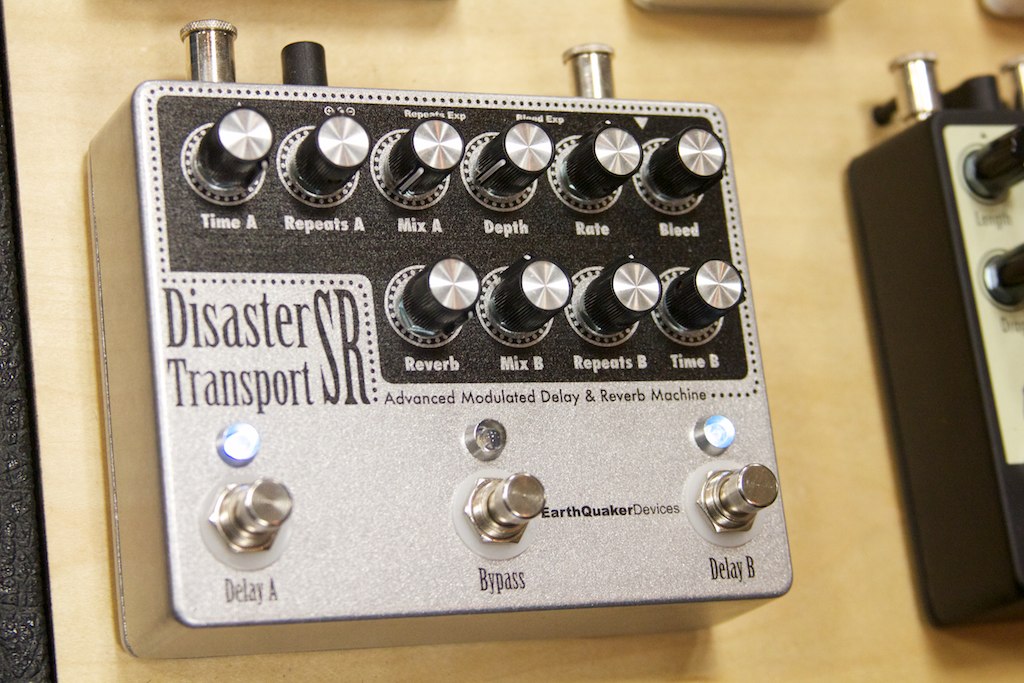
EarthQuaker’s own catalogue answers most of the Dispatch Master’s shortcomings elsewhere. The Avalanche Run is explicitly a stereo, tap-tempo-equipped version of the same idea — if the missing tap tempo is your objection, that is the pedal, and EQD have never pretended otherwise. The Afterneath handles otherworldly, granular reverb. The Disaster Transport SR is the deep modulated-delay machine, and owners comparing the two note it delivers Memory Man/Memory Toy-style sounds with far more control over modulation. The Dispatch Master’s role in that lineup is deliberately the simplest one.
Buying Guide
Which version should you buy?
Buy a V3 if you can. It is still in production at $199, it has the silent relay switching, top jacks and Flexi-Switch, and the used market for V3s is healthy. There is no meaningful sonic reason to hunt an earlier one.
V2 is a fine used buy if it is meaningfully cheaper. You get top jacks and silent switching; you lose only momentary operation.
V1 only at a discount, and only if the pop does not bother you. It sounds the same. It has side jacks, which will cost you board space, and the footswitch pop is real and widely reported. Do not pay V3 money for one.
How to identify a version
Jack placement is the quickest tell: side jacks means V1, top jacks means V2 or V3. Distinguishing V2 from V3 visually is harder — the reliable method is to plug it in and hold the footswitch down. If the effect drops out when you release, it is a V3.
Power
78 mA is not trivial. It is well within the capacity of any isolated supply, but a daisy chain shared with several other pedals may struggle, and EarthQuaker are emphatic that switching-type supplies and daisy chains let through noise this pedal will happily amplify. Use an isolated output. And remember: no power, no signal — the relay switching does not fail to true bypass.
What you are not getting
Be clear-eyed. No tap tempo. No expression pedal input. No presets. No stereo. No separate footswitches for delay and reverb. These are not oversights; they are the design. Every one of them is a common owner request, and every one of them is answered by a different, larger, more expensive pedal.
Living With It
Placement. End of chain, after dirt and modulation, is the default and the right answer for most people. If your amp has an effects loop, the Dispatch Master generally sounds cleaner in it — you are feeding it a fully-formed preamp signal rather than asking it to reverberate something the amp is about to distort.
The clipping issue. This is the one genuine technical gotcha, and it is worth knowing before you buy. Some owners report the Dispatch Master clipping on boosted clean signals — hit it hard enough with a hot output and the input stage will complain. The reported workaround is to place a buffered pedal before it, which tames the level going in. If you run a high-output humbucker into a clean boost into the Dispatch Master, listen for it.
Reverb versus delay balance. A recurring owner observation: the more reverb you add, the less defined the delays become. That is not a fault, it is the nature of running both effects through one Mix control, but it means the pedal leans reverb-forward at high settings. Several owners describe it as “more of a reverb pedal with a delay” than a true 50/50 split. If you want articulate, countable repeats, keep Reverb below 11 o’clock.
The preamp effect. Owners frequently report that the Dispatch Master adds a slight warmth and saturation even at low Mix settings, and that leaving it on improves the whole board. Whether that is an intentional analog-path characteristic or a psychoacoustic effect of the added ambience, we cannot document — but the reports are consistent enough to mention.
Reliability and service. EarthQuaker’s limited lifetime warranty is not decorative. Owners reporting faults — including one case of a high-pitched noise on a V3 — report the company repairing them free. This is a real factor in the used-market calculation for a fifteen-year-old design.
On bass. It works, and EarthQuaker proved it deliberately: the two Juan Alderete films from August 2014 exist specifically to demonstrate the pedal on bass. The analog dry path means your fundamental is never converted, so the low end stays intact under the wash.
Who should skip it
If you need rhythmically locked delay, you need tap tempo, and this pedal does not have it. If you want distinct reverb algorithms — spring, plate, shimmer, modulated — this pedal has exactly one voice. If you need to switch delay and reverb independently mid-song, buy something with two footswitches. If you want a delay that self-oscillates into chaos, this is emphatically the wrong pedal; it is engineered specifically not to. And if $199 for a four-knob box offends you on principle, the objection is legitimate — there are cheaper ways to get delay and reverb, and several of them are good.
Frequently Asked Questions
What is the difference between the Dispatch Master V1, V2 and V3?
The circuit is unchanged across all three. V1 (2011) has side-mounted jacks and a mechanical footswitch with a well-documented pop. V2 (November 2016) added top-mounted jacks and silent relay-based switching. V3 (January 2019) added Flexi-Switch, which allows momentary operation — hold the switch for the effect, release to bypass — alongside normal latching. Everything else is identical.
Does the Dispatch Master have tap tempo?
No, and it never has. This is the single most common owner complaint. EarthQuaker’s own answer is the Avalanche Run, which was designed as a stereo and tap-tempo-equipped version of the same delay-plus-reverb concept.
Can I use it as reverb only, or delay only?
Yes to both. For delay only, turn Reverb fully down. For reverb only, turn Time and Repeats fully down first — then bring Repeats back up, because with the delay out of the picture it controls the reverb’s decay, depth, thickness and tone rather than repeats. That second mode is the most under-used feature on the pedal.
How much delay time does it have?
1500 ms — 1.5 seconds — on the current V3 specification. The original 2011 press material claimed “nearly 2000 ms,” and some retail listings still repeat that figure. EarthQuaker’s current documentation says 1.5 seconds and that is the number to work with.
Will it self-oscillate?
No. EarthQuaker specifically engineered infinite repeats without runaway self-oscillation. At maximum Repeats you get an endless, stable drone you can play over. If you want a delay that screams when you push the feedback, look at analog delays like the Deluxe Memory Man instead.
Does it work on bass and synth?
Yes. The dry signal path is analog, so your fundamental passes through unprocessed. EarthQuaker published two dedicated bass demonstration films with Juan Alderete in 2014, and their own product page includes bass and Fender Rhodes audio samples alongside the guitar ones.
Why does my Dispatch Master go silent when my power dies?
The V2 and V3 use relay-based switching, which requires power to pass signal at all. Unlike a mechanical true-bypass pedal, an unpowered Dispatch Master is a dead link in your chain, not a piece of wire. Make sure it is on a reliable isolated supply output.
Is the Dispatch Master worth $199 in 2026?
That depends entirely on how you use pedals. If you want maximum features per dollar, no — a multi-effects unit or a Boss RV-6 gives you more. If you want one pedal you turn on at the start of the gig and forget about, built by hand in Ohio with a lifetime warranty and a fifteen-year track record on boards from Queens of the Stone Age to boygenius, the price has been justified by a large number of people for a long time.
What is the “Ghost Disaster” I keep reading about?
A limited run from 2010 that combined EarthQuaker’s Ghost Echo reverb and Disaster Transport delay in one enclosure. It sold out, and the Dispatch Master was built in 2011 as the smaller, permanent-production answer to the demand it created. EarthQuaker said so in the original press release.
The Verdict That Isn’t One
The Dispatch Master is not the most interesting pedal EarthQuaker has ever built. It has no exotic switching, no mad naming conceit, no circuit that anybody argues about on forums. Next to the six-clipping-voice Palisades or the one-knob-of-fury Acapulco Gold, it is almost boring.
It is also, by the company’s own account, the best-selling thing they make, and it has stayed that way for a decade and a half in a market that replaces its ambience pedals roughly every eighteen months. The reason is not mysterious. Troy Van Leeuwen called it “a nice reverb echo” — four words, no poetry — and that is precisely the point. It is a pedal that solves a problem so completely that nobody feels the need to describe it at length.
Isaiah Mitchell got closer than anyone when he reached for Daniel Lanois. Lanois’s whole approach to guitar ambience is about refusing to separate the delay from the reverb, treating them as one continuous medium the note travels through rather than two effects stacked on top of each other. That is what four knobs and one Mix control force you to do. You cannot pick them apart, so you stop trying.
Fifteen years, three revisions, one voice, and a user list that runs from Pavement to Alter Bridge to a film director’s drone band. If you need tap tempo, buy the Avalanche Run. If you need presets, buy a Strymon. If you need an atmosphere, this has been the answer since 2011 and nothing has come along to change that.
Image credits
- A pedalboard full of colourful pedals: Skimel, Wikimedia Commons, CC BY-SA 4.0.
- An EarthQuaker Devices Disaster Transport SR pedal: Steve Castellano from Toronto, Wikimedia Commons, CC BY 2.0.
- An EarthQuaker Devices Bit Commander pedal: Victor Sounds, Wikimedia Commons, CC BY-SA 2.0.
- Adrian Belew: Kevin Dooley, Wikimedia Commons, CC BY 2.0.
- Top image: GuitarGangsters AI-generated reference illustration, not a photograph.
- EarthQuaker Devices Dispatch Master Digital Delay & Reverb: AI-generated illustration by GuitarGangsters, based on the manufacturer’s product design (not a photograph).
Latest News
Related
On This Day
Monday 9 November
From this week: