DigiTech FreqOut: How a Small Blue Box Bottled the One Sound You Could Never Fake
DigiTech FreqOut guide: how the seven harmonic feedback types work, full specs, verified players, tone recipes, rivals compared and honest buying advice.
There is a sound every electric guitarist recognises within a quarter of a second and almost nobody can produce on demand. It is the moment a note stops decaying and starts growing — when the speaker’s output finds its way back into the strings and the guitar and the amplifier stop being two objects and become one system. Feedback. Sustain that never ends. The note that walks up an octave on its own and hangs there like it has somewhere to be.
For seventy years the only recipe for that sound has been the same: a loud amplifier, a room, and a guitarist standing in exactly the right spot. Which is fine if you are playing a stage. It is useless if you are recording at two in the morning, playing a 60-seat room where the sound engineer has already asked you twice, running direct into a modeller with no cabinet in the building, or — most galling of all — standing in front of a perfectly loud amp and finding that tonight, in this room, the note that fed back beautifully last week just sits there and dies.
The DigiTech FreqOut Natural Feedback Creator exists to remove the room from that equation. It is a compact pedal with three knobs, two toggles and a footswitch, and its entire purpose is to take the note you are playing, work out what its harmonics are, and boost one of them until the note behaves the way it would if you were standing in front of a cranked stack. At any volume. Clean or dirty. Through headphones if you like.
It won MusicRadar‘s Best Pedal of NAMM 2017 award. It has since turned up on the boards of a Nashville cosmic-country bandleader, a Tool-adjacent studio architect, a Zappa, and — most improbably and most delightfully — George Thorogood. This guide covers where it came from, what the manual actually says (including a current-draw figure and a bypass quirk that most owners never discover), which players have genuinely been documented using one, how to dial it in so it sounds like feedback instead of an effect, and whether it is the right pedal for you.
Housekeeping: three things to state before the history
This guide is built from primary sources. Three of them need flagging up front, because one of them is the kind of error this series exists to catch.
1. The artist list this SKU arrives with is not a user list
The FreqOut’s associated players are listed as Josh Homme, Tom Morello, David Gilmour and “session guitarists.” Those are three enormous names and all three are famous for feedback and sustain in one form or another. None of the three could be verified as a documented FreqOut user in the research window for this article — no Rig Rundown, no interview, no manufacturer artist page, no photographed board.

What they are is a list of guitarists associated with the sound the pedal imitates, which is a completely different claim. This is the single most common failure mode in gear writing: the roster of players who made an effect famous quietly becomes the roster of players who use a particular box that does that effect. It is how you end up reading that Dimebag Darrell used a pedal launched a decade after he died. We name the sound-lineage players in this article and we link them, because their music is genuinely the reference point for what this pedal is trying to do — but we say plainly, every time, that they are the lineage, not the user list. The verified users are elsewhere in this guide, they are fewer, and they are much more interesting.
2. The FreqOut is a hungry pedal, and the figure is only in the manual
DigiTech’s owner’s manual (document 5082465-A, © 2022 CORTEK Corp.) gives the electrical figure as 2.1 Watts, 235 mA typical at 9 V DC. That is a substantial draw for a compact enclosure — comparable to the DigiTech Drop‘s sub-250 mA and roughly double what most digital delays want. There is no battery option at all: the manual states flatly that the pedal requires an adapter and that battery power is not available. The recommended brick is the PS0913DC-04, rated 9 V DC 1.3 A, which is the adapter’s capacity rather than the pedal’s appetite.
The practical rule, and it is the most important ownership fact on this SKU: give the FreqOut its own isolated, regulated 9 V DC output with at least 300 mA of headroom, and never daisy-chain it. Under-powering a DSP pedal does not produce a polite reduction in volume; it produces tracking failures, glitching and dropouts that will read to you as “this pedal is broken.”
3. The bypass type changes depending on a toggle, and almost nobody knows
This is the single most under-reported fact about the FreqOut and it is stated once, in small print, in the manual. The pedal is true bypass when the Momentary switch is OFF and buffered bypass when the Momentary switch is ON. The specification table confirms it from the other direction: input impedance is listed as 1 MΩ “effect enabled or effect bypassed w/ Momentary switch on,” and simply as “True Bypass” when the effect is bypassed with Momentary off.
That matters more than it sounds. If you flip Momentary on to get held-note feedback bursts, you have also, invisibly, inserted a buffer at the very front of your signal chain — which is exactly where the FreqOut is supposed to sit. If you run a Fuzz Face-style circuit that needs to see your pickups directly, or a treble booster whose whole design assumes an unbuffered input, that toggle position is now a tone decision, not just an ergonomic one. Nobody tells you this. The manual does, in one sentence, on page three.
Where the FreqOut came from: NAMM 2017 and a company between owners
DigiTech announced the FreqOut at Winter NAMM in January 2017, alongside the CabDryVR cabinet simulator. It shipped in March 2017 at a street price of $179.99 against an MSRP of $279.95; UK and European pricing at launch ran to roughly £149 / €180. MusicRadar named it Best Pedal of NAMM 2017 — a genuinely competitive category that year — and Michael Astley-Brown’s full review followed on 20 June 2017.
The company context is worth knowing because it explains the pedal’s shape. DigiTech began in 1984 as the digital-effects arm of DOD Electronics, the Salt Lake City firm that gave us analogue workhorses like the DOD 250 Overdrive Preamp and the DOD Rubberneck. DOD made the dirt; DigiTech made the boxes with converters in them — the Whammy above all, and later the Drop, the Ricochet and the HammerOn.
The FreqOut arrived at the very end of that run. It was among the last genuinely new DigiTech designs before the brand went, in Guitar World‘s phrase, “effectively dormant in terms of design as a brand from 2018 until Cort-Tek acquired the brand alongside DOD in 2022.” The FreqOut you buy today is the FreqOut of 2017 — same seven types, same three knobs, same enclosure — reissued under Cort-Tek with a 2022-dated manual. That is not neglect so much as an accident of corporate timing, and it has an unexpected upside: nine years on, there is no revision confusion, no MkII, no “which version do I want.” There is one FreqOut.
What the FreqOut actually does to your signal
Real acoustic feedback is a closed loop. The speaker moves air, the air moves the string, the string drives the pickup, the pickup drives the amp, the amp drives the speaker. When the gain around that loop exceeds the losses at a particular frequency, that frequency stops decaying and starts growing. Which frequency wins depends on the room, the distance, the angle of the guitar, the pickup, the amp’s response, the volume, and — infuriatingly — what the last note did.
The FreqOut does not close that loop. It cannot: there is no air in the circuit. What it does instead is a two-part trick that MusicRadar summarised as “a combination of pitch-shifting and reversed feedback suppression tech.”
Part one is pitch detection. The pedal analyses the incoming signal and works out what note you are playing and what its harmonic content is. This is the same family of DSP that underpins DigiTech’s whole pitch line, and it is why the FreqOut wants a clean, unprocessed guitar signal to look at.
Part two is the elegant bit. Automatic feedback suppression — the technology in every decent live-sound processor — works by identifying the frequency that is running away and notching it out. The FreqOut runs that logic in reverse: it identifies a harmonic of the note you played and boosts it, with a controllable rate of onset, until it dominates and sustains. DigiTech’s manual describes the effect as one that “boosts a user-selectable harmonic of the input note, creating controlled, natural-sounding feedback sustain through any amp or amp modeler at any volume.”
The word doing the heavy lifting there is selectable. Real feedback gives you whatever the room decides. The FreqOut lets you choose the interval in advance and get it every single time — which is simultaneously the pedal’s greatest strength and the thing you have to work hardest to disguise.
DigiTech FreqOut: full specifications
| Specification | Figure |
|---|---|
| Effect type | Harmonic feedback generator (pitch detection plus reverse feedback suppression) |
| Controls | Gain, Onset, Type (7-position), Momentary On/Off toggle, Dry On/Off toggle, Effect footswitch |
| Feedback types | SUB, 1ST, 2ND, 3RD, 5TH, NAT LOW, NAT HI |
| Signal-to-noise ratio | Greater than −106 dB (A-weighted); ref = max level, 22 kHz bandwidth |
| THD | 0.004% at 1 kHz; ref = 1 dBu with unity gain |
| A/D/A conversion | 24-bit |
| Input | 1/4″ unbalanced TS; max level +5 dBu |
| Input impedance | 1 MΩ (effect on, or bypassed with Momentary ON); true bypass (bypassed with Momentary OFF) |
| Output | 1/4″ unbalanced TS; max level +10 dBu |
| Output impedance | 1 kΩ (effect on, or bypassed with Momentary ON); true bypass (bypassed with Momentary OFF) |
| Dimensions | 4.75″ (L) x 2.875″ (W) x 1.75″ (H) |
| Weight | 0.8 lb (0.363 kg) |
| Power consumption | 2.1 W (235 mA typical at 9 V DC) |
| Power requirement | 9 V DC external adapter (sold separately) — no battery option |
| Recommended adapter | PS0913DC-04 (US, JA, EU, AU, UK), 9 V DC 1.3 A |
| Announced / released | Winter NAMM January 2017 / shipping March 2017 |
| Launch pricing | $179.99 street, $279.95 MSRP; approx. £149 / €180 |
| Manual | Document 5082465-A, © 2022 CORTEK Corp. |
Two figures deserve a second glance. The 0.8 lb weight makes the FreqOut noticeably denser than it looks — more than double the 0.36 lb of the DigiTech Drop in a near-identical footprint. And the +5 dBu maximum input level is a real ceiling: this pedal is designed to see a guitar, not a line-level signal or the output of a hot boost. Hit it too hard and you will clip the converter before the algorithm gets a chance to do anything musical.
The controls, one at a time
Type: the seven harmonics
The Type knob is the FreqOut’s identity. Seven positions, split into two groups that behave in fundamentally different ways.
The five harmonic types give you feedback at a predictable, repeatable frequency, every time, on every note:
- SUB — feedback an octave below the note. Subsonic weight; the sound of a cabinet loading up rather than a note singing.
- 1ST — first-harmonic (unison) feedback. The note itself, sustaining. The most transparent and the most “just a very sustaining guitar.”
- 2ND — second-harmonic feedback. One octave up. The classic controlled squeal.
- 3RD — third harmonic: an octave plus a fifth above the note.
- 5TH — fifth harmonic. As DigiTech’s manual carefully explains, five times the note’s frequency, which lands “two octaves above a major third interval of the original note.” MusicRadar called it a “two-octave-plus 5th harmonic squeal.” This is the ceiling, and it is a lot.
The two natural types behave like the real thing, which is to say inconsistently and on purpose:
- NAT LOW — various frequencies in the lower harmonic range. Crucially, DigiTech restricts this mode so it will not produce feedback at the 5th harmonic or above. The stated reason is beautifully practical: it “ensures that you don’t get feedback that sounds ‘major’ on minor chords.” That is a pedal designer thinking about the music, not just the DSP.
- NAT HI — the same behaviour with a wider ceiling. Higher-pitched results, and, per the manual, “slightly increases the odds of the feedback transitioning mid-note.”
On the natural settings you may get a different result from the same note twice in a row. That is not a bug. It is the whole point, and it is what separates the FreqOut from every “sustain effect” that came before it.
Gain and Onset: the two knobs that make it believable
Gain sets how much feedback there is. Low settings give you a subtle bloom on the tail of a note; high settings give you a runaway squeal that will happily outlast your patience. Onset sets how long the feedback takes to reach full strength — and this is the control that determines whether the effect reads as feedback or as an effect. Lower settings arrive fast, higher settings take their time.
Real feedback almost never arrives instantly. It builds. If your FreqOut sounds fake, the odds are overwhelming that your Onset is too fast for the tempo of the music. The left-hand row of LEDs exists specifically to show you the onset rate: the LED ladder lights from the inside out as the feedback grows, so you can literally watch the swell and match it to the phrase.
The Dry switch: the EBow button
Turning the Dry switch OFF mutes your dry signal entirely, leaving only the generated feedback. What you get is a note with no pick attack at all — it simply materialises and swells. DigiTech’s manual describes this, with a trademark footnote for Heet Sound Products, as an effect “reminiscent of an EBow.” MusicRadar went further: “slide between notes and you’ve got a thoroughly usable theremin/EBow impersonation.”
One warning the manual gives and most owners discover the hard way: if Momentary is ON and Dry is OFF, there is no dry signal passing through the pedal at all. Not muted-then-restored — nothing. If your rig goes silent when you flip that combination, the pedal is behaving exactly as designed.
The Momentary switch: two completely different pedals
With Momentary OFF, the footswitch latches like a normal pedal. Step on it and the FreqOut stays engaged; every note you play will start to feed back according to your Gain and Onset settings. This is the “feedback is part of my sound tonight” mode, and it is what DigiTech’s own spotlight copy describes as feedback that “can be continuous or activated only while holding a note.”
With Momentary ON, the effect is only active while you are holding the switch down. This is the surgical mode: you play a phrase clean, hold the switch on the last note, and it blooms. It is also the mode that switches the pedal to buffered bypass, as covered above.
Almost every player who has stuck with the FreqOut long-term ends up in the momentary camp, for the same reason nobody leaves a wah rocked forward all night. Feedback is punctuation. Constant punctuation is just noise.
Famous players: who has actually been documented using a FreqOut
This is where the FreqOut gets genuinely interesting, because the verified user list is nothing like what you would guess. It is not shoegaze bands and it is not doom. It is a Nashville country bandleader, a studio architect, a Zappa, and a blues-boogie legend who has been playing the same three chords magnificently since 1974.
Mat Mitchell (Puscifer) — Premier Guitar Rig Rundown, 30 November 2022
The strongest single endorsement any utility pedal can receive is being the only one. Mat Mitchell, Puscifer’s guitarist, producer and — in Premier Guitar‘s phrase — “musical scaffolder,” rebuilt the band’s touring rig around a Fractal Axe-Fx III specifically to eliminate hardware. As he told PG‘s Chris Kies at Nashville’s Ryman Auditorium: “we have enough songs that our rig was getting bigger, more complex, and it had more failure points. We also wanted a clean stage, so there’s no amps, no cabs, no pedalboards onstage.”
And then, under a section header PG titled “Lone Wolf”: “His only guitar-specific hardware outside the Axe-Fx III is this DigiTech FreqOut, to help Mitchell stir up a funnel of feedback.”
Read that again in context. A player who deliberately deleted every amp, every cabinet and every pedalboard from the stage — whose patches are built on modelled Mesa/Boogie Mark II C+ and Vibro-King voicings, who plays headless Kiesel Type-X guitars through a Shure Axient wireless system — kept exactly one physical box. Not a drive. Not a delay. A feedback generator. That tells you something the marketing never could: feedback is the one thing a modeller genuinely cannot fake, because it is not an effect on the signal, it is a property of the room. Take away the room and you need the FreqOut.
Mitchell’s studio arsenal for Existential Reckoning — a Steinberger GL2T, a Fairlight CMI, a Fender Custom Shop Esquire, a ZVEX Fuzz Factory, a Fulltone OCD, an EHX Micro POG, a Boss VB-2 and FZ-2, a Radial SGI and a pair of Oto Machines — makes the point even more sharply. He has access to everything. Onstage he carries one pedal.
Daniel Donato — Premier Guitar Rig Rundown, 8 October 2025
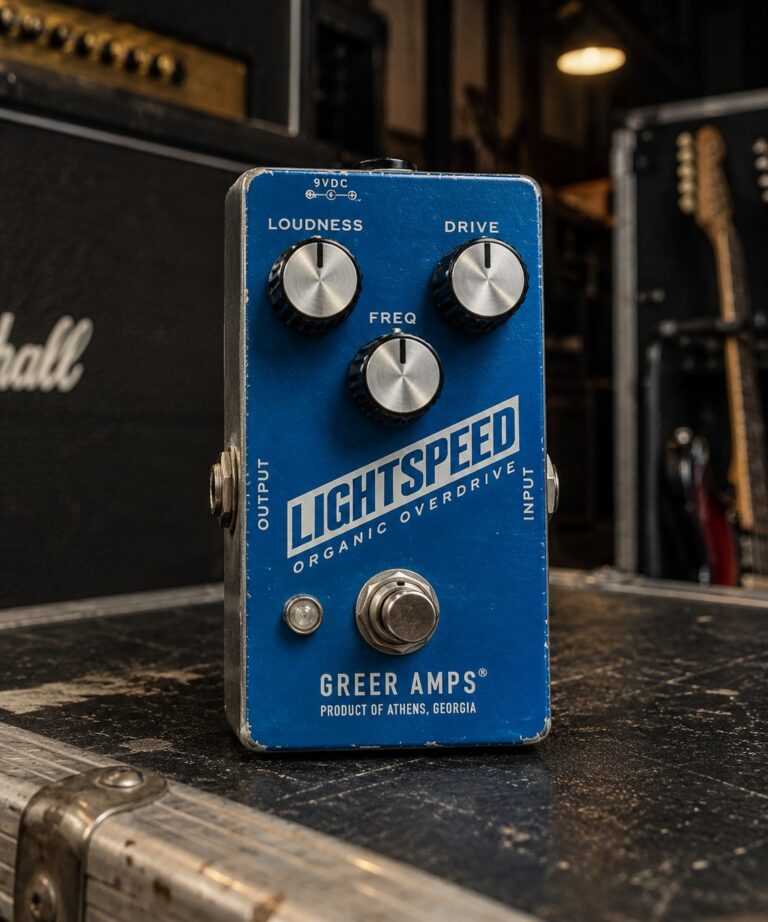
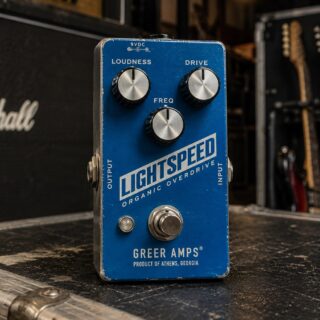
If Mitchell is the FreqOut’s minimalist endorsement, Daniel Donato is its maximalist one. The cosmic-country bandleader’s board, built by XAct Tone Solutions and documented by PG‘s John Bohlinger while touring the Horizons record, runs a Dunlop X Volume Mini, a CAE Wah, a Gamechanger Audio Plus, a Greer Lightspeed, a Keeley Noble Screamer, a Keeley Cosmic Country Phaser and Rotary, a Strymon TimeLine, a Walrus R1, a Universal Audio Max, a DigiTech FreqOut, and an Eventide H90 — into a Fender Tone Master Pro and out of a 1966 Fender Pro Reverb converted to 2×12.
The relevant detail is not the FreqOut’s presence but its company. That board already contains a Gamechanger Audio Plus — an infinite-sustain pedal — and an H90 capable of a dozen kinds of ambient smear. Donato carries the FreqOut anyway, because sustain and feedback are not the same thing. A sustain pedal holds a note you already played. Feedback grows a note into a different note. On a Telecaster through a black-panel Fender, with .010–.052 Slinkys, that is not a sound you are getting any other way.
George Thorogood — Premier Guitar Rig Rundown, 18 March 2026
This one is genuinely surprising and it is the single best argument for the FreqOut’s usefulness outside experimental music. George Thorogood — fifty-plus years of blues and boogie-rock, copper-pipe slides cut and taped by his tech Rev Jones, GHS .012–.054 for standard and .015–.056 for open tunings, a pair of Epiphone ES-125 “White Fang” hollowbodies — runs a rack-mounted effects board switched by a Voodoo Labs PX-8 Plus.
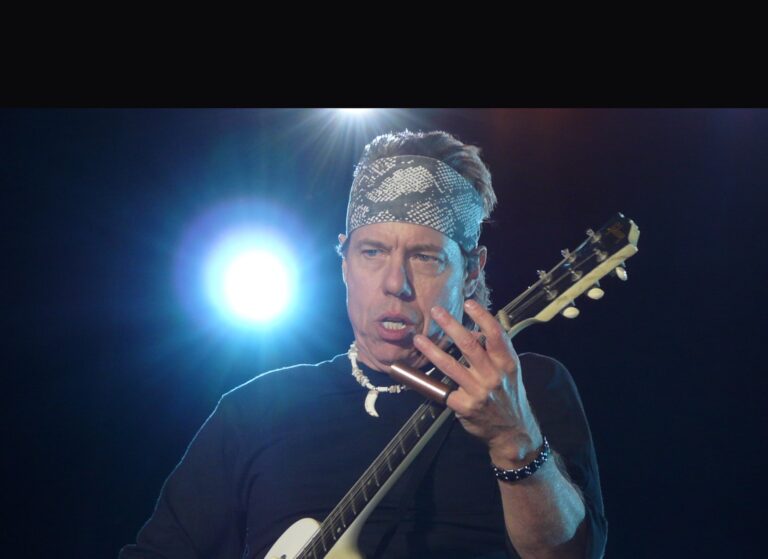
What is in it, per PG‘s John Bohlinger, filmed before a February 2026 Grand Ole Opry gig: an MXR Boost/Line Driver, an Empress Para EQ, a DigiTech FreqOut, a Boss BF-3, a Boss TR-2 and a Boss DD-5. Six pedals. That is the entire list. When a player whose whole sound is “guitar, slide, loud” carries exactly six effects and one of them is a feedback generator, the pedal has earned its place.
There is also a technical reason it makes sense on that rig specifically. Thorogood plays semi-hollow ES-125-style guitars into Electro-Harmonix 22 Caliber power amps through Mesa/Boogie 1×12 cabinets — a small-cabinet, moderate-wattage setup. Semi-hollows feed back readily but unpredictably, and small cabinets do not move the air that makes controlled feedback reliable at the front of a big room. A FreqOut turns “this guitar might howl tonight” into “this guitar howls in the second bar of the solo, every night.”
One small provenance note, offered in the spirit of checking sources against themselves: PG‘s page description for that Rundown says the crew met the band at “PRS Nashville,” while the body text of the same article says “PRG Nashville.” One of those is a typo and it does not matter to a single fact above — but a discrepancy inside one article is exactly the sort of thing worth noticing rather than silently smoothing over.
Dweezil Zappa — Premier Guitar Rig Rundown, 2025
Premier Guitar‘s 2025 Dweezil Zappa Rundown documents a rack containing an Axe-Fx III, an Eventide H90 and a TC Electronic TC 2290 on the top shelf, with a second tier holding a BK Butler Tube Driver, a DigiTech FreqOut, a Red Panda Radius and Raster, a Krozz Devices Airborn analogue flanger and a Paul Trombetta Design Tornita fuzz, all controlled from a Fractal FC-12 at his feet.
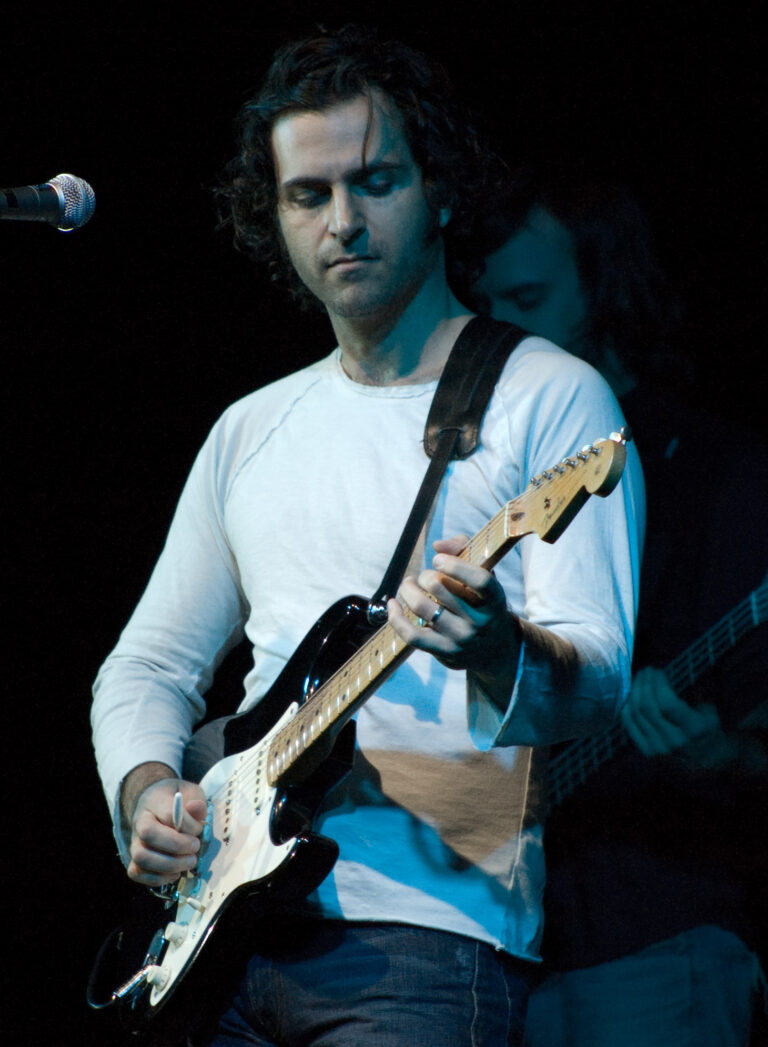
One clarification, because the surname is a trap: the documented FreqOut user here is Dweezil. Frank Zappa died in 1993, twenty-four years before this pedal existed, and no amount of family resemblance transfers a gear credit. Frank’s own approach to sustain ran through a Systech Harmonic Energizer, a preamp-driven Les Paul and sheer volume. Different problem, different century, different solution.
Ron “Bumblefoot” Thal — DigiTech’s own product spotlight
DigiTech’s product spotlight page for the FreqOut links a demo video by Bumblefoot (Ron Thal) using his fretless guitar, which the company itself calls “amazing.” That is a first-party citation, and it is worth listing — but it belongs on a lower evidential tier than the four Rundowns above. A manufacturer-hosted demo tells you a player was willing to demonstrate the pedal on camera. It does not tell you the pedal lives on his board. We list it as what it is.
The fretless detail is genuinely instructive, though. On a fretless instrument, sliding between pitches while feedback sustains gives you continuous glissando on the harmonic as well as the fundamental — which is precisely the theremin territory MusicRadar identified when the Dry switch is off. If you own a fretless or play a lot of slide, that combination is the FreqOut’s most underexplored trick.
The lineage — the players whose sound this pedal is chasing, none of whom used one
MusicRadar‘s review named the reference points explicitly: the FreqOut “captures the wails beloved by the likes of Hendrix, Cobain and Satriani.” Those three are the sound. They are not users, and MusicRadar did not claim they were.
The same applies to the wider feedback canon that any honest article on this pedal has to gesture at: Pete Townshend, who built an entire performance vocabulary out of a Rickenbacker and a wall of Hiwatts; Jeff Beck, whose feedback control was so fine it functioned as a second right hand; Jimmy Page; Brian May, whose Red Special and Deacy amp produced sustained harmonics that sound synthesised and are not; Robert Fripp, whose sustain rig eventually became a signature product in its own right; and Kevin Shields, who turned uncontrolled feedback into an actual compositional element.
And the three names — Josh Homme, Tom Morello and David Gilmour — belong in exactly the same category until somebody produces a photograph. Gilmour’s sustained, singing lead tone is one of the most-imitated sounds in rock and it came from a Big Muff, a Hiwatt and a very large volume of air, not from a blue box. Morello’s harmonic squeals come from a Whammy and a toggle switch. Homme’s sustain comes from Ampeg Dan Armstrongs and cranked Vox AC30s. All three are worth listening to if you want to know what the FreqOut is aiming at. None of them is evidence that it hits.

Tone recipes: eight starting points that actually work
1. “The note that won’t die” — invisible sustain
Type: 1ST · Gain: 9 o’clock · Onset: 2 o’clock · Dry: ON · Momentary: OFF
The most useful and least showy setting on the pedal. Unison feedback at low gain with a slow onset does not sound like an effect at all — it sounds like your guitar suddenly has the sustain of a much better guitar through a much louder amp. Bends hold. Vibrato at the end of a phrase keeps blooming instead of dying. Nobody in the audience will identify a pedal. This is the setting that justifies the purchase for most players.
2. Classic controlled squeal
Type: 2ND · Gain: 1 o’clock · Onset: 11 o’clock · Dry: ON · Momentary: ON
Octave-up feedback, arriving reasonably quickly, only when you hold the switch. Play the phrase, hold the last note, stamp. This is the sound everyone buys the pedal for, and momentary mode is what stops it from becoming exhausting.
3. The slow bloom
Type: NAT HI · Gain: 2 o’clock · Onset: 3 o’clock · Dry: ON · Momentary: ON
High gain, very slow onset, natural mode. The feedback takes several seconds to arrive and may transition mid-note, which is exactly what real high-frequency feedback does as the fundamental decays. Unpredictable by design. Hold a chord at the end of a song and let it go somewhere.
4. EBow impersonation
Type: 1ST or 2ND · Gain: 12 o’clock · Onset: 2 o’clock · Dry: OFF · Momentary: OFF
Kill the dry signal and there is no pick attack — just a swell. Slide between notes for the theremin effect MusicRadar singled out. Add reverb after the pedal and this becomes an entire ambient texture. Compare against the more mechanical, non-pitched approach of the EHX Freeze.
5. Cabinet rumble and doom weight
Type: SUB · Gain: 1 o’clock · Onset: 10 o’clock · Dry: ON · Momentary: ON
Sub-octave feedback with a fast onset behaves less like a squeal and more like a cabinet loading up underneath the riff. On a downtuned guitar, especially one already running a DigiTech Drop, this adds weight without adding a second guitar track. Watch your low end; this setting will eat a bass player’s territory.
6. The minor-safe wash
Type: NAT LOW · Gain: 11 o’clock · Onset: 1 o’clock · Dry: ON · Momentary: OFF
NAT LOW is the setting DigiTech built specifically so the feedback would not turn major over a minor chord. Leave it latched on for an entire minor-key section and the pedal will find something musically appropriate on each chord. The most set-and-forget of the natural modes.
7. Screaming top-end lead
Type: 5TH · Gain: 3 o’clock · Onset: 9 o’clock · Dry: ON · Momentary: ON
Fifth harmonic, high gain, fast onset. This is the two-octaves-plus squeal and it is a lot — genuinely piercing. Use it on one note in a solo and then get off it. Roll your amp’s presence back a touch before you commit to this one in a live room.
8. Clean-tone sustain for people who never play loud
Type: 1ST · Gain: 10 o’clock · Onset: 3 o’clock · Dry: ON · Momentary: OFF
The setting that most justifies the pedal’s existence for recording and quiet practice. A clean tone through headphones with slow unison feedback is a physically impossible sound — no clean amp at bedroom volume sustains — and it is what MusicRadar was getting at with “it’s hard to believe the sounds you can coax from the FreqOut aren’t real feedback, until you remember you’re playing a clean tone through headphones.”
DigiTech’s own quick start is sensible and worth doing first: Gain, Onset and Type all at 12 o’clock, Momentary OFF, Dry ON, then play single notes and adjust. Everything below assumes you have done that once and know what neutral sounds like.
Placement, and why it is not negotiable
DigiTech’s manual is direct: “Since the FreqOut pedal is emulating the interaction between your guitar and an amplifier, it is recommended to place it at the beginning of your effects chain. This will provide a pure guitar signal and allow the pedal to properly create the feedback harmonics.”
The reason is the pitch-detection stage. The algorithm has to identify the fundamental and its harmonic structure. Put a fuzz in front of it and you have handed it a signal whose harmonic content has been comprehensively rewritten — the pedal will still do something, but what it identifies as “the note” may not be the note. Put a compressor in front and you have flattened the envelope the onset stage is watching. Put a chorus or a pitch shifter in front and you have given it two fundamentals to choose between.
This is the same first-in-chain rule that governs the DigiTech Drop (“The Drop should be the first pedal in your effects chain”) and, for the same reason, most polyphonic pitch devices including the EHX Pitch Fork and the EHX POG2. Tuner, then FreqOut, then everything else.
The one genuine exception is a wah. A wah in front of a FreqOut is a filter sweeping the frequency the detector is looking at, which is chaotic — but it is chaotic in a way some players actively want. Try it after you have got the basics working, not before.
How it compares
Versus an EBow
The EBow is a handheld electromagnetic driver that vibrates one string directly. It produces infinite sustain with a completely alien attack and it is genuinely irreplaceable for a certain kind of playing. But it occupies your picking hand, it works on one string at a time, and you have to physically pick it up. The FreqOut’s Dry-off mode gets you a convincing impersonation, hands-free and switchable mid-phrase. It does not replace an EBow for a player who has built a technique around one. It replaces it for everyone else.
Versus sustain and freeze pedals
The EHX Freeze, the Gamechanger Audio Plus and their relatives hold a note or a chord indefinitely by looping or resynthesising what you already played. The FreqOut does something different in kind: it changes the note, boosting a harmonic until a new pitch dominates. A Freeze gives you a pad. A FreqOut gives you a squeal that arrives on its own. Daniel Donato carries both, which settles the argument.
Versus a Sustainiac or Fernandes sustainer system
Installed sustainer pickups drive the strings electromagnetically inside the guitar and are, by common consent, the most convincing way to get infinite harmonic feedback. They are also a routing job, a battery cavity and a permanent commitment to one instrument. The FreqOut costs less, installs in zero minutes and works on every guitar you own. If you have one guitar and you are certain, get a sustainer. If you have four, get the pedal.
Versus modelling and multi-effects
Every major modeller now ships some kind of feedback block. The evidence against relying on them is Mat Mitchell: a player running an Axe-Fx III with a deliberate policy of zero hardware onstage who still carries a FreqOut. Similar reasoning applies if you are running a Line 6 Helix or a Boss GT-1000 — the FreqOut in front of the input is a genuinely additive move, not a redundant one.
Versus other DigiTech pitch boxes
They solve different problems and they stack well. The Whammy bends pitch under your foot. The Drop transposes everything down. The FreqOut adds a harmonic that was not there. If you want harmonised, modulated pitch as an ambient texture instead, that is Eventide PitchFactor or H90 territory. And if what you actually want is the note to become a synthesiser rather than to feed back, look at the Boss SY-1, the Meris Enzo or the Hologram Infinite Jets.
Buying guide: is the FreqOut for you?
Buy it if you record at home or at night; you play through a modeller or direct; you play small rooms at controlled volume; you play a clean or lightly-driven tone and want sustain that clean amps physically cannot provide; you play semi-hollow or hollowbody instruments whose feedback behaviour is unpredictable; or you want feedback that arrives on cue rather than when the room feels like it.
Skip it if you already play a loud amp in a room you know, standing where you always stand — in which case you have the real thing and it is better. Skip it if your board’s power supply is already at its limit; 235 mA is not a rounding error. Skip it if you were hoping for a “feedback” effect you can leave on, because you will hate it within one gig.
Look at it seriously if your board contains a sustain pedal you never quite bonded with. The most common FreqOut origin story is a player who bought something to hold notes, discovered that a held note and a growing note are not the same musical event, and went looking for the difference.
Pricing and availability in 2026
Launch pricing was $179.99 street against a $279.95 MSRP, with roughly £149 / €180 outside the US. Nine years and one change of corporate ownership later the FreqOut remains in DigiTech’s current line under Cort-Tek, in a single version, with a 2022-revision manual. There is no MkII and no signature variant to be confused by. Used examples are common and, because the pedal has no moving parts beyond a footswitch and three pots, low-risk — check the footswitch and the power jack and you have checked everything that fails.
Ownership notes: the things you learn in month two
Power it properly or do not bother. 235 mA typical, no battery, isolated output, 300 mA of headroom. This is the number one cause of “my FreqOut tracks badly.”
Set your amp’s volume before you set the pedal. The manual’s connection procedure is specific and slightly unusual: turn the amp’s master down, make all connections, apply power, then strum and gradually bring the master up. A pedal designed to make things sustain uncontrollably is not a pedal you want to audition at full volume.
The LED ladder is a tool, not decoration. It shows onset progress from the centre outward. When you are matching feedback swell to a song’s tempo, watch it rather than guessing.
Your pickup selection steers the natural modes. DigiTech spells this out: for lower-frequency feedback, play more softly, roll off your tone and use the neck pickup; for higher-frequency feedback, pick harder, open the tone control and use the bridge. And since high-frequency feedback is more likely to transition downward as the note decays, the recipe for getting those satisfying mid-note transitions is the high-frequency recipe.
Remember which bypass mode you are in. Momentary ON means buffered bypass. If a vintage-voiced fuzz or treble booster downstream suddenly sounds different from how it sounded at home, check that toggle before you blame the fuzz.
Use it far less than you want to. Every long-term FreqOut owner arrives at the same conclusion independently. Feedback is punctuation.
Frequently asked questions
Does the DigiTech FreqOut work with a clean tone?
Yes, and that is arguably its best trick. Because the pedal generates the harmonic internally rather than relying on gain-driven regeneration, it works identically clean or distorted, at any volume, including through headphones. MusicRadar‘s conclusion was that “it’s hard to believe the sounds you can coax from the FreqOut aren’t real feedback, until you remember you’re playing a clean tone through headphones.”
Where should the FreqOut go in my signal chain?
First, immediately after your guitar and tuner. DigiTech’s manual is explicit: the pedal is emulating the guitar-and-amplifier interaction, so it needs a pure, unprocessed guitar signal to analyse. Drives, fuzzes, compressors and modulation all degrade its pitch detection. Everything else goes after it.
What power supply does the FreqOut need?
9 V DC from an external adapter — there is no battery option. The manual specifies 2.1 W, 235 mA typical at 9 V DC, and recommends the PS0913DC-04 (rated 9 V DC 1.3 A). In practice: one isolated, regulated output with at least 300 mA of headroom, and no daisy-chaining.
Is the DigiTech FreqOut true bypass?
It depends on the Momentary switch, which almost nobody realises. With Momentary OFF, the pedal is true bypass. With Momentary ON, it uses a buffered bypass signal path. Both are stated in the manual and confirmed in the specification table’s impedance figures.
What is the difference between the harmonic types and the natural types?
The five harmonic types (SUB, 1ST, 2ND, 3RD, 5TH) give predictable, repeatable feedback at a fixed interval relative to the note you play. The two natural types (NAT LOW, NAT HI) behave like real feedback — you may get a different result from the same note twice. NAT LOW is deliberately restricted below the 5th harmonic so it will not produce feedback that “sounds major on minor chords.”
Can the FreqOut replace an EBow?
For most players, yes; for an EBow specialist, no. Switching the Dry signal off leaves only the generated feedback, producing swells with no pick attack that DigiTech itself describes as “reminiscent of an EBow.” The FreqOut is hands-free and switchable mid-phrase; a real EBow drives the string physically and has a character of its own. Note the trade-off: with Momentary ON and Dry OFF, no dry signal passes at all.
Which famous guitarists actually use a DigiTech FreqOut?
Documented users, all via Premier Guitar Rig Rundowns: Mat Mitchell of Puscifer (November 2022 — his only guitar hardware outside an Axe-Fx III), Daniel Donato (October 2025), George Thorogood (March 2026) and Dweezil Zappa (2025). Ron “Bumblefoot” Thal has demonstrated one in a video hosted on DigiTech’s own site. Josh Homme, Tom Morello and David Gilmour are frequently listed alongside this pedal but could not be verified as users — they are the feedback lineage, not the customer list.
Does the FreqOut work on bass?
It was announced as a pedal for guitar and bass, and the pitch-detection engine tracks low notes without difficulty. The SUB setting on a bass is largely academic — an octave below a low E is mostly felt rather than heard on typical rigs — but the 1ST, 2ND and NAT LOW settings give bassists sustained harmonic content that is otherwise very hard to produce. Mind the +5 dBu maximum input level if you play an active instrument with a hot output.
Is the FreqOut still worth buying in 2026?
Yes, with one caveat. Nine years on it remains the only widely-available dedicated pedal that does this specific job well, it has never needed a revision, and the four documented professional users above span country, prog, blues-rock and studio work — an unusually broad spread for a niche device. The caveat is power: 235 mA and no battery option means it needs planning on a crowded board. If you can feed it, it does something nothing else on your pedalboard does.
Image credits
- Tom Morello: deep ghosh, Wikimedia Commons, CC BY 2.0.
- Josh Homme: Rama, Wikimedia Commons, CC BY-SA 2.0 fr.
- Josh Homme: Bill Ebbesen, Wikimedia Commons, CC BY 3.0.
- George Thorogood: Matt Becker, Wikimedia Commons, CC BY 3.0.
- Dweezil Zappa: Björn Söderqvist from Taastrup, Denmark, Wikimedia Commons, CC BY-SA 2.0.
Latest News
Related
On This Day
Monday 9 November
From this week: